Why rising bond yields can hit property investments before house prices move
Rising Australian bond yields are putting pressure on listed property and the cost of capital. Here’s why A-REITs can signal changes in property valuations before the direct market moves.
 4 min
4 min
Most property investors spend considerably more time watching interest rates than bond markets.
That makes sense. The Reserve Bank cash rate has an obvious relationship with mortgage repayments, borrowing capacity and investor sentiment, while government bonds can seem far removed from what someone will pay for an apartment in Sydney or an office building in Melbourne.
But the bond market can provide one of the earliest indications that the price investors are willing to pay for property is changing.
That became evident last Thursday, when Australian shares suffered their worst trading session in months. The S&P/ASX 200 fell almost two per cent, with property among the rate-sensitive sectors caught in the sell-off as government bond yields moved sharply higher.
Australia’s 10-year government bond yield pushed to around 5.4 per cent, close to its highest level in 15 years, against a backdrop of rising global yields and renewed concern about inflation and the direction of interest rates.
For property investors, that matters because the government bond yield is effectively one of the reference prices for money.
An investor buying an Australian government bond is receiving a return while taking comparatively little credit risk. Property comes with tenants, vacancies, maintenance, leasing costs, illiquidity and the possibility that the underlying asset falls in value, so investors generally expect to be compensated for accepting those additional risks.
A property yielding five per cent therefore looks considerably more attractive when a 10-year government bond yields three per cent than when that same bond is yielding more than five per cent.
That does not mean property values automatically fall every time bond yields increase. Rental growth, scarcity, lease structures and the quality of an asset can all outweigh movements in rates, but it changes the return investors require and therefore what they may be prepared to pay.
SG Hiscock & Company made that point in an ASX Investor Update, arguing that real, or inflation-adjusted, bond yields can be particularly relevant to property because real estate is fundamentally a long-duration investment whose value is derived from future income.
The first place investors can often see that repricing is the sharemarket.
A house or commercial building does not have a price that changes every few seconds. An Australian real estate investment trust does.
A-REITs can own billions of dollars of shopping centres, offices, warehouses and other property, but their securities trade continuously on the ASX. When expectations around interest rates and bond yields change, investors can immediately alter what they are willing to pay for those property earnings.
That can create a situation where the value attributed to a portfolio on the sharemarket falls even though the underlying buildings have not changed hands and their independent valuations remain unchanged.
The two markets simply move at different speeds.
Mark Ferguson, Head of Charter Hall Maxim Property Securities, has previously described direct property valuations as lagging the listed market. Writing for Charter Hall during an earlier period of rising interest rates and bond yields, Ferguson noted that listed property was already pricing increases in capitalisation rates and falls in underlying property values before those adjustments had fully emerged in direct-market valuations.
The effect can be substantial.
Consider a commercial property producing $1 million a year in net operating income. At a five per cent capitalisation rate, that income implies a value of $20 million.
If investors subsequently require a 5.5 per cent return while the property’s income remains unchanged, the implied value falls to around $18.18 million. At six per cent, it falls again to roughly $16.67 million.
Nothing necessarily happened to the building. It could have the same tenant paying the same rent under the same lease. What changed was the return required by the person buying it.
That is also why income growth becomes so important.
A well-located property with constrained supply and strong rental growth can increase its earnings quickly enough to absorb some of the pressure from higher required returns. An ageing office building facing vacancies, refurbishment costs and an approaching debt refinancing could instead be hit from several directions at once.
Debt adds another dimension because property is one of the economy’s most capital-intensive asset classes.
Higher market rates can increase the cost of financing an acquisition or refinancing existing debt while simultaneously increasing the return investors expect from the property itself. For developers, the consequences can be even more pronounced because higher construction finance costs can coincide with lower anticipated end values.
If that happens, a project can be squeezed from both directions: it becomes more expensive to deliver at precisely the time investors become less willing to pay yesterday’s price for the finished asset.
The direct property market generally takes longer to reveal that adjustment.
An A-REIT can lose five per cent of its market value in a trading session. An office building may not transact for another year. Owners can reject lower offers, transactions can be withdrawn and valuers must wait for comparable sales to establish new evidence.
That lag is one reason listed property can be useful even for investors who have no intention of buying a REIT.
The same principle eventually extends to residential property, although houses and apartments are generally valued using comparable sales rather than capitalisation rates.
Residential property is particularly sensitive to credit. Higher bond and swap rates can influence bank funding and fixed mortgage pricing, while higher borrowing costs reduce the amount households can service.
If prospective buyers can borrow less, the number of people capable of paying yesterday’s price can shrink. Vendors may initially resist that adjustment, resulting in fewer transactions rather than immediate price falls, before motivated sales eventually establish new comparable values.
For investors, rental growth can provide an important buffer. Rising rents can help offset higher financing costs, just as increasing commercial rents can compensate for some expansion in capitalisation rates. Investors relying primarily on capital growth while accepting a low rental yield have considerably less protection when the cost of money rises.
That is why movements in listed property and bond markets deserve attention beyond the trading floor.
They provide a constantly updating view of how investors are pricing interest rates, debt, future income and property risk, often months before those changes become obvious in direct transactions.
For an A-REIT investor, that means looking at gearing, debt maturity, hedging, interest cover and the discount or premium to net tangible assets rather than simply chasing the highest distribution yield.
For a commercial property investor, it means testing what happens to valuations if capitalisation rates move 25, 50 or 100 basis points higher.
For residential investors, it means understanding mortgage costs, borrowing capacity, realistic rental income and how much of the investment case relies on future capital growth.
The cash rate will continue to attract most of the attention in Australian property. But investors looking for an earlier indication of how the market is repricing risk should also be watching the bond market.
Property prices might take months to respond to a changing financial environment. The price of money moves considerably faster.

Porsche’s Cayenne Turbo Electric produces up to 1,156PS and reaches 100km/h in a claimed 2.5 seconds.
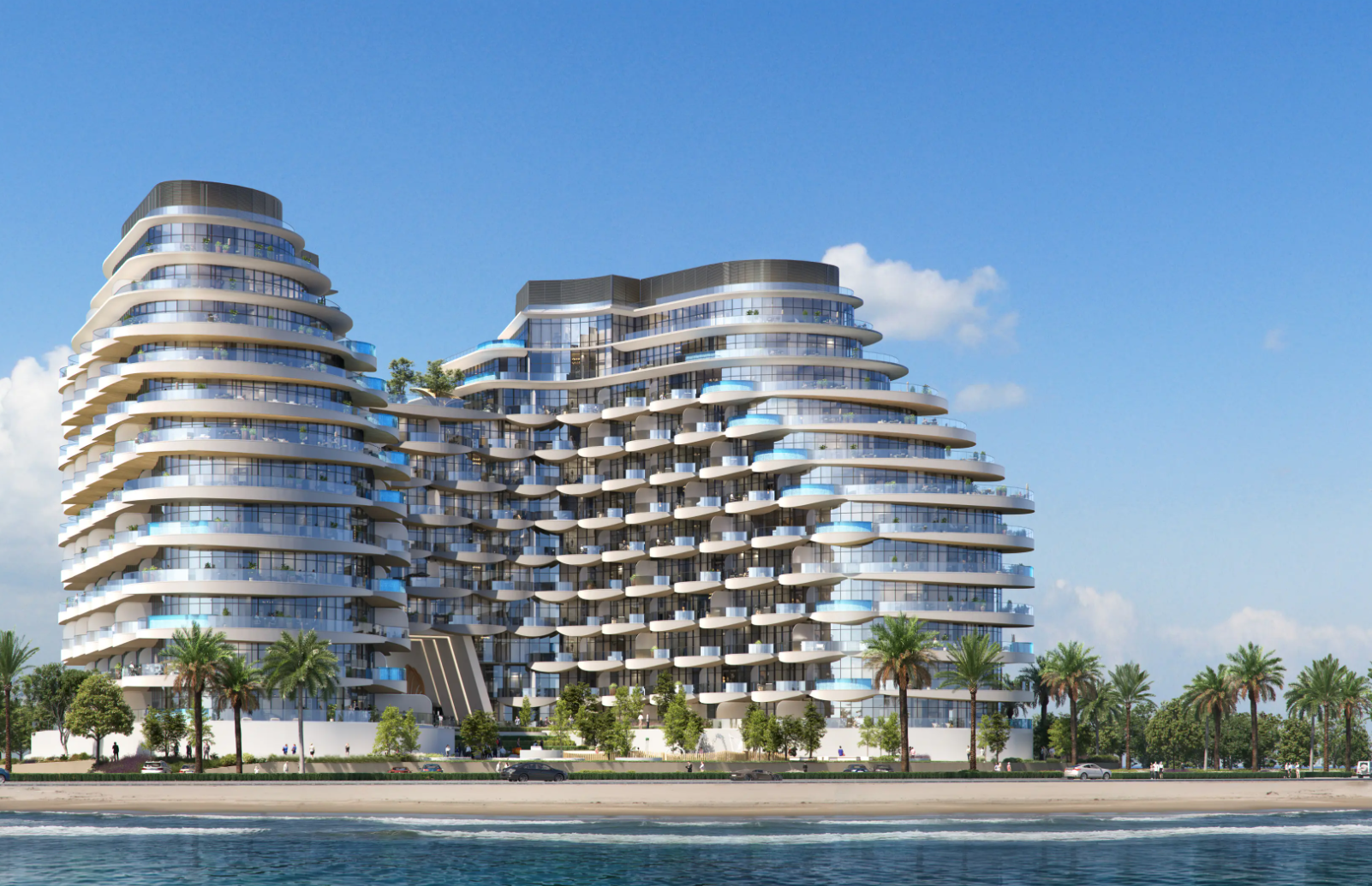
BNW Developments has established a Sydney presence, joining Arada and Sobha Realty among the growing number of UAE developers pursuing Australian buyers and development opportunities.
Blackmores vitamin mogul Marcus Blackmore and Caroline Furlong have listed their transformed Bayview waterfront, three years after buying the century-old Pittwater cottage known as The Shack.
3 min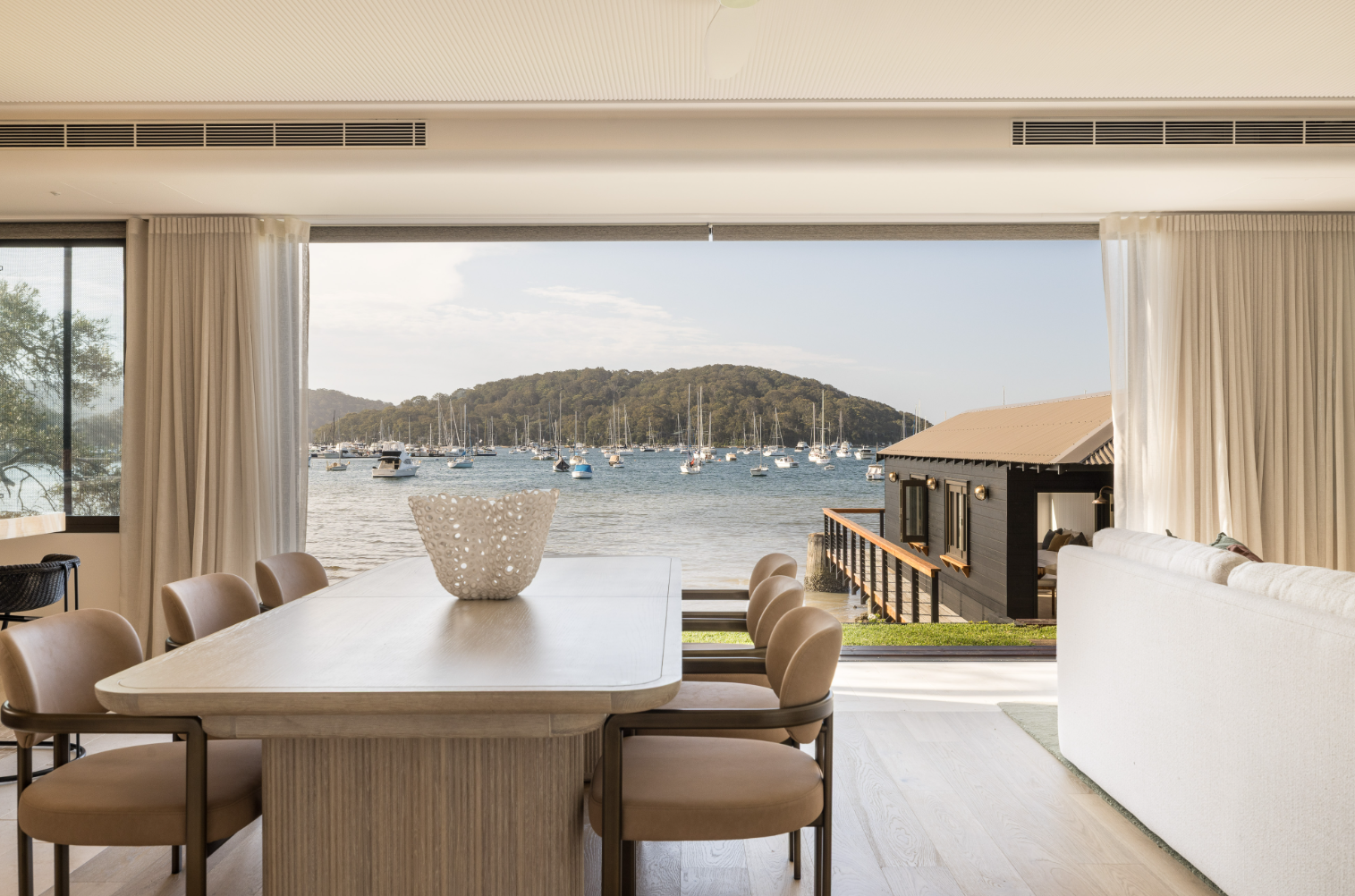
There is very little left of the century-old Pittwater shack Marcus Blackmore and Caroline Furlong bought for $5.7 million just over three years ago.
The vitamin industry heavyweight and his wife have returned 1808 Pittwater Road, Bayview to the market, but what buyers will find today is considerably different from the modest waterfront cottage that Blackmore and Furlong bought in August 2023.
The couple bought the tightly held property, long known locally as The Shack, after it had remained with the same family since the 1930s.
The timing of the purchase was particularly notable. It came immediately after Japanese brewing giant Kirin’s $1.9 billion takeover of Blackmores was announced, a deal which resulted in an $11.6 million dividend for Blackmore as a major shareholder of the company founded by his father, Maurice Blackmore.
It ended almost a century of ownership by the family of local teacher Neville Moodie.
The original three-bedroom, one-bathroom cottage sat almost on the water, with lawns running to Pittwater and a timber boathouse at the shoreline. Its appeal was less about the house itself and more about a rare north-facing position overlooking Scotland Island and a location where waterfront holdings are seldom offered for sale.
Three years on, Blackmore and Furlong have completely reimagined the site. 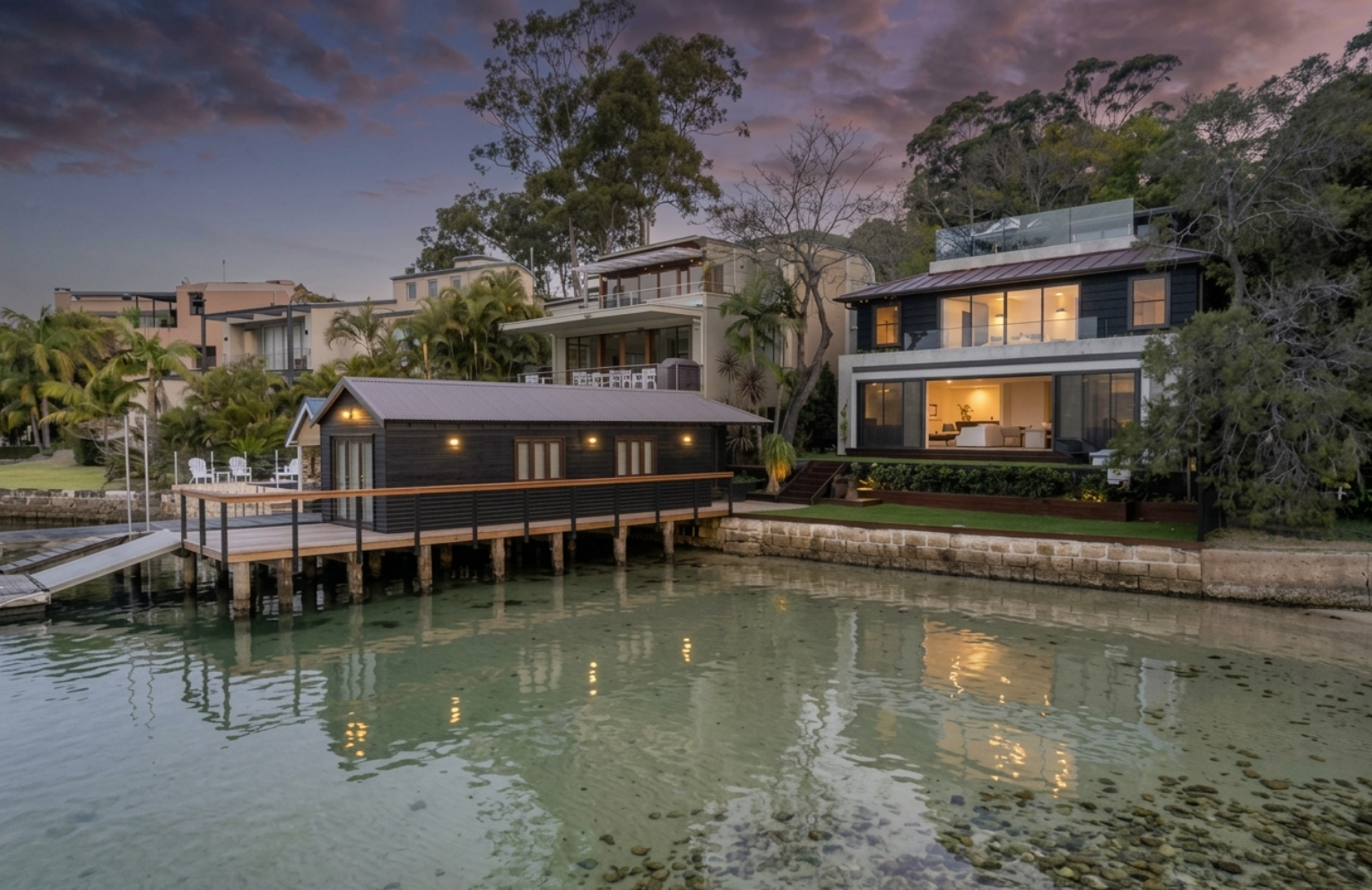 Walter Barda Design was commissioned to design a new split-level residence, delivered by Touchstone Construction Group, that takes full advantage of the relatively compact waterfront parcel and its prized northern orientation.
The resulting home is unmistakably contemporary, with curved architectural forms, natural limestone and timber flooring, extensive glazing and reinforced concrete construction wrapped in external timber cladding.
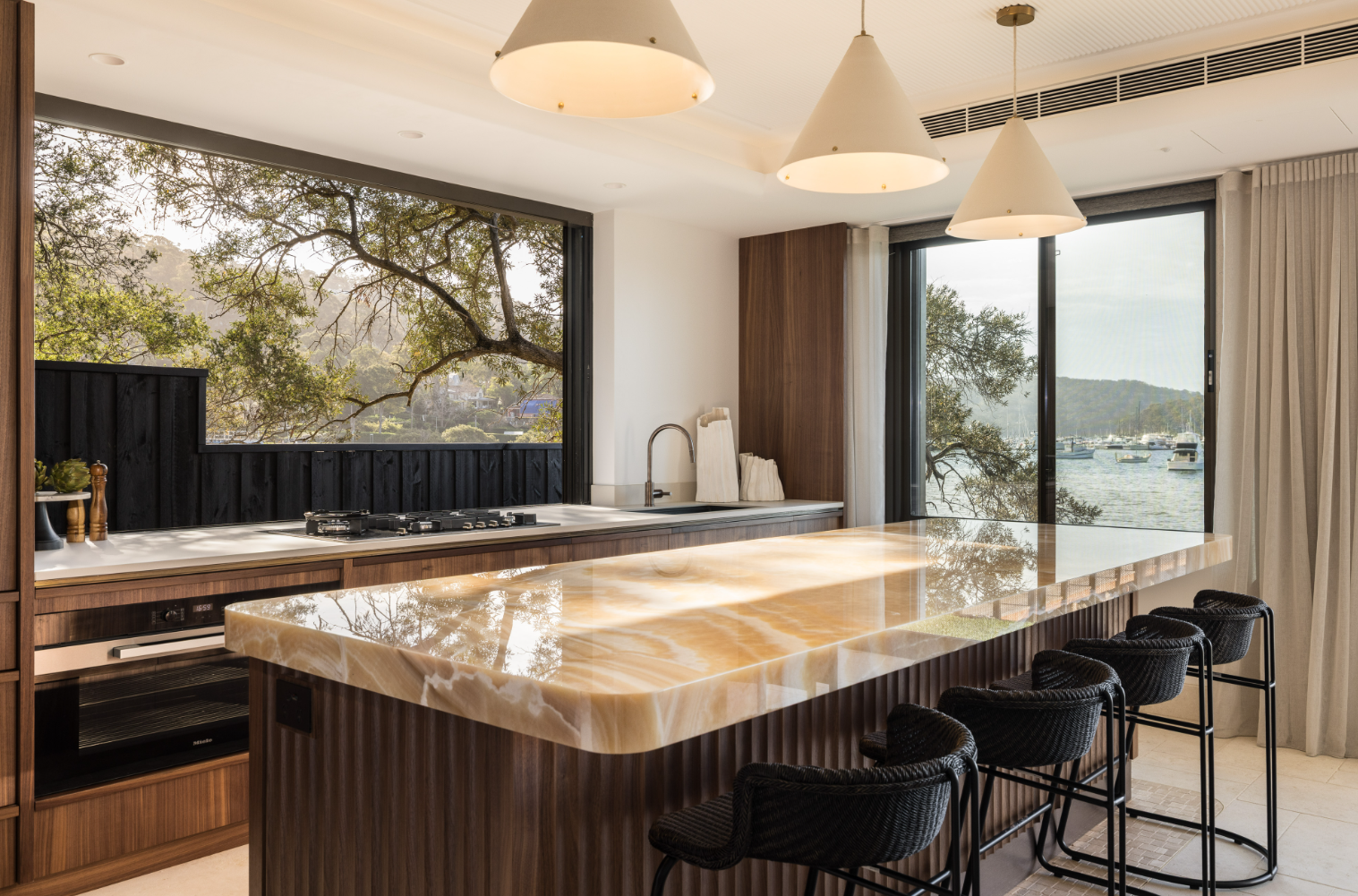
The main living level opens directly to a north-facing terrace and waterfront lawn, while the kitchen centres around a substantial island bench with Miele appliances and a butler’s pantry.
The main bedroom has been designed almost as a private suite within the home, with two walk-in wardrobes, two ensuites and its own balcony. Two further bedrooms each have an ensuite, while the waterfront boathouse has been designed as a multipurpose space with its own bathroom, giving it the flexibility to operate as additional accommodation.
Perhaps the most impressive addition sits above it all.
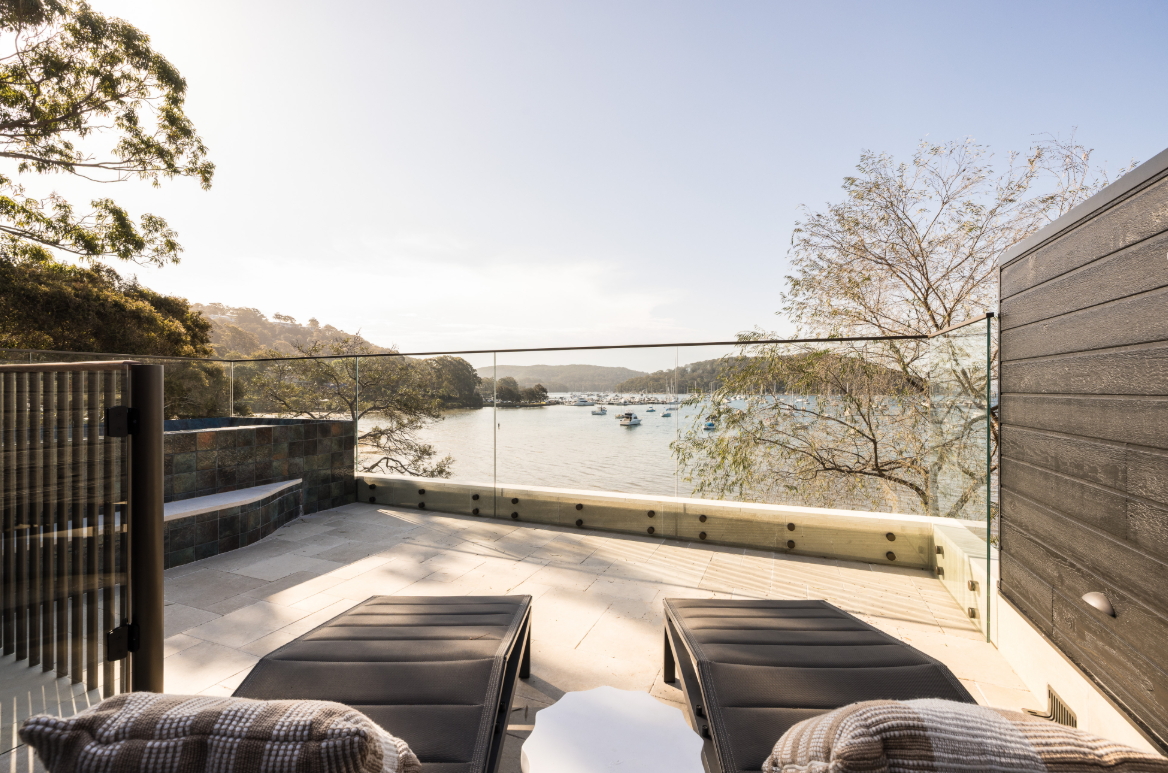
The top floor combines a home office with an outdoor kitchen and rooftop entertaining terrace, complete with a spa and elevated views across Pittwater towards Scotland Island.
An internal lift connects the home’s levels, while underfloor heating, home automation, solar, ducted air conditioning, an EV charger and an internal-access double garage bring the original Pittwater weekender firmly into the 21st century.
A private slipway preserves perhaps the most important feature for a long-time Pittwater resident and accomplished sailor such as Blackmore: direct access to the water.

The project represents the latest chapter in a long-running love affair with Pittwater property for Blackmore.
He spent 25 years on Prince Alfred Parade in Newport after buying the deep waterfront property for $1.31 million in 1995. Blackmore and Furlong extensively renovated the Rowan Stewart-designed home over their ownership before selling it in 2020 for $8.125 million.
By then, they had already secured their next Pittwater address.
In 2016, the couple paid $9.25 million for Sandgate, a Queenslander-style waterfront residence further along Pittwater Road in Bayview, bought from USForex co-founder Matthew Gilmour.
The 1,500 sqm holding subsequently underwent a substantial rebuild, with development documents at the time putting the cost of the new home, swimming pool and jetty at around $3.37 million. It became their principal Bayview residence after the Newport sale.
Property of the Week
Property: 1808 Pittwater Road, Bayview, NSW
Owners: Marcus Blackmore and Caroline Furlong
Agent: Phillip Sheh, Black Diamondz
Price: Contact agent
Purchased: $5.7 million, August 2023
Architect: Walter Barda Design
Builder: Touchstone Construction Group

Travellers are swapping traditional sightseeing for immersive experiences, with Africa emerging as a must-visit destination.

Victorian auction buyers will soon receive a piece of information that has traditionally been withheld until bidding reaches it: the vendor’s reserve price. Under new property-sale and underquoting laws, agents must publish the agreed reserve at least seven days before an auction or fixed-date sale. Most changes begin on 1 October 2026 and apply to …
Continue reading “Victoria’s New Auction Rules Will Force Reserve Prices Into the Open”