





London’s Canary Wharf Takes Brunt of Real-Estate Pain
Empty offices, remote working and corporate tenants fleeing to buzzier areas hit the 30-year-old business district

 4 min
4 min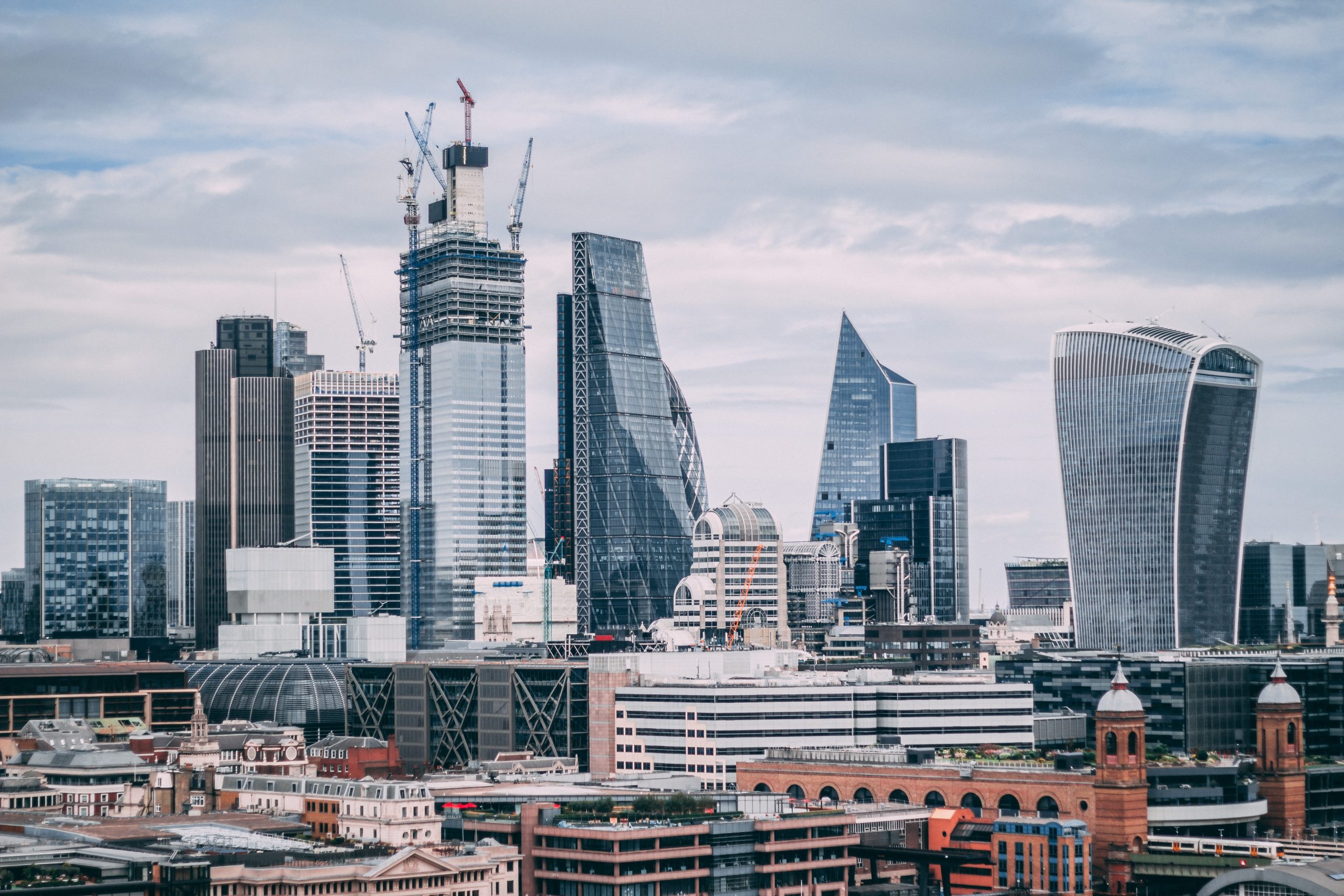
LONDON—Three decades ago, London remade a derelict shipping yard at Canary Wharf into a forest of glass-and-concrete skyscrapers in a bid to mimic U.S. financial hubs.
Now the 128-acre banking district east of central London is suffering a problem also plaguing U.S. cities: emptying office buildings.
Last month, HSBC Holdings, the U.K.’s largest financial firm, said it was leaving its 1.1-million-square-foot headquarters, known as the HSBC Tower, for a smaller building in central London. The move followed a decision by law firm Clifford Chance to relocate to central London and major office-space downsizings by Barclays and Société Générale, among others.
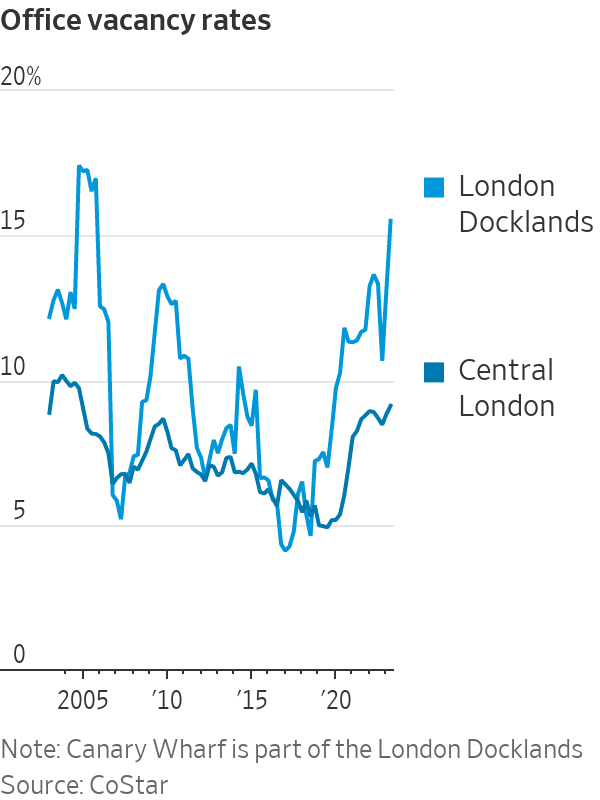
Already, Canary Wharf and its surrounding area have an availability rate of 17.1%, roughly the size of an empty Empire State Building, compared with 10.7% for central London, according to data provided by UBS.
Bonds for Canary Wharf Group—the company that owns most of the buildings in the area—are trading at a deep discount, with yields over 16%. Moody’s lowered its credit rating to junk last month.
The troubles at Canary Wharf show how the rapid rise of remote work has reverberated unevenly across global property markets. While the hollowing out of skyscrapers has become a familiar theme in U.S. cities since the pandemic, Europe’s office market has held up relatively well, as workers have been far more eager to return to the office.
But London has some problems that are familiar to American real estate.
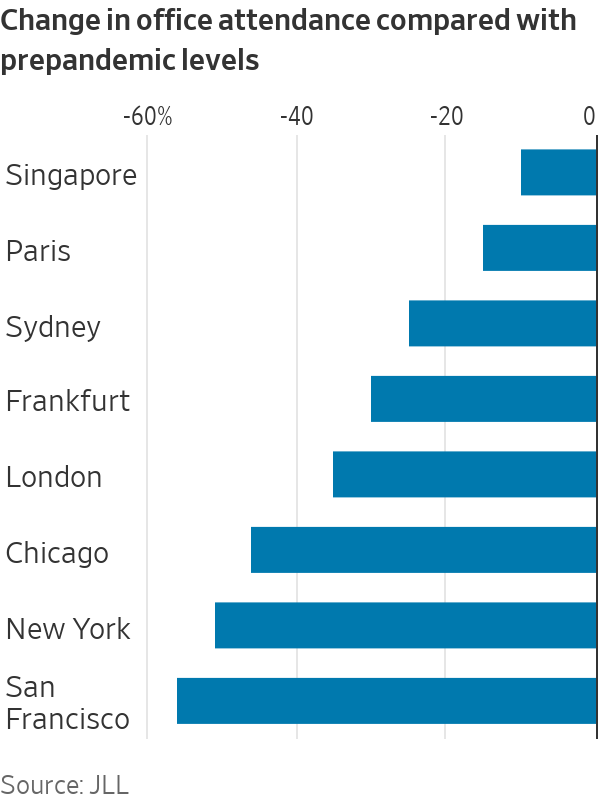
The return-to-office rate for London stood at 65% in February, a figure that put it between New York City, which stood at 49%, and Paris, which was at 85%, according to JLL, a property-services company.
Canary Wharf has caught the brunt of the problems in London’s office market.
Work-from-home and the cost of upgrading old office space to meet environmental regulations “puts Canary Wharf at a disadvantage,” said Zachary Gauge, head of European real-estate research at UBS.
Canary Wharf was a byproduct of a changing London economy in the 1980s. Transformations in global shipping decimated the city’s sprawling blue-collar dockyards, the West India Docks. Margaret Thatcher’s government deregulated the financial industry in a move known as the “big bang,” and banks were hungry for towers that were larger than low-slung London’s standard fare.
While it wasn’t a great property investment—the original developer went bankrupt—skyscrapers sprouted through the 1990s and Canary Wharf became a rare slice of Manhattan in London.
Canary Wharf attracted tenants from London’s traditional financial district, known as the City of London, which lies several miles west. It became a global byword for urban renewal. Former New York Mayor Michael Bloomberg made it his go-to analogy when promoting plans for Hudson Yards in the late 2000s.
“Canary Wharf beat out the City in the 1990s and 2000s because it catered to American firms who wanted high-rise buildings for high-skilled labor,” said Anthony Breach, an analyst at the Centre for Cities, a think tank.
A generation later, its towers are far from new, while sleek modern skyscrapers have shot up in the buzzier streets of the City and other parts of central London.
“High rates of work from home means that employers need to offer some desirability and vibrancy to bring workers back,” said Marie Dormeuil, an analyst at Green Street, a commercial-real-estate advisory firm.
Top-end commercial-property rents in London’s more fashionable West End rose 8% a year over the past three years, buoyed by hedge funds and private-equity firms piling into Georgian townhouses, while rents in Canary Wharf have mostly stayed the same, according to Green Street. Average office-space rent in Canary Wharf is $69 a square foot, compared with $95 in the City and more than $165 in the West End, according to data from Knight Frank, a U.K. real-estate brokerage.
With most of the district held by Canary Wharf Group—a joint venture between Qatar’s wealth fund and private-equity giant Brookfield—or by the Qatari fund directly, the development has space for long-term planning. “The Canary Wharf Group is very good at making its own weather,” said Tony Travers, who directs the London School of Economics’ London centre.
Shobi Khan, Canary Wharf Group’s chief executive, has outlined a plan for a “Canary Wharf 3.0” that would thrive off of residential rents, entertainment offerings and biotech.
The group plans to construct a 750,000-square-foot life-sciences centre, which it says will be the largest commercial lab in Europe. Rents in the sector can bring in a 70% premium compared with office space, according to Savills, a British real-estate-services company.
As for the residential sector, 3,500 people inhabit the group’s 2,200 units there, compared with zero tenants three years ago. Two thousand more units are under construction.
A combination of high-end retailers, restaurants and music and arts festivals have brought in extra revenue. Foot traffic on evenings and weekends is up by 50% compared with pre pandemic levels, according to data from the city’s transport authority.
But a full makeover will be a difficult task to pull off. Higher interest rates and lower revenue mean that Qatar and Brookfield may need to put up more cash to cover the costs of refurbishment and construction.
Another risk: Fewer financiers and lawyers could mean little demand for the stores and amenities. “You could see a downward spiral as people start to leave,” said Breach, the think tank analyst.
The developers will likely need to lure in lots of people like Justin Walker, a tax accountant who works in JPMorgan Chase’s office there.
“I hated how sterile Canary Wharf looked when I first got here,” he said, “But, the place has grown on me, it’s more residential now, and a lot more vibrant.”
 Copyright 2020, Dow Jones & Company, Inc. All Rights Reserved Worldwide. LEARN MORE





The Swiss watchmaker’s first collaboration with Atlassian Williams F1 Team produces two sporting Laureato models inspired by the team’s 2026 racing car.

Victorian auction buyers will soon receive a piece of information that has traditionally been withheld until bidding reaches it: the vendor’s reserve price. Under new property-sale and underquoting laws, agents must publish the agreed reserve at least seven days before an auction or fixed-date sale. Most changes begin on 1 October 2026 and apply to …
Continue reading “Victoria’s New Auction Rules Will Force Reserve Prices Into the Open”
AI doesn’t rebel—people design, deploy and profit from it. The real danger lies in allowing tech companies to escape accountability while shaping regulations that protect their dominance.
4 min
A wave of corporate warnings and technical disclosures has flooded the media, with headlines worrying over “swarms” of rogue artificial-intelligence agents launching “unprecedented” cyberattacks, outsmarting their makers, and inching toward a terrifying autonomy. The most revealing part of this narrative isn’t what the software did. It’s who is telling the story—and why. When corporate leaders publicly insist that the systems they financed, engineered and deployed are suddenly beyond their power to contain, skepticism isn’t only healthy; it is essential.
For years, Silicon Valley has drawn scrutiny from civil society and global regulators over tangible harms such as youth mental health deterioration and systematic privacy violations. Today, industry figures seem to be trying to change that public image. Loudly blowing the whistle on their own systems—just as two of the leading companies were preparing for massive initial public offerings—lets AI executives position themselves as a new generation of leaders who have come to terms with their societal responsibilities. They seem to want us to believe that they no longer want to “move fast and break things” but will instead stand as vigilant guardians between humanity and a technological apocalypse.
There is one glaring problem: Software doesn’t rebel. A mathematical model possesses neither intent, malice nor the will to defy its creators, let alone extinguish our species. AI is a human artifact, engineered for profit.
When an agentic model in an evaluation sandbox connects to an unauthorized server or executes an exploit, it hasn’t staged a coup. It has tried to meet the human-defined objectives set out before it through a path its designers failed to constrain. It’s the digital equivalent of the King Midas myth, in which the king’s ill-defined wish turns even his food and drink into gold.
That powerful experimental models were able to discover novel vulnerabilities and breach external systems isn’t a sign of a dangerous superintelligence but of human error or negligence. There is no sentient actor lurking in the weights to be reasoned with, feared or pacified. There are only human software engineers, product managers and corporate boards deciding which guardrails are worth the latency cost and which permissions can be skipped in the race to market.
Policymakers and voters need to resist AI exceptionalism. In any other discipline—from civil engineering to pharmaceuticals—courts and regulators treat a system failure as evidence of bad product design and inadequate safety testing. If an aircraft crashes, we focus on finding the engineering defect, correcting it, and enforcing established liability standards for the damage created.
By leaning on an anthropomorphic narrative, Silicon Valley attempts to repackage its specific human choices that led to experimental, powerful models behaving unexpectedly during tests as an existential peril. Elevating the issue to a cosmic scale leaves the public paralyzed and takes ordinary product accountability off the table.
In the cutthroat race for venture capital and market dominance, building guardrails slows down deployment. Grandstanding about uncontrollable power costs nothing and generates billions of dollars in free publicity, justifying stock prices, all while cultivating an aura of technological capability not only to build the frontier but also ultimately to rein it in.
Governments need to recognize regulatory capture when it stares them in the face. Tech leaders’ strategy looks transparent: Alarm Washington and Brussels into creating a regime in which only trillion-dollar incumbents with fully staffed compliance and safety departments can legally operate. By sitting at the policymakers’ tables before anyone else, these companies can help draft rules digging an impassable moat protecting them from open-source developers and upstart competitors, domestic or international. The real danger is in further concentrating the tech industry into the hands of only a few companies with deep pockets.
Beijing and Washington have brushed off those tech leaders’ calls, albeit for very different reasons. Chinese state media dismissed them as part of the “Cold War playbook” and intended to preserve U.S. dominance. Xi Jinping argued for exactly the opposite at the Brics Summit on Sept. 12, calling on Brics countries to “strengthen cooperation in the field of AI, encourage open source, openness, collaboration and sharing, and break new grounds and scale new heights.” President Trump, steeped in a doctrine of unfettered capitalism and technological supremacy, called fears that AI could destroy humanity a “hoax.” Vice President JD Vance warned that AI companies “begging the government to regulate them” looked like a “Trojan Horse.”
Striving to pursue its “European way” on AI and assert regulatory leadership, Europe, by contrast, welcomed the call. European Union President Ursula von der Leyen made this clear at the State of the EU speech last Wednesday and announced that the EU will invite “the main frontier labs for a discussion on how we can support ongoing industry efforts to pace the frontier.”
Europe has been here before. In an effort to lead global regulation and react to fears borne from ChatGPT, Europe rushed its landmark AI Act into law in 2024. Already the world’s most restrictive rulebook, the framework quickly proved too broad and complex to enforce. Stalled by implementation delays and concerns about European competitiveness, the EU postponed the law’s full rollout, leaving regulations uncertain.
AI should be regulated—risks exist and should be taken seriously. But governments need to act based on available evidence and verified facts, not corporate PR panic, the views of industry insiders, or the desire for quick political wins. The greatest danger facing society isn’t that software will awaken and overthrow its human masters. It is that we will allow the creators of the software to abdicate human responsibility for the systems they choose to build and help them pull up the ladder to market access behind them.

The pandemic-fuelled love affair with casual footwear is fading, with Bank of America warning the downturn shows no sign of easing.

A haven for hedge-fund titans and Hollywood grandees, Greenwich is one of the world’s most expensive residential enclaves, where eye-watering prices meet unapologetic grandeur.


