A Rare Frank Lloyd Wright-Designed California Home Sells for $22 Million
The ship-like house is the only one of its kind by the architect on the ocean

 3 min
3 min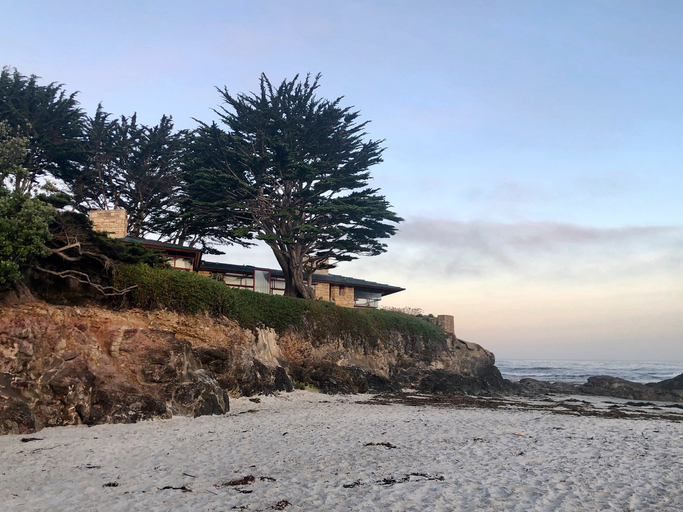
A significant Frank Lloyd Wright-designed home in Carmel-by-the-Sea, Calif., has sold for its asking price of $22 million, an enormous price per square foot for the area.
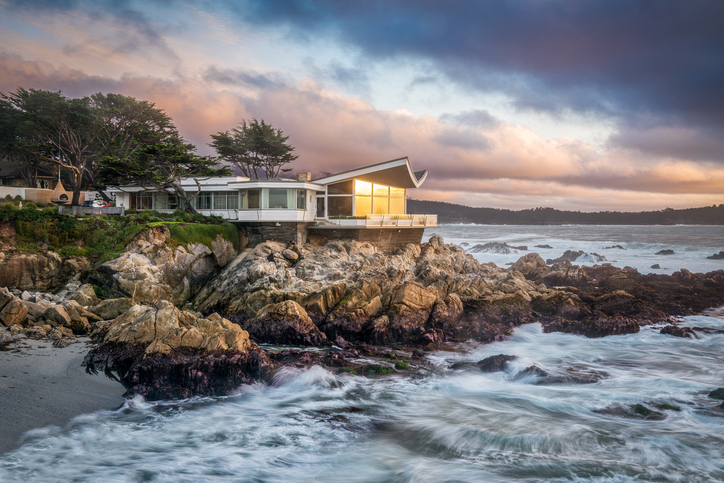
The single-storey, roughly 1,400-square-foot property, on a rocky promontory overlooking Carmel Bay, is the only home of its kind completed by architect Frank Lloyd Wright in a coastal environment, according to paperwork submitted for its designation on the National Register of Historic Places. Sitting on a triangular site, the house appears like a ship’s prow growing out of the landscape.
According to the historic places report, the home’s most prominent feature is a hexagonal living room framed in glass panels with panoramic views over the coastline. The three bedrooms are located in wings to the rear of the property, which is shaped like an arrow. Mr. Wright had the lot lowered 4 feet to enable the house to melt into the landscape, the report shows. The house made the National Register of Historic Places in 2016, records show.
The sellers are a group of descendants of the home’s original owner Della Walker, an artist and the widow of Minneapolis lumber executive Clinton Walker. The couple relocated to California in 1904, living there for four decades before Mr. Walker’s death in 1944, the historic places report says. The descendants couldn’t immediately be reached for comment.
The buyer is Esperanza Carmel LLC, records show. The company’s website describes it as a real-estate investment and development firm. It is headed by Patrice Pastor, a businessman and property developer based in Monaco, and owns other significant properties in the Carmel area. A spokesperson for Esperanza did not immediately respond to a request for comment.
Ms. Walker originally wrote to Mr. Wright in 1945, asking him to consider the project, according to the historic places report.
“I am a woman living alone—I wish protection from the wind and privacy from the road and a house as enduring as the rocks but as transparent and charming as the waves and delicate as the seashore,” she wrote. “You are the only man who can do this—will you help me?”
Mr. Wright quickly agreed to work on the project, expressing his pleasure that her letter was “brief and to the point.” In later correspondence between the pair, Ms. Walker wrote to the architect that her daughter had sent her a picture of Fallingwater, the architectural house Mr. Wright had designed in Pennsylvania. “If Mr. Wright did this for a stream, what will he do for an ocean,” she said her daughter wrote.
The original construction of the house, constructed from cedar wood, Carmel stone, steel, copper, concrete and glass, was completed in 1952. In 1956, a studio addition was designed by Mr. Wright for Ms. Walker’s craftwork and weaving at the southeast corner of the building. The plans were eventually used to make way for an expanded primary bedroom in 1960, the report says. The total lot size is around 14,000 square feet and includes a small beach, according to the sellers’ agent.
Canning Properties Group of Sotheby’s International Realty represented the sellers in the deal. Jessica Canning said the home was a rare combination of the ideal setting and architectural pedigree. Though she declined to comment on the buyer, she said the property had sold to the buyer with the very first showing.
“They fell in love with it exactly how it is, right down to the pillows and the books,” she said, noting that all the furniture was included in the sale. “The authenticity and character of it was one of the major draws.”
The property is one of a number of architecturally significant homes that have been marketed for sale in Carmel over the past year. Carmel’s Butterfly House, known for its distinctive Midcentury Modern architectural look, is on the market for $40 million. In July, Brad Pitt bought a roughly century-old home designed by Charles Sumner Greene, a prominent early 20th-century architect known for championing the American Arts and Crafts movement, for $40 million.
 Copyright 2020, Dow Jones & Company, Inc. All Rights Reserved Worldwide. LEARN MORE





From making unpopular decisions to learning when to listen, leaders from five businesses reveal what nobody prepared them for — and how running a company has challenged their expectations.

Technology and semiconductor shares fell sharply as investors questioned the debt financing the AI infrastructure boom and confronted higher rates and Chinese competition.

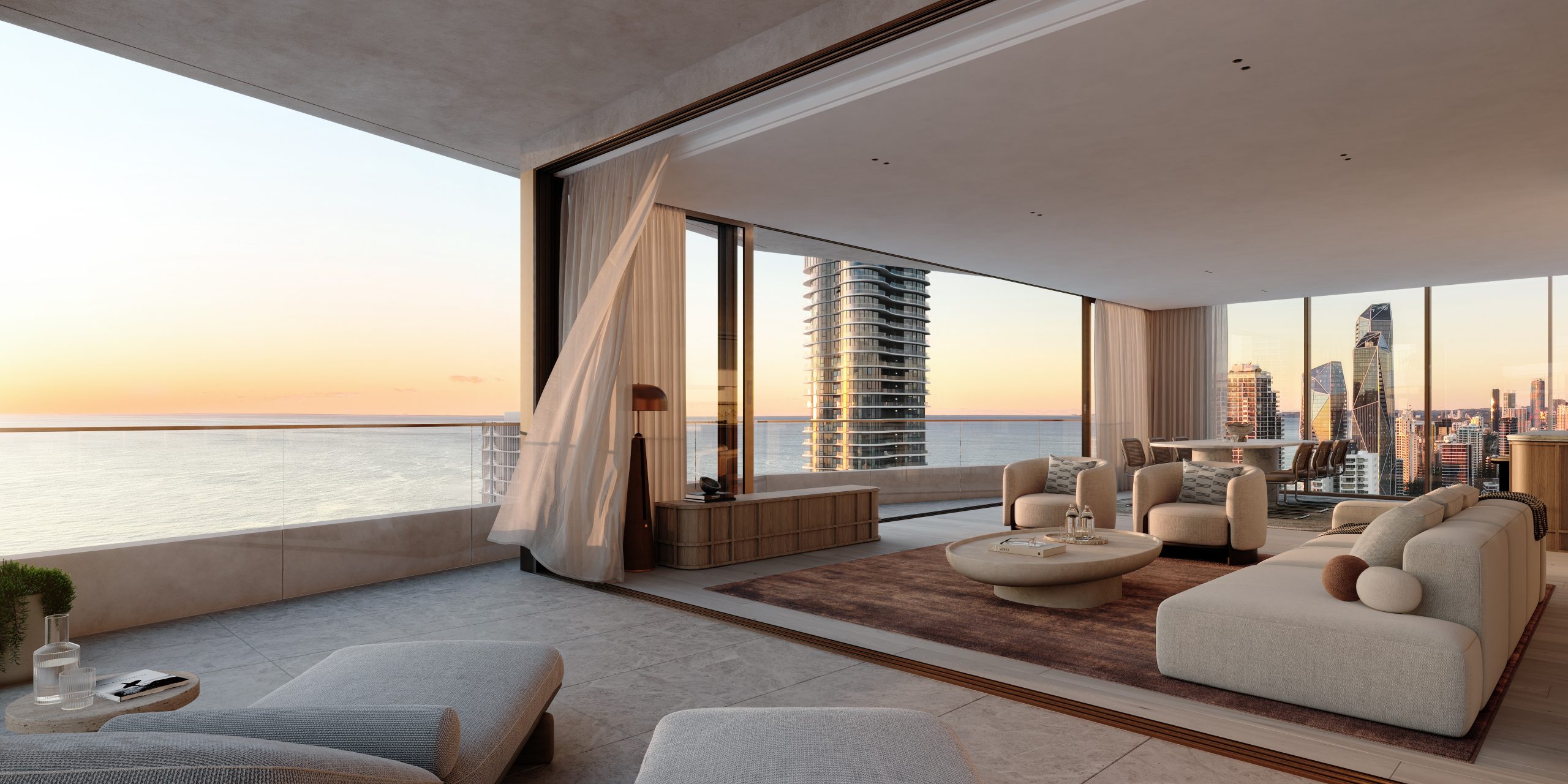
Mirvac’s 45-level Trielle has topped out at Yarra’s Edge, pairing riverfront apartments with wellness facilities, private dining and resident services.
3 min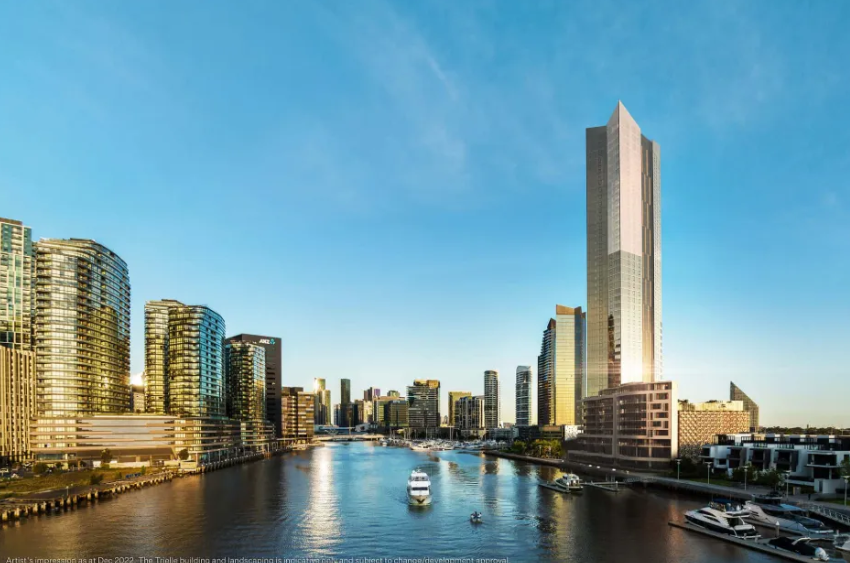
Mirvac has topped out Trielle at Melbourne’s Yarra’s Edge, with more than 70 per cent of the riverfront development sold and approximately 80 per cent of purchasers intending to make their apartment a home.
The figures, released on September 22, point to an owner-occupier audience for one of the precinct’s final residential towers. Mirvac began developing Yarra’s Edge in 2003, and its latest addition occupies one of the remaining absolute riverfront sites.
Mirvac CEO of Development Stuart Penklis said existing residents were among those moving up within the neighbourhood.
“Many purchasers already have a connection to Yarra’s Edge,” Mr Penklis said, describing buyers whose changing needs were encouraging an upgrade within the precinct.
“As one of the final residential towers within Yarra’s Edge, Trielle represents the culmination of more than two decades of creating one of Melbourne’s most established and sought-after waterfront communities,” Penklis said.
“Positioned on the Collins Street axis with absolute river frontage, Trielle offers residents a rare opportunity to enjoy sweeping views across the Yarra River, Melbourne skyline and Port Phillip Bay, while remaining seamlessly connected to the CBD. With Trielle now more than 70 per cent sold, we’re continuing to see strong demand from buyers seeking quality homes in established locations.”
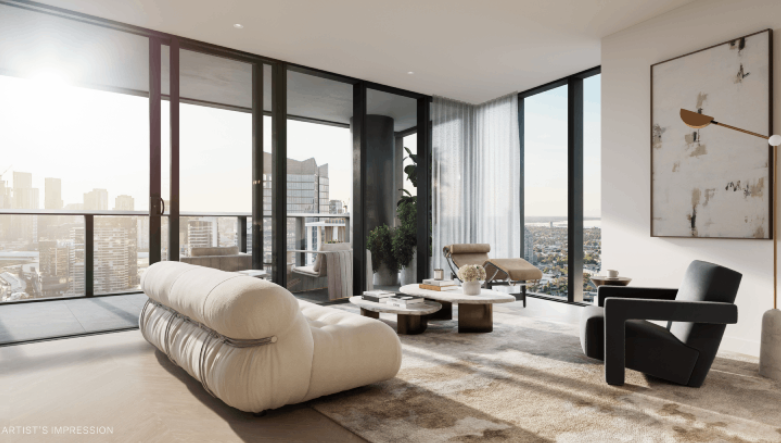
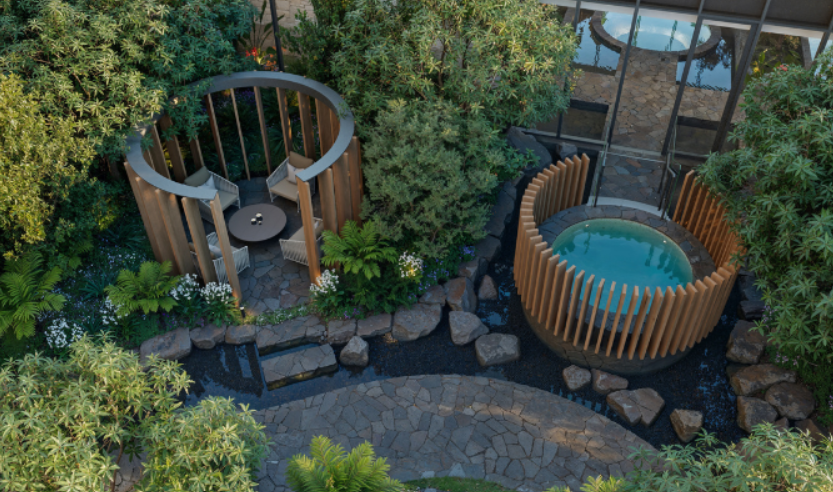
The developer also flagged a penthouse and sub-penthouse collection with larger layouts, premium finishes and broad outlooks. The planned wellness centrepiece, The Oasis, encompasses a 900-square-metre elevated urban rainforest.
Mirvac General Manager Residential Development Victoria Elysa Anderson said Trielle had resonated strongly with buyers seeking a rare lifestyle offering in Melbourne.
“Opportunities to secure a new luxury residence on a riverfront site of this calibre are incredibly rare, particularly within a community like Yarra’s Edge,” Anderson said.
“What makes Trielle unique is the combination of exceptional views, world-class residential facilities and the lifestyle that already exists around it. Residents are buying into a mature waterfront community with parks, promenades, dining, wellness and strong community connections already in place.”
The 45-level tower brings a substantial new presence to that waterfront. Its residential offering spans one-, two-, three- and four-bedroom apartments, with Signature, Prestige and Sub-Penthouse collections accommodating different household sizes. The north-facing position connects the apartments visually to the river and city beyond.
Seven storeys above the promenade, the planned Oasis combines planting and a running stream with a Scandinavian-inspired wellness club developed with spa specialist Naomi Gregory. Facilities include a 25-metre lap pool, hot magnesium pool, sauna, hydrotherapy, a gym, yoga and Pilates room, and treatment spaces.
The amenity extends beyond exercise. Residents will have access to The Biblioteca library and workspaces, ground-floor work pods, and The Salone piano lounge. A private Chef’s Table dining room offers a setting for larger gatherings, while a cinema, games room and sports lounge broaden the entertaining options. Concierge services and a dog-wash area support everyday routines.
Trielle comprises a collection of one, two, three and four-bedroom residences. Reflecting strong demand from owner occupiers, approximately 80 per cent of purchasers to date intend to live in their homes, highlighting the project’s appeal to those seeking a long-term waterfront lifestyle.
Mirvac has recently delivered The Albertine, a premium apartment development on the edge of Melbourne’s CBD, and is nearing completion of Prince & Parade in Brunswick, further strengthening its portfolio of thoughtfully designed apartment communities in some of Melbourne’s most sought-after urban locations.

Barnet, in North London, lays claim to two of the country’s most expensive roads to own a home.

A 30-metre masterpiece unveiled in Monaco brings Lamborghini’s supercar drama to the high seas, powered by 7,600 horsepower and unmistakable Italian design.