The World Bakes Under Extreme Heat
Warming oceans and heat domes are contributing to one of the hottest summers on record

 4 min
4 min
Deadly heat waves are upending daily life in large parts of the U.S., Europe and Asia, as warming oceans and unprecedented humidity fuel one of Earth’s hottest summers on record.
Meteorologists say last month was the hottest June on record and 2023 could be the hottest year ever if July’s record temperatures continue, straining businesses and threatening power grids.
Several factors are contributing to the record heat this summer, said Brett Anderson, a senior meteorologist at AccuWeather. Among them: Unusually warm oceans are raising humidity levels; several heat domes are trapping warmth around the world for longer than usual; and jet streams are causing deadly storms like the ones in Vermont this month to move slowly.
The hot seas and a recurring warm climate pattern called El Niño are compounding the effects of climate change, which scientists say is contributing to higher global temperatures.
“We are seeing an increasing number and more extremes and this is because of global warming,” said Jose Alvaro Mendes Pimpao Alves Silva, a consulting climatologist for the World Meteorological Organization, referring to extreme heat waves. “These situations are not unprecedented. But as they happen, their intensity is higher.”
Climate change has exacerbated extreme heat events, which have increased sixfold since the 1980s, according to the World Meteorological Organization. Increasing surface temperatures from climate warming make heat waves longer, more intense, and produce the weather conditions that keep them stalled over one place.
Global ocean temperatures hit record highs for the third consecutive month after El Niño conditions strengthened in June, according to the National Oceanic and Atmospheric Administration.
High-pressure heat domes that bring sweltering temperatures have occurred during the past few summers, but having four of them over land at the same time is still surprising to Carl Schreck, a tropical climatologist at North Carolina State University who works with NOAA.
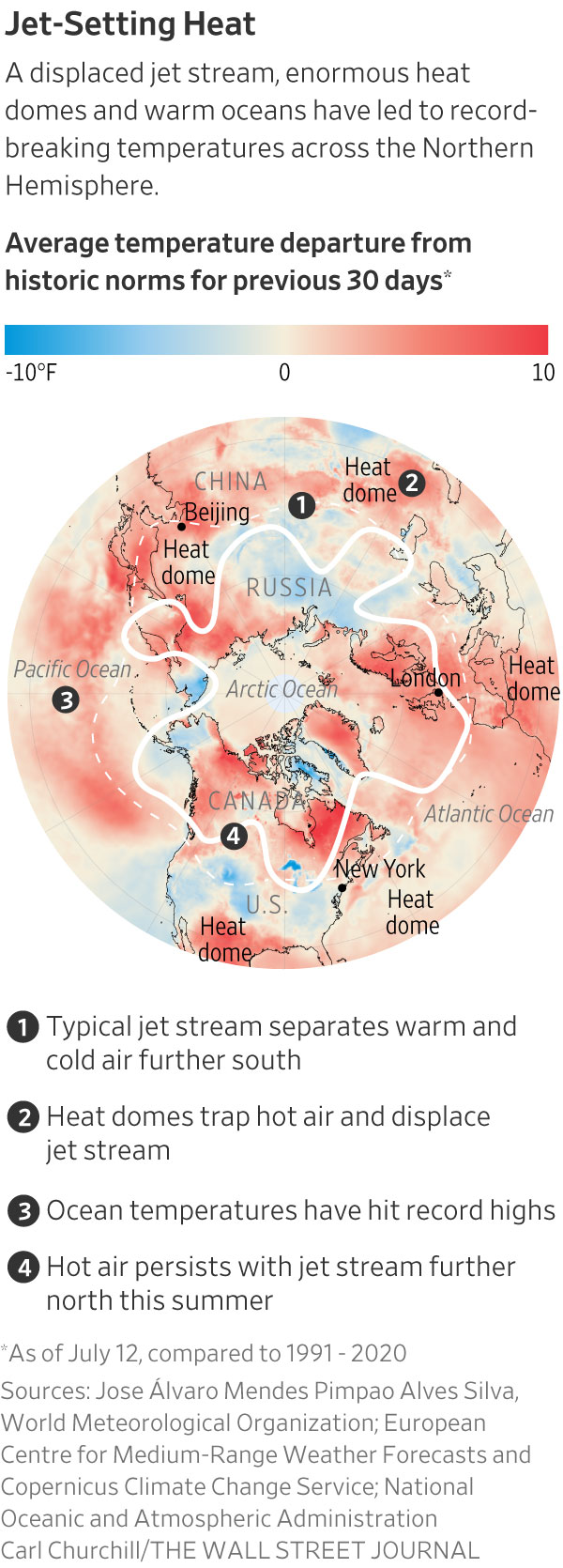
“We’ve seen this over the last couple of summers, but it’s still remarkable when it does appear,” said Schreck.
Still, the sustained heat waves haven’t stopped tourists from hitting the beach in Spain or visiting landmarks in Washington, D.C. Some have even basked in the heat in California’s Death Valley, one of the hottest places on Earth.
U.S.
Several cities, including Phoenix, have broken records as the southern U.S. deals with unrelenting heat. El Paso, Texas, logged a record 33rd day in a row Tuesday with triple-digit temperatures. Texas’ power grids have held up despite concerns they couldn’t handle demand surges.
In the North, parts of Michigan, New York and Vermont have also broken daily temperature records this summer.
The waters off Florida in recent weeks have been hotter than 90 degrees, several degrees above normal, according to NOAA. The temperatures are threatening the coral reefs off the coast and fueling heat and humidity in the southern part of the state.
Europe
Europe is baking under a sustained heat wave that is covering much of the Mediterranean, according to the World Meteorological Organization. The Spanish state meteorological service warned of temperatures of between 108 and 111 degrees and issued alerts for the interior and Balearic Islands. Parts of the Balkans are also under alert.
The Italian island of Sardinia was forecast to approach an all-time high for the continent on Tuesday. Sicily set the highest recorded temperature in Europe at 119.8 degrees Fahrenheit, in August 2021.
Alberto Urpi, the mayor of Sanluri in Sardinia, said authorities had issued a weather red alert for the area, advising people to stay inside from late morning until 6 p.m.
“We are ready,” said Urpi. “We’ve gotten used to these heat waves and have had time to organise our response.”
Authorities closed the Acropolis in Athens for a large part of Friday and Saturday due to the heat. The Greek capital is forecast to stay above 97 degrees all week, topping out at almost 110 on Sunday.
Middle East
As temperatures soar to about 100 degrees across Egypt, the government has been cutting power in neighbourhoods across the country, forcing ordinary Egyptians to go without air conditioning, fans and refrigeration even during the hottest hours of the day.
“We are having horrible nights. Babies are crying because of the high temperatures and our refrigerator broke down,” said Nemaa Moustafa, a 31-year-old homemaker with newly born twins.
Egypt is in the midst of an economic crisis that has officials scrambling to bring in foreign currency to pay off staggering debts and stave off a currency collapse. Diverting the country’s natural-gas resources away from domestic use and toward lucrative exports is one way to get U.S. dollars.
In El-Shorouk city, on the outskirts of greater Cairo, residents said power cuts were happening four or five times a day, leaving them without electricity for hours. Some said they were also experiencing water disruptions making it more difficult to cope with the heat. Many stores and supermarkets have struggled to keep food fresh as refrigerators go down amid the cuts.
Asia
Another heat wave is simultaneously sweeping across parts of Asia. In China, a village in the northwestern region of Xinjiang hit a record high 126 degrees, according to state media.
During the heat wave, the U.S. climate envoy John Kerry met Chinese officials including Beijing’s top foreign policy envoy, Wang Yi, and Premier Li Qiang to discuss how to accelerate decarbonisation and other climate change goals. China and the U.S. are the world’s top greenhouse gas emitters.
Silva from the World Meteorological Organization said there are currently high-pressure systems trapping hot air in the region. The systems will remain in place over the next several days.
“It’s moving very slowly, but we will not have this situation forever,” Silva said.
—Chao Deng contributed to this article.
 Copyright 2020, Dow Jones & Company, Inc. All Rights Reserved Worldwide. LEARN MORE





From making unpopular decisions to learning when to listen, leaders from five businesses reveal what nobody prepared them for — and how running a company has challenged their expectations.

Technology and semiconductor shares fell sharply as investors questioned the debt financing the AI infrastructure boom and confronted higher rates and Chinese competition.

Elon Musk is exploring a potential merger between Tesla and SpaceX, a deal that could reshape the future of AI, robotics, autonomous vehicles and space technology. With a combined valuation potentially reaching $3.5 trillion, the move could bring Musk’s vision of an interconnected technology ecosystem closer to reality, although a deal remains uncertain.
5 min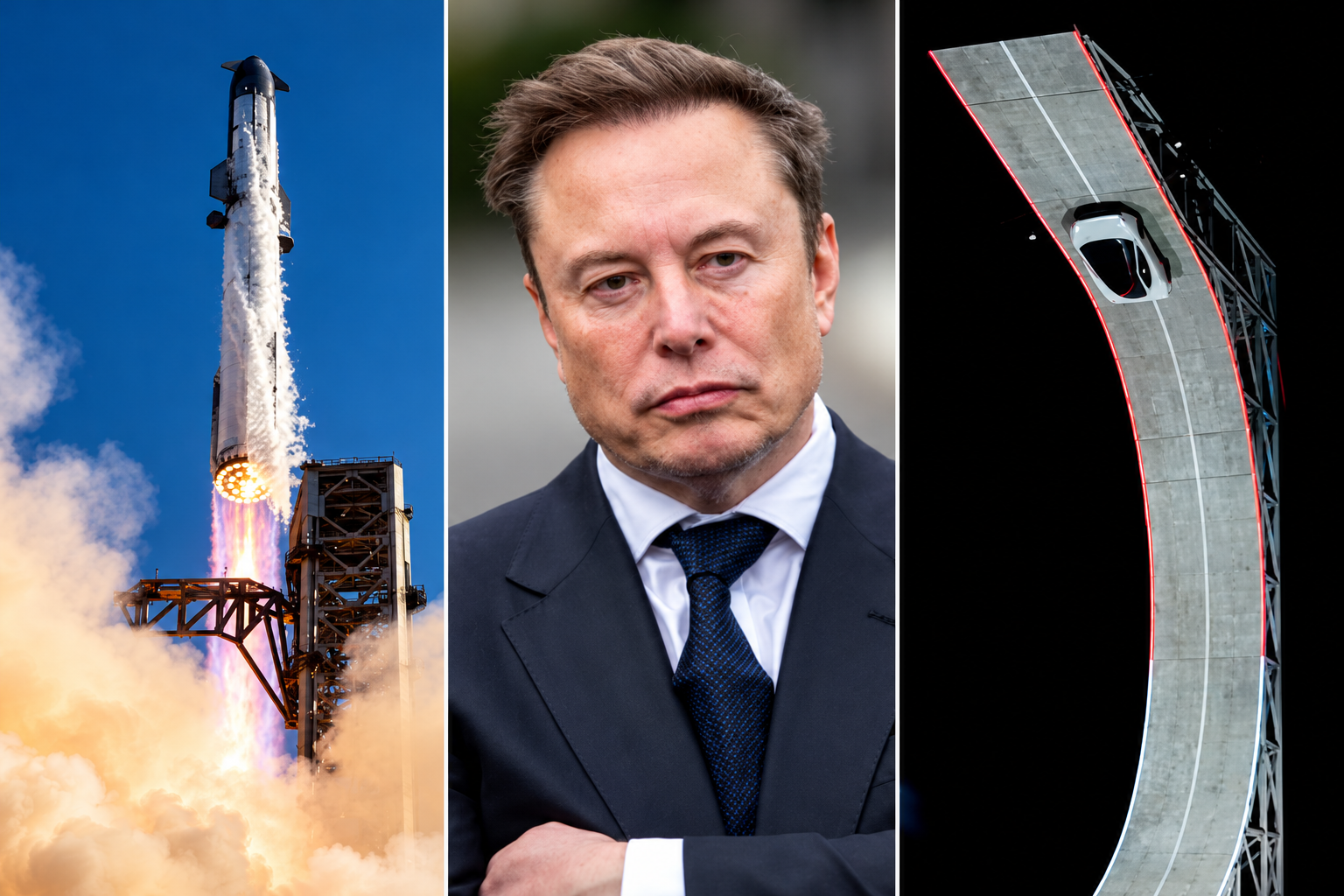
Elon Musk has engineered ties between Tesla TSLA 3.41%increase; up pointing triangle and SpaceX SPCX 7.79%increase; up pointing triangle that are hard to break, and now he wants to fuse them together permanently.
Musk has run both Tesla and SpaceX concurrently over the past two decades, using a schedule that dictated which days he spent focused on each business.
The companies have often shared resources and personnel, signaling their close ties. Last year, SpaceX looked into creating a spacesuit for Tesla’s humanoid robot Optimus, a person familiar with the matter said. Tesla last week showed off its new Roadster, a vehicle featuring SpaceX rocket thrusters that it hopes to soon bring to market.
And in recent months, Musk has repositioned both companies by expanding beyond their core operations toward a shared mission centered on artificial intelligence.
The world’s richest man on Tuesday signaled his interest in tying up SpaceX and Tesla, marking what would be the biggest corporate merger of all time. Because he serves as chief executive of SpaceX and Tesla, Musk said committees of independent directors at both companies are evaluating a possible deal, adding that a transaction might not come to fruition.
The committees will likely evaluate, with lawyers and bankers, how each company would fare in a potential deal and how a deal might best be structured. They then present their conclusions to their respective boards, who typically vote on whether to proceed.
“It’s an odd Kabuki dance where two groups of people are talking and I can’t be in the conversation,” Musk told SpaceX investors on Tuesday in response to an analyst’s question about a potential deal.
For Musk, the merger supports his vision of a world full of autonomous cars, humanoid robots and weekly rocket launches, as well as the data centers and satellites required to keep the whole thing running.
Some investors and analysts said they expect a transaction would be structured as an all-stock deal, with SpaceX potentially paying a modest premium for Tesla shares.
SpaceX, which has a market value of about $2 trillion, said it is seeing sharp growth in revenue across its businesses, which include operating data centers, launching rockets and operating satellite networks such as the internet service Starlink. Tesla is valued at about $1.5 trillion and is expanding its operations beyond its automotive and energy business. Shares in both companies traded higher following the news Tuesday.
Musk’s substantial ownership stakes in both companies, along with voting control at SpaceX, has enabled him to set the deal in motion. Analysts and investors said the deal will probably face regulatory scrutiny internationally, though some see Musk’s close relationship with the Trump administration as an asset to getting approval.
Blurred lines
The companies haven’t said which directors are on the special committees evaluating a potential deal. Several SpaceX and Tesla board members have either personal or business ties to Musk. And like Musk, venture capitalist Ira Ehrenpreis sits on both boards.
In a filing this week, Tesla outlined millions of dollars in business agreements with SpaceX and its subsidiaries last year, including $143 million in car sales to SpaceX, $3.3 million in advertising that it bought on the social-media platform X and $430 million in revenue from the sale of Megapack batteries for SpaceX’s data centers.
The companies also split the cost of resources including the use of Musk’s SpaceX jet and the bill for his personal security, which he runs through a private company.
Employees at both companies routinely move between companies to work on special projects, and some executives have dual roles, including Charles Kuehmann, vice president of materials engineering at both SpaceX and Tesla, and Ashok Elluswamy, the vice president of AI software at Tesla who runs a joint venture with SpaceX called Digital Optimus.
Over the years, Musk has launched new startups within his empire, including brain-implant company Neuralink, underground-tunnel developer the Boring Company and xAI, the AI startup that merged with SpaceX in February.
It is that AI business that Musk thinks can serve a market worth tens of trillions of dollars, justifying the need for a merger.
The business case goes like this: Tesla is developing robotaxis and robots, which it calls “physical AI.” SpaceX is working on the back end of physical AI: the data-center capacity and internet connection required for those robotaxis and robots to operate continuously.
“I don’t see what the value of Tesla is if it’s not merged with SpaceX,” said investment adviser Ross Gerber, a former Tesla bull turned critic invested in both companies. “If they don’t merge, the brains of everything that runs Tesla is owned by another company.”
On top of it all, both companies face constraints on the supply chains they need to make this world a reality, particularly when it comes to chips. To address this, Musk earlier this year announced a joint venture between Tesla, SpaceX and Intel to design and manufacture chips in Texas. “The most epic chip-building exercise by far,” he has said.
Musk at the wheel
For Musk, a merger would also solve two problems: demands on his attention and his lack of control at Tesla.
Tesla for years was Musk’s only public company, a status that came with greater scrutiny. There, Musk reports to a public board, as well as individual investors who make up around 30% of Tesla’s voting power, according to FactSet.
The question of Musk’s attention became a particular focus for investors and the board in recent years after he acquired Twitter in 2022 and launched xAI in 2023, and again in 2025 as he spent time in Washington, D.C., running the Department of Government Efficiency in the early months of President Trump’s second term.
As Tesla’s car business suffered in 2025, Musk threatened to take his AI ambitions outside the company if he wasn’t granted 25% voting control. Last November, Tesla shareholders approved a new pay package for Musk, which created a path for him to vastly expand his stake.
As of Sept. 30, Musk owned a roughly 20% stake in Tesla, according to the company’s proxy filing.
The SpaceX IPO gave Musk a different path. When SpaceX went public in June, the deal’s structure enabled him to have more than 80% voting power at the company—so much that he can’t be fired and decisions can’t be made without his support.
If SpaceX acquires Tesla, he will likely stay in control.

Porsche has revealed a one-off 911 GT2 RS that brings the extraordinary silhouette of its 935/78 “Moby Dick” racing car onto the road. Created by Porsche Sonderwunsch with Manthey, the commission began with a near-new GT2 RS. The owner requested greater performance, a Slantnose profile and a rear wing influenced by the limited 911 GT3 …
Continue reading “Porsche Builds a Road-Going “Moby Dick” From a 911 GT2 RS”

Three completed developments bring a quieter, more thoughtful style of luxury living to Mosman, Neutral Bay and Crows Nest.