Australia in Global Top 10 for Ultra-Wealthy as Property Investment Grows
 3 min
3 min
Australia has cemented its place among the world’s wealthiest nations, ranking ninth globally for individuals with more than US$10 million in assets, according to Knight Frank’s newly released The Wealth Report 2025.
The report found that 1.8% of the global US$10m+ population resides in Australia, with 42,789 high-net-worth individuals (HNWIs). This places Australia ahead of Hong Kong SAR (42,715 HNWIs), Italy (41,080), South Korea (39,210), and Taiwan (28,391). The United States leads the rankings, accounting for nearly 39% of the world’s ultra-wealthy.
Knight Frank Chief Economist Ben Burston noted that while Australia faced economic headwinds in 2024 due to higher interest rates, global wealth creation remained strong.
“While several major economies, including Australia, saw sluggish growth in 2024 as higher interest rates took a toll on household incomes, robust growth in the United States supported the global economy and underpinned ongoing wealth creation,” Burston said.
Future Growth: Australia’s Wealthy Set to Expand Further
The report predicts continued growth in Australia’s ultra-wealthy population, with Australasia’s US$10m+ segment expected to rise by 5.3% by 2028. The number of individuals worth US$100 million or more in the region is also projected to grow by 4.8%, from 1,918 in 2024 to 2,010 by 2028.
Globally, the number of HNWIs increased by 4.4% in 2024, reaching 2.34 million. The trend is expected to continue, with a projected rise of 6.9% by 2028.
Real Estate Investment a Key Priority for the Wealthy
Property remains a crucial asset class for the world’s wealthiest, with a survey of 150 family offices revealing a strong appetite for real estate investment.
In Australia, 31% of family offices surveyed plan to increase their real estate holdings over the next 18 months, compared to 44% globally. The top three real estate sectors of interest for Australian investors are:
- Industrial properties (42%)
- Data centres (21%)
- Infrastructure (18%)
This contrasts with global preferences, where the leading investment sectors are living spaces (14%), industrial/logistics (13%), and luxury residential (12%).
Knight Frank CEO James Patterson highlighted the ongoing demand for real estate among ultra-wealthy investors, despite recent downturns in commercial property markets.
“More than 30 per cent of respondents expect to increase their exposure to real estate over the next 18 months,” Patterson said. “It’s evident investors are increasingly conscious that they can now acquire assets at an attractive entry point off the back of the downturn and with strong prospects of cyclical recovery in the medium term.”
Luxury Real Estate: A Top Choice for the Next Generation
The report also explored investment trends among younger high-net-worth individuals. Knight Frank’s Next Generation Survey, a global study of 1,788 wealthy individuals aged 18 to 35, found that real estate topped the list of luxury assets they aspire to own.
John McGrath, CEO of McGrath Estate Agents, Knight Frank’s Australian partner, noted that younger generations are drawn to real estate for both lifestyle and investment reasons.
“The next generation desires luxury real estate from a lifestyle point of view, but they can also see the strength of this asset class as an investment with continuing price growth around the world delivering ongoing capital gains,” McGrath said.
He added that Australia’s undersupply of luxury properties, combined with high demand, will continue to drive price appreciation in the sector.
“Australia is a particularly desirable market for luxury real estate due to its plentiful lifestyle locations, as well as being on the doorstep of all the global powerhouse nations within the Asian region.”
Wealth and Real Estate: A Lasting Connection
The findings reinforce the long-standing link between wealth accumulation and real estate investment. Family offices globally continue to allocate significant portions of their portfolios to property, seeing it as a hedge against inflation and a means of long-term wealth preservation.
As Australia’s ultra-wealthy population grows, so too does the demand for strategic real estate investment, with industrial, data centres, and infrastructure emerging as the preferred sectors.
With global wealth set to rise further, the Australian property market remains a key destination for high-net-worth individuals looking to expand their portfolios and secure long-term returns.

Australian shares fell on Thursday as Wall Street weakness, rising oil and persistent rate concerns weighed on most of the market. The S&P/ASX 200 declined 0.72 per cent to 8,702. The All Ordinaries lost 0.66 per cent to finish at 8,897. Mining stocks were hit particularly hard, while real estate also dragged on the index. …
Continue reading “ASX falls 0.7 per cent as miners and property stocks retreat”

Borrowers cannot control the Reserve Bank, but they can control how exposed their household budget is to its next decision. The RBA meets on 29 September with inflation concerns still elevated and major-bank economists increasingly bringing forward their rate-rise calls. Fixed mortgage rates have also been moving, reducing the value of waiting for perfect certainty. …
Continue reading “What mortgage holders should do before the next RBA decision”

A five-bedroom Palo Alto home designed by Steven Ehrlich is listed for $44 million, making it the city’s most expensive listing. Built around a dramatic concrete spine, the home features four courtyards and a pool.
3 min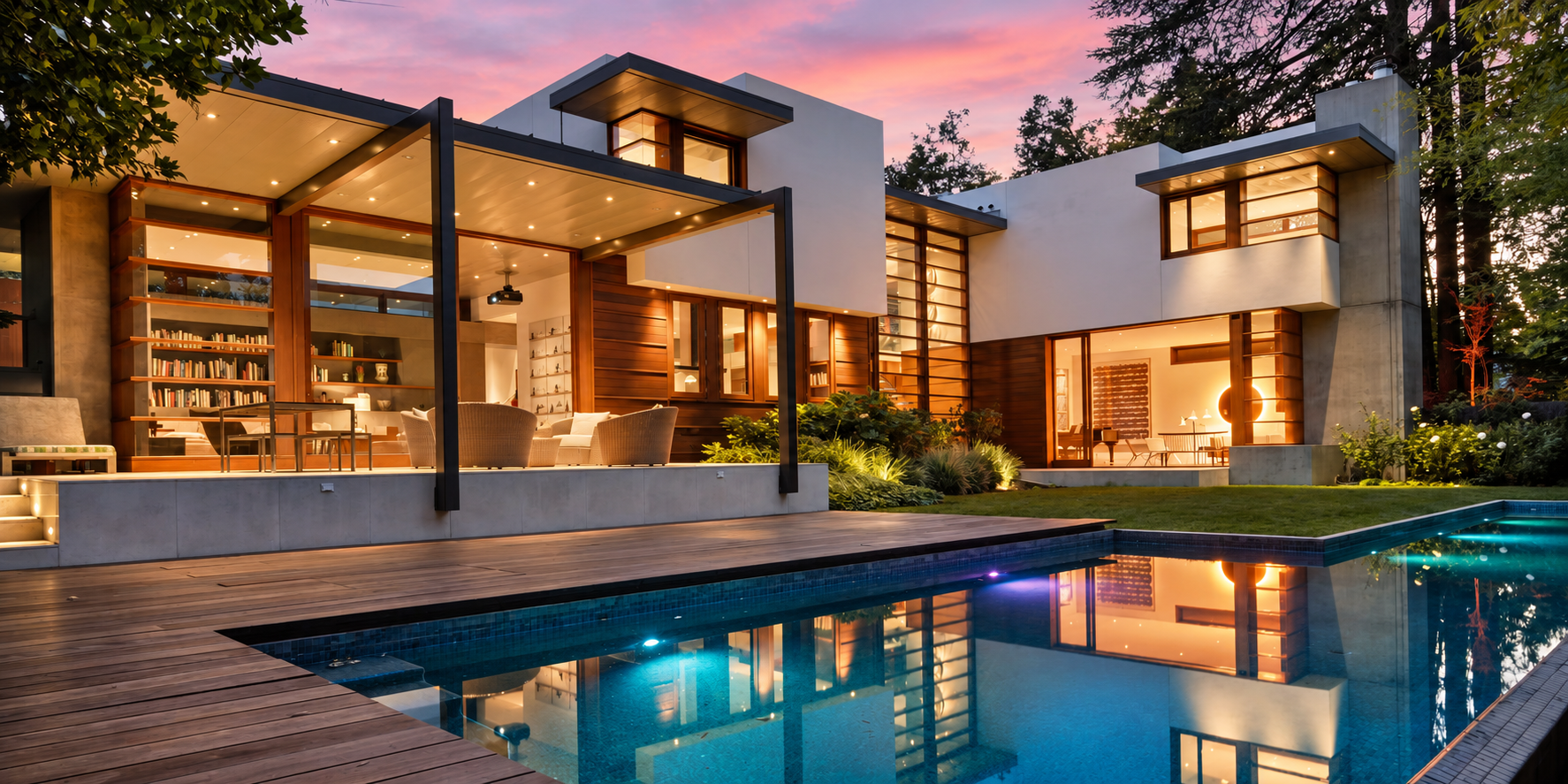
For years, tech entrepreneur Asher Waldfogel and his wife, Helyn MacLean, dreamed of building a modern house in Palo Alto, Calif.
The couple, however, worried about clashing with the Mediterranean-style architecture typically associated with their neighborhood of Old Palo Alto.
So they tapped architect Steven Ehrlich to create a design that paid homage to its surroundings with stucco, mahogany and titanium zinc cladding. They spent $20 million over several years building the house, completed in 2005.
Now looking to be closer to their adult daughter on the East Coast, they are putting the five-bedroom home on the market for $44 million—the most expensive listing in Palo Alto.
Waldfogel is an angel investor who co-founded Redback Networks, a telecommunications-equipment company. MacLean previously had a career in fundraising.
The couple purchased the roughly 0.4-acre site for $7.1 million in 2000 and demolished a circa-1930s Spanish Colonial home. The house they built pinwheels around a central staircase. It has 7,900 square feet of livable space, with four distinct courtyards and a pool.
A key feature of the home is a cast-in-place concrete wall, or spine, that is two stories high and about 80 feet long. “There’s a little bit of controlled chaos in what comes out of the form,” unlike a perfectly uniform surface, Waldfogel said. “If you want that, you do it in plastic.”
Waldfogel said he and his wife are thinking about the next phase of life now that their daughter is grown, although they have not decided where they will move. They also have a home in Sun Valley, Idaho.
“Right now we’re just trying to emotionally let go and decide what to do next,” he said.
Palo Alto, an epicenter of venture capital and tech startups in Silicon Valley, is home to some of the country’s biggest tech titans. Sales volume and prices are rising, with a median sale price of $3.5 million for the three months ending in August, up 5.8% year-over-year, according to real-estate brokerage Redfin.
Arthur Sharif of Sotheby’s International Realty—San Francisco Brokerage has the listing.

The PG rating has become the king of the box office. The entertainment business now relies on kids dragging their parents to theatres.

The pandemic-fuelled love affair with casual footwear is fading, with Bank of America warning the downturn shows no sign of easing.