

The Workers Opting to Retire Instead of Taking on AI
Their careers spanned the personal computing, internet and smartphone waves. But some older workers see AI’s arrival as the cue to exit.

 4 min

Luke Michel has already lived through two technology overhauls in his career, first desktop publishing in the 1980s and online publishing later on. But AI? He’s had enough.
So when his employer, the Dana-Farber Cancer Institute, made an early-retirement offer to some staff last year, the 68-year-old content strategist decided to speed up his exit. Before, he had expected to work a couple more years.
“The time and energy you have to devote to learning a whole new vocabulary and a whole new skill set, it wasn’t worth it,” he said.
It isn’t that he’s shunning artificial intelligence—he is learning Spanish with the help of Anthropic’s Claude. But, at this point, he’s less than eager to endure all the ways the technology promises to upend work.
“I just want to use it for my own purposes and not someone else’s,” he said.
After rising for decades and then hovering around 40% in the 2010s, the share of Americans over 55 years old in the workforce has slipped to 37.2%, the lowest level in more than 20 years.
The financial cushion of rising home equity and stock-market returns is driving some of the decline, economists and retirement advisers say.
But for some older professionals, money is only part of the equation.
They say they don’t want to spend the last years of their career going through the tumult of AI adoption, which has brought new tools, new expectations and a lot of uncertainty.
Many people retire when key elements of their work lives are disrupted at once, said Robert Laura , co-founder of the Retirement Coaches Association and an expert on the psychology of retirement.
“Maybe their autonomy is being challenged or changed, their friends are leaving the workplace, or they disagree with the company’s direction,” he said.
“When two or three of these things show up, that’s when people start to opt out.”
“AI is a big one,” he adds. “It disrupts their autonomy, their professionalism.”
Michel, whose work required overseeing and strategizing on website content, has been here before.
When desktop publishing arrived in the 1980s, he was a graphic designer using triangles and rubber cement.
The internet’s arrival changed everything again. Both developments required new skills, and he was energized by the challenge of learning alongside colleagues and peers.
It felt different this time around. “Your battery doesn’t hold a charge as long as it used to,” he said.
He would rather spend his energy volunteering, making art, going to operas and chairing the Council on Aging in North Andover, Mass., where he lives.
In an AARP survey last summer of 5,000 people 50 and over, 25% of those who planned to retire sooner than expected counted work stress and burnout as factors.
About half of those retired said they had left work at least partly because they had the financial security to do so.
In general, older Americans are less likely than younger counterparts to use AI, research shows.
About 30% of people from ages 30 to 49 said they used ChatGPT on the job, nearly double the share of those 50 and older, according to a 2025 Pew Research Center survey of more than 5,000 adults.
Baby boomers and members of Generation X also experienced the sharpest declines in confidence using AI technology, according to a ManpowerGroup survey of more than 13,900 workers in 19 countries.
“We as employers aren’t doing a good enough job saying (to older workers), we value the skills that you already have, so much so that we want to invest in you to help you do your job better,” says Becky Frankiewicz , ManpowerGroup’s chief strategy officer.
Jennifer Kerns’s misgivings about AI contributed to her departure last month from GitHub, where the 60-year-old worked as a program manager.
Coming from a family of artists, she said, it offends her that AI models train on the creative work of people who aren’t compensated for their intellectual property. And she worries about AI’s effect on people’s critical-thinking skills.
So she was dismayed when GitHub, a Microsoft-owned hosting service for software projects, began investing heavily in AI products and expecting employees to incorporate AI into much of their work. In employee-engagement surveys, the company had begun asking them to rate their AI usage on a scale of 1 to 5.
When it came time to write reports and reviews, colleagues would suggest that she use ChatGPT.
“I’d be like, ‘I have no idea how to use that and I have no interest in using AI to write anything for me,’” she said.
It would have been more prudent to work until she was closer to Medicare eligibility, she said. But by waiting until her children were out of college and some of her stock grants had vested, the math worked.
Her first act as a nonworking person: a solo trip to Scotland, where she took a darning workshop and learned how to repair sweaters.
“The opposite of AI,” she said.
Employers already under pressure to cut workers—such as in the tech industry—may welcome some of these retirements, said Gad Levanon , chief economist at Burning Glass Institute, which studies labor-market data.
“The more people retire, the fewer they have to let go,” he said.
Some of the savviest tech users are also balking at sticking around for the AI upheaval. Terry Grimm, who worked in IT for 40 years, retired from his senior software consultant role at 65 last May.
His firm had just been acquired by a bigger firm, which meant learning and integrating the parent company’s AI and other tech tools into his work.
Until then, Grimm expected he might work a couple more years, though he felt that he probably had enough saved to retire.
“I just got to the point where I was spending 40 hours at work and then 20 hours training and studying,” said Grimm, who has since moved with his wife from the Dallas area to a housing development on a golf course in El Dorado, Ark.
“I’m like, ‘I’ll let the younger guys do this.’”
 Copyright 2020, Dow Jones & Company, Inc. All Rights Reserved Worldwide. LEARN MORE



A Sydney couple has paid $15.5 million for the Grand Penthouse at Marquee’s $285 million La Belle Residences beachfront development which is nearing completion at Palm Beach, eclipsing the record for an off-the-plan apartment sale on the southern Gold Coast. The sprawling single level 640 sqm beachfront residence, with sweeping views of the Gold Coast …
Continue reading “$15.5m La Belle Penthouse eclipses southern Gold Coast record”

On the owner’s deck, a 20-metre swimming pool incorporates Feadship’s patented ContraWave technology and extends indoors as a suspended, glass-bottomed infinity pool.
A new study models a potential $80.6 billion lift in Australian GDP after a decade, as national testing shows a decline in Year 10 digital literacy.
2 min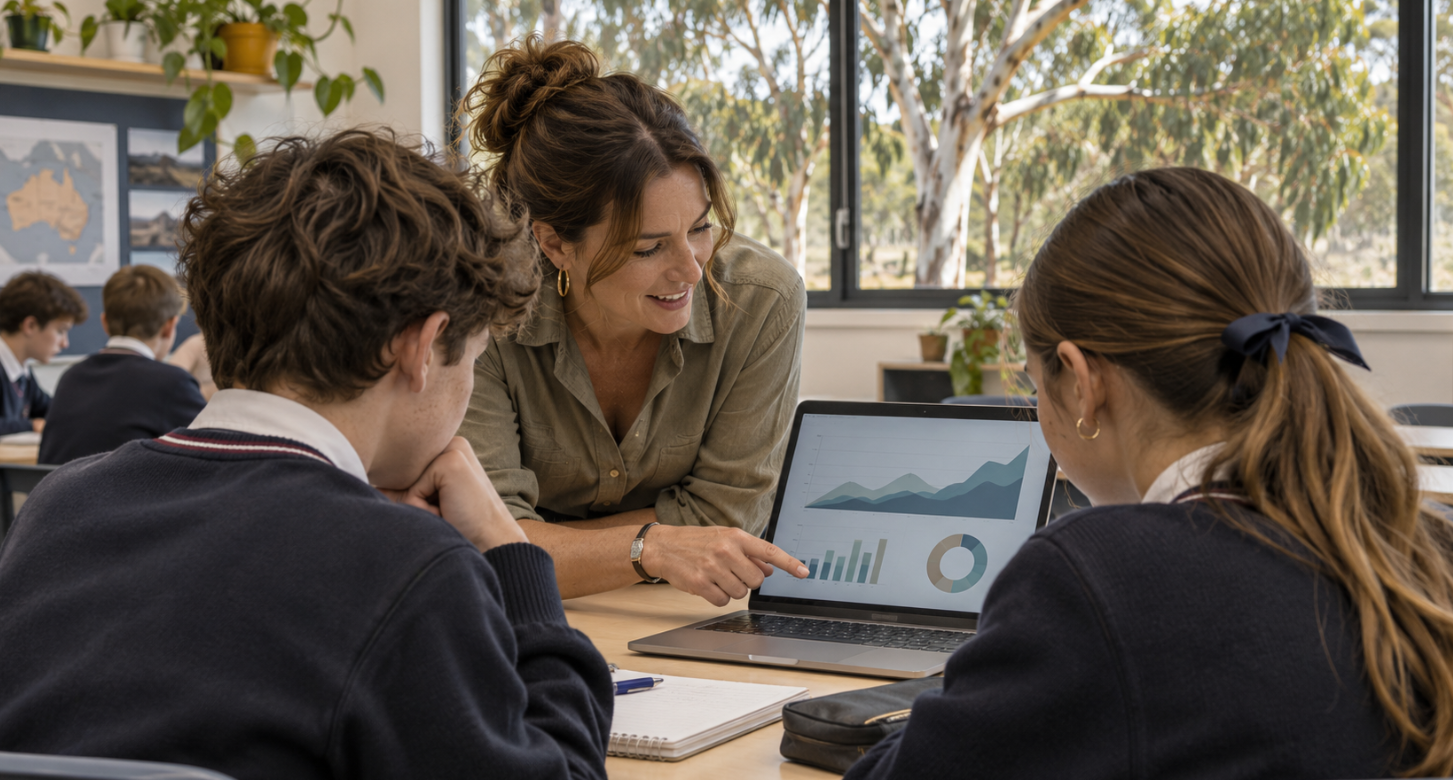
Australia trails Singapore and Malta in a new Commonwealth index, while national testing shows fewer than four in 10 Year 10 students meet the standard for digital literacy.
Australia has ranked third among 56 Commonwealth countries for youth AI readiness, with researchers estimating that artificial intelligence could lift the level of Australian GDP by $80.6 billion after a decade under their middle scenario.
The Ayre Think Tank released the index at the Commonwealth Heads of Government Meeting in Antigua and Barbuda. Australia scored 71 out of 100, behind Singapore on 77.6 and Malta on 75. The United Kingdom followed closely on 70.8, with Canada fifth on 70.2. Only 15 countries reached the study’s benchmark of 53.
What the $80.6 billion figure measures
The researchers applied International Monetary Fund estimates for broad groups of economies to Australia’s 2025 GDP. The resulting scenarios put the potential lift in Australian GDP after 10 years at between $40.9 billion and $120.3 billion, with $80.6 billion representing the midpoint.
The figures describe how much larger the economy could be at the end of the period under each scenario. They represent a change in the level of GDP in year 10.
Digital literacy falls as schools roll out AI tools
Australia scored 8.7 out of 10 for access to technology and 7.5 for digital, data, media and AI capability. Separate national testing found that 37 per cent of Year 10 students met the proficient standard for information and communications technology literacy in 2025, down from 46 per cent in 2022. About one in 10 students reported receiving substantial teaching on AI-related tasks. National assessment results
The report points to two state initiatives aimed at building those skills. Queensland began rolling out an AI education platform in state schools in 2026, while Victoria introduced free specialist training for workers looking to develop AI skills or move into related roles.
The index draws on 1,128 sources and examines the conditions facing people aged 15 to 29, including access to technology, education and pathways into work. Australia had usable data for 76 of the 102 indicators used in the rankings. The researchers found too little comparable evidence to score an eighth area covering critical judgement and people’s ability to exercise control over AI systems.
Professor C. Justin Robinson, campus principal of the University of the West Indies’ Five Islands Campus, said young people should be equipped to question and improve AI tools and supported in building alternatives suited to their needs.
The report calls for affordable access to technology, more practical education and stronger links between training, employment and entrepreneurship. It also urges governments and educators to support AI tools suited to local languages and give young people ways to challenge automated decisions.

Waldorf Astoria Kuala Lumpur is scheduled to open on 30 October, introducing the Hilton luxury brand to Malaysia with an all-suite hotel in the city’s Golden Triangle.

Limited to 630 units, Lamborghini’s latest Urus Capsule pushes personalisation further than ever, blending hybrid performance with over 70 bespoke design combinations.