Exclusive: $35 million Gordons Bay House to Reset Coogee House Price Record
Now known as GB House or Gordons Bay House, the five-bedroom residence has been brought to market through James Ball and Michael Pallier of Sydney Sotheby’s International Realty, who are telling prospective purchasers a record $35 million would be enough to secure the landmark home.
 4 min
4 min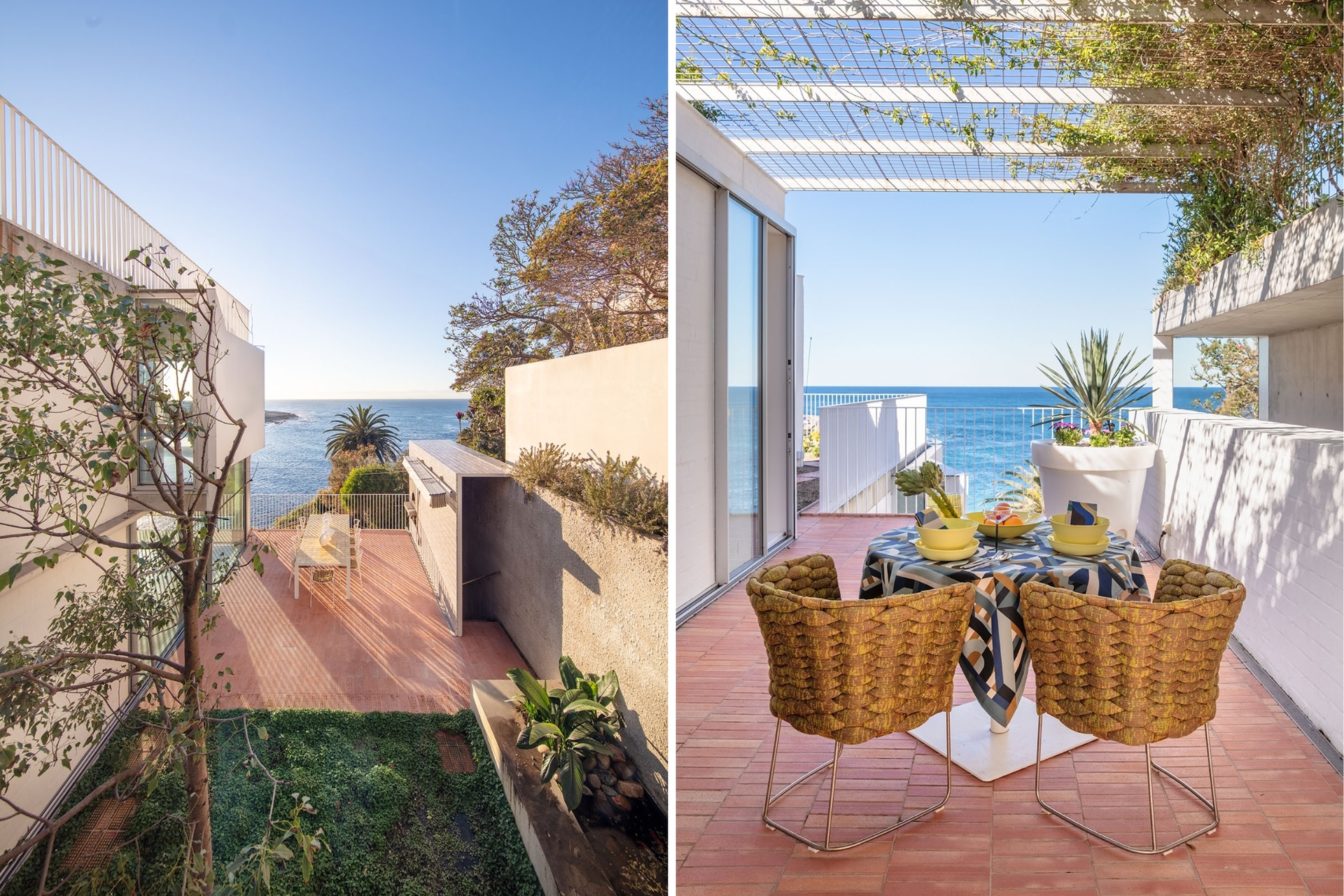
For years, the progress of the remarkable house at 1 Major Street was observed by the thousands of people who followed Sydney’s Bondi-to-Coogee coastal walk.
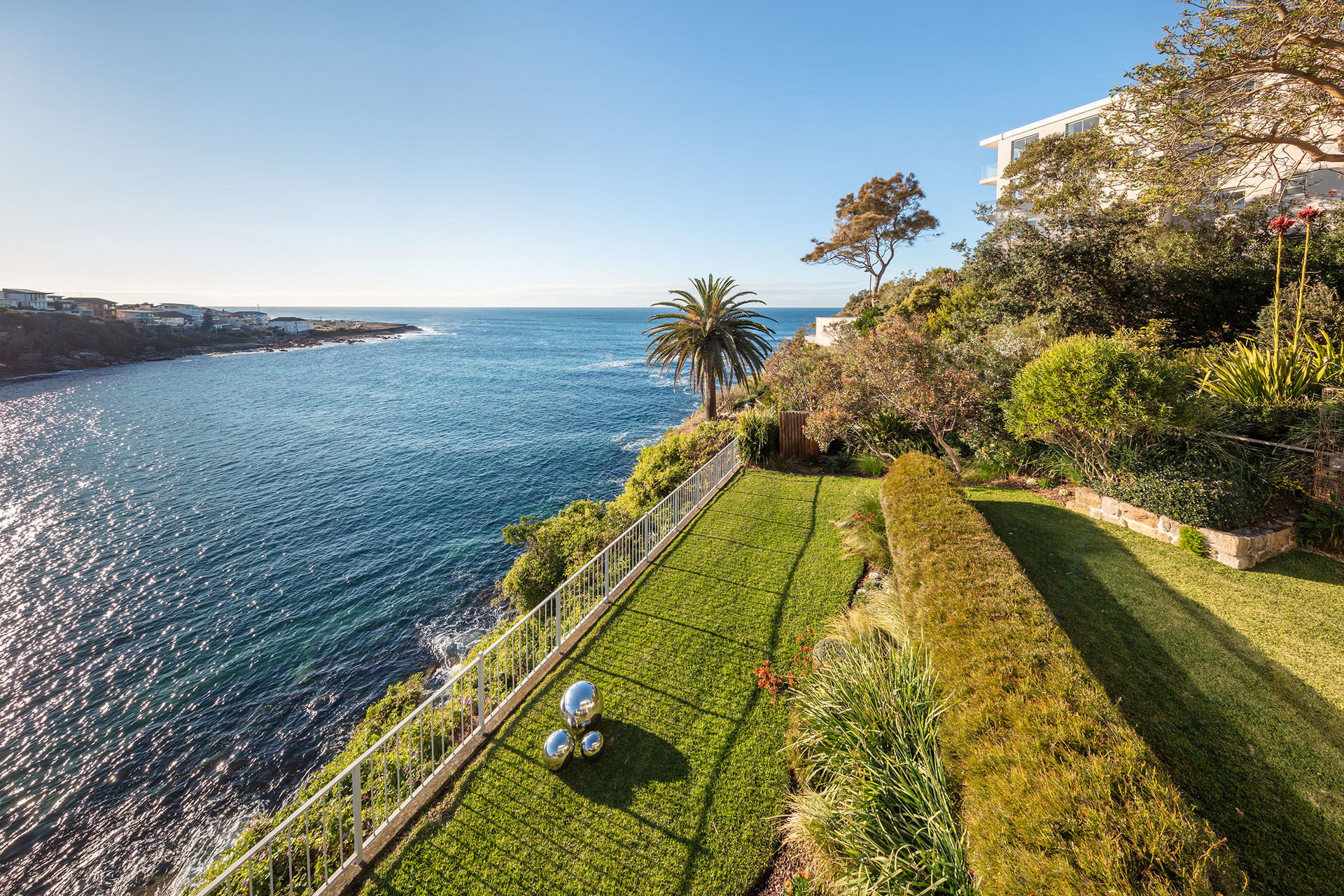
Perched directly above Gordons Bay, its construction unfolded in unusually public view. Walkers could see the enigmatic white structure gradually taking shape on the cliff, even as the completed residence was being designed to preserve privacy from the path and neighbouring properties.
Now known as GB House or Gordons Bay House, the five-bedroom residence has been brought to market through James Ball and Michael Pallier of Sydney Sotheby’s International Realty, who are telling prospective purchasers a record $35 million would be enough to secure the landmark home.
The residential price records for Coogee was set in 2024 when the penthouse atop Ballamac House, the redevelopment of a historic mansion into a boutique collection of apartments, sold for just over $20 million.
Architecture at the water’s edge
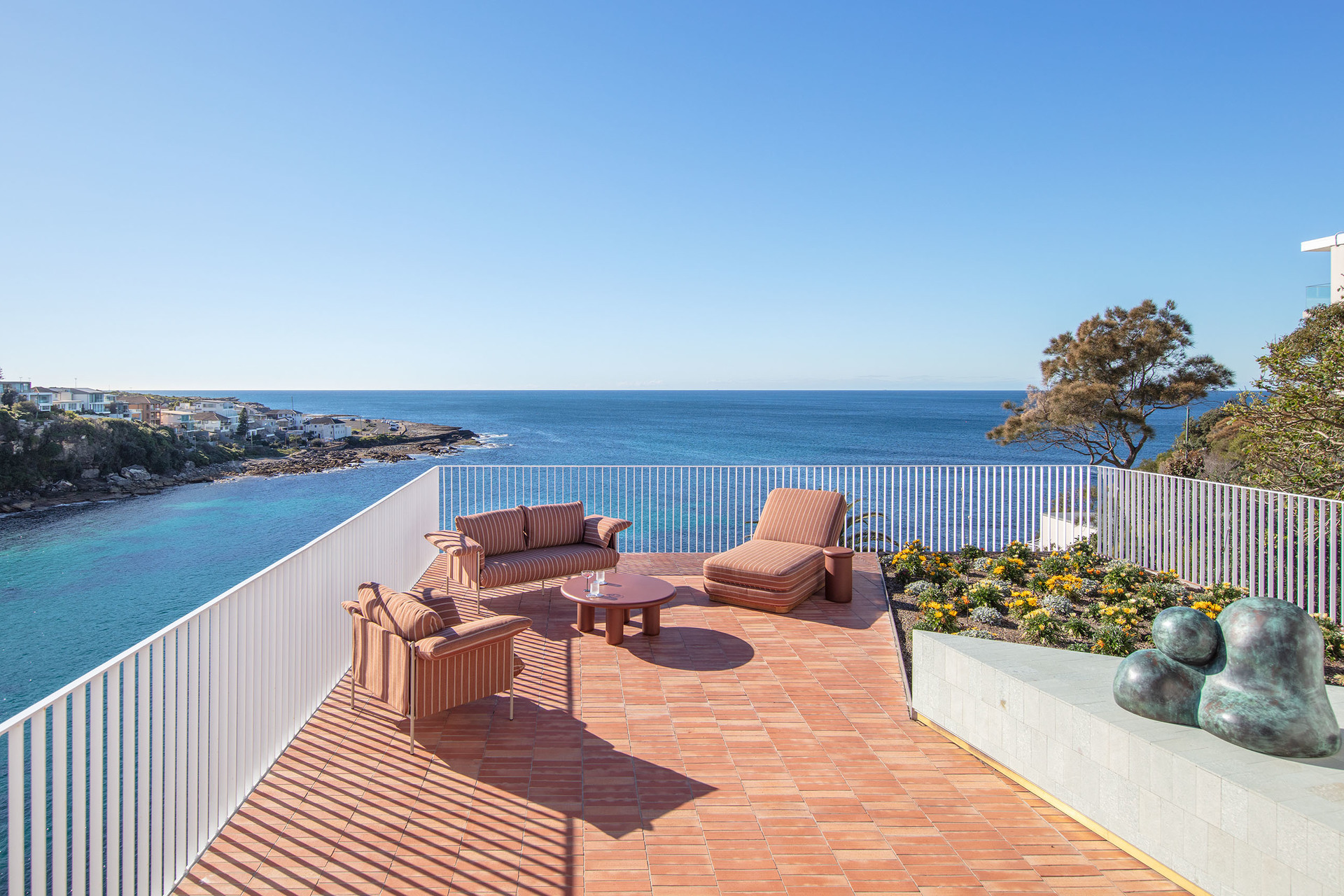
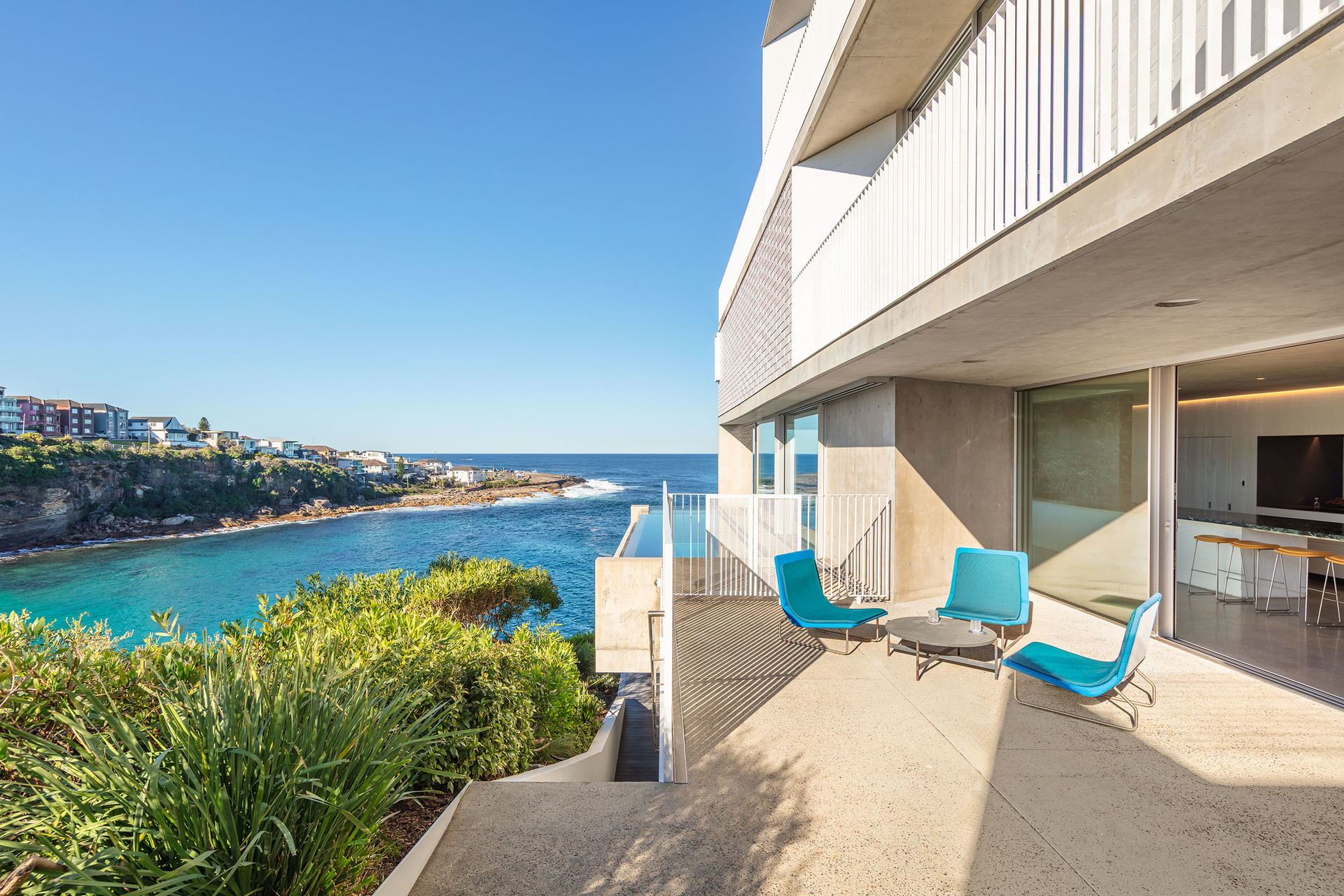
Designed by Renato D’Ettorre Architects, GB House occupies approximately 740sqm at the northern edge of Coogee, looking across the protected waters of Gordons Bay and out to the Pacific Ocean.
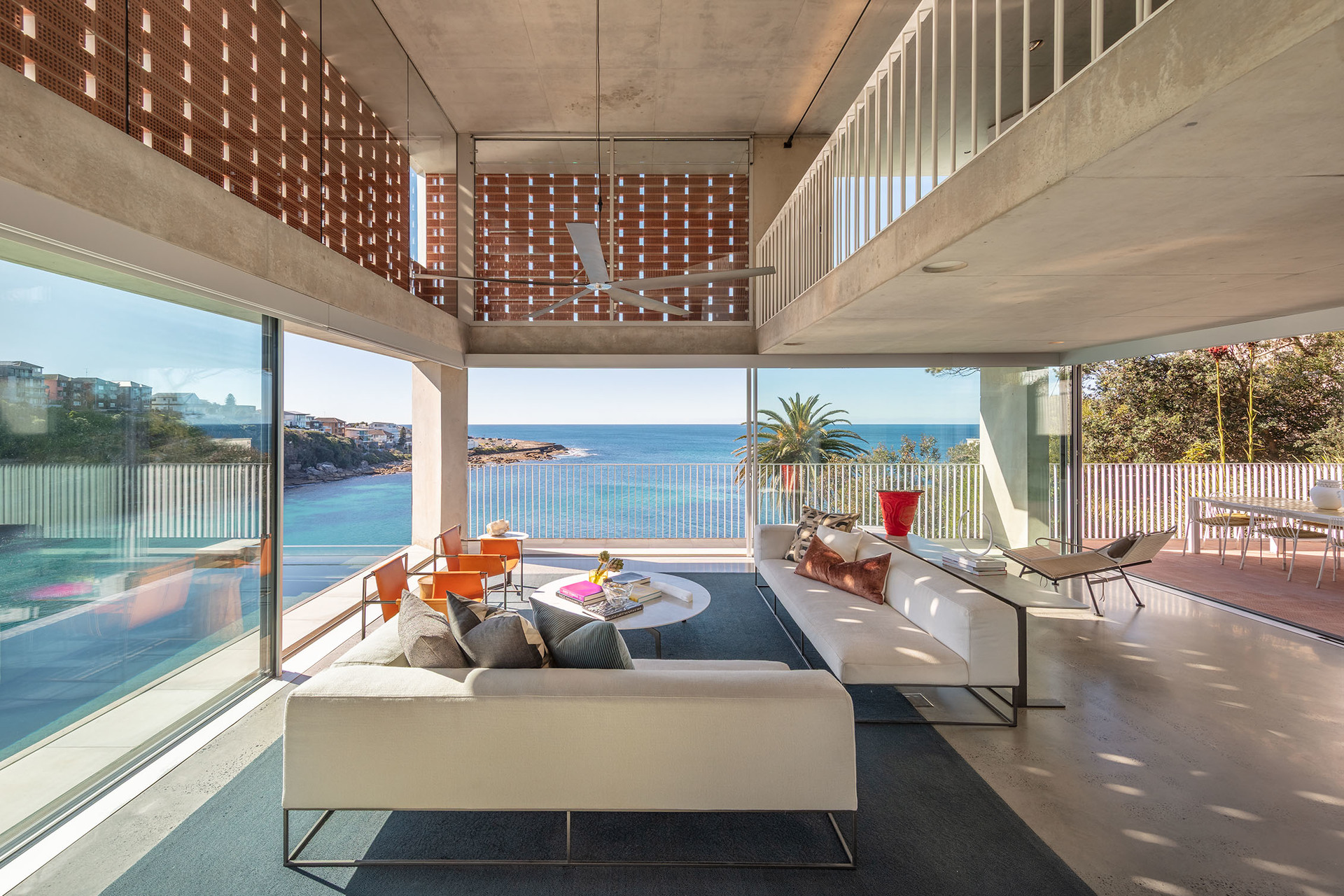
Its restrained white exterior draws on the elemental architecture of the Greek islands. Behind that comparatively quiet street presence, perforated glazed brickwork filters sunlight, ocean air and fragments of blue water into the house.
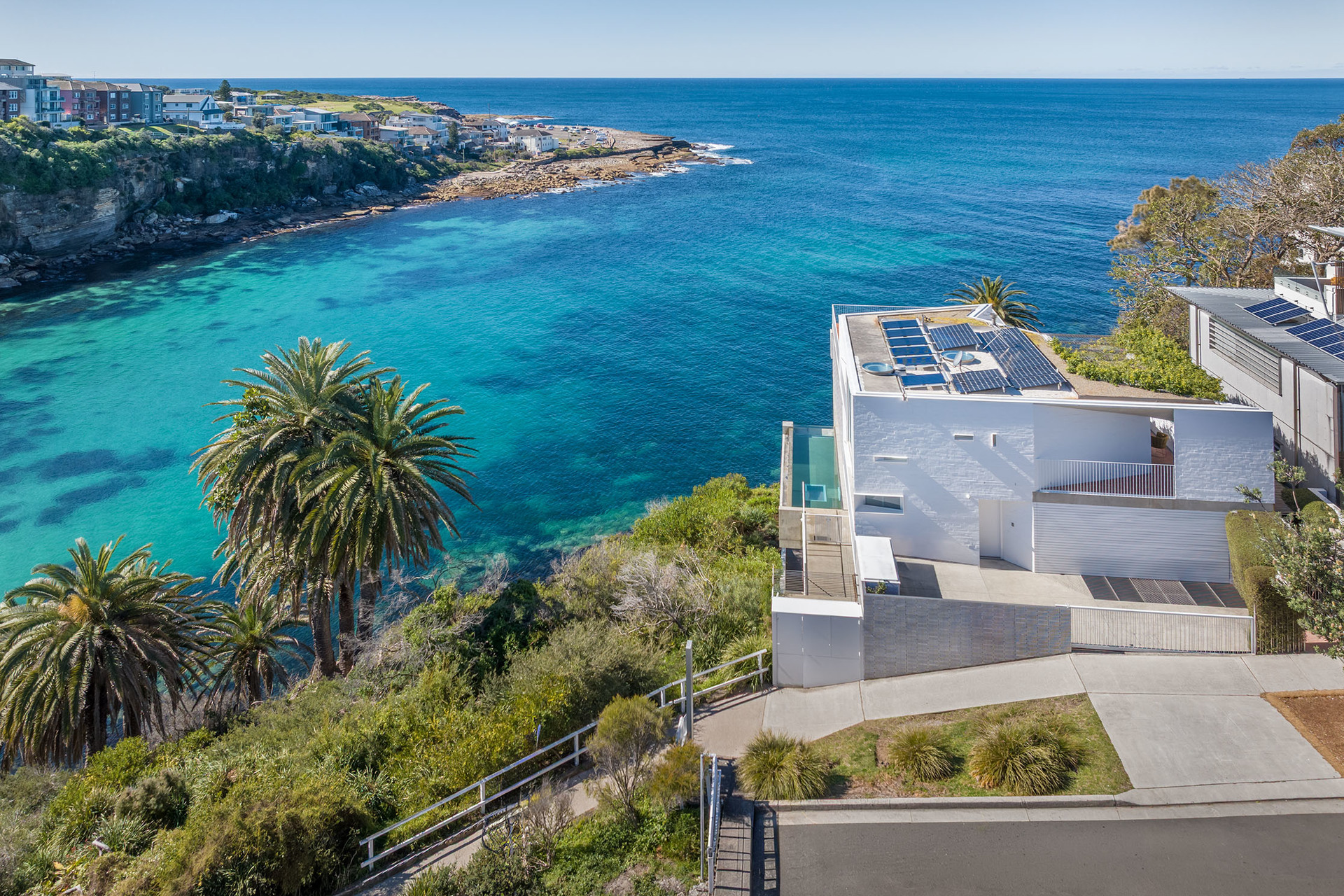
The design is based on alternating experiences of openness and enclosure. Broad ocean views are not revealed all at once. Instead, the residence moves between sheltered courtyards, framed openings, reflective water and expansive rooms facing the coastline.
Arrival is marked by a reflection pond and the sound of waves below. From there, the house opens gradually towards its north-east aspect and uninterrupted views across Gordons Bay.
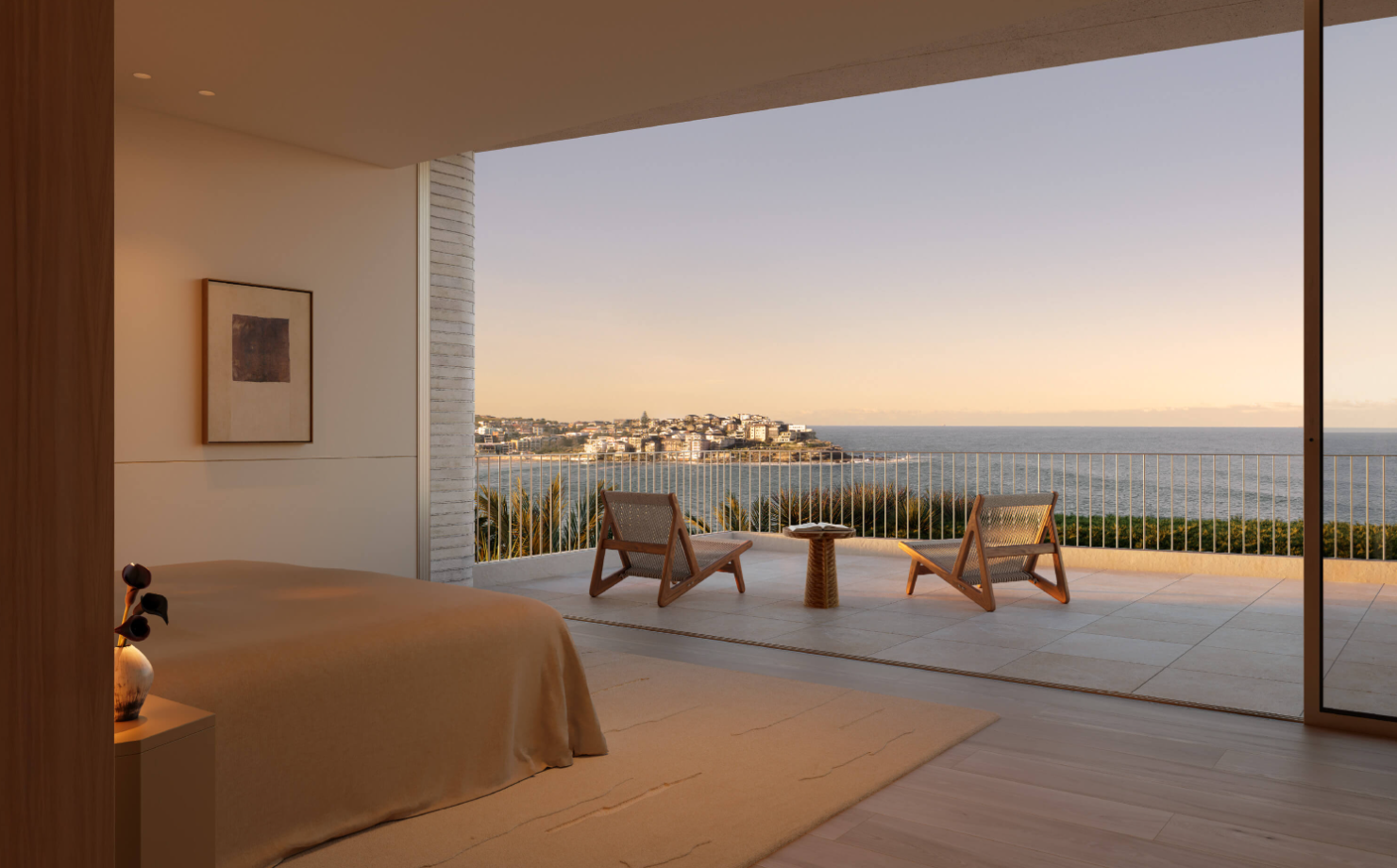
The residence spans approximately 538sqm internally, with five ensuite bedrooms and six bathrooms. The principal suite occupies an entire level and includes a private courtyard, ocean-facing terrace, fireplace, dressing area and a Tadelakt-finished bathroom with an Agape bath positioned towards the view.
One of the remaining bedroom suites is configured as a self-contained studio with its own entrance, giving the house flexibility for guests, adult children or live-in assistance.
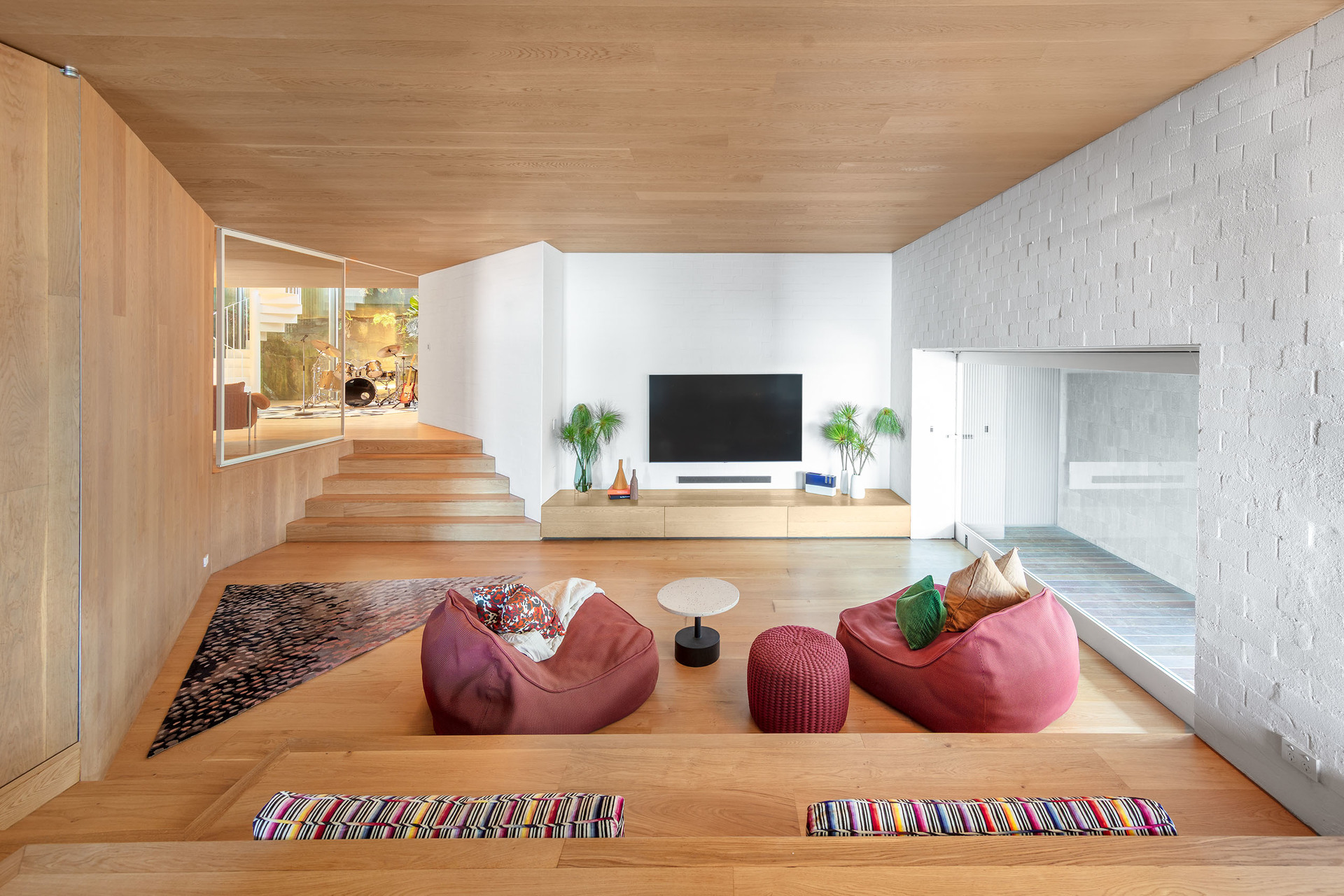
At the centre of the home is a vast living pavilion with a sunken lounge and ceilings rising to approximately five metres. A dramatic internal rock wall and garden extend through the double-height volume, accompanied by a 2.5-metre waterfall cascading into a fish pond.
The feature reinforces the central architectural idea: this is a house in which stone, water, light and planting are treated as part of the interior rather than scenery beyond it.
Marble, fire and filtered light
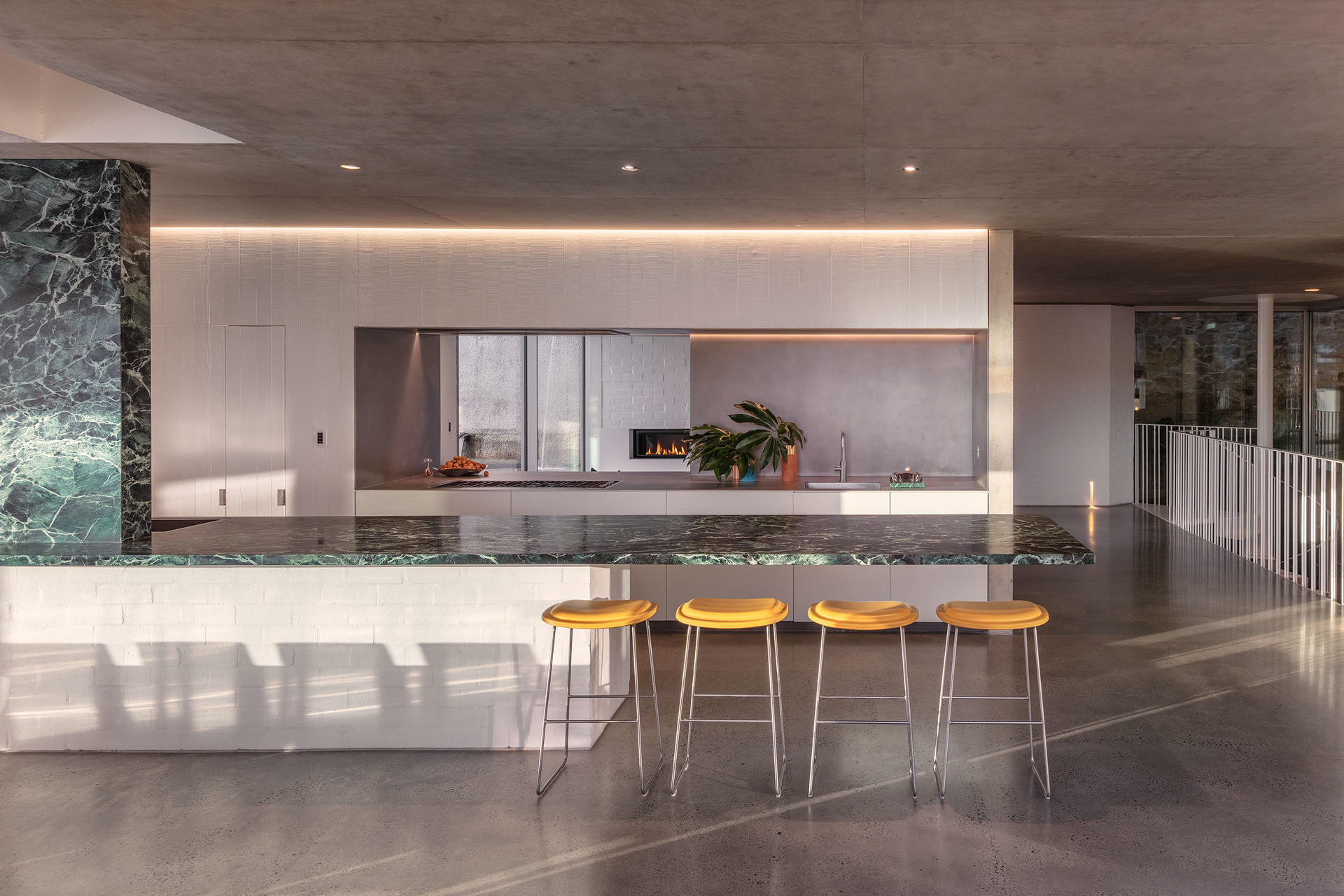
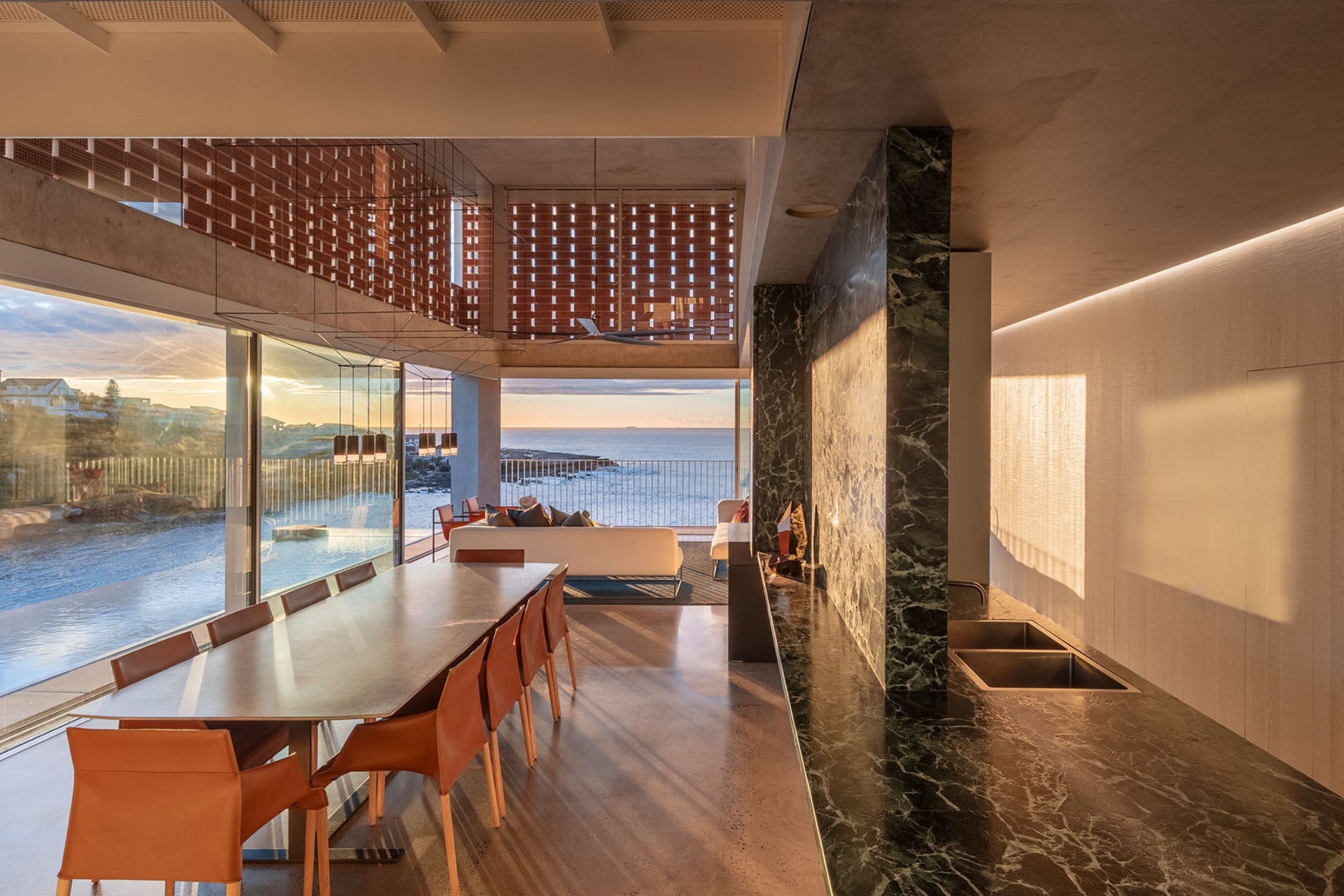
The kitchen is anchored by a sculptural cantilevered bench in Verdi Alpi marble, complemented by Miele appliances, a Barazza gas hob, Zip HydroTap and concealed butler’s pantry.
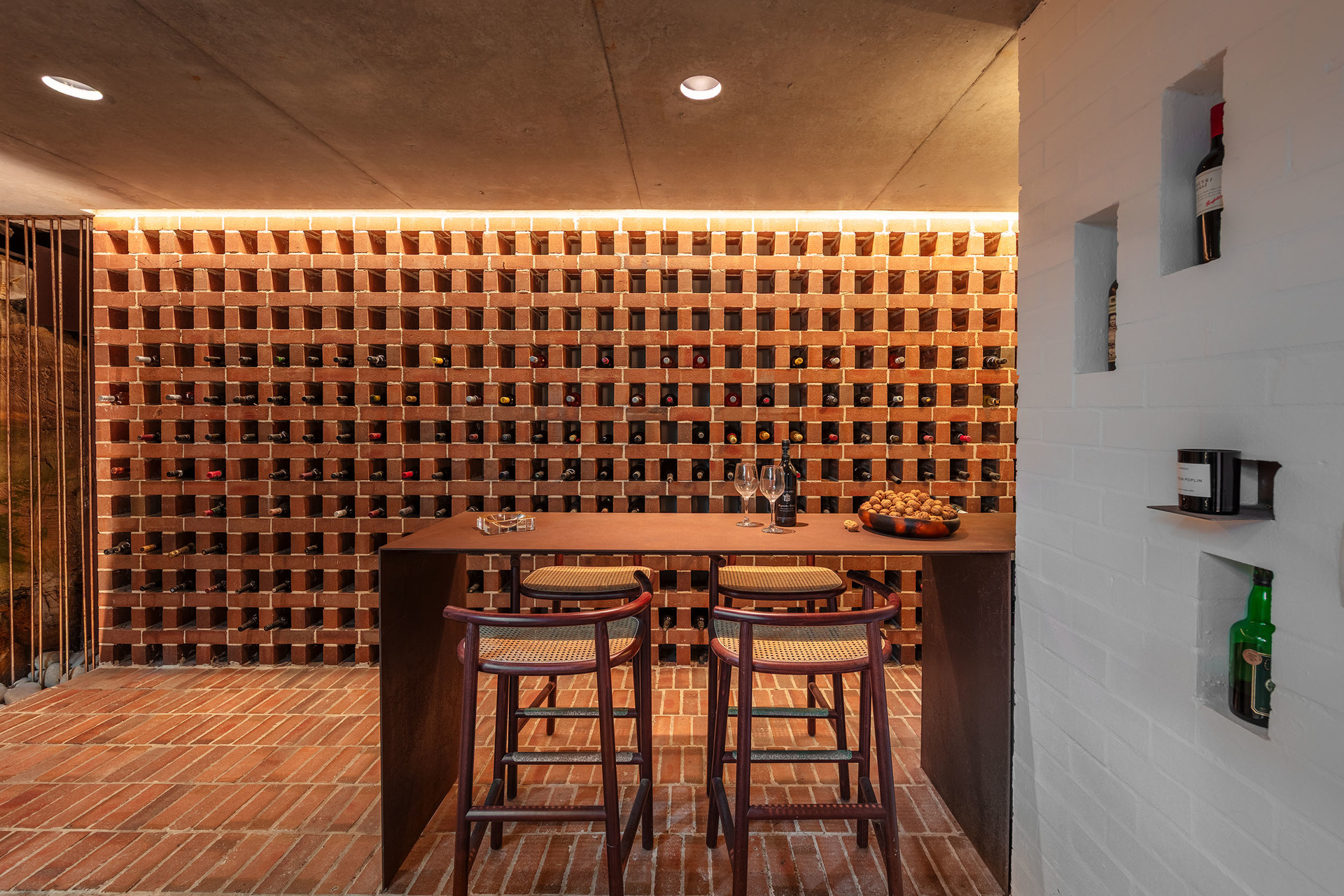
There are several living and entertaining zones, including a mezzanine office or media area, a subterranean music room, theatre or rumpus room, and a temperature-controlled cellar.
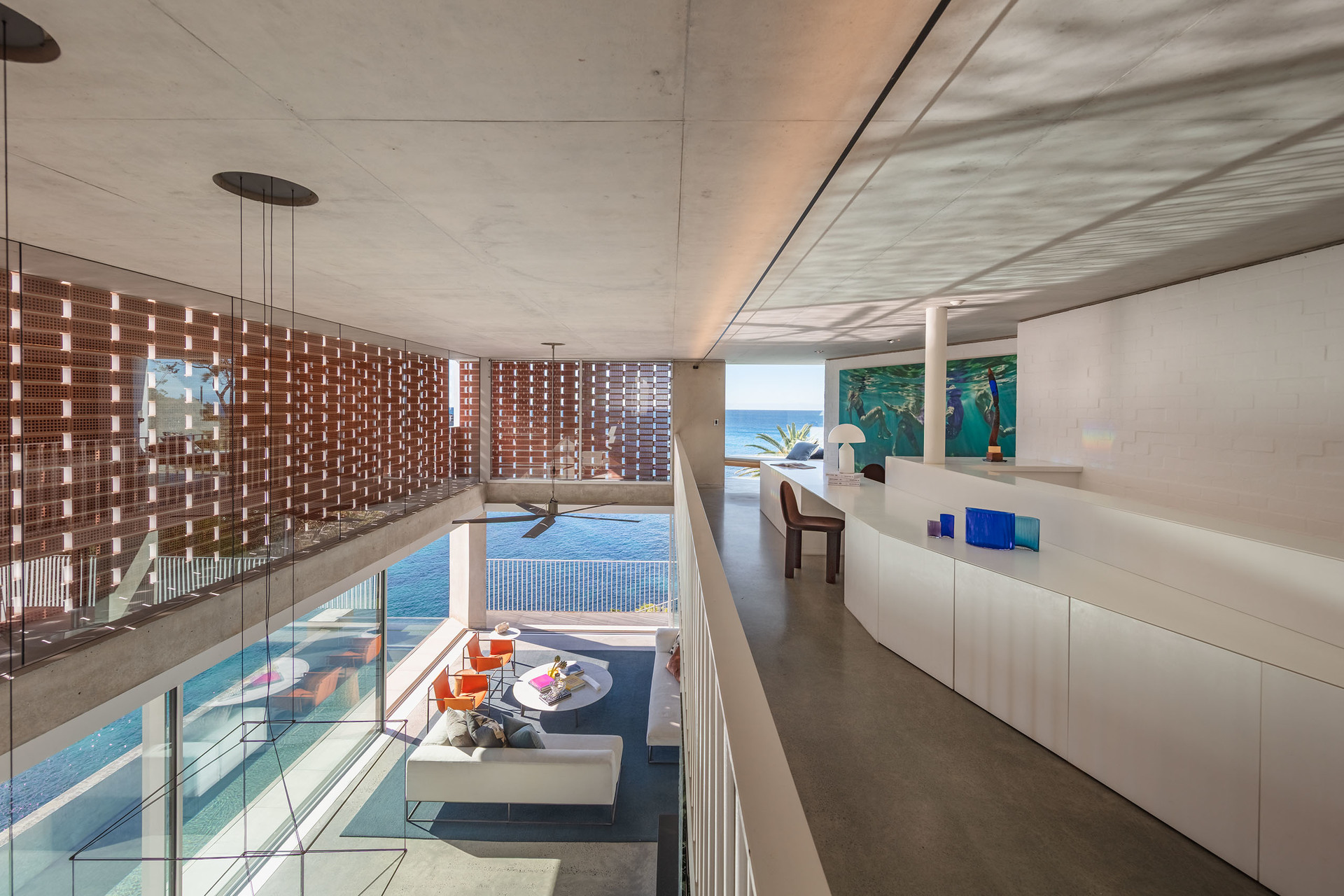
Three integrated fireplaces serve the principal bedroom and two living areas, while hydronic underfloor heating and four zones of reverse-cycle airconditioning provide year-round climate control.
The house is also equipped with smart-home technology, timed blinds, solar photovoltaic and solar-thermal systems, custom joinery and Boffi tapware.
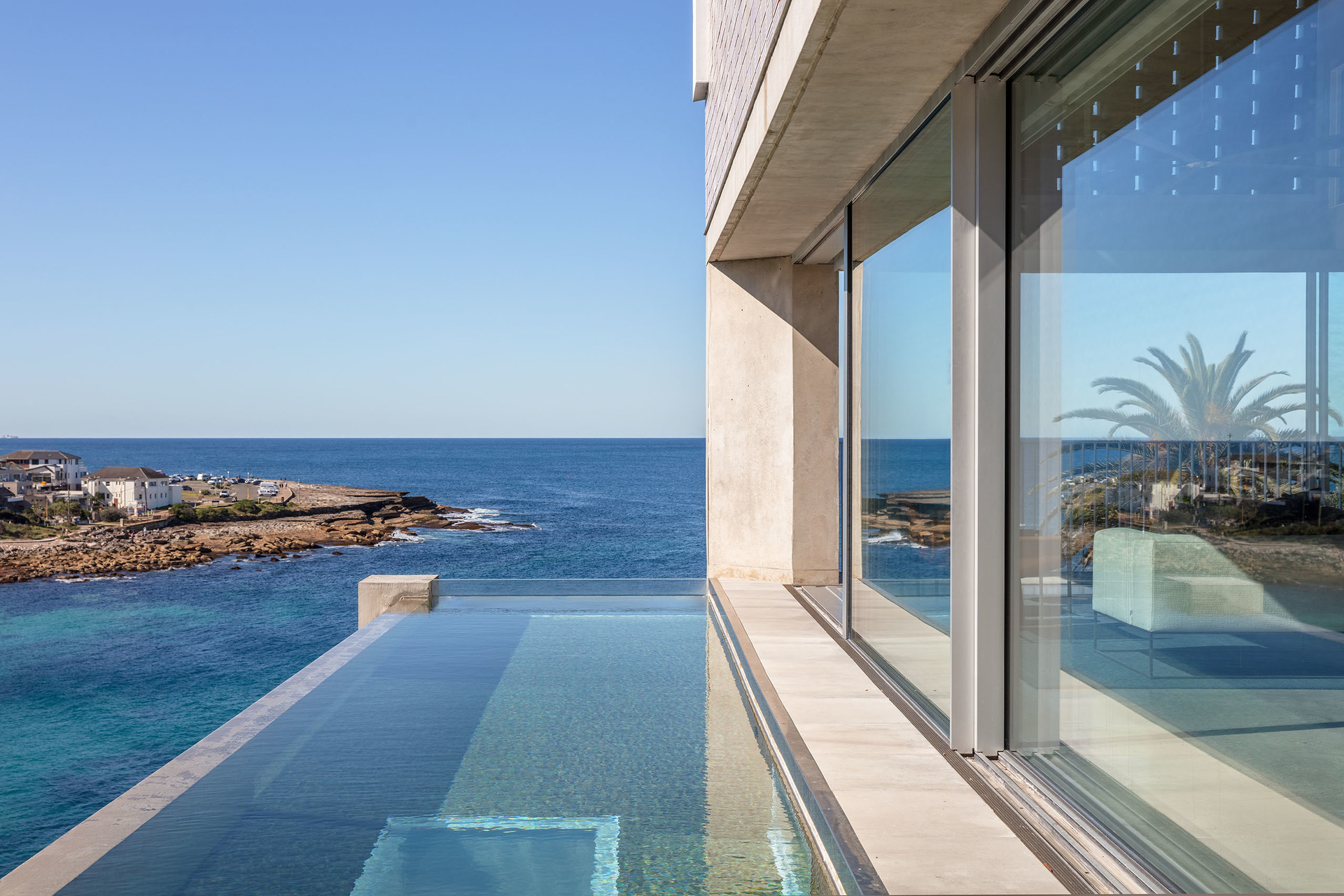
Outside, an ocean-facing garden descends towards the cliff. A heated infinity pool with swim jets appears to merge with the Pacific horizon, while separate entertaining areas include a north-facing barbecue terrace, outdoor refrigeration, pizza oven and retractable awning.
The campaign also refers to plans for an additional ocean terrace suspended above the sea. Buyers should independently establish the approval status, conditions and transferability of those plans before treating them as part of the property’s future potential.
One of Australia’s most awarded coastal houses
GB House is already well known within Australian architecture.
The project received the 2019 Wilkinson Award for Residential Architecture from the NSW chapter of the Australian Institute of Architects—one of the state’s most important awards for residential design.
It also received a national residential architecture award, the Horbury Hunt Residential Award at the Think Brick Awards, and recognition for its interiors and use of materials.
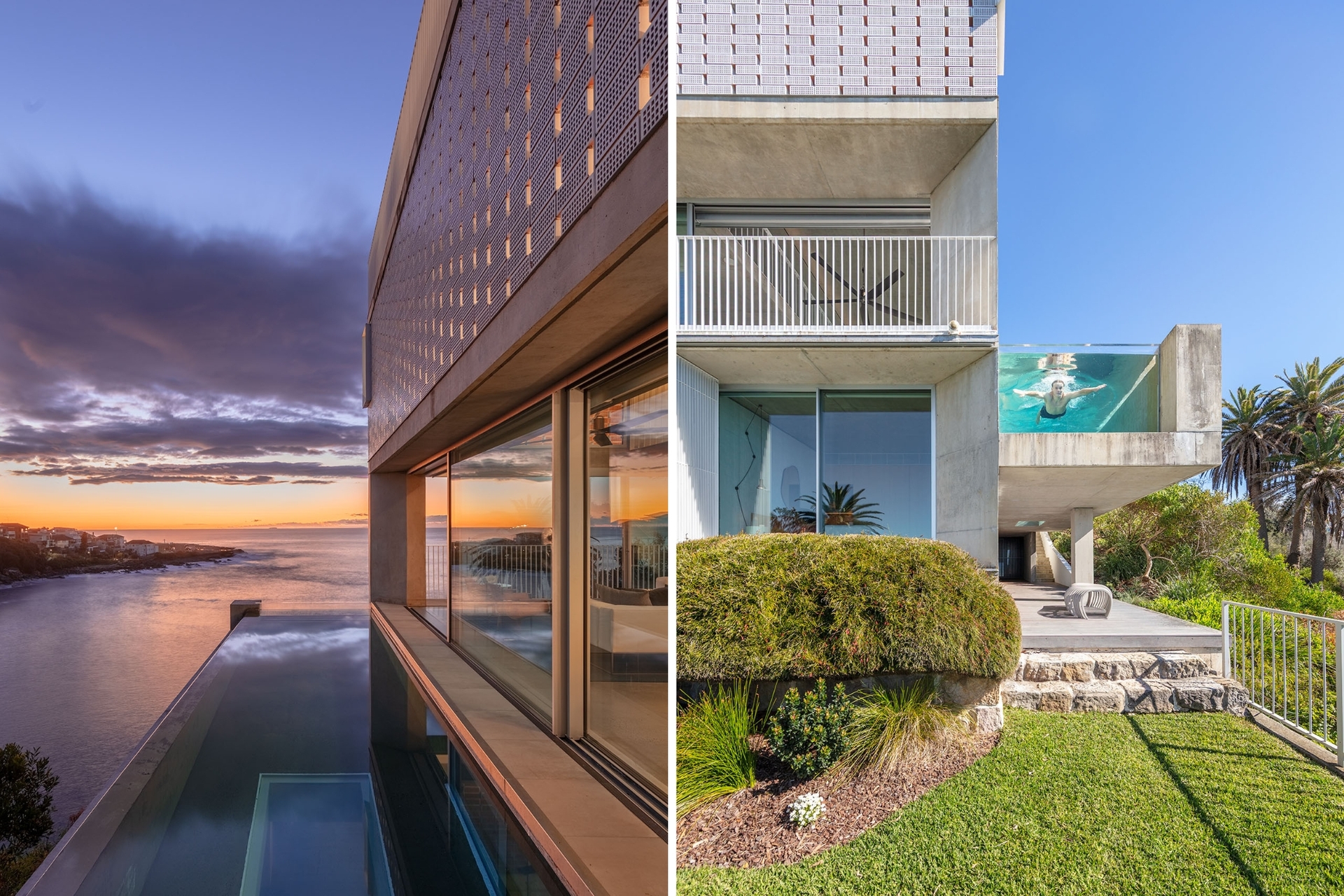
The home has appeared in architectural and design publications, as well as film and television coverage. Dimark Constructions, which documents the project in its portfolio, credits Justin Alexander for its published photography.
Its awards are significant because they establish GB House as more than a newly presented prestige listing. It is an already recognised work of Australian residential architecture, created for one of the most difficult and valuable types of site in Sydney: an exposed coastal holding that must balance views, weather, privacy and public visibility.
From $6.9 million to a potential suburb record
Public property records indicate 1 Major Street last changed hands for $6.9 million in 2010, long before the former home was demolished.
Although the residence became a familiar landmark to people using the coastal walk, the architecture was conceived to provide shelter from that very exposure. Angled walls, courtyards and screened openings protect its living spaces while maintaining direct contact with the water.
That combination gives the current campaign unusual reach. It is a trophy home with international architectural credentials, but it is also part of Sydney’s public coastal memory, a house thousands of people have walked past, watched evolve and wondered about from the path below.
GB House at a glance
- Address: 1 Major Street, Coogee, NSW
- Also known as: GB House and Gordons Bay House
- Price guide: $35 million
- Selling agents: James Ball and Michael Pallier, Sydney Sotheby’s International Realty
- Architect: Renato D’Ettorre Architects
- Construction: Dimark Constructions
- Land: Approximately 740sqm
- Internal area: Approximately 538sqm
- Bedrooms: Five, all with ensuites
- Bathrooms: Six
- Parking: Double garage plus two off-street spaces
- Aspect: North-east
- Key amenities: Infinity pool, gym, steam room, music room, theatre/rumpus room, cellar, internal waterfall and fish pond
- Previous recorded sale: $6.9 million in 2010
- Current Coogee property record: $20 million-plus Ballamac penthouse sale
- Previous freestanding-house record: $13.1 million on Wolseley Road
- Listing: View the live campaign

From making unpopular decisions to learning when to listen, leaders from five businesses reveal what nobody prepared them for — and how running a company has challenged their expectations.

Technology and semiconductor shares fell sharply as investors questioned the debt financing the AI infrastructure boom and confronted higher rates and Chinese competition.
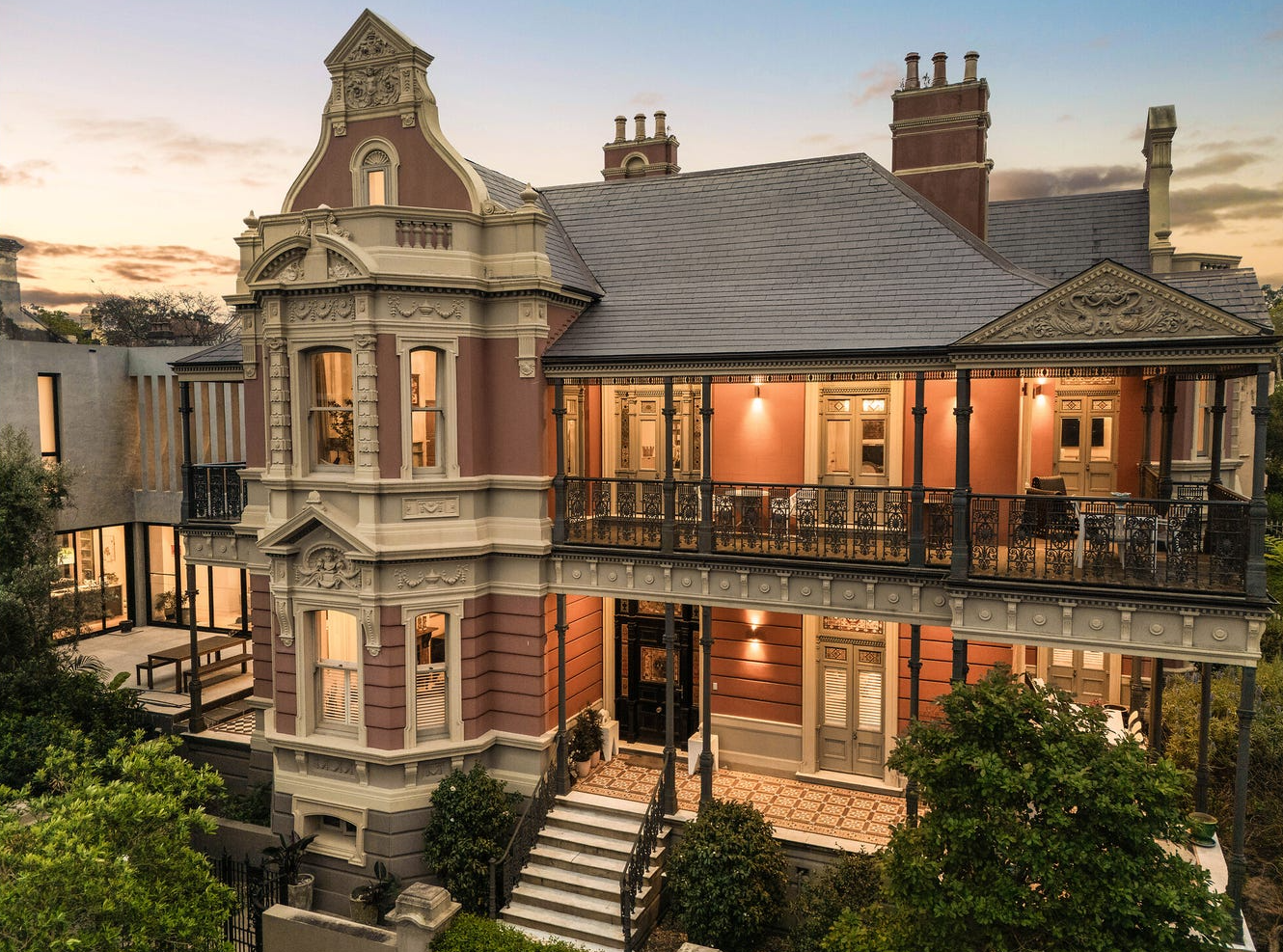
Blackmores vitamin mogul Marcus Blackmore and Caroline Furlong have listed their transformed Bayview waterfront, three years after buying the century-old Pittwater cottage known as The Shack.
3 min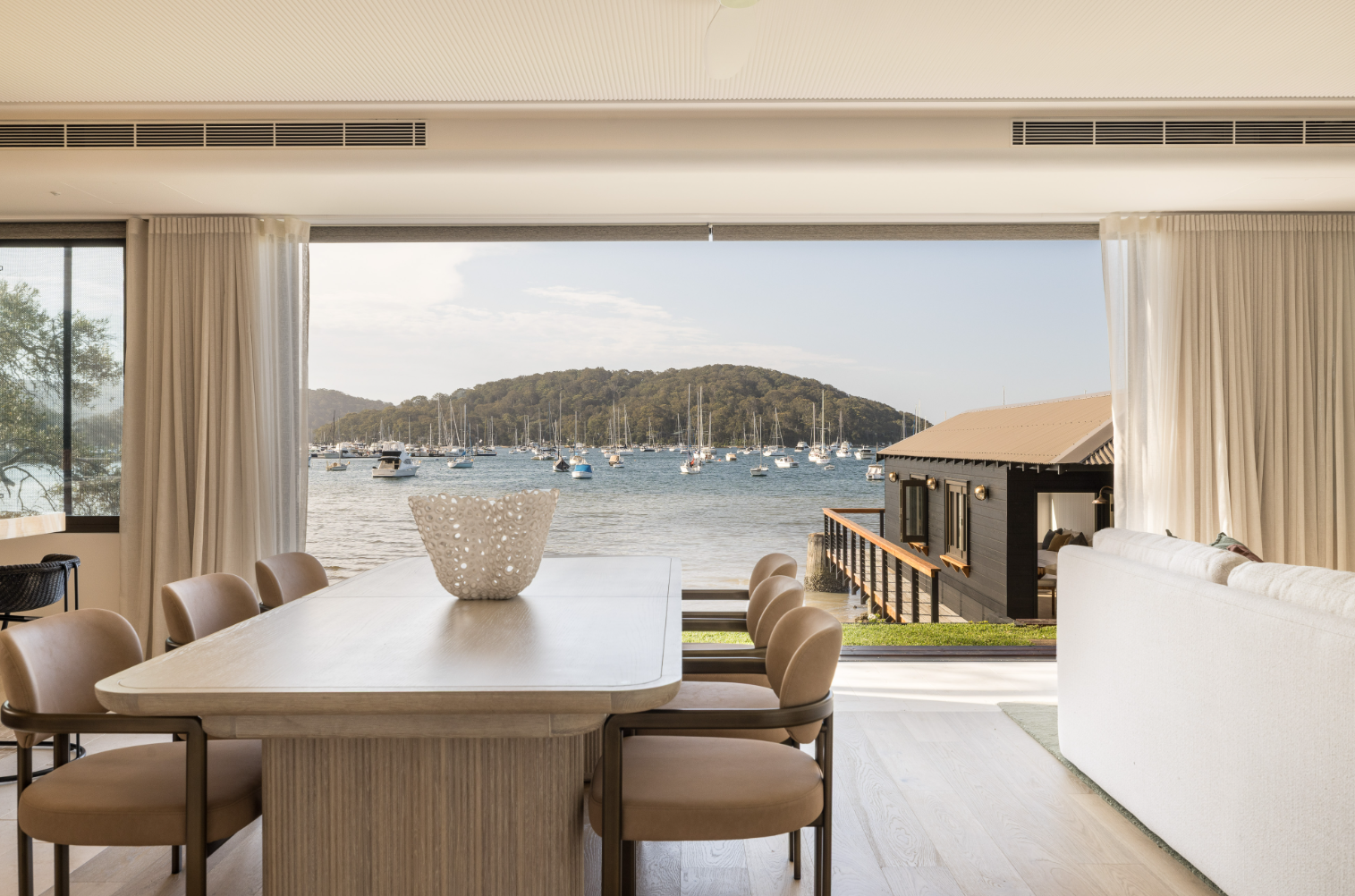
There is very little left of the century-old Pittwater shack Marcus Blackmore and Caroline Furlong bought for $5.7 million just over three years ago.
The vitamin industry heavyweight and his wife have returned 1808 Pittwater Road, Bayview to the market, but what buyers will find today is considerably different from the modest waterfront cottage that Blackmore and Furlong bought in August 2023.
The couple bought the tightly held property, long known locally as The Shack, after it had remained with the same family since the 1930s.
The timing of the purchase was particularly notable. It came immediately after Japanese brewing giant Kirin’s $1.9 billion takeover of Blackmores was announced, a deal which resulted in an $11.6 million dividend for Blackmore as a major shareholder of the company founded by his father, Maurice Blackmore.
It ended almost a century of ownership by the family of local teacher Neville Moodie.
The original three-bedroom, one-bathroom cottage sat almost on the water, with lawns running to Pittwater and a timber boathouse at the shoreline. Its appeal was less about the house itself and more about a rare north-facing position overlooking Scotland Island and a location where waterfront holdings are seldom offered for sale.
Three years on, Blackmore and Furlong have completely reimagined the site. 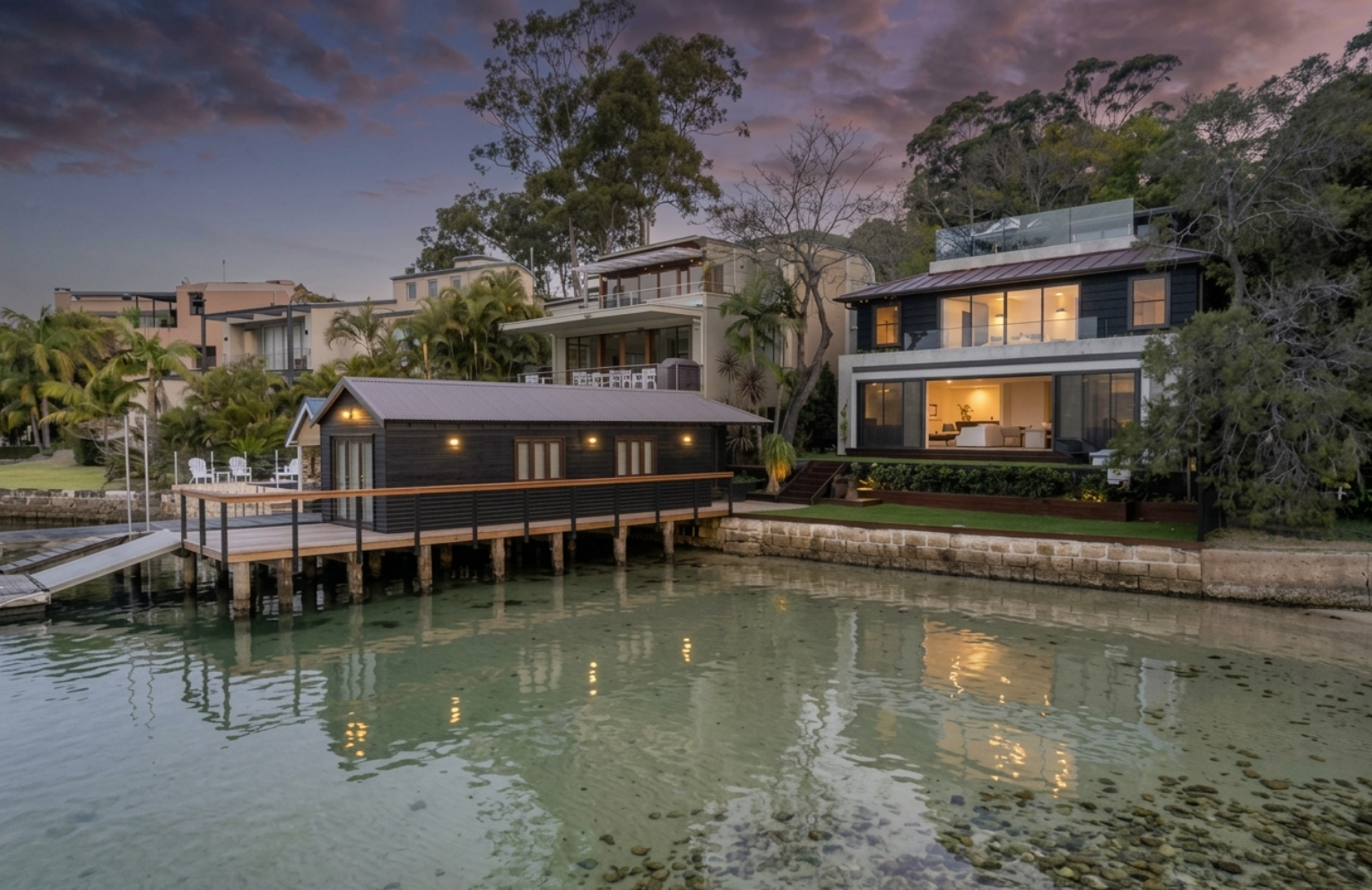 Walter Barda Design was commissioned to design a new split-level residence, delivered by Touchstone Construction Group, that takes full advantage of the relatively compact waterfront parcel and its prized northern orientation.
The resulting home is unmistakably contemporary, with curved architectural forms, natural limestone and timber flooring, extensive glazing and reinforced concrete construction wrapped in external timber cladding.
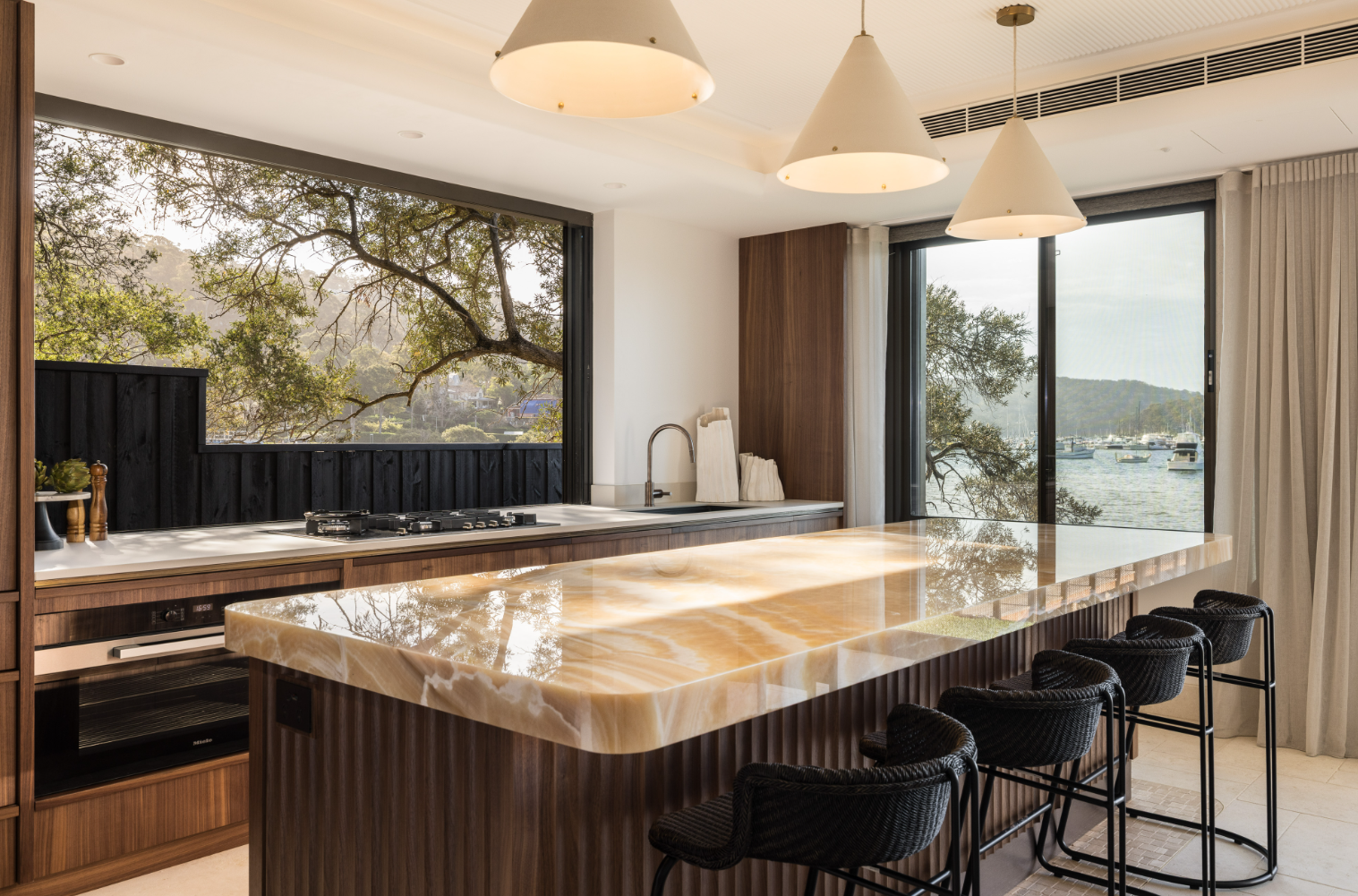
The main living level opens directly to a north-facing terrace and waterfront lawn, while the kitchen centres around a substantial island bench with Miele appliances and a butler’s pantry.
The main bedroom has been designed almost as a private suite within the home, with two walk-in wardrobes, two ensuites and its own balcony. Two further bedrooms each have an ensuite, while the waterfront boathouse has been designed as a multipurpose space with its own bathroom, giving it the flexibility to operate as additional accommodation.
Perhaps the most impressive addition sits above it all.
The top floor combines a home office with an outdoor kitchen and rooftop entertaining terrace, complete with a spa and elevated views across Pittwater towards Scotland Island.
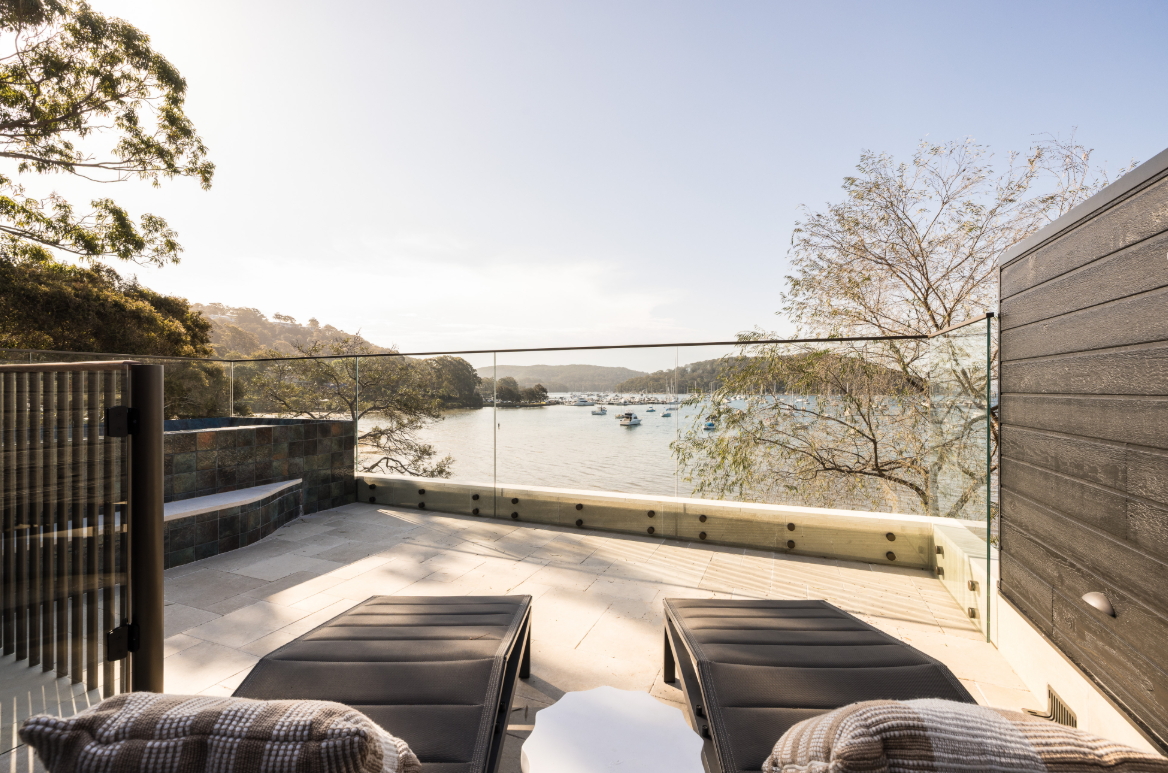
An internal lift connects the home’s levels, while underfloor heating, home automation, solar, ducted air conditioning, an EV charger and an internal-access double garage bring the original Pittwater weekender firmly into the 21st century.
A private slipway preserves perhaps the most important feature for a long-time Pittwater resident and accomplished sailor such as Blackmore: direct access to the water.
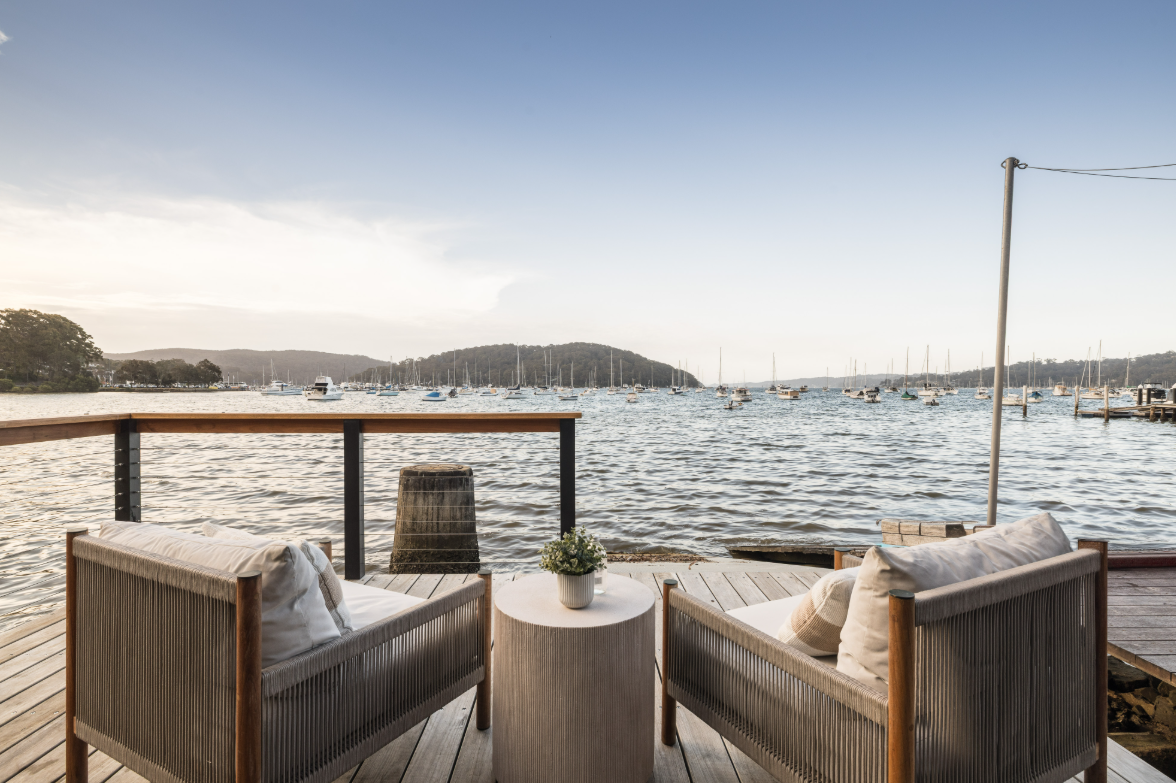
The project represents the latest chapter in a long-running love affair with Pittwater property for Blackmore.
He spent 25 years on Prince Alfred Parade in Newport after buying the deep waterfront property for $1.31 million in 1995. Blackmore and Furlong extensively renovated the Rowan Stewart-designed home over their ownership before selling it in 2020 for $8.125 million.
By then, they had already secured their next Pittwater address.
In 2016, the couple paid $9.25 million for Sandgate, a Queenslander-style waterfront residence further along Pittwater Road in Bayview, bought from USForex co-founder Matthew Gilmour.
The 1,500 sqm holding subsequently underwent a substantial rebuild, with development documents at the time putting the cost of the new home, swimming pool and jetty at around $3.37 million. It became their principal Bayview residence after the Newport sale.
Property of the Week
Property: 1808 Pittwater Road, Bayview, NSW
Owners: Marcus Blackmore and Caroline Furlong
Agent: Phillip Sheh, Black Diamondz
Price: Contact agent
Purchased: $5.7 million, August 2023
Architect: Walter Barda Design
Builder: Touchstone Construction Group
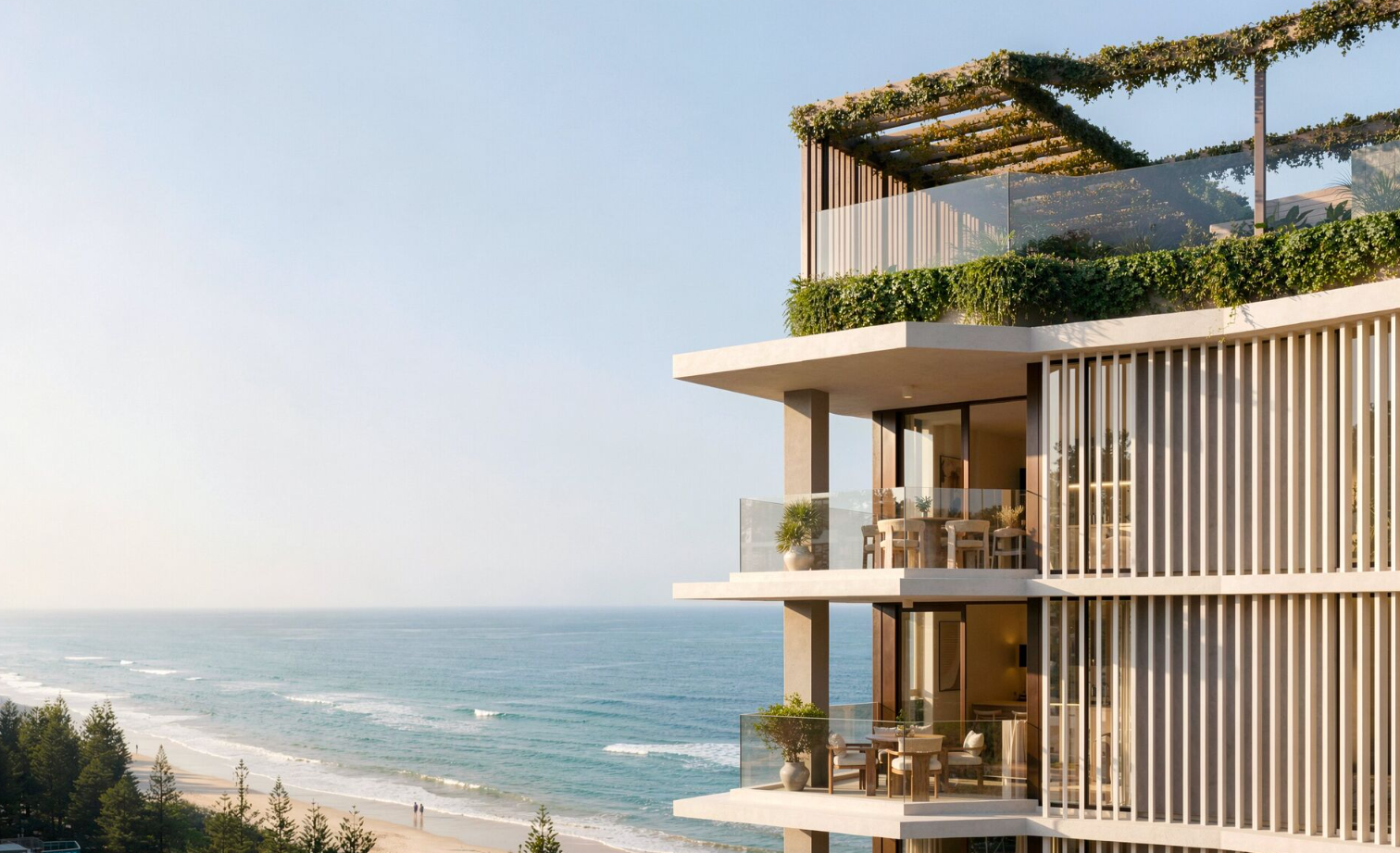
Studio apartments have almost disappeared from new Australian developments. Lura is bringing them back to Burleigh Heads from $495,000.

Australian shares fell on Thursday as Wall Street weakness, rising oil and persistent rate concerns weighed on most of the market. The S&P/ASX 200 declined 0.72 per cent to 8,702. The All Ordinaries lost 0.66 per cent to finish at 8,897. Mining stocks were hit particularly hard, while real estate also dragged on the index. …
Continue reading “ASX falls 0.7 per cent as miners and property stocks retreat”