America Is Trying to Electrify. There Aren’t Enough Electricians.
Climate law is expected to add new demand for car chargers and heat pumps

 4 min
4 min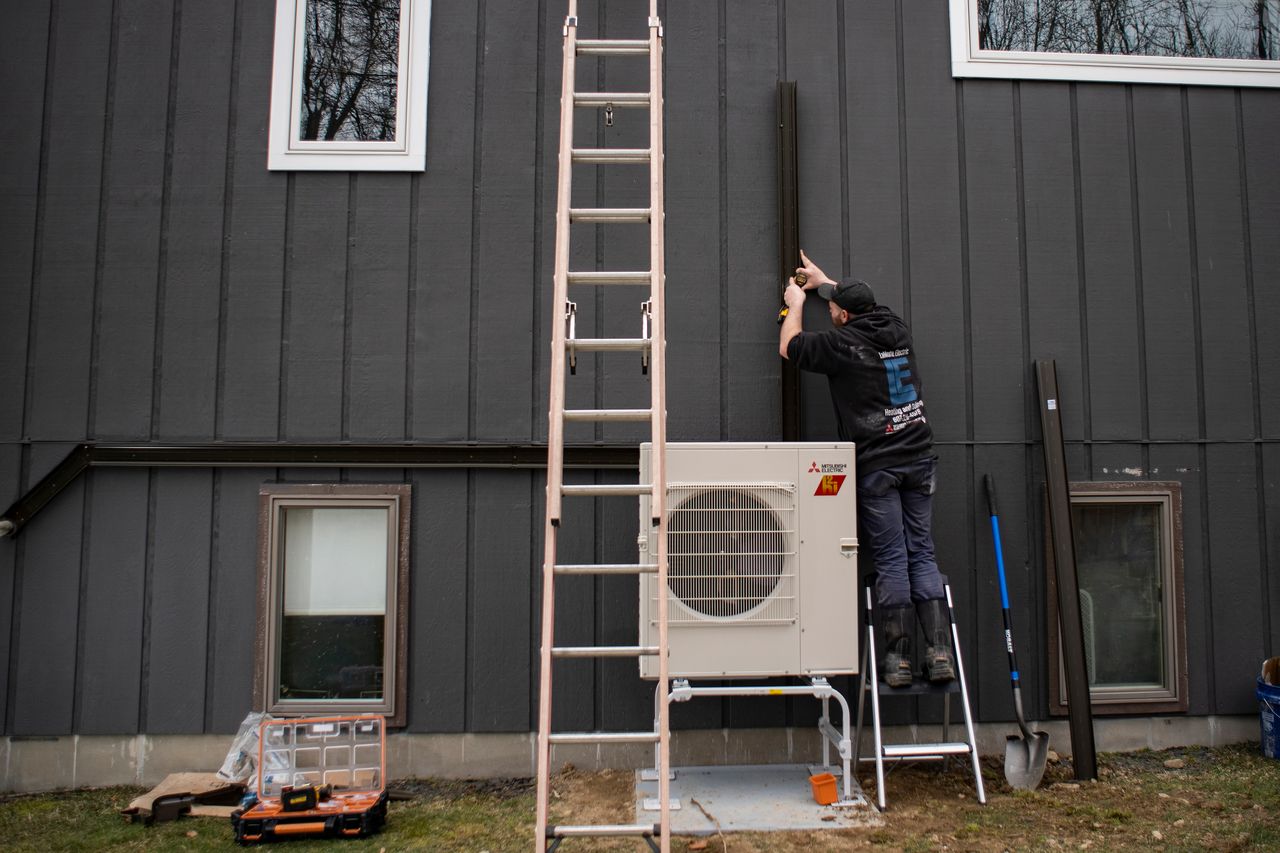
Electricians, the essential workers in the transition to renewable energy, are in increasingly short supply. They are needed to install the electric-car chargers, heat pumps and other gear deemed essential to address climate change.
Electricians say they are booked several months out and struggling to find enough workers to keep up with demand. Many are raising wages and prices and worried that they won’t be able to keep up as government climate incentives kick in.
“I’m tired of telling people I can’t help them,” said Brian LaMorte, co-owner of LaMorte Electric Heating and Cooling in Ithaca, N.Y., which does residential heat-pump installations and electric-service upgrades. His six-person company is booked roughly six months out, so he has been referring potential new customers to other firms in the area.
The 48-year-old brought on two apprentices last year and has seen the price of an average job rise to roughly $20,000 from about $16,000 two years ago due to rising raw materials, equipment and labor prices.
Dan Conant says he worries about getting enough electricians for his West Virginia renewable-energy company Solar Holler. The company started an internship program in partnership with a local high school and expects the state will need several thousand more electricians over the next decade.
“Ultimately, this is the bottleneck,” Mr. Conant said.
The scarcity is part of a nationwide labour shortage and most acute in the Northeast and California, where demand for green-energy products is highest, in part due to state incentives. Some economists expect the pinch to spread across the country as incentives from the new federal law known as the Inflation Reduction Act kick in.
The current total of more than 700,000 electricians in the U.S. is expected to grow about 7% over the next decade, slightly faster than the nationwide average of 5%, according to the Bureau of Labor Statistics. The shift to renewable energy and the need to update electrical systems is expected to drive that growth. Some analysts say that expansion needs to be several times faster for the U.S. to meet its climate and electrification goals.
The BLS includes a separate category of solar photovoltaic installers, some of whom could also be electricians. Growth in that much smaller sector is expected to be above 25%.
Industry analysts say it will be difficult to meet that demand, particularly because more electricians retire every year than are replaced, and many retired during the coronavirus pandemic.
The median age of electricians is over 40 years old, in line with the broader workforce. But nearly 30% of union electricians are between ages 50 and 70 and close to retirement, up from 22% in 2005, according to the National Electrical Contractors Association.
The average annual electrician salary rose from roughly $50,000 to about $60,000 from 2018 to 2022, an increase roughly in line with the national average, according to the BLS.
The climate law will put several hundred billion dollars’ worth of incentives into the economy designed to accelerate the energy transition and boost clean-energy supply chains in the U.S. The law followed an infrastructure spending package and incentives for domestic semiconductor manufacturing that are also expected to spur demand for labour and could end up pushing up total construction costs.
“We’re definitely in a new era of industrial policy,” said Philip Jordan, vice president at BW Research, a firm that studies how policies will impact the economy and workforce. “We’re putting our finger on the scale in a much more aggressive way than we ever have before.”
The impact of these policies differs from that of broad-based stimulus passed under the Trump and then Biden administrations in 2020 and 2021. Those packages raised demand across the board for goods and services. These latest policies are much smaller in total dollars, but also more focused, with their effects falling acutely on certain types of workers and products and in certain regions.
“There’s not enough people to do all this,” said Georgia Republican Gov. Brian Kemp, who argues the programs should have been spread out over a longer period. His state has attracted billions of dollars in investments from companies such as Norwegian firm Freyr Battery and Koch Industries Inc. since the climate law’s passage.
To help address worker shortages, the law ties tax credits for renewable projects to the number of hours worked by apprentices.
Product makers such as Schneider Electric SE are working to make simpler products and drive down installation times. The company has been investing tens of millions of dollars in expanding its product manufacturing in North America and partnering with trade associations on training programs for electricians who install them, said Michael Lotfy, senior vice president of power products.
“We’re really trying to cope with the spike in demand that will happen,” he said.
On a recent week in Ithaca, three of Mr. LaMorte’s employees were installing a heat pump for Matthew Minnig, a 40-year old engineer who lives with his wife in a four-bedroom house. Mr. Minnig hopes to use the heat pump—which moves air between the inside and outside of a home—to replace a natural-gas boiler for heat in the winter and add air conditioning in the summer.
He ordered the units in April, but was told installation would take several months. “There are times I can remember last summer thinking, ‘We’ve already paid a considerable amount for this project, and I’m still sweating in my house,’ ” he said.
Demand for electrical upgrades and heat pumps is likely higher in Ithaca than many cities because of local and state policies and incentives encouraging a shift away from fossil fuels.
Electricians say jobs can be bigger than expected because of the high electricity demands of devices such as car chargers and induction stoves. That often entails upgrading home electric panels to accommodate 100, 200 or 400 amperes, they say.
Jesse Kuhlman, owner of Kuhlman Electrical Services Inc. in Massachusetts, said the company’s South Shore division is booked out to the summer, its longest such backlog in recent years. The company focuses on rewiring old homes and has been doing many more electric-car charger installations lately.
Mr. Kuhlman has tried to grow the company by training apprentices over time. He expects new demand for rewiring homes and electric-panel upgrades to support the business even if the economy slows, a shift from the 2008 financial crisis, when he remembers not having jobs for weeks at a time.
“You can’t just take people off the street and throw them into what we do,” he said.
—Greg Ip contributed to this article.
 Copyright 2020, Dow Jones & Company, Inc. All Rights Reserved Worldwide. LEARN MORE





Porsche’s Cayenne Turbo Electric produces up to 1,156PS and reaches 100km/h in a claimed 2.5 seconds.

BNW Developments has established a Sydney presence, joining Arada and Sobha Realty among the growing number of UAE developers pursuing Australian buyers and development opportunities.

Rising Australian bond yields are putting pressure on listed property and the cost of capital. Here’s why A-REITs can signal changes in property valuations before the direct market moves.
4 min
Most property investors spend considerably more time watching interest rates than bond markets.
That makes sense. The Reserve Bank cash rate has an obvious relationship with mortgage repayments, borrowing capacity and investor sentiment, while government bonds can seem far removed from what someone will pay for an apartment in Sydney or an office building in Melbourne.
But the bond market can provide one of the earliest indications that the price investors are willing to pay for property is changing.
That became evident last Thursday, when Australian shares suffered their worst trading session in months. The S&P/ASX 200 fell almost two per cent, with property among the rate-sensitive sectors caught in the sell-off as government bond yields moved sharply higher.
Australia’s 10-year government bond yield pushed to around 5.4 per cent, close to its highest level in 15 years, against a backdrop of rising global yields and renewed concern about inflation and the direction of interest rates.
For property investors, that matters because the government bond yield is effectively one of the reference prices for money.
An investor buying an Australian government bond is receiving a return while taking comparatively little credit risk. Property comes with tenants, vacancies, maintenance, leasing costs, illiquidity and the possibility that the underlying asset falls in value, so investors generally expect to be compensated for accepting those additional risks.
A property yielding five per cent therefore looks considerably more attractive when a 10-year government bond yields three per cent than when that same bond is yielding more than five per cent.
That does not mean property values automatically fall every time bond yields increase. Rental growth, scarcity, lease structures and the quality of an asset can all outweigh movements in rates, but it changes the return investors require and therefore what they may be prepared to pay.
SG Hiscock & Company made that point in an ASX Investor Update, arguing that real, or inflation-adjusted, bond yields can be particularly relevant to property because real estate is fundamentally a long-duration investment whose value is derived from future income.
The first place investors can often see that repricing is the sharemarket.
A house or commercial building does not have a price that changes every few seconds. An Australian real estate investment trust does.
A-REITs can own billions of dollars of shopping centres, offices, warehouses and other property, but their securities trade continuously on the ASX. When expectations around interest rates and bond yields change, investors can immediately alter what they are willing to pay for those property earnings.
That can create a situation where the value attributed to a portfolio on the sharemarket falls even though the underlying buildings have not changed hands and their independent valuations remain unchanged.
The two markets simply move at different speeds.
Mark Ferguson, Head of Charter Hall Maxim Property Securities, has previously described direct property valuations as lagging the listed market. Writing for Charter Hall during an earlier period of rising interest rates and bond yields, Ferguson noted that listed property was already pricing increases in capitalisation rates and falls in underlying property values before those adjustments had fully emerged in direct-market valuations.
The effect can be substantial.
Consider a commercial property producing $1 million a year in net operating income. At a five per cent capitalisation rate, that income implies a value of $20 million.
If investors subsequently require a 5.5 per cent return while the property’s income remains unchanged, the implied value falls to around $18.18 million. At six per cent, it falls again to roughly $16.67 million.
Nothing necessarily happened to the building. It could have the same tenant paying the same rent under the same lease. What changed was the return required by the person buying it.
That is also why income growth becomes so important.
A well-located property with constrained supply and strong rental growth can increase its earnings quickly enough to absorb some of the pressure from higher required returns. An ageing office building facing vacancies, refurbishment costs and an approaching debt refinancing could instead be hit from several directions at once.
Debt adds another dimension because property is one of the economy’s most capital-intensive asset classes.
Higher market rates can increase the cost of financing an acquisition or refinancing existing debt while simultaneously increasing the return investors expect from the property itself. For developers, the consequences can be even more pronounced because higher construction finance costs can coincide with lower anticipated end values.
If that happens, a project can be squeezed from both directions: it becomes more expensive to deliver at precisely the time investors become less willing to pay yesterday’s price for the finished asset.
The direct property market generally takes longer to reveal that adjustment.
An A-REIT can lose five per cent of its market value in a trading session. An office building may not transact for another year. Owners can reject lower offers, transactions can be withdrawn and valuers must wait for comparable sales to establish new evidence.
That lag is one reason listed property can be useful even for investors who have no intention of buying a REIT.
The same principle eventually extends to residential property, although houses and apartments are generally valued using comparable sales rather than capitalisation rates.
Residential property is particularly sensitive to credit. Higher bond and swap rates can influence bank funding and fixed mortgage pricing, while higher borrowing costs reduce the amount households can service.
If prospective buyers can borrow less, the number of people capable of paying yesterday’s price can shrink. Vendors may initially resist that adjustment, resulting in fewer transactions rather than immediate price falls, before motivated sales eventually establish new comparable values.
For investors, rental growth can provide an important buffer. Rising rents can help offset higher financing costs, just as increasing commercial rents can compensate for some expansion in capitalisation rates. Investors relying primarily on capital growth while accepting a low rental yield have considerably less protection when the cost of money rises.
That is why movements in listed property and bond markets deserve attention beyond the trading floor.
They provide a constantly updating view of how investors are pricing interest rates, debt, future income and property risk, often months before those changes become obvious in direct transactions.
For an A-REIT investor, that means looking at gearing, debt maturity, hedging, interest cover and the discount or premium to net tangible assets rather than simply chasing the highest distribution yield.
For a commercial property investor, it means testing what happens to valuations if capitalisation rates move 25, 50 or 100 basis points higher.
For residential investors, it means understanding mortgage costs, borrowing capacity, realistic rental income and how much of the investment case relies on future capital growth.
The cash rate will continue to attract most of the attention in Australian property. But investors looking for an earlier indication of how the market is repricing risk should also be watching the bond market.
Property prices might take months to respond to a changing financial environment. The price of money moves considerably faster.

French luxury-goods giant’s results are a sign that shoppers weren’t splurging on its collections of high-end garments in the run-up to the holiday season.

For Central Element, the start of work at Pearl represents another step in the company’s growing eastern suburbs pipeline.