INSIDE AUSTRALIA’S MOST EXCLUSIVE REAL ESTATE CLUB
Off-market real estate is the gold standard in luxury, where privacy, prestige and exclusivity come first.
 3 min
3 min
In a world saturated with luxury listings, glossy marketing campaigns and high-profile property sales, there remains a quietly powerful corner of the real estate market—one that thrives on trust, privacy, and exclusivity.
At the centre of this discreet world is Monika Tu, Founder and Director of the Black Diamondz Group, widely recognised for leading the revolution of global buyers into Australia’s ultra-prestige property market.
Tu, whose clients include billionaires, celebrities, and political leaders, operates in a rarefied space where the most desirable homes are never advertised, and deals are often done before the broader market even knows a property is for sale.
Off-market real estate isn’t a niche for her—it’s the gold standard.
“In the ultra-high-net-worth space, discretion is not a luxury — it’s a necessity,” Tu explains. “My clients are often celebrities, global business leaders, and influential investors who value privacy above all else. Off-market deals provide that veil of exclusivity.”
But for Tu, the allure of off-market transactions isn’t just about secrecy — it’s about substance.
A growing appetite for luxury
These clients, she says, aren’t merely buying houses. “They are acquiring legacies, generational wealth, and status symbols — and that level of prestige is rarely found on public portals,” she says,
As Australia’s luxury market tightens amid limited premium stock and global volatility, the appetite for private, bespoke deals is rising.
“In 2025, especially with ongoing market volatility and limited premium stock, off-market opportunities have become even more appealing,” she says. “They offer a sense of control in an otherwise competitive market.”
So how do these deals begin?
“It always starts with trust,” says Tu. “I often say that luxury real estate isn’t just about property — it’s about people. The best off-market transactions begin through curated relationships: long-standing connections, private referrals, and personal introductions.”

Privacy, Exclusivity & Power
The advantages of transacting away from the public eye are threefold, Tu says: “privacy, exclusivity, and negotiating power.”
Privacy, of course, is paramount. “It ensures they can transact without media speculation or market noise — especially important for politically exposed persons or high-profile figures.”
Exclusivity, meanwhile, creates cachet. “They’re accessing real estate most will never know is available — these are trophy assets, often passed quietly between elite hands.”
And for sellers, it’s an elegant way to test the market — discreetly. “Avoiding public listings protects them from over exposure and allows them to test the market without commitment,” she says.
“It also creates a sense of prestige. Some of our most successful sales have been whisper listings — sold to the right buyer, at the right time, for the right price.”
Although identities remain confidential, one such sale involved a waterfront estate in Sydney’s Eastern suburbs valued at more than $60 million.
“The property had never been formally listed — it belonged to an ultra-private family who only wanted it shown to a ‘handpicked few.
“The buyer was an international billionaire relocating to Australia under the Significant Investor Visa program,” Tu says.
The deal, Tu recalls, was incredibly complex. “We negotiated over midnight calls, coordinated legal teams across three time zones, and even sourced a bespoke designer to help the buyer envision the home’s potential. We had it sold — quietly and cleanly — within three weeks.”
The Invisible Market
Tu says the off-market trend has only gained momentum in recent years. “In 2024 and 2025, we’ve seen record levels of wealth transfer, tighter stock levels at the top end of the market, and an increased appetite from overseas buyers — particularly from Asia and the Middle East — who want access to Australia’s safest, most prestigious homes.”
But there’s also a cultural shift driving this appetite for discretion. “The rise of social media, digital surveillance, and a 24/7 news cycle has made UHNWIs more protective of their privacy than ever,” Tu says. “Off-market is no longer niche — it’s the gold standard for how the elite transact.”
So what advice does she give those considering a step into this rarefied world?
“My number one piece of advice: choose your agent carefully,” Tu says. “Off-market success doesn’t come from slick marketing — it comes from relationships, insight, and discretion.”
“For buyers, be clear on what you want, be patient, and align yourself with someone truly embedded in the luxury space. This is not the world of open inspections and price reductions — it’s about timing and precision.”
And for sellers? “Understand that pricing power is maintained through exclusivity. Don’t feel pressured to go public unless it’s strategic. With the right network, your buyer is already out there — and they’ll pay a premium for privacy.”

Australian shares fell on Thursday as Wall Street weakness, rising oil and persistent rate concerns weighed on most of the market. The S&P/ASX 200 declined 0.72 per cent to 8,702. The All Ordinaries lost 0.66 per cent to finish at 8,897. Mining stocks were hit particularly hard, while real estate also dragged on the index. …
Continue reading “ASX falls 0.7 per cent as miners and property stocks retreat”

Borrowers cannot control the Reserve Bank, but they can control how exposed their household budget is to its next decision. The RBA meets on 29 September with inflation concerns still elevated and major-bank economists increasingly bringing forward their rate-rise calls. Fixed mortgage rates have also been moving, reducing the value of waiting for perfect certainty. …
Continue reading “What mortgage holders should do before the next RBA decision”

A five-bedroom Palo Alto home designed by Steven Ehrlich is listed for $44 million, making it the city’s most expensive listing. Built around a dramatic concrete spine, the home features four courtyards and a pool.
3 min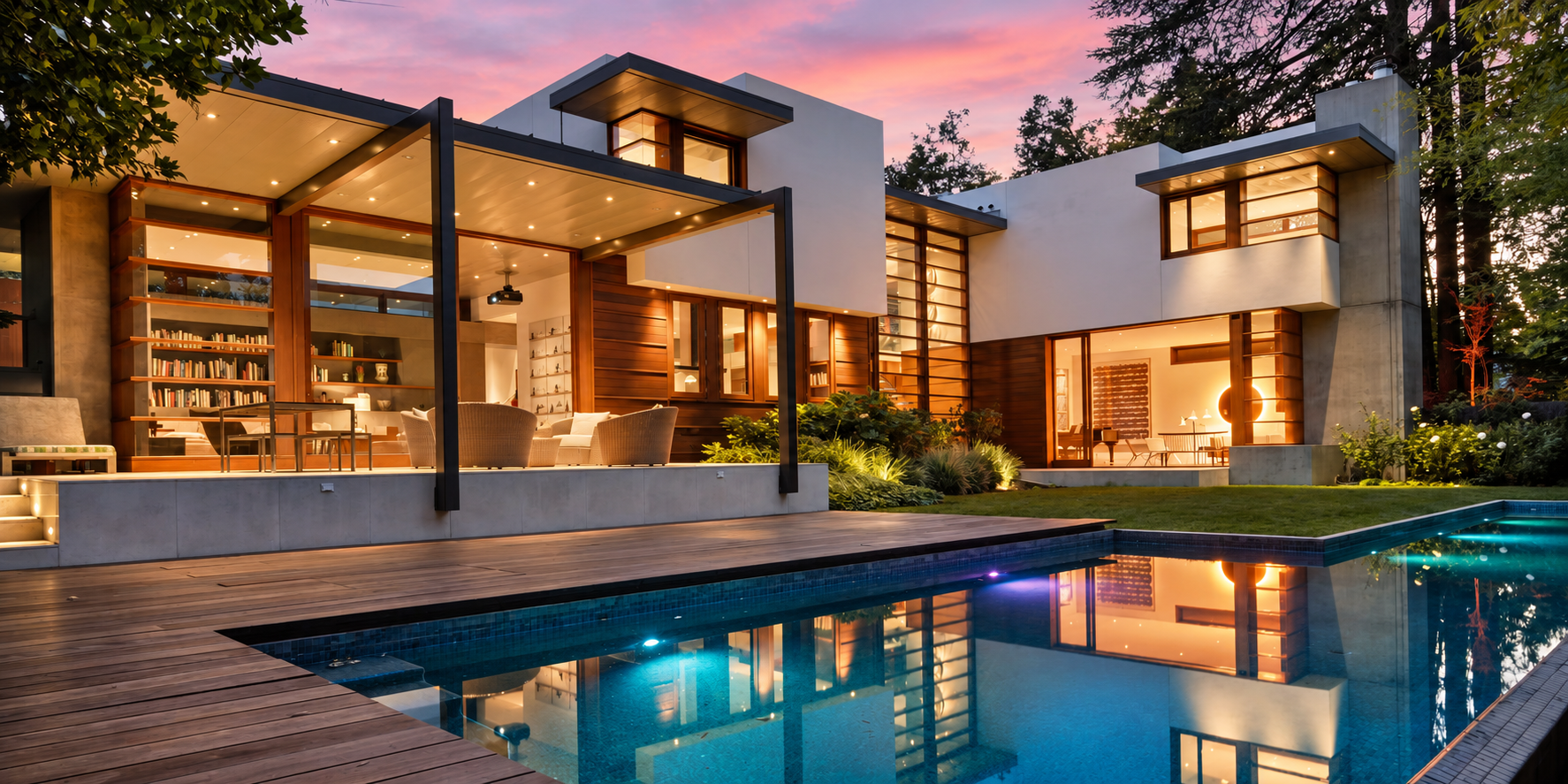
For years, tech entrepreneur Asher Waldfogel and his wife, Helyn MacLean, dreamed of building a modern house in Palo Alto, Calif.
The couple, however, worried about clashing with the Mediterranean-style architecture typically associated with their neighborhood of Old Palo Alto.
So they tapped architect Steven Ehrlich to create a design that paid homage to its surroundings with stucco, mahogany and titanium zinc cladding. They spent $20 million over several years building the house, completed in 2005.
Now looking to be closer to their adult daughter on the East Coast, they are putting the five-bedroom home on the market for $44 million—the most expensive listing in Palo Alto.
Waldfogel is an angel investor who co-founded Redback Networks, a telecommunications-equipment company. MacLean previously had a career in fundraising.
The couple purchased the roughly 0.4-acre site for $7.1 million in 2000 and demolished a circa-1930s Spanish Colonial home. The house they built pinwheels around a central staircase. It has 7,900 square feet of livable space, with four distinct courtyards and a pool.
A key feature of the home is a cast-in-place concrete wall, or spine, that is two stories high and about 80 feet long. “There’s a little bit of controlled chaos in what comes out of the form,” unlike a perfectly uniform surface, Waldfogel said. “If you want that, you do it in plastic.”
Waldfogel said he and his wife are thinking about the next phase of life now that their daughter is grown, although they have not decided where they will move. They also have a home in Sun Valley, Idaho.
“Right now we’re just trying to emotionally let go and decide what to do next,” he said.
Palo Alto, an epicenter of venture capital and tech startups in Silicon Valley, is home to some of the country’s biggest tech titans. Sales volume and prices are rising, with a median sale price of $3.5 million for the three months ending in August, up 5.8% year-over-year, according to real-estate brokerage Redfin.
Arthur Sharif of Sotheby’s International Realty—San Francisco Brokerage has the listing.

The Perpetual Padellone draws its name from the coveted reference 8171 while introducing an instantaneous complete annual calendar to Rolex’s modern Perpetual collection.

A long-standing cultural cruise and a new expedition-style offering will soon operate side by side in French Polynesia.