New Grads Have No Idea How to Behave in the Office. Help Is on the Way.
As the Class of 2023 enters the workforce, employers are seeing a lack of the skills necessary to navigate the office. The solution: instruction on how to send an email, the right way to buttonhole the boss and what not to wear.

 5 min
5 min
Recent graduates might be great at accounting or coding, but they need a little help when it comes to dinner parties and dress codes.
Many members of the class of 2023 were freshmen in college in the spring of 2020, when campuses shuttered due to the Covid-19 pandemic. They spent the rest of their college years partially in virtual mode with hybrid internships and virtual classes. Students didn’t learn some of the so-called soft skills they might have in the past by osmosis on the job, from mentors and by practicing on campus.
To address deficiencies in everything from elevator chitchat to presentation skills, companies, universities and recruiters are coming up with ways to train new hires and give them clear advice. They are eating it up.
Recent graduate Joslynn Odom had her first hybrid internship after her junior year and found working in person to be draining thanks to wearing professional attire and staying energetic consistently. It made her realise that she needed to sharpen her communication and networking skills.
Programming arranged by her college, Miami University in Ohio, has since helped. Just before graduation she attended an etiquette dinner where she learned to follow the lead of more senior leaders over dinner: Eat at their pace, discuss neutral topics and avoid personal questions. When buttering bread, it is best to put a slab on one’s own bread plate before applying it to a roll, and when cutting food, holding the fork hump-side up is best, she said.
“Knowing that, I feel more confident,” she said.
William Lopez-Gudiel, 23 years old, interned last year for Warner Bros. Discovery and found a presentation on office dynamics especially helpful. It covered dress codes, navigating interpersonal relationships and what working in person is like, he said.
The company said it has offered similar guidance in the past. Some of it felt like common sense to Lopez-Gudiel, who graduated in December from George Mason University and is a self-described extrovert.
But Lopez-Gudiel ultimately appreciated the information, realising that the pandemic may have limited what soft skills he might have learned at past work experiences. He will be working at the company full time as a software developer.
Many soon-to-be graduates are itching to get rid of Zoom and work face-to-face with co-workers where their interpersonal skills will be quickly tested. In an April survey of about 700 Class of 2023 graduates from the virtual student-health company TimelyCare, 53% said they wanted a fully in-person work environment, while 21% said they wanted to be fully remote.
Graduates’ disrupted college experience might mean they struggle with the basics reading colleagues’ cues or navigating a meeting, said Heidi Brooks, a senior lecturer in organizational behavior at Yale University’s School of Management. In class, when students didn’t have cameras on, that was harder to determine.
New hires will need to learn “those nuances of, how do you actually create enough connection, visibility, ability to manoeuvre,” she said.
The missing piece for young professionals who have graduated since 2020, in fact, has been no real proximity to mentorship and leadership, recruiters say.
“This is so much more important today,” said Sandy Torchia, vice chair of talent and culture at KPMG, whose full-time hires this summer and fall will go to the firm’s training facility in Florida where they’ll get new presentation training.
They’ll practice scenarios involving conflict within teams, plus the basics of talking in person—as simple as how to introduce yourself to a client or colleague. Key tips include maintaining eye contact, taking pauses and avoiding jargon. It is also best to listen carefully to others, and to adjust your introduction to highlight pieces of your background that will be most interesting to them.
The company has found that some young professionals are stiff, talk too fast, or rely too much on filler words like “um,” as they presented. Some of the employees said they wanted to feel more comfortable, too.
Allan Rubio, 21 years old was a freshman at Dartmouth College in the spring of 2020. Online classes continued all through his sophomore year, which Rubio completed from his family’s home in Bangkok. Course sessions stretched to 11 p.m. or sometimes 2 a.m. local time, he said.
Professors were far more flexible on deadlines during the pandemic, amenable to extensions if students asked, he said. When Rubio had an in-person internship last summer, he realised his manager, team or client depended on him meeting deadlines.
Presentation skills are also something Rubio needs to learn better, he said. He had presented virtually in academic classes, and often kept a few thoughts and scripted language in a Notes file on screen—or on a separate device nearby. Once on a video call, he said, he blamed an internet delay while he stopped talking mid sentence and collected his thoughts.
None of those aids could help him through presenting in-person on stage at a hackathon on campus. It was more difficult than he expected, he said.
Since then Rubio, who graduated this month, has rehearsed extensively before live presentations. He lays out key points and slims a longer script into bullet points before memorising key areas.
Though new hires are digital natives, today’s graduates’ professional email skills need improvement, said Jialan Wang, an assistant professor of finance at the University of Illinois at Urbana-Champaign.
Many won’t acknowledge important messages but will expect a response from professors immediately, even over holidays, she said.
Michigan State University’s business-school career centre has urged companies to be explicit about what students should expect at work, to over-communicate details about how a first day will play out, what to wear and what people typically do for lunch.
The school last year began requiring many business students to take classes on soft skills in the workplace, after observing that students are more awkward and unsure when they network than they used to be, said Marla McGraw, director of career management.
The program goes step by step through an in-person networking conversation. In one handout, the centre instructs students to introduce themselves by their first and last name. “STOP! Let them tell you their name,” it reads.
Later it urges the students to share that they are interested in hearing about opportunities at the company and share that they follow the company closely, are familiar with its products or services or know someone who interned there, among other options.
“STOP! Pause for only a few seconds to see if they offer any questions or input on your above comments. They may ask you for your resume.”
Students should keep an eye out for signs that a person is trying to end a conversation, McGraw added. Someone might begin to gather their things, or look around the room, signalling they need to talk to another person. Often, one can facilitate a smooth exit by saying, “Well, thanks so much. It’s been a pleasure.”
Professional-services firms PricewaterhouseCoopers and Protiviti have had to tell some young workers what types of clothes are appropriate, including for client-site visits.
Many people are dressing less formally, said Scott Redfearn, Protiviti’s executive vice president of global human resources.
Now the company defines what it means by business casual—including slacks, tailored denim, sport jackets, dresses, skirts, collared shirts, blouses, sweaters and professional footwear—and explains why it’s important to maintain a serious professional image. The company also relays that when it is appropriate to wear bluejeans, darker hues without rips are best, he said.
The company has tried to be proactive when it shares broad guidance about attire, but when a worker shows up in athleisure or flip-flops, that is best handled with a one-on-one conversation.
“Working hybrid brings a lot more decisions to the individual employee,” Redfearn said.
During the pandemic, the firm extended its onboarding process to a series of small-group virtual meetings that took place over a full year. One topic includes making conversation as a social skill, he said. It includes an improv-based public-speaking workshop, where in one prompt, participants need to describe themselves in three words quickly, going with their first impulse. The company said the sessions help workers to find their authentic communication styles.
Protiviti hosts social gatherings around in-person meetings so that workers can practice.
Redfearn said he gives a pep talk to new graduates, urging them to introduce themselves around the office, stick their hand out and smile. Another tip: Have a prepared question ready to ask if needed.
—Ray A. Smith contributed to this article.
 Copyright 2020, Dow Jones & Company, Inc. All Rights Reserved Worldwide. LEARN MORE





From making unpopular decisions to learning when to listen, leaders from five businesses reveal what nobody prepared them for — and how running a company has challenged their expectations.

Technology and semiconductor shares fell sharply as investors questioned the debt financing the AI infrastructure boom and confronted higher rates and Chinese competition.

Elon Musk is exploring a potential merger between Tesla and SpaceX, a deal that could reshape the future of AI, robotics, autonomous vehicles and space technology. With a combined valuation potentially reaching $3.5 trillion, the move could bring Musk’s vision of an interconnected technology ecosystem closer to reality, although a deal remains uncertain.
5 min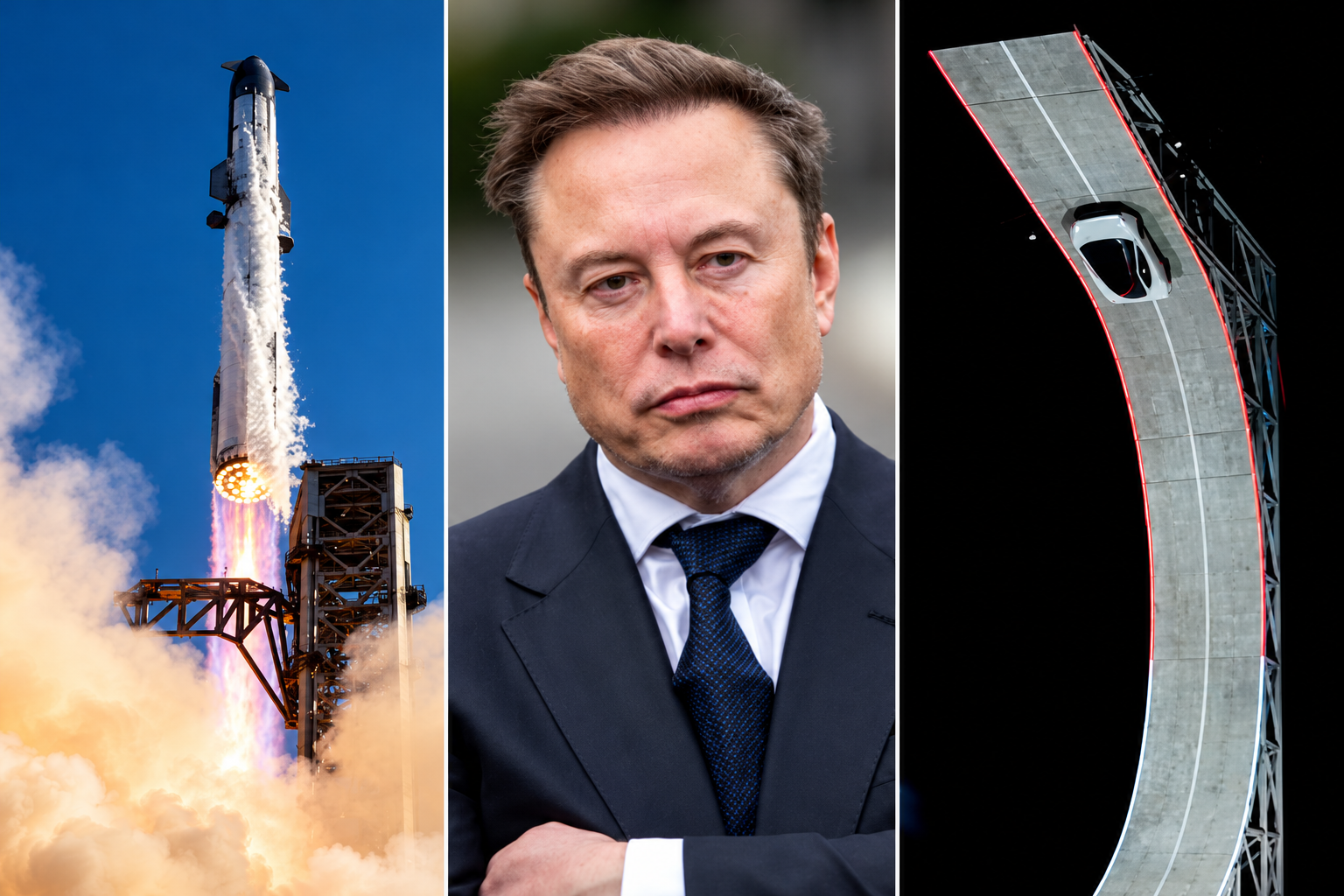
Elon Musk has engineered ties between Tesla TSLA 3.41%increase; up pointing triangle and SpaceX SPCX 7.79%increase; up pointing triangle that are hard to break, and now he wants to fuse them together permanently.
Musk has run both Tesla and SpaceX concurrently over the past two decades, using a schedule that dictated which days he spent focused on each business.
The companies have often shared resources and personnel, signaling their close ties. Last year, SpaceX looked into creating a spacesuit for Tesla’s humanoid robot Optimus, a person familiar with the matter said. Tesla last week showed off its new Roadster, a vehicle featuring SpaceX rocket thrusters that it hopes to soon bring to market.
And in recent months, Musk has repositioned both companies by expanding beyond their core operations toward a shared mission centered on artificial intelligence.
The world’s richest man on Tuesday signaled his interest in tying up SpaceX and Tesla, marking what would be the biggest corporate merger of all time. Because he serves as chief executive of SpaceX and Tesla, Musk said committees of independent directors at both companies are evaluating a possible deal, adding that a transaction might not come to fruition.
The committees will likely evaluate, with lawyers and bankers, how each company would fare in a potential deal and how a deal might best be structured. They then present their conclusions to their respective boards, who typically vote on whether to proceed.
“It’s an odd Kabuki dance where two groups of people are talking and I can’t be in the conversation,” Musk told SpaceX investors on Tuesday in response to an analyst’s question about a potential deal.
For Musk, the merger supports his vision of a world full of autonomous cars, humanoid robots and weekly rocket launches, as well as the data centers and satellites required to keep the whole thing running.
Some investors and analysts said they expect a transaction would be structured as an all-stock deal, with SpaceX potentially paying a modest premium for Tesla shares.
SpaceX, which has a market value of about $2 trillion, said it is seeing sharp growth in revenue across its businesses, which include operating data centers, launching rockets and operating satellite networks such as the internet service Starlink. Tesla is valued at about $1.5 trillion and is expanding its operations beyond its automotive and energy business. Shares in both companies traded higher following the news Tuesday.
Musk’s substantial ownership stakes in both companies, along with voting control at SpaceX, has enabled him to set the deal in motion. Analysts and investors said the deal will probably face regulatory scrutiny internationally, though some see Musk’s close relationship with the Trump administration as an asset to getting approval.
Blurred lines
The companies haven’t said which directors are on the special committees evaluating a potential deal. Several SpaceX and Tesla board members have either personal or business ties to Musk. And like Musk, venture capitalist Ira Ehrenpreis sits on both boards.
In a filing this week, Tesla outlined millions of dollars in business agreements with SpaceX and its subsidiaries last year, including $143 million in car sales to SpaceX, $3.3 million in advertising that it bought on the social-media platform X and $430 million in revenue from the sale of Megapack batteries for SpaceX’s data centers.
The companies also split the cost of resources including the use of Musk’s SpaceX jet and the bill for his personal security, which he runs through a private company.
Employees at both companies routinely move between companies to work on special projects, and some executives have dual roles, including Charles Kuehmann, vice president of materials engineering at both SpaceX and Tesla, and Ashok Elluswamy, the vice president of AI software at Tesla who runs a joint venture with SpaceX called Digital Optimus.
Over the years, Musk has launched new startups within his empire, including brain-implant company Neuralink, underground-tunnel developer the Boring Company and xAI, the AI startup that merged with SpaceX in February.
It is that AI business that Musk thinks can serve a market worth tens of trillions of dollars, justifying the need for a merger.
The business case goes like this: Tesla is developing robotaxis and robots, which it calls “physical AI.” SpaceX is working on the back end of physical AI: the data-center capacity and internet connection required for those robotaxis and robots to operate continuously.
“I don’t see what the value of Tesla is if it’s not merged with SpaceX,” said investment adviser Ross Gerber, a former Tesla bull turned critic invested in both companies. “If they don’t merge, the brains of everything that runs Tesla is owned by another company.”
On top of it all, both companies face constraints on the supply chains they need to make this world a reality, particularly when it comes to chips. To address this, Musk earlier this year announced a joint venture between Tesla, SpaceX and Intel to design and manufacture chips in Texas. “The most epic chip-building exercise by far,” he has said.
Musk at the wheel
For Musk, a merger would also solve two problems: demands on his attention and his lack of control at Tesla.
Tesla for years was Musk’s only public company, a status that came with greater scrutiny. There, Musk reports to a public board, as well as individual investors who make up around 30% of Tesla’s voting power, according to FactSet.
The question of Musk’s attention became a particular focus for investors and the board in recent years after he acquired Twitter in 2022 and launched xAI in 2023, and again in 2025 as he spent time in Washington, D.C., running the Department of Government Efficiency in the early months of President Trump’s second term.
As Tesla’s car business suffered in 2025, Musk threatened to take his AI ambitions outside the company if he wasn’t granted 25% voting control. Last November, Tesla shareholders approved a new pay package for Musk, which created a path for him to vastly expand his stake.
As of Sept. 30, Musk owned a roughly 20% stake in Tesla, according to the company’s proxy filing.
The SpaceX IPO gave Musk a different path. When SpaceX went public in June, the deal’s structure enabled him to have more than 80% voting power at the company—so much that he can’t be fired and decisions can’t be made without his support.
If SpaceX acquires Tesla, he will likely stay in control.

From snow-dusted valleys to festival-filled autumns, Bhutan reveals itself as a rare destination where culture, nature and spirituality unfold year-round.

From warmer neutrals to tactile finishes, Australian homes are moving away from stark minimalism and towards spaces that feel more human.