You remember the 1999 movie “The Talented Mr. Ripley,” from the Patricia Highsmith novel. It was fabulous—mysteries, murders, a sociopath scheming his way among high-class expats on the Italian Riviera. The laid-back glamour of Jude Law, the Grace Kelly-ness of Gwyneth Paltrow, who looks like a Vogue magazine cover decided to take a stroll through the streets of 1950s Venice, the truly brilliant acting of Matt Damon, who is so well-liked by audiences I’m not sure we notice anymore what a great actor he is. The director, Anthony Minghella, deliberately showed you pretty shiny things while taking you on a journey to a heart of darkness.
There’s a new version, a streaming series from Netflix, called “Ripley.” I turned to it eagerly and watched with puzzlement. It is unrelievedly ugly. Grimy, gloomy, grim. Tom Ripley is now charmless, a pale and watchful slug slithering through ancient rooms. He isn’t bright, eager, endearing, only predatory. No one would want to know him! Which makes the story make no sense. Again, Ripley is a sociopath, but few could tell because he seemed so sweet and easy. In the original movie, Philip Seymour Hoffman has an unforgettable turn as a jazz-loving, prep-schooled, in-crowd snob. In this version that character is mirthless, genderless, hidden. No one would want to know him either. Marge, the Paltrow role in the movie, is ponderous and plain, like a lost 1970s hippie, which undercuts a small part of the tragedy: Why is the lovely woman so in love with a careless idler who loves no one?
The ugliness seemed a deliberate artistic decision, as did the air of constant menace, as if we all know life is never nice.
I go to the No. 1 program on Netflix this week, “Baby Reindeer.” People speak highly of it. It’s about a stalker and is based on a true story, but she’s stalking a comic so this might be fun. Oh dear, no. It is again unrelievedly bleak. Life is low, plain and homely. No one is ever nice or kind; all human conversation is opaque and halting; work colleagues are cruel and loud. Everyone is emotionally incapable and dumb. No one laughs except for the morbidly obese stalker, who cackles madly. The only attractive person is the transgender girlfriend, who has a pretty smile and smiles a lot, but cries a lot too and is vengeful.
Good drama always makes you think. I thought: Do I want to continue living?
I go to the Daily Mail website, once my guilty pleasure. High jinks of the rich and famous, randy royals, fast cars and movie stars, models and rock stars caught in the drug bust. It was great! But it seems to have taken a turn and is more about crime, grime, human sadness and degradation—child abuse, mothers drowning their babies, “Man murders family, self.” It is less a portal into life’s mindless, undeserved beauty, than a testimony to its horrors.
I go to the new “Cabaret.” Who doesn’t love “Cabaret”? It is dark, witty, painful, glamorous. The music and lyrics have stood the test of time. The story’s backdrop: The soft decadence of Weimar is being replaced by the hard decadence of Nazism.
It is Kander and Ebb’s masterpiece, revived again and again. And this revival is hideous. It is ugly, bizarre, inartistic, fundamentally stupid. Also obscene but in a purposeless way, without meaning.
I had the distinct feeling the producers take their audience to be distracted dopamine addicts with fractured attention spans and no ability to follow a story. They also seemed to have no faith in the story itself, so they went with endless pyrotechnics. This is “Cabaret” for the empty-headed. Everyone screams. The songs are slowed, because you might need a moment to take it in. Almost everyone on stage is weirdly hunched, like a gargoyle, everyone overacts, and all of it is without art.
On the way in, staffers put stickers on the cameras of your phone, “to protect our intellectual property,” as one said.
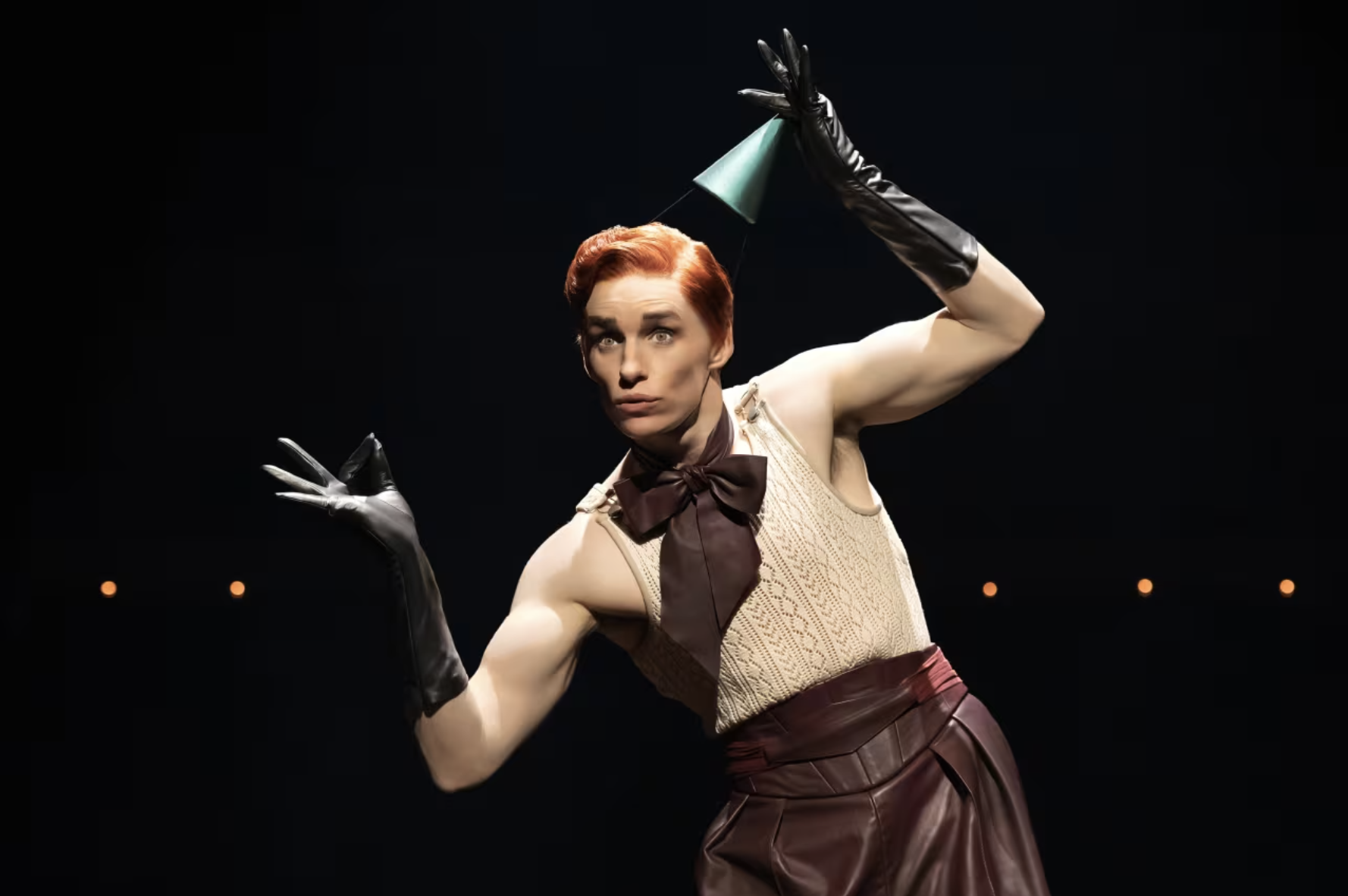
It isn’t an easy job to make the widely admired Eddie Redmayne unappealing, but by God they did it. As he’s a producer I guess he did it, too. He takes the stage as the Emcee in a purple leather skirt with a small green cone on his head and appears further on as a clown with a machine gun and a weird goth devil. It is all so childish, so plonkingly empty.
Here is something sad about modern artists: They are held back by a lack of limits.
Bob Fosse, the director of the classic 1972 movie version, got to push against society’s limits and Broadway’s and Hollywood’s prohibitions. He pushed hard against what was pushing him, which caused friction; in the heat of that came art. Directors and writers now have nothing to push against because there are no rules or cultural prohibitions, so there’s no friction, everything is left cold, and the art turns in on itself and becomes merely weird.
Fosse famously loved women. No one loves women in this show. When we meet Sally Bowles, in the kind of dress a little girl might put on a doll, with heavy leather boots and harsh, garish makeup, the character doesn’t flirt, doesn’t seduce or charm. She barks and screams, angrily.
Really it is harrowing. At one point Mr. Redmayne dances with a toilet plunger, and a loaf of Italian bread is inserted and removed from his anal cavity. I mentioned this to my friend, who asked if I saw the dancer in the corner masturbating with a copy of what appeared to be “Mein Kampf.”
That’s what I call intellectual property!
In previous iterations the Kit Kat Club was a hypocrisy-free zone, a place of no boundaries, until the bad guys came and it wasn’t. I’m sure the director and producers met in the planning stage and used words like “breakthrough” and “a ‘Cabaret’ for today,” and “we don’t hide the coming cruelty.” But they do hide it by making everything, beginning to end, lifeless and grotesque. No innocence is traduced because no innocence exists.
How could a show be so frantic and outlandish and still be so tedious? It’s almost an achievement.
And for all that there is something smug about it, as if they’re looking down from some great, unearned height.
I left thinking, as I often do now on seeing something made ugly: This is what purgatory is going to be like. And then, no, this is what hell is going to be like—the cackling stalker, the pale sociopath, Eddie Redmayne dancing with a plunger.
Why does it all bother me?
Because even though it isn’t new, uglification is rising and spreading as an artistic attitude, and it can’t be good for us. Because it speaks of self-hatred, and a society that hates itself, and hates life, won’t last. Because it gives those who are young nothing to love and feel soft about. Because we need beauty to keep our morale up.
Because life isn’t merde, in spite of what our entertainment geniuses say.
 Copyright 2020, Dow Jones & Company, Inc. All Rights Reserved Worldwide.