Tougher Return-to-Office Policies Are No Remedy for Half-Empty Buildings
Office owners are struggling with near record-high vacancy rates

 3 min
3 min
First, the good news for office landlords: A post-Labor Day bump nudged return-to-office rates in mid-September to their highest level since the onset of the pandemic.
Now the bad: Office attendance in big cities is still barely half of what it was in 2019, and company get-tough measures are proving largely ineffective at boosting that rate much higher.
Indeed, a number of forces—from the prospect of more Covid-19 cases in the fall to a weakening economy—could push the return rate into reverse, property owners and city officials say.
More than before, chief executives at blue-chip companies are stepping up efforts to fill their workspace. Facebook parent Meta Platforms, Amazon and JPMorgan Chase are among the companies that have recently vowed to get tougher on employees who don’t show up. In August, Meta told employees they could face disciplinary action if they regularly violate new workplace rules.
But these actions haven’t yet moved the national return rate needle much, and a majority of companies remain content to allow employees to work at least part-time remotely despite the tough talk.
Most employees go into offices during the middle of the week, but floors are sparsely populated on Mondays and Fridays. In Chicago, some September days had a return rate of over 66%. But it was below 30% on Fridays. In New York, it ranges from about 25% to 65%, according to Kastle Systems, which tracks security-card swipes.
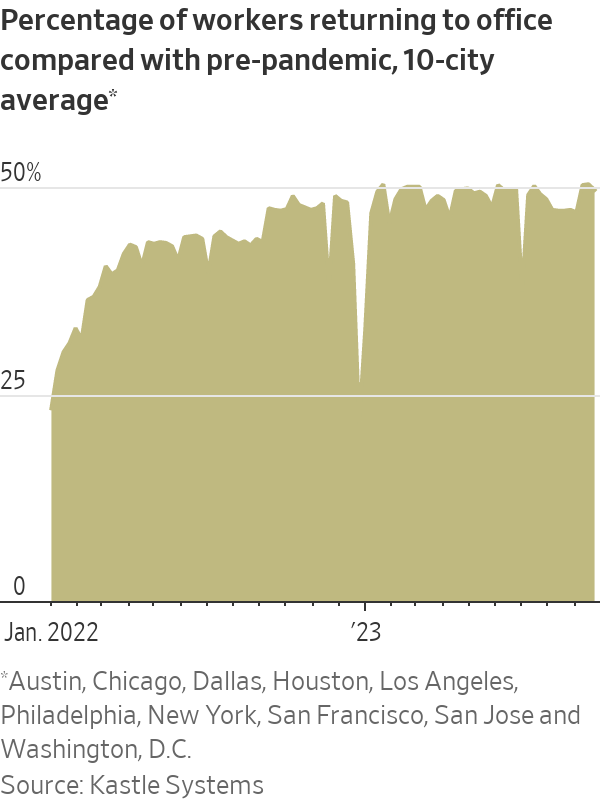
Overall, the average return rate in the 10 U.S. cities tracked by Kastle Systems matched the recent high of 50.4% of 2019 levels for the week ended Sept. 20, though it slid a little below half the following week.
The disappointing return rates are another blow to office owners who are struggling with vacancy rates near record highs. The national office average vacancy rose to 19.2% last quarter, just below the historical peak of 19.3% in 1991, according to Moody’s Analytics preliminary third-quarter data.
Business leaders in New York, Detroit, Seattle, Atlanta and Houston interviewed by The Wall Street Journal said they have seen only slight improvements in sidewalk activity and attendance in office buildings since Labor Day.
“It feels a little fuller but at the margins,” said Sandy Baruah, chief executive of the Detroit Regional Chamber, a business group.
Lax enforcement of return-to-office rules is one reason employees feel they can still work from home. At a roundtable business discussion in Houston last week, only one of the 12 companies that attended said it would enforce a return-to-office policy in performance reviews.
“It was clearly a minority opinion that the others shook their heads at,” said Kris Larson, chief executive of Central Houston Inc., a group that promotes business in the city and sponsored the meeting.
Making matters worse, business leaders and city officials say they see more forces at work that could slow the return to office than those that could accelerate it.
Covid-19 cases are up and will likely increase further in the fall and winter months. “If we have to go back to distancing and mask protocols, that really breaks the office culture,” said Kathryn Wylde, head of the business group Partnership for New York City.
Many cities are contending with an increase in homelessness and crime. San Francisco, Philadelphia and Washington, D.C., which are struggling with these problems, are among the lowest return-to-office cities in the Kastle System index.
About 90% of members surveyed by the Seattle Metropolitan Chamber of Commerce said that the city couldn’t recover until homelessness and public safety problems were addressed, said Rachel Smith, chief executive. That is taken into account as companies make decisions about returning to the office and how much space they need, she added.
Cuts in government services and transportation are also taking a toll. Wait times for buses run by Houston’s Park & Ride system, one of the most widely used commuter services, have increased partly because of labor shortages, according to Larson of Central Houston.
The commute “is the remaining most significant barrier” to improving return to office, Larson said.
Some landlords say that businesses will have more leverage in enforcing return-to-office mandates if the economy weakens. There are already signs of such a shift in cities that depend heavily on the technology sector, which has been seeing slowing growth and layoffs.
But a full-fledged recession could hurt office returns if it results in widespread layoffs. “Maybe you get some relief in more employees coming back,” said Dylan Burzinski, an analyst with real-estate analytics firm Green Street. “But if there are fewer of those employees, it’s still a net negative for office.”
The sluggish return-to-office rate is leading many city and business leaders to ask the federal government for help. A group from the Great Lakes Metro Chambers Coalition recently met with elected officials in Washington, D.C., lobbying for incentives for businesses that make commitments to U.S. downtowns.
Baruah, from the Detroit chamber, was among the group. He said the chances of such legislation being passed were low. “We might have to reach crisis proportions first,” he said. “But we’re trying to lay the groundwork now.”
 Copyright 2020, Dow Jones & Company, Inc. All Rights Reserved Worldwide. LEARN MORE




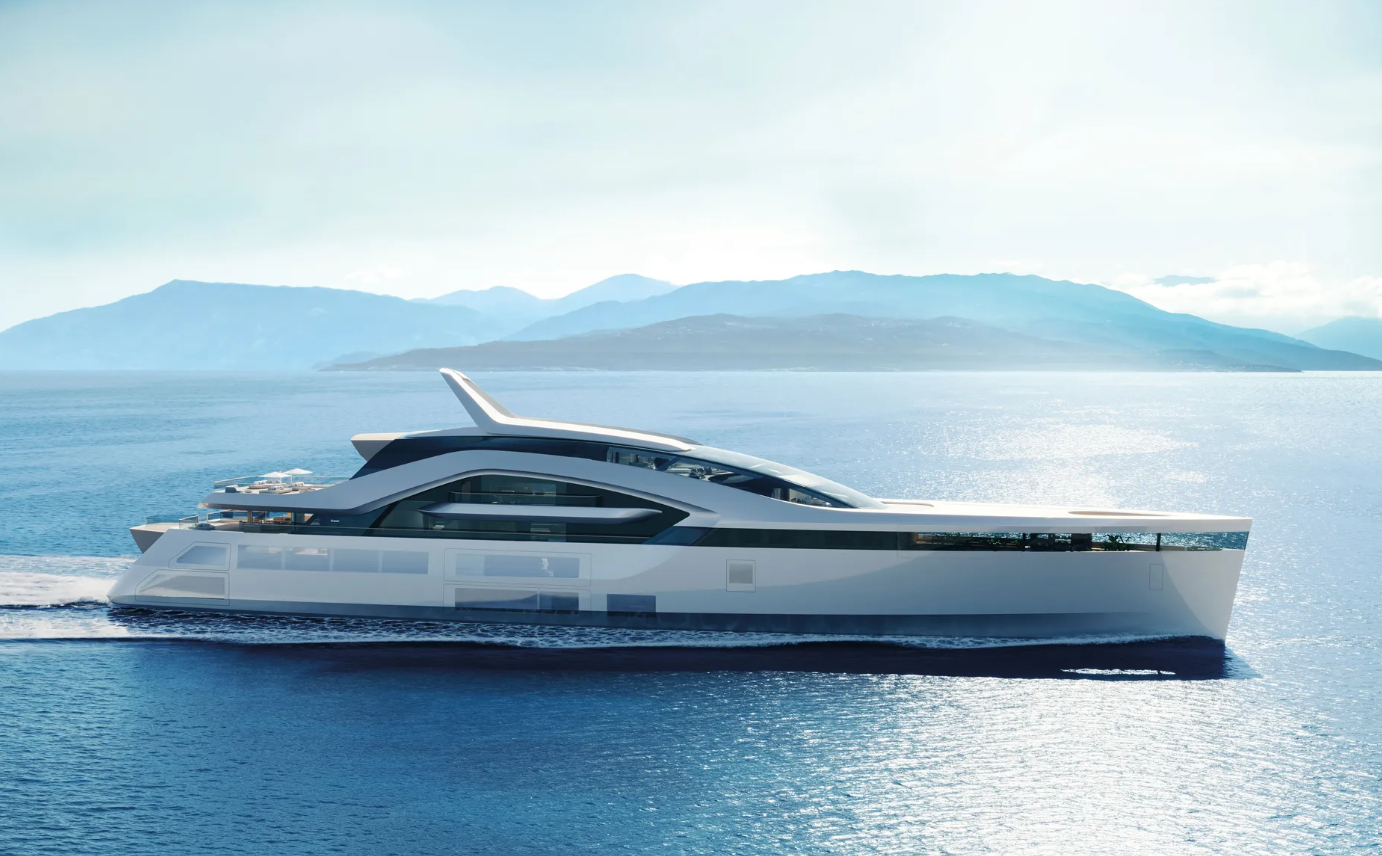
On the owner’s deck, a 20-metre swimming pool incorporates Feadship’s patented ContraWave technology and extends indoors as a suspended, glass-bottomed infinity pool.

Automobili Lamborghini is turning its attention to something considerably more difficult to define: what makes Italian excellence uniquely Italian?

Mirvac’s 45-level Trielle has topped out at Yarra’s Edge, pairing riverfront apartments with wellness facilities, private dining and resident services.
3 min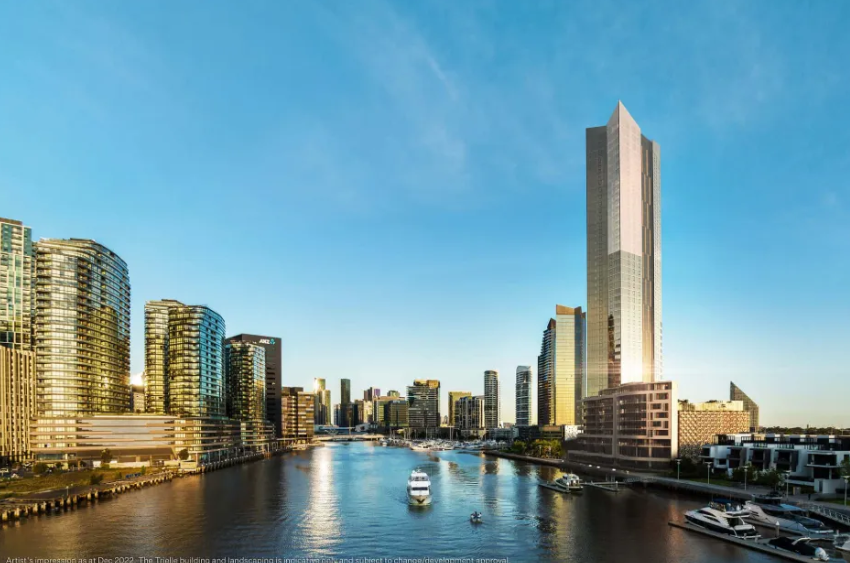
Mirvac has topped out Trielle at Melbourne’s Yarra’s Edge, with more than 70 per cent of the riverfront development sold and approximately 80 per cent of purchasers intending to make their apartment a home.
The figures, released on September 22, point to an owner-occupier audience for one of the precinct’s final residential towers. Mirvac began developing Yarra’s Edge in 2003, and its latest addition occupies one of the remaining absolute riverfront sites.
Mirvac CEO of Development Stuart Penklis said existing residents were among those moving up within the neighbourhood.
“Many purchasers already have a connection to Yarra’s Edge,” Mr Penklis said, describing buyers whose changing needs were encouraging an upgrade within the precinct.
“As one of the final residential towers within Yarra’s Edge, Trielle represents the culmination of more than two decades of creating one of Melbourne’s most established and sought-after waterfront communities,” Penklis said.
“Positioned on the Collins Street axis with absolute river frontage, Trielle offers residents a rare opportunity to enjoy sweeping views across the Yarra River, Melbourne skyline and Port Phillip Bay, while remaining seamlessly connected to the CBD. With Trielle now more than 70 per cent sold, we’re continuing to see strong demand from buyers seeking quality homes in established locations.”
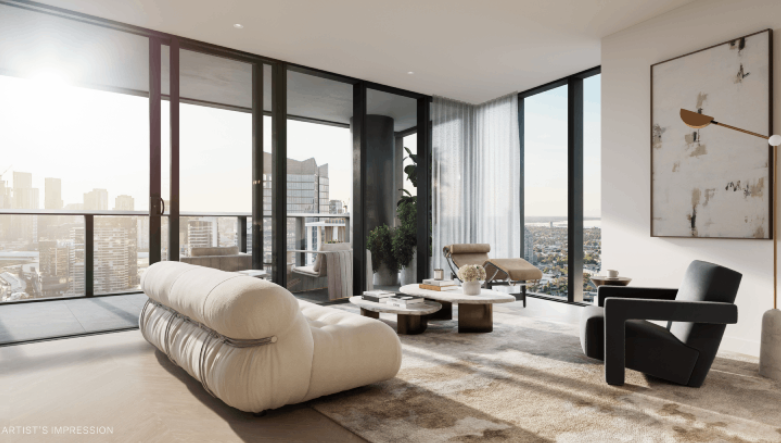
The developer also flagged a penthouse and sub-penthouse collection with larger layouts, premium finishes and broad outlooks. The planned wellness centrepiece, The Oasis, encompasses a 900-square-metre elevated urban rainforest.
Mirvac General Manager Residential Development Victoria Elysa Anderson said Trielle had resonated strongly with buyers seeking a rare lifestyle offering in Melbourne.
“Opportunities to secure a new luxury residence on a riverfront site of this calibre are incredibly rare, particularly within a community like Yarra’s Edge,” Anderson said.
“What makes Trielle unique is the combination of exceptional views, world-class residential facilities and the lifestyle that already exists around it. Residents are buying into a mature waterfront community with parks, promenades, dining, wellness and strong community connections already in place.”
The 45-level tower brings a substantial new presence to that waterfront. Its residential offering spans one-, two-, three- and four-bedroom apartments, with Signature, Prestige and Sub-Penthouse collections accommodating different household sizes. The north-facing position connects the apartments visually to the river and city beyond.
Seven storeys above the promenade, the planned Oasis combines planting and a running stream with a Scandinavian-inspired wellness club developed with spa specialist Naomi Gregory. Facilities include a 25-metre lap pool, hot magnesium pool, sauna, hydrotherapy, a gym, yoga and Pilates room, and treatment spaces.

The amenity extends beyond exercise. Residents will have access to The Biblioteca library and workspaces, ground-floor work pods, and The Salone piano lounge. A private Chef’s Table dining room offers a setting for larger gatherings, while a cinema, games room and sports lounge broaden the entertaining options. Concierge services and a dog-wash area support everyday routines.
Trielle comprises a collection of one, two, three and four-bedroom residences. Reflecting strong demand from owner occupiers, approximately 80 per cent of purchasers to date intend to live in their homes, highlighting the project’s appeal to those seeking a long-term waterfront lifestyle.
Mirvac has recently delivered The Albertine, a premium apartment development on the edge of Melbourne’s CBD, and is nearing completion of Prince & Parade in Brunswick, further strengthening its portfolio of thoughtfully designed apartment communities in some of Melbourne’s most sought-after urban locations.
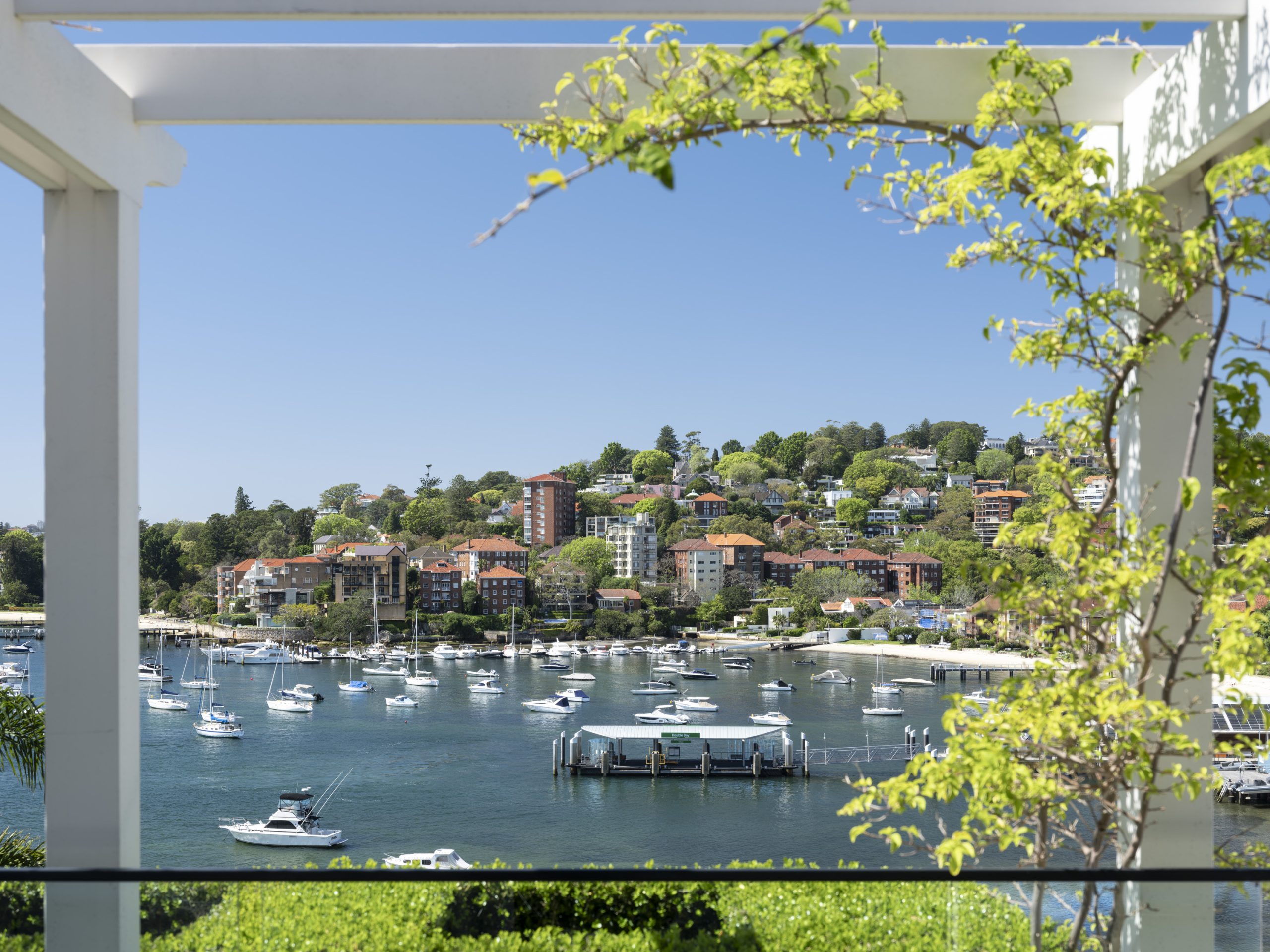
The grand harbourside residence combines sweeping Sydney Heads views, resort-style entertaining and refined designer finishes with a reported $36 million price guide.
International AI strategist Justin Kabbani will headline the Kanebridge Property Summit in Sydney on June 18, with tickets selling fast.