Crystal Consults and Tarot Readings: Energy Healers Become the Go-To Home-Repair Pro
Homeowners across the country are turning to gurus, shamans and other energy practitioners to cleanse bad vibes and elevate their spaces

 7 min
7 min
Brook Harvey-Taylor felt creatively stuck.
The CEO and founder of Pacifica skin care and cosmetics company had moved into a Santa Barbara, Calif.-area estate in December 2022, and something was blocking her from decorating the five-bedroom, five-bathroom space. A year ago, the only furniture in the living room was two sofas. A year later, the living room still only has two sofas.
Then there was the matter of honouring the property, a 1980s vestige originally designed for a television producer by interior designer Michael Taylor, the godfather of the California look. Harvey-Taylor, 54, and her husband have a great reverence for the house—which has Ibiza finca-style overtones and a Mediterranean feel—and how it sits in nature. “We wanted to show the property and the original owner gratitude,” says Harvey-Taylor, who declined to disclose the purchase price.
So Harvey-Taylor enlisted Colleen McCann, 44, a Los Angeles-based shamanic energy practitioner, to harmonise the property’s energy. Home harmonising is one of the services McCann offers through her consulting firm, Style Rituals, which she founded in 2015 after a 15-year career as a fashion designer and stylist.
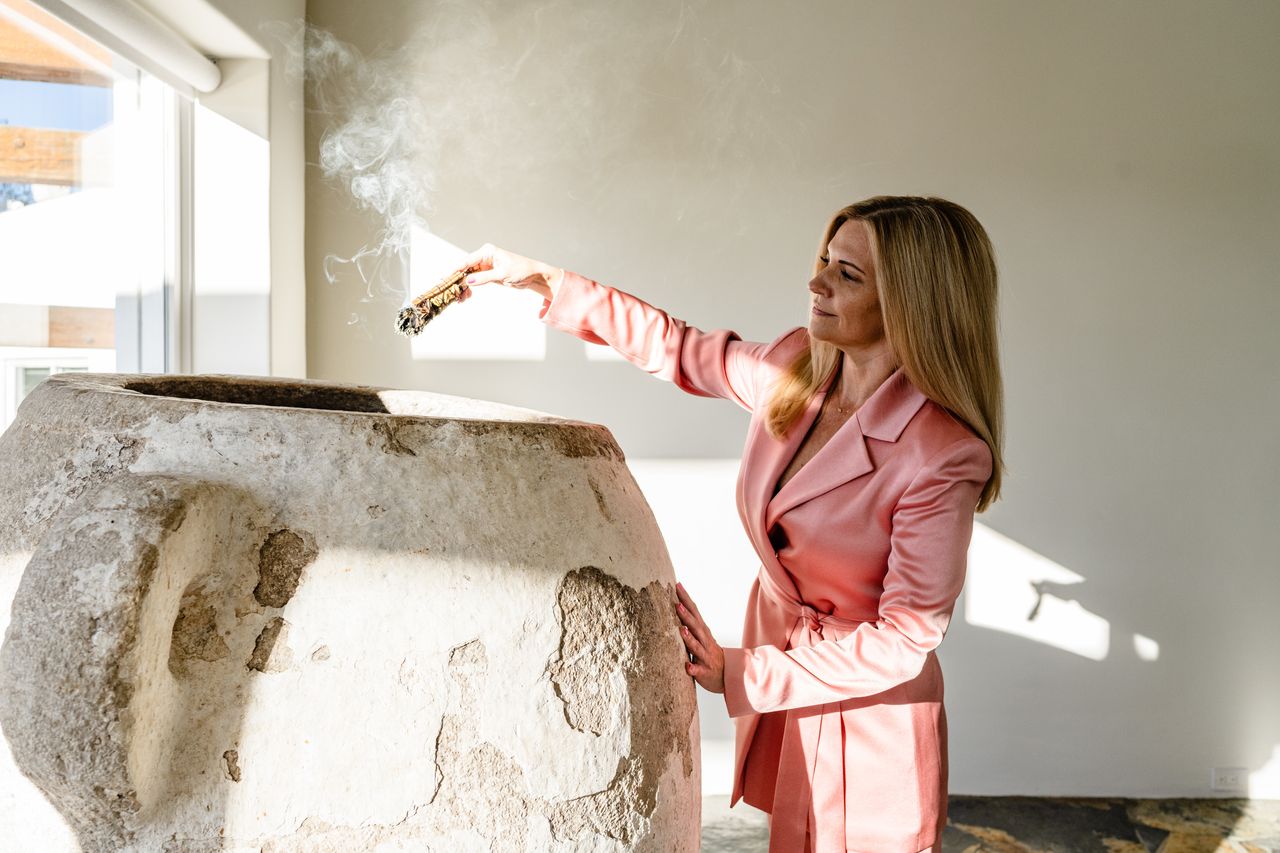
In November, McCann spent four days at Harvey-Taylor’s estate. They performed a Celtic space clearing blessing, paid ceremonial homage to the original owner and upgraded a spiral staircase’s feng shui energy flow, among other activities. But the pair says the biggest aha moment came when crystals, tarot cards and a dowsing pendulum helped reveal that locating Harvey-Taylor’s office within the house was creating a family-wide creativity block. This revelation, Harvey-Taylor says, and the subsequent scheme to move her office into the garage, feels like the beginning of unblocking her creative stuckness.
Across the U.S., homeowners are hiring house-energy specialists to reset and elevate their home’s energy, often through modern-day twists on ancient spiritual practices and healing arts. Real-estate professionals are tapping into their mystical sides, too, embracing these same ritualistic endeavours.
Ele Keats, 52, is an actress—she starred in Disney’s 1992 movie “Newsies”—who has been designing crystal and gemstone jewellery for 20 years. Through her Santa Monica, Calif.-based shop, Ele Keats Jewelry, she offers house crystal consultations.
Crystal healing, to wildly oversimplify it, is a practice rooted in the belief that crystals have healing powers: citrine amplifies creativity and wealth; rose quartz enhances love; selenite clears and purifies; and so on. Practitioners believe placing crystals on or around the body, or in a physical space, can balance energy. Crystals can be priced as little as about $3 for a small, hand-held piece, whereas world-class, museum-quality specimens can cost roughly $100,000 to $1 million and higher.
Keats works with homeowners such as a client who wanted to revamp the sad, empty energy she felt permeated her Los Angeles dwelling. “There was no life force,” Keats says. To usher in vibrancy and aliveness, Keats helped the client with the personal process of positioning a half-dozen or so crystal types, varying in sizes and forms, inside and outside the client’s residence.
Keats was recently hired to select crystals to inlay under a 50-foot indoor saltwater pool at The Huron, a 171-unit condo building slated to open in Greenpoint, in Brooklyn, in January 2024. “It was top of mind to make sure the pool space is tranquil, rejuvenating and soul-cleansing,” says Jared White, senior vice president at Quadrum Global, the New York-based company developing the project, where offerings currently range from $750,000 studios to $3.16 million three-bedrooms. “That discussion went to crystals.”
In Boca Raton, Fla., Senada Adžem is Douglas Elliman’s executive director of luxury sales. She recently listed a $23.995 million Delray Beach, Fla., property at which the homeowners put their interest in crystal healing on display. They commissioned custom-designed chandeliers made from healing crystals. They use crystals as design pieces, including a nearly human-sized amethyst by the dining room’s doorway. Built in 2018, the house has six bedrooms and 10 bathrooms, and is 11,457 square feet of living space on 2.5 acres.
Additionally, after a house showing, the space is saged, says Adžem, referring to the ancient ritual of burning plants—in this case, sage—for purification.
Brook Harvey-Taylor’s energy stylist Colleen McCann says clients engage her in house energy work for many reasons. Some want their space’s energy refreshed annually. Others are experiencing a house-affecting life transition, such as moving, having a baby or divorcing. Others can’t put their finger on why they are feeling bad vibes. Then there are people who are freaked out. “They say, ‘There are doors slamming, the lights are flickering,’ ” says McCann, who works globally.
McCann says one of the many steps in her home-harmonising process is laying crystals and tarot cards on a house’s blueprint, and using a dowsing pendulum, tools she uses along with her intuition. Over the past 15 years, McCann has studied many different spiritual, mystical and metaphysical lineages. “My preference is to learn a lot of modalities and blend it together to make it my own,” McCann says. Consultations start at $1,000 and prices vary on the project’s scope.
New York-based Holly Star, 45, has 20 years of energetic work experience. She studied for five years with various gurus, healers and shamans. Her space-clearing process tends to involve custom bundles of herbal and botanical mixtures, sometimes up to three or four mixes of 10 or 15 types, such as frankincense, copal, pine, lavender and sandalwood. When working on a house, she does a lot of burning and bells. “I kind of go into a trance,” Star says. “It’s almost like I pan back from the space and I can feel the energetic templating shifting.” Afterward, clients often tell her their spaces feel light, says Star, who also owns Matter and Home, a spiritually inclined luxury home goods boutique. Her space clearing fee starts at $2,000.
Sometimes houses need healing like people do, says London-based Emma Lucy Knowles, 39, who has been working in clairvoyance, crystals, energy, hands-on healing, light, meditation and spiritual coaching for 20 years. Knowles says she treats a house like a body: She reorients, manipulates and liberates a space’s energy to its true form. She uses energy healing, elemental sources (such as crystals and fire, the latter through burning palo santo, sage and incense) and sound (such as music, sound bowls, mantra or chanting). To close her sessions, she lights a violet flame for intention. She often decorates with crystals, which she says work like energy hubs around the house. Her space energy clearing work depends on square footage, but starts at $400.
Brooke Lichtenstein, 46, refers to herself as spiritual guide and family energy healer who, with her husband, is renting a five-bedroom, five-bathroom, 4,800-square-foot house in Los Angeles’s Pacific Palisades neighbourhood, where the median listing price is $4.3 million. In her house, she performs clearings, healing and blessings through rituals such as prayer, light visualisations, herb burning, rosewater spraying and sound healing using her voice in prayer and playing instruments such as crystal bowls, chimes and a harp. To her, this is home maintenance. “People do a lot of things to maintain their homes,” she says. “This is paramount for us.” Her 7- and 8-year-old sons sometimes join her practice. “To watch them owning their own space is a privilege to witness,” she says.
“People have a desire to have a spiritual component to their lives,” says Lytton John Musselman, Old Dominion University’s Mary Payne Hogan Professor of Botany, Emeritus, who is an expert in the intersection of plants and spirituality. The University of Texas at Austin’s curator of gems and minerals, Kenneth Befus, agrees. “Humans believe in religion and the spiritual realm,” says Befus, a crystal expert. “We want to. It brings us peace.”
The problem, both scholars say, is separating the religious and psychosomatic from medical efficacy. Musselman says, “If I plant lavender in my garden and feel better, is that because I want to feel better? Or because I enjoy planting it, or smelling it? Or does it really have an effect on my other senses?”
Befus says crystal healing has no empirical scientific evidence. “Crystal healing is in the realm of metaphysical,” he says. “We call it pseudoscience.” However, he acknowledges the potential of the placebo effect. “That’s a place where crystals could be healing,” he says. “It’s not in the word ‘energy’ or ‘chakra’ or ‘aura.’ ”
Musselman—whose latest book, “Solomon Described Plants,” is a guide to biblical botany—says as a scientist he seeks documentation from field studies and scientific literature. “I was at a large, wonderful bazaar in Iraq, and I saw a very poisonous rosary pea,” he says. “I asked the vendor what it was for, and he said, ‘For women to drive away evil spirits.’ I thought, ‘How are you going to test that?’”
Energetic healing practitioner and energy consultant Holly Star says, “People may not be able to scientifically prove how something came to be, but I believe how you feel and seeing change in your life or home is the proof.” She says sometimes the most powerful part of a clearing lies in homeowners learning about themselves. “Their lives start to open,” she says. “It’s kind of a backdoor.” Jewellery designer and crystal-store owner Ele Keats shares a similar sentiment: She says she’s heard countless stories of how crystals have enabled breakthroughs and life improvements.
Chelsea Leibow, 33, took the backdoor approach when she addressed a problem in her house using tarot, a tool for divination and tapping into one’s intuition.
In September 2022, Leibow and her husband, Mike Farrell, 34, purchased a five-bedroom, four-bathroom, 3,200-square-foot house in West Orange, N.J., for $805,000. Early on, they splurged on hiring painters for their front foyer, stairway, second-floor landing and back hall. The painters did a great job. The issue was that Leibow deeply believed she chose the wrong colour of white paint.
“I could not live with myself,” Leibow says. “I was like, ‘It’s wrong and I hate it and I want to fix it immediately.’ ” Her husband, on the other hand, thought they should embrace the paint. He thought it looked exactly like every other white paint.
To get a grip on the situation, Leibow sorted through her feelings using tarot, a modality she dabbled in during college but got more serious about in 2020, when, during the Covid-19 pandemic, she began attending a Sunday Zoom group led by a practicing witch who is an expert in tarot and astrology. “The cards were like, ‘You’ve got to chill out. Just give it a beat,’ ” says Leibow, who owns communications firm Chelsea Leibow Communications.
Leibow listened to her husband—and the cards. The couple agreed the paint would stay, but if Leibow still detested it a year later, they’d get it fixed.
A year later, their foyer, stairway, second-floor landing and back hall are now a new colour of white paint.
 Copyright 2020, Dow Jones & Company, Inc. All Rights Reserved Worldwide. LEARN MORE





The Swiss watchmaker’s first collaboration with Atlassian Williams F1 Team produces two sporting Laureato models inspired by the team’s 2026 racing car.
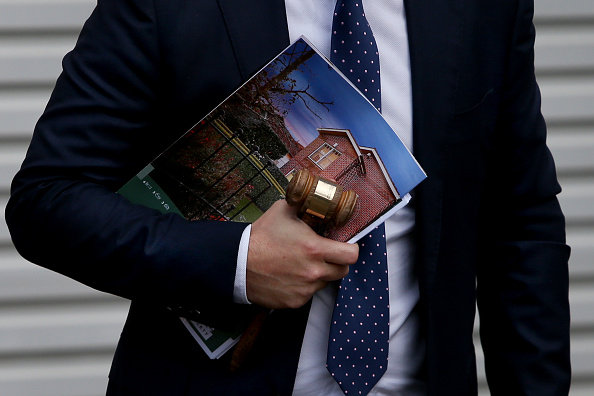
Victorian auction buyers will soon receive a piece of information that has traditionally been withheld until bidding reaches it: the vendor’s reserve price. Under new property-sale and underquoting laws, agents must publish the agreed reserve at least seven days before an auction or fixed-date sale. Most changes begin on 1 October 2026 and apply to …
Continue reading “Victoria’s New Auction Rules Will Force Reserve Prices Into the Open”
Paramount and California’s attorney general are in advanced settlement talks over the company’s proposed $81 billion merger with Warner Bros. Discovery. Potential concessions include investing $1.5 billion in California production, retaining both studio lots and introducing safeguards for CNN’s editorial independence.
3 min
California’s attorney general and Paramount PSKY -3.86%decrease; down pointing triangle have discussed a series of potential concessions as part of advanced settlement negotiations, including a $1.5 billion investment by the company in production in California, according to people familiar with the discussions.
Paramount executives and a coalition of states that sued to block its $81 billion merger with Warner Bros. Discovery WBD -1.56%decrease; down pointing triangle spent the weekend hashing out the details of a possible settlement. Such an agreement would clear the way for a deal that would bring HBO, CBS, CNN, streaming services and famed movie studios under one owner.
Among the concessions the parties have discussed beyond the sizable production investment: a promise not to sell either studio lot and to stay in the state of California, the people said. The company had explored moving out of the state as the deal faced opposition.
The parties have also considered potential penalties if Paramount doesn’t make good on an earlier pledge to make 30 movies a year after the merger, including having to sell its stake in Miramax, known for such classic movies as “No Country for Old Men” and “Pulp Fiction,” the people familiar with the matter said.
Other measures the sides have explored include the sale of some cable channels and the creation of a board to ensure that CNN retains editorial independence, people with knowledge of the talks said. The network has been a political flashpoint throughout Paramount CEO David Ellison’s fight for Warner. Paramount had been discussing creating such an editorial board before the lawsuit.
A final deal hasn’t been reached, and it is unclear what terms the parties may ultimately agree to.
Ellison has spent the past year fighting to buy Warner in a megadeal that would expand his entertainment empire, but that has drawn opposition from some political and Hollywood figures.
A dozen Democratic-led states led by California Attorney General Rob Bonta sued in July to block the deal on antitrust grounds, arguing that the combination of Paramount and Warner would create too much concentration in the markets for theatrical films and cable television channels.
The Writers Guild of America sued over the merger, saying that the deal would eliminate jobs and career opportunities for Hollywood screenwriters.
About two dozen demonstrators gathered in front of the Elihu M. Harris State Office Building in downtown Oakland on Sunday evening to protest a potential settlement. Holding signs reading “Bonta: Don’t You Dare” and “Block the Megamerger,” they took turns giving speeches urging the attorney general to continue pressing the suit.
“Nothing has changed since he filed the case,” said Annie Leonard, co-founder of the nonprofit Committee for the First Amendment, which advocates for free expression. “He needs to stay as strong as he was in filing it.”
The two sides had come under pressure to settle the matter in recent months, including from California Gov. Gavin Newsom, Los Angeles Mayor Karen Bass, gubernatorial candidate Xavier Becerra, movie theater chains and some Hollywood labor unions.
Paramount’s agreement with Warner also included a “ticking fee” with payments to Warner shareholders of roughly $650 million a quarter, or $7 million a day, beginning next month, until the transaction closes.
Paramount had asked a federal judge to require the states and the Writers Guild to put up a nearly $1.9 billion bond for challenging the acquisition, money that would go to the company if it ultimately won the case.

By improving sluggish performance or replacing a broken screen, you can make your old iPhone feel new agai

From Tokyo backstreets to quiet coastal towns and off-grid cabins, top executives reveal where they holiday and why stepping away makes the grind worthwhile.