Their Home Had to Be Fashion Forward. But Above All Else, It Needed a Killer Closet.
Ralph Lauren meets Tom Ford inside this sleek and sophisticated Chicago house, which cost $1.8 million to build

 4 min
4 min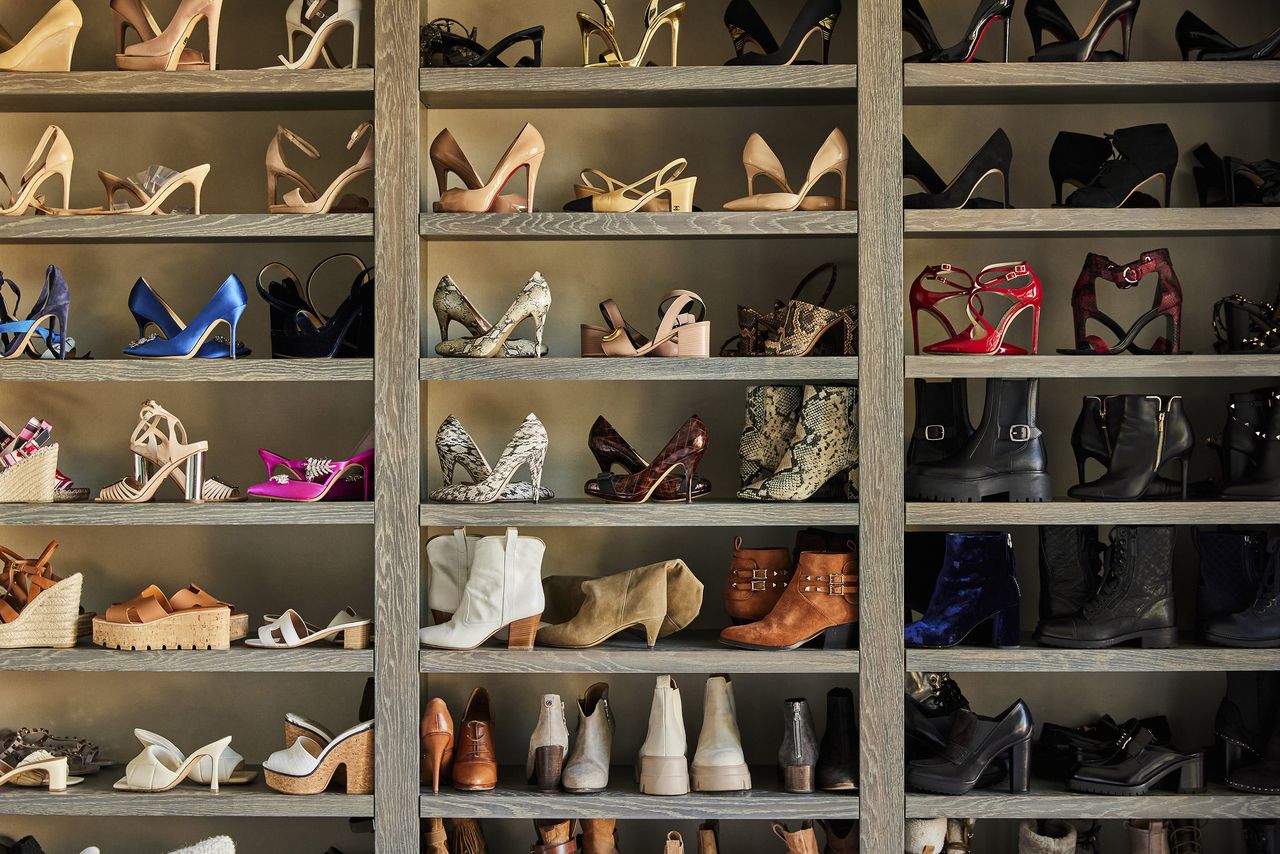
If Kelli and Fei Wang’s house had a soul, it would be the walk-in closet.
The house, in Chicago’s Ukrainian Village neighbourhood, is designed around the couple’s love for fashion and includes a 300-square-foot custom closet, with charcoal-suede wall covering and cerused-oak shelves, amplified by a vanity within a 40 x 60 inch mirror. There is a separate accessories side room, modelled after a showroom, where Kelli’s collection of designer bags and shoes sit on shelves and where she hangs out on a silver love seat.
In the couple’s previous home in Chicago’s Lincoln Park, they had to change out their wardrobes every season, hauling clothes from their apartment to their storage unit in the building’s basement, because there wasn’t room for it all upstairs.
“I wanted to never do a closet swap again,” says Kelli, 42, dressed in a floaty, cream-coloured shirt dress from Sandro Paris and light pink Manolo Blahnik pumps. “The closet was the first thing I thought about for the house.”
The Wangs bought their Ukrainian Village property for $511,000 in 2016 and tore down the existing 2,500-square-foot, three-bedroom, old brick home on it. The new house, finished in 2021, is 5,000 square feet, has three bedrooms and cost $1.8 million, with about $100,000 of millwork, carpet and furnishings going into the primary closet alone.
To design the house, the couple hired Dan Mazzarini, the principal of New York-based BHDM Design, who was a director of store design at Ralph Lauren for six years and also worked on Michael Kors, Calvin Klein and Kate Spade retail spaces.
Mazzarini knew Kelli from college, and understood the couple’s love for fashion: they’d shopped together many times in New York, where Fei had a special affinity for the Ralph Lauren store on Madison Avenue.
“I wanted to live in the Ralph Lauren store,” says Fei, 46, dressed in a custom-made Pini Parma shirt and a Boggi sweater. “It makes you feel elegant, elevated, and classy.”
As a guide for the house’s overall aesthetic, they decided on “Ralph Lauren meets Tom Ford, a mixture of buttoned up and timeless sophistication and sexy, modern, crisp elegance,” says Mazzarini. That meant a lot of black, white and charcoal.
That mixture can be seen throughout the house. In the living room, open from the kitchen on the main floor, a Ralph Lauren influence can be seen in the classic white sofa, while the angles of the coffee table and the chairs are more Tom Ford, says Mazzarini.
Tom Ford comes out in the kitchen, where the black granite counters, black-matte open shelves and stainless-steel appliances have a “refined industrialism,” says Mazzarini. The dining room has a crafty Ralph Lauren chandelier and white leather chairs.
On the second floor, Fei’s office is “menswear-oriented” It has a modern, crisp, geometric style, with a glass coffee table, an oversize black linen sofa, and dark grey flannel curtains, like a suit, says Mazzarini. The red fox fur and brown velvet pillows, the rosewood desk and the nubby rug add more classic textures.
The primary suite, with its bathroom and the centrepiece closet, takes up the entire third floor. It is designed in part after the Bulgari Hotel Milano, where the couple stayed on one of their first trips to Italy. The furnishings include grey-velvet drapes, an ebony headboard, a leather bench and a large brown-velvet armchair.
When designing the closet, Mazzarini says he asked the couple how many suits, shoes, bags and accessories they had—and that number kept growing as the home-building process progressed, going from around 50 to more than 100 pairs of shoes for each. While the overarching goal was beauty and style, it also had to be comfortable—and to reflect what Mazzarini calls the couple’s “Midwestern warmth and hospitality.”
Fei was born in Shanghai and grew up in Chicago, where his father was getting a Ph.D. in chemistry. Living on a teacher assistant’s budget didn’t leave much for buying designer clothes, but Fei says he “always had an eye for fashion—it was innate.” He says his parents, who grew up when many Chinese people wore blue worker’s suits, weren’t interested in subsidising his passion, so he started working in a clothing store when he was 14 years old. The first suit he bought himself was from Banana Republic.
He graduated from Illinois State University in 1999 and then from the University of Chicago with an M.B.A. in 2004. He went to work in asset management at Morgan Stanley, then to J.P. Morgan Asset Management and UBS before landing again at Morgan Stanley in 2021, where he is now a senior vice president in family wealth management.
Kelli also remembers a passion for fashion from a young age. Growing up in Piqua, Ohio, north of Dayton, she couldn’t afford to buy designer clothes, so she mixed and matched, she says. She graduated from Miami University in Oxford, Ohio, and went to work at J.P. Morgan Asset Management before moving on to Merrill Lynch and Centric Wealth Management in 2018, where she is currently director of financial planning.
Fashion is central to the couple’s relationship. When they first met in 2008, when they were both working in J.P. Morgan’s wealth management unit in Chicago, each noticed the other’s clothes. “She was chic and classy,” says Fei. “I pay attention to style.” Kelli remembers the first time she saw her now-husband walk by in a suit. “He looked the Wall Street-financier part,” she says.
After their wedding in Lake Como, Italy, the couple honeymooned at JK Place (now called The Place), in Florence, a hotel that also influenced the design of their home. They started traveling to Italy and France every year because they love traveling and shopping together, and they both appreciate the goal of having the best experience possible, whether it is food, art, clothing or design. “The downside of that is there’s no voice of reason,” jokes Fei.
The Wangs say they have passed their fashion appreciation on to their 2½-year-old daughter, Gemma, who loves to hang out in the accessory room of the closet, where she tries on her mum’s shoes. In Gemma’s own bedroom, a shelf is filled with miniature designer bags: Gucci, Chanel, Prada, Louis Vuitton. “She has a better sense of style than both of us,” says Kelli.
 Copyright 2020, Dow Jones & Company, Inc. All Rights Reserved Worldwide. LEARN MORE





Borrowers cannot control the Reserve Bank, but they can control how exposed their household budget is to its next decision. The RBA meets on 29 September with inflation concerns still elevated and major-bank economists increasingly bringing forward their rate-rise calls. Fixed mortgage rates have also been moving, reducing the value of waiting for perfect certainty. …
Continue reading “What mortgage holders should do before the next RBA decision”

Australian shares finished higher on Tuesday, September 22, as a technology rally and lower oil prices outweighed weakness in energy companies and continued anxiety about domestic interest rates. The S&P/ASX 200 closed 25.9 points, or 0.30 per cent, higher at 8,757.8. The All Ordinaries gained 0.36 per cent to 8,951.0, while the All Technology index …
Continue reading “ASX Wrap: Technology lifts the ASX as falling oil relieves inflation pressure”
 2 min
2 minBorrowers cannot control the Reserve Bank, but they can control how exposed their household budget is to its next decision.
The RBA meets on 29 September with inflation concerns still elevated and major-bank economists increasingly bringing forward their rate-rise calls. Fixed mortgage rates have also been moving, reducing the value of waiting for perfect certainty.
The first task is to calculate the impact of another 0.25 percentage-point increase. Indicative Canstar figures reported earlier this month suggest that such a move would add about $91 a month to repayments on a $600,000 loan, $122 on $800,000 and $152 on $1 million, although actual changes depend on rate, term and loan structure.
The second task is to compare the current loan with the market. Borrowers should examine the interest rate, annual package fee, offset balance, redraw rules and the revert rate on any expiring fixed portion. A lower advertised rate is not necessarily a better deal after fees, lost features or refinancing costs.
Third, test the household budget at least one percentage point above the current rate. This is not a forecast; it is a resilience exercise. Include council rates, strata, insurance, maintenance, school costs and realistic discretionary spending. Investors should also allow for vacancy and repairs rather than assuming uninterrupted rent.
Fourth, contact the existing lender before lodging multiple applications. A borrower with a sound repayment history may be able to negotiate a discount without refinancing. If the offer is weak, obtain comparable quotes and seek advice on whether changing lenders will genuinely improve the position.
Fifth, preserve liquidity. Using every available dollar to reduce principal may feel prudent, but an offset account can provide interest savings while retaining access to cash. The right structure depends on tax position and loan purpose, particularly where owner-occupied and investment debt coexist.
Borrowers considering a fixed rate face a trade-off. Fixing can provide repayment certainty, but may restrict additional repayments, offsets or early exit. Splitting a loan can diversify rate exposure without removing risk.
The worst time to examine a mortgage is after repayments have become unmanageable. A review conducted now gives borrowers more choices: renegotiate, refinance, adjust spending or build a buffer while their record remains strong.
Borrower checklist
Calculate: Repayments after a 0.25 and one percentage-point increase.
Compare: Rate, fees, offset, redraw, cashback conditions and total cost.
Review: Fixed-rate expiry, interest-only expiry and remaining loan term.
Protect: Emergency liquidity and insurance.

From snow-dusted valleys to festival-filled autumns, Bhutan reveals itself as a rare destination where culture, nature and spirituality unfold year-round.

A cluster of century-old warehouses beneath the Harbour Bridge has been transformed into a modern workplace hub, now home to more than 100 businesses.