Would You Pay $500 for Bed Sheets? I Finally Did, and Here’s Why
Why are we willing to spend that much for, say, nice boots, yet consider bed linens that cost that much unconscionably indulgent? Our columnist fights her way past this double standard.

 3 min
3 min
The other day I threw open the windows, ready to spring clean and flip the mattress. Then I started to strip my bed only to see…sheets shredded by my husband’s toenails.
How long has this situation been developing? I spend eight hours a day physically interacting with my bedsheets, so how did I miss this?
We all have private, recurring bedroom fantasies. Mine is that every night I tuck myself into crisp, unwrinkled, lavender-smelling sheets. But the sad reality is I give my bedsheets no attention—and on the rare occasions I do buy new ones, I get another cheap, $150 set that wrinkles, doesn’t wear well and feels limp after the fourth go-round in the laundry.
But spring is a season of renewal. Maybe I can change—with help.
“I’ll spend money on things for myself—like a $500 pair of boots—so why not on the bedsheets I use every day?” I asked Charles D. Lindsey, an associate professor of marketing at the State University of New York at Buffalo.
Lindsey, whose research focuses on how consumers make choices, said it’s not unusual for shoppers to spend more money on items other people see.
“Clothing is a very public product, and you get social status from it. There’s the emotional satisfaction when someone says, “I love your sweater,’ ” he said. “But bedding is very private. You may be thinking, ‘Oh, that’s just something I sleep on.’ ”
A few centuries ago, I probably would have been more attached to my sheets—if I were lucky enough to have them. Before the 18th century, many people didn’t. They didn’t even have beds, much less separate rooms for sleeping, said historian Annie Coggan, an associate professor at Pratt Institute School of Design in Brooklyn. “They slept on the floor or with the servants.”
In the American colonies, beds and bedrooms were a symbol of wealth and status. “In probate inventories of the time, there was a hierarchy of how things were valued,” she added. “First was the bed linen—because a bedsheet took the most labor if you were weaving it yourself, or else it was imported from England or France, which made it dear. Then it was the table linen and then the rugs.”
These days, when an expensive queen-size sheet set with pillow cases costs upward of $500, bed linens would still rank high in the probate inventory of my estate. But my inner cheapskate can’t help but wonder: What makes sheets worth more than my $150 set?
“Oh, Michelle, when you have good sheets, it’s like having a love affair,” said Tricia Rose, founder of Rough Linen, a sheet maker in San Rafael, Calif., whose Orkney linen queen-size flat sheet is $217.
“In what way?” I asked.
“They absorb moisture so you feel cool and sleep better, they feel fresh on your bed for longer between washes and they will last 10 years if you care for them properly,” she said. Laundering in cold water is easier on the fabric, she says, and “whisk them from the dryer when they feel faintly damp instead of baking them to death.”
“But what about wrinkling? I can’t get the binding on the top sheet to lie flat even if I iron it,” I complained.
“On cheap sheets they sometimes don’t take care to cut the fabric with the grain,” she said.
Also, high-quality sheets are woven from extra-long strands of cotton or flax fibers, “which makes the yarn smoother, finer and softer,” said George Matouk Jr., a sheet maker in Fall River, Mass., whose company’s signature Lowell queen-size flat sheets cost $549 apiece. “They’re woven from cotton grown in the Nile valley, which has ideal conditions to grow the plants.”
My next call was to Manhattan interior designer Gideon Mendelson.
“If I were your client, and I hypothetically had a situation where my husband’s toenails shredded the sheets, how would you convince me to buy nice ones instead of cheaping out on them?” I asked.
“First, I would tell you what my mother, who was a designer, would say—that we all should spend on our shoes and our bed linens. Those are the things we experience the most in a day,” he said.
Next, he would recommend pedicure tools. “I hear about toenails, and dry heels, and both are bad for sheets,” he said. “I often put a nice pumice stone in the bathroom.”
“OK, I’m ready to make the leap—any other advice?” I asked.
He recommended choosing a solid color to complement the other textiles in the bedroom. “Sheets have to fit in with everything else, because they’re usually the last element you choose.”
“So, undyed linen,” I said.
“I lean toward a cotton percale myself,” he said.
But I prefer the texture of linen—and have long coveted Rough Linen’s heavyweight Orkney sheets (“The fabric weighs 8.3 rather than the typical 5.6 ounces per square yard of linen and will last longer,” Rose said).
I ordered a nearly $500 set of sheets. They were nice and flat post washing and damp-drying, and after I slept on them—so smooth! so luxurious!—I was a convert. I want these sheets to last forever.
So I put a toenail-care kit in the bathroom.
 Copyright 2020, Dow Jones & Company, Inc. All Rights Reserved Worldwide. LEARN MORE




From making unpopular decisions to learning when to listen, leaders from five businesses reveal what nobody prepared them for — and how running a company has challenged their expectations.

Technology and semiconductor shares fell sharply as investors questioned the debt financing the AI infrastructure boom and confronted higher rates and Chinese competition.

Elon Musk is exploring a potential merger between Tesla and SpaceX, a deal that could reshape the future of AI, robotics, autonomous vehicles and space technology. With a combined valuation potentially reaching $3.5 trillion, the move could bring Musk’s vision of an interconnected technology ecosystem closer to reality, although a deal remains uncertain.
5 min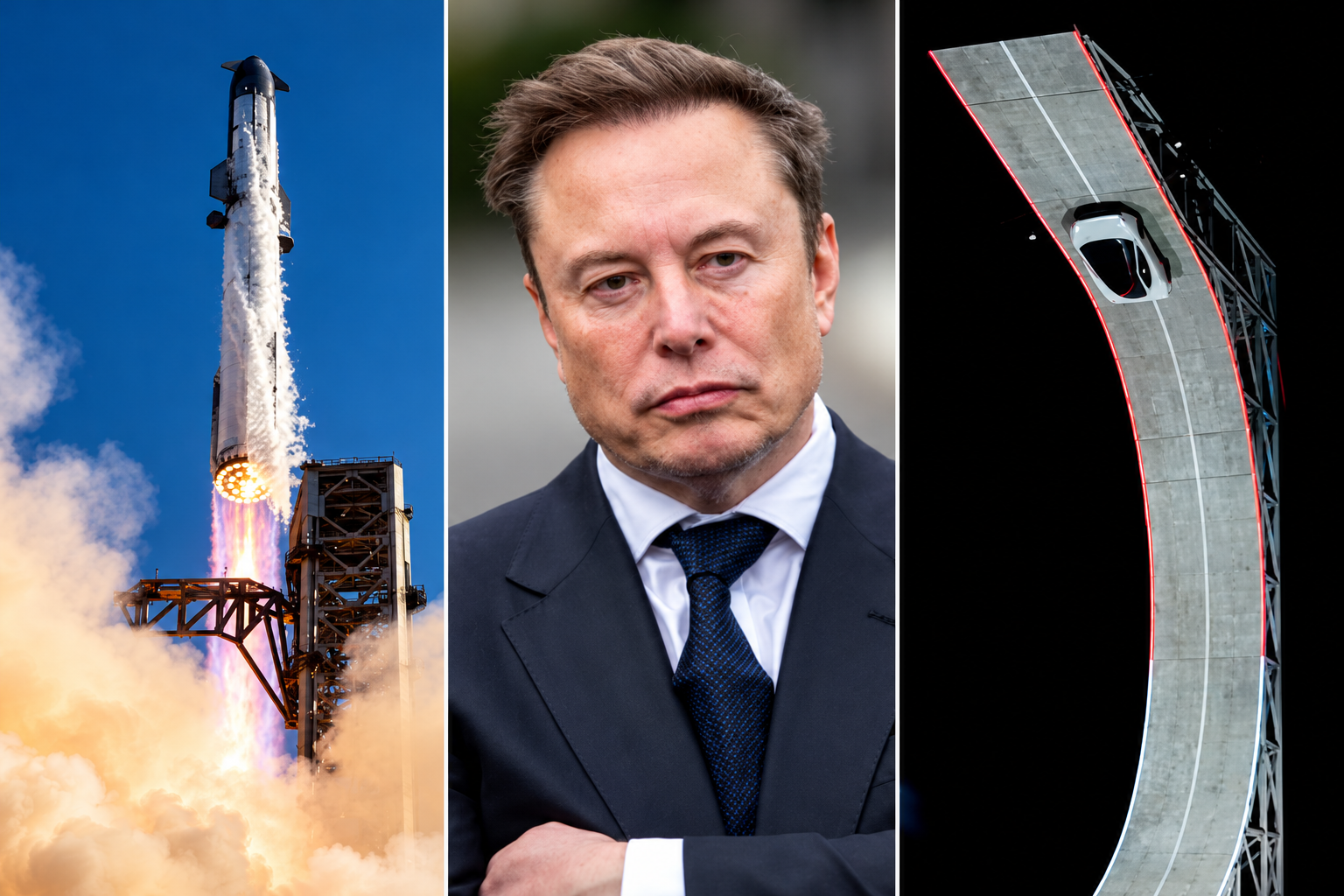
Elon Musk has engineered ties between Tesla TSLA 3.41%increase; up pointing triangle and SpaceX SPCX 7.79%increase; up pointing triangle that are hard to break, and now he wants to fuse them together permanently.
Musk has run both Tesla and SpaceX concurrently over the past two decades, using a schedule that dictated which days he spent focused on each business.
The companies have often shared resources and personnel, signaling their close ties. Last year, SpaceX looked into creating a spacesuit for Tesla’s humanoid robot Optimus, a person familiar with the matter said. Tesla last week showed off its new Roadster, a vehicle featuring SpaceX rocket thrusters that it hopes to soon bring to market.
And in recent months, Musk has repositioned both companies by expanding beyond their core operations toward a shared mission centered on artificial intelligence.
The world’s richest man on Tuesday signaled his interest in tying up SpaceX and Tesla, marking what would be the biggest corporate merger of all time. Because he serves as chief executive of SpaceX and Tesla, Musk said committees of independent directors at both companies are evaluating a possible deal, adding that a transaction might not come to fruition.
The committees will likely evaluate, with lawyers and bankers, how each company would fare in a potential deal and how a deal might best be structured. They then present their conclusions to their respective boards, who typically vote on whether to proceed.
“It’s an odd Kabuki dance where two groups of people are talking and I can’t be in the conversation,” Musk told SpaceX investors on Tuesday in response to an analyst’s question about a potential deal.
For Musk, the merger supports his vision of a world full of autonomous cars, humanoid robots and weekly rocket launches, as well as the data centers and satellites required to keep the whole thing running.
Some investors and analysts said they expect a transaction would be structured as an all-stock deal, with SpaceX potentially paying a modest premium for Tesla shares.
SpaceX, which has a market value of about $2 trillion, said it is seeing sharp growth in revenue across its businesses, which include operating data centers, launching rockets and operating satellite networks such as the internet service Starlink. Tesla is valued at about $1.5 trillion and is expanding its operations beyond its automotive and energy business. Shares in both companies traded higher following the news Tuesday.
Musk’s substantial ownership stakes in both companies, along with voting control at SpaceX, has enabled him to set the deal in motion. Analysts and investors said the deal will probably face regulatory scrutiny internationally, though some see Musk’s close relationship with the Trump administration as an asset to getting approval.
Blurred lines
The companies haven’t said which directors are on the special committees evaluating a potential deal. Several SpaceX and Tesla board members have either personal or business ties to Musk. And like Musk, venture capitalist Ira Ehrenpreis sits on both boards.
In a filing this week, Tesla outlined millions of dollars in business agreements with SpaceX and its subsidiaries last year, including $143 million in car sales to SpaceX, $3.3 million in advertising that it bought on the social-media platform X and $430 million in revenue from the sale of Megapack batteries for SpaceX’s data centers.
The companies also split the cost of resources including the use of Musk’s SpaceX jet and the bill for his personal security, which he runs through a private company.
Employees at both companies routinely move between companies to work on special projects, and some executives have dual roles, including Charles Kuehmann, vice president of materials engineering at both SpaceX and Tesla, and Ashok Elluswamy, the vice president of AI software at Tesla who runs a joint venture with SpaceX called Digital Optimus.
Over the years, Musk has launched new startups within his empire, including brain-implant company Neuralink, underground-tunnel developer the Boring Company and xAI, the AI startup that merged with SpaceX in February.
It is that AI business that Musk thinks can serve a market worth tens of trillions of dollars, justifying the need for a merger.
The business case goes like this: Tesla is developing robotaxis and robots, which it calls “physical AI.” SpaceX is working on the back end of physical AI: the data-center capacity and internet connection required for those robotaxis and robots to operate continuously.
“I don’t see what the value of Tesla is if it’s not merged with SpaceX,” said investment adviser Ross Gerber, a former Tesla bull turned critic invested in both companies. “If they don’t merge, the brains of everything that runs Tesla is owned by another company.”
On top of it all, both companies face constraints on the supply chains they need to make this world a reality, particularly when it comes to chips. To address this, Musk earlier this year announced a joint venture between Tesla, SpaceX and Intel to design and manufacture chips in Texas. “The most epic chip-building exercise by far,” he has said.
Musk at the wheel
For Musk, a merger would also solve two problems: demands on his attention and his lack of control at Tesla.
Tesla for years was Musk’s only public company, a status that came with greater scrutiny. There, Musk reports to a public board, as well as individual investors who make up around 30% of Tesla’s voting power, according to FactSet.
The question of Musk’s attention became a particular focus for investors and the board in recent years after he acquired Twitter in 2022 and launched xAI in 2023, and again in 2025 as he spent time in Washington, D.C., running the Department of Government Efficiency in the early months of President Trump’s second term.
As Tesla’s car business suffered in 2025, Musk threatened to take his AI ambitions outside the company if he wasn’t granted 25% voting control. Last November, Tesla shareholders approved a new pay package for Musk, which created a path for him to vastly expand his stake.
As of Sept. 30, Musk owned a roughly 20% stake in Tesla, according to the company’s proxy filing.
The SpaceX IPO gave Musk a different path. When SpaceX went public in June, the deal’s structure enabled him to have more than 80% voting power at the company—so much that he can’t be fired and decisions can’t be made without his support.
If SpaceX acquires Tesla, he will likely stay in control.

Advertising legend John Singleton unveils an exclusive 16-residence Caroline Bay development, marking his latest high-end property play on the Central Coast.

Paine Schwartz joins BERO as a new investor as the year-old company seeks to triple sales.