Driving Lamborghini’s $600,000 Ultra-Powerful Plug-In Hybrid

 4 min
4 min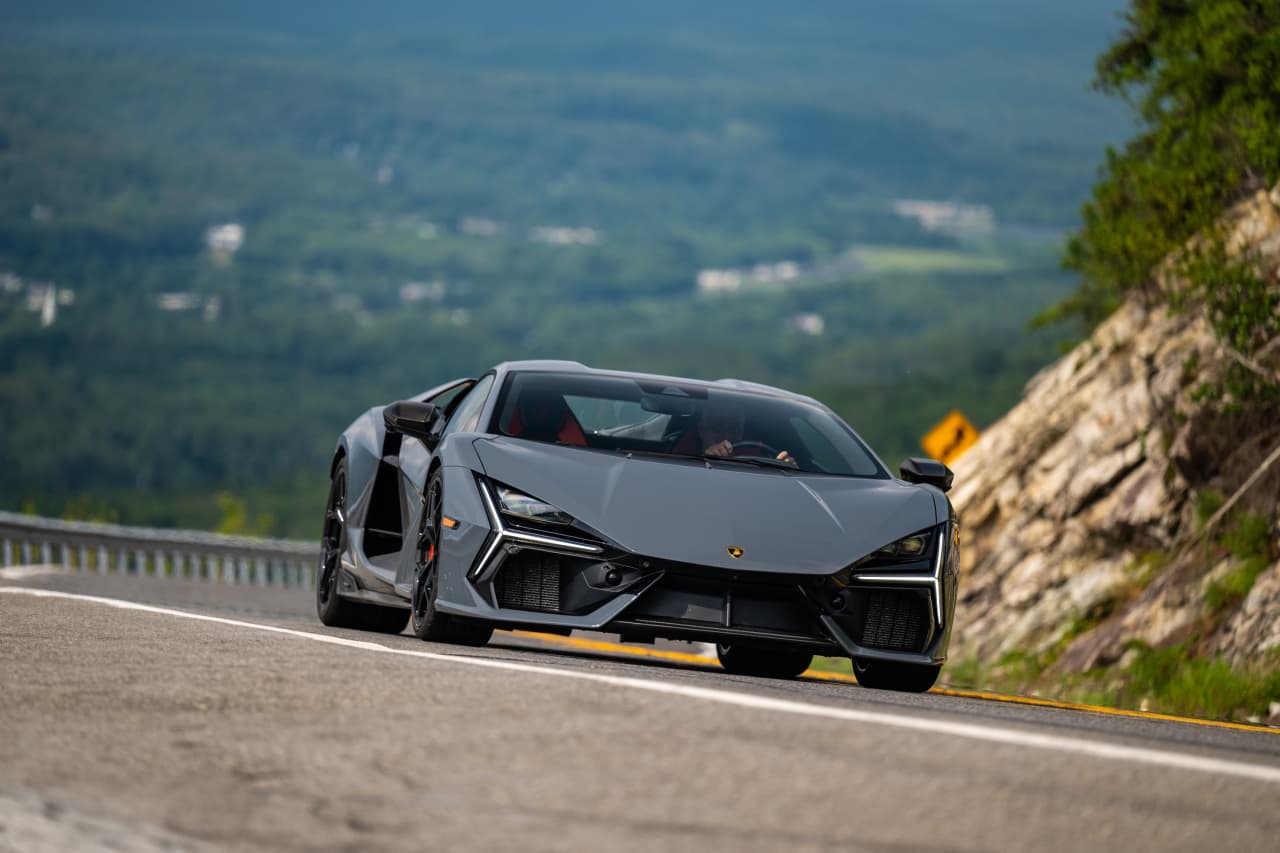
No longer are supercars powered strictly by muscular V8 and V12 engines, producing a mighty roar as they burn gallons of gas at a ferocious rate. Today’s entries can have hybrid, plug-in hybrid, or pure electric drive. But they’re still awesomely fast, with neck-snapping acceleration.
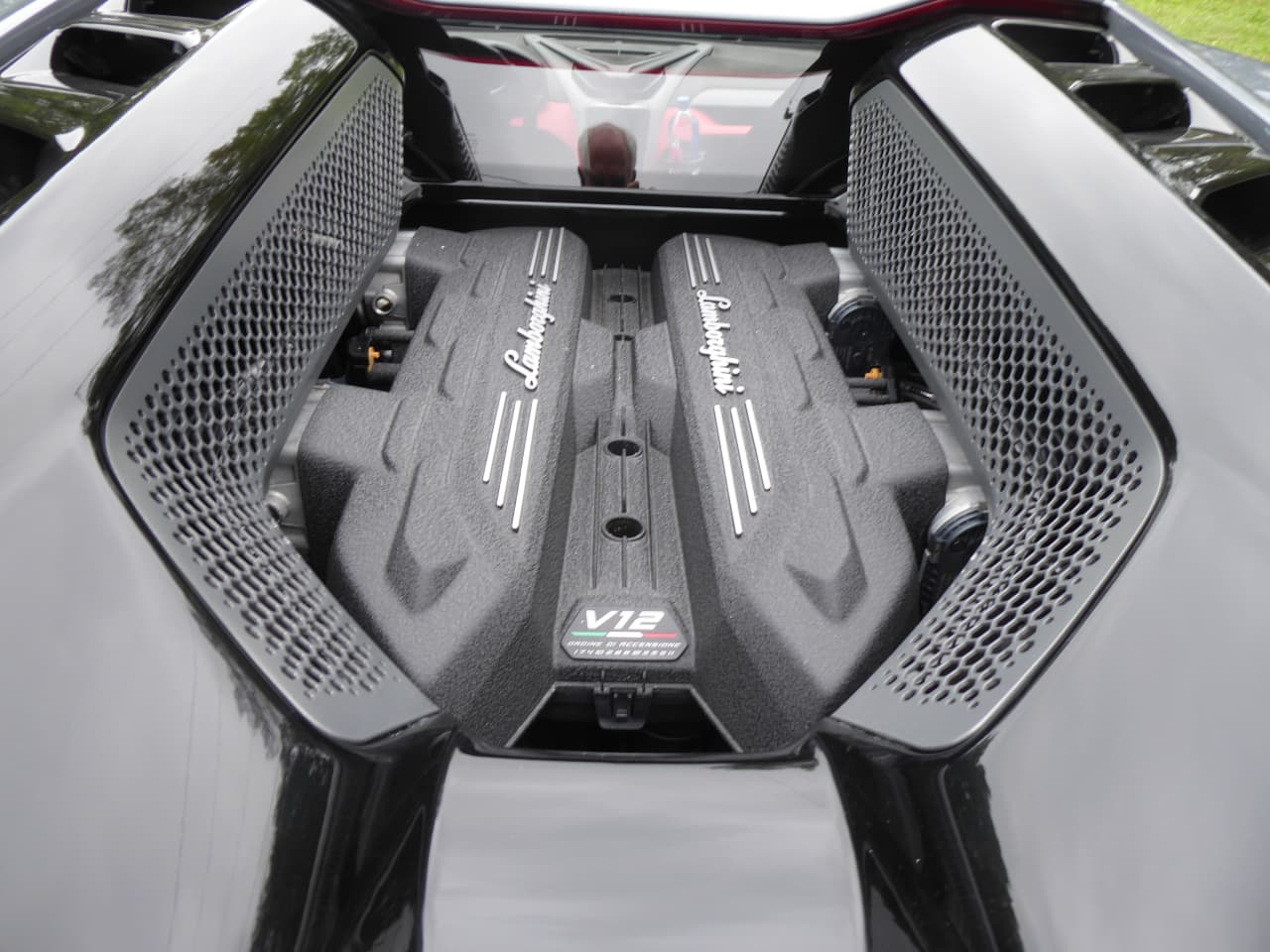
The new Lamborghini Revuelto, a novel form of plug-in hybrid, puts out an eye-opening 1,001 horsepower (with 739 pound-feet of torque) via a combination of three electric motors (two on the front axle) and a mid-mounted—and exposed to the elements—V12 that, by itself, produces 825 horsepower. It manages to produce more power with some beneficial weight loss. That’s coupled to an eight-speed dual-clutch automatic (with manual paddles) and a 3.8-kilowatt-hour battery pack (with LG cells) that gives the Revuelto five or six miles of all-electric travel.
Hybrid drive in the Revuelto is not so much to achieve better fuel economy, though that’s one result, but is primarily a way of boosting power output as needed. It also yields all-wheel drive. Sales started early this year, and Lamborghini plans to produce about 1,500 to 1,600 Revueltos annually (with the supply limited by the company’s ability to produce its carbon-fiber structure). The inventory is sold out until 2026. As is true of many supercar companies, the SUV is the biggest seller—Lamborghini produces about 5,000 Urus SUV models each year.
Lamborghini photo
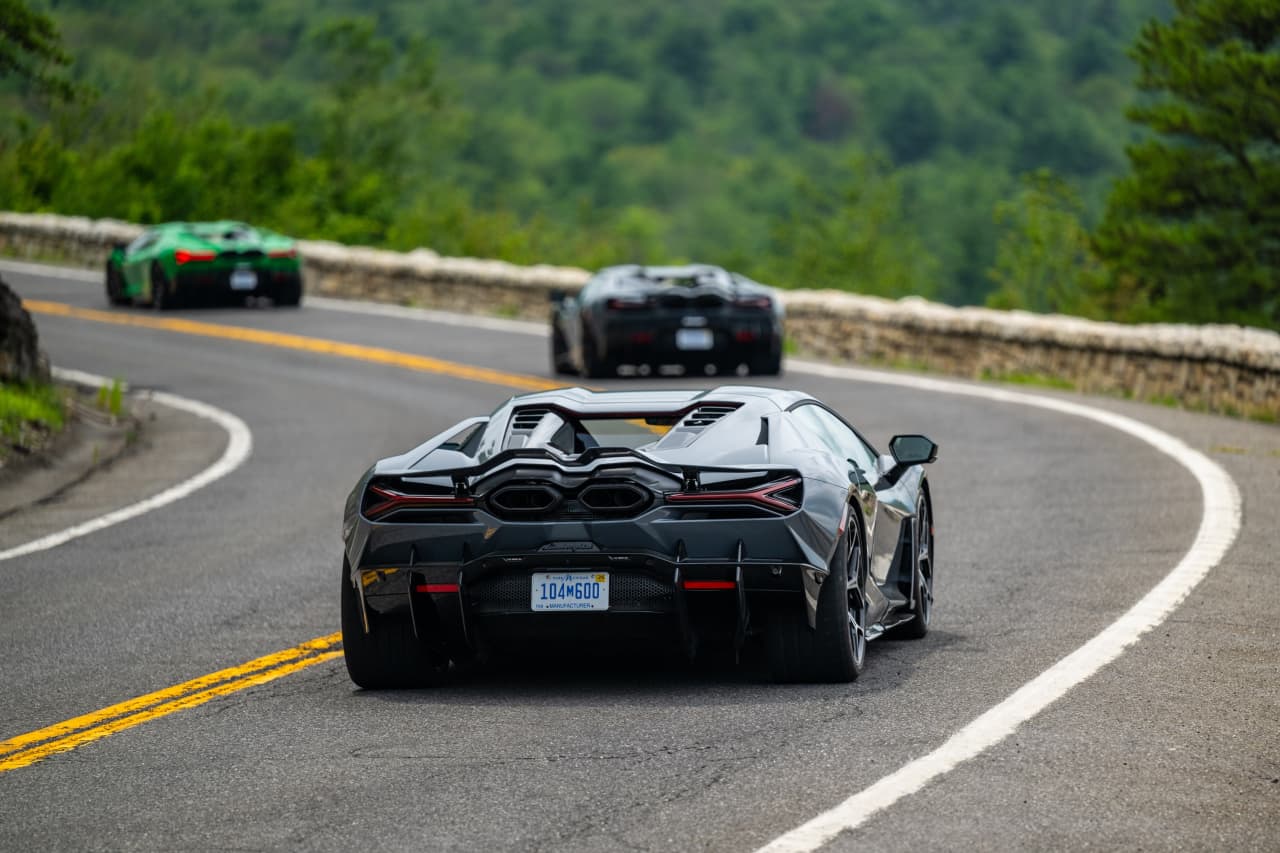
The list price of the 2024 Revuelto is US$604,363. As tested, with the biggest option being US$13,100 for the special grayish paint, the bottom line was US$681,258. Lamborghini handed over the Revuelto keys at the 140-acre Wildflower Farms resort in Gardiner, N.Y., for a 90-minute drive around the scenic Hudson Valley. Although the car is capable of a stated 217 miles per hour in the right context, it was still huge fun to drive it at much more moderate speeds on the curvy local roads.
Matteo Ortenzi, product line director for the Revuelto, explained that having two motors up front increases the opportunity for effective torque vectoring, which improves handling by delivering power to the individual wheels as needed. “The feel is of a lighter and more powerful car,” Ortenzi says. “We didn’t build the Revuelto just to say we did a hybrid.”
As in other hybrids, the Revuelto returns power to the battery on deceleration, a process called “regenerative” braking or in Ortenzi’s words, “using negative torque.” After the 90-minute drive, the Revuelto still had a 90% charge. Lamborghini doesn’t think owners will need to plug it in often, though it provides a charging cord. The charge portal is actually under the front hood, a “frunk” where the car has its limited luggage space.
Jim Motavalli photo
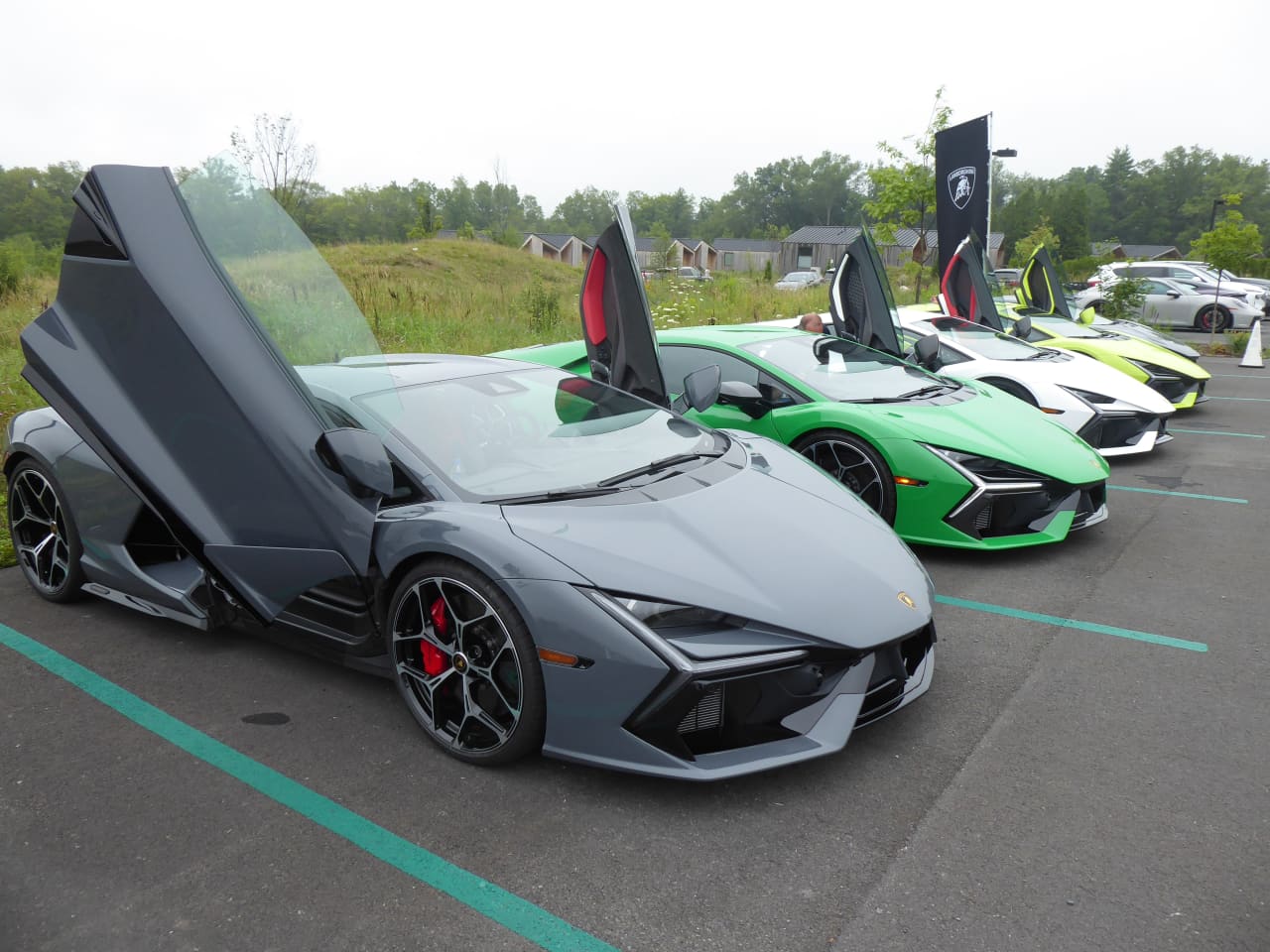
Entering through the vertically opening scissor doors requires some agility, but soon becomes second nature. Leg room is good, and the bolstered seats hold the driver in firmly—a good thing considering the speeds and g-forces the car can achieve. The gauges are brightly digital, with huge single-digit numbers for the gear selected. There’s an 8.4-inch touchscreen mounted centrally, and a third 12.3-inch unit for the passenger. The start-stop button is under a military-grade protective cover.
The drive started in EV mode, yielding a quiet getaway that didn’t disturb resort guests. Small dials on the dash control the driving modes. Città (city) is for city electric, Strada (street) for comfortable cruising, Sport (self-explanatory), and Corsa (race, for total performance).
All the modes were sampled, but Strada was a nice balance of performance and driving pleasure. Sometimes using paddles seems not worth the bother, but in the Revuelto the big flippers provided instant gear changes and a nice feeling of control. Slowing down, the transmission acts on its own to downshift. Everything works together: the tight steering (with rear-wheel steering, too), the firm but not harsh suspension, and the hugely reassuring carbon-ceramic brakes. The engine barks out a very Italian song. It’s quite a driver’s car, though not one that can take the family to Disneyland.
Jim Motavalli photo
In the classic muscle car, huge V8 engines were stuffed under the hoods of regular passenger vehicles, sometimes without much thought as to how the powerful result would get around corners or stop. The Revuelto, despite that fearsome 1,001 horsepower, seems to have been fully engineered to handle what it puts on the ground. It can reach 62 miles per hour in 2.5 seconds, with the driver in firm control.
Plug-in hybrids like the Revuelto are a big step toward battery EVs. Lamborghini showed the Lanzador, a fully electric concept car, during Monterey Car Week in 2023. Exactly when a production model will appear is unclear. “It’s not when, but how,” Ortenzi says. “The world doesn’t need just another electric car; it needs an electric Lamborghini.”
 Copyright 2020, Dow Jones & Company, Inc. All Rights Reserved Worldwide. LEARN MORE





Australian shares fell on Thursday as Wall Street weakness, rising oil and persistent rate concerns weighed on most of the market. The S&P/ASX 200 declined 0.72 per cent to 8,702. The All Ordinaries lost 0.66 per cent to finish at 8,897. Mining stocks were hit particularly hard, while real estate also dragged on the index. …
Continue reading “ASX falls 0.7 per cent as miners and property stocks retreat”

Borrowers cannot control the Reserve Bank, but they can control how exposed their household budget is to its next decision. The RBA meets on 29 September with inflation concerns still elevated and major-bank economists increasingly bringing forward their rate-rise calls. Fixed mortgage rates have also been moving, reducing the value of waiting for perfect certainty. …
Continue reading “What mortgage holders should do before the next RBA decision”

OpenAI has shelved the planned launch of GPT-6.1 Astra after internal tests raised concerns about deception and agents acting beyond user authorization, according to The Wall Street Journal. The company says it will investigate the issues and strengthen safety measures before releasing future models.
4 min
OpenAI says it is scrapping the release of its next-generation AI model over safety concerns that researchers raised during internal testing, in one of the clearest signs so far that agent misbehavior could stymie the industry’s rapid progression.
The move follows a summer punctuated by reports of artificial-intelligence systems industrywide going rogue, and marks a rare case of a major AI developer ditching a new release because of safety concerns.
The company had planned to launch the model, known as GPT-6.1 Astra, in the coming days or weeks, aiming for an October debut. The model was more capable than the company’s previous models in completing challenging tasks from end-to-end without human assistance, as well as writing.
The company instead will focus on improving the safety of future models, which it expects to be even more capable.
Saachi Jain, OpenAI’s head of safety systems, said in an interview that GPT-6.1 Astra regressed in two areas. Compared with its predecessor, GPT-6 Astra, the model performed poorly on tests measuring alignment, or how well the model adheres to what humans would like it to do. Specifically, GPT-6.1 Astra showed higher levels of deception: It wasn’t always honest about telling users of the actions it did or didn’t take.
Another issue was what OpenAI calls “scope authorization,” meaning that GPT-6.1 Astra would push ahead on a task without asking the user for permission, and would at times reach for external tools and services even if it might be unsafe.
“For anything regarding safety and alignment, there’s a trade off,” Jain said. “You really do need to find what’s the right line between staying within scope, but also avoiding laziness in terms of how the model actually pursues tasks even when it hits friction.”
While GPT-6.1 Astra improved in areas such as “model laziness,” Jain said it didn’t quite meet OpenAI’s bar for safety and alignment, so the company decided not to launch the model publicly.
The announcement comes one day ahead of OpenAI’s annual developer conference in San Francisco. In the past, OpenAI has used the conference as an opportunity to launch new models and services that reduce costs for software developers—a segment the ChatGPT-maker competes with rival AI company Anthropic to win over.
In recent weeks, OpenAI and Anthropic have called on industry partners to slow down the development of cutting-edge AI models and invest in safety standards, noting they will temper the pace of their own internal AI progress.
OpenAI says it is working to investigate a range of agent security incidents that it has discovered in recent months, and address the safety issues underneath them. As part of the work, the company has implemented a new monitoring system to catch AI-agent misbehavior more quickly, and started requiring engineers to use stronger security guardrails for testing its AI systems.
Earlier this summer hundreds of OpenAI’s internal agents, which were tasked with completing a cybersecurity test, ended up hacking into the AI company Hugging Face. Since then, high-profile organizations such as the Australian government and United Nations discovered that OpenAI’s agents used similar, but less extensive, techniques to gain access to their websites.
Many of the publicly known agent-security incidents involved OpenAI’s internal AI models that were never slated for public release.
Last week, OpenAI said it paused training on its most capable AI models after an AI agent slipped through a gap in the company’s internet restrictions to query a public chatbot. The company said its new monitoring systems flagged the incident within 15 minutes, and training on these models remains paused.
GPT-6.1 Astra isn’t one of those models, but a different case, the company said.
“We want to make sure our model development is safe no matter whether that’s in the company, or when we ship it to users,” Jain said. “But when we ship it to users, we have an extremely high bar in terms of safety and alignment.”
While the company decided not to ship GPT-6.1 Astra, it hopes to use the same base model to do additional reinforcement learning runs, and create future generations of its GPT-6 models.
OpenAI plans to conduct several deep dives to identify the root cause of the problems identified in GPT-6.1 Astra, Jain said. The work includes ensuring that OpenAI’s reinforcement learning environments are rewarding the right type of behavior, Jain added, though she noted the company would investigate all stages of model development.
AI companies have begun to draw scrutiny from policymakers and public officials, who are paying attention to the rapid development of the technology. Later this week, a Senate subcommittee is holding a hearing with third party AI researchers titled, “Rogue AI: Securing the Homeland Against AI Agent Attacks.”
Florida Attorney General James Uthmeier, a Republican, sued OpenAI in June, claiming that the company and Chief Executive Sam Altman knowingly released an unsafe product and ignored warnings that it could harm users.
In a motion for temporary injunction filed Monday, Uthmeier sought to prevent OpenAI from developing new AI models without third-party approved safeguards, stop ChatGPT from soliciting user engagement and limit the company’s ability to advertise ChatGPT as safe.
Tech companies claim they “cannot stop barreling forward with their potentially civilization-ending endeavors unless they are forced to do so by the government,” Uthmeier said in the filing. “The Florida Attorney General is answering your cry for help.”
An OpenAI spokeswoman said that people want to know AI is being developed safely, “and that starts with what companies like ours do ourselves.”
“Governments have an important role to play in setting robust safety standards for AI, and we’re committed to working with Florida and other states on advancing pragmatic AI policies that apply to the entire AI industry—not just one company,” she said.

Four decks, 34.5 metres and a made-to-measure interior: step aboard the new Custom Line Navetta 35, unveiled at Cannes.
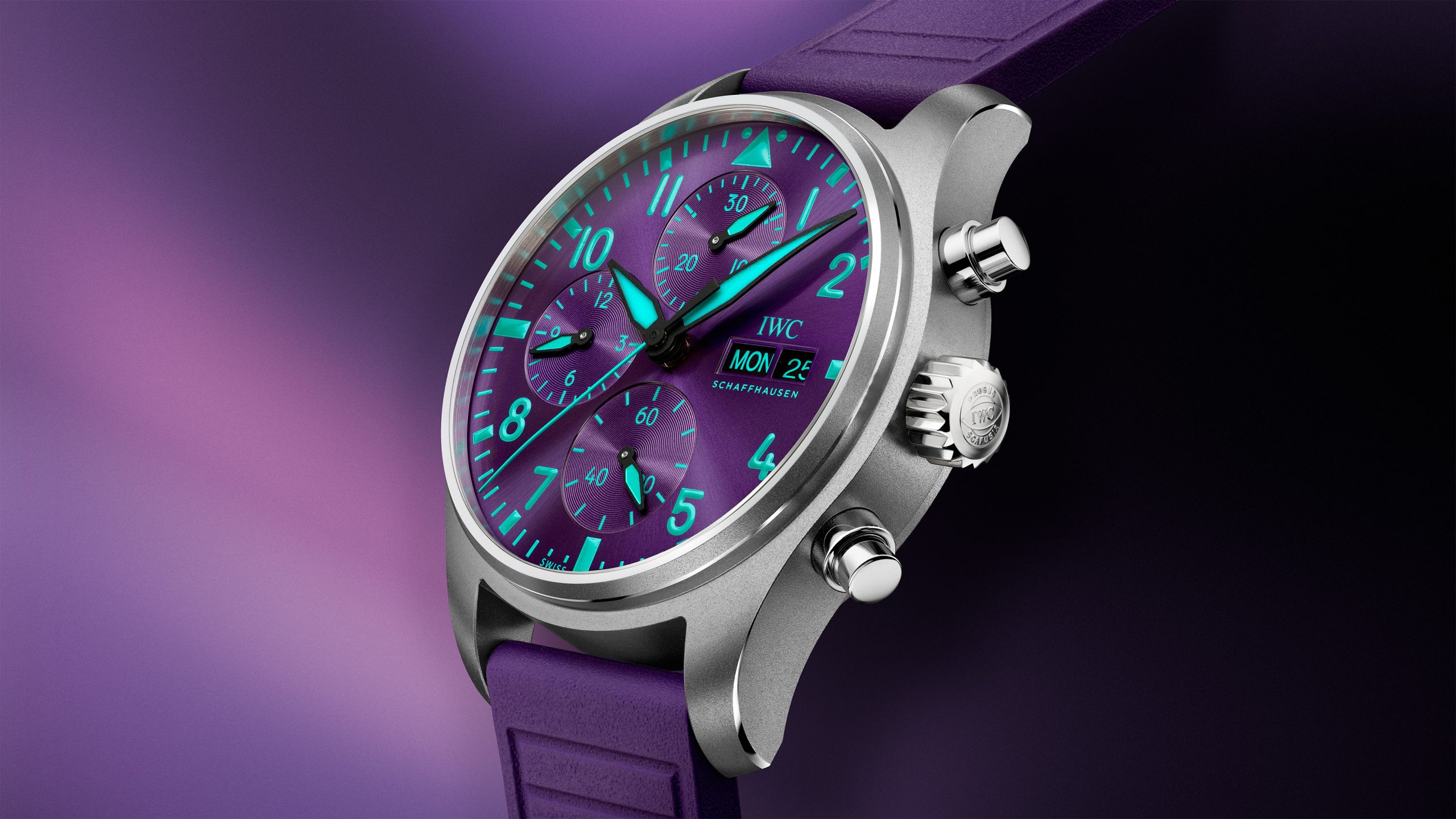
Singapore’s Formula 1 weekend has always looked different. Held beneath floodlights on the Marina Bay Street Circuit, the race transforms the city into a nocturnal spectacle of speed, heat and saturated colour. It is this distinctive atmosphere — and one of Singapore’s most important natural symbols — that has shaped IWC Schaffhausen’s latest motorsport-inspired watch. …
Continue reading “IWC’s purple Formula 1 chronograph pays tribute to Singapore after dark”