Ringling Circus Brother Built This Newly Listed Florida House in 1918 Complete With a Speakeasy
Alfred Ringling commissioned the Sarasota house, now listed for $2.5 million, solely for entertaining and hosting guests.

 2 min
2 min
A Sarasota, Florida, home built for one of the founders of the Ringling Brothers Circus is now up for sale, asking nearly $2.5 million.
The Gulf Coast home was built in 1918 for Alfred Ringling and his family as their “entertaining house,” according to listing agent Ryan Ackerman of Coldwell Banker Realty. A grander home where the family actually resided was built next door. Alfred Ringling, however, died in 1919 before he got to enjoy the property.
Because the home was built solely for entertaining and hosting guests, its main living space, designed as a ballroom, has 20-foot ceilings, and large bedrooms were built on the ground floor of the home. There’s also one very period-specific detail.
“The home was built during the Prohibition era, so there’s an area that was a speakeasy,” said Ackerman, who brought the home to the market in mid-March.
The speakeasy room is upstairs, with a slanted ceiling and a sink. It’s currently used as an art studio, though it could serve any function that’s needed by the next owners, whether that’s a home office or an additional bedroom.
There are many other original details, including the pine floors, baseboards and windows with hand-poured antique glass that open by a pulley system. There’s also original picture rails throughout, and the home’s paneled walls were made with the siding from the Ringling family’s train cars.
“All of the owners who have owned this home since Alfred Ringling have really kept true to the home in terms of its bones,” Ackerman said.
The home last traded hands in 2022, when Michele Vandendooren, founder of eye care company Low Vision Works, bought it for $1.6 million, according to records on PropertyShark.
Vandendooren said she felt a responsibility to preserve the historic home. “I see myself as a caretaker. It’s a home that deserves to be protected and loved,” she said in an email.
She “gently” modernized the home where needed, redoing the pool area and decking as well as the entire kitchen area, which includes the laundry room and a coffee bar, Ackerman said.
Located steps from the Sarasota Bay, the 4,782-square-foot home has five bedrooms, four full bathrooms and one partial bathroom . There’s a detached two-car garage, and the pool area also has a hot tub and a fire pit.
Alfred Ringling was the middle of seven brothers, though only five were involved with the circus, founded as the Ringling Bros. World’s Greatest Shows in 1884.
In 1919, the Ringling brothers acquired P.T. Barnum and James Anthony Bailey’s circus to become the Ringling Bros. and Barnum & Bailey Circus, which closed in 2017. The circus relaunched in 2023 without animal acts.
While the first iteration of the Ringling Brothers Circus was founded in Wisconsin, brothers John and Charles moved it to Sarasota. In the 1920s, John Ringling had an extravagant mansion built as his family’s winter retreat, known as Cà d’Zan.
It’s now a historical site that’s open to the public and is part of the Ringling Cultural Center, which also includes an art museum and a circus museum and is located just 2 miles south of Alfred Ringling’s home.
 Copyright 2020, Dow Jones & Company, Inc. All Rights Reserved Worldwide. LEARN MORE





Australian shares fell on Thursday as Wall Street weakness, rising oil and persistent rate concerns weighed on most of the market. The S&P/ASX 200 declined 0.72 per cent to 8,702. The All Ordinaries lost 0.66 per cent to finish at 8,897. Mining stocks were hit particularly hard, while real estate also dragged on the index. …
Continue reading “ASX falls 0.7 per cent as miners and property stocks retreat”

Borrowers cannot control the Reserve Bank, but they can control how exposed their household budget is to its next decision. The RBA meets on 29 September with inflation concerns still elevated and major-bank economists increasingly bringing forward their rate-rise calls. Fixed mortgage rates have also been moving, reducing the value of waiting for perfect certainty. …
Continue reading “What mortgage holders should do before the next RBA decision”
A five-bedroom Palo Alto home designed by Steven Ehrlich is listed for $44 million, making it the city’s most expensive listing. Built around a dramatic concrete spine, the home features four courtyards and a pool.
3 min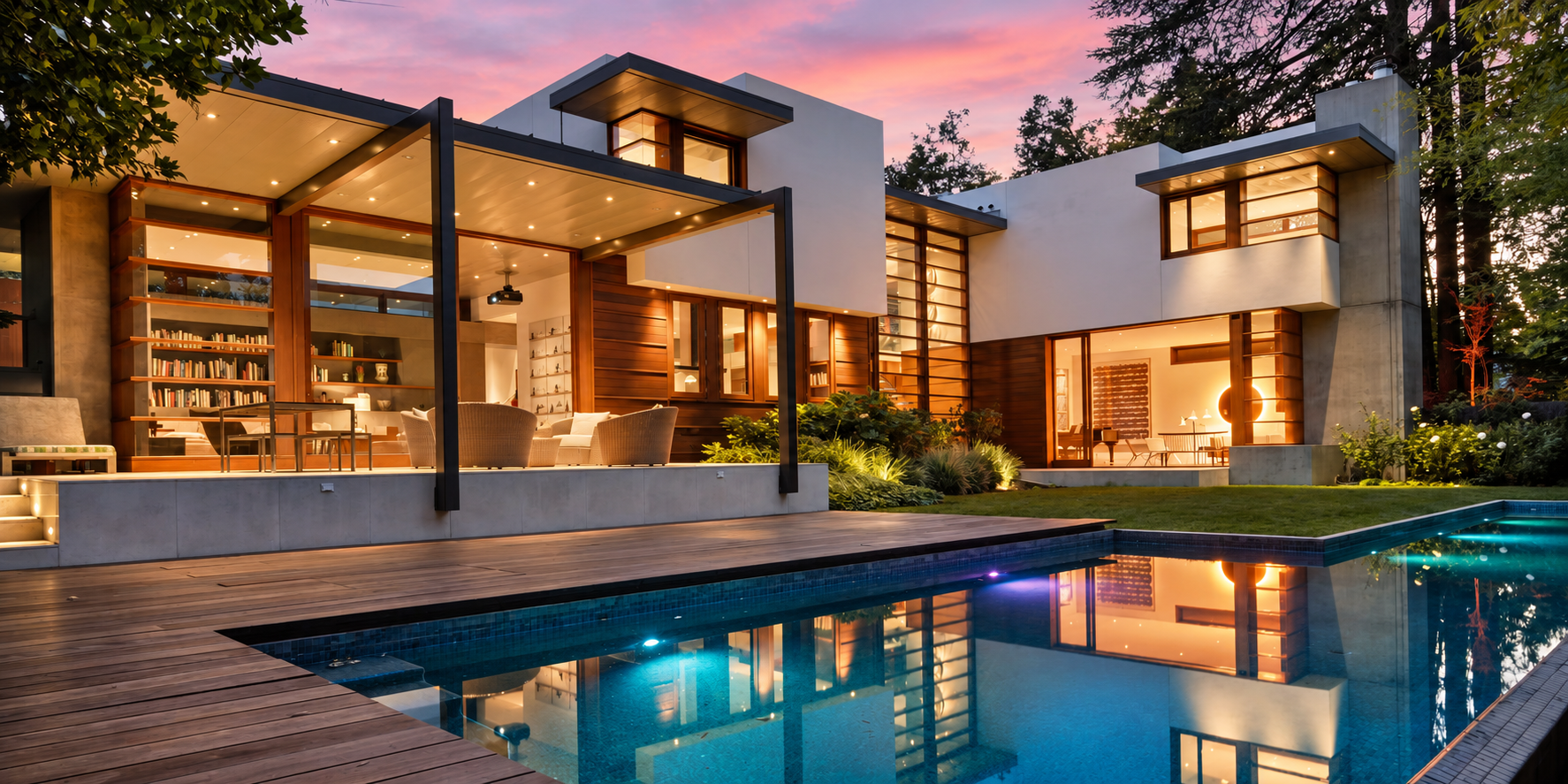
For years, tech entrepreneur Asher Waldfogel and his wife, Helyn MacLean, dreamed of building a modern house in Palo Alto, Calif.
The couple, however, worried about clashing with the Mediterranean-style architecture typically associated with their neighborhood of Old Palo Alto.
So they tapped architect Steven Ehrlich to create a design that paid homage to its surroundings with stucco, mahogany and titanium zinc cladding. They spent $20 million over several years building the house, completed in 2005.
Now looking to be closer to their adult daughter on the East Coast, they are putting the five-bedroom home on the market for $44 million—the most expensive listing in Palo Alto.
Waldfogel is an angel investor who co-founded Redback Networks, a telecommunications-equipment company. MacLean previously had a career in fundraising.
The couple purchased the roughly 0.4-acre site for $7.1 million in 2000 and demolished a circa-1930s Spanish Colonial home. The house they built pinwheels around a central staircase. It has 7,900 square feet of livable space, with four distinct courtyards and a pool.
A key feature of the home is a cast-in-place concrete wall, or spine, that is two stories high and about 80 feet long. “There’s a little bit of controlled chaos in what comes out of the form,” unlike a perfectly uniform surface, Waldfogel said. “If you want that, you do it in plastic.”
Waldfogel said he and his wife are thinking about the next phase of life now that their daughter is grown, although they have not decided where they will move. They also have a home in Sun Valley, Idaho.
“Right now we’re just trying to emotionally let go and decide what to do next,” he said.
Palo Alto, an epicenter of venture capital and tech startups in Silicon Valley, is home to some of the country’s biggest tech titans. Sales volume and prices are rising, with a median sale price of $3.5 million for the three months ending in August, up 5.8% year-over-year, according to real-estate brokerage Redfin.
Arthur Sharif of Sotheby’s International Realty—San Francisco Brokerage has the listing.

From citrus oils to warming spices, the classic G&T is being reimagined at home as a more thoughtful, seasonal ritual for modern entertaining.
When the Writers Festival was called off and the skies refused to clear, one weekend away turned into a rare lesson in slowing down, ice baths included.