Inside The Craft-Led Luxury Dog Brand Changing Pet Style
From Italian vegetable-tanned leather to real-world training insight, Australian brand PK9 Gear is redefining what luxury means for discerning dog owners.
 4 min
4 min
For many luxury consumers, the idea of premium pet accessories has long been synonymous with designer logos and glossy marketing.
But in Melbourne, professional dog trainer Chris Loverseed is quietly reshaping the conversation around what true luxury dog gear should look and feel like.
As founder of PK9 Gear, Loverseed sits at the intersection of functional performance and traditional craftsmanship, creating handcrafted collars, leads and harnesses designed first and foremost with the dog in mind.
“As trainers, we work with dogs in real-world environments every day, so that experience directly influences how we design every piece of gear,” he told Kanebridge News.
Unlike many mass-produced pet accessories, PK9 Gear products are developed through hands-on training rather than driven by aesthetic trends.
“One of our core principles is that we only design and sell products that we genuinely use ourselves in training,” he said.
“Unfortunately, many brands create products simply to look trendy or appealing on social media, with very little consideration for how they actually function for the dog or the handler in the real world.”

For Loverseed, product development begins with performance, ergonomics and canine wellbeing.
“When I design a product, I always start with a dog-first perspective, and then consider the handler.
“That might mean looking at how a collar sits on a dog’s neck, how a lead feels in the handler’s hand, or whether a tug toy gives the dog the right grip and satisfaction when they bite.
“If a product doesn’t improve the dog’s experience and make handling easier, we simply don’t make it. That philosophy sits at the centre of everything we create at PK9 Gear.”
Defining luxury beyond logos
In a crowded market of designer-inspired pet accessories, Loverseed believes true luxury is less about branding and more about authenticity.
“Standing out from mass-produced pet accessories is actually quite simple. Using ethical labour, quality materials, and genuine craftsmanship already sets you apart from much of the market.
“But defining luxury is more complex, because luxury can mean different things to different people.”
He sees a broader shift taking place among consumers who are increasingly questioning what luxury really represents.
“I believe there is also a noticeable shift happening in the market.
“With USA tariffs and those viral videos showing how many “luxury” handbags are actually manufactured, consumers are starting to question whether luxury is simply a price tag or something more meaningful.”
Instead, he points to a growing appreciation for understated design and meticulous detail.
“For me, it is twofold. First, I believe quiet luxury is becoming the new flex, where quality and craftsmanship speak louder than visible branding.”
His work with high-net-worth dog owners has reinforced this belief.
“As a professional dog trainer in Melbourne, I work with several VIP clients who live in $40 million plus homes.
“One thing I have noticed is that people at that level are rarely trying to impress others with logos. They value craftsmanship, authenticity and products that are simply made well.”
Materials also play a defining role in the brand’s positioning.
“At PK9 Gear, we take the opposite approach. We use premium vegetable-tanned leathers from Italy, sourced from tanneries that are part of the Pelle Conciata al Vegetale consortium.”
These traditional tanning methods prioritise durability, natural finishes and longevity. Hardware choices are equally considered, with solid brass, stainless steel and 24-carat gold PVD stainless steel used across the range, alongside hand-stitched construction techniques.
“For us, luxury is not about logos. It is about craftsmanship, integrity in materials and creating gear that is functional, beautiful and built to last for both the dog and the handler.”
The rise of Australian craftsmanship
As global consumers move away from fast fashion and disposable purchases, Australian artisans are finding renewed recognition.
“Australian craftsmanship is definitely gaining global attention, and I think part of that comes from consumers moving away from fast fashion and mass production,” Chris said.
“People are beginning to value products that are made properly, with care and attention to detail.”
PK9 Gear reflects this shift by offering both accessible performance-driven products and highly bespoke pieces that showcase traditional leatherworking techniques.
“Traditional handmade products naturally come at a higher cost because of the time, skill and materials involved.
“That alone places them in a more premium or luxury category, but many consumers are now willing to pay for something that will last longer and has genuine craftsmanship behind it.
A trainer’s favourite companion

Despite working with a wide range of breeds, Loverseed has a clear personal favourite.
“If I could have only one dog breed it would be a Rottweiler,” he says.
In a luxury market increasingly driven by authenticity, longevity and meaningful design, PK9 Gear represents a new kind of status symbol.
One that values quiet excellence over overt display and performance over perception.

Waldorf Astoria Kuala Lumpur is scheduled to open on 30 October, introducing the Hilton luxury brand to Malaysia with an all-suite hotel in the city’s Golden Triangle.

Located steps from Crows Nest Metro, the near-complete development brings luxury living to Sydney’s Lower North Shore.
3 min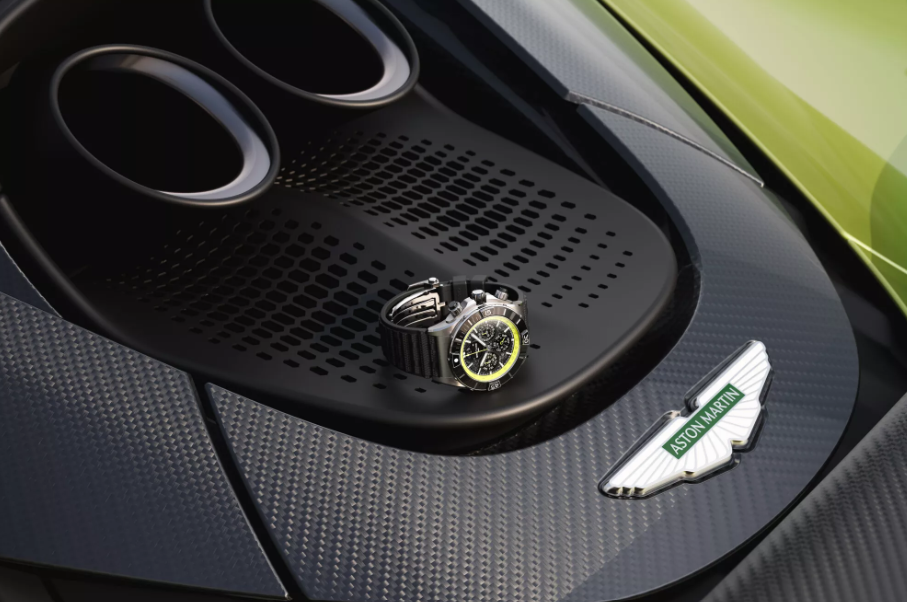
Buyers of Aston Martin’s 1,079PS Valhalla can commission one of two bespoke Breitling Super Chronomat watches, with colours and personalised details inspired by their individual car.
The relationship between cars and watches has produced countless branded chronographs, racing editions and logo-bearing collaborations. Breitling and Aston Martin are taking a more personal route with a new watch program reserved exclusively for owners of the Valhalla supercar.
Rather than offering every customer the same limited-edition watch, Breitling is opening part of its Super Chronomat design process to Valhalla owners. A dedicated configurator will allow each buyer to commission a timepiece inspired by the specification of their car and their individual tastes.
Two Super Chronomat models are available: a technically ambitious 44mm perpetual-calendar chronograph and a more compact 38mm automatic watch.
The flagship is the Super Chronomat B19 44 Perpetual Calendar Chronograph. Presented in a 44mm titanium case with Breitling’s distinctive Rouleaux bracelet, it combines a carbon-fibre dial with one of mechanical watchmaking’s most sophisticated complications.
Its automatic perpetual calendar accounts for months of different lengths, leap years and the phases of the moon. Provided it continues running, the calendar will not require manual correction until 2100—the next centurial year that will not be recognised as a leap year.
The B19 movement also provides a 96-hour power reserve, allowing the watch to be left unworn for four days without stopping. A display caseback exposes the movement and black rotor.
Valhalla owners can customise the colour of the inner bezel, seconds hand and chronograph counter hands. The rotor can also be engraved, creating a more permanent connection between the watch and its owner.
The second option, the Super Chronomat Automatic 38, offers a less complicated and more restrained interpretation.
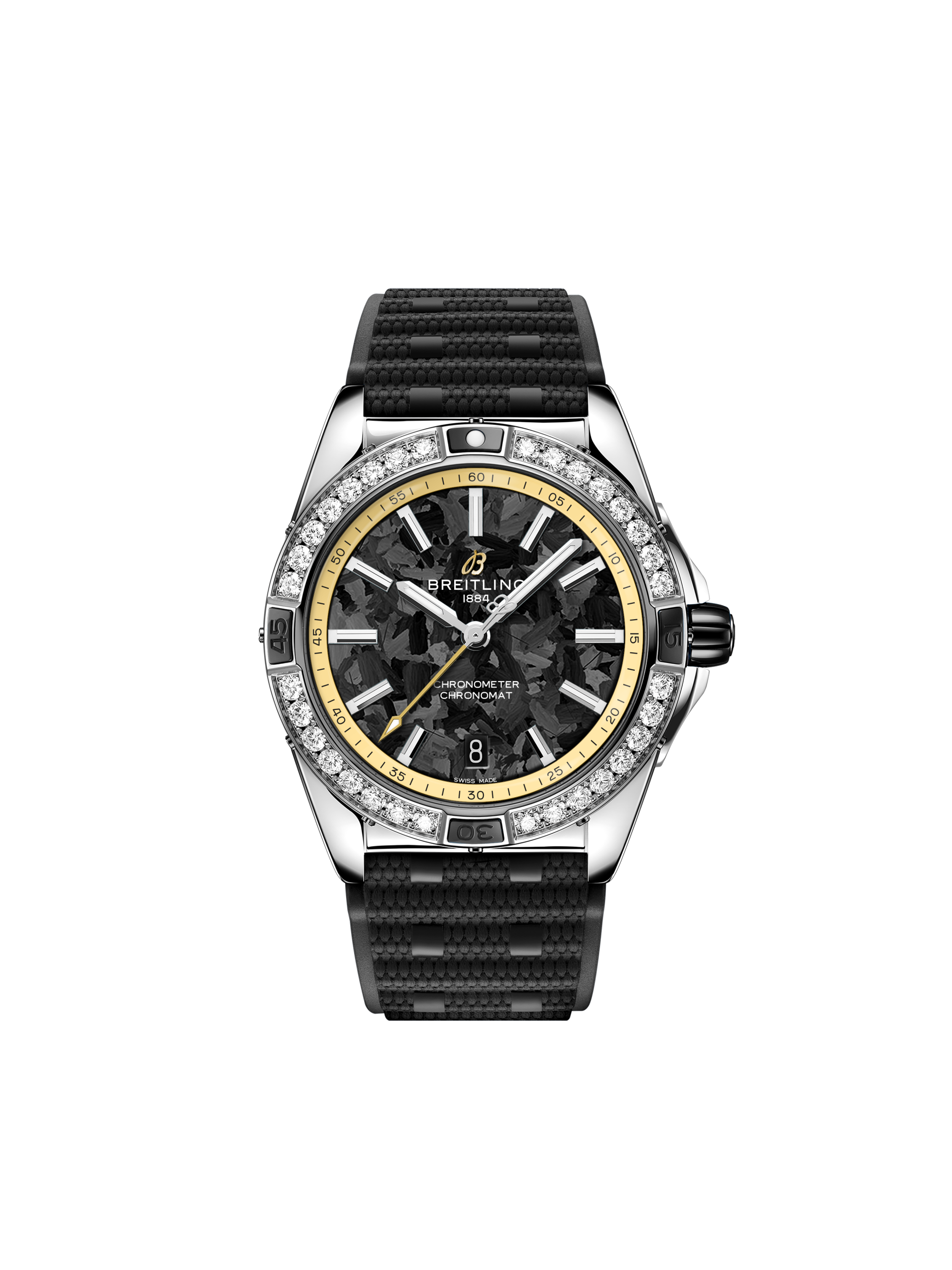
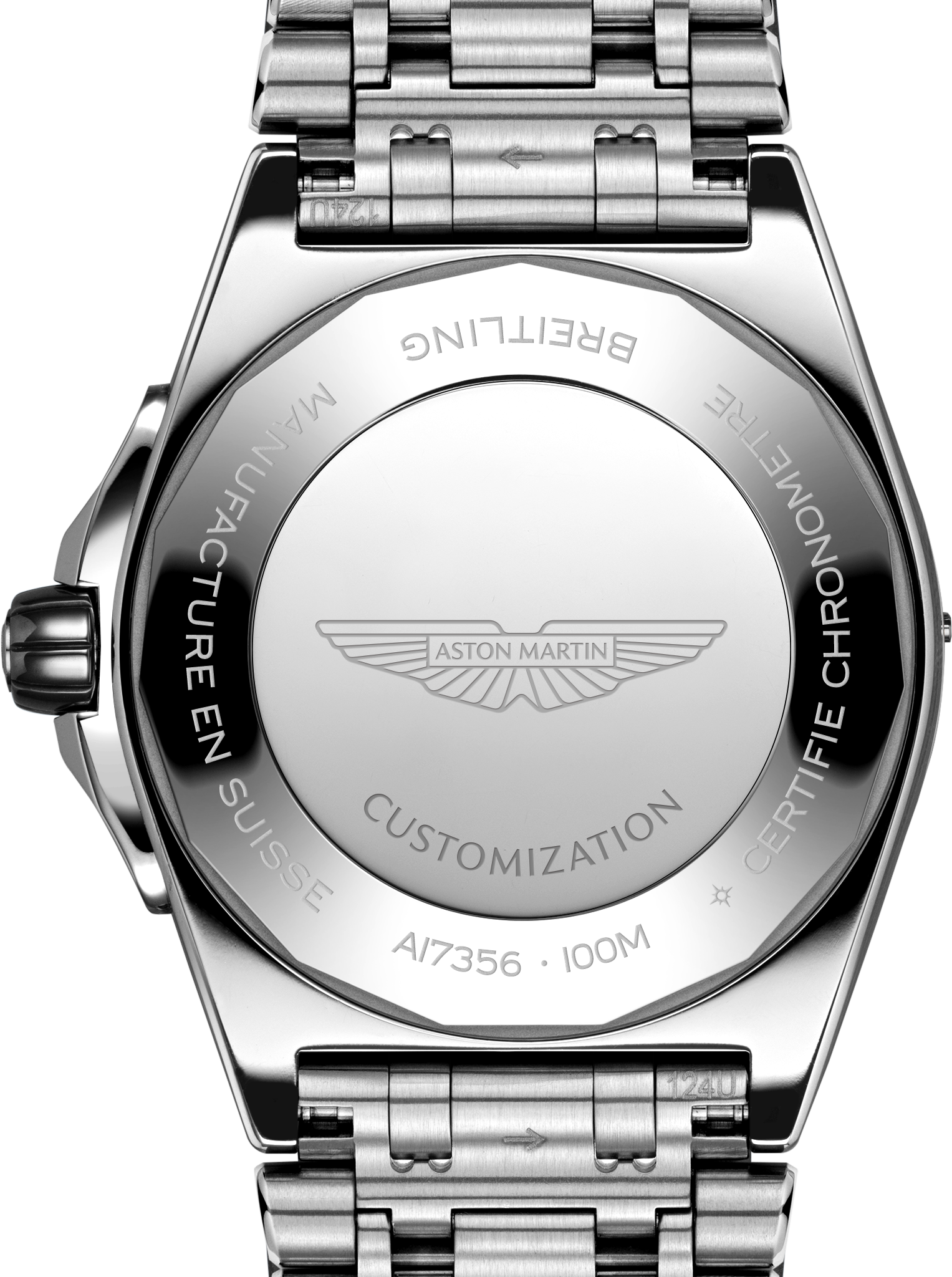
Its 38mm stainless-steel case is paired with a textured carbon-fibre dial, a titanium crown and a diamond-set bezel. The automatic three-hand display incorporates a date window at six o’clock, while customisation extends to the colours used for the inner bezel and hands, together with a personalised caseback engraving.
The combination of carbon fibre and diamonds might appear contradictory, but it captures the dual character of the Valhalla: a car built around highly technical performance that remains unmistakably positioned as a luxury object.
The watch program draws directly from Aston Martin’s first series-production, mid-engined plug-in hybrid supercar.
Valhalla combines a 4.0-litre twin-turbocharged V8 with three electric motors to produce 1,079PS. Aston Martin claims it can accelerate from zero to 62mph—approximately 100km/h—in 2.5 seconds and reach 217mph, or about 349km/h.

Production is limited to 999 examples worldwide.
Formula One-derived technology and aerodynamic development have played central roles in the car’s engineering, but customisation is equally important to its ownership proposition. Breitling’s configurator extends that process from the Aston Martin specification studio to the wrist.
Each car will be produced at Aston Martin’s headquarters in Gaydon, England, while the watches will be made at Breitling’s Chronometrie in La Chaux-de-Fonds, Switzerland.
The program also reflects a broader change in the luxury market. Exclusivity is increasingly being defined by access rather than the simple production of another numbered edition. These watches cannot be purchased merely by joining a waiting list or paying a premium on the secondary market; the commission begins with ownership of the corresponding car.
That restriction gives the project greater authenticity than a conventional co-branded release. The strongest configurations should be those that use colour and engraving to create a subtle relationship with a particular Valhalla, rather than attempting to reproduce the car too literally.
For Valhalla buyers, the choice ultimately comes down to two very different expressions of the same idea. The 44mm B19 is the serious collector’s proposition, built around a rare combination of perpetual calendar and chronograph. The Automatic 38 is simpler, smaller and likely more versatile as an everyday watch.
Both turn the usual automotive-watch collaboration into something more individual: a timepiece configured alongside one of Aston Martin’s most significant new cars.
Watch summary
Program: Bespoke Breitling Super Chronomat watches for Aston Martin Valhalla owners
Available models: Super Chronomat B19 44 Perpetual Calendar Chronograph and Super Chronomat Automatic 38
B19 case: 44mm titanium
B19 power reserve: Approximately 96 hours
B19 complication: Automatic perpetual calendar chronograph
Automatic 38 case: 38mm stainless steel
Shared design element: Textured carbon-fibre dial
Customisation: Selected colours and personalised engraving
Availability: Exclusively for Aston Martin Valhalla owners
Valhalla production: Limited to 999 cars worldwide

Micro-needling promises glow and firmness, but timing can make all the difference.

From Tokyo backstreets to quiet coastal towns and off-grid cabins, top executives reveal where they holiday and why stepping away makes the grind worthwhile.