Lamborghini and Babolat unveil limited-edition BL.001 padel racket

Automobili Lamborghini and Babolat have unveiled a new evolution of the BL.001 padel racket, introducing five fresh colour variants for the limited-edition design collaboration between the Italian supercar marque and the French sporting giant.

First launched in 2024, the BL.001 marked the beginning of the partnership between the two brands, combining Lamborghini’s expertise in engineering and composite materials with Babolat’s long-standing pedigree in racket sports.

The latest edition was revealed at Lamborghini Arena, the brand’s annual showcase event, with production once again capped at just 50 units globally.

According to Lamborghini, the new collection places a stronger emphasis on colour and finish, elements the company describes as central to its design identity.

Produced at Lamborghini’s Sant’Agata Bolognese facilities using processes inspired by its super sports cars, the racket features a 3K carbon surface designed to maximise responsiveness, power and precision.

The frame is reinforced with KORIDION, a rigid foam technology intended to improve structural stiffness and energy transfer on impact, while maintaining a high level of control for players.

The companies said the collaboration reflects a shared focus on innovation and high performance, with the racket positioned as more than simply a sporting accessory.

The BL.001 will be exclusively showcased and tested during Lamborghini Arena 2026, taking place at Italy’s Imola Circuit on May 9 and 10, where media, influencers and guests will have the opportunity to trial the racket firsthand.

ITALY’S FINE WINES GAIN GROUND AS VALUE PLAY FOR COLLECTORS

Italian fine wines are gaining momentum among Australian collectors and drinkers, with new data from showing a surge in interest driven by value, versatility and a new generation of producers.

Long dominated by France, the premium wine conversation is beginning to shift, with Italy increasingly positioned as a compelling alternative for both drinking and collecting.

According to Langtons, the category is benefiting from a combination of factors, including its breadth of styles, strong food affinity and more accessible price points compared to traditional European benchmarks.

“Italy has always offered fine wine fans an incredible range of wines with finesse, nuance, expression of terroir, ageability, rarity, and heritage,” said Langtons General Manager Tamara Grischy.

“There’s no doubt the Italian wine category is gaining momentum in 2026… While the French have long dominated the fine wine space in Australia, we’re seeing Italy become a strong contender as the go-to for both drinking and collecting.”

The shift is being reinforced by changing consumer preferences, with Langtons reporting increased demand for indigenous Italian varieties and lighter, food-first styles such as Nerello Mascalese from Etna and modern Chianti Classico.

This aligns with the broader rise of Mediterranean-style dining in Australia, where wines are expected to complement a wider range of dishes rather than dominate them.

Langtons buyer Zach Nelson said the category’s versatility is central to its appeal.

“Italian wines often have a distinct, savoury edge making them an ideal pairing for a variety of cuisines,” he said.

The move towards Italian wines also comes as prices for traditional French regions continue to climb, particularly in Burgundy, prompting collectors to look elsewhere for value without compromising on quality.

Italy’s key regions, including Piedmont and Etna, are increasingly seen as offering that balance, with premium wines available at comparatively accessible price points.

Nelson said value is now a defining factor for buyers in 2026.

“Value is the key driver for Australian fine wine consumers… Italian wines are offering exactly that at an impressive array of price points to suit any budget,” he said.

The category is also proving attractive for newer collectors, offering what Langtons describes as “accessible prestige” and a more open entry point compared to the exclusivity often associated with Bordeaux.

Wines such as Brunello di Montalcino and Nebbiolo-based expressions are increasingly being positioned as entry points into cellar-worthy collections, combining ageability with relative affordability.

At the same time, a new generation of Italian producers is reshaping the category, moving away from heavier, oak-driven styles towards wines that emphasise site expression and vibrancy.

“There’s definitely a ‘new guard’ of Italian winemaking… stripping away the makeup… to let the raw, vibrating energy of the site speak,” Nelson said.

Langtons is also expanding its offering in the category, including exclusive access to wines from family-owned producer Boroli, alongside a broader selection spanning Piedmont, Veneto, Sicily and Tuscany.

The company will showcase the category further at its upcoming Italian Collection Masterclass and Tasting in Sydney, featuring more than 50 wines from 23 producers across four key regions.

For collectors and drinkers alike, the message is clear: Italy may have been overlooked, but it is no longer under the radar.

A Radical New Engine Shows Why Internal Combustion Still Matters

Reports of the death of the internal combustion engine have been exaggerated.

Electric vehicles were once poised to diminish the ubiquity of traditional engines, but automakers are booking huge losses and killing off one new model after another.

Sales of new electric vehicles in the US this past quarter were only half what they were at their peak in the third quarter of 2025, according to industry service provider Cox Automotive.

While there’s still an overall trend toward electrification of the world’s light-duty vehicles, gas power is now likely to remain the choice of most consumers for a while—especially in the US where gasoline remains cheaper than in the rest of the world. In defence and aviation, experts say, full electrification may never be an option.

That’s prompted more companies to take a fresh look at old combustion tech, including the rotary engine. They’re also figuring out new ways for gas power and battery power to work together.

A century-old engine, reinvented

Alexander Shkolnik is founder of LiquidPiston, a company attempting a nearly impossible feat: developing a liquid-fuel-powered alternative to the traditional piston engine. 

He says his company has cracked the problem, at least for limited applications.

The key is the rotary engine. Unlike a traditional gasoline or diesel engine, it has no pistons. 

Instead, it has an oddly shaped chunk of metal at its heart, spinning inside an oblong chamber in which the usual cycle of compression, combustion and exhaust takes place. 

LiquidPiston’s engine can run on everything from diesel to jet fuel, while being a fraction of the size of a comparable diesel engine, and up to 30% more efficient than a comparable gasoline one.

Shkolnik and his team didn’t invent this. The first rotary engines were pioneered in the late 1800s by French and American inventors, and made their way into early motorcycles and airplanes. In the 1950s, German engineer Felix Wankel updated the concept to include the spinning triangular rotor. LiquidPiston calls its engine an “inside-out Wankel” to acknowledge the commonalities.

The U.S. Army and Air Force are both watching. Over the past decade, the Defense Department, including its cutting-edge research-funding body Darpa, has pumped tens of millions of dollars into the company. 

Whether LiquidPiston’s engine is up to snuff as a portable power station for front-line troops will become evident by sometime next year. 

That’s when the Army should have results from tests of the latest prototype, says Matthew Willis, director of Fuze, the Army’s new venture-capital-style funding body.

LiquidPiston’s rotary engine is also suited to powering long-range hybrid drones, says Shkolnik. 

The company built and flew a prototype of one such drone, in which batteries power the vertical takeoff and the rotary engine takes over for long-range horizontal flight. 

The company is now working on a second, updated version for the Air Force. The hope is that eventually such a drone could fly farther and run quieter than one powered by a piston engine.

The automaker that won’t give up

Wankel’s engine is legendary among engineers and gearheads, on account of its simplicity and elegance: It has far fewer parts than a typical piston engine. 

While General Motors spent years working fruitlessly to develop rotary engines, Mazda’s efforts made it to the showroom floor. 

In 1967 the company released the Cosmo Sport 110S, a car legendary for its styling if not its reliability. Others, including France’s Citroën, dabbled in rotary.

The rotary engine’s last U.S. appearance was in the 2012 Mazda RX-8 sports car. The vehicle was beloved for the sound of its race-car-like engine, but its dirty emissions ultimately doomed it—a chronic Wankel problem.

Mazda never gave up completely. In 2024, the company reconstituted its rotary engine research group. 

In 2025, the company unveiled a truly odd duck: the 510-horsepower plug-in hybrid Vision X-Coupe concept car with 100 miles of electric-only range, and up to 500 miles total with the car’s rotary gas engine engaged.

In the X-Coupe, the vehicle’s shaft is directly driven by a Wankel. “This direct propulsion delivers an evolved ‘joy of driving’ with significant range,” says a company spokeswoman.

Translation: This is no Prius, but part of a new breed of plug-in hybrid supercars. (See also: Ferrari)

A strange new hybrid

A new kind of hybrid could be a bridge technology to EVs, says James Turner, a professor of mechanical engineering at King Abdullah University of Science and Technology in Saudi Arabia.

Instead of battery-powered electric motors working to support the gas powertrain, as in many contemporary hybrids, the gas motor serves as a generator to charge the electric powertrain’s battery. 

That’s why they’re called extended-range electric vehicles, aka EREVs. Nissan has said it would release an EREV version of its bestselling Rogue next year.

LiquidPiston’s Shkolnik says that someday, his company’s novel rotary engine could be ideal for providing range extension.

For the foreseeable future, the right answer will be the current style of hybrid with a traditional engine, says James Heywood, who literally wrote the textbook on modern internal combustion engines. 

If every new car was a hybrid, the U.S. could increase gas vehicle efficiency by 30% while raising the sticker price by a single digit percentage, he says.

Hybrid, plug-in hybrid and EREV tech works regardless of the engine style, and regardless of whether that vehicle drives, flies or swims. 

The entire world’s personal-vehicle fleet will eventually be almost entirely electric, says Turner. 

But on the way there, the gas-powered combustion engines will play an invaluable, if supporting, role.

SUSTAINABLE TRAVEL SHIFT AS AUSSIES DODGE CROWDS AND CLIMATE RISKS

Australians are quietly rewriting the rules of travel, moving away from peak-season getaways and crowded hotspots as climate concerns and changing habits reshape the industry, new research from Booking.com shows.

The 2026 Travel & Sustainability Report reveals that timing and destination are now central to how Australians approach travel, with 42 per cent planning to holiday outside peak periods and 43 per cent actively avoiding overcrowded destinations.

This is not just about comfort. It reflects a broader shift in thinking, where travellers are increasingly aware of their impact on places they visit, with many deliberately trying to reduce pressure on popular destinations.

At the same time, climate is no longer a background consideration. It is shaping decisions in a far more immediate way. Nearly three-quarters of Australians now factor extreme weather into where and when they travel, while more than a quarter have already changed or cancelled trips in the past year due to weather events.

There is also a growing sense that some destinations are becoming less viable altogether. More than half of Australians say certain locations have become too hot to visit at their preferred time of year.

A generational split is emerging

While sustainability is now firmly on the agenda, the report highlights a gap between what travellers say and what they actually do.

Younger Australians tend to express stronger views about sustainable travel, yet it is older travellers who are more likely to follow through with practical actions such as reducing waste, cutting energy use and shopping locally.

That does not mean younger travellers are disengaged. They are more likely to participate in cultural experiences and conservation-focused activities, pointing to a different interpretation of what sustainable travel looks like.

From intention to behaviour

The shift is already playing out in booking patterns. Across the region, more travellers are choosing accommodation with recognised sustainability credentials, and sustainable travel is moving from a niche consideration to a mainstream expectation.

Yet barriers remain. Cost, confusion and a lack of clear information continue to hold some travellers back from making more sustainable choices, suggesting the industry still has work to do in making those options accessible and easy to understand.

For now, the direction is clear. Travel is becoming less about ticking off destinations at peak moments and more about timing, impact and experience.

Or, put more simply, Australians are still travelling, just a little more thoughtfully than before.

RETAIL PROPERTY BOOM FACES NEW RISKS AS GEOPOLITICS CLOUDS OUTLOOK

Australia’s retail property sector entered 2026 as the strongest performing commercial asset class, but rising geopolitical risks and cost pressures are beginning to test its resilience, according to new research from Knight Frank.

The latest Australian Retail Review shows the sector rode a wave of consumer spending and constrained supply through 2025, delivering total returns of 9.2 per cent and driving transaction volumes up 43 per cent year-on-year to $14.4 billion.

That momentum carried into early 2026, with around $3.6 billion in deals recorded in the first quarter alone.

“Retail clearly emerged as the standout commercial property performer in 2025,” said Knight Frank Senior Economist, Research & Consulting Alistair Read.

“Improving household spending, limited new supply and stronger leasing fundamentals combined to drive better income growth and renewed investor confidence in the sector.”

Spending rebound drives retail strength

A lift in household spending has been central to the sector’s performance. Consumer spending rose 4.6 per cent year-on-year to February 2026, supported by easing inflation and improving real incomes.

That shift flowed directly into retailer performance, with average EBIT margins across major retailers rising to 8.9 per cent in the first half of 2026, their strongest level in several years.

“Stronger consumer spending was critical in restoring momentum to the retail sector,” Mr Read said.

“Retailers have generally been better able to absorb costs, rebuild margins and support sustainable rental outcomes, particularly in higher-quality centres.”

Improved trading conditions also pushed leasing spreads up 4.2 per cent in 2025, reinforcing income growth and supporting capital values.

Geopolitical tensions begin to bite

But the outlook has become more complicated. The report warns that escalating conflict in the Middle East and its impact on fuel prices, supply chains and interest rates could weigh heavily on consumer spending.

“Higher fuel prices, flow-on cost pressures across supply chains, and recent interest rate increases are collectively squeezing household budgets, and early consumer sentiment data suggests confidence is already softening,” Mr Read said.

“While household balance sheets remain generally resilient, heightened uncertainty over future costs is likely to weigh on spending — particularly in discretionary categories — in the months ahead.”

The impact is already being felt in investment activity. While the year began strongly, transaction volumes slowed in March as investors paused amid the uncertainty.

“Early indicators suggest elevated uncertainty has already begun to affect the market. While retail investment enjoyed its strongest start to a year in a decade, with nearly $3 billion transacted by the end of February, activity stalled in March, as investors took a pause amid elevated uncertainty,” Mr Read said.

Solid foundations support medium-term outlook

Despite the near-term headwinds, Knight Frank maintains that the sector’s underlying fundamentals remain strong. Limited new supply, high construction costs and population growth are expected to continue supporting rental growth over the medium term.

“Retail has entered this period of uncertainty from a position of strength,” Mr Read said.

“Supply-side constraints, population growth and improving income fundamentals remain powerful structural supports for the sector.”

The report highlights several trends shaping the year ahead, including steady yields as interest rates rise, mounting pressure on tenant margins, continued outperformance of prime centres, the growing need for logistics integration, and risks linked to underinvestment in capital expenditure.

For now, retail remains a sector with momentum, but one increasingly at the mercy of forces far beyond the shopping centre.

AUSTRALIA’S PROPERTY BOOM IS MASKING A DEEPER ECONOMIC PROBLEM

For decades, Australia has leaned into its reputation as the lucky country. But luck, as it turns out, is not an economic strategy. 

What once looked like resilience now appears increasingly fragile. Beneath the surface of rising property values and steady headline growth, the Australian economy is showing signs of strain that can no longer be ignored. 

Recent data paints a sobering picture. Australia has recorded one of the largest declines in real household disposable income per capita among advanced economies.  

Wages have failed to keep pace with inflation, meaning many Australians are working harder for less. On a per capita basis, income growth has stalled and, at times, reversed. 

And yet, on paper, things still look relatively solid. GDP is growing. Unemployment remains low. But that growth is increasingly being driven by population expansion rather than productivity.  

More people are contributing to output, but not necessarily improving living standards. 

That distinction matters. 

For years, Australia’s economic success rested on a powerful combination: a once-in-a-generation mining boom, a credit-fuelled housing market, strong migration and a property sector that rarely faltered. Between 1991 and 2020, the country avoided recession entirely, building enormous wealth in the process. 

But much of that wealth is tied to property. Around two-thirds of household wealth sits in real estate, inflated by leverage and sustained by demand. It has worked, until now. 

The problem is the supply side of the economy has not kept up. 

Housing supply is falling behind population growth. Rental vacancies are near record lows.  

Construction firms are collapsing at an elevated rate. At the same time, massive infrastructure pipelines are competing with residential projects for labour and materials, pushing costs higher and delaying delivery. 

The result is a system under pressure from all angles. 

Despite near full employment, productivity growth has stagnated for years. In simple terms, Australians are putting in more hours without generating more output per hour. The economy is running faster, butgoing nowhere. 

Meanwhile, government spending continues to expand. Public debt is approaching $1 trillion, with spending now accounting for a record share of GDP.  

The gap between spending and revenue has been filled by borrowing for decades, adding further pressure to an already stretched system. 

This is where the uncomfortable question emerges. 

Has Australia become too reliant on a model driven by rising property values, expanding credit and population growth? 

As asset prices rise, households feel wealthier and borrow more. Banks lend more. Governments collect more revenue. Migration fuels demand. The cycle reinforces itself. 

But when productivity stalls and debt outpaces real income, the system begins to depend on constant expansion just to stay stable. 

It is not a collapse scenario. But it is not particularly stable either. 

Nowhere is this more evident than in housing. 

The National Housing Accord targets 1.2 million new homes over five years, yet current completion rates are well below that pace. With approvals falling and construction costs rising, the gap between supply and demand is widening, not narrowing. 

Housing is also one of the largest contributors to inflation, with costs rising sharply across rents, construction and utilities. Yet the private sector, from small investors to major developers, is struggling to make projects stack up in the current environment. 

This brings the policy debate into sharper focus. 

Tax settings such as negative gearing and capital gains concessions have undoubtedly boosted demand over the past two decades. But they have also supported supply. Removing them may ease prices briefly, but risks deepening the supply shortage over time. 

That is the paradox. 

Policies designed to make housing more affordable can, in practice, make the shortage worse if they discourage development. The optics may appeal, but the economics are far less forgiving. 

It is also worth remembering that most property investors are not institutional players. The majority own just one investment property. They are, in many cases, ordinary Australians using real estate as their primary wealth-building tool. 

Undermining that system without replacing it with a viable alternative risks unintended consequences, from reduced supply to higher rents and increased inflation. 

So where does that leave Australia? 

At a crossroads. 

The country can continue to rely on population growth and rising asset prices to drive economic activity. Or it can shift towards a model built on productivity, innovation and sustainable growth. 

The latter is harder. It requires structural reform, long-term thinking and political discipline. 

But it is also the only path that leads to genuine, lasting prosperity. 

The question is no longer whether Australia has been lucky. 

It is whether it can evolve before that luck runs out. 

Paul Miron is the Co-Founder & Fund Manager of Msquared Capital. 

PROPERTY OF THE WEEK: BOUTIQUE BYRON RETREAT WITH FIVE-STAR RETURNS

An exclusive slice of Byron Bay’s hinterland hospitality has entered the property chat.

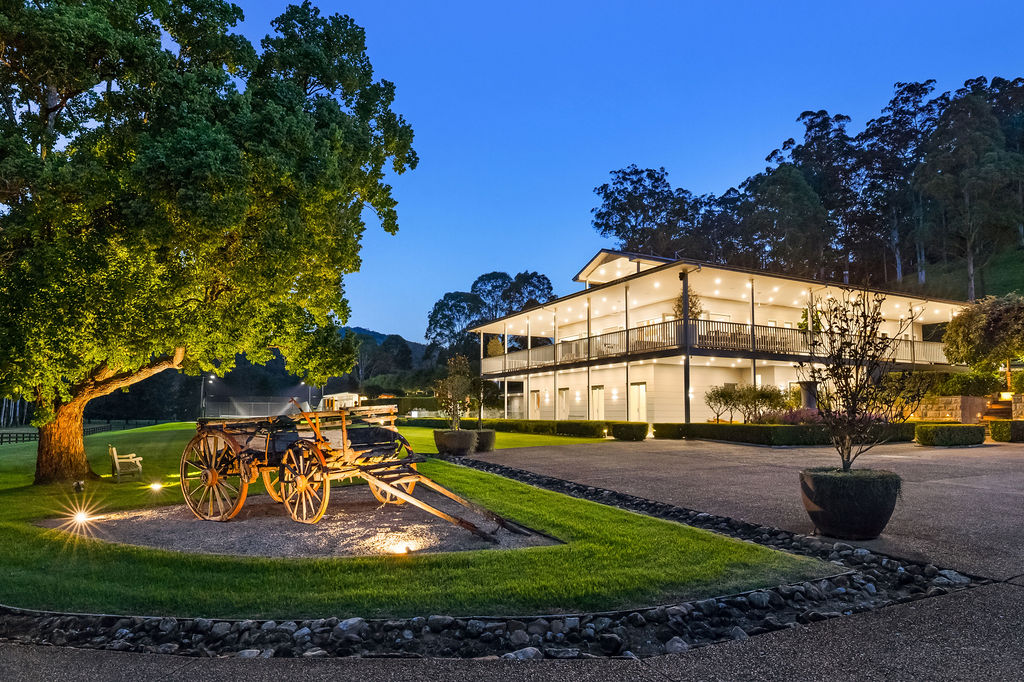
The Brooklet is a boutique adults-only retreat hidden in the hills around 20 minutes’ drive west of the iconic beach town.

As a getaway, each of The Brooklet’s luxury cabins earns between $800 and $2000 a night, but as a prestige asset, the 47ha estate is expected to fetch more than $20 million through selling agents Kim and Angus Jones of Kim Jones & Co Real Estate.

With a stellar reputation as one of the region’s premier design-led accommodation venues, coupled with its enviable location just outside of Newrybar, the expansive retreat has been turning heads since it opened about three years ago.

Time Out Sydney recently gave The Brooklet a full five-star rating, describing it as a “ridiculously heavenly idyll”. Across all booking platforms, the rural escape has earned an impressive 9.6 out of 10 rating.

Elevated above the surrounding countryside and just down the road from the late Olivia Newton-John’s former retreat, Gaia, this one-time macadamia farm has sweeping panoramic views, total seclusion from neighbours, and a sophisticated level of finishes throughout the personal and communal spaces.

The architect-designed accommodation includes six black-clad self-contained villas alongside two standalone three-bedroom residences, each with its own private pool; The Farmhouse and a reimagined dairy known as The Bails. There is the potential for the next owners to expand upon the existing accommodation offerings, with DA approval for two more villas and an additional recreational space.

Each individual one- or two-bedroom villa has been crafted to maximise light, space and outlook, with high ceilings, cosy fireplaces, balconies, full kitchens, palatial bedroom suites and chic bathrooms.
The amenities at The Brooklet elevate the experience from a regional resort to a glamorous, full-scale retreat. A 25m heated mineral infinity pool with an integrated pool blanket is perfectly positioned along the ridgeline and anchored by a timber deck and an outdoor fireplace, surrounded by district views.

Additional wellness perks in The Barn include an infrared sauna, an ice bath, a mineral hot tub, a fully equipped gym, and a full tennis court. There is also a treatment room and meeting space.

The Brooklet Bar is set up for wine tasting with another warming fireplace for intimate gatherings.

Walking trails weave through the property, and organic gardens provide herbs, flowers, and produce for guests to take back to their accommodations.

Bonus infrastructure with the property includes a private helipad, EV charging capability, 270,000L tank water storage and a bore supply for self-sufficiency.

The Brooklet is approximately five minutes from Newrybar with its general store and cafe, eclectic boutiques and future new dining precinct. It is also eight minutes to Bangalow and about 20 minutes to central Byron Bay, its world-famous beaches and lighthouse, plus the Ballina-Byron Gateway Airport.

The Brooklet at 841 Fernleigh Rd, Brooklet is listed with Kim Jones & Co Real Estate with a price guide in the vicinity of $20 million.

The U.S. Wants to Ban China’s High-Tech Cars, but They’re Already Here in El Paso

CIUDAD JUÁREZ, Mexico—Just 5 miles from the U.S. border, a bustling commercial strip here offers the buzzy Chinese car brands currently blocked from the American market.

A Geely dealership features the all-electric EX2, a sleek compact that starts at only around $20,000. A bulky hybrid pickup truck sits next to a charger outside a BYD dealership. Great Wall Motors boasts some beefy gas-powered sport-utility vehicles, one advertised with the slogan “Be More Tank.”

Luis Hernandez, a Geely salesman, said he has poached many longtime Ford and Chevrolet owners attracted to the affordable sticker prices and whiz-bang Chinese technology.

He recently sold two Geely Emgrand sedans, which start at around $17,000, to a Mexican family for their two daughters to commute to college in El Paso, where the sleekest Chinese cars are now attracting attention.

“If they were allowed to be sold in the United States,” Hernandez boasted of the Chinese models, “they would destroy the American car market.”

U.S. automotive executives don’t entirely disagree. Without a clear plan to deal with Chinese competitors, some of them said in interviews, the arrival of affordable, high-tech Chinese cars could upend a U.S. industry that contributes $1.3 trillion to the economy each year.

“I’m telling you, it is very difficult—not to say impossible—to compete,” said Hyundai Motor Chief Executive José Muñoz . “We cannot compete at the same price as the Chinese in the market where we operate. Otherwise, we will be losing money.”

So far, the many Chinese car companies that want to expand into the U.S. have been kept at bay. The U.S. has applied sky-high tariffs to vehicles imported from China, and regulations make it nearly impossible for such vehicles purchased in Mexico to be registered in the U.S.

A trio of senators has urged the Trump administration this month to ban Chinese vehicles sold and registered in Mexico and Canada from entering the country; several dozen House lawmakers sent a similar letter this week. A Senate bill to prohibit China’s carmakers from building cars in the U.S. is being crafted.

“Whenever there’re market challenges, reality is, we’ll need to find a way to adapt to it,” said Brian Gu , vice chairman of Chinese carmaker Xpeng . “But our long term goal is to make our products available to as many customers as possible, including the U.S. customers.”

It’s no secret that Chinese EVs match up well against their American counterparts. After test driving a Xiaomi SU7 MAX, a Wall Street Journal columnist in January wrote a love letter to the car that isn’t yet available in the U.S.

But it isn’t just Chinese EVs that are keeping American car executives awake at night. Some of China’s biggest automakers have expanded into gas-powered and hybrid vehicles that are more in line with the American market.

“For me, it’s not only an EV problem,” said Christian Meunier , chairman of Nissan Americas, which competes with Chinese carmakers in Mexico.

The threat to the U.S. car industry, which notched more than 16 million new-vehicle sales last year, is unlike anything it has faced in decades. Having largely abandoned budget cars years ago, Detroit’s Big Three now rely heavily on expensive SUVs and pickup trucks that deliver fatter profits.

At the same time, fewer entry-level models are being offered to car buyers. No new car offered in the U.S. today has a sticker price below $20,000. The Chinese have vehicles ready to fill that market hole.

Auto executives and lawmakers say China has created an unfair playing field, with heavy government subsidies and ultralow labor costs. In addition to applying tariffs, the U.S. government banned Chinese-connected software in new cars.

BYD, Geely and Great Wall Motors are now among the biggest carmakers in the world. They have been gobbling up market share in Europe and other parts of Asia. In Mexico, Chinese vehicles account for a quarter of total sales. Soon, Canada will allow tens of thousands of inexpensive Chinese EVs to be imported.

Sen. Bernie Moreno (R., Ohio) said the bill he plans to introduce would “hermetically seal” the U.S. from Chinese automakers. Chinese cars from Canada or Mexico couldn’t be driven into the country.

American car companies couldn’t pursue joint-ventures with Chinese automakers. Chinese car companies that own U.S. brands, such as Geely-controlled Volvo and Polestar, would have to divest themselves of those brands by 2030.

Cheaper and sleeker

U.S. consumers, though, are warming to the Chinese car alternative. About 30% of American car buyers would be open to buying a vehicle from China, up by 15 percentage points from a decade prior, according to a survey by Strategic Vision, a market-research firm.

Federal regulations allow Mexican residents and those with dual citizenship to drive their cars into the U.S., even if their vehicles aren’t compliant with relevant standards.

That is giving Americans along the border a firsthand look at the Chinese competition. undefined undefined Every week, 21-year-old Dario Araiza drives his Chinese BYD Song Pro plug-in hybrid across the border from Ciudad Juárez through El Paso to attend flight school. It’s a sleek four-door SUV.

BYD hooked him with affordability. Araiza paid about $31,500 for the vehicle last fall at the BYD dealer. The cabin technology is intuitive, he said. Airbags are labeled in both English and Chinese. A karaoke app—a hallmark of Chinese cars—is available for use while driving.

Araiza said no other automaker came close to offering something with as much value at that price. “Cars that were $35,000 were worse than what I had before,” he said.

At an El Paso car dealer network, Casa Auto Group, salespeople said prospective buyers have started asking why they don’t offer something as inexpensive as the Chinese cars sold just miles away in Mexico.

Ronnie Lowenfield, Casa’s chief executive, said that with new American cars now averaging $50,000, customers curious about Chinese cars mention affordability. That should sound the alarm for domestic automakers, he said.

“When manufacturers don’t have an interest in affordability, and they do have a financial interest—I will say, short-term financial interest—in producing a lot higher dollar vehicles, I think it’s a slow death,” he said.

The U.S. auto industry has been in this position before. In the 1970s, Toyota and other Japanese car companies began grabbing market share.

The subsequent entry of Hyundai and Kia undermined any lingering edge domestic carmakers had in the budget sedan market. The combined market share of General Motors and Ford Motor, once roughly 70%, declined sharply, and Chrysler nearly went bankrupt in the early 1980s.

That’s around when China’s auto industry got off the ground, helped by joint ventures with Western automakers.

In 2006, Geely showed up at the Detroit auto show with a dowdy sedan it hoped to sell in the U.S. within two years for less than $10,000. Car and Driver magazine deemed Geely’s vehicles “hopelessly outdated.”

At first, the U.S. industry shrugged off the new competition. In a 2011 interview, Tesla Chief Executive Elon Musk burst out laughing when asked about an EV that BYD hoped to bring to the U.S. “Have you seen their car?” Musk said.

But China continued to invest in automaking, bolstered by its access to crucial raw materials needed for components such as EV batteries and windshield wipers to work properly. Along the way, it continued to learn from the American industry, through the joint ventures that Beijing required of U.S. carmakers to operate in the country.

“They’ve had about 20 to 25 years of experience, and then it wasn’t a very big step for some of the entrepreneurial-focused ones—like BYD—to decide to go into business on their own,” said Bob Lutz, a former senior executive at Ford, Chrysler, BMW and GM, where he was vice chairman.

Earlier this decade, Lutz said, he had an epiphany about how advanced Beijing has become when he bought a China-made Buick Envision crossover, which GM exported to the U.S.

It rocked him—the fit and finish, the absence of road noise, the “total silkiness and sweet refinement” of the vehicle, he said. “I thought, ‘Boy, if they know how to make Buicks like this in China, they obviously know how to make great cars.’”

Export ambitions

In the mid-2010s, BYD brought several dozen street-legal EVs into the U.S. as part of a pilot program for taxi fleets. Complying with U.S. safety and emissions standards proved tough, and repeated attempts at launching in America proved too difficult at the time for the company and its Chinese counterparts .

Other brands tried to push ahead. Great Wall Motors had a product plan sketched for building vehicles in the U.S., and it was preparing to launch before the pandemic hit, people familiar with the discussions said. U.S. tensions with China stalled the effort.

With the U.S. market closed off, China’s carmakers started blitzing other countries. BYD eyed Mexico, where it began selling cars in 2023, as a manufacturing toehold for North America.

Like Volkswagen and Nissan before it, BYD looked to build a factory in Mexico , where it could export to the U.S. After President Trump won the election that year, Mexico got skittish about the proposed project and BYD shelved the idea .

Geely gained a foothold in the U.S. after acquiring Volvo from Ford in 2010, and later launched the EV brand Polestar in the country. Its U.S. presence remains limited, though, despite now being one of the 10 biggest carmakers in the world. Geely said earlier this year it could announce plans to expand in the U.S. within two to three years.

Despite the current barriers keeping Chinese cars out of the U.S., there is resignation in the industry that they will eventually come.

In some ways, they are already here. Alphabet’s autonomous driving unit Waymo is currently outfitting purpose-built robotaxis made by Zeekr, a Geely-owned brand, which are imported and worked on at an Arizona plant.

Some Chinese-made Volvos have been exported to the U.S.  A California-based startup, Faraday Future, has said it is trying to work with Chinese carmakers to help bring their cars into compliance for the American market, using its own factory.

Faraday has imported prototype vehicles from Zeekr to work on, according to trade-data firm ImportGenius.

This month, car-shopping platform Edmunds published a review of the Geely Galaxy M9, a plug-in hybrid with three rows of seats that’s built in China and not for sale in the U.S. Edmunds put the vehicle through a 227-point evaluation process and came away impressed, saying it would deliver a premium interior and cutting-edge tech and compete mightily at its price point.

The vehicle gets more than 100 miles of all-electric range—more than any plug-in hybrid on sale in the U.S. today—and an estimated 800 miles total once it kicks into hybrid mode.

“The question we wanted to answer is, is the American consumer missing out?” said Alistair Weaver, Edmunds’s editor in chief. “There’s nothing in the vehicle that would make you think this wouldn’t work in America.”

On the streets of Mexico’s Ciudad Juárez, the Chinese cars are already plentiful. On a recent weekday, a Chery Omoda 5 crossover drove past a pickup truck from Great Wall Motors.

At Geely’s dealership, Hernandez, the salesman, said the store’s top seller is the entry-level, gas-powered Emgrand, which would compete in America against compact cars such as the Nissan Sentra or Hyundai Elantra.

Hernandez said he was in the process of selling one to a Mexican local who works as a lifeguard in El Paso. “People come, they see the difference, and they’re impressed,” he said.

That is exactly what U.S. car executives are preparing for.

“The Chinese are going to find a way to get to the U.S. market,” said Nissan Americas Chairman Meunier. “It will happen.”

Joby Aviation’s NYC Air Taxi Test Flight Is Proving Flying Cars Are Real

As the song “New York, New York” made famous by Frank Sinatra puts it, if you can make it there, you can make it anywhere.

That’s what Joby Aviation is hoping. Its stock is rising in early trading on Monday following Joby’s announcement that it had completed the first point-to-point air taxi demonstration in New York City. The flight was the first in a week-long series of test flights.

Joby stock rose 6.4% on Monday, closing at $9.04, while the S&P 500 rose 0.1% and the Dow Jones Industrial Average fell 0.1%.

Joby’s aircraft left JFK Airport and landed at multiple sites across the city’s existing heliport network, including Downtown Skyport and the West 30th Street and East 34th Street heliports in Midtown, according to the news release.

The flights are part of the electric vertical takeoff and landing, or eVTOL, Integration Pilot Program, or eIPP, launched by the Transportation Department in 2025 to accelerate the development and adoption of air taxis.

Joby and its peers are working on eVTOLs, which are quieter and easier to operate than traditional helicopters, opening up potential urban air taxi markets. Urban air taxis are why Joby’s products are sometimes called flying cars.

Coming into Monday trading, Joby stock was down 36% year to date, but up 31% over the past 12 months.

Shares have been volatile . Joby doesn’t generate sales yet and trades largely on news flow related to aircraft certification and the start of commercial service in the Middle East. Both are expected in late 2026.

Middle East sentiment appears to be weighing on shares. Joby stock was down about 16% since fighting broke out in Iran.

Wall Street expects the company to post roughly $110 million in sales in 2026. Sales are projected to rise to $1.1 billion by 2029 and $2 billion by 2030. Predicting aircraft certification and demand has been hard for analysts. Three years ago, the 2029 sales estimate was closer to $3 billion.

LAMBORGHINI URUS SE TETTONERO CAPSULE REVEALED

Lamborghini has unveiled its most customisable Super SUV to date, introducing the Urus SE “Tettonero” Capsule at Milan Design Week.

Limited to 630 units globally, the new release builds on the brand’s hybrid Urus SE platform, combining a V8 twin-turbo engine with an electric motor to deliver a total output of 800 CV and 950 Nm of torque.

But performance is only part of the story.

Personalisation at scale

The Tettonero Capsule is designed around Lamborghini’s Ad Personam programme, allowing buyers to create highly individual vehicles through an extensive palette of colours, finishes and interior treatments.

Six exterior paint colours can be paired with contrasting Nero Shiny detailing across the roof, upper body and design elements, alongside a further six exclusive livery options. The result is more than 70 possible combinations, making it the most customisable Urus yet.

“The Lamborghini Ad Personam program represents the most authentic and pure expression of our commitment to exclusivity,” says Federico Foschini, Chief Marketing and Sales Officer.

“When it comes to a limited-edition Urus, personalization is not just a distinctive quality, but also something that amplifies the product’s uniqueness.”

Additional exterior options include multiple brake caliper colours, wheel sizes ranging from 21 to 23 inches, and optional detailing such as the ‘63’ logo, referencing the year Lamborghini was founded.

Inside the cabin

The interior continues that level of detail.

Carbon fibre features heavily throughout, from the dashboard and central tunnel to the door panels, complemented by Dinamica leather and Corsa-Tex microfiber finishes. A dedicated carbon fibre plaque marks the anniversary of the Ad Personam studio, reinforcing the model’s focus on individualisation.

The primary interior tone, Nero Ade, can be paired with a selection of contrast colours and embroidery options, allowing owners to tailor the cabin to a high degree.

Hybrid performance

Underneath, the Tettonero Capsule retains the Urus SE’s hybrid powertrain, pairing a 4.0-litre V8 with an electric motor and a 25.9 kWh battery.

The system enables all-wheel-drive electric capability, with a pure electric range of more than 60 kilometres, while also enhancing performance across all driving conditions.

A centrally mounted torque splitter and electronically controlled rear differential work together to distribute power dynamically, allowing for what Lamborghini describes as “oversteer on demand”.

Performance figures remain firmly in supercar territory, with 0 to 100 km/h in 3.4 seconds and a top speed of 312 km/h.

A design-led release

The Tettonero Capsule was presented during Milan Design Week, with launch imagery captured at Pirelli HangarBicocca, a contemporary art space in Milan.

It’s a fitting backdrop for a model that leans as heavily into design as it does engineering.

For Lamborghini, the message is clear: in a segment where performance is expected, it is personalisation that now defines the experience.

REVEALED: THE REAL OPPORTUNITIES IN AUSTRALIA’S PROPERTY MARKET

By any traditional measure, Australia’s property market should be moving in sync. Instead, it is fragmenting. 

New research from MaxCap, led by Head of Research Bruce Wan, paints a picture of a market no longer defined by national trends, but by sharp regional divergence, where performance gaps between cities are widening, and the smartest capital is moving accordingly. 

At the top end of the ladder, Perth and southeast Queensland are surging ahead. At the other, Melbourne and Auckland are only just beginning to recover from recent downturns. And sitting squarely in the middle is Sydney, steady but constrained. 

The takeaway is clear: the era of relying on headline markets is over. 

The rise of the unexpected leaders 

Brisbane and the broader southeast Queensland region have emerged as standout performers, driven by population growth, infrastructure investment and a sustained undersupply of housing. 

According to the report, housing values in the region have continued to accelerate, supported by long-term tailwinds including the 2032 Olympic Games and a decade of relatively subdued price growth prior. 

Perth is telling a similar story, albeit for different reasons. Once heavily tied to commodity cycles, the Western Australian capital is now benefiting from a broader base of economic drivers, including defence spending and sustained resource sector strength. 

The result is a housing market that remains one of the strongest in the country, even as price growth begins to ease from its peak. 

Sydney holds, but doesn’t lead 

For Sydney, the story is more nuanced. 

While prices continue to climb and the city remains Australia’s most expensive market, affordability constraints are clearly limiting its pace. Residential growth, while positive, lags behind smaller capitals, and commercial sectors are being held back by softer demand in key industries. 

There are, however, signs of momentum building. New infrastructure, including the western Sydney Airport and expanded rail networks, is expected to unlock development opportunities and support future growth, particularly in emerging precincts. 

Still, the report positions Sydney firmly in the “middle of the pack”, no longer the automatic frontrunner for investors. 

Melbourne’s slow reset 

Melbourne, once a consistent performer, has spent recent years recalibrating. 

Extended lockdowns, combined with new state property taxes, have weighed heavily on investor sentiment and pricing, particularly across the commercial office sector. Residential values have also underperformed, though for different structural reasons. 

Now, there are early signs of recovery. 

Improved affordability, population growth and a stabilising economic backdrop are beginning to draw buyers back into the market, with both residential and commercial sectors showing tentative signs of improvement. 

Auckland’s turning point 

Across the Tasman, Auckland has faced its own challenges, particularly from an outflow of younger workers to Australia, which has dampened demand and stalled price growth. 

But here too, the tide appears to be shifting. 

A return to positive migration, lower interest rates and policy changes — including the easing of foreign buyer restrictions — are expected to support a gradual recovery, alongside renewed interest from offshore capital. 

A market that rewards precision 

If there is one unifying theme, it is this: broad-brush strategies no longer work. 

MaxCap’s research highlights that the most compelling opportunities are increasingly found outside the traditional powerhouses of Sydney and Melbourne, requiring investors to take a more targeted, locally informed approach. 

“Given these persistent performance gaps, there is plentiful scope for alpha returns, just by picking the right locations and market segments,” the report notes. 

In other words, success in this market is no longer about being in property — it is about being in the right property, in the right place, at the right time. 

And increasingly, that place may not be where you expect.

AMBROSE BRINGS ENGLISH GARDEN ROMANCE TO WOODEND

Seemingly borrowed from a scene in Bridgerton, or plucked from the pages of a Brontë novel, St Ambrose in the picturesque Macedon Ranges of Victoria is a masterclass in English-inspired charm. 

It’s no surprise, then, that the expansive 108ha estate, whose grounds are known as The Enchanted Garden, is the former home of celebrated landscaper Paul Bangay.  

St Ambrose is a property with a genuine narrative. The story begins in the 1880s, when the original bones of the modernised homestead were just a humble schoolhouse. 

Just over a century later, Bangay bought the country compound and spent a decade transforming it into a magical escape showcased in his iconic book, The Enchanted Garden.  

Arranged as a sequence of “rooms”, the grounds are connected by sculptured hedges and framed planting that has been handpicked to connect with the surrounding Macedon landscape. 

Now the estate is back on the market via an expressions-of-interest campaign with Campbell Kilsby and Tony Ryan of Kay & Burton Bayside, who are seeking offers between $8 million and $8.8 million. According to title records, it last traded in 2023 for $8 million. 

A line of perfectly placed pencil pines frames a structured forecourt, anchored by a central, calming water feature. 

Beyond the landmark gardens, the residence has also been revived, crafted into a series of connected pavilions balancing old and new. The former schoolhouse is still part of the story, now integrated into the main living zones. 

Inside, the house features epic proportions with high ceilings, big fireplaces, spacious rooms, and expansive glazing that captures the romance of the outdoors from every angle. 

The central country kitchen has stone surfaces, an island bench, shaker cabinetry, and French doors to the patio. 

There are four bedrooms, including a main suite with a quiet garden outlook, while additional bedrooms are positioned for privacy. At the far end of the vast floor plan, there is also a fully self-contained one-bedroom guest residence for extended family or visitors. 

Two separate garages have raked western red cedar ceilings, polished concrete floors, and custom timber doors that open the space up for entertaining in the stately setting. Ordinarily, the garage can accommodate more than five vehicles. 

In addition to the heritage-style gardens, the grounds feature a newly rebuilt 20m wet-edge pool with an integrated spa, as well as an upgraded reflection pond complete with new filtration and lighting. 

Other recent behind-the-scenes renovations include hydronic heating, air conditioning, irrigation, and water storage. 

 St Ambrose is close to Woodend Station and is approximately 70kms from Melbourne’s CBD. 

St Ambrose at 7 Wood St, Woodend, Victoria, is listed through an expressions-of-interest campaign with Kay & Burton Bayside. Offers close on May 27 at 5 pm, and the price guide is $8 million to $8.8 million. 

Wealth on the rise as billionaires reshape Australia’s property landscape

Australia’s luxury property market is being quietly reshaped by one of the most significant wealth expansions in the world. 

According to Knight Frank’s latest Wealth Report, the country’s billionaire population is set to grow by 77 per cent over the next five years, rising from 48 to 85 individuals. 

That surge sits within a broader wave of wealth creation. Ultra-high-net-worth individuals, those with more than US$30 million, are forecast to increase by nearly 60 per cent to over 26,000 Australians by 2031. 

Globally, the pace is accelerating. The report reveals that 89 new ultra-wealthy individuals are created every day, a figure that underscores a structural shift in capital formation rather than a cyclical upswing. 

For luxury property markets, this is not just a headline number. It is a demand driver. 

Australia’s wealth story is increasingly underpinned by diversification across resources, finance, technology and services, creating a depth of private capital that is both mobile and strategic. 

And mobility is key. The ultra-wealthy are no longer tied to a single market. Instead, they are operating across multiple global hubs, maintaining footholds in cities like London, New York and Singapore, while using Australia as a stable base. 

In this environment, real estate becomes less about shelter and more about positioning. Trophy assets remain desirable, but capital is increasingly being deployed across the full risk spectrum, from long-term holds to value-add opportunities. For Australia, the implications are clear. As wealth expands, so too does the expectation of product, and the locations that can attract it. 

The billionaire effect  

While property remains central to wealth preservation, the latest data shows that capital is increasingly spreading across luxury asset classes, albeit with a more disciplined approach. 

Knight Frank’s Luxury Investment Index recorded a modest 0.4 per cent decline in 2025, signalling a stabilisation phase after several years of correction. 

But beneath that headline number is a more telling shift. Collectors are moving away from speculative buying and toward assets defined by rarity, provenance and cultural significance. 

Impressionist art led the market, rising 13.6 per cent, buoyed by landmark sales including a US$236 million Klimt painting. Watches also performed strongly, up 5.1 per cent, driven by continued demand for brands like Patek Philippe and Rolex. 

At the same time, more volatile categories have corrected. Whisky values fell 10.9 per cent, while parts of the fine wine market have softened following pandemic-era highs. 

Perhaps the most notable trend is behavioural. Younger investors are entering the market through fractional ownership platforms, gaining exposure to high-value assets that were once out of reach. 

For property, the parallels are clear. The same focus on scarcity, narrative and long-term value is increasingly shaping buying decisions at the top end of the residential market. 

Global wealth  

The growth in billionaires is not just increasing demand, it is changing where that demand is directed. 

In Australia, Brisbane has emerged as one of a handful of global cities experiencing rapid change in its luxury positioning. The city’s transformation is being driven by infrastructure investment and the 2032 Olympics, with top-end apartment prices rising from around US$6 million to more than US$10 million in just 12 months. 

Luxury price growth has remained steady, with Brisbane rising 2.1 per cent in 2025, while the Gold Coast recorded 2.8 per cent. 

At the same time, buying power is tightening. US$1 million now buys 5 per cent less in Brisbane than it did five years ago, reflecting the upward pressure on prime markets. 

The trend is not confined to capital cities. Regional lifestyle markets are also capturing attention. Geelong’s waterfront has been identified as one of the world’s hottest luxury residential markets, driven by a combination of coastal amenity, infrastructure and relative value. 

In these markets, pricing is no longer the sole driver. Lifestyle, accessibility and long-term growth are increasingly shaping buyer decisions, particularly among globally mobile wealth. 

Alternative luxury assets  

Beyond residential property, high-net-worth individuals are continuing to diversify into alternative assets that combine lifestyle and investment potential. 

One of the most compelling examples is vineyard investment. Knight Frank’s Global Vineyard Index highlights the Barossa Valley as one of the best-value wine regions globally, where US$1 million can secure more than 18 hectares of land. 

Despite a 10 per cent decline in land values over the past year, the broader outlook remains positive, particularly as the global wine industry shifts toward premiumisation. 

This “trading up” trend is seeing consumers favour higher-quality, provenance-driven wines over mass-market products, reinforcing the long-term appeal of established regions like the Barossa and Eden Valleys. 

For investors, the appeal lies in the intersection of lifestyle and capital preservation. Vineyard assets offer not only production potential, but also a narrative — something increasingly valued in a market where experience and authenticity carry weight. 

Late Swarovski Billionaire’s Private Island Near Venice, Italy, Asks €24 Million

A private island near Venice, Italy, that was owned by an heir to the Swarovski crystal fortune is set to hit the market for the first time in 40 years with an asking price of €24 million (US$28.3 million), Mansion Global has learned. 

Isola Santa Cristina is in the northern part of the Venetian Lagoon, about a 40-minute boat ride from Venice. Drawn to the area’s fishing culture, Gernot Langes-Swarovski, the great-grandson of Swarovski founder Daniel Swarovski, acquired the island in 1986, according to Venice Sotheby’s International Realty, which is marketing the property. 

The 72-acre island became a retreat for Gernot Langes-Swarovski, who valued sustainability and nature and maintained it with respect for those concerns.  

In fact, the island’s fish farming has been redeveloped in collaboration with Venice’s Ca’ Foscari University, according to Sotheby’s International Realty.  

“Gernot Langes-Swarovski’s passion for agriculture, heritage and ecology made his stewardship of Isola Santa Cristina extremely personal, forging relationships with local centres of excellence, such as Ca’ Foscari University, which shared his passion and view,” said Dr Christoph Völk, chair of the trustees of SEGNAL Privatstiftung, the private family trust selling the island.  

Today, the island’s landscape still includes much of Langes-Swarovski’s additions: apricot and plum orchards; an olive grove, roughly 7 acres of vineyards producing Merlot, Chardonnay and Cabernet grapes; a vegetable garden; and beehives that produce organic salt marsh honey.  

In addition to being involved in the family business, Gernot Langes-Swarovski co-founded business jet operator Tyrolean Jet Services. In 2014, Forbes estimated he had a net worth of $1.3 billion. He died in 2021 at the age of 77.  

After his death, ownership of the island was transferred into a family trust, and the property was previously operated by Gernot Langes-Swarovski’s stepson René Deutsch and his wife, Sandra, as a luxury retreat with “a limited number of bookings per year,” according to the island’s website.  

The historic villa spans 9,250 square feet across four floors, and includes nine bedrooms, nine bathrooms, two reception rooms, a formal dining room and a chef’s kitchen, plus air conditioning throughout. A crystal chandelier remains in the villa as a nod to Langes-Swarovski’s stewardship of the island.  

Outdoor features include a veranda with a large dining space and an open-fire rotisserie and grill; an altana, a traditional Venetian roof terrace; and a heated saltwater pool. A path from the villa leads down to a dock and boat house, and there’s also a mooring for up to five boats. 

Across a pond from the main house, there’s a 6,080-square-foot farmhouse with two bedrooms, two bathrooms, a kitchen, a living room and a yoga studio, as well as a self-contained apartment, also with two bedrooms, two bathrooms and a kitchen.  

The family trust has continued to invest in the island in keeping with Langes-Swarovski’s eco-friendly ideals, according to information provided by the brokerage.  

Most recently, they’ve planned the installation of a new €2 million-plus Centro Tecnologico, a facility that will support the island’s technical services, water management and storage of agricultural equipment. 

“The time is now right for stewardship of Isola Santa Cristina to pass to a new custodian,” Völk said, “who appreciates the uniqueness of the location and whose passion for ecology and the lagoon will ensure its future.”

BHUTAN IN EVERY SEASON: A KINGDOM OF TIMELESS DISCOVERY

There are destinations you visit, and then there are those you experience slowly, season by season. Bhutan belongs firmly in the latter. 

Long regarded as one of the world’s most elusive and culturally preserved nations, the Himalayan kingdom is now positioning itself not as a fleeting escape, but as a year-round destination defined by rhythm, contrast and depth.  

Each season brings a distinct expression of the country’s landscape, traditions and way of life, offering travellers a rare sense of continuity between nature and culture. 

Winter arrives quietly in Bhutan, settling over its valleys between December and February with snow-capped peaks and a stillness that feels almost meditative.  

It is a time for retreat, when remote valleys take on a serene beauty and traditional farmhouses offer a more intimate glimpse into Bhutanese life.  

Cultural gatherings such as the Druk Wangyel Tshechu, held at Dochula Pass, bring a sense of ceremony to the season, set against sweeping mountain vistas. 

By contrast, spring unfolds in colour. From March to May, rhododendrons bloom across the country, orchards flower in the valleys of Paro and Haa, and the landscape shifts into something softer, more expansive.  

Summer brings a different kind of richness. As monsoon rains transform the valleys into vibrant green corridors, the country’s agricultural heart becomes more visible.  

Photo: Marcus Westberg

Then comes autumn, often considered Bhutan’s most striking season. Clear skies open up views across the Himalayas, while the cultural calendar reaches its peak. Festivals such as Thimphu Tshechu and Thimphu Drubchen draw locals and visitors alike, with sacred mask dances, music, and ritual offerings that offer insight into Bhutan’s deeply rooted Buddhist traditions. 

“Bhutan is not just a destination; it is a journey through time, culture, and nature,” said Damcho Rinzin, Director of the Department of Tourism.  

“Whether it’s the serenity of the winter valleys, the blooms of spring, the vibrant energy of summer festivals, or the celebrations of autumn, Bhutan offers experiences that awaken the senses and inspire the soul. We invite travellers to explore Bhutan throughout the year, to connect with our culture, our people, and our extraordinary landscapes.”