Courtside Cuts: The Hairstylist Who Pampers Players at the U.S. Open

 3 min
3 min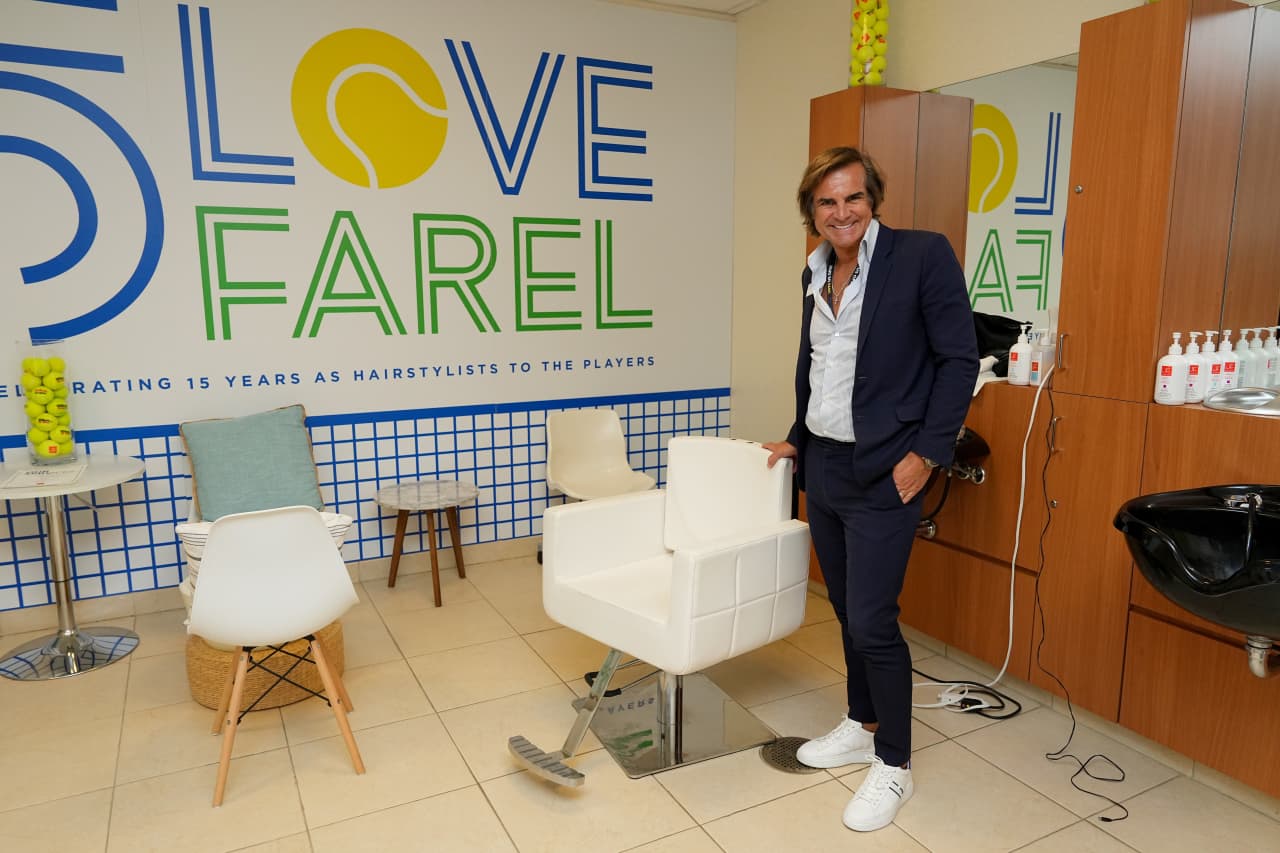
Julien Farel, with a regular clientele that includes Catherine Deneuve, Kate Moss, Brooke Shields, Sienna Miller, Liam Neeson, and countless other high-profilers, is among the most sought-after hairstylists today. His haircuts command a rate of US$1,250, and an appointment to see him is considered a coveted “get.”
But Farel’s role as the official stylist for the U.S. Open may be his biggest calling card, at least according to Farel himself, who’s had the gig since 2007.
“I approached the Open about having an onsite salon for players at the tournament, and it took me five years of pitching to finally get the contract,” Farel, a native of France, says during an interview at his eponymous salon at the Loews Regency New York hotel on Manhattan’s Upper East Side. (He has a second salon in Palm Beach, Fla.)
The position has Farel and seven employees creating a temporary salon at Arthur Ashe Stadium in Queens, N.Y., on the penthouse level in a secure area where players can freely walk around without being surrounded by spectators.
The roughly 250-square-foot space is a perk for the 500 or so stars who participate in the Open and offers haircuts, blow-dries, hairstyling, and makeup sessions, manicures and pedicures, Farel says. It debuts for the season two days before the tournament begins and is open from 9 a.m. to 6 p.m. throughout the event. The official dates for the 2024 U.S. Open are Aug. 26 to Sept. 8.
Over the years, his salon has hosted several hundred players, according to Farel, including Roger Federer, Serena Williams, Coco Gauff, and Novak Djokovic. Retired players, including Billie Jean King, whose moniker is part of the official name of the U.S. Open venue—the USTA Billie Jean King National Tennis Center—have also stopped in, Farel says.
“The players make appointments, but if an A-Lister like [Rafael] Nadal or Djokovic walks in, we try to make it work,” Farel says. “We’re busy all day for the entire Open.”
Patrick McEnroe, a retired professional player and an ESPN tennis commentator of the U.S. Open, is a client of Farel’s at his Manhattan salon. McEnroe says that Farel is also a friend, and he visits him at his Arthur Ashe salon whenever he can.
“It’s a hot spot and where all the players hang out and socialise,” McEnroe says. “They love coming to the salon, and it’s a great amenity for them.”
On-site salons for players at major tennis tournaments aren’t uncommon, but Farel was the first to introduce the concept to the U.S. Open, he says. (A representative for the U.S. Open is unable to confirm if this is the case.)
Farel’s experience as a tournament stylist was the impetus for bringing his salon to the Open.
“I worked at Roland-Garros in Paris at the French Open for a decade under my mentor Jacques Dessange, who had an on-site salon there,” Farel says. “I did haircuts and styling for all the big players at the time, including Pete Sampras, Andre Agassi, John McEnroe, and Monica Seles.”
Eric Butorac, the director of player relations for the U.S. Open, says that the tournament’s executives offer the salon as a benefit to players because they recognise that they’re under the public eye and need to look their best. “We understand they’re under scrutiny, and we understand the challenge of life on the road, where they’re living out of a suitcase,” Butorac says. “Julien’s salon is well-used and an amenity that isn’t related to a player’s tennis performance the way our fitness centre or nap rooms are.”
Croatian player Donna Vekic, who is fresh off winning a silver medal at the Olympics, takes full advantage of the perk. The star says that she frequents the salon throughout the tournament for blow dries, manicures, and pedicures and also visits the Manhattan location for colour jobs.
“It’s very convenient to have it at the stadium,” Vekic says. “I want to look and feel good when I’m playing.”
And if they don’t hit up the salon during the tournament, some players will stop by when the matches are finished, Farel says. “Many of the players are so busy during the Open that they only get time to pamper themselves when the tournament is over.”
 Copyright 2020, Dow Jones & Company, Inc. All Rights Reserved Worldwide. LEARN MORE





Australian shares fell on Thursday as Wall Street weakness, rising oil and persistent rate concerns weighed on most of the market. The S&P/ASX 200 declined 0.72 per cent to 8,702. The All Ordinaries lost 0.66 per cent to finish at 8,897. Mining stocks were hit particularly hard, while real estate also dragged on the index. …
Continue reading “ASX falls 0.7 per cent as miners and property stocks retreat”

Borrowers cannot control the Reserve Bank, but they can control how exposed their household budget is to its next decision. The RBA meets on 29 September with inflation concerns still elevated and major-bank economists increasingly bringing forward their rate-rise calls. Fixed mortgage rates have also been moving, reducing the value of waiting for perfect certainty. …
Continue reading “What mortgage holders should do before the next RBA decision”
2 min
A property portfolio can look comfortable until several small pressures arrive together: a rate increase, a vacancy, higher insurance and an unexpected repair. The correct time to model that combination is before it occurs.
Start by recalculating every loan at 0.25, 0.50 and one percentage point above its current rate. Include principal-and-interest repayments even where a loan is temporarily interest-only, because the eventual step-up may be larger than the next RBA move.
Then calculate true net rent. Deduct management, council and water charges, strata, insurance, maintenance, land tax where applicable and a vacancy allowance. A property advertised with an attractive gross yield can produce a very different result after these costs.
Third, review the portfolio’s liquidity. An offset account can reduce interest while keeping cash accessible, but investors should obtain tax advice before moving funds between loans. The distinction between investment and private debt affects deductibility, and poorly structured redraws can create lasting complexity.
Fourth, examine refinancing risk rather than just today’s rate. A highly leveraged investor may be unable to refinance on the same terms because the new lender tests total debt at a higher assessment rate. Credit-card limits, owner-occupied debt and shaded rental income can all reduce capacity.
Fifth, rank properties by resilience. Consider net yield, vacancy risk, near-term capital expenditure, tenant demand, debt attached and the cost of selling. This is not an instruction to sell the weakest performer automatically; transaction costs and tax consequences matter. It is a way to identify where pressure would emerge first.
Investors should also review fixed-rate and interest-only expiry dates. A portfolio with several facilities resetting in the same quarter carries concentration risk even when each loan appears manageable individually.
The goal is not to predict the RBA perfectly. It is to ensure that one policy decision does not force a rushed refinancing, sale or reduction in essential maintenance. A portfolio that can absorb higher rates and temporary income interruptions gives its owner time to make deliberate decisions.
Read more: What mortgage holders should do before the next RBA decision
Portfolio checklist
Stress test: Current rate plus 0.25, 0.50 and one percentage point.
Model: Net rent after every recurring cost and vacancy.
Check: Fixed-rate expiries, interest-only expiries and loan maturity.
Preserve: An accessible emergency buffer.
Review: Insurance, land tax, strata works and major maintenance.
Seek advice: Licensed credit, financial and tax advice before restructuring.

As housing drives wealth and policy debate, the real risk is an economy hooked on growth without productivity to sustain it.

Two coming 2027 models – the first of the “Neue Klasse” cars coming to the U.S. early next year – have been revealed.