How Reflective Paint Brings Down Scorching City Temperatures
Communities fight urban heat islands with technologies shielding roofs and pavement

 3 min
3 min
Cities across the U.S. have found relief from this summer’s record-setting heat with the help of technologies that shield roofs, pavement and other surfaces from the sun’s scorching rays.
Some of these technologies have been around for more than a decade but are experiencing greater demand as global temperatures rise. Washington, D.C., for example, has built more than 3,200 green roofs covering 9 million square feet—up from about 300,000 square feet in 2006, according to federal and city officials.
Other technologies, such as super-reflective coatings for pavement, streets and windows, are just now becoming effective and affordable enough for widespread use.
The Los Angeles neighbourhood of Pacoima, a densely packed location sandwiched between freeways and an industrial area, has created a partnership with GAF, a New Jersey-based roofing manufacturer, to paint a basketball court, local park and neighbourhood streets with a reflective coating.
“There’s a lot of asphalt and lack of investment for tree canopies,” said Melanie Paola Torres, 24 years old, a community organiser with the group Pacoima Beautiful. “Given the fact that we are in an industrial zone, that contributes to the urban heat-island effect.”
The reflective coating has reduced air temperatures in the test area at 6 feet above ground by 3.5 degrees Fahrenheit during extreme heat days, and surface temperatures by 10 degrees, according to Jeff Terry, GAF’s vice president of corporate social responsibility and sustainability.
Sweltering conditions are worse in urban heat islands, which can be 10 degrees hotter than surrounding suburbs and occur as buildings, roads and other infrastructure absorb and re-emit the sun’s energy.
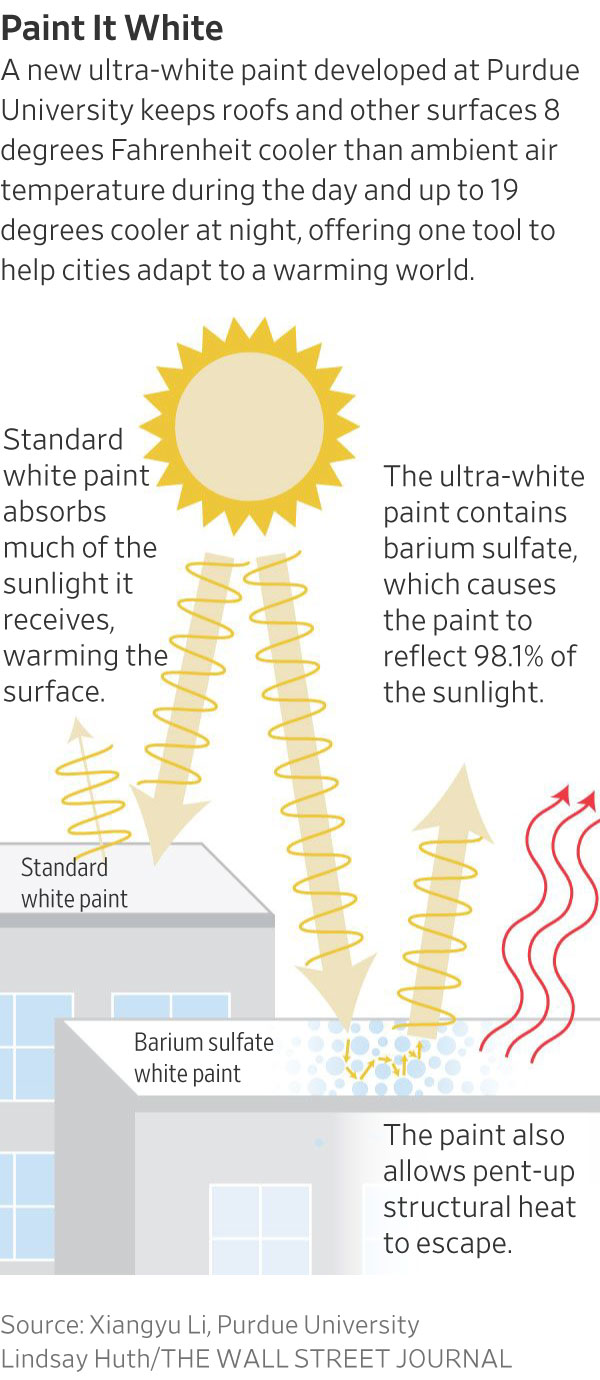
Cooling technologies mitigate this. Green roofs absorb heat before it penetrates the buildings beneath. Super-reflective coatings reflect the sun’s visible light and invisible infrared radiation away from surfaces to keep them cooler. And an ultra-white paint developed at Purdue University promises even more protection, although the product isn’t commercially available yet. Each strategy helps reduce energy use.
“The important thing is to help people cool their homes and workplaces affordably,” said Jane Gilbert, chief heat officer for Miami-Dade County, which experienced a record 46 straight days of a 100-degree-plus heat index this summer. “The more efficient we can make both the buildings and the AC systems themselves, the less we’re contributing both to greenhouse gases and also waste heat that goes to our urban heat islands.”
Miami is one of the most vulnerable cities to the urban heat-island effect, along with San Francisco, New York, Chicago and Seattle, according to an analysis by Climate Central, a New Jersey-based nonprofit that researches the effects of climate change. Its analysis found that 41 million people living in 44 cities face an urban heat-island effect of at least 8 degrees. Nine U.S. cities had at least one million people exposed to urban heat of 8 degrees or higher because of the local built environment.
To fight the heat, some cities are leveraging federal money and other incentives to persuade local builders to turn office buildings greener and cooler.
In Miami-Dade County, officials used federal funds to outfit 1,700 public housing units with new low-energy air-conditioning units. Local officials also offered a successful amendment to the Florida state building code requiring cool reflective roofs on all new commercial buildings beginning in 2024, and enrolled 150 structures in a voluntary energy-audit program to track improvements to cut energy use and keep temperatures down.
New York, Chicago, Philadelphia, Toronto and other cities are pushing green roofs with tax breaks and other incentives in an effort to lower energy bills and reduce ambient temperatures, according to Steven Peck, president of Green Roofs for Healthy Cities, a Toronto-based green-roof and -wall industry association. Peck said green roofs can be 30 to 40 degrees cooler than a similar-size blacktop roof, while also cutting waste heat from air-conditioning units.
In the Los Angeles neighbourhood of Pacoima, Torres says residents tell her the streets and playgrounds feel cooler since the reflective coating was completed in August 2022.
“The number-one thing that always comes up is the heat waves when you’re looking down the street,” Torres said. “They don’t see those anymore.”
The next step is to install reflective roofing material on a handful of homes as part of the neighbourhood cooling effort. “We want to keep stacking the solutions to overall create a cool community with multiple strategies,” Torres said.
Altering the urban landscape to adapt to extreme heat requires money and technical know-how, according to city leaders and academic experts. But they also acknowledge the need to keep people safe as global temperatures rise.
“Any one solution is not going to necessarily be able to address the entire problem, but by systematically applying solutions that work in each individual location, we can make a dent in the urban heat-island effect,” said David Sailor, professor of geographical sciences and urban planning at Arizona State University.
 Copyright 2020, Dow Jones & Company, Inc. All Rights Reserved Worldwide. LEARN MORE





Two coming 2027 models – the first of the “Neue Klasse” cars coming to the U.S. early next year – have been revealed.

A&K Sanctuary unveils Kitirua Plains Lodge, a sustainability-focused luxury property shaped by landscape, local craft and contemporary safari architecture.

Four one-off Cullinan commissions draw on the design language of yachting, blending marine craftsmanship with Rolls-Royce’s signature bespoke detailing.
< 1 min
Rolls-Royce has revealed a new series of bespoke Cullinan motor cars inspired by the world of yachting, with four individually commissioned vehicles reflecting the materials, movement and design codes of life at sea.
Presented at Goodwood in the UK, the Cullinan Yachting collection comprises four one-off vehicles themed around the cardinal directions, North, South, East and West, each expressed through distinct exterior finishes and interior detailing.
The commissions lean heavily into maritime influence, a space Rolls-Royce says is closely aligned with its global client base.
Each vehicle features marine-grade teak, hand-painted fascia artwork inspired by the wake of a tender cutting through water, and intricate marquetry compass motifs made from more than 40 individual pieces of wood veneer.
Hand-painted elements have become an increasingly sought-after feature among Rolls-Royce clients, with the brand employing dedicated artisans to develop bespoke interior compositions.
For the Cullinan Yachting series, the painted wake effect required months of experimentation to achieve a natural sense of movement.
Inside, the vehicles are finished in Arctic White and Navy Blue leather, with hand-stitched detailing designed to echo the structure of nautical ropework. A signature Rolls-Royce Starlight
Headliner has also been reimagined, with fibre-optic constellations arranged to reflect Mediterranean wind patterns.
Each car’s exterior colour has been developed to align with its directional theme, ranging from lighter blue tones evoking northern waters to deeper hues referencing warmer southern seas and storm-lit horizons.
Rolls-Royce said the collection reflects a longstanding relationship between the marque and the world of yachting, dating back to its co-founder Charles Rolls, whose family owned a steam yacht and travelled extensively through the Mediterranean.
The release underscores the growing demand for highly personalised vehicles among ultra-high-net-worth buyers, with Rolls-Royce increasingly positioning its cars as part of a broader luxury lifestyle that extends beyond the road.

The PG rating has become the king of the box office. The entertainment business now relies on kids dragging their parents to theatres.

Paine Schwartz joins BERO as a new investor as the year-old company seeks to triple sales.