$30m Southern Highlands trophy home Invergowrie returns to the market
Kanebridge News
Share Button

$30m Southern Highlands trophy home Invergowrie returns to the market

One of the Southern Highlands’ most celebrated country estates has returned to the market, with the historic Invergowrie offered for sale amid expectations it could achieve up to $30 million.

By Staff Writer
Mon, Mar 9, 2026 3:43pmGrey Clock 2 min

Invergowrie, one of the best-known and most luxurious estates in the Southern Highlands, has been listed for sale with a price of up to $30 million.

The Exeter acreage is being offered for the first time since 2019, when it was sold by former Liberal Party leader John Hewson to little-known Queensland grazier Victoria Anderson.

The property attracted significant attention during Hewson’s ownership, having remained on the market for a decade prior to its sale. He initially sought $11 million in 2009, then ultimately accepted $6 million seven years later.

Architectural heritage and landmark gardens

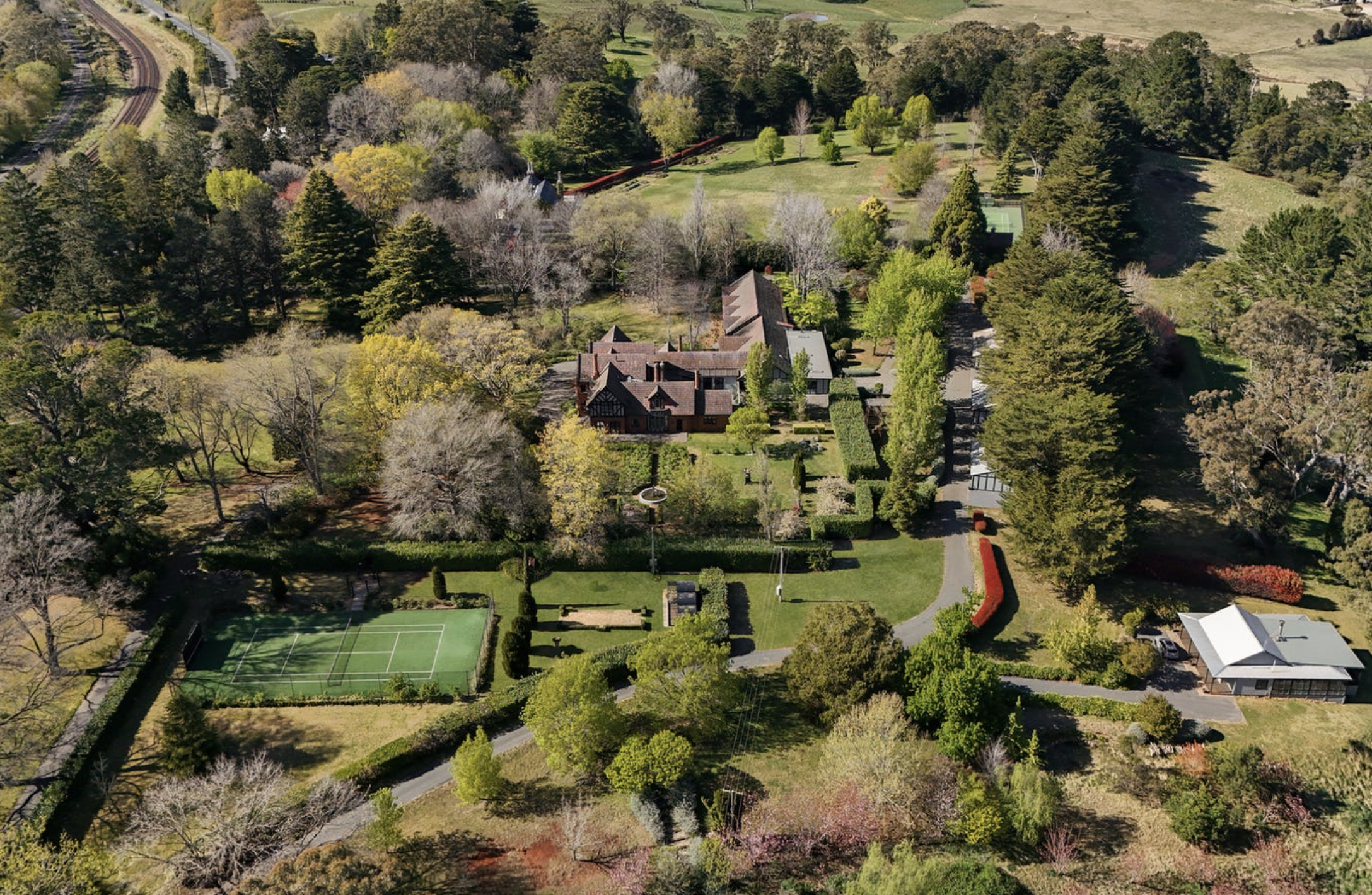
The main residence dates back to 1936, when it was commissioned by pioneering industrialist Sir Cecil Harold Hoskins, whose leadership helped shape the nation’s iron and steel industry. Designed by architect Geoffrey Loveridge, Invergowrie is a grand Tudor Revival residence set within gardens conceived by celebrated landscape designer Paul Sorensen. His early 20th-century landscapes remain among the most admired in the Highlands.

Today, those heritage plantings — sweeping lawns, ancient oaks, stately silver elms and groves of cedar — continue to frame the home in established grandeur.
A richly reimagined interior

Since purchasing Invergowrie in 2019, Anderson has comprehensively reimagined the interiors, engaging award-winning studio Greg Natale Designs to transform the historic residence into a richly layered and opulent home.

Every detail speaks to bespoke quality: deep navy joinery offset by striking brass fixtures and hand-gilded ceilings; French oak parquetry laid in the classic Versailles pattern; Italian porcelain tessellated tiles; and plush custom carpeting underfoot. One-off wallpapers from Papiers de Paris sit alongside coveted designs by Versace, Gucci and Ralph Lauren, while decorative lighting selections include pieces from Ralph Lauren Home, Kelly Wearstler and Kate Spade.

The designer kitchen is fitted with integrated Miele refrigeration, a Smeg cooktop, a Thermoseal oven, a EuroCave wine cabinet, and a Qasair executive range hood, while Carrara marble surfaces and a Billi tap deliver boiling, chilled, and sparkling water. Bathrooms and powder rooms are finished in Norwegian Rose and Carrara marble.

A private estate on 9.3 hectares

Spanning two levels, Invergowrie comprises six bedrooms in the main residence, along with several formal and informal living and dining rooms, an office, gym, reception room, bar and wine cellar. There is also a trophy room adjoining a billiards room and an indoor 25-metre pool.

Across the 9.3-hectare estate sits a self-contained 1800s Lakehouse with two additional bedrooms, as well as a separate two-bedroom guest house and a caretaker’s cottage. The grounds also feature a tennis court, wrought-iron arbour, aviary and bocce court.

Cullen & Royle agents Deborah Cullen and Richard Royle are marketing the property in conjunction with James Hall of Savills.


MOST POPULAR

A record-breaking $11 million sale at The Centennial Collection has set a new benchmark for luxury apartment living in Bondi Junction.

As interest rates, inflation and market sentiment fluctuate, investors are being urged to focus on data, not panic.

Related Stories
Property
HOUSING CRISIS WON’T BE SOLVED BY DEMAND-SIDE POLICIES, PROPERTY EXPERTS WARN
By Jeni O'Dowd 22/06/2026
Property of the Week
Property Of The Week: Country Compound with a $30m Price Tag
By Kirsten Craze 19/06/2026
Property
$11m sale breaks Bondi Junction apartment record
By Staff Writer 18/06/2026
HOUSING CRISIS WON’T BE SOLVED BY DEMAND-SIDE POLICIES, PROPERTY EXPERTS WARN

Australia’s housing affordability crisis is being fuelled by chronic undersupply, planning delays and rising development costs, as politicians continue to focus on the wrong solutions.

By Jeni O'Dowd
Mon, Jun 22, 2026 3 min

Australia’s housing crisis will not be solved by first-home buyer incentives or tax changes alone, with leading property figures warning governments must tackle supply constraints if affordability is to improve.

Speaking at the Kanebridge Quarterly Property Leadership Summit in Sydney last week, expert project marketing specialist Sam Elbanna, property investor and fund manager Paul Miron and property consultant Karla McNeice said that a lack of housing supply remained the central issue facing the market.

Elbanna, Director of CPM Realty with more than 30 years’ experience in project sales,  argued that successive governments had focused too heavily on stimulating demand rather than addressing the barriers preventing new housing from being delivered.

“The misconception is that politicians think the way to solve the housing crisis is to drive demand,” he said.

“The reality is that’s not the way. This is a supply-side problem, and it needs to be solved on the supply side.”

Drawing on his experience in project sales, Elbanna said policies designed to help first-home buyers often had unintended consequences, pointing to previous grants that ultimately flowed through to higher property prices.

Instead, he said developers were facing increasing red tape, approval delays and rising costs, which were discouraging new housing supply.

“In the absence of stock, demand exceeds supply,” he said.

Miron, a Co-Founder and Fund Manager of Msquared Capital, said the housing debate had become overly focused on tax policy while overlooking broader structural issues.

He argued that affordability challenges stemmed from a combination of factors, including planning constraints, supply shortages, migration levels and interest rates.

“No-one can be 100 per cent certain on the real reason for property prices is going up,” he said.

“The reason why property prices are higher is a combination of interest rates, lack of supply, migration, vacancy rates and maybe taxes play a role.”

Miron was critical of recent federal housing policy changes, warning they could reduce the number of new homes being built and further constrain supply that was even highlighted in the budget.

He also highlighted the importance of the property sector to the broader economy, noting that residential real estate and related industries employed more than one million Australians.

McNeice, who advises developers on sales strategy and market intelligence, said understanding buyers had become increasingly important as affordability pressures intensified.

While affordability remained a major consideration, she said today’s buyers were focused on value rather than simply price.

“People are looking for value for money,” she said.

She said buyers were increasingly evaluating factors such as transport connections, walkability, nearby amenities and flexible living spaces that could accommodate changing family needs.

“What infrastructure is going on? Can I walk to the shops? Can I meet people at the local cafe?” she said.

The panel also discussed the mounting pressures facing developers, with Elbanna arguing that many projects become financially unviable from the moment a site is purchased.

“The viability of a development happens at the moment the site is bought,” he said.

He said rising construction costs, higher interest rates and overly optimistic feasibility assumptions had left some developers exposed as market conditions changed.

While acknowledging the growing number of smaller and first-time developers entering the market, Elbanna said property development required expertise across finance, construction, marketing and legal disciplines.

“It is actually a business that requires a level of expertise,” he said.

Looking ahead, the panel agreed opportunities remained in the market despite current challenges.

Miron said property should continue to be viewed as a long-term investment and cautioned against trying to time short-term market movements.

McNeice said success would increasingly depend on identifying projects that genuinely met changing buyer expectations.

Elbanna said affordable housing remained achievable, but developers needed to deliver more than just homes.

“We can provide affordable housing in this country,” he said.

“But we’ve got to wrap that affordable housing with the things that people want.”

As Australia’s housing affordability debate intensifies, the panellists agreed on one point: without a meaningful increase in housing supply, demand-side measures alone are unlikely to solve the nation’s property challenges.

MOST POPULAR

From warmer neutrals to tactile finishes, Australian homes are moving away from stark minimalism and towards spaces that feel more human.

Australia’s housing market rebounded sharply in 2025, with lower-value suburbs and resource regions driving growth as rate cuts, tight supply and renewed competition reshaped the year.

Related Stories
Lifestyle
Pure Amazon Sets Sail: A New Standard in Luxury River Cruising
By Staff Writer 06/11/2025
Property
Charming 1840s Berrima Residence Lists in the Highlands’ Most Sought-After Village
By Kirsten Craze 14/11/2025
Property
These Are the Priciest Streets in All of Great Britain
By Liz Lucking 16/03/2026
0
    Your Cart
    Your cart is emptyReturn to Shop