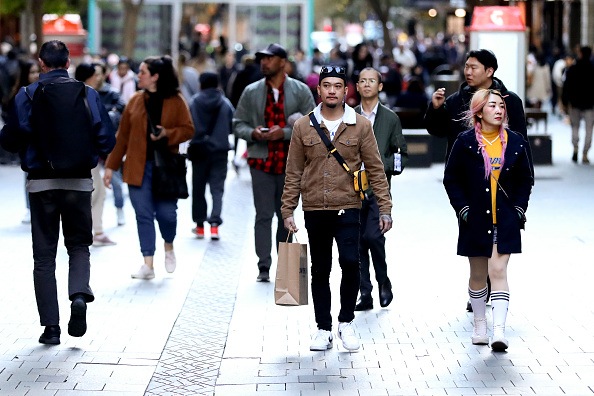
SYDNEY—Australia’s job market showed signs of cooling down in October as employment growth for the month came in a little bit below expectations, albeit the jobless rate remained near its historic lows.
The economy churned out 15,900 new jobs in October, about 10,000 fewer than economists had expected, and well short of the spectacular gains seen in recent months, the Australian Bureau of Statistics said Thursday.
Still, the unemployment rate remained at 4.1% for a third month in a row in October, continuing to track below where the Reserve Bank of Australia has forecast it would be.
With employment growth slowing over the month, October might mark the start of a slowdown in hiring, which many economists have been expecting given that interest rates remain elevated and the economy overall has been sluggish.
The conditions for a cut in official interest rates early in 2025 appear to be slowly falling into place with inflation in a steady retreat and the job market now showing tentative signs of slowing down, economists said.
Still, money market traders are less optimistic than economists about the potential for a cut in interest rates, with swap markets not fully pricing in an interest rate cut until August next year.
The October unemployment rate remained 0.6 percentage points above its recent low of 3.5% in June 2023, while being 1.1 percentage points below its level just prior to the pandemic, the ABS said.
The number of unemployed people in October was 67,000 higher than a year ago, but was still 82,000 people lower than in March 2020, the ABS added.
When tens of thousands of software engineers, tech enthusiasts and salesmen descended on San Francisco for the annual Salesforce megaconference in September, startup founder Jari Salomaa had an idea: What if he rented out a sauna?
Salomaa was looking to pitch his startup Valo, which has built an artificial-intelligence tool that helps users on Salesforce’s platform. But an anti-alcohol movement that’s sweeping through the tech industry is disrupting work gatherings that revolve around drinking or eating. That’s leading Salomaa and others to try “social saunas,” where networking happens inside a steamy 200-degree box. In bathing suits.
The experience can take some getting used to. Bathrobes and bikinis can be distracting. It’s also very sweaty.
But investors and venture capitalists say it’s refreshing to have someplace other than a bar to gather and that business is getting done everywhere from a pop-up sauna in a Napa vineyard, to an 80-person sauna in New York.
Salomaa, 46, grew up in Finland where the sauna was part of everyday life and at his first job for Nokia in Helsinki, saunas were built inside the offices.
“There are more saunas than cars in Finland,” he said. “As many saunas as toilets.”
Still, he worried how Americans would react to hanging out in their bathing suits for a corporate event. “Scandinavians are more at ease with body images than the average American,” he said.
He thought about having one event for women and another for men, but the planning soon got complicated. In the end, Salomaa decided on a sort of social experiment: a coed gathering in San Francisco. He wound up with a wait list of 100 guests.
Salomaa imposed some sauna etiquette—bathing suits required and stay hydrated. And he started the event like any other investor pitch, by giving a PowerPoint presentation to an audience clad in bathrobes.
Attendees shared images of the event on social media, and soon Salomaa was fielding calls from friends in the tech industry, asking how they could do a similar event. He’s eager to help, but maintains some reservation about moving too much work inside the sauna.
“If it’s all talk about work, it kind of kills the vibe,” he said.
New social saunas have popped up in San Francisco, New York and Colorado this year.
They are built with stadium seating to fit more people—usually around 20 to 40 people—and conversation is often encouraged.
At Othership, a new sauna facility that opened in New York City’s Flatiron district in July, the sauna can fit up to 90 people. Lined with ambient lighting that can switch from warm red to neon pink, the sauna looks more like a nightclub than a place of tranquility.
Founder Robbie Bent, 40, said young tech founders make up a large part of his clientele. “They want to be healthier, meet like-minded people, and often don’t want to be out late,” he said.
The company hosts founder nights, as well as events for investors and founders to mingle. Othership says tech companies big and small are considering offering its services as a benefit to employees.
Othership has also offered to organise complimentary “team sweats” as team-building exercises. But according to Bent, they received pushback from human resources at companies across tech and Wall Street. Colleagues congregating in bathing suits wasn’t going to fly.
In response to these critiques, Bent designed a “corporate swimsuit”—basically a full-body rashguard for people to wear in the sauna.
Will Drescher, 29, built a social sauna in Boulder, Colo., after going to one in Minneapolis this year. “Neither me nor my co-founder drink,” said Drescher. “And we just thought, why don’t we have this?”
They built Portal, a “more DIY” option than the saunas popping up in New York and San Francisco, said Drescher.
“We wanted to bridge what’s happening in the coasts with what we’re seeing in the middle of the country,” said Drescher.
Venture investor Helene Servillon, 35, proposed a meeting with a founder of a tech company at Portal.
The meeting lasted an hour, which allowed them to cycle in and out of the sauna for three sessions. After learning more about the startup, Servillon said she plans to invest in it soon.
“VCs socialise a lot. If we only have two options—have a drink or a meal—that can just get really exhausting,” she said. When founders or investors ask to meet for happy hour these days, she will often counter-propose with a sauna or a hike.
Fintech investor Sheel Mohnot, 42, co-hosted an August social sauna event in San Francisco and attended an investor event in Napa, where a mobile sauna was wheeled on to the vineyard.
“The reality is there are always chances for people to feel uncomfortable, and more people are feeling that way about drinking,” Mohnot said. “We just didn’t have great sauna options here before.”
Not all tech workers have bought in. Laila Danielsen, chief executive of an AI software company, was invited to a social sauna event in October. She enjoyed the event and the environment it provided to have conversations, but she didn’t go into the hotbox.
“I don’t know if I’d necessarily put on my bikini to go out and pitch a VC, you know what I mean?” the 55-year-old said. “I’ll consider meeting them at the sauna after we close the deal.”
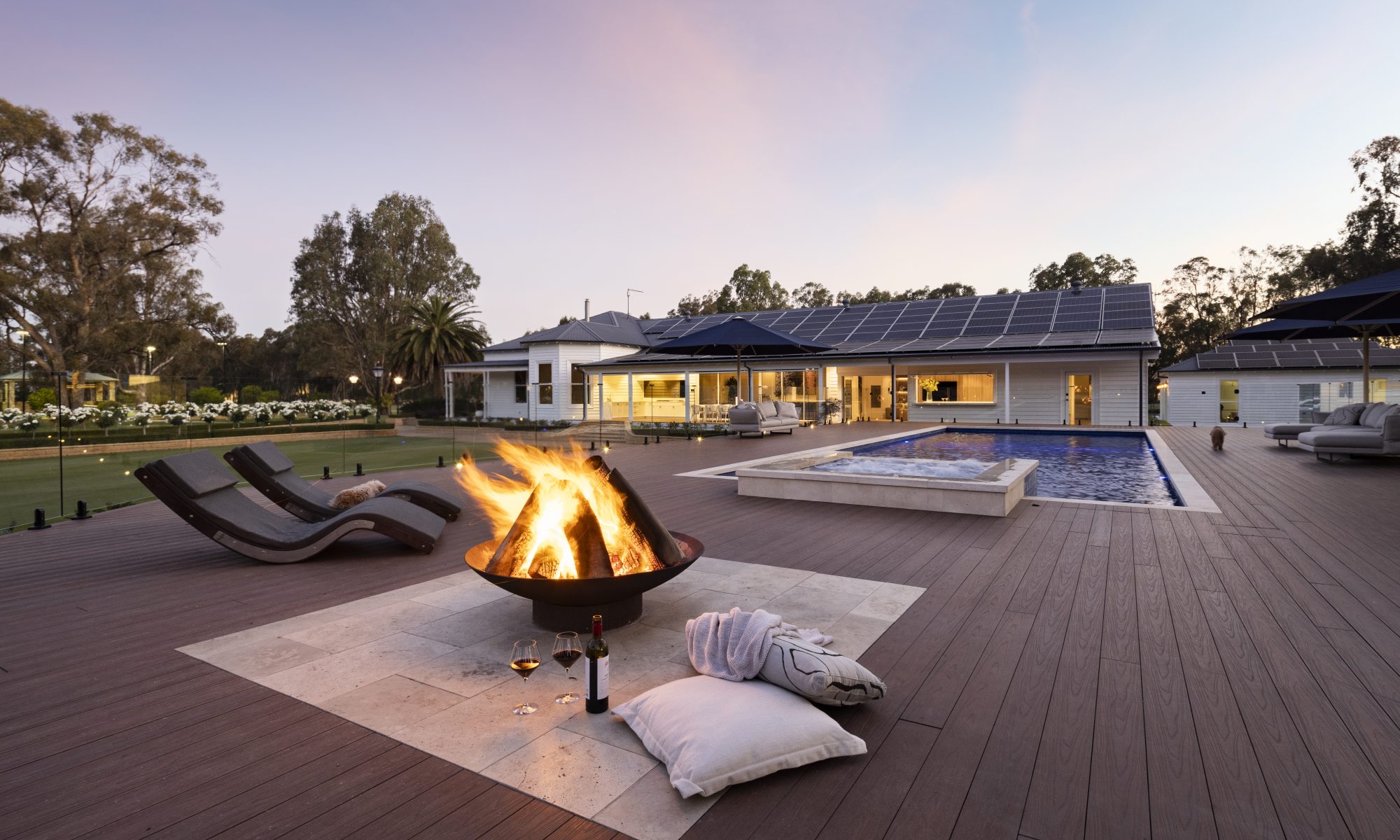
Finding the time to hit the fairway isn’t a problem for anyone sporting their own golf course at home. Clarendon Eyrealongside the iconic Murray River in northern Victoria is a rural retreat with a difference — it’s home to five holes, complete with manicured fairways, genuine bunkers and a turquoise ornamental lake.
The Miller family bought the expansive estate as a traditional farm 18 years ago and set about turning the 105ha parcel into an all generations playground. Almost two decades later, Josh Miller and his wife Steph Claire Smith, a fitness influencer who recently appeared on Forbes’ 30 Under 30 list, got hitched at the picturesque property that holds a special place in their hearts.
“My wife and I first met there after her parents bought a property one paddock across. She was 12, I was 15, and in 2019 we had our wedding at the property so it’s really full of memories for us.”
The project manager and photographer is one of four siblings who grew up at Clarendon Eyre.
“I spent a lot of my life riding motorbikes and playing golf there. When we first bought it, there were a few very basic sand scraped greens. One day our Dad, who’s a retired horticulturist, bought a bag of golf balls off eBay and we started hitting them into the bush, but he had a better idea. One green turned into two, then three, four and five!” Miller adds.
Designed to replicate Augusta National, the rare private course features Santa Ana couch and Mackenzie Bent grass and has been meticulously maintained by a full-time team using top-tier equipment, all negotiable in the sale.
Nathan Verwoert and Robert Fletcher of Forbes Global Properties are marketing the 105ha property with a price guide of $8 million to $8.8 million.
“I’ve been in this job since 2009 and I get to see some pretty beautiful homes, but this just blows your mind. When you arrive, the property just comes out of left field and is such an oasis. It’s certainly one of the most unique properties I’ve ever had the pleasure of selling,” Verwoert says.
“It’s been a real labour of love for this family, who over a couple of decades have improved it and created their own sanctuary over the course of the time.”
Clarendon Eyre’s main residence is a tale of two houses, one is the former Mornington Art Gallery while the other was a weatherboard from Malvern in Melbourne. Both were relocated and connected to create an impressive seven-bedroom, five-bedroom homestead.
To marry the pair of properties, an architectural ‘bridge’was conceived and now plays host toan expansive formal dining space that caters for up to 18 people and flows out to a shady alfresco area.
Neighbouring the landmark river which separates the two states, the Bearii estate is flanked by grand redgums, palm trees and space for rolling paddocks. Beyond the unique personal golf course, the land also houses an upgraded tennis court, a basketball court, a heated pool, spa and an Olympic built-in trampoline.
Following a recent refurbishment, the house has high-end features including Kustom timber floors, porcelain benchtops, automatic DIY Blinds, Control4 smart technology and Sonos sound system throughout including the home cinema.
The Bearii property is approximately a three-hour drive, or 45 minute helicopter journey, from Melbourne.
Clarendon Eyre is listed via an expressions of interest campaign through Forbes Global Properties with a price guide of $8 million to $8.8 million.
No one likes to think about their own demise, but planning can make life after your death significantly easier for heirs.
Here are five ways to help heirs avoid extra time, money, stress and acrimony after you pass:
Keep documents updated
Having a will or living trust is essential—but it isn’t enough. The proper documents need to be updated periodically, especially as life circumstances change.
Amber Hughes , a lawyer in the Phoenix office of law firm Dickinson Wright, offers the example of a mother who belatedly drafted new estate-planning documents but died before signing them. The old will had named as heirs stepchildren she hadn’t spoken to in 20 years, and her sons are spending tens of thousands of dollars to have the unsigned will enforced by a judge.
Many people also fail to update beneficiaries for life insurance, retirement accounts and bank or investment accounts. These assets pass according to the beneficiary designation, if there is one, regardless of what the will or living trust says, says Laura Zwicker , chair of the private client services group at law firm Greenberg Glusker Fields Claman & Machtinger in Los Angeles.
A client’s brother had an IRA valued at several million dollars. When he died, the IRA funds went to a woman he hadn’t dated for at least 10 years instead of to his brother’s daughters, even though they were named as beneficiaries in his trust. The heir indicated on the IRA was the former girlfriend, and that was the one that counted. “Imagine their surprise, but there’s nothing we can do about it,” Zwicker says.
Address digital assets
Many people have digital assets, including email and online photos, that could be lost to heirs if proper provisions aren’t put in place. For instance, a writer who stores plays or novels on a Google drive, but doesn’t set up a Google inactive-account profile, may make it harder or impossible for heirs to gain access to these works. Terms might differ, so having appropriate documentation on file with each provider is important.
Cryptocurrency and non fungible tokens can also easily be lost if their owners don’t provide heirs a way to access these assets. So people should make sure beneficiaries know how to access an account’s private keys—the secret numbers used to access cryptocurrency—as well as the kind of wallet and crypto type. One caveat: Those private keys and other sensitive information shouldn’t be included in a will because it becomes public through the probate process and that puts the assets at risk.
Assign personal property in advance
Many people assume that heirs will figure out on their own how to divide personal property, but that can lead to fights.
Hughes offers the example of three sisters who fought over their mother’s collection of hundreds of porcelain dolls. They had to hire a professional mediator to draw straws until all of the dolls were distributed. Had the mother made a personal-property list before she died, significant aggravation and hostility might have been avoided. The list can be handwritten and up-to-date, and should be kept with estate-plan documents. The document should also include where items can be found.
Leave good notes
Estate-planning experts advise that people set aside a folder with important information for the heirs, such as names, numbers and locations of accounts, as well as names and contact information for attorneys, accountants and financial advisers. This is especially important since bills are often paid online, eliminating once-helpful paper statements. Also let heirs know where to find your estate-planning documents. “If you can’t find the will and you don’t know who the trust and estate attorney is, that’s a horrible situation,” says Seth Slotkin at law firm Akin Gump Strauss Hauer & Feld in New York.
One word of caution: Try not to leave unnecessary documents for your heirs, because it’s overwhelming, Slotkin says. How long to keep certain documents depends on their nature, but generally speaking, purging unnecessary documents will save your heirs time and money, he says.
Strive for conflict-avoidance
Parents sometimes create conflict by choosing one child over another to serve as executor, trustee or both, says Neil Solarz , shareholder at Weinstock Manion in Los Angeles.
Sometimes it may be appropriate. But in most instances, Solarz recommends naming a relative or friend to avoid potential sibling-rivalry issues. If there’s no one else available, people might consider hiring a trust company or a private professional fiduciary—vetted and licensed individuals who are licensed to act as trustees or executors.
People who have specific reasons for dividing assets or roles unevenly should prepare a letter that explains their thought process, which can help mitigate the potential for future conflicts, Slotkin says. For example, clarify that you named your daughter as executor because she lives locally, but that you want all of your children to work together to settle the estate, he says. Or, if you are leaving the younger of three children $100,000 more than the others, explain why. This extra step can mean the difference between harmony and acrimony among your heirs, he says.
“The thing that’s most likely to cause the estate process to dissolve into something horrible is acrimony among the children,” Slotkin says. “If you want to make things easy for your kids, if there’s anything that could be misinterpreted, explain it to them so they’re not fighting about it.”
Higher barriers to trade would have a negative impact on the global economy, and Europe must be prepared for increased tensions, Bank of Finland Gov. Olli Rehn said Tuesday.
Rehn, who is a member of the European Central Bank’s governing council, said a soft landing for the eurozone economy was still a plausible scenario, but that the outlook is clouded by growing geopolitical uncertainty.
A new element in that uncertainty is the trade policy of Donald Trump in his second term as U.S. president. Trump has expressed a desire to raise tariffs on imports from a wide range of countries.
“What we do know is that significant import duties could have negative ramifications for the global economy,” Rehn said.
Questions about the future of one of Europe’s key trade relationships add to the other uncertainties that face policymakers, including Russia’s war on Ukraine, the conflict in the Middle East, and China’s military and technological ambitions, Rehn said.
“A new trade war is the last thing we need amid today’s geopolitical rivalries, especially among allies,” he told investors at a London conference.
Rehn said Europe must be better positioned to respond than it was during Trump’s first term.
“If a trade war were to start, Europe must not be unprepared,” he said.
The threat of new tariffs comes at a time when the eurozone’s two largest economies—Germany and France—are being led by minority governments. However, trade policy is decided at the level of the European Union as a whole, and implemented by the European Commission, rather than national governments.
“Political turmoil in Germany and France underscores the importance of the European Commission in providing leadership and direction,” Rehn said. Rehn was a member of the Commission from 2004 until 2014.
The ECB continues to say that its key interest rate needs to stay restrictive, and damp demand to cool inflation. But as it cuts its key rate, there will come a point where it moves to neutral, where policy is neither restraining or stimulating the economy. Rehn said that was likely to happen in the first half of next year.
“We might expect leaving restrictive territory between January and June, ” he said.
Donald Trump will retake office in a global economy substantially transformed from eight years ago—one much more reliant on the U.S.
It means that the president-elect’s plans, including across the board tariffs , could pack an even greater wallop on other countries than the first round of “America First” economic policy. It also gives Trump much more leverage in negotiations over trade policy.
Strong growth since the pandemic has expanded the U.S.’s weight in the global economy. Its share of output among the Group of Seven wealthy nations is higher than at any point since at least the 1980s, International Monetary Fund data shows.
Growth in China, the world’s second-largest economy, has slowed. Germany, the largest European economy, is contracting. Many poorer economies are buckling under the weight of high debt.
U.S. gains in global output partly reflect the strong dollar, which pushes up the value of American output relative to that of foreign economies. But they also result from substantial increases in U.S. productivity compared with the rest of the world.
The changes in the global economy have made America, not China, the premier destination for foreign direct investment, enlarging the exposure that foreign companies have to the U.S. economy and changes in government policy. A booming U.S. stock market has attracted huge flows of investment dollars.
“The fact that much of the rest of the world is now struggling to generate demand on its own provides more reason for countries to try to reach some sort of accommodation with Trump,” said Brad Setser, a senior fellow at the Council on Foreign Relations.
Trump started imposing tariffs in 2018, primarily on China but also on Europe and other allies. Those tariffs fractured global trade, weighing on large exporting economies in Asia and Europe, while not obviously hurting the U.S., which is less reliant on foreign demand than its trading partners. Trump campaigned on a promise to impose at least a 60% tariff on China, and an across the board tariff of 10% to 20% on everywhere else.
America’s superior economic performance has been driven in part by energy independence and massive government spending, said Neil Shearing , chief economist at Capital Economics in London. Since the U.S. now exports more energy than it imports—including millions of barrels of oil each month to China—the nation as a whole benefits when energy prices rise, unlike for net importers such as China and Europe.
The upshot: America’s traditional role as the centre of gravity in the global economy has become even more pronounced in the years after Trump’s first-term tariffs, the pandemic, and Russia’s full-scale invasion of Ukraine.
U.S. influence over Europe’s economy is a case in point. The U.S. has cemented its position as Europe’s largest export market as trans-Atlantic trade surged in recent years and China’s imports from Europe stalled. The U.S. has replaced Russia as Europe’s major source of imported energy. Europe runs big trade surpluses with the U.S. but big trade deficits with China.
The result is access to the U.S. market is far more important for Europe than access to European markets for the U.S. That asymmetry will give Trump leverage in trade negotiations with Europe, according to economists.
Germany exports around 7% of its entire manufacturing value-added to the U.S., but Germany imports only around 0.8% of value-added in U.S. manufacturing, according to a September paper by researchers at Germany’s Ifo Institute for Economic Research.
“German business is vulnerable to Trump,” said Marcel Fratzscher , president of the Berlin-based economic research institute DIW Berlin.
Parts of Asia have benefited from the changes in supply chains sparked by Trump’s initial trade war with China. Many manufacturers, including Chinese ones, moved factories to places such as Vietnam and Cambodia. For the past two quarters, Southeast Asia’s exports to the U.S. have exceeded those to China.
But that now leaves them more exposed to across the board tariffs, a policy that Trump advisers say will be necessary to force manufacturing back to the U.S.
To be sure, Trump’s policies could create countervailing forces. Tariffs would decrease imports and potentially weigh on productivity, but tax cuts would drive up household and business spending, including, inevitably, on imports. Other countries could retaliate by placing tariffs on U.S. goods.
Meanwhile, a tight U.S. labor market has pushed up wages, which is good for those workers. But it could pressure employers to raise prices, in turn making them vulnerable to foreign competition.
Many economists are girding for a different type of trade war from Trump 1.0, when trade fell between the U.S. and China but was diverted elsewhere.
“As long as protectionism refers only to one country, China, the world can live with this,” said Joerg Kraemer , chief economist at Commerzbank. “The thing becomes difficult or dangerous if you implement tariffs on all countries. This would be a new era in global trade.”
From the Spring issue of Kanebridge Quarterly. Order your copy here.
Architect Richard Cole is accustomed to working with challenging sites but this property in the Southern Highlands of NSW was a stretch, even for him.
With experience designing for everything from exposed oceanfront locations to remote properties in regional areas, his team is familiar with a variety of constraints, including managing extreme weather conditions and meeting requirements for bushfire prevention strategies.
And at first glance, the block in the small locality of Wildes Meadow near the picturesque Fitzroy Falls in the Southern Highlands of NSW seemed quite straightforward. A greenfield site, it offered a flat piece of land with a backdrop of mature eucalypts and a tranquil setting, which was in keeping with the owners’ plans to use the home as a retirement option, as well as a destination for family and friends. The area is also home to some of the most exclusive, architect-designed residences in the state.
On closer inspection, however, the complexities of the site revealed themselves.
“It had a lot of challenges,” Cole says. “To start with, it had power transmission lines across it and any dwelling had to keep clear of them. It was also in a high biodiversity zone. It’s potential koala habitat but we had to get an ecological study and a specific impact statement on the Fitzroy Falls Spiny Crayfish.”
Louvred windows and concrete floors control indoor temperatures while the Spotted Gum ceiling adds warmth to the living area. Image: Simon Wood
As the name would suggest, the Fitzroy Falls Spiny Crayfish is only found in Wildes Meadow Creek area, and maintaining the surrounding habitat is considered critical to its survival. To add further complexity, the site is in a bushfire-prone area, restricting how and where a house could be built.
“The problem with being in a bushfire zone as well as an ecological zone is with bushfire, you create an ‘asset protection zone’, which means clearing trees and flora, which is in direct opposition to the habitat you are trying to protect,” he says.
If that wasn’t difficult enough, the site is also an overland flow area, making it vulnerable to flooding whenever there was substantial rainfall. The constraints lead to some clear design decisions.
“We were looking at building quite close to the forest area but we decided on the middle of the paddock area, well away from the trees to maintain the habitat,” Cole says.
In the event of a bushfire, it’s a requirement that water is available on site, without the need for firefighters to cross the fire zone to access it. In addition to the 110,000L rainwater tank for domestic use, Cole provided a dedicated water tank for the purpose, as well as provisions for a dam.
To deal with the potential for flooding, he turned what could have been a liability into an asset. Substantial drainage channels direct water to a spillway located adjacent to the house to manage excess water — and creating a house with water views. At just 300mm deep, it is technically a water feature.
“The house is cantilevered a little over the water but the water is really built up to the house,” says Cole. “So you can control the maximum level of the dam and there’s no danger it will flood.”
The house has been designed as two pavilions with the owner’s wing looking directly over the water. Image: Simon Wood
The single level home has been designed as two pavilions, with the main bedroom, including ensuite, a study and living area all in one building overlooking the water, and further accommodation for guests in the second building, connected by an outdoor walkway.
Cole says the concept for separating the two pavilions was to provide the owners with the option of closing down the second building when they were the only ones on site without losing any of the amenity they enjoyed.
While the house takes in views of rolling hills to the south west, Cole designed the house around a north east-facing courtyard to permit as much natural light as possible to penetrate living spaces.
The kitchen is flooded with natural light. Image: Simon Wood
An angled roofline to the northern side of the house also allows for highlight windows, openable above the kitchen, further enhancing access to natural light and air flow.
Given it is positioned away from the surrounding tree canopy that would shade the house, it made sense for the roof to be covered in photovoltaic cells to provide solar-powered electricity. The house has further embraced passive solar design principles with a concrete slab for thermal mass, double glazing for the windows and cooling breezes captured as they move across the water in summer. Any additional heating and cooling requirements are managed by reverse cycle air conditioning.
Indoors, spaces celebrate the materials Cole is known for, with a Spotted Gum-lined ceiling and timber veneers in the kitchen, offset against blonde bricks from Bowral Bricks, a concrete slab floor and Endicott crazy paving from Eco Outdoor. The choice of natural finishes allows the building to feel at home in its environment without compromising on comfort — or style.
The house was constructed during COVID with the work undertaken by the owner’s brother based on detailed documentation provided by Cole’s team.
The outcome is a generous residence for extended family on a site that is both safe and inviting. Best of all, it’s a haven of respite — for humans and wildlife alike.
The chief executive of Saudi Arabia’s futuristic planned city Neom abruptly left his role, a major shake-up at the world’s biggest construction project.
Nadhmi al-Nasr, a hard-charging executive who had been chief executive of the kingdom’s marquee development project since 2018, departed in recent days, according to people familiar with the decision and an internal Neom email announcing the change.
The specific reasons for Nasr’s departure couldn’t be learned, but it amounts to a major reshuffling atop Neom, a priority of Saudi Crown Prince Mohammed bin Salman that calls for an arid mountain ski resort, a floating business district and two 106-mile-long skyscrapers taller than the Empire State Building.
Delays, cost overruns and staff turnover have plagued the project. Saudi officials have come to realise they don’t have the money to fund all of the giant projects in the country they once planned, Saudi officials have said.
Executives from the country’s sovereign-wealth fund, the Public Investment Fund — which oversees Neom—are coming in to wield control over the project, the people familiar with the decision said.
Aiman al-Mudaifer , a Public Investment Fund real-estate executive, was named acting CEO, according to an email sent Tuesday to employees from the Neom board. It called the move “a strategic decision of the Board and a natural evolution.”
Nasr didn’t respond to a request for comment.
The crown prince has pushed Neom, a region the size of Massachusetts, as a symbol of the country’s ambitious economic and social transformation.
He envisioned the project as both a sprawling real-estate development and a home for industries that could drive growth and diversify Saudi Arabia’s economy away from dependence on oil. But Neom’s urban planners have struggled to translate the ideas into reality.
Neom has also faced cultural challenges. In recent months, two other top executives at the project have left: Wayne Borg , who ran the project’s media division, and Antoni Vives , who helped lead development of the Line, according to several people familiar with the departures. Both were the subject of a Wall Street Journal article in September that highlighted the checkered pasts and inappropriate workplace behaviour of some Neom executives.
Borg and Vives didn’t respond to requests for comment.
The departure of senior executives could signal a shift in focus by Saudi officials from Neom to other investments across the country. When Neom was announced in 2017, Saudi officials viewed the project as a way to initiate change in the once-conservative Islamic kingdom without moving too quickly in the biggest cities, Riyadh and Jeddah.
Since then, Prince Mohammed’s moves to liberalise his economy have rapidly changed the kingdom as a whole, with a huge increase in women joining the labor force and an influx of foreign investors setting up offices in the capital. Some Neom employees now argue that there is little need for a separate part of the country with its own laws and regulations.
Neom employees also have grappled with turning eye-catching architectural ideas into viable business models.
The Line, the planned pair of skyscrapers marked by a shimmering mirror exterior, has proved particularly challenging. In the past three years the first phase of the project has been repeatedly downsized, from 10 miles to the current plan for 1.5 miles—in what would still be by far the world’s largest building. Foreign investors—once billed as key to the project—have yet to materialise despite numerous attempts to attract outside cash.
Around 100,000 workers live in a pop-up city in Neom, where excavation teams have dug the footprint of the Line and a set of train tracks meant to run beneath it, leaving a more than 60-mile-long gash in the desert.
Nasr came to the job as an accomplished builder. In the 1990s, he expanded a massive oil field for Saudi oil company Aramco, then led construction of a university complex on the edge of the Red Sea in the 2000s.
The challenge of Neom was far greater. When it was announced in 2017, the crown prince wanted the barren piece of desert turned into a shimmering city of one million by 2030, and ultimately nine million people. He put the price tag at $500 billion.
Former executives say the full cost of the Line alone would be well over $2 trillion, far more than the country has to spend on a development.
After Nasr took the reins in 2018, he pushed staff hard. Former employees described his management style as highly aggressive and abrasive, as he frequently yelled and belittled staff in meetings. “I drive everybody like a slave,” Nasr said in one meeting, the Journal previously reported.
Saudi officials have said the country is delaying some projects and canceling others, although it didn’t announce details. The country’s Public Investment Fund has about $1 trillion in assets, but most of that is tied up in investments that would be difficult to unload quickly , including 16% of Aramco, a Saudi telecom company and numerous stakes in private-equity funds.
William Rudin, scion of one of New York City’s premier real-estate dynasties, says his grandfather built a property empire by following a cardinal rule: Never sell.
While the city’s office market wobbled during economic downturns, values and cash flows would always recover because workers came back during good times.
But last year, Rudin sold control of a 30-storey office tower in downtown Manhattan his family developed in the 1960s. This fall, the family agreed to part with 80 Pine Street, another financial district tower, after anchor tenant American International Group left.
“The world has changed,” said Rudin, the 69-year-old co-executive chairman of his family’s firm. “We have to take a cold hard look at our business in order to make sure there’s a foundation for the next generation.”
The office market’s severe downturn is forcing some of the city’s multi-generational family owners to do something they managed to avoid during world wars, financial meltdowns and a global pandemic: sell their core properties.
Families like the Rudins and the Kaufmans built their New York empires by passing these buildings from one generation to the next. The office properties steadily rose in value and provided a comfortable living for an expanding number of children, grandchildren, nieces and nephews.
“We and the other families did not sell,” said Jonathan Iger, chief executive of Sage Realty, the management firm running the 100-year-old Kaufman real-estate business founded by his great grandfather. “You see yourself through the dips and you come out—not just fine, but more than fine.”
Members of the Rudin family, which decided to sell two downtown office towers despite their long-held philosophy against selling. Illustration: WSJ, Bloomberg News, Rudin
Today, U.S. office vacancies are near record levels and demand looks permanently impaired by remote work and by companies doing more with less space. Properties that had been reliable cash cows now require substantial upgrades or other capital infusions to replace departing or shrinking tenants.
For many families in their third and fourth generation of ownership, it makes more sense to sell for whatever they can get. The Kaufman family agreed to sell a downtown office tower this year and are marketing another one in Midtown. Like others, the Kaufmans are selling the family jewels at values significantly below what they were five years ago.
Tracking the precise number of sales by these families is tricky. But real-estate investment banking firm Eastdil Secured says that New York real-estate families have sold about 10 office buildings over the past 24 months. In the previous decade there were fewer than five such deals.
“Instead of 50 different aunts and uncles getting distributions, they’re getting capital calls,” said Gary Phillips , an Eastdil managing director.
Individuals and small private owners have stakes in about one third of the 350,000 office properties tracked by data firm CoStar Group. The decision by a number of families to sell is part of a natural evolution under way in New York and other big cities.
Recent transactions include the Kaufman family’s $95 million deal this year to sell 77 Water Street. Photo: Peter Grant/WSJ
Often the buyers are large developers or investment firms with the deep pockets to convert these buildings into other types of properties more in demand, especially rental apartments.
“Many landlords are going through this process,” said Michael Cohen, the patriarch of one of three New York families that led a sale of a Madison Avenue office building this year. The new owner plans to demolish it and convert the property to a different use.
These can be emotionally fraught decisions. Over the decades, more family members have gained a stake in the properties. They often have widely varying financial needs or incentives.
Tensions between family members who want to hold and those who want to sell have always simmered in the background. Today’s tough times have intensified these battles.
Pictured over the years are members of the Cohen family, which led a sale of a Madison Avenue office building that the new owner plans to demolish. Illustration: WSJ, Michael Cohen (2)
When values and profits are rising, “it’s harder to make a case to sell. Now there’s a sense of: ‘Wait a second. We’re not seeing improvement,’” said Peter Boumgarden, director of the Koch Center for Family Enterprise at Washington University in St. Louis.
New York City dynasties have played a major role in real-estate growth since the late 1800s. Many of the early family members were European immigrants who started real-estate companies that their children and grandchildren grew into empires. The Dursts, Milsteins and Trumps are among the New York families to shape the cityscape.
Families were able to hold on to their buildings by following low-debt strategies, which insulated them from market downturns and positioned them to profit when markets recovered.
Lately, some office markets are showing a few positive signs, as bosses call workers back to the office. But the buildings that stand to benefit are new ones or those in top-tier locations, like Rockefeller Center, that have gone through extensive upgrades. Tenants are moving to those amenity-laden spaces to give their employees more of an incentive to put up with lengthy commutes.
Many of New York’s real-estate families own older buildings in less desirable locations, offering few of the special features that attract tenants. They also have large vacancies that are costly to fill these days. Landlords feel the need to offer free rent and spend heavily on new interiors to compete.
“There’s little incentive for landlords to make a significant contribution,” said Stephen Siegel, chairman of global brokerage for real-estate services firm CBRE Group . “It’s money in and really no money out.”
Even with recent sales, the Rudins are keeping most of their office portfolio, which includes 14 other New York buildings. So are the Kaufmans. Some families are even making big investments in their aging office buildings, betting that they will be among the winners.
The Gural family last year led a group that agreed to invest new equity into the DuMont Building, on Madison Avenue, which the family has controlled for over 60 years. Partners who were used to getting disbursements from the property had to reach into their pockets to pay their share for capital improvements and paying down debt.
“It’s called a capital call, which is the most dreaded term in our industry,” said Jeffrey Gural , chairman of GFP Real Estate, which manages the family’s properties.
But the decision paid off. By putting in fresh money, the partners were able to negotiate a loan extension with the building’s creditors and attract tenants.
“I have yet to sell a building where I didn’t regret selling,” Gural said.
Yet other families are choosing to walk away from properties—even if they reinvested in them. The Rudins recently spent $100 million on renovations at 80 Pine’s lobby and building systems, adding a terrace and dining room. Now, William Rudin considers forking over any additional money a waste.
“Even if we spent money to fix up the building, the ceilings are too low, there are a lot of columns, the floors are too big,” he said. “It became clear to us we needed to stop putting capital back into the building.”
It was a gut-wrenching decision, letting go of what amounted to a family heirloom.
“When I go by 80 Pine Street, I remember the good times and I remember the bad times,” Rudin said. “But you’ve got to move on.”
When the world’s most-followed investor doesn’t feel comfortable investing, should the rest of us be worried?
Warren Buffett , who has quipped that his favourite holding period for a stock is “forever,” continues to have substantial money at work in American companies. But he has never taken this much off the table either—a whopping $325 billion in cash and equivalents, mostly in the form of Treasury bills.
To appreciate the immensity of that hoard, consider that it would allow Berkshire to write a check, with change left over, for all but the 25 or so most-valuable listed U.S. corporations—iconic ones such as Walt Disney, Goldman Sachs , Pfizer, General Electric or AT&T. In addition to letting the dividends and interest pile up on its balance sheet, the conglomerate has aggressively sold down two of its largest shareholdings, Apple and Bank of America, in the past several months. And, for the first time in six years, it has stopped buying more of the stock it knows best— Berkshire Hathaway.
Does that mean mere investing mortals should be cautious about the market? Maybe, but it tells us even more about Berkshire.
Buffett and his late business partner Charlie Munger didn’t outperform the stock market 140-fold by being market-timers. Probably Munger’s most famous quote is his first rule of compounding: “Never interrupt it unnecessarily.” Investors who follow Berkshire closely and hope for a bit of its magic to rub off on their portfolios pay very close attention to what it is buying and selling, but much less to when.
Yet the seemingly always optimistic and patient Buffett has turned cautious before, famously shutting his extremely successful partnership in 1969 when he said markets were too frothy and also building up substantial cash in the years leading up to the global financial crisis—money he deployed opportunistically.
“He’s cognisant of the fact that markets gyrate and go to extremes,” says Adam J. Mead, a New Hampshire money manager and Buffetologist who is the author of “The Complete Financial History of Berkshire Hathaway.”
Stock values being stretched doesn’t mean they are on the precipice of a crash or even a bear market. Instead, zoom out and look at what today’s valuations say about returns over the next several years, which will include both good and bad periods. Goldman Sachs strategist David Kostin predicted recently that the S&P 500’s return over the next decade would average just 3% a year—less than a third of the postwar pace.
Kostin’s report went over like a record scratch at a time of high investor optimism, but it is consistent with other forecasts. Giant asset manager Vanguard recently predicted an annual return range of 3% to 5% for large U.S. stocks and just 0.1% to 2.1% for growth stocks over a decade. And Prof. Robert Shiller ’s cyclically adjusted price-to-earnings ratio is consistent with an average return of about 0.5% a year after inflation —similar to Kostin’s projection.
Then there is the even simpler “Buffett Indicator,” which the Oracle of Omaha once called “probably the best single measure of where valuations stand at any given moment.” There are variants on the theme, but it is basically a ratio of all listed stocks to the size of the U.S. economy. Taking the Wilshire 5000 Index as a proxy it is now around 200%, which would leave it more stretched than at the peak of the tech bubble.
With T-bills now yielding more than the prospective return on stocks, it might seem that Buffett has taken as many chips off of the table as possible since there is no upside in risky stocks. But he is on record saying that he would love to spend it.
“What we’d really like to do is buy great businesses,” he said at Berkshire’s 2023 annual meeting. “If we could buy a company for $50 billion or $75 billion, $100 billion, we could do it.”
With Berkshire now worth $1 trillion, it would take a deal of that size to move the needle. Mead explains that a transaction matching acquisitions like 2010’s Burlington Northern Santa Fe deal or the 1998 acquisition of insurer General Re would be worth $100 billion scaled to today’s balance sheet.
Could it also mean that Buffett sees value in keeping dry powder ahead of the next crisis or general froth in the market? Yes, but he isn’t saying, and individual investors also have more options than he does. First of all, we don’t have to pay a 20% or more premium to the market price to invest in a business like Berkshire would in a takeover. We also can sail in much shallower waters and smaller ponds. For example, Vanguard’s 10-year projections range from 7% to 9% a year for non-U.S. developed market stocks and 5% to 7% for U.S. small capitalisation stocks. Other than a very profitable bet on Japanese trading companies in recent years, though, Buffett has kept his money mostly stateside and likely will continue to do so.
Changes at Berkshire are inevitable, though—and not just because the 94-year-old is nearing the end of his remarkable career. Buffett hasn’t hesitated to return cash to shareholders, almost exclusively through stock buybacks, yet he clearly deems even his own stock too pricey for that.
Berkshire also has reached a size at which it can’t replicate its long-run record of deploying its profits and handily beating the market. It is going to have to hand money back somehow—probably through a dividend, reckons Mead. Eventually it becomes necessary to interrupt compounding.
Hoka sneakers, On shoes, Ugg boots and Birkenstock sandals don’t look very much alike, but they do have one thing in common: They have all been flying off the shelf. What are they doing right?
Getting a shoe’s comfort, performance and style right is important. But these brands also have taken a page out of luxury brands’ playbook by being choosy about where they make their shoes available and pacing growth.
Deckers Outdoor , which owns both Hoka and Ugg, has seen healthy growth at both brands. Sales at Ugg, its largest brand, rose 16% last fiscal year and are expected to grow by a further 7.4% in the current fiscal year. Revenue at Hoka, its second-largest brand, has managed an impressive compound annual growth rate of roughly 50% over the last four years, while its competitor, On, averaged compound growth of more than 65% over the comparable period. Revenues for both On and Hoka are expected to expand by some 25% this year. Sandal brand Birkenstock is set to increase revenue by a double-digit percentage in each of the next few years.
Industry analysts say Deckers stands out for the meticulous way it allocates inventory. The company learned its lesson through Ugg boots, which were popular in the early 2000s before fizzling out. The company made a decision in 2016 to stop distributing through certain retailers, pulling back from some 200 stores. Instead, it narrowed its distribution through larger partners such as Amazon and Macy’s. That effort, alongside buzzy, limited supply launches of some styles—such as the Ultra Mini Platforms—helped boost brand cachet.
Deckers applied those learnings to Hoka, which it acquired in 2012. The company has been introducing Hoka to retail partners at a “slow, deliberate pace,” and has been picky about the stores it works with, according to Joseph Civello, equity analyst at Truist Securities. The brand is also intentional about the styles it introduces by store: For example, putting performance-driven sneakers at running specialty stores while prioritising style-forward shoes at locations like Foot Locker to attract sneakerheads, according to Civello.
Hoka rival On has opted for a selective strategy, too, though it made some mistakes along the way. The company has stopped selling at discount shoe seller DSW in the U.S. and at stores it classifies as “comfort” shoe retailers in Europe, where the brand wasn’t reaching the right audience. Its current retail partners include specialty running stores such as Fleet Feet and upscale department store Nordstrom .
Birkenstock is another example: The brand typically ships retailers about 75% of what they would like to order, according to a research note from Evercore. In a September industry conference, Birkenstock Americas President David Kahan said the scarcity model drives consumers’ “urgency to buy.” “Nobody is buying the product and price comparing—[asking], can I get it cheaper someplace else?” he said.
The selective strategy is clearly showing up on these companies’ bottom lines: Deckers Outdoor, On and Birkenstock all boast gross margins exceeding 55%. On’s 60% gross margins are closer to luxury behemoth LVMH’s than to Nike ’s.
Getting the quantity of inventory right is important, but so is achieving the right mix of where it is sold. These brands would make more profit if they started channeling more sales through their own stores and websites. But as Nike learned the hard way, companies can also shoot themselves in the foot by trying to abandon middlemen too quickly . Sneaker upstarts like Hoka probably benefited from Nike’s decision to abruptly exit retail stores, notes Paul Lejuez, equity analyst at Citi. Deckers Outdoor, On and Birkenstock are increasing the share of shoes sold directly, but they are doing so slowly. Retail partners still account for about 60% of sales at all three companies.
Retail is littered with examples where brands’ desire for rapid growth backfired. Under Armour , for example, was the subject of an accounting probe a few years back, after it was accused of trying to inflate quarterly sales numbers by urging retailers to take products early and redirecting goods to off-price chains like T.J. Maxx in the final days of a quarter. The company settled those claims without admitting or denying wrongdoing. Whether or not those claims were true, Under Armour’s overexposure to discount sellers cheapened the brand’s image, which it is still trying to recover .
VF Corp., which acquired popular streetwear brand Supreme in 2020, failed to keep the brand’s street cred going, possibly because it made products too available . It sold Supreme to EssilorLuxottica earlier this year.
Publicly listed companies are prone to short-term thinking because they are beholden to investors who want to see growth quarter to quarter. That isn’t the case for European luxury conglomerates, which are publicly traded but are still family controlled and, thus, can put the brakes on short-term revenue growth in favour of long-term cachet.
To keep the streak of success going, investors of these popular shoemakers might need to adopt the patience of luxury-conglomerate families.
Three peninsulas make up Halkidiki, an 1,130-square-mile area in Greece’s northern Macedonia region. Like a trident, Athos, Sithonia and Kassandra stretch into the Aegean sea.
Of the three, Kassandra “is the most developed part of Halkidiki,” according to Theodor Nikolaou, an agent with Engel & Völkers Greece in Thérmi. “Activity started in the 1970s and ’80s, and just continued, especially in coastal villages.”
While lower-profile and less touristed than Greek islands like Santorini or Mykonos, Kassandra still boasts sought-after restaurants, nightclubs and shops, said Ioanna Paloka, an agent with Savills Greece in Thessaloniki. “People prefer to buy here because of the amenities, the beautiful beaches, and the mixture of commercial and residential development,” she said. Beaches including Polychrono Beach, Hanioti Beach and Pefkochori Beach boast clear waters, soft sand and postcard-perfect coastal scenery.
Boundaries
Kassandra is the westernmost of Halkidiki’s peninsulas, and the most populated. At about 128 square miles, Kassandra descends from Cassandreia, its northernmost city, to the Aegean Sea. Kassandra is also the nearest peninsula to Thessaloniki, Greece’s second-largest city, and its international airport. “It’s the most accessible part of Halkidiki,” Paloka said.
Seaside locations are most coveted for luxury property, according to Nikolaou. They include the village of Sani, on the west side of Kassandra; Pefkochori, on the peninsula’s east side; and the area around Glarokavos Harbour, just south of Pefkochori. “The combination of sun, the blue of the sea, and the green of pine draws people from around the world,” he said.
Kassandra’s most exclusive locations are Sani, the east-peninsula village of Paliouri, Possidi in the southwest, and Pefkohori, Pakola said.
Thessaloniki is about 60 miles northwest of central Kassandra. Thessaloniki Airport Makedonia, the regional international airport, is a few miles further west. Athens is about 350 miles south.
Price Range
Beachfront properties in Kassandra command premium prices, Paloka said. “Most people at the high end prefer to buy beachfront.” Prices range from €3,000 (US$3,243) to €6,000 per square meter, she said. “For €6,000 per square meter, you’re buying about 20,000 square meters of land with a 1,000-square-meter house, a swimming pool, very modern, in a new development by the sea and surrounded by forests.”
For €5 million in Sani, Savills has listed a 350-square-meter home with six bedrooms and three bathrooms on about 17,000 square meters of land with sea views. In a new development in the village of Siviri, Savills is offering 350-square-meter beach-adjacent homes with seven bedroom suites, private pools, and garages for €2.05 million. Siviri, on Kassandra’s west side, is popular with tourists for its clusters of bars and cafes.
This Sani home is asking €2.7 million. Listglobally
Prices across Kassandra “depend on the distance from the sea,” said Nikolaou of Engel & Volkers Greece. “The closer you are, and the more private the property, the higher the price.” While prices average €2,500 to €4,000 per square meter across Kassandra, they can soar to €8,000 to €10,000 “for the best beachfront luxury property,” he said.
In Pallini, on Kassandra’s east coast, Engel & Volkers is offering an oceanfront hilltop estate on more than 4,000 square meters of land, with nine bedroom suites and amenities including a wine cellar and full bar. Built in 1991, the property is listed for €4,500,000.
The most expensive Kassandra listing in October was a 10-bedroom, 1000-square-meter Sani villa with sea views and a pool for €17,000,000, offered by the Hellenic Property agency.
Housing Stock
In the coastal parts of Kassandra undergoing rapid development, architecture is almost uniformly modern. “There are three types of homes here. Apartments and villas, which aren’t as hot. Multi-home complexes with sea views, which are better. And private luxury beachfront properties, which are at the top.”
Older and even “ancient” properties are common in Kassandra’s mountainous inland regions, according to Nikolaou. “These traditional stone houses in some of the old villages can qualify as luxury homes once they’re renovated, but many require extensive work,” he said. The village of Agia Paraskevi, in south-central Kassandra, has also become a popular tourist destination for its thermal spas and ancient churches.
Seaside locations are most coveted. Getty Images/imageBROKER RF
The higher end of the market consists almost exclusively of detached, modern homes, said Paloka. “Condominiums make up the lower end of the market here,” she said. “And there are almost no historical buildings in the most sought-after coastal areas.”
Luxury Amenities
Greek and international buyers are discovering Kassandra as an alternative to tourist hubs like Mykonos and Santorini. “The fact that Kassandra is not the islands is an amenity in itself,” Paloka said. “It’s very private, relaxed and peaceful, without that madness. Most of the infrastructure here only appeared over the last 10 years.” For golf and tennis, most locals frequent the seaside Sani Resort, which operates private athletic clubs along with its five high-end hotels. Most complexes also have private pools, according to Nikolaou of Engel & Volkers.
MORE : Republican Fundraiser and Rockstar Energy Drink Founder Russell Weiner Lists $47 Million Park City, Utah, House
As Kassandra’s profile has risen, its restaurant scene has flourished, with high-end eateries including Metoxi, in a temple-like stone building with sunset views; “creative Greek” spot Giria Elia in Pefkohori’s Hotel Anna Maria; and Kriopigi’s Fiki Fiki, the first Asian-Peruvian fusion restaurant in Halkidiki. Several private medical clinics operate on the peninsula, including the 24-hour Kassandria’s Health Center and Primary Medical Care of Pefkochori.
What Makes It Unique
“Kassandra is a picturesque environment, surrounded by forest, with clean, beautiful, crystal-clear seas,” said Paloka. “The proximity to Thessaloniki also makes it unique. You’re just an hour from the city centre, but you can enjoy all Kassandra has to offer.”
Kassandra’s annual Sani Festival brings A-list musical talent to the peninsula every year; the 2024 edition saw stars including Placido Domingo, Madeleine Peyroux, Tom Jones, and Emeli Sande on the roster.
Who Lives There
Nearly 40% of buyers in Kassandra are “from central Europe, especially German-speaking countries,” Nikolaou said. “They see the Mediterranean, and this part of Greece, as the Florida of Europe. They want a home in the region to use in retirement.” Another 25% of buyers come from the Balkans, including Bulgaria and Romania, “and other countries without direct access to the Mediterranean Sea. This is the first possible access for them,” he said. An additional 15% of buyers hail from Israel and the Middle East. “Thessaloniki once had a significant Jewish population, and Israelis love it. They want to invest here,” Nikolaou said. Just a handful of buyers come from North America, he added.
Kassandra is picturesque. Getty Images
Kassandra’s largest, most extravagant villas belong to Greeks, according to Paloka of Savills. But those owners are starting to take their profits. “Those properties had been second homes, and the Greek owners are now selling to mostly European buyers,” she said.
Greece’s golden visa program, which grants a five-year residency permit in exchange for a minimum real-estate purchase, has attracted “a huge number of foreigners, but to less expensive properties,” Paloka said. In October, however, the Greek government raised the minimum investment for a golden visa to €800,000 from €250,000 in sought-after destinations including Halkidiki, the region where Kassandra is located.
Notable Residents
Swiss-based Greek billionaire Aristotеlis Mistakidis “has bought a lot of property in Halkidiki, including a villa in Glarokavos,” Nikolaou said. Brad Pitt and Angelina Jolie vacationed in Kassandra when they were an item, and John Travolta and Robert De Niro “spend summers in Kassandra with their families,” Nikolaou said.
Outlook
“Consistency” is the hallmark of the market in Kassandra, said Paloka of Savills.
“Prices may have gone up on lower-end properties, but prime estates have stayed the same or maybe dropped just a bit. What’s key is that it’s more affordable than the islands, and a better value for your money.” Kassandra’s rental market is also “extremely strong, year-round,” meaning owners can generate revenue from their properties, she said. “Even at Christmas, people love coming here. The islands are great, but you can’t get flights there all year―you have to take a ferry off-season.”
Nikolaou, however, said that “the demand for second homes means prices will continue to increase.” He also noted that property prices per square meter “are much more of a value for the money, especially for beachfront properties.”
Investors “are now looking to Kassandra and Halkidiki to develop new tourist areas,” Nikolaou said. “They don’t want to go to the islands. If you count the kilometres of seashore here, it’s like you have 100 islands. And it’s sunny the whole year.”
Wall Street’s verdict is clear: A second Trump presidency is likely to deliver a blow to an export-dependent European Union that is struggling with sclerotic economic growth and ever-multiplying political crises. Whether it will finally spark some change is the question for patient investors.
Since Wednesday, the day after the election, the S&P 500 has gained 3.7%. Meanwhile, the Euro Stoxx 50 and the FTSE 100 are down. Among those to shed the most market value have been clean-energy firms such as Vestas, carmakers such as BMW , consumer-goods companies such as Nestlé and Unilever and sellers of pharmaceuticals such as Roche. They all sell a lot to the U.S.
The U.S. is the top goods export market for the European Union, and for Germany, with pharmaceuticals, machinery and vehicles topping the export list.
During the campaign, President-elect Donald Trump floated a 60% tariff on Chinese imports and a 10%-to-20% levy across the board. The think tank German Economic Institute estimates that such a measure could make the German economy between 1.2% and 1.4% smaller than it would have been by 2028.
The core of the European Union’s export machine has been plunged into difficulties because of the end of cheap Russian energy, delays in joining the electric-vehicle revolution and an over reliance on selling to China.
Volkswagen last week announced the closing of at least three plants in Germany. According to FactSet, American customers make up 18% of its sales, about the same as the German market.
“I want German car companies to become American car companies,” Trump said last month while holding a rally in Savannah, Ga. “If you don’t make your product here, then you will have to pay a tariff, a very substantial tariff,” he added.
On Wednesday, Oliver Zipse , chairman of German carmaker BMW, underscored that the company has a plant in Greer, S.C.
“The most demanded vehicles in the United States, we produce there,” he told analysts Wednesday in a conference call. “So there is some natural cover against possible tariffs.”
Volkswagen and Mercedes-Benz have factories in Chattanooga, Tenn., and Vance, Ala., respectively. Manufacturers Airbus , Siemens and BASF also service the U.S. market from within, as do Nestlé and Unilever.
Much depends on details. In early 2021, Airbus’s assembly line in Mobile, Ala., was forced to pay tariffs for its shipments of fuselage, wing and tail components from France and Germany, as part of a World Trade Organization dispute. An agreement was quickly reached to suspend them.
Regardless, building up capacity to service all types of American-based demand would be hard. The Mobile plant makes A220 and A320 jets, but A330 and A350 wide-bodies are assembled in France. Volkswagen uses Chattanooga for the Atlas SUV, the Passat sedan and the electric ID.4, but the bestselling Tiguan and Jetta are built in Mexico. Roughly a quarter of U.S. imported cars originate there, and Trump has suggested that a 200% tariff could be slapped on them.
And when it comes to high-performance models, most EU firms still make them domestically and ship them over. Exports to the U.S. amounted to about 800,000 cars in 2023.
To be sure, EU leaders have struck a conciliatory tone with Trump this week, suggesting that a more amicable endgame such as the 2018 trade deal between the U.S., Canada and Mexico is possible.
Another risk is that China would send even more cheap goods to Europe if the U.S. ratchets up its trade war with Beijing. Yes, recent experience shows that China often just reroutes exports through third countries—and, as of recently, faces higher tariffs for electric vehicles in the EU anyway—but even small shifts could have big effects.
For a decade and a half, the 27-nation bloc has limped along, fostering just enough political change to avoid a painful breakup during the debt crisis of the 2010s and the 2020 pandemic, but never enough to truly invigorate its economy. Attempts by France’s Emmanuel Macron and Germany’s Olaf Scholz to change course have ended in paralysis. Scholz’s three-party government collapsed this week, after years that saw the coalition’s pro-austerity member blocking efforts to spur domestic industry with public spending.
Yet the first Trump presidency did galvanise some early support for a cohesive industrial strategy in Europe. The long-term bull case for European equities is that Trump 2.0 will be a catalyst for further transformation. European Central Bank President Mario Draghi published a report in September urging less red tape, state aid to key sectors and, where appropriate, harsher tariffs, all of which has buy-in from officials in Brussels.
On a small scale, the impulse toward a European industrial policy is already playing out. European defence contractors such as BAE Systems, Rheinmetall and Thales have seen their shares jump on the expectation that less American military involvement in Europe will force governments there to rely on their own capabilities. By 2030, the EU wants members to direct 50% or more of their procurement budgets toward European contractors.
Elsewhere, substituting foreign markets for domestic consumers will prove much harder, though providing advantages to buyers of electric vehicles has proved extremely effective in Norway. They now outnumber cars that run on gasoline.
Caught between the U.S. and China, Europe’s economic strategy is soon to face its biggest challenge since the eurozone crisis. Investors are right to be wary.
Trying to buy just the right souvenir on a trip is a risky business. You can wind up with a lifetime treasure—or an albatross you feel stuck with forever.
Consider the giant painting of a chicken flying out of Cuba that has been hanging over our couch in Palos Verdes, Calif., for the past 15 years. Buying it cheaply seemed to make sense when we were in Havana, since my husband’s family had fled the country after the revolution.
But the flying chicken just didn’t seem as, well, poignant by the time we returned home and hung the 4-by-7-foot painting. No guest has ever said a word about it. “I can’t help you with the chicken,” an art dealer told me long ago when I asked for help in selling it.
So, how do you find the right souvenir? Or is there even any such thing?
An everyday reminder
For many people, the answer to the second question is an unqualified “No,” and they have stopped trying. “Souvenirs never look as enticing or beautiful as they did at the time of purchase once you get them home,” warns Patricia Schultz, the author of “1,000 Places to See Before You Die.”
After collecting rugs on her trips, then Christmas ornaments, before running out of room at home for both, Schultz says, “I have gone cold turkey. I collect memories.”
But for others, surrendering just won’t do. “It’s intrinsic when people travel that they wind up bringing a keepsake of the journey,” says Rolf Potts, the author of “Souvenir,” a book that traces the history of travel souvenirs back to the earliest recorded journeys.
“It can be a way to show off,” he says. “Much like the envy-inducing travel posts on Instagram.” But for many people, he says, “It’s proof you were there, not only to show other people but also for yourself.”
For those who lean in this direction, there are ways to help avoid regrets. Tara Button , founder of the Buy Me Once website, and the author of “A Life Less Throwaway: The Lost Art of Buying for Life,” suggests focusing on practical items that fit your lifestyle and double as mementos.
As an example, she once bought a “very affordable” baby blanket made from alpaca fiber on a trip to Peru and now uses it every day. The blanket not only reminds her of “the time pre-children when I was traveling,” she says. “It goes over my 2-year-old son every night. It’s always soft and always gorgeous.”
She has a friend who collects one cup from each destination. “Those are perfect memory keepers,” she says. “A small item that is used every day.”
Finding the right scale
One obstacle to finding the right souvenir is that it can be hard to think practically when you are swept up in the excitement of a new culture. Consider the Burmese puppet, 15 inches tall, that has spent about two decades in the closet of Liz Einbinder , head of public relations for Backroads, an adventure-tour company.
“We saw a lot of puppets everywhere and just got caught up in all of the Burmese art and culture,” she says. Now she wonders, “Why did I bring this back? It sits in the back of my closet and I can’t seem to get rid of it. It creeps me out when I see it.”
When that buying urge sweeps over you, Button and other travel experts suggest pausing to consider your lifestyle, taste, needs, and the scale of your home—you’re going back to the reality of your everyday life, after all.
But that doesn’t necessarily mean being entirely practical. Einbinder collects miniatures, mostly miniature houses, from every country, and has more than a hundred. Most are in storage, but she keeps a little London bus and a little Egyptian pyramid on her desk. For her, souvenirs aren’t just about memories, they’re also about the hunt. “It gives me something to search for” on each trip, she says. “That’s half the fun.”
Ignore the hard sell
Another way travelers often go wrong is by giving in to pressure, or at least persistence, from salespeople.
When Kimba Hills, an interior designer, went to Morocco, she hired a guide who took her to a rug store in Fez, where the dealers delivered a whirlwind sales pitch while serving tea. She wound up buying a $4,000 flat-weave Turkish rug, measuring about 13 feet by 9 feet.
“No one in my group could believe I got seduced,” she says.
When the rug finally arrived at her home in Santa Monica, “It smelled like cow dung,” she says. Washing the rug was going to change the color.
When she called the dealer in Fez and demanded her money back, he refused, offering to send her a different rug instead. “We got into a yelling match,” says Hills. “All my skills went out the window.”
Looking back, she says, “You are in a buying mode because you are there and feel like you should buy something.” On a recent trip to Mexico, she bought nothing, explaining, “I’m wiser.”
Sometimes, magic
Spontaneity can cut both ways. There’s the chicken painting. But waiting for inspiration to strike, rather than planning to go home with a souvenir, can still help.
Henry Zankov, a sweater designer, says that when he travels, he explores his destinations with the idea that he won’t buy anything unless he comes across something he loves. He still buys plenty, but says “I don’t have regrets.” At his home in Brooklyn, he has ceramics, vases and glassware from shops he found randomly in Spain, Greece, and Italy. “I buy what I have to have,” he says.
There are times he doesn’t find anything. “So I just give up,” he says. “It’s OK.”
Some souvenirs do become the treasure of a lifetime.
Annie Lucas , the co-owner of MIR, which offers tours to less-traveled destinations, became captivated by a mirror on a trip to Morocco. It was made with hand-pounded silver and pieces of camel bones.
She went back to the store three or four times, debating the cost and whether she would regret it once she got home. It was heavy and measured 24 inches by 40 inches.
“That was 15 years ago, and I still treasure it,” she says. “If I had to get out of my house and had only five minutes to pack, I would grab that off the wall.”
Spring Hill Enviro-Cottage is the ultimate fairytale of old meets new, an architectural marriage of two distinctly different eras that seamlessly come together in 21st-century Brisbane.
The Isaac Street home is one of Spring Hill’s original workers’ cottages that in 2010 was expertly transformed into a uniquely sustainable home with all the modern-day must-haves and plenty of boxes ticked on the wish list too.
While preserving the classic Queenslander, the 286sqm property has been reimagined to deliver an innovative and eco-friendly address.
Kitchen joinery has been crafted from reclaimed timber, there is environmentally friendly paint, a suite of energy efficient appliances, solar power, underground water storage, and an Eco Plunge Pool.
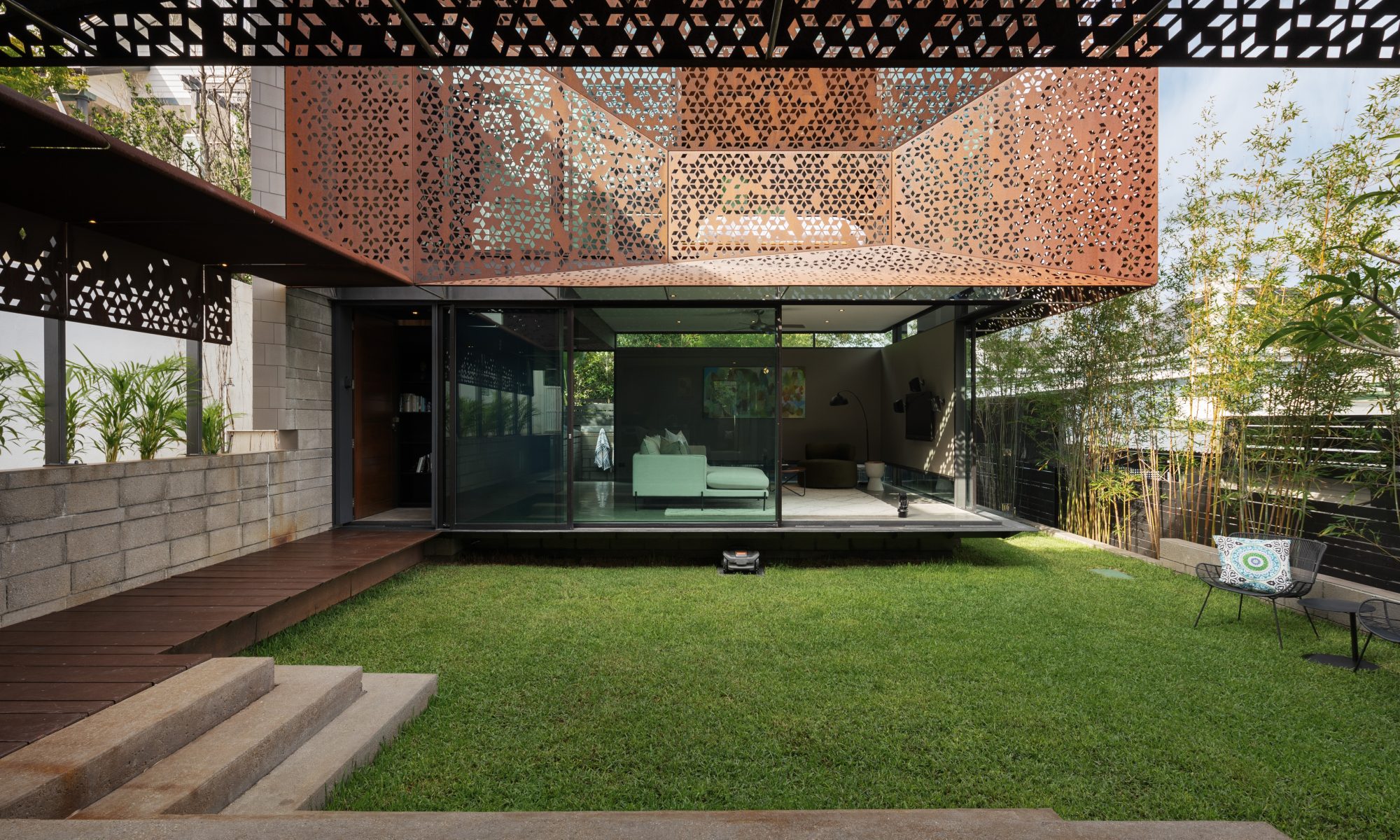
Although the charming period facade remains, the rear of the house has an ultra contemporary backdrop of patterned Corten steel privacy screens that minimise heat and create dappled light across the interior spaces. At night, the unique partition’s geometric laser-cut design provides a star-like feature in the main bedroom suite.
The considered passive design principles extend to the strategically located louvres, doors and windows that draw in cooling breezes, while a vast skylight over the dining area and kitchen allows for plenty of natural light in winter. Burnished concrete floors keep the ground cool and grand walls of glass peel back to reveal a seamless flow to the outdoors with a grassed and landscaped private courtyard.
Although the ground floor has been designed for everyday living and entertaining, the multi-purpose front room with ensuite is an ideal guest retreat or even a perfect ‘work from home’ space complete with a separate entry via the front patio.
Upstairs, a mezzanine lounge provides another breakout area for families, and the two first floor bedrooms open out to the traditional full-width balcony overlooking the street. These bedrooms have built-in wardrobes and desks with a shared family-friendly bathroom.
At the rear of the footprint, a freestanding two-storey pavilion features yet another living space next to the pool with an integrated bar. Above the space the top floor main bedroom has an ensuite and walk-through wardrobe.
A long list of bonus features include ceiling fans in all bedrooms and living areas, a thermostat-controlled whirlybird to extract excess heat, a 5kW solar system with a SMA Sunny Boy inverter, a 20,000L rainwater tank, a filtering and UV disinfection system and a solar hot water system with 450L storage tank.
Although there is a lock up garage, this city-fringe home is within walking distance of Roma Street Parkland, Roma Street Station and Victoria Park. Brisbane Central State School is also only two streets away.
In keeping with Queensland consumer law, properties going under the hammer cannot carry advertised price guides.
This Brisbane home at 32 Isaac St, Spring Hill is on the market with Ray White New Farm with an auction date set for November 30. For details contact agent Samuel Angus on 0411 044 949.