Would work be better if we all took a collective coffee break?
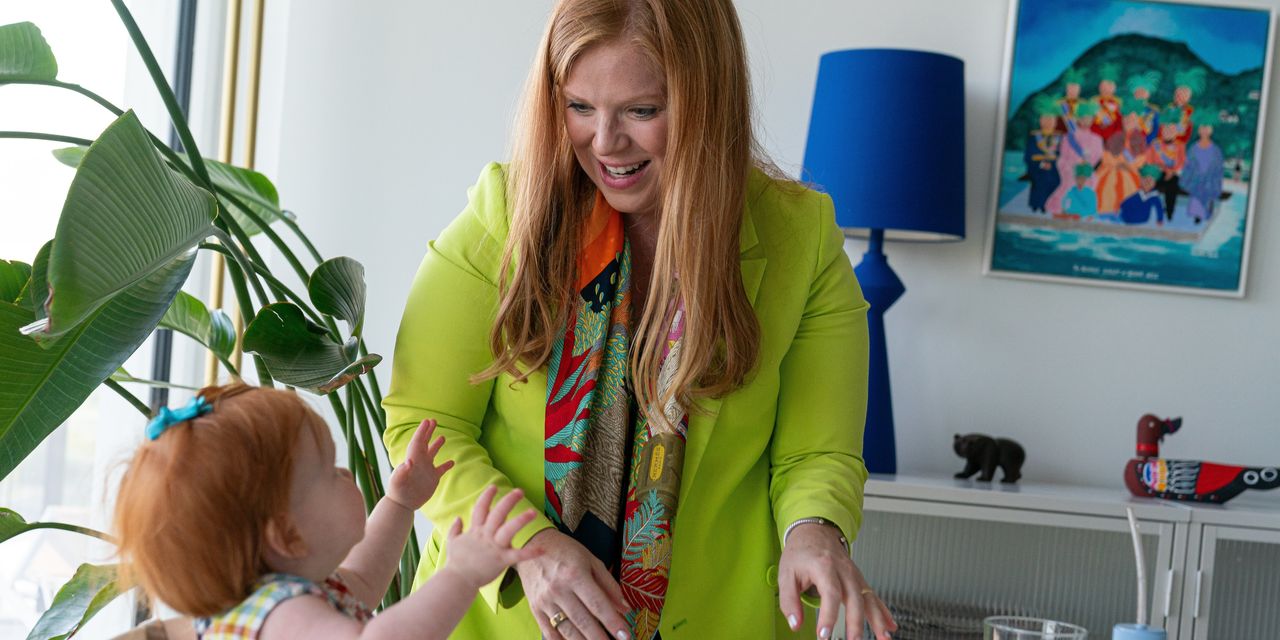
Workers in Sweden certainly think so. There, work life has long revolved around fika, a once- or twice-a-day ritual in which colleagues put away phones, laptops and any shoptalk to commune over coffee, pastries or other snacks. Swedish employees and their managers say the cultural tradition helps drive employee well-being, productivity and innovation by clearing the mind and fostering togetherness.
Now, as bosses and workers elsewhere try to reinvigorate office life and flagging job satisfaction, fika fascination is seeping into other workplaces.
The Grand, a New York-based career and leadership coaching platform, summons its all-remote staff of 10 every other Friday for coffee and conversation over Zoom. London-based Hubble, a website for finding flexible workspaces, took up the tradition after being introduced to it by a Swedish staff member.
“Everyone has an excuse to log off and let their hair down,” said Tushar Agarwal, chief executive of Hubble, where staff gather the last Thursday of every month for baked goods, chitchat and, of course, coffee.
A recent product offering—for part-time office space with new contract terms—sprang from a discussion that took place during fika, says chief of staff Charlie Bastier. It’s now one of the fastest-growing revenue streams, he says.
Not a Starbucks run
The pressure to make tweaks to the daily ritual is particularly acute in the U.S. Employees continue to report feeling less engaged in their jobs than in pre pandemic times, Gallup data show.
In addition, bonding with colleagues has become harder and less of a priority for many people in the hybrid world of work. Some employers worry the lack of social cohesion is harming company culture and operations.
At The Grand’s regular fika, staffers take turns hosting, leading with casual conversation or a board game such as Code Names or a drawing competition. The Grand’s co-founder Rei Wang says that fika allows her to spend time with her staff, making her a better leader.
“Learning more about their passions and their geniuses helps me understand and collaborate with them,” she says.
Pronounced “fee-kah,” the Swedish culture of breaking for coffee involves much more than a schlep to Starbucks. It’s meant to be a deliberate pause to provide space and time for people to connect. Many Swedish companies build a mandatory fika into the workday, while the Embassy of Sweden in Washington holds one for staff weekly. IKEA, promoting its Upphetta coffee maker on the corporate website, extols the virtues of fika: “When we disconnect for a short period, our productivity increases significantly.”
“Fika is where we talk life, we talk everything but work itself,” said Micael Dahlen, professor of well-being, welfare and happiness at the Stockholm School of Economics. The ritual helps drive trivsel, he says, a term that means a combination of workplace enjoyment and thriving. The concept is so fundamental to Swedish workplaces that many companies in Sweden have trivselcommittees, he said.
Dahlen said he suspects a pandemic-era drop in office fikas contributed to a sharp decline in Swedes’ happiness at work. Just over half of workers in Sweden reported a high level of job satisfaction in 2022, according to Eurostat, compared with 69.5% in 2017.
A productivity booster
There’s some evidence that communal coffee breaks help boost productivity. In a study of call centre workers at Bank of America, researchers at the Massachusetts Institute of Technology found that teams that scheduled 15-minute breaks together were 18% more communicative with one another through the workday than groups with staggered breaks.
Annual turnover, likewise, was 12% among teams that held collective coffee breaks versus 40% among other workers. In all, the teamwork fostered via the breaks led to an estimated $15 million in increased annual productivity, says lead researcher Ben Waber.
“People who are in a tight knit social group have higher levels of trust,” said Waber, who has since founded a behavioural analytics company called Humanyze.
Hubble employees take turns baking and get a stipend of about $20 for supplies for the company’s monthly fikas. Last week, 26 staff members gathered in a communal area away from desks and cubicles.
Kate Mehigan, an account manager, brought in homemade arancini balls and Eliot Dixon, an account team lead, laid out a Basque cheesecake from a recipe he’d found online. Some people played ping pong.
Fleur Sylvester, a Hubble account executive, used the time to quiz a colleague on training advice for running a half-marathon. Sylvester says when she joined the company over a year ago the gatherings were invaluable for helping put faces to names.
“You get an opportunity to speak to other team members that you don’t get to talk to on a day-to-day basis,” Sylvester said. “When you’re online you don’t get the opportunity to have those chats.”
Peter Linder, head of thought leadership in North America for Swedish telecom giant Ericsson, recently introduced the fika concept to Jason Inskeep, senior director at management consulting company Slalom. The two men had initially met on a joint panel discussion, and Linder wanted to congratulate Inskeep on his new job at Slalom. He sent Inskeep a Zoom invite for a 20-minute fika one-on-one.
“I didn’t know what it was,” Inskeep said.
The vibe of the midmorning conversation—which meandered from the future of artificial intelligence to Inskeep’s own feelings navigating a new company culture—was different from the usual business tête-à-têtehe said. Bouncing ideas back and forth in a relaxed way left him feeling energised the rest of the morning.
“It was a mix of coffee shop and barber shop,” he said.
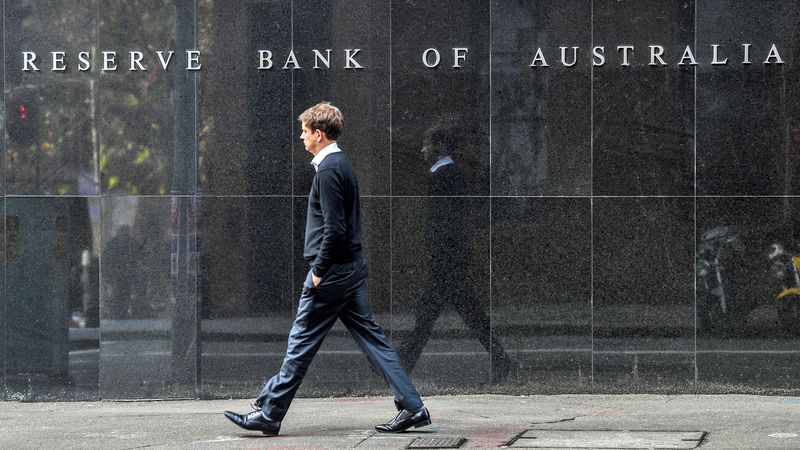
The Reserve Bank of Australia decided to keep the cash rate on hold at its first meeting for 2024, as it takes a cautious approach to last week’s news on inflation.
In a statement released earlier today, the board said rates would remain at 4.35 percent with the interest rate paid on Exchange Settlement balances unchanged at 4.25 percent.
The announcement was widely expected, with most economists pointing to September as the likely date for a fall in rates to start. This is despite inflation slowing to 4.1 percent in December, a greater than expected drop.
“Inflation continued to ease in the December quarter,” the RBA Board said in a statement. “Despite this progress, inflation remains high at 4.1 percent. Goods price inflation was lower than the RBA’s November forecasts. It has continued to ease, reflecting the resolution of earlier global supply chain disruptions and a moderation in domestic demand for goods.
“Services price inflation, however, declined at a more gradual pace in line with the RBA’s earlier forecasts and remains high. This is consistent with continuing excess demand in the economy and strong domestic cost pressures, both for labour and non-labour inputs.”
Despite positive signs, the board maintained that the outlook is still ‘highly uncertain’ and indicated a desire to tread carefully over the coming months to achieve the board’s desired 2-3 percent inflation target by 2025.
Inflation remained ‘sticky’ for much of 2023, with the RBA announcing 13 rate rises in just over 12 months to try to drive it down to more acceptable levels. Today’s decision offers a reprieve to mortgage holders and reflects the board’s interest in directing inflation down over the longer term.
“The Board needs to be confident that inflation is moving sustainably towards the target range,” the board said. “To date, medium-term inflation expectations have been consistent with the inflation target and it is important that this remains the case.”
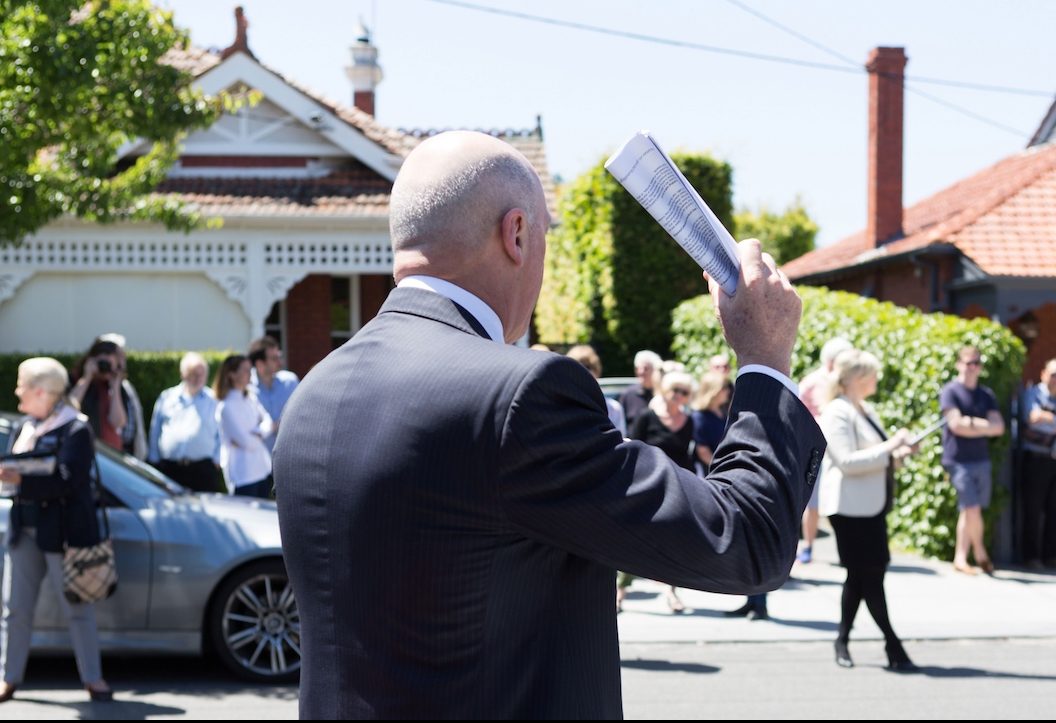
More than seven in 10 homes that went to auction on Saturday sold under the hammer, delivering a preliminary national clearance rate of 73.9 percent across the combined capital cities, according to CoreLogic data. The strongest result was seen in Canberra where 80 percent of the 75 homes auctioned were sold. Adelaide recorded a 77.6 percent clearance rate, Sydney 76.3 percent, Melbourne 71.9 percent and Brisbane 68.5 percent.
Impressive clearance rates were also recorded in regional areas. Newcastle and Lake Macquarie hosted 37 auctions with a 77.8 percent clearance. The Gold Coast saw 126 homes go to auction with a clearance of 65.3 percent. For perspective, a clearance rate of 60 percent reflects normal market conditions, with anything above this indicating strong selling conditions and high buyer demand.
Australia’s biggest agency network, Ray White, also reported a 74 percent clearance rate for the 387 auctions it conducted on Saturday. The company said the market was roaring back in 2024, with the number of buyers attending open inspections up by 24 percent since 1 January compared to the same period last year.
CoreLogic said the first major week of auctions had set a “cracking pace” for the market in terms of volume and sales success. Saturday was the second-biggest start to a new year’s auction season since CoreLogic began keeping records in 2008. A total of 1,671 homes went to auction across the capital cities. CoreLogic economist Kaytlin Ezzy said the clearance rates in Sydney and Melbourne represented “a sizeable step change” compared to the end of last year.
“Overall, it looks like auction markets are starting the year on a strong footing,” Ms Ezzy said. “Potentially, the news of low inflation and the possibility of early rate cuts is already boosting sentiment. The next few weeks should provide further guidance on whether this strong result is simply some early-year exuberance or a trend that can persist.”
Last week the Australian Bureau of Statistics revealed inflation fell to 4.1 percent in December, lower than the expected forecast of 4.5 percent, representing a two-year low. Prior to the figures being released, most economists were predicting that interest rates could start to fall by September this year.
The first interest rate decision by the Reserve Bank will be announced at 2.30pm today. Following on from changes signalled last year in the way the rate decision is announced, Governor Michele Bullock will conduct a press conference to explain the board’s decision and answer questions from journalists at 3.30pm.
Canada’s government has extended through the end of 2026 a controversial ban on foreign home buyers that took effect last January after years of debate.
“For years, foreign money has been coming into Canada to buy up residential real estate, increasing housing affordability concerns in cities across the country, and particularly in major urban centres,” Chrystia Freeland, Canada’s deputy prime minister and minister of finance, said in a news release yesterday. “Foreign ownership has also fuelled worries about Canadians being priced out of housing markets in cities and towns across the country.”
The Prohibition on the Purchase of Residential Property by Non-Canadians Act forbids non-citizens from buying residential property in most urban areas, though it includes a long list of exceptions. Property in many rural and “recreational” regions is exempt; most students, refugees, permanent residents, spouses of Canadian citizens, and some temporary workers in Canada may still buy homes.
While the government says the ban will help ease Canada’s severe housing crunch, critics in the real estate industry counter that the prohibition is misguided―and ineffective.
“The newly announced two-year extension is completely unnecessary, considering the fact there is no analysis, evidence or data from Statistics Canada, CMHC [Canada Mortgage and Housing Corporation] or Finance Canada, to support the government’s intended impact on housing affordability in Canada,” said Janice Myers, CEO of the Canadian Real Estate Association (CREA), in a statement Monday. “If the government decides to move forward with this baseless extension, CREA urges them to consider recommendations including exempting pre-construction financing, defining and exempting recreational property, including CUSMA [Canada-United States-Mexico Agreement] exemptions, and giving provinces input to tailor to their housing market requirements,” she added.
Don Kottick, the president and CEO of Sotheby’s International Realty Canada, agreed.
“Canada’s housing market has been driven almost entirely by the housing needs and demands of locals, as well as by population gains due to in-migration of Canadians from other cities, and through immigration,” he told Mansion Global in an email. “The extension of the foreign buyers ban will continue to have little or no impact on housing affordability and housing prices. This policy has only confused and frustrated those from other countries with crucial skills, talent and capital that Canada has been striving to attract and retain.”
The ban has also chilled luxury home sales in key markets like Toronto, said Maureen O’Neill, manager of Sotheby’s International Realty Canada in Toronto. “People who want to sell houses for more than C$5 million [US$3.92 million] can no longer rely on the buyers they used to count on globally,” she said. “It’s another extra burden on selling a house.”
That burden may soon get even heavier; Toronto’s mayor last week endorsed a 10% tax on foreign home buyers in that city, Canada’s largest. The province of Ontario already imposes its own 25% “non-resident speculation tax” on foreign buyers.
Though Canadian data on non-resident buyers is limited, the CBC last year reported that in British Columbia―one of the nation’s hottest housing markets―only about 1.1% of transactions in 2021 involved a foreign buyer, a drop of 3% in 2017. At the time, Ontario’s government told the CBC it had seen “a downward trend” in foreigners buying property since it began taxing non-resident purchases in 2017.
In a transaction that further cements NBA Hall of Famer Michael Jordan’s standing atop the world of sports memorabilia, Sotheby’s New York sold six Air Jordan sneakers earlier Friday for the whopping total of US$8 million.
Dubbed the Dynasty Collection, the set of six shoes were sold to an anonymous buyer who was in the room during the bidding, according to the auction house. Sotheby’s had publicised the sale with a far-reaching tour, displaying the sneakers around the world while estimating that the set would sell for between US$7 million and US$10 million.
“To have something from one of Jordan’s championship clinching games is a goal for every collector of sports artefacts. To have something from all six is unheard of,” says Brahm Wachter, Sotheby’s head of modern collectables. “We are thrilled with the result which is a testament to the greatest to ever play the game.”
The Dynasty Collection earned headlining status for the second edition of Sotheby’s “The One,” a cross-category sale that features an eclectic range of notable objects representing human achievement and excellence.
Michael Jordan of the Chicago Bulls shoots the winning jump shot with 5.2 seconds left during game six of the NBA Finals against the Utah Jazz in Salt Lake City in June, 1998. The Bulls won 87-86 for their sixth NBA championship. AFP via Getty Images
As the hammer fell, the final price tag set a new global benchmark for game-worn sneakers while becoming the second-highest price achieved for any Jordan memorabilia, just behind Jordan’s 1998 NBA Finals Game 1 jersey from the famed “Last Dance” season, which achieved US$10.1 million at Sotheby’s in September 2022 and still holds the world record for any game-worn sports memorabilia.
The auctioneer also holds the record for any pair of sneakers, with Jordan’s 1998 NBA Finals Game 2 Air Jordan 13s having earned $2.2 million in April 2023.
Jordan, who turns 61 on Feb. 17, famously handed off one of his size-13 and 13.5 shoes—an Air Jordan VI (1991), Air Jordan VII (1992), Air Jordan VIII (1993), Air Jordan XI (1996), Air Jordan XII (1997), and Air Jordan XIV (1998)—after each championship-deciding victory to Bulls PR exec Tim Hallam.
The sneakers were later obtained from Hallam by a private American collector, who ultimately enlisted Sotheby’s for the sale. Initially announced nearly a year ago, the collection has captured the attention of sports fans and hobbyists alike.
“Today’s record-breaking price is a testament to the GOAT. The Dynasty Collection undeniably ranks among the most significant compilations of sports memorabilia in history,” Wachter said in a statement announcing the result.
“Serving as both a reminder of Michael Jordan’s lasting impact on the world and a tangible expression of his recognized legendary status, its significance is further validated by this monumental result.
One other piece of Jordan memorabilia was included in the auction: the signed official scorekeeper’s sheet from the highest-scoring game of his career—a 69-point effort against the Cleveland Cavaliers on March 28, 1990. It sold for US$50,800.
A few years ago, Indonesia set out to turn its treasure trove of nickel into an electric-car manufacturing boom.
It imposed a sweeping ban on the export of raw nickel. That meant that companies wanting to tap the world’s largest source of the mineral—used in the most powerful type of EV batteries—would have to build smelters in Indonesia. Officials bet that factories to make EV batteries and entire electric cars would also follow, spawning end-to-end supply chains close to the mineral bounty.
The smelters came, and Indonesia’s nickel industry witnessed explosive growth. But powering it is a coal binge that is throwing off the country’s climate goals. And Indonesians are still waiting for EV makers to lay down production lines.
As President Joko Widodo prepares to leave office this year after a decade—the most he can serve—he is exhorting his potential successors to stick with the policy that is at the centre of his economic legacy. Indonesia holds presidential elections on Feb. 14, and a new leader will take charge in October.
Widodo has cast his plan, referred to in economist-speak as downstreaming, as the answer to the question of how Indonesia will become a rich nation. He says the country is reversing a 400-year pattern dating back to colonial times of being exploited for its natural resources and getting little in return. He has prodded other developing nations to follow its lead.
Last year, officials escorted delegations from mineral-rich Papua New Guinea and the Democratic Republic of Congo to one of Indonesia’s largest nickel industrial parks to show them the scale of Indonesia’s achievements. New Chinese-built smelters dot the archipelago. The value of Indonesia’s nickel exports is up four times since 2019 to around $33 billion.
Not everyone believes the silver metal is a silver bullet.
Nickel smelters have led to a surge in coal use, with new coal plants coming up at a time when the world is trying to phase out the fossil fuel. A January report by Climate Rights International, a U.S. environmental group, said that a single nickel-focused industrial park located on eastern Indonesia’s Maluku islands will burn more coal than Spain or Brazil when it is fully operational.
“We are sacrificing the environment and society, while at the same time getting limited profits for the country,” Muhaimin Iskandar, a vice-presidential candidate in the coming election, said during a televised debate with his political opponents.
Other candidates have pledged to carry forward the president’s nickel policies, including the front-runner for president, Prabowo Subianto, who has said it is much better to export electric-vehicle batteries than raw nickel.
The “dirty nickel” reputation is threatening the very economic opportunities Indonesia covets. In October, nine U.S. senators signed a letter opposing a proposed free-trade agreement to source critical minerals from Indonesia, citing environmental and safety concerns. Without a free-trade deal, EV batteries with substantial quantities of Indonesia-processed nickel won’t be eligible for a major U.S. tax credit.
That makes the country’s nickel less attractive to Western EV makers, who are already battling questions from green groups about the environmental fallout of the country’s sprawling nickel operations.
In a sign of the growing unease, a deputy director for batteries and critical materials at the U.S. Energy Department, Ashley Zumwalt-Forbes, voiced concern in a LinkedIn post last month about what she called the grip of dirty Indonesian nickel on the market. Indonesia accounts for half the global nickel supply, up from a quarter in 2018.
The problems with nickel are also pushing EV makers to rework car batteries and go nickel-free. A lithium-iron-phosphate alternative is gaining traction, though it remains less powerful than batteries containing nickel.
Then there is the question of whether the policy is taking Indonesia toward Widodo’s goal of downstreaming—that is, a shift to higher-value manufacturing. Widodo has long said the endgame isn’t localising nickel processing but rather attracting EV and battery factories. Anything less, he says, could put Indonesia on the same track as some commodity-rich Latin American economies that have languished.
But so far, EV makers haven’t rushed into Indonesia. Tesla, which Widodo has assiduously courted, including on a 2022 trip to Texas to meet with founder Elon Musk, hasn’t shown any signs it plans to set up a factory in the country. No other Western automakers have built EV factories either, though General Motors has a stake in one China-based automaker producing electric cars in Indonesia. Some, like Ford, have made deals to tie up nickel supply.
Korean automaker Hyundai has since 2021 operated one of Indonesia’s only EV factories, focused on the domestic market. The unit can produce 150,000 vehicles a year, but made fewer than 9,500 in 2022 and 2023. Hyundai and Korea’s LG expect to begin producing battery cells at a plant in West Java this year.
Automakers generally look to set up battery and EV plants in the markets where people are already buying electric cars. That puts Indonesia, where few consumers have switched from combustion-engine vehicles, at a disadvantage. The country has a limited charging network and gasoline is heavily subsidised.
Indonesian policymakers who believe the country’s nickel bounty gives it leverage over carmakers are mistaken, said Tom Lembong, a former trade minister under Widodo. He pointed to the growth of nickel-free batteries as a warning against betting big on nickel.
Lembong, who is advising presidential candidate Anies Baswedan—whose ticket advocates focusing on promoting labor-intensive industries—said Indonesia has made limited progress moving up the value chain.
“The irony about this is they call it downstreaming, but we’re still very upstream,” he said.
Septian Hario Seto, a senior Indonesian official involved in nickel policymaking, acknowledged that EV battery and car factories have been slower to come than nickel smelters. The government has brought new regulations to address that, he said, such as one that makes it easier for EV makers to import cars into Indonesia on the condition they later build a factory.
Last month, Chinese EV giant BYD said it would begin car sales in Indonesia, and break ground on a manufacturing unit later this year.
Overall, Seto said the nickel policy has been successful, boosting economic growth in less-developed eastern regions where the nickel is found, and providing jobs and tax revenue. The government has taken steps to limit environmental degradation, such as by banning companies from jettisoning mining waste into the ocean, and will try to bring hydropower projects online as an alternative to coal, he said.
Cullen Hendrix, a senior fellow at the Peterson Institute for International Economics in Washington, D.C., said there are two ways to assess Indonesia’s industrial policy.
“It’s been successful at driving foreign investment and building nickel processing capacity,” he said. “So far it hasn’t achieved the fully integrated mine-to-EV battery assembly to which it aspires.”
Board members at Elon Musk’s electric-car maker, Tesla, were facing a dilemma.
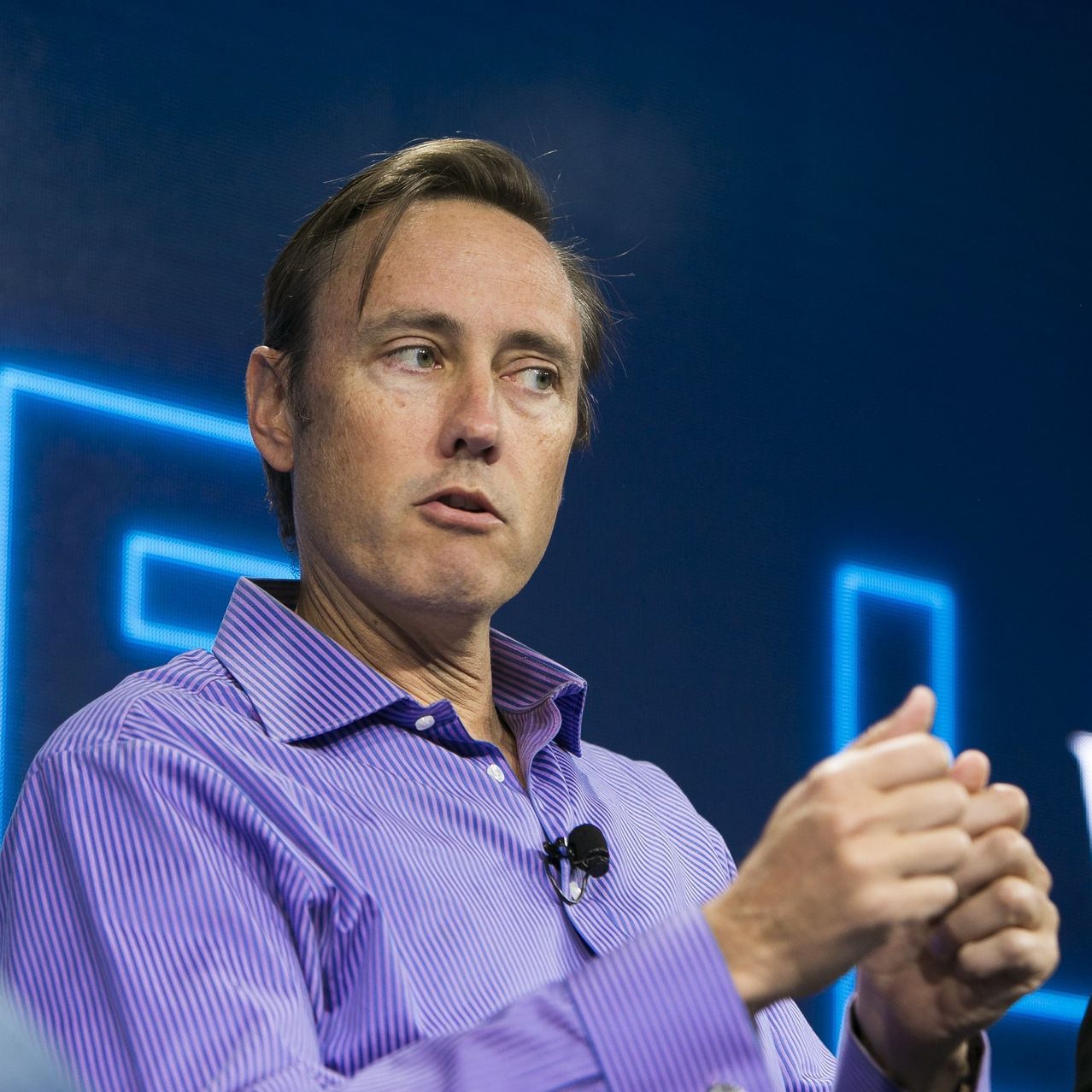
One longtime director, the venture capitalist Steve Jurvetson, had left his firm after an internal investigation found he had slept with multiple women in the tech industry and used illegal drugs.
Some of the details had been splashed across the press in 2017, and Tesla directors informally discussed how they should handle it, according to people familiar with the situation. Some urged him to resign.
Luckily, Jurvetson, even though the company designated him an independent director, had a good friend with whom he had deep financial ties and also attended parties with, using ecstasy and LSD: Musk.
Musk pushed directors in private conversations to allow Jurvetson to take an unusual leave of absence from the board of the public company, and then step down on his own accord in 2020, the people said. Jurvetson remains a director at Musk’s privately held rocket company, SpaceX.
“The answer was do nothing and see what happens,” said another former independent Tesla director and good friend of Musk’s, Antonio Gracias, in a 2021 court deposition, when asked how the board handled the Jurvetson situation. Gracias and his venture-capital firm held investments recently valued at about $1.5 billion in Musk companies.
Multiple other directors of Musk companies have deep personal and financial ties to the billionaire entrepreneur, and have profited enormously from the relationship. The connections are an extreme blurring of friendship and fortune and raise questions among some shareholders about the independence of the board members charged with overseeing the chief executive. Such conflicts could run afoul of the loose rules governing what qualifies as independence at publicly traded companies.
On Tuesday, a Delaware judge struck down Musk’s multibillion-dollar pay package at Tesla, saying board members who signed off on it in 2018 were beholden to Musk.
Several current or former directors at Tesla and SpaceX attend parties with him, go on exotic vacations and hang out at Burning Man, the Nevada arts and music festival.
Musk and these directors, including venture capitalists Gracias and Ira Ehrenpreis, tech mogul Larry Ellison, former media executive James Murdoch, as well as Musk’s brother, Kimbal Musk, have invested tens of millions of dollars in each other’s companies—Ellison held billions of dollars in Tesla shares with about a 1.5% holding in 2022. Some also received career support and help from Elon Musk.
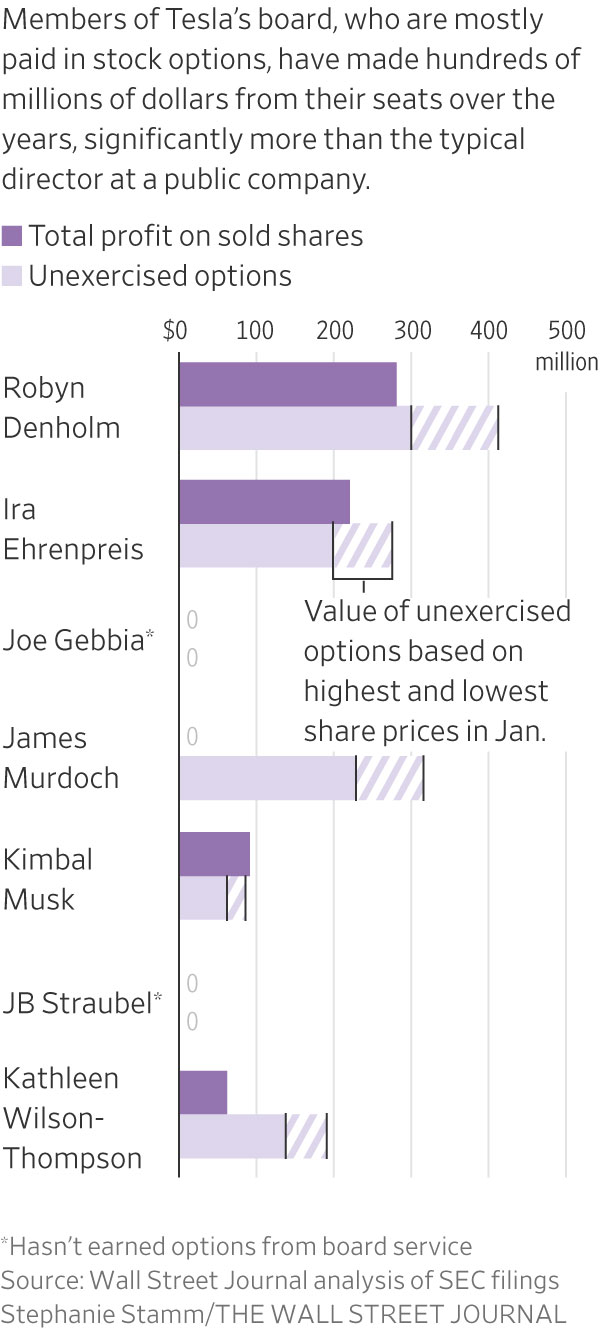
Most members of Tesla’s current eight-person board have amassed shares worth hundreds of millions of dollars from their seats over the years, significantly more than what board members at other companies make for their service.
Tesla pays its directors mostly in stock options, and the current board, not including Musk himself, collectively has made more than $650 million selling shares from those options. They hold additional options valued at nearly $1 billion. Some directors agreed to return a portion of that compensation to Tesla to resolve a shareholder lawsuit about their compensation while denying any wrongdoing. A judge has yet to approve the settlement.
Some current and former Tesla and SpaceX directors have knowledge of Musk’s illegal drug use but haven’t taken public action, according to people who have witnessed the drug use or were briefed on it.
The Wall Street Journal reported in January that Musk has used drugs including cocaine, ecstasy, LSD and magic mushrooms, and that leaders at Tesla and SpaceX were concerned about it, particularly his recreational use of ketamine, for which Musk has said he has a prescription. The illegal drugs violate strict anti drug policies at Musk’s companies and could put SpaceX’s federal contracts and Musk’s security clearance at risk.
At the upscale Austin Proper Hotel, Musk has attended social gatherings in recent years with Tesla board member Joe Gebbia, the Airbnb co-founder and a friend of his, where Musk took ketamine recreationally through a nasal spray bottle multiple times, according to people familiar with the drug use and the parties.
Other directors, Gracias, Jurvetson and Kimbal Musk, have consumed drugs with him, according to people who have witnessed the drug use and others with knowledge of it.
Musk and some people close to him, including Kimbal Musk, attend parties at Hotel El Ganzo, a boutique hotel in San José del Cabo, Mexico, known for its art and music scene as well as drug-fueled events, according to people familiar with the parties.
The volume of drug use by Musk and with board members has become concerning, some of these people said.
In the culture Musk has created around him, some friends, including directors, feel there is an expectation to consume drugs with him because they think refraining could upset the billionaire, who has made them a lot of money, some of the people said. More so, they don’t want to risk losing the social capital that comes from being close to Musk, which for some feels akin to having proximity to a king.
Musk and his lawyer, Alex Spiro, didn’t respond to requests for comment.
In response to the Journal article in January about Musk’s illegal drug use, Spiro said Musk is “regularly and randomly drug tested at SpaceX and has never failed a test.”
After that article, Musk tweeted that in three years of undergoing random drug testing after a pot-smoking incident in 2018, “Not even trace quantities were found of any drugs or alcohol. @WSJ is not fit to line a parrot cage for bird [poop emoji].” He later tweeted: “If drugs actually helped improve my net productivity over time, I would definitely take them!”
Tesla’s general counsel and a SpaceX spokesman didn’t respond to requests for comment.
Ellison offer
Some board members worry about the negative effects of Musk’s behaviour on the six companies he oversees and the roughly $800 billion in assets held by investors, according to people close to Musk.
Despite the concerns, the Tesla board hasn’t investigated his drug use or recorded their worries into official board minutes, which could become public.
Around the winter of 2022, Musk’s good friend and former Tesla board member, Ellison, urged him to come to his Hawaiian island to relax from work and dry out from the drugs, according to people familiar with the offer.
The outreach came as friends and others close to Musk worried that his drug use was getting worse, and some asked him to go to rehab, some of the people said.
Around the same time as the Ellison offer, Musk attended a party in the Hollywood Hills where he consumed a liquid form of ecstasy from a water bottle, according to a person who was there. Musk’s security guards asked people to leave the floor of the house for privacy before Musk took the drug.
Across Silicon Valley, executives sometimes invest in each others’ companies and ventures, and might have one or two personal friendships on a company board, especially before it goes public.
Musk, because of the extent of his personal and professional board ties and the enormous amount of money involved, is the most prominent example of a chief executive who is intertwined with directors. The Journal traced connections by reviewing hundreds of pages of court documents and depositions, Securities and Exchange Commission filings and other public records.
The amount Tesla pays its directors is far more than the average compensation for boards at most U.S. companies. The average total compensation for board members in the largest 200 U.S. companies was $329,351 in 2023, according to a new report from the National Association of Corporate Directors and compensation consultant Pearl Meyer. By comparison, current Alphabet board members hold stock valued at about $8 million, and received an average annual compensation for board service of about $475,000 since 2015.
Beyond board pay, some Tesla and SpaceX directors have tens of millions of dollars in additional investments in Musk’s companies, including his brain implant startup, Neuralink, and his tunneling venture, The Boring Co.
Musk, in turn, invests in some directors’ companies. Board members also have invested in Kimbal Musk’s Kitchen Restaurant Group and in SolarCity, a company run by Musk’s cousins that was acquired by Tesla.
Governance experts, such as longtime board members and advisers to boards, say the personal and financial ties could muddy directors’ views, and that it is highly unusual at U.S. public companies.
According to the rules of Nasdaq, where Tesla trades, an independent director can’t be an employee, a family member or someone whose relationship “would interfere with the exercise of independent judgment.” Nasdaq requires a majority independent board.
While rules governing independent directors across the country are murky, financial entanglement is one area where courts have sometimes found public companies at fault for claiming directors’ independence while they hold investments tied to one another.
Amalgamated Bank, which managed around $180 million of investments in Tesla as of September, signed a shareholder letter last year asking Tesla board members to step up their “meagre oversight” of Musk.
The investors expressed concern that the close ties between Musk and several Tesla directors make the board ill-equipped to act in the best interest of shareholders.
CEO with leeway
Some directors view Musk as a once-in-a-generation genius, with a brilliant mind and unusual methods. In depositions and courtroom testimony, directors have said they think Musk’s leadership is crucial to both Tesla and SpaceX, and believe in his long-held mission to colonize Mars. He is seen as the soul of his companies and intertwined with their success. Tesla’s stock is up more than 300% in the past four years, but has dropped about 25% since the beginning of January.
When striking down Musk’s pay package on Tuesday, the Delaware Court of Chancery judge called the process for approving it “deeply flawed” and cited Musk’s “extensive ties” to some of the directors who negotiated it. A Tesla shareholder had sued, alleging Musk played too big a role in deciding his own pay.
Musk “enjoyed thick ties with the directors tasked with negotiating on behalf of Tesla, and dominated the process that led to board approval of his compensation plan,” wrote Chancellor Kathaleen McCormick in the opinion. She described board Chair Robyn Denholm’s approach to her oversight obligations as “lackadaisical.”
Tesla board members can appeal the decision to the Delaware Supreme Court. After the ruling, Musk posted on X saying, “Never incorporate your company in the state of Delaware” and said Tesla would hold a shareholder vote about incorporating in Texas.
Board members had signed off on the pay deal in 2018, with Tesla valuing it at a maximum of $55.8 billion. It was the biggest pay package ever to the chief executive of a U.S. public company, according to governance-data firm Equilar.
While negotiating the pay package, Musk emailed the company’s top lawyer explaining how he would use the additional compensation. “The added comp is just so that I can put as much as possible towards minimising existential risk by putting the money towards Mars,” Musk wrote. Ehrenpreis, a yearslong friend, was head of the board’s compensation committee.
Company directors frequently allowed Musk an unusual amount of leeway on issues big and small.
After he bought Twitter in 2022, for example, Musk tapped Tesla employees to review the social-media platform’s engineering talent. Also around that time, SpaceX signed off on an unusual $1 billion loan to its chief executive, the Journal has reported.
A 2018 settlement with the SEC, following Musk’s tweet about plans to take Tesla private, required Tesla to establish more controls and form a new committee of independent board members to oversee Musk’s communications. But according to court documents, Denholm said Musk “does self-regulate” compliance, and some directors said they don’t review his tweets.
Tesla disclosed in 2022 that it had received a subpoena from the SEC seeking information about how the company was complying with the settlement.
Musk’s freewheeling commentary on Twitter, now X, and in interviews has injected volatility into Tesla’s share price and affected his other companies. In 2020, Tesla’s stock closed down more than 7% for the day after Musk tweeted, “Tesla stock price is too high imo.” Last year, major companies stopped advertising on X after he described an antisemitic post on X as “the actual truth.”
Investors have for decades pressed for independent directors, especially at public companies, because it allows them to push back against management and closely monitor what is happening inside the business.
The sweeping set of rules known as Sarbanes-Oxley in 2002 mandated that public companies have independent directors, including on the audit committee. The rules came after the collapse of energy trading giant Enron, which later was found to have hidden its financials amid improper board oversight.
Stock exchanges generally spell out how they define independence on boards and other expectations. At private companies, there are no requirements for the number of independent directors, or what constitutes one. At Nasdaq, if a company doesn’t comply with its majority independent board rule, it gives the company one year or until its next shareholder meeting to make a change; if not, it may be delisted.
Questions about a public director’s independence have gone to the courts, with judges sometimes finding problems with deep financial ties.
The Delaware Supreme Court in 2016 ruled that the majority of videogame developer Zynga’s board weren’t independent. Among the reasons was that a venture-capital firm two directors worked for had invested in a startup the CEO’s wife co-founded and that another director and her husband co-owned a private plane with the CEO.
Following the court’s decision, Zynga expanded its board and formed a special litigation committee to investigate insider trading allegations. Zynga settled the suit in 2019 for $11 million.
“To me, it’s really: Are you capable of making a disinterested, objective decision uninfluenced by the relationship?” said Lawrence Hamermesh, former director of the Widener Institute of Delaware Corporate and Business Law, who has also served as senior special counsel in the SEC’s corporate finance division.
Surrounded by friends
When Tesla was looking to replace a departing director, it turned to a familiar face in JB Straubel. The board believed the company’s former chief technology officer, whom Tesla considers a co-founder, was someone Musk would listen to, could fill Ellison’s shoes and had technical expertise, according to people with knowledge of the board’s thinking.
Last year, ahead of a vote to approve Straubel, some shareholders pushed back over his close ties to the company, saying if he were added to the board then at least five of the eight members would lack independence. Straubel was elected anyway. A Nasdaq spokesman said it doesn’t comment on specific companies and referred a Journal question on how Straubel can be classified as an independent director to Tesla.
Musk has long surrounded himself with close friends as he built his business empire. He has turned to them for advice on new business ventures and on daily operational help.
In addition to Musk on the Tesla board, his brother, Kimbal Musk, is a member. He previously served on the SpaceX board and has counselled Musk on numerous ventures, including whether to start OpenAI and Neuralink. He and Musk are also close personally, often attending the same events and parties.
Ehrenpreis, who chairs two of four committees on the Tesla board, is designated independent by the company and has been close to Musk for years.
The venture capitalist held the right to buy the first Tesla Model 3—which some covet for bragging rights. Around Musk’s 46th birthday in 2017, he gave it to Musk, tweeting, “Much love and respect for everything you do.”
Ehrenpreis has personally or through his venture-capital firm, DBL Partners, invested in many of Musk’s ventures, totalling about $70 million.
On the Tesla board, he has made more than $220 million on stock sales earned through board service and has additional options worth more than $200 million at recent prices.
James Murdoch, former chief executive of 21st Century Fox, also is classified independent by Tesla. His friendship with Musk dates back to around 2006, and he has vacationed with Musk and their families, including on trips to Israel and Mexico.
In court testimony in 2022, Musk said he didn’t know Murdoch well, though Murdoch in an earlier deposition affirmed his friendship with Musk.
Murdoch, who is the younger son of Rupert Murdoch, chairman emeritus of News Corp, which owns The Wall Street Journal, has said in court testimony he considers himself independent and has described a director as “having an ability to exercise independence of thought in governance and oversight as a member of a public company.”
Murdoch poured $20 million into SpaceX, and a company controlled by him invested about $50 million in the space company, court records show.
Denholm, who is designated independent, is based in Australia and doesn’t socialize with Musk. She has said in court testimony she doesn’t have personal investments in Musk’s other companies.
Her decade-long position on the Tesla board has been lucrative, earning her more than $625 million in the company’s equity. Denholm has exercised about half her options, profiting more than $280 million from the sales.
Denholm runs Tesla board meetings as informal, family-style occasions. Directors sometimes ask softball questions of Musk, such as future Tesla product colours, according to people familiar with the board.
Musk, meanwhile, would sometimes arrive two hours late, or hours early, and then blame his staff for not getting him there at the appropriate time, according to one of the people.
Musk said he handpicked Denholm, who replaced him as board chair in 2018 under an agreement with the SEC, according to an interview on “60 Minutes” that year.
The idea Denholm would watch over him was “not realistic” given his status as the company’s largest shareholder, he said in the interview, adding: “I can just call for a shareholder vote and get anything done that I want.” Musk later tweeted that the show had edited the interview in a misleading way. A “60 Minutes” spokeswoman said the show stands by its reporting.
Gebbia, the Airbnb co-founder and friend of Musk’s, joined the Tesla board in 2022, lives in Texas and is designated an independent director.
Former Walgreens Boots Alliance executive Kathleen Wilson-Thompson, who joined the board in 2018, is designated independent and doesn’t have public ties to Musk.
Deal with ex-girlfriend
Three current and former Tesla and SpaceX board members have been among Musk’s closest personal and financial partners.
Ellison, the co-founder and current chief technology officer of Oracle, was designated independent during his board tenure at Tesla between 2018 and 2022. He has said “I’m very close friends” with Musk and has hosted him multiple times at his Hawaiian island, Lanai.
When Musk revealed his plans to buy Twitter, Ellison committed $1 billion in 2022, while still on the Tesla board, to help fund it, surpassing the investments of many of the venture-capital firms involved in the deal.
Gracias, whom Tesla classified as the company’s lead independent director from 2010 until 2019, has been close friends with Musk for more than two decades. Musk turned to Gracias for support after his baby son died in the early 2000s, according to a 2021 court deposition.
He is also one of the friends who attends private parties around the world and sometimes consumes illegal drugs with Musk.
In court testimony in 2022, he called Musk “extraordinary,” “an amazing engineer” and “a product genius.”
For his work on the Tesla board, he has made more than $100 million by selling shares he earned.
Former Tesla and current SpaceX board member Steve Jurvetson, shown in 2016, is among the directors who have used drugs with Musk, according to people who have witnessed it and others with knowledge of it. PHOTO: NIKKI RITCHER FOR THE WALL STREET JOURNAL
When Musk needed cash, Gracias lent him $1 million, Gracias said in a court deposition, though it is unclear when he gave the money or what it was for. Musk has also personally invested about $10 million in Gracias’s Valor Equity Partners.
When asked in a court deposition whether his close friendship and business relationships with Musk affected his ability to act as an independent director at Tesla, particularly related to Musk’s 2018 pay package, Gracias said it didn’t. “Otherwise, I wouldn’t have done it,” he said.
Gracias stepped down from the Tesla board after more than a decade in 2021 in response to the pressure to improve its corporate governance. He remains a SpaceX director.
Jurvetson is one of Musk’s closest friends, and the two have mixed friendship and business for years. Jurveston was an early investor in SpaceX, and the two have used LSD and ecstasy together.
Jurvetson, who is an amateur rocket enthusiast, often hosts Elon and Kimbal Musk for parties at his house at Half Moon Bay, a small beachside city south of San Francisco.
One episode, soon after the 2017 scandal that led to Musk and Jurvetson working to keep his Tesla board seat, shows the extreme intertwining of personal and business relationships around Musk.
Tesla’s general counsel at the time, Todd Maron—who had been a divorce lawyer for Musk—helped negotiate an understanding with one of Jurvetson’s ex-girlfriends, Keri Kukral, according to emails between the company and Kukral reviewed by the Journal.
As part of the 2018 arrangement, Kukral was given permission by Maron to review and approve public messaging, such as press releases, related to Jurvetson and his Tesla board seat, the emails show. After Maron left Tesla, his successor general counsel, Jonathan Chang, continued to communicate with her, the emails show.
In return, Kukral wrote a professional recommendation of Jurvetson to Tesla as he campaigned to keep his board seat.
It is highly unusual for a company’s general counsel to get involved in such personal matters of board members, or to give an outside person the power to review company messaging, corporate governance experts said.
Musk also tried to persuade board members to let Jurvetson vote while he was on a leave of absence, people familiar with the conversations said. Kimbal Musk, Murdoch and Denholm pushed back, the people said.
Jurvetson made more than $9 million selling Tesla shares received as a director before leaving the board in 2020, according to the documents reviewed by the Journal.
At least two former board members have bristled at the company’s lack of corporate governance and deference to Musk.
Former Tesla board member Linda Johnson Rice wasn’t close with Musk or other directors outside of work, although she sometimes saw fellow director Gracias at work events in Chicago, where they are both based.
She didn’t stand for re-election to the board in 2019 after serving less than two years over frustration with Musk’s volatile behavior, including his drug use, the Journal reported. She informally asked whether the board should investigate and was brushed off.
“She served her term and that was it,” Musk tweeted about Rice, following the Journal’s January article about his drug use. “No negativity at all with Linda!”
Similarly, Hiromichi Mizuno, a former chief investment officer of Japan’s Government Pension Investment Fund, left the Tesla board in 2023 after three years in part because of the lack of ability he felt he had to work on improving the company’s governance-related practices. At issue was the board’s deference to Musk, who had different priorities for Tesla, according to people familiar with the board.
Mizuno found the board to operate more like a family company with fiefdoms, rather than a public company with stringent rules and regulations, even if it did usually perform well. He has made a practice of avoiding close relationships with others in the workplace to remain objective. While Mizuno was sometimes invited for a drink with Musk, he never attended his private parties or events, according to the people.
Musk has been recently pushing for even greater control over Tesla. He currently owns around 13% of the company.
In mid-January, before the Delaware court ruling on his pay package, he wrote in a post on X that he was uncomfortable transforming the electric vehicle giant into a leader in artificial intelligence and robotics without voting control over roughly 25% of the company.
“Unless that is the case, I would prefer to build products outside of Tesla,” Musk wrote.
The tweet was effectively an ultimatum for Tesla board members to revisit his compensation. The board so far hasn’t acted.
—Berber Jin, Lisa Schwartz and Jim Oberman contributed to this article.
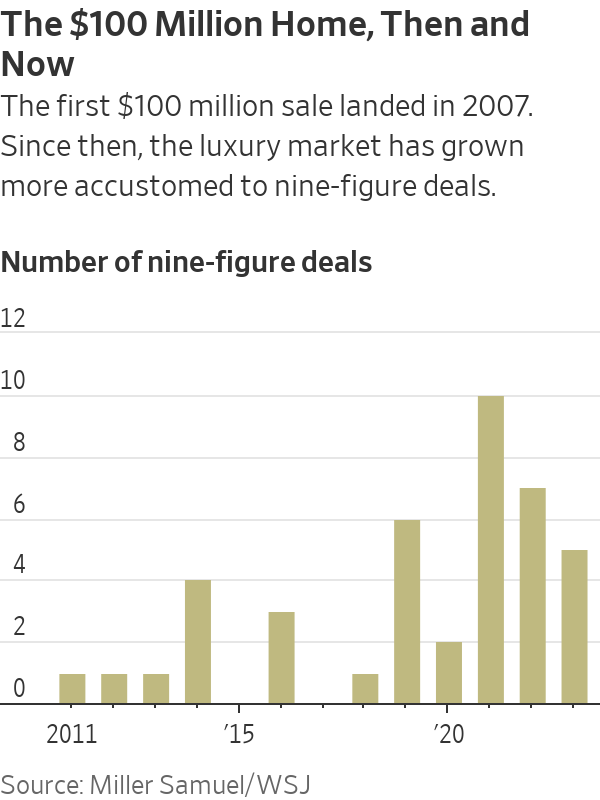
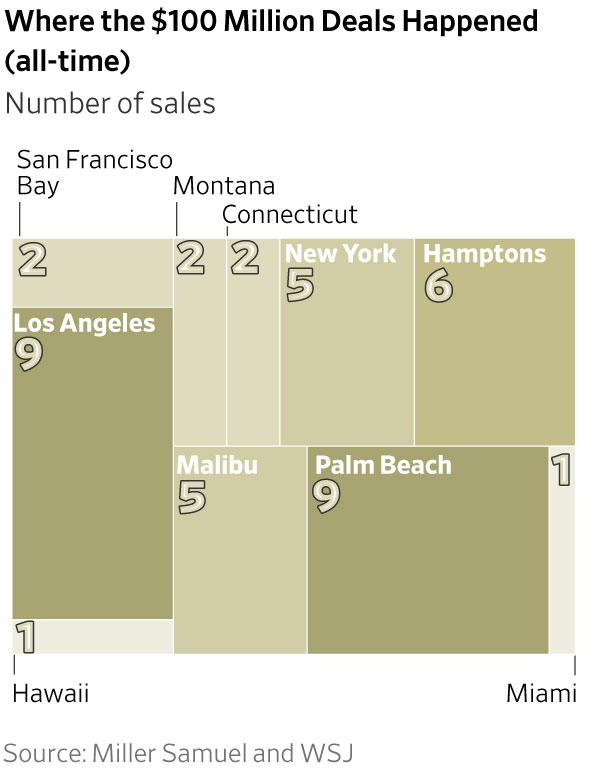
It has been nearly 20 years since the country’s first $100 million home sale, but in some ways the market is just taking off: Since 2020, at least 24 homes nationwide have traded for $100 million and up, more than the total number of nine-figure sales during the entire prior decade combined.
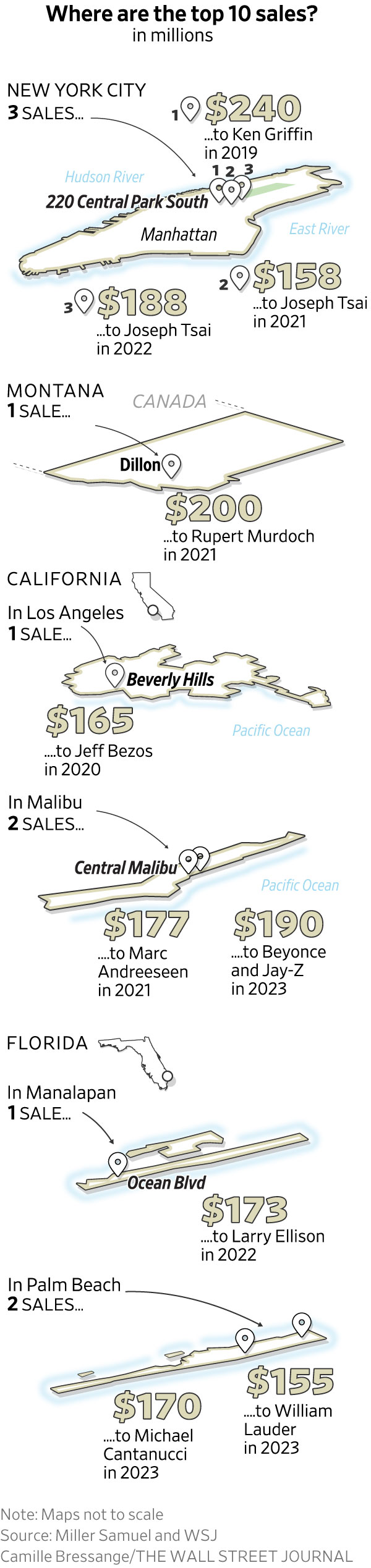
The 24 homes, and their uber-wealthy owners, also tell the compelling story of massive wealth creation and migration in the U.S. since the onset of the pandemic, with a dramatic surge in nine-figure deals in Florida in recent years. Since 2020, three homes over $100 million have changed hands in New York City compared with six in and around Palm Beach, including a $170 million deal in 2023 that set a Florida sales record.
“People’s wealth has grown so substantially and there’s such limited product,” said Chris Leavitt of Douglas Elliman in Palm Beach. “There are more billionaires than there are oceanfront, sprawling estates.”
Los Angeles and Malibu, Calif., have also notched a string of major transactions, gaining steam as the wealthy sought space and privacy during the pandemic or picked up second homes. Last year, entertainment power couple Beyoncé and Jay-Z paid $190 million for a mansion in Malibu that set a California sales record—and sparked predictions that the $200 million threshold is within reach.
“Soon $100 million will be $200 million, that’s the way it’s going,” said Drew Fenton of Carolwood Estates in Beverly Hills. “We’re inching closer to it.”
Nationwide, the number of mega deals skyrocketed as the ranks of ultra wealthy individuals swelled around the globe. There were 3,194 billionaires in 2023, up from 2,170 in 2013, according to wealth research firm Wealth-X.
Meanwhile, luxury home prices nationwide have soared. In 2023, the median sale price for a luxury home nationwide—defined as homes in the top 5% of the market—was $1.14 million, up 75% compared with 2013, according to real-estate brokerage Redfin.
In the past few years, the values of trophy homes around the country—disconnected as they might be from the rest of the market—also skyrocketed. So did the number of deals. In the 10 years between 2011 and 2020, there were 19 deals at or above $100 million. There were 22 deals over $100 million between 2021 and 2023. Those deals included properties that roughly doubled in value in a short amount of time.
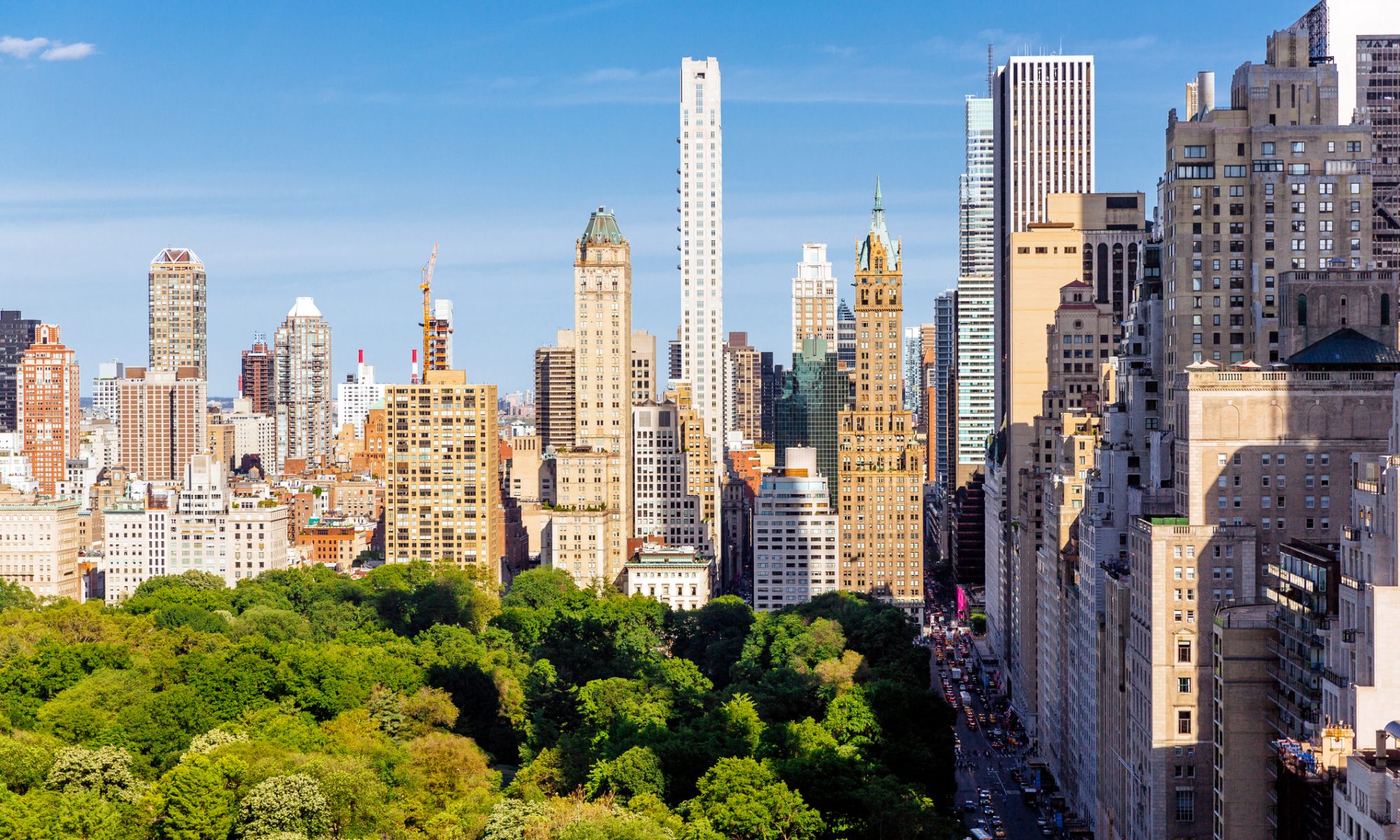
For example, Alibaba Group co-founder and Brooklyn Nets owner Joseph Tsai paid $188 million in 2022 for a penthouse at 220 Central Park South, the Robert A.M. Stern Architects-designed condo tower on Manhattan’s Billionaires’ Row. The seller was billionaire investor Daniel Och, who purchased the property for $95 million in 2019. Also in 2022, Oracle co-founder Larry Ellison bought an oceanfront estate near Palm Beach for $173 million. Seller Jim Clark, a co-founder of Netscape, paid just over $94 million for the property in 2021.
Although Ken Griffin’s roughly $240 million penthouse buy in Manhattan in 2019 is still the country’s most expensive sale, nine-figure deals have surged in Malibu and South Florida.
Florida, which had an influx of wealthy residents during Covid, had one deal above $100 million in 2013 and two in 2019. Since 2020, there have been seven—including six in and around Palm Beach, where the city’s sales record was shattered twice in 2023. In March, billionaire William Lauder bought the late Rush Limbaugh’s longtime Palm Beach estate for $155 million. The next month, luxury car dealership owner Michael Cantanucci paid $170 million for an oceanfront estate from Green Mountain Coffee Roasters founder Robert Stiller.
Miami, which courted the tech industry and others during the pandemic, also saw record sales in quick succession. In January 2022, Griffin paid a record $75 million for a mansion on Star Island, besting the prior Miami sales record of $60 million for two penthouses at Miami’s Faena House condominium. (The Citadel founder was also the buyer of those units, which he has since sold.) Then in June 2022, Phillip Ragon, founder of software company InterSystems, purchased three homes in Golden Beach—about 20 miles from downtown Miami—for a combined $93 million. In September 2022, Griffin struck again and handed Miami its first nine-figure deal with his $106.875 million purchase of a 4-acre estate from philanthropist Adrienne Arsht.
“That was a new frontier for Miami, but it was such a stupendous property,” said Jill Hertzberg of the Jills Zeder Group at Coldwell Banker Realty, who represented Griffin in the deal with colleague Jill Eber. Hertzberg said unlike Miami’s last real-estate boom in the early 2000s, which was fuelled by foreign buyers, domestic buyers are driving up prices for luxury properties.
With buyers from America’s 1% focused elsewhere, New York City logged fewer $100 million-plus deals by comparison. In 2023, Manhattan had no nine-figure deals. In 2022, it had two, including Tsai’s $188 million purchase and philanthropist Julia Koch’s purchase of two Upper East Side penthouses from the estate of the late Paul Allen for a combined $101 million. In 2024, real-estate developer Extell inked a deal to sell a penthouse at Central Park Tower for around $115 million. The deal hasn’t yet closed.
Local real-estate agents said the city’s biggest sales have taken place within a roughly 1-mile radius, where there are a limited number of properties that can fetch $100 million or more. “Everybody wants the Central Park view,” said Pam Liebman of the Corcoran Group. “There’s only a handful of buildings that could ever warrant that price,” she said. “It’s just a scarcity thing.”
But Jonathan Miller of real-estate appraisal firm Miller Samuel said developers sold off many of their biggest units over the past few years, and new inventory is skewing smaller. “The odds of having a lot more 10,000-square-foot transactions—those are the ones that are going to break the $100 million threshold—seem limited,” he said.
Covid also altered the city’s luxury market permanently. “Everybody needs to be here, it’s still the finance capital of the world, but they’re spending less time here,” said Tal Alexander of real-estate brokerage Official. He said buyers who want a sprawling apartment overlooking Central Park can get one for $40 million to $50 million. For that reason, he thinks buyers are more likely to spend $100 million for oceanfront land with multiple structures in Palm Beach than they are on a condominium in Manhattan, he said.
The reality is that many $100 million-plus properties rarely come to market, said Corcoran’s Tim Davis, who works in the Hamptons. “We’ve got low inventory,” he said. In 2023, a roughly 8-acre Hamptons estate sold for $112.5 million, the priciest Hamptons sale of the year.
Historically, California’s largest trades have also involved a small collection of trophy estates in Los Angeles, and to a certain degree, new spec homes. The size, provenance and location of L.A.’s iconic estates makes them rare commodities, Fenton said.
Among them is Casa Encantada, a roughly 8.5-acre estate owned by late billionaire Gary Winnick and his wife, Karen Winnick. After setting a U.S. sales record when it sold in 1980 and again in 2000, Casa Encantada hit the market in 2023 asking $250 million. It is now listed for $195 million.
Kurt Rappaport of Westside Estate Agency, who is marketing Casa Encantada with Fenton, said the price is justified by how infrequently properties of this caliber come to market. “There are a lot of people who own these properties who don’t want to sell,” he said. He pointed to Bezos’s 2020 purchase of the Warner Estate in Beverly Hills for $165 million, and Lachlan Murdoch’s purchase of Chartwell, an estate in Bel-Air, for roughly $150 million in 2019. (Murdoch is executive chairman of News Corp which owns Dow Jones & Co., publisher of The Wall Street Journal.) “If you look at who owns these great houses, some of them are generational,” Rappaport said.
Given the scarcity of singular trophy homes, savvy buyers have scooped up multiple properties in prime markets in recent years. Griffin, for example, has spent more than $250 million assembling land to build a mansion in Palm Beach over the past few years. In 2023, Bezos paid a combined $147 million for adjacent properties in Miami’s Indian Creek Village. “People have realized how precious land is in cities—there’s not a lot of land so if you find a particular piece that’s gorgeous, and you have the opportunity to buy next to you, why not?” Hertzberg said.
Buyers have also paid a premium for more space and privacy. In Malibu, WhatsApp founder Jan Koum spent a combined $187 million for neighbouring properties that he bought in two transactions in 2019 and 2021. Likewise, venture-capitalist Marc Andreessen and his wife, Laura Arrillaga-Andreessen, paid $177 million for a Malibu compound in 2021; a year later, they paid $44.5 million for another trophy home nearby.
Real-estate agents said there are also some properties that have been built over time that would likely fetch $100 million if they were ever sold. In Manhattan’s Greenwich Village, for instance, Chipotle Mexican Grill founder Steve Ells paid close to $32 million in two transactions in 2014 and 2015 to buy neighbouring townhouses. He later filed for permission from the New York City Landmarks Preservation Commission to combine the two buildings—spanning almost 16,000 square feet combined—into a mansion. In recent months, Ells has quietly been shopping the property, according to people familiar with the offer. The asking price? $125 million.
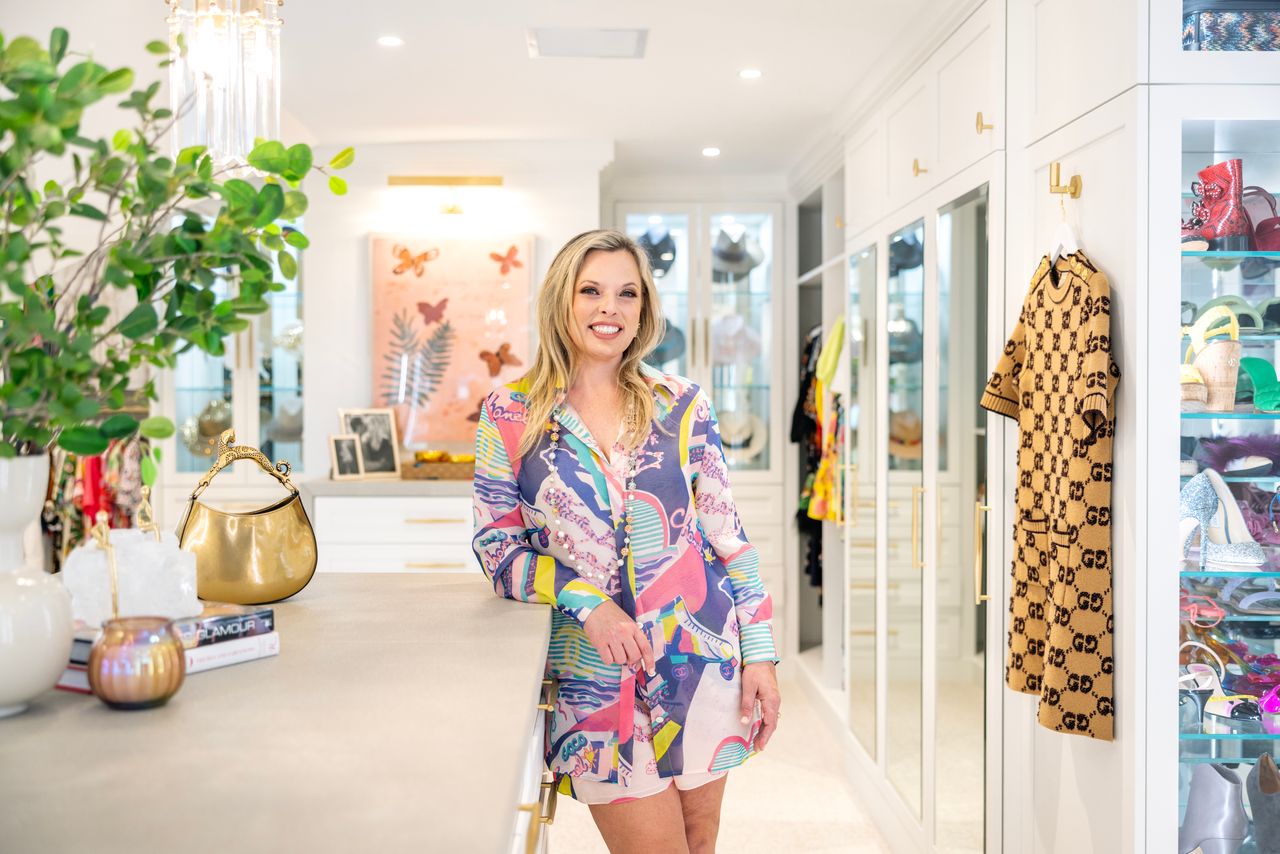
On an October evening, Kimmie Turiansky and four girlfriends sipped pink champagne in her Bedminster, N.J., home as they prepared for a night out. Chandeliers illuminated silk wallpaper and pink window treatments as pop music blared, while the women swapped clothes and perched on window seats.
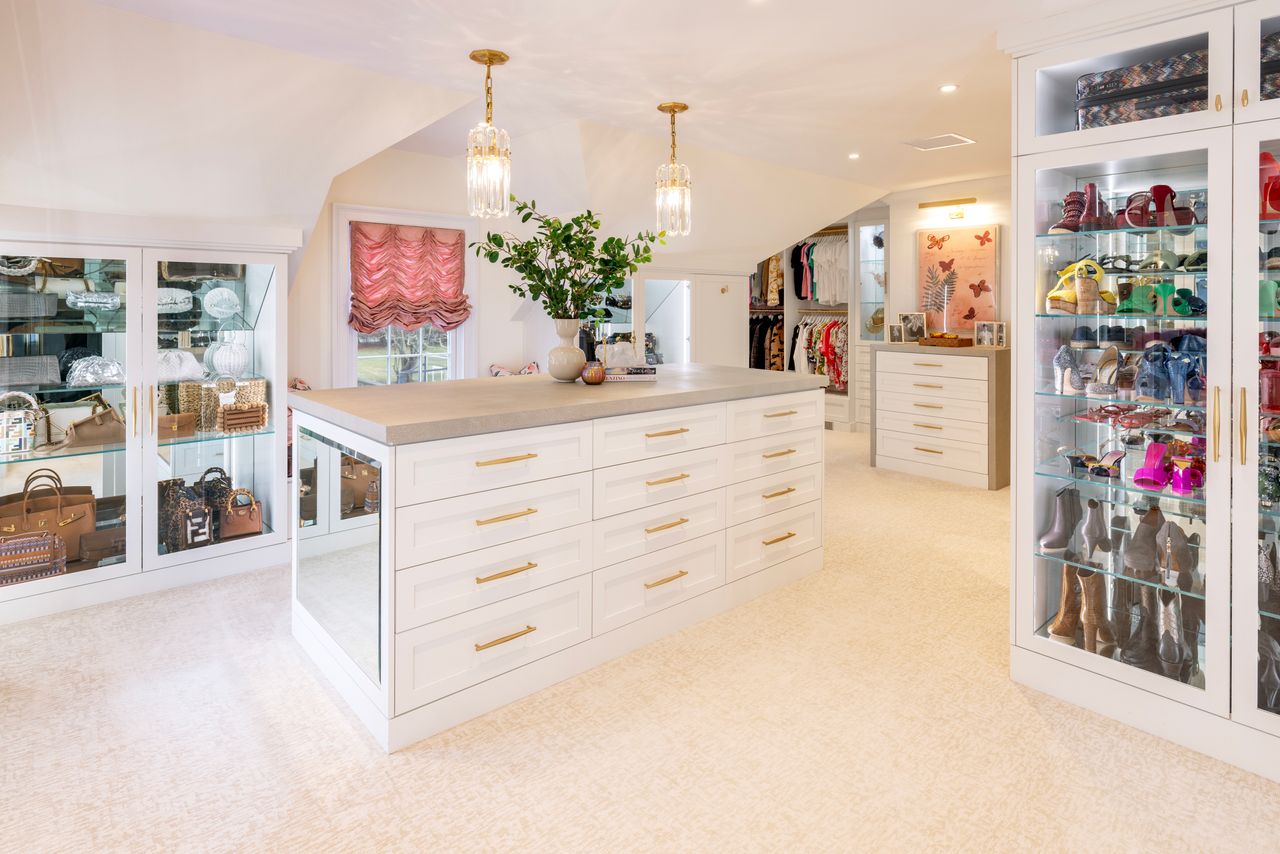
The primary setting for all this activity wasn’t Kimmie’s bedroom or bathroom, but the roughly 470-square-foot closet she created at a cost of roughly $120,000 during a recent home renovation.
“It didn’t feel like this was my house until this was done,” Kimmie, 49, said of the closet. “This is truly the only space that is mine alone.”
Kimmie’s closet has silk wallpaper and pink window treatments. PHOTO: DOROTHY HONG FOR THE WALL STREET JOURNAL
Closets in luxury homes are getting bigger and more expensive, as homeowners look to display increasingly extensive, curated fashion collections. Closets are also doubling as entertaining spaces, with seating areas and champagne bars where owners can host friends, said Christina Relyea, president of the Association of Closet and Storage Professionals.
These days, “clients actually do hang out in their closet,” said Container Store executive Barbara Snook, who leads sales-and-design training for the company’s custom-closet design service. When a project is completed, “the first thing they will often do is throw a closet-reveal party.”
Average budgets for top-of-the-line closets have skyrocketed to $200,000 to $300,000, up from $60,000 to $80,000 a decade ago, according to custom-closet builder Claudio Faria, chief executive of Ornare Miami, who said he often works on projects costing more than $500,000. Closet designer Matthew Quinn of Design Galleria in Atlanta said a client recently spent over $1 million on a two-story closet with a spray-tan booth and an elevator.
These days, some high-end closets have features such as thumbprint-protected jewellery cases, built-in watch winders, revolving shoe racks and clothing storage with dry-cleaning capabilities, said Eric Marshall, co-founder of the Closet Training Institute in Scottsdale, Ariz. Christian Nadeau, president of Maryland-based recycled leather business EcoDomo, said he recently installed custom leather stairs in a two-story Las Vegas closet. A Dallas client’s closet, Quinn said, has a camera that takes pictures of each outfit and sends images to a digital folder, much like in the movie “Clueless.” The system allows the client to select outfits remotely and have her assistant pack for her, he said. Some closet owners are even putting meditation areas in their closets, said Donna Infantolino, a California Closets designer in Northern New Jersey.
Kimmie, a mother of three, and her husband, marketing executive Eric Turiansky, bought their roughly 100-year-old house for $2.55 million in 2021. As part of an extensive renovation, they nearly doubled the size of Kimmie’s closet, commissioning Wendy Scott of Timeless Closets & Cabinetry to create boutique-like displays for clothes, purses and shoes. A display case was custom built for Kimmie’s Chanel roller skates, Kimmie says, while a centre island has a brass charging port for a Chanel handbag with an LED screen.
For many clients, closets are private spaces, Quinn said, which frees them up when it comes to design decisions. “Because it isn’t shared, in a closet you can have more fun and show your personality,” he said. “It doesn’t have to match the rest of the house.”
One of Quinn’s clients, Jill Gallagher, chose an antique crystal chandelier passed down from her grandmother as the focal point of her 180-square-foot closet in Palm Beach Gardens, Fla.
Gallagher, 49, and her husband, Vionic Shoes co-founder Chris Gallagher, 54, bought their home for $2.1 million in 2018 and hired Quinn to renovate it.
Jill also selected grey leopard-print carpet for her closet, as well as a central island with a white and gray quartzite countertop. Cabinetry and lighted display shelving are stacked all the way up to the room’s 12-foot ceiling.
“I wanted it to feel like not just like my own little boutique, but like my own personal art gallery where I could display some of my special bags and shoes,” said Jill. The cost of creating the closet was about $150,000, she said.
She’s not the only one in the family with a fabulous closet. Chris, originally from Australia, has a roughly $70,000 Aussie-inspired closet, with leather drawer pulls and cabinet handles made of cattle horns.
In his roughly 75-square-foot closet, marble countertops and textured wallpaper give the space a “men’s retail store” feel, he said. Metal mesh shelves store his roughly 50 pairs of shoes, allowing them to “breathe” without being prominently displayed, he said.
“I’m a shoe guy,” he said. “I wanted to have a nice place for my shoes but I didn’t want to see them, because men’s shoes can look a bit clunky.” Having numerous hooks and hampers in the closet was also important for keeping the space uncluttered, he said.
Leather finishes are a popular choice for men’s closets, said New York architect Thomas Juul-Hansen. He has designed closets around large shoe and T-shirt collections for male clients, he said, including the hip-hop promoter Damon Dash, whose New York City closet holds 200 pairs of sneakers, 1,000 folded T-shirts and hundreds of baseball caps, he said. Elton John’s Atlanta condo, which sold for $7.225 million last year, had shelves with space for about 200 pairs of shoes, said Chase Mizell of Atlanta Fine Homes Sotheby’s International Realty, who had the listing. And hip-hop artist and producer Sean Armani said he hired California Closets in 2022 to design a closet for about 100 pairs of shoes in his Miami home, at a cost of roughly $70,000. His condo is now for sale, asking $6.45 million with Elke Johnson and Christopher Wands of Douglas Elliman.
Homeowners often see a return on investment for the tens of thousands of dollars they spend on luxury closets, real-estate agents said. “In my experience, buyers are willing to pay a premium for homes with well-organized, aesthetically pleasing closet spaces,” said Ginger Martin of Sotheby’s International Realty – St. Helena Brokerage in California.
Some 93% of home buyers were willing to pay 10% more for a home with upgraded closets, according to a 2023 study by ClosetMaid, an Orlando-based home storage-and-organization company. At the Jade Signature condominium in Miami, the average unit’s sale price increases about $150,000 with the addition of a roughly $120,000 luxury closet, according to Ornare, which designed some of the closets in the building.
Condo developers are leaving larger footprints for closets in their floor plans and partnering with designers to build out custom closets for interested buyers, said Daniel Seigle of Brown Harris Stevens Development Marketing. Miami developer David Martin said Villa Miami, which he is developing with the One Thousand Group, will have bigger closets than past projects as a result of feedback from focus groups. The St. Regis Sunny Isles will have about 20% more space for closets than the developer’s last project, the Ritz-Carlton Residences, Sunny Isles Beach, said Faria. And closet designer Sandra Swieder of the Closet Builder in Bergen County, N.J., said she is working on her third project with New York City-based Minrav Development to develop large, custom closets.
In 2018, fashion blogger Emily Gemma built a home in Tulsa, Okla., with her husband, internist Dr. John Gemma. The couple, both in their 30s, designed a roughly $135,000, two-story closet with an office. The closet is roughly 450 square feet, larger than the home’s primary bedroom, said Gemma, who launched the style and beauty blog “The Sweetest Thing” in 2013.
Gemma films content for her blog on the first floor of the closet, which has a marble and wood floor and lighted shoe displays. Windowed doors provide natural light for filming, she said. A large staircase lighted by a Parisian chandelier leads to the second floor, which also serves as an office for the blog’s two full-time employees. On the second level, French windows open to a Juliet balcony.
In Gemma’s Instagram posts, the closet is often mistaken for a foyer, she said. “It gets people really stirred up,” she said. “They say, ‘I can’t believe you store shoes at the entry place of your home.’”
The Australian property market will undergo its first major test tomorrow when 1,700 capital city homes go under the hammer on the first significantauction day of the year.CoreLogic economist Kaytlin Ezzy said it will be the second biggeststart to February on record behind 2022 when 1,779homes went to auction. In the country’s two biggest auction markets, there will be 608 auctions held in Melbourne and 591 in Sydney.
Ms Ezzy said auction clearance rates weakened to below-average levels toward the end of last year and tomorrow’s event would “help set the pace for the pre-Easter selling season and provide a timely test of buyer demand”.
She added: “This week’s results could help indicate whether the weaker selling condition seen towards the end of last year has persisted into 2023 or if sentiment has lifted with earlier expectations of rate cuts following [this week’s] inflation update.”
Australia’s median home value moved higher for the twelfth consecutive month in January, up 0.4 percent. This follows an 0.3 percent uplift in both November and December. However, price performance is mixed across the capital cities, with Perth once again delivering outstanding growth at 1.6 percent in January. CoreLogic research director, Tim Lawless explained: “The western capital continues to see housing demand outweigh supply, helping to push values 16.7 percent higher over the past 12 months. Despite that, housing prices remain relatively affordable compared with most capital cities, with the median dwelling value sitting just under $677,000.”
Adelaide home values lifted 1.1 percent in January, Brisbane prices rose by 1 percent and Sydney values moved up 0.2 percent. Conversely, Hobart home values fell 0.7 percent, Canberra prices dipped 0.2 percent and Melbourne declined by 0.1 percent.
Mr Lawless noted that house prices across Australia continued to rise faster than apartments. The price gap is now at a new record high of 45.2 percent. House values across the capital cities lifted by 0.5 percent in January, equivalent to about $4,800 in value, while apartments lifted 0.1 percent, or about $900 in value. “Since the commencement of the upswing, capital city house values have surged 11 percent higher while unit values are up 6.9 percent,” Mr Lawless said.“It seems that most Australians are willing to pay a higher premium than ever for a detached home.”
Sales volumes remain elevated, withCoreLogic estimating 115,241 dwellings were soldover the three months ending January, which was 11.9 percent higher than the same time last year. “Despite ongoing cost of living pressures, high interest rates, low consumer sentiment and affordability constraints, homes are still selling,Mr Lawless said.“Housing demand has been buoyed by high migration, but also tight rental markets that have probably incentivised renters to transition towards home ownership if they can afford to do so.”
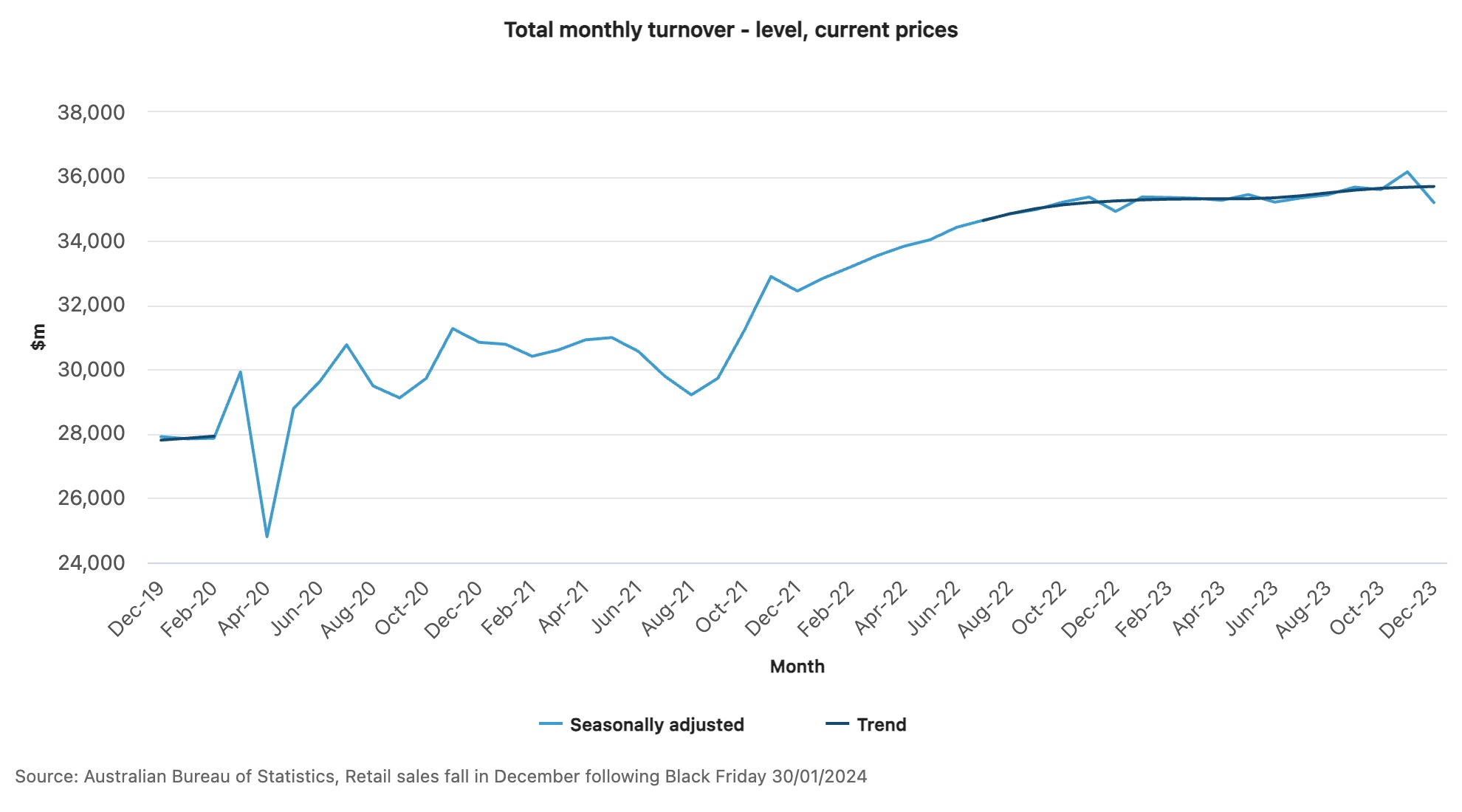
Inflation fell to a two-year low of 4.1 percent per annum in the December quarter, according to figures released by the Australian Bureau of Statistics. This is well below the Reserve Bank (RBA) forecast of 4.5 percent, with CBA’s head economistGareth Airdsayingit “should be a straightforward decision” for the RBA to keep rates on hold at its first meeting for 2024 next week.
Michelle Marquardt, ABS head of prices statistics, said the consumer price index (CPI) rose 0.6 percent in the December quarter, which was the smallest quarterly rise since the March 2021 quarter. Annual CPI has now fallen from a peak of 7.8 percent in the December 2022 quarter to 7 percent in the March2023 quarter, 6 percent in the June quarter, 5.4 percent in the September quarterand sharply lower to 4.1 percent in the December quarter.
The most significant price rises in the December quarter were for tobacco, up 7 percentfollowing the introduction of the 5 percent annual tobacco excise indexation; domestic holiday travel and accommodation, up 3.9 percent; and insurance, up 3.8 percent. “The increase in insurance was due to higher premiums across motor vehicle, house and home contents insurance,” Ms Marquardt said. “Over the past twelve months, insurance rose 16.2 percent, making it the largest annual rise since March 2001.”
Housing costs rose by 1 percent over the quarter, driven by new dwellings purchased by owner–occupiers, up 1.5 percent; rents, up 0.9 percent; and utilities, up 0.6 percent. “Higher labour and material costs contributed to price rises this quarter for construction of new dwellings, Ms Marquardt said. CoreLogic head of research Eliza Owen commented that rental inflation “is finally slowing, suggesting some hope for tenants that the rental market could turn a corner in 2024, which is also indicated by CoreLogic rent measures”.
Annual goods inflation continues to moderate faster than services. December was the fifth consecutive quarter of lower goods inflation, down from a peak of 9.6 percent in the September 2022 quarter to 3.8 percent in the December2023 quarter. Prices have even fallen in some categories over the past 12 months, such as clothing, footwear, furniture and household appliances. Annual services inflation eased for the second consecutive quarter, down from a peak of 6.3 percent in the June quarter to 4.6 percent in the December quarter.
Federal Treasurer Jim Chalmers said the government’s cost-of-living relief measures were directly contributing to a reduction in inflation. “Our cost of living policies took half of a percentage point off inflation through the year to December quarter 2023,” Dr Chalmers said. The ABS figures show that over the year, electricity prices rose 6.9 percent but would have risen 18.9 percent without the Energy Bill Relief Fund rebates. Childcare prices fell 7.2 percent butotherwise would have risen 13 percent.Rents rose 7.3 percent but would have risen 8.9 percent without the largest increase to Commonwealth rent assistance in 30 years.
Mr Aird said the inflation data would be “viewed favourably by policymakers”. He added: “The fall in the rate of inflation over the past year has been swift. The job of returning inflation to the 2-3 percent target band is not yet done. But the RBA is now on the home straight. We continue to expect an easing cycle commencing in September. We have 75bp of rate cuts in our profile in late 2024 and a further 75bp of easing in H1 25, which would take the cash rate to 2.85 percent.”
It’s an area already popular with the likes of Oprah Winfrey, Ellen DeGeneres, Prince Harry and Meghan Markle.
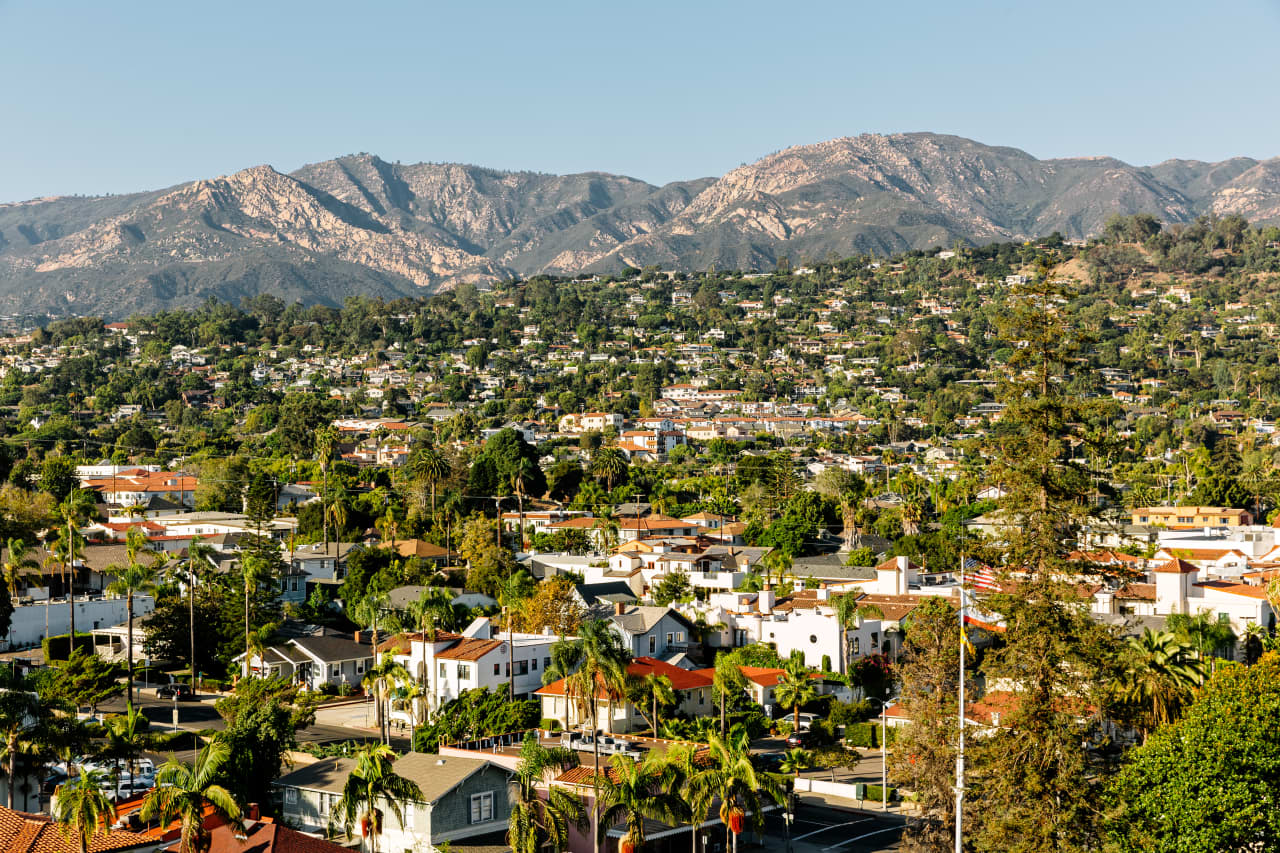
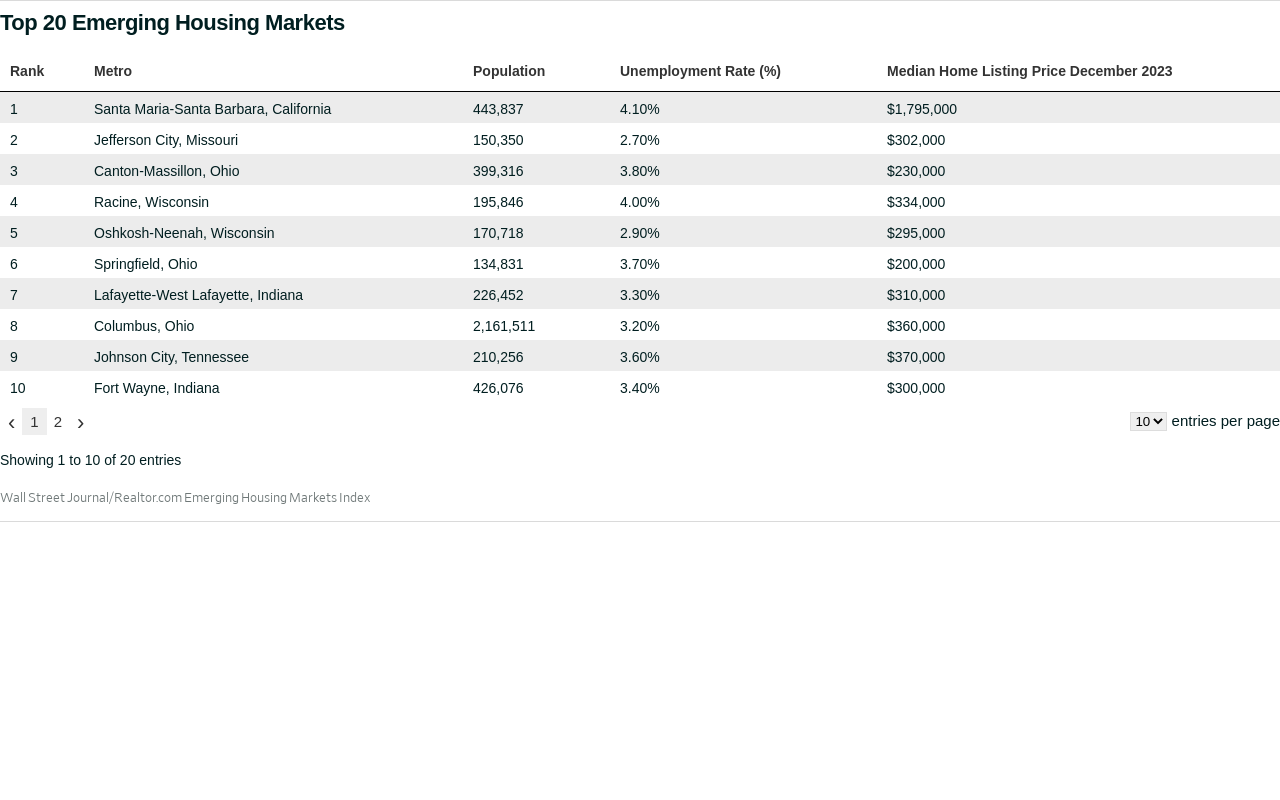
But now the affluent Santa Maria-Santa Barbara metropolitan area on the Central Coast of California nestled between the Santa Ynez Mountains and the Pacific Ocean has ranked as the top housing market in the latest Wall Street Journal/Realtor.com Emerging Housing Markets Index, released Wednesday.
It’s a surprise result for the quarterly index, which has, until now, typically seen more affordable cities rank at the top—Topeka, Kansas, took first place in the prior iteration of the report, released in fall, and Lafayette, Indiana, in the summer ranking.
“Santa Maria-Santa Barbara topping the list serves to highlight the division in today’s housing market,” said Danielle Hale, chief economist at Realtor.com. It’s the one and only West Coast market in the top 20, and, with a median listing price of $1.795 million in December, the highest-priced market by more than $1 million.
The top five cities in the index were rounded out by Jefferson City, Missouri, where the median listing price was $302,000 in December; the Canton-Massillon metro area in Ohio ($230,000); Racine, Wisconsin ($334,000); and the Oshkosh-Neenah metro area in Wisconsin ($295,000).
“Many housing markets cooled off after the pandemic’s run-up in prices and inventory-depleting demand,” Hale explained. “The markets that have continued to chug along, and even gain steam, are either priced low enough that buyers can compete, or priced high enough that the typical affordability constraints are not of concern to the market’s buyers.”
The latter is the scenario that’s playing out in Santa Barbara.
The index analyses key housing market data, as well as economic vitality and lifestyle metrics for the largest 300 metropolitan areas in the country to highlight emerging housing markets that offer a high quality of life and are expected to see future home price appreciation. It identifies markets that those considering a home purchase should add to their shortlist—whether the goal is to live in it or rent.
Santa Barbara “offers perhaps the finest lifestyle in the U.S.,” said local agent Luke Ebbin of The Ebbin Group at Compass. “Three-hundred days of sunshine and warm weather, a relaxed pace of living, proximity to uncrowded beaches, mountain hikes, fine food and wine, and incredible cultural offerings more often found in major metropolitan areas.”
However, with that median listing price of $1.79 million—more than four times the national median—the price tag attached to the idyllic locale is well out of range for many would-be buyers.
“Though Santa Barbara is among the highest-priced large housing markets in the U.S., buyers in the area have seen similar trends to buyers in other more affordable markets,” Hale said. “For-sale inventory fell rapidly during the early days of the pandemic, and has not recovered much as demand waned in the area and homeowners chose not to sell.”
As a result, “buyers hoping to snag a median-priced home are facing more competition, which has driven prices higher,” she said.
In December, 71% of homes on the market in the metro were priced at $1 million or higher, up from the same time in 2019, when the metric stood at 62%.
“Buyers who have been eager to purchase here and have been on the sidelines due to low inventory and high interest rates are entering the market as rates decline and more inventory becomes available,” Ebbin said. That “low inventory and high demand are keeping prices elevated.”
It should come as no surprise then that Santa Barbara boasts an affluent population who “are drawn to the area’s lifestyle, amenities and upscale housing options,” said Santa Barbara-based agent Jason Streatfeild of Douglas Elliman.
Santa Barbara has “long been a popular destination for retirees, especially those seeking a mild climate, beautiful scenery and a relaxed coastal lifestyle,” Streatfeild said, noting that many migrate from colder regions of the country, as well as from other parts of California.
Not only charmed by the balmy wealth, individuals from far and wide are equally wooed to the area by its thriving entrepreneurial community, and Santa Barbara’s “robust job market, including opportunities in technology, healthcare, finance and education, attracts professionals from various parts of the country,” Streatfeild said. “Some may relocate from major metropolitan areas like Los Angeles, San Francisco or New York in search of a more balanced and less crowded lifestyle.”
Indeed, out-of-towners appear to be driving demand in the coastal enclave, according to search data from Realtor.com. More than three-quarters (79.5%) of views to Santa Barbara home listings on the site came from outside of the metro in the fourth quarter, with a notable amount of attention coming from the Los Angeles (32.8%) area, according to the index. House hunters from Silicon Valley, Atlanta and New York City were also shopping in the area, according to Realtor.com data.
Meanwhile, Prince Harry and Megan Markle are prime examples that “Santa Barbara’s appeal extends beyond U.S. borders,” Streatfeild said.
The University of California, Santa Barbara, also attracts a global cohort—along with plenty of domestic new residents—who move to the area to pursue higher education.
The Santa Barbara metro area “attracted a sizeable 3.3% of its listing viewership from shoppers outside of the U.S.,” Hale said in the report. “Suggesting that international demand is applying pressure to already high prices.”
For comparison, “the average international viewership share across the 300 ranked markets was less than half (1.4%) the viewership share in Santa Barbara,” she added.
Sarah Tucker-Ray, a partner in McKinsey’s Washington, D.C., office, felt a lot of trepidation when she took a six-month parental leave in 2022.
“There is fear about, ‘Am I going to get written out of the story?’ ” says the 36-year-old Tucker-Ray, whose daughter, Viviana, was born in August 2022. “Is someone going to step in for me and take over? How will I come back?”
She addressed those fears in a reintegration plan that she drafted before going on leave. It included instructions for those who would be covering her workload while she was out, and it laid out what she wanted her job to look like when she returned. For example, Tucker-Ray didn’t want her role to change significantly, but she asked to not be given any internal projects—those focused on McKinsey’s own operations versus those of outside clients—during her first six months back. She also thought about small stuff, such as writing down all of her passwords, and she connected with other working mothers at the company who served as peer counselors before she went on leave.
“They told me that the goal for week one is to get dressed, have breakfast with my baby, get into a suit without getting spilled on and get out the door,” she says. “It sounds so basic but I hadn’t had to do that yet.”
The days, weeks, and months after a new parent returns to work after leave can be a critical and challenging time for an employee. Many experience anxiety about how they are going to manage work and parenting, and some end up feeling like a failure at both.
To address that, some organisations have launched formal “reboarding” programs that structure those first months back after leave so they aren’t overwhelming for new parents, while also providing them with emotional support. McKinsey tested such a program in Europe and then expanded it globally
Many see it as a business imperative. Organisations are making substantial investments in paid maternity and paternity leave—in 2023, 40% of organisations in a Society for Human Resource Management survey offered paid maternity leave and 32% offered paid paternity leave—and they want to ensure new parents return to work and are productive and content when they do.
Tucker-Ray was happy to learn that McKinsey would cover the cost of her daughter and her husband to join her on a business trip. PHOTO: ELIZABETH FRANTZ FOR THE WALL STREET JOURNAL
Creating a plan
A successful reboarding program requires planning, and it and starts long before an employee goes on leave, consultants and HR leaders say. It begins with mapping out a comprehensive work-coverage plan, including if and under what circumstances the employee wants to be contacted about work while out on leave. The plan also should create clear expectations about what the return-to-work will look like, including the employee’s job description post-leave and even an explanation of what that first daunting day back might entail.
Many reboarding programs also connect new moms with experienced working parents or colleagues who have recently returned from parental leaves, as well as a coach (often an outside consultant) who can help set priorities and guidance on best practices.
When Maria del Mar Martinez became head of McKinsey’s diversity, equity and inclusion efforts in Europe in 2018, she learned that working moms left the management-consulting firm at nearly double the rate of their childless female peers with similar tenure. In exit interviews, women shared common grievances, including the challenge of balancing parenthood with a demanding job, a lack of support from their managers and few role models.
She heard similar sentiments in Asia and the U.S.
“That was a business problem,” says del Mar Martinez, now the global head of DEI at McKinsey. “I don’t want to lose those amazing women coming up the pipeline.”
To combat attrition, del Mar Martinez created a reboarding pilot program in Europe that included coaching employees before, during and after a parental leave. (Men are eligible to take part in the program if they have taken 12 weeks or more of leave.)
Built into the plan was a guarantee that new parents would have “meaningful work” upon their return, with the option of slowing down if that’s what they wanted, says del Mar Martinez. One issue, she and others say, is that managers often incorrectly assume that new mothers want lighter workloads or don’t want to travel, which is why it’s important for employees to spell out their preferences in a reboarding plan.
The McKinsey pilot required managers to confirm they understood their employee’s reintegration plan and to calibrate goals in performance reviews to ensure the person taking leave wouldn’t be penalised.
It worked. McKinsey closed the European attrition gap in 18 months, del Mar Martinez says, and later expanded the program globally.
The manager’s role
Other companies are increasing the support they offer to new parents, too, including Wall Street’s Morgan Stanley, which in 2019 appointed Allyson Bronner head of family advocacy at the company’s institutional division, a full-time position that focuses on supporting employees before, during and after parental leaves.
Bronner says one of the best ways to ensure a successful return experience for new parents is to include managers in the process.
To that end, she meets with an expecting employee’s manager between the 25th and 30th week of pregnancy to preview what the employee’s return-to-work will look like and discuss best practices for easing the transition.
“It’s important to set the scene and give them tools to manage their employees,” she says.
She says her next meeting with the manager occurs about a month before the employee is due back to discuss how the first month should be structured. She suggests the manager call the new parent two to three weeks ahead to preview what the first few days back will look like—namely, checking email and showing colleagues baby pictures.
The support continues throughout the first several months, with managers having weekly check-ins with the employee for the first six weeks and then monthly check-ins after that. Bronner encourages managers to ask new parents how they are doing and how their child care is going to determine whether they would benefit from more support or advice in that area.
Since Morgan Stanley created the family advocacy role, “it feels like there has been a culture shift,” Bronner says. “It’s hard to quantify in numbers, but culturally it feels like we’re moving in a more positive direction.”
A culture shift is also under way at chip-equipment maker ASML, which recently expanded the paid parental leave it offers and in May joined forces with employee-benefits firm Parentaly to create a support system for new parents.
ASML is in a male-dominated industry, says Karen Reinhardt, the firm’s chief human-resource officer in the U.S., so retaining women is critical to having a diverse workforce.
As of December, 82 employees had registered for the reboarding program, “more people than we expected,” Reinhardt says.
Among them is Meredith Polm Sheain of San Diego, a knowledge-management developer who went out on maternity leave in late August. In her reboarding plan, she made clear that she wanted to be notified while on leave about any bumps in a recently launched product. She also laid out her priorities for the first two months of her return.
“I felt so much better about the concept of returning to work once I gave my team this plan,” says Polm Sheain, who returned to work on Dec. 22. “I left them and myself in the best position I could.”
Reboarding isn’t the only new benefit companies are offering to make life easier for new parents.
McKinsey’s Tucker-Ray was asked to attend a partner conference in Atlanta about six weeks after returning from maternity leave. The firm covered the cost of her daughter and caregiver (her husband) to join her on the trip since she was still breast-feeding.
“I would have been torn about going away for nearly a week for an internal event but it became a nonevent,” she says. “It got rid of the barrier to feeling you can’t participate fully in parenting and be a leader.”
Retail sales fell in December, as consumers brought forward their spending to take advantage of the Black Friday sales, data released yesterday reveals.
Figures from the Australian Bureau of Statistics reveal retail spending fell by -2.7 percent in December down from an increase of 1.6 percent in November. This, in turn, came after a -0.2 percent drop in October.
ABS head of retail statistics, Ben Dorber, said it was a subdued end to the year as shoppers looked to take advantage of bargains ahead of Christmas.
“This shift in spending from December to November reflects the growing popularity of Black Friday sales and the impact of cost-of-living pressures, with consumers seeking out bargains and taking advantage of discounts in November,” Mr Dorber said.
December sales fell in the discretionary spending markets with household goods taking the biggest hit, down -8.5 percent after the greatest increase the previous month. This was followed by department store spending, down -8.1 percent, and clothing, footwear and personal accessory spending at -5.7 percent.
In signs that cost of living pressures remain a concern for consumers, spending also fell in cafes, restaurants and takeaway businesses. In retail, spending began to rebound in the post Christmas sales period.
“Retailers told us that trading conditions were slow in early December following the success of Black Friday before picking up again in the lead up to Christmas and Boxing Day sales where discounting activity returned,” Mr Dorber said.
The Black Friday event originates from the US, where it falls on the day between their Thanksgiving event and the weekend at the end of November. It is now considered the biggest pre-Christmas sale event in Australia.
The highest quality office buildings have had much better success navigating the industry’s turmoil. Now, even premier towers are starting to wobble.
Rents at the highest-end buildings have been falling, while the rate of leasing has been slowing. Tenants have become more sensitive to costs in a world of higher interest rates and lingering concerns about a possible economic slowdown, market participants say.
Owners of the most elite buildings escaped this fate for a while by convincing the market they had created a new class of office tower—one that surpassed the traditional Class A building at the top of the pecking order.
These landlords persuaded blue-chip tenants that reluctant workers would return if only their offices sparkled with lush roof decks, fully loaded gyms and food prepared by Michelin-starred chefs. Owners invested heavily in these properties, which were usually new developments with the best locations, views, air quality and modern designs.
But that strategy is losing steam as more companies have accepted the reality of hybrid work schedules and, for the most part, have given up on compelling workers to be in five days a week.
“The ship has sailed on full return to the office for most companies,” said Rob Sadow, chief executive of Scoop Technologies, a software firm that developed an index that tracks workplace strategies. “They’re not going to go from three days a week to five days a week by making their space nicer.”
That is one reason why few office developers are considering new ground breakings. Current rents don’t pencil out for building expensive space. The U.S. had only 31 million square feet in office construction starts last year, the lowest level since 2010. New buildings will represent only 1% of inventory by 2027, the lowest in at least 25 years, according to CoStar.
“New starts have essentially ground to a halt,” said Dylan Burzinski, analyst at real-estate analytics firm Green Street.
Premium, amenity-rich office space has outperformed in terms of rent and occupancy throughout the pandemic. In New York, SL Green Realty opened a new office tower called One Vanderbilt across the street from Grand Central Terminal in the fall of 2020. It boasted a 4,000-square-foot terrace and cafe and a menu overseen by star chef Daniel Boulud. The 93-story building quickly filled up even though its top asking rents were near record levels at more than $300 a square foot.
That sort of exceptionalism is beginning to wane. Asking rents for prime space in 16 U.S. markets declined in the third quarter after increasing on average from about $61 a square foot in mid-2021 to close to about $70 in the second quarter of last year, according to CBRE Econometric Advisors. They were just under $69 in the fourth quarter, CBRE said.
The share of leasing activity is also falling among the premier towers. The office properties that data firm CoStar Group defines as five-star buildings accounted for 8% of the market in 2022 and 2023, down from 10% in 2019. Meanwhile, new leases in five-star buildings were on average 43% smaller than 2019, CoStar said, reflecting how companies are becoming more efficient in their space use and tolerating some degree of work from home.
In the fourth quarter, 62% of companies offered some form of remote work, up from 51% one year ago, according to Scoop. On average, those companies with hybrid strategies required workers in the office 2.5 days a week in October, Scoop said. In 2021 and 2022, many companies still expected to bring workers back five days a week and were leasing space with that in mind.
Office buildings that have opened recently have done well, but not by One Vanderbilt’s standards. In Boston, for example, Millennium Partners has leased about 60% of the 812,000 square feet of office space that hit the market last year in the new Winthrop Center project with such tenants as Cambridge Associates and consulting giant McKinsey. But rents are about 10% less than what Millennium originally forecast, said Joe Larkin, principal of MP Boston, the developer’s local arm.
Larkin said that Millennium expects to achieve its goal of taking three years to lease the building. “What we lost in the last couple of years is the hope to exceed how we planned this building,” he said.
High interest rates and concerns about a possible recession are also giving companies second thoughts about trading up to higher quality spaces. Moves are expensive especially when borrowing costs are higher than they’ve been in decades.
Cost-conscious companies are noticing that the gap between asking rents in top buildings and lower quality buildings is widening. The result: Renewals were 42% of the leasing volume last year, compared with 31% in 2018 and 2019 combined, according to CBRE.
“If companies aren’t going to have people in the office full time, maybe taking the lower-grade space might be a better economic decision,” Sadow said.