Oktoberfest Now Has Its Culture War. It Isn’t About the Beer.

MUNICH—Oktoberfest is usually all about the beer. This year, it is about chicken.

A decision by the Paulaner festival tent to serve all-organic hens at its marquee venue is stoking a debate between advocates of a sustainable Oktoberfest against traditionalists wary of a “Woke Wiesn”—a play on the short form of the name of the Bavarian celebration.

“It’s an experiment,” said Arabella Schörghuber, who runs the Paulaner Festzelt. “It’s more expensive, but the quality is higher. We want to make sure that the animal has a good life. We’ll see what happens.”

On Saturday, she helped hand out the first beers from the middle of the giant festival tent after thousands of people counted down to the tapping of the first keg. Waiters each toting a dozen glasses with a liter of beer wove through the crowds as huge rotisserie ovens cooked hens in a side kitchen, five on each spit.

Andrea Koerner, 56 years old, comes to Oktoberfest each year and usually orders the chicken, the most popular festival food. Not this time. When she saw that an organic half hen cost 20.50 euros, the equivalent of $22, about 50% more than the nonorganic hens, she opted for pretzels and a cheese spread instead.

“We don’t know the taste because it costs too much to try,” Koerner said.

Other guests said the chicken was good and worth the price. “I don’t care at all,” said Jake Williams, a 32-year-old guest. “I guess it is good if people care about the chickens.”

The price hike is among other inflation-related markups. The cost of a litre—or “mass”—of beer in most big tents increased this year by 6% to €14.50, according to a survey done by the city. That is after prices rose sharply last year following Russia’s invasion of Ukraine. Oktoberfest was canceled in 2020 and 2021 because of the Covid-19 pandemic.

The menu shift follows a pressure campaign by a coalition of groups, demanding that the Bavarian festival of hearty food and enormous beers should turn into a vehicle promoting organic farming.

The activists held a public exhibition in the city’s central square showing a carousel of imitation bloody chicken heads to denounce industrial slaughtering. The group secured a meeting between activists, officials and Oktoberfest tent owners in the spring.

“There’s already a lot going on. But my perspective is from an organic local farming business, and there’s not enough,” said Susanne Kiehl, a board member of the Munich Food Council.

She and Anja Berger, an Oktoberfest official and a Green Party member, said the changes are important to meet the city’s goal of becoming climate-neutral by 2035.

In other matters, Berger’s party this year also secured four free water fountains on the festival grounds.

During a tour of the grounds last week, Mayor Dieter Reiter admired the new taps and joked of what might come next. “A free beer fountain!” he said. “I just haven’t found anyone who will do it yet.”

Activists have sought gastronomic mandates at the festival, but the city has not imposed them. An association of Munich’s innkeepers have pushed back at such rules, saying people should be allowed to live—and eat—as they see fit. “I don’t think anyone really wants a planned economy in which a small group decides what is good for the people and what is not,” said Thomas Geppert, head of the Bavarian Hotel and Restaurant Association.

Schörghuber, who is a vegetarian, said she received a mixed reaction to her chicken initiative from the other tents, with some concerned that they would be pressured to follow suit.

For many visitors, locals and overseas tourists, Oktoberfest is a freewheeling carnival—a chance to let loose and drink (often to excess) beer served by waitresses clad in revealing Dirndl dresses. Many guests also don the traditional Bavarian outfits and tie the ribbon of their aprons on a different side to indicate whether they are single or taken.

“It must stay a traditional volksfest, because otherwise it wouldn’t be attractive,” said Clemens Baumgärtner, an official who oversees the festival and a member of the conservative CSU. “If you talk about being woke on the other 340 days a year, nobody really listens to that. But if you talk about being woke on the Oktoberfest, you get lots of media attention.”

The first Oktoberfest was celebrated in 1810 to commemorate a royal marriage and build support for the budding Bavarian monarchy. It was so popular that it became an annual tradition, adding agricultural displays, vaudeville shows and eventually thrill rides. Despite its name, the festival now mostly takes place in September. Around seven million people are expected to visit the Theresienwiese grounds in Munich during an 18-day run that started Saturday.

“Wiesn will have to change as it has changed always over the decades,” said Lukas Bulka, who started working at an Oktoberfest tent as a teenager and now runs the city’s Beer and Oktoberfest Museum.

The festival already uses electricity generated from renewable sources, Baumgärtner said, and single-use dishes and utensils are banned.

An association of the 15 largest festival tents—which have seats for about 100,000 people—committed to becoming climate-neutral by 2028, mostly through projects that offset their energy use. Four tents, including the Paulaner venue, already meet the targets and built systems to recycle some wastewater.

But when it comes to farming practices, it isn’t feasible to rely on only organic hops and barley for the roughly seven million liters of beer that will be consumed, Schörghuber said. Hofbräu, one of the six Oktoberfest breweries, estimated that the production and transportation of festival beer in 2019 created 66 metric tons of carbon dioxide. Munich has an organic brewery, Haderner, but it doesn’t have one of the coveted slots at the festival.

Schörghuber said she focused on chicken because it is so sought after—the city estimated that around 500,000 chickens were consumed at Oktoberfest in 2019—and a change was feasible. She found a farm in Austria that raised the organic birds for this year’s festival and spent a year speaking with her cooking staff about what changes were needed to grill what are larger than conventional hens.

Kiehl said that while her group was happy with the Paulaner tent’s chicken change, it would be more difficult to convince the public that the brewers should be forced to tweak their recipes.

“That’s not an easy point in Munich,” she said. “That’s almost like religion.”

Sand, sea and tonnes of style

If Melbourne is the most liveable city in Australia then the inner circle location of St Kilda must be amongst the most liveable suburbs in the southern capital. Vibrant restaurants and cultural activities, including the iconic Luna Park, are within easy distance of the popular beach, which is itself rimmed by parkland and the Bay Trail.

Overlooking this view of bush, sand and sea is St Moritz at 14-16 The Esplanade. Designed by Fender Katsilidis, the building offers residents direct views of the beach, down the Peninsula and across the waters to Williamstown.

Completed less than two years ago, the exclusive residence was constructed on the former St Moritz ice rink. Since opening, it has become synonymous with the best of residential luxury design while offering facilities more commonly seen in five-star hotels, including a 25m pool, sauna and spa room, a fully equipped gym, a cryotherapy and floatation tank as well as a yoga and pilates space. In addition, there is also a library, a cinema and champagne bar plus a wine storage space, tasting room and private dining area.

While the properties were quick to sell, the sub penthouse has just come onto the market, offering a rare opportunity to buy into this boutique development. Positioned on the sixth floor, the three-bedroom apartment feels more like a house, with multiple thoughtfully planned living spaces and separate dining area. The marble kitchen is fully equipped for entertaining, with Gaggenau appliances, Vintec wine storage and restaurant-style Sub Zero fridges.

The master bedroom offers a full suite experience, with extensive wardrobe and dressing room and a sanctuary-style bathroom complete with generous bath and rainwater showerheads.

There’s also a dedicated four-car garage and fifth parking space, the final luxury for an outstanding property.


Address:  601G/14-16 St Moritz, The Esplanade, St Kilda

Agent: Michael Paproth 0488 300 800 The Agency Victoria

Open for inspection: Wednesday September 20, 4.30pm-5pm 


Sky high demand for units but approvals remain in the doldrums

Apartment Construction

High density housing supply will fall significantly short of demand by 2027, CoreLogic predicts, leaving first homebuyers and investors out in the cold.

The CoreLogic Property Pulse report, authored by economist Kaytlin Ezzy, said the State of the Nation report released by the National Housing Finance and Investment Corporation forecast a national housing deficit of 175,000, with a 59 percent shortfall in unit supply.

Ms Ezzy said this comes as the market is increasingly turning to high density housing as a solution to Australia’s residential supply woes.

“The continued reliance on the unit sector to deliver fresh housing stock is particularly evident across some of Australia’s largest capitals, including Sydney and Melbourne, as well as the ACT, where limited land supply has made further development of low-density dwellings increasingly difficult,” Ms Ezzy said. “The medium to high-density sector is increasingly becoming an important tool in delivering additional housing stock for Australia’s growing population, especially as households continue to congregate in metropolitan areas.”

According to CoreLogic estimates made in August, units account for 30.4 percent of capital city housing stock. However ABS data shows a continuing decline in construction approvals, with July figures recording a -19.9 percent fall compared with the previous month and -39.8 percent below the decade average.

Ms Ezzy said the trend was set to continue.

“Despite surging demand, developers and consumers alike are exercising a more cautious approach in light of uncertain economic conditions, weaker capital gains, high construction costs, a tight labour market for trades and rising interest rates,” Ms Ezzy said. “With fewer unit projects set to move through the construction pipeline, it’s likely completions will continue to ease, with units making up a smaller portion of new housing stock over the coming years.”

While current concerns among buyers in regard to higher interest rates and an uncertain economic outlook have kept the lid on prices despite growing demand, Ms Ezzy said that could change next year.

“With the cash rate potentially easing in 2024, greater purchasing demand could fuel a stronger price boom in the unit market at this time,” she said. 

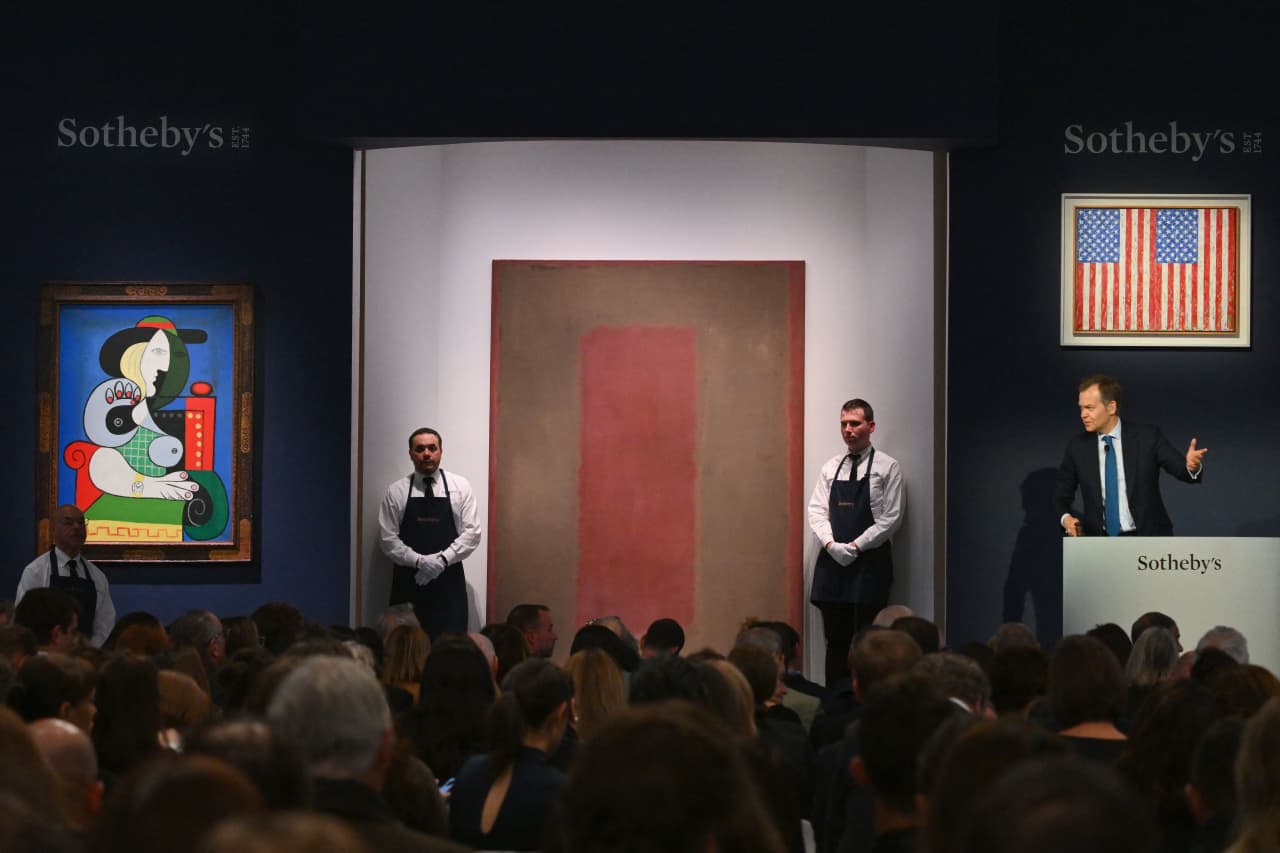
It’s ‘the Whisky Olympics’—Ultra-Rare and One-off Bottles Head to Auction at Sotheby’s

An ultra-rare whisky auction, known as the Distillers One of One, has announced its second edition will take place next month at Hopetoun House on the outskirts of Edinburgh, Scotland.

In partnership with Sotheby’s, the auction brings together a collection of one-off Scotch whiskies specially created and donated by leading distilleries across Scotland.

Headlining the sale is the highest valued lot, Bowmore STAC 55 Years Old, the oldest whisky the island distillery’s ever produced. It’s housed in a 1.5-litre hand-blown glass vessel that pays homage to Bowmore’s home on the island of Islay. The lot is estimated to sell for between £300,000 and £500,000 (roughly between US$371,900 and US$619,770).

The auction “represents all of the best elements of this industry: the community spirit, the rarity of the liquid, the creativity of the presentation, and, above all, the charitable nature,” says Jonny Fowle, global head of spirits at Sotheby’s.

Headlining the sale is the highest valued lot, Bowmore STAC 55 Years Old,.
Courtesy of Sotheby’s

Also of note is the 50-year-old Brora Iris (with an estimate between £200,000 and £400,000), the oldest Brora single malt that has ever been bottled and one that will never be made commercially available. The liquid is presented in a 1.5-litre decanter that’s suspended within a handcrafted stone sculpture. The bottle was designed to represent the eye of a Scottish Wildcat, the highly elusive native of the Scottish Highlands that is the emblem of the distillery.

Proceeds of the auction will be donated to the Distillers’ Charity, principally to the Youth Action Fund, which aims to improve the lives of disadvantaged young people in Scotch whisky-making communities.

The first Distillers One of One was held at Barnbougle Castle, also near Edinburgh, in December 2021. That auction featured more than 39 lots and achieved record-breaking hammer prices, with more than £2.4 million donated to The Distillers’ Charity.

“The success of the first auction was tremendous—the vision and work put in by the Distillers’ Charity supported by the contributions from the Scotch whisky industry has established a new force in Scotland to back our young people in extremely difficult times,” John Swinney, former deputy first minister of Scotland, said in the catalog notes.

Scheduled for Oct. 5, the auction—a ticketed event for which all attendees must be registered—will feature 39 lots with estimates ranging from £2,000 to £500,000. Collectors can place online bids in advance; a selection of lots is currently on view in Sotheby’s New Bond Street galleries in London through Sept. 20.

The entire operation is dependent on the generosity of some of the most revered brands in the field, with producers both new and old presenting exceptional whiskies, all in the name of charity. In addition to the rare bottles, casks and experiences donated for sale, the brands also provide support to make the event possible.

The Visionary (which has an estimate between £50,000 and £90,000), is a single malt that has been aged 68 years.
Courtesy of Sotheby’s

Other offerings at the sale include the Visionary (with an estimate between £50,000 and £90,000), a single malt that has been aged 68 years, making it one of the oldest whiskies to be released by Speyside’s historic Glen Grant Distillery.

Another unique item for sale is the Gordon & MacPhail Recollection Showcase (with an estimate between £80,000 and £160,000). Housed in a handcrafted cabinet made of elm and oak, the offering features five engraved Glencairn decanters. Each contains a one-off 70-cl single malt from five distilleries that have been lost or silent for decades.

“A wiser man than me described this as being ‘the whisky olympics,’ Fowle says. “I cannot wait to be on the rostrum for this auction and see how we can develop this project into 2025.”

Couples Embrace the Least Romantic Date Ever: The Money Date

To set the mood for poring over budgets and savings goals, Tierra Bates and her husband, Gregory, get dressed to the nines and head to dinner at a fancy steakhouse.

“We’re discussing things, but we’re celebrating at the same time,” said Bates, a school therapist and real-estate agent in Shelby, N.C. “Treating ourselves while still talking about the goals we have in mind.”

This mix of romance and finance has been dubbed a money date by financial advisers and others in the business of building wealth. The idea is to carve out time for the sort of conversations couples often dread by making it an event to look forward to.

Advisers and relationship counsellors say couples who go on regular money dates can better manage their spending, saving and investing. Since disagreements over money can strain marriages, having regular open discussions about financial decisions in a fun and intimate way can help address any troubles before they become a source of resentment.

“I have even suggested to clients, ‘Have the money date in your sexy clothes,’” said Christine Luken, a financial coach based in Cincinnati. “Just go ahead and have it naked—as long as you get the money stuff done.”

Bates and her husband plan money dates throughout the year. In January they set goals for the year, then they set up shorter quarterly follow-ups, as well as brief monthly check-ins for short-term concerns and week-to-week budgeting.

At their August check-in, Bates and her husband visited a local food hall and hired a babysitter to keep the focus on the big conversation: the Bates’s back-to-school budget.

Talking about something as stressful as the school year can bring up a lot of emotions, Bates said, but the money date gives them a specific time to work through everything together. Plus, doing it with good food and adults-only time makes it more enjoyable.

The art and science of the money date

Turning financial planning into a date might sound like a mismatch, but science backs up the premise. It is a form of temptation bundling, pairing a less exciting task with a more exciting reward, that research suggests can actually help people change their habits, said Scott Rick, associate professor of marketing at the University of Michigan.

“Pair the want with the should in order to entice you to do the should,” he said. “Get each other money date presents. Open the nice bottle of wine. Say, ‘This is the night we order in from the best restaurant in town.’”

You might have to spend money to make better money decisions, as counterintuitive as that might seem. As Adam Kol, a financial therapist based in Fort Lauderdale, Fla., likes to remind his clients: “You don’t get bonus points for having a money date if you’re sitting in a dark room and you’re in a miserable mood.”

Box-office receipts

When Megan and Bronson Allen got married in 2019, the Chicago-based couple pooled their finances. They also set up a regular recurring calendar invite that prompted them to sit down together to go over savings, investments and personal-account expenditures.

Megan will pop a big bowl of popcorn and project their laptop onto the TV screen so they can review the money-date agenda items almost “more like a game or a movie that’s playing,” Bronson said.

They have taken their laptops to a coffee shop and cozied up while reviewing coming travel and other big purchases. They also tried a double money date with Megan’s brother and his wife.

“It’s about finding ways to make them kind of lighthearted, like a date and not like a chore,” said Bronson, a 33-year-old software designer.

Their money dates can take several forms, Megan, a 28-year-old product designer, said. Sometimes they look at the calendar and plan travel spending for the month. Or they look back at the previous month’s budget and compare it to the bank statement.

Then there are pitch days, when one of them makes the case for an especially big purchase or financial goal. On a recent money date, Bronson made the case to take some money from their shared account to invest in a new road bike for his triathlon training, laying out his plans as he and Megan mixed drinks.

“I’ve been running the numbers, and this is what I’m thinking, and this is the account it would come from,’” he told her.

They landed on a compromise: Bronson would sell his old bike to invest in the newer one.

Making a first money date

For couples looking to set up their first-ever money date, Kol recommends reviewing the most recent credit-card statement as a duo. When both partners are looking at the transaction history, they are better able to get on the same page about what needs to be done about recurring subscriptions or spendthrift tendencies.

“It doesn’t have to be ‘I can’t believe you spent this, we need to cut this,’ but instead ‘Let’s make sure nothing weird is going on here. Let’s make sure our kid isn’t charging $700 to Candy Crush,’” he said.

From there, you can build onto your money dates and introduce different themes or topics to organise them. For example, maybe one month you and your partner review your respective student-loan payment plans, and the next you could price out travel options for a coming vacation.

“Having that monthly touchpoint allows you to feel like ‘OK, if I have a concern, it’s not going to go on indefinitely. I’ll have a chance to talk to them, I don’t have to confront them,’” Kol said.

Many Boards Are Playing Catch-Up on ESG and Green Issues

Many corporate board directors aren’t confident about their ability—or their board’s—to oversee sustainability and social impact issues, even as companies pursue such goals and regulators want more disclosures on environmental, social and governance impact.

Eighty-three percent of directors surveyed said ESG topics were critical knowledge for directors, but less than half considered themselves to have “advanced” or “expert” level knowledge, according to a survey of board directors conducted in July by WSJ Pro in collaboration with the National Association of Corporate Directors.Directors of larger firms and listed companies expressed higher confidence, as did those in the energy industry.Respondents relied on external advisers to build their knowledge.

Other findings were that most believed sustainability efforts had brought real benefits and said ESG engagement with investors had been mostly positive. Directors also said the anti-ESG movement had an impact. They also reported that while about half of big companies had ESG targets—many linked to executive compensation—smaller, private companies lagged behind.

The survey’s 506 respondents covered a range of company sizes and included public, private and not-for-profit organizations from many sectors, with a concentration in financial services, industry, tech and energy. They said their ESG maturity level was across the spectrum: 4% self-identified as industry leaders, 27% as well developed, 36% as somewhat developed, 28% as early stage and 5% hadn’t started with ESG. Overall respondents rated their own ESG expertise slightly higher than that of their fellow board members.

Training up on sustainability

“As a board member, if you’re hoping that ESG is just a fad that will pass with time, we have enough data now from the last 2½ decades to know ESG is here to stay and boards need to be ready,” said Kristin Campbell, general counsel and chief ESG officer of Hilton Worldwide Holdings and board director at ODP and Regency Centers.

Campbell said boards must evaluate ESG as part of the company’s long-term strategy, otherwise activists, regulators, customers or someone else might do it for them, perhaps in a way that will be painful operationally or harmful to their reputation. “It’s that classic story of either you’re at the table or you’re on the menu, said Campbell.

Alan Smith—responsible for the strategic management of the Church of England’s £10.1 billion (equivalent to $12.6 billion) perpetual endowment fund—said many boards had brushed up on ESG knowledge with in-house training, e-learning packages or advisers to run workshops. A former senior adviser at HSBC on climate and ESG risk and current First Church Estates Commissioner, Smith said he also found it helpful to see projects, such as offshore-wind farms, and speak to their operators in person.

“I think an integrated approach to board director education—of which one important part is getting on the ground and in the mud or on the boat—is very important,” he said.

More than two thirds of directors said their organisations brought in external advisers to complement or build board’s ESG skills, with most advisers providing subject matter expertise (44%), education and training (41%), or research and analysis (37%).

“What we know about ESG will change today and will probably change tomorrow,” Hilton’s Campbell said. “It’s the job of an external adviser to know what’s going to happen next week and next year, which is useful in keeping the board ahead of the game.”

Stakeholder engagement

Overall, investors were the most influential stakeholders on board decisions related to ESG strategy, followed by company executives, regulators and customers. For public companies investors were most influential, followed by regulators, while directors of private businesses ranked their customers as top with investors in second place.

Respondents ranked their ESG-related interactions with investors as largely positive or neutral. Seventy-one percent of directors of organisations with investors said their largest ones had engaged with the board over the past 12 months on ESG topics.

However, public and private businesses approached this engagement quite differently. Private company investors most often engaged with the full board or directly with management, whereas public company investors worked most often with individual directors or sometimes with the full board, but rarely with management.

Anti-ESG impact

The survey also examined the impact of the rising anti-ESG movement in the U.S. Many boards started their ESG journey in 2020, but, particularly in the last six to 12 months, the extent of the political backlash in the U.S. has made it more complicated, said Smith. “You had a wind that was giving companies and boards energy, and now you have a countervailing wind of political backlash,” Smith said.

As the pressure has mounted, there have been numerous reports of green-hushing—when a company scales back what it says about its climate and social initiatives in corporate communications. The survey found evidence to support this: 7% of directors said their company no longer publicly communicates about its ESG activities, and 14% said their board and management no longer use the term ESG when referring to relevant activities.

Respondents report substantive changes too. One in five said their companies are reassessing their approach to ESG, 12% said they have deprioritised ESG as a critical business issue, and 15% of directors, primarily in smaller private businesses, believe ESG is negatively affecting their business decisions and strategy.

Despite those changes, half of respondents believe ESG will continue to be an important driver of their business decisions and strategy. Nearly as many say their board and management remain committed to ESG as an opportunity for growth and a driver of long-term risk reduction.

Driving ESG performance

While most respondents said ESG is critical knowledge for directors, only 37% of their organisations have set a climate-impact reduction target, although that was 54% for large organisations. Nine out of 10 of those companies with a target said their boards monitored their progress toward those goals and four out of five believed they were achievable.

To encourage management to hit targets, over one quarter of respondents said their company had linked executive pay to ESG goals, and a further 29% were considering doing so in the next 12 months.

“If we’re going to be more serious about ESG and building it into a company’s long-term strategy then I think it needs to be tied to executive compensation like any other [key performance indicator],” Campbell said.

Nearly a fifth of directors surveyed said reducing the impact of climate change is a priority regardless of financial performance. Almost half said it is a priority but not at the cost of financial performance, while the remaining third said it isn’t a priority at all.

Many directors report real benefits from their ESG efforts. In particular it has enhanced their company’s reputation and brand value (57%), risk management and resilience (54%), and ability to attract and retain talent (44% and 40%, respectively).

Climate change was talked about more frequently in 43% of the boardrooms, while in 31% it actually decreased. The topic was discussed at most or every board meeting for 29% of respondents, 36% said it came up at some meetings, and 23% said it was rarely talked about. Only 11%—primarily small, private companies—hadn’t discussed it at all.

Smith said it was particularly important for smaller companies to keep climate change front of mind: “Those that say they aren’t doing anything yet are paradoxically the ones that may be hit first because they’re downstream of big companies setting more immediate net zero carbon neutral targets.”

As well as calling it a business differentiator for small businesses, Smith said a focus on climate impact reduction was “a survival mechanism.”

Meet the Homeowners Spending Tens of Thousands to Let Their Lawns Go Wild

Within Denver’s Washington Park neighbourhood, an enclave south of downtown where the median house listing price is just over $2 million, quintessential manicured American lawns roll out in front of historic brick bungalows, restored Victorians and contemporary new builds. Then there is Lisa Negri’s yard, which sits adjacent to her three-bedroom, two-bathroom bungalow where she’s lived since 2012.

“It looks like nature,” says Negri, 66, a retired engineer.

Roughly 50,000 plants comprising 92 species engulf her 0.14-acre lot, which until 2020 sported green lawn grass. She estimates the yard has cost roughly $75,000 for plants, bulbs, seeds and hardscaping. Negri’s creation, designed by Denver Botanic Gardens assistant curator of horticulture Kevin Philip Williams, rejects the time-honoured status symbol of a tidy lawn in favour of a new luxury: the rewilded yard.

Lisa Negri sits among her yard’s plants, including the purple-topped Rocky Mountain blazing star (the tallest plant to the left) and the orange and purple licorice mint (to the right). Negri bought the house next door to hers to prevent a new building from being constructed there. PHOTO: JIMENA PECK FOR THE WALL STREET JOURNAL

“Rewilding is returning land to a more natural state,” says Allison Messner, co-founder and CEO of Yardzen, a landscape design company with clients nationwide. Rewilding a yard typically involves introducing regionally appropriate plants, also called native plants, and fostering habitats for local wildlife. People come to the practice for myriad reasons. Some people want to support pollinators; some want to avoid water-guzzlers; others want to signal they are climate conscious. But the overarching purpose is universal: to encourage the flourishing of natural ecosystems and to mitigate the effects of habitat loss and climate change.

A common big black wasp sits atop a spotted beebalm in Negri’s yard. PHOTO: JIMENA PECK FOR THE WALL STREET JOURNAL

In Negri’s yard, this means interweaving prairie grasses and southwestern shrubs commingle with pockets of bulbs, wildflowers and succulents, all chosen to thrive in Denver’s climate, which is warm and dry in the summer and harsh in the winter, and has fierce year-round sun because of the altitude. Plants also specifically open the door to animals, insects, fungi and bacteria.

The space is one big meshed movement that throughout the year waxes and wanes in colour, height, shape and texture. A low-slung, post-winter skeletal brown becomes spring’s sprouting rainbow of lush hues, which gives way to summer’s 8-foot, reach-for-the-sky feathery silvers and waxy blues before fall’s explosion of radioactive yellows and Martian reds take hold for a last gasp as winter’s white waits in the wings.

A total of 9,000 plants and bulbs were planted in 2020, largely with help from neighbours and friends. Since then, Negri has planted fewer than 1,000 new plants but has added a large number of seeds. It took a year of significant watering to get roots established. Now the only substantial maintenance required is cutting the yard to the ground in the spring and watering two to three times a year.

An aerial view of Negri’s yard shows off such plants as the snow-on-the-mountain, which is to the back with white bracts (modified leaves), and the yellow flowering stiff goldenrod. PHOTO: JIMENA PECK FOR THE WALL STREET JOURNAL


The xeric crevice garden, which is the hottest, driest part of the yard, puts Negri’s love of cactuses on display. PHOTO: JIMENA PECK FOR THE WALL STREET JOURNAL

“A niche group of people has supported yard rewilding over the past decade or so, but recently it’s become much more mainstream,” Messner says. In 2022, Yardzen saw a 66% year-to-year increase in clients replacing green lawn grass with fully rewilded yards. “We’re not seeing thousands of people say, ‘Tear out my lawn and put in a rewilded yard,’ ” she says, but the majority of Yardzen’s clients are rewilding in some capacity. Last year, 90% of new Yardzen clients installed some type of native plants. “Things are moving in this direction,” she says.

Rewilded yards look different depending on climate and topography. In general, however, they support the web of life from below the ground up to the canopy, and every ecological layer in between, says Melissa Marie Wilson, CEO of Mill Valley, Calif.-based landscape firm Want Green Gardens. Lawns are nonexistent or minimized with native grasses. Plants bloom throughout the seasons. Native trees anchor the yard and provide wildlife with food and year-round shelter.

Eden Passante, 38, and Zan Passante, 47, worked with Yardzen to rewild their half-acre lot about 30 miles northwest of Los Angeles in the ranch community of Newhall, Calif. They purchased the property in 2016 for $560,000 and spent $400,000 gut-renovating their space, which totals 2,100 square feet and has three bedrooms, three bathrooms and a guesthouse. They estimate they have spent $65,000 on rewilding. Plants cost about $10,000; hardscaping cost the most. The bulk of the designing and planting took five months.

The Passante family on their back porch. The dried purple sage in the vase comes from their yard. PHOTO: TEAL THOMSEN FOR THE WALL STREET JOURNAL

Today, the grassless yard is filled with whimsical flowers and succulents, such as blue chalksticks and large blue agaves. Gravel pathways lead to sitting and dining areas and a fire pit. There are garden beds for vegetables and edible flowers and a separate herb garden for mint, thyme, oregano and pineapple sage. A citrus grove has a Eureka lemon tree, a Meyer lemon tree, a yellow grapefruit tree, a lime tree and an orange tree.

“They are half native plants but all of the plants are drought-tolerant and zoned for this area,” says Eden Passante, who is the CEO of the home-entertaining website Sugar and Charm. Wildlife is active in the yard. A partridge laid 12 eggs under a bush. Pollinators love the blooming citrus trees.

The yard is low maintenance. “I try to let nature do its thing, but I remove any invasive weeds and keep the pathways nice,” she says. “The only difficulty is keeping the dust, rocks and pebbles out of the house.” Sometimes she wishes there was a soft play surface for her two young children.

Emily Murphy, an ethnobotanist with a background in ecology and environmental science and author of the regenerative gardening book Grow Now, says it is easy to get in the weeds with rewilding terminology. “It’s evolving in real time,” she says, noting that the word rewilding sprung up in conservation biology and ecology circles in the 1990s in reference to large-scale efforts to restore biodiversity and improve the integrity of landscape and natural systems.

Murphy says that rewilding a yard will obviously look very different from rewilding, say, a National Park. “Purists would say—and there is always a purist—that your yard can’t be compared to the reintroduction of wolves in Yellowstone.” But she believes that rewilded yards do contribute to the greater good. “Once you plant native plants, biodiversity will come,” she says, giving the example of a native oak tree, which can support roughly 2,300 species of animals and insects. In comparison, a non-native Chinese ginkgo has been documented to support five or fewer local species.

Jennifer Ehlert, vice president of landscape design firm Metro Blooms Design+Build in Minneapolis, says rewilding costs roughly the same as other landscaping. “A DIY pollinator patch might be in the hundreds,” she says. “Hiring a landscaping company to design and build some portion of a rewilded yard might be in the thousands. Rewilding your whole yard might be in the tens of thousands. If you’re into the hundreds of thousands, you have a huge property or you’re hardscaping as part of a bigger project.”

Dan Dufficy, founder of Mill Valley, Calif.-based California Native Landscapes nursery, encourages clients to start small. “Customers aren’t used to seeing these plants,” he says. “Their friends aren’t used to seeing these plants. They have no idea what the maturity of the product looks like.” To help clients get excited, he uses his hands to animate what plants look like and he uses vivid, educational language.

Not everyone is excited about yard rewilding. Homeowner associations can have landscape aesthetic rules. People who are allergic to bees have legitimate concerns. And then there are neighbours who just don’t get it.

Her first summer of rewilding, Lisa Negri in Denver received a cease-and-desist order from the city, which closed her down for eight months. “A neighbour called the city on me and said, ‘We don’t know what this person is doing. We’re afraid of it,’ ” Negri says. With the help of her garden designer and several horticulturists, she put together a 90-page presentation and ultimately received an open space conservation zoning designation, which is one of several types of conservation-related protections homeowners could pursue locally. Some cities—such as Austin, Texas, Evanston, Ill., and Green Bay, Wisc.—have passed ordinances in support of wildlife-friendly homeowners. This is also happening at the state level. In Minnesota, for example, a new state law bans cities from limiting managed natural landscapes.

The plants in the front yard of the home of Roshanna Baron and Nir Einhorn in Santa Monica, Calif., include foxtail agave (the succulent in the front), a princess flower tree with purple flowers (to the far back right), and a spiky-looking New Zealand flax (in the upper left, in front of the gate). PHOTO: NATASHA LEE FOR THE WALL STREET JOURNAL


Roshanna Baron in front of a fuchsia-coloured salvia in her yard. PHOTO: NATASHA LEE FOR THE WALL STREET JOURNAL


Roshanna Baron tested out several kinds of pebbles—evaluating them when they were both dry and wet—before she settled on this pea gravel that sits between and around the pavers. PHOTO: NATASHA LEE FOR THE WALL STREET JOURNAL

In Santa Monica, Calif., Roshanna Baron is having an opposite problem: Neighbours are copying her 0.13-acre rewilded yard. She and her husband, Nir Einhorn, 48, bought their house for $1.1 million in 2017. The couple received a landscaping blank slate when their yard was torn up during a nine-month renovation of their home, which has three bedrooms and two bathrooms, and totals 2,220 square feet, including their short-term rental guesthouse.

Planning their fully rewilded yard lasted about a month. Buying and installing $4,000 worth of plants took about two weekends with the help of a gardener. At first the landscaping felt empty, but after a year it was grown in. Three years later, the yard is colourful and warm with green- and blue-tinted plants, flowering succulents and a Meyer lemon tree. They kept a 75-year-old persimmon tree, the fruit of which keeps getting better as the yard’s soil improves.

“I’ve been stopped several times from husbands or wives saying they are planning on copying our yard,” says Roshanna Baron, 51, who works in entertainment industry talent relations and event planning. “One specifically told me he was copying everything because his wife loved it so much. A stranger parked in front of our home to tell me they aspire to have a yard like this.”

The state that’s still the pick of the bunch for local migration

Queensland is attracting more interstate migration than any other state, as residents flee NSW, data released by the ABS has shown.

The COVID-induced domestic exodus to the Sunshine State has continued with statistics showing a net migration north of 31,070. By contrast, NSW has experienced a net loss of -30,213 residents, the largest population decline of any state in Australia.

The ABS noted that the 12-month review to March 2023 reflected the residual effects of COVID, which saw tens of thousands of Australians moving north permanently when state border restrictions lifted in early 2022.

This growth in population was followed by Western Australia, which also recorded a net migration of 11,121. South Australia recorded a much more modest net increase of 157 new residents. All the other states recorded net drops in population.

Head of research at Hello Haus property advisory, Sam Powell, said the data presented investors with an opportunity to capitalise on possible yields in growth suburbs in both WA and Queensland.

“The big shift both north and west is unsurprising,” he said. “Queensland and WA have relatively affordable real estate, and both offer exceptional lifestyle appeal, plus comprehensive facilities and infrastructure. 

“Their prospects look great economically as well. The 2032 Olympics will put Queensland on the world stage, and a resurgence in commodity prices as global economies recover bodes well for WA in the long term too.” 

Mr Powell identified three suburbs of Brisbane — Oxley, Boondall and Fitzgibbon — as areas with strong potential for growth. The Greater Perth suburbs of Gosnells and Girrawheen and the Perth locales of Mirrabooka, Caversham and Ballajura, were also likely to be strong performers, he said, based on relatively low median house prices and strong yields.

Work From…Anywhere? Tips From Travellers Who Do ‘Workcations’ Right

ASHLEY SCHWARTAU escaped to a Mexican beach town just two weeks after starting a new job for a Chicago-based insurance company. It’s not that Schwartau, 38, is a late-blooming spring breaker. She and her husband both work remotely, so when winter arrived at home in Nashville, Tenn., the pair decided to clock in from a vacation rental with a pool in Playa del Carmen.

For the next four weeks, the couple took calls from their temporary home, while their 4-year-old son attended a bilingual preschool whose $350 monthly tuition would be implausible back in Nashville. After hours, the trio played at the nearby beach, lounged poolside or grazed at neighbourhood taco stands. Following a weeklong-vacation chaser at month’s end, they returned to Tennessee restored. “It’s hard for working parents to truly find moments of relaxation, and that was one of the most relaxing trips we’ve ever taken,” said Schwartau, who documented the trip on her blog to inspire others looking to expand their own definitions of remote work.

Unlike some full-time “digital nomads”—who skew young, male and child-free—Schwartau has no plans to permanently swap home life for stints in Lisbon or Bali. Instead, Schwartau used her hybrid “workcation” to capitalise on a remote-friendly job and temporarily set up shop away from home’s routines and responsibilities.

The trip also let her save some paid time off while still traveling, a strategy that appeals to workers in the U.S., where the average private-sector job affords just 11 days off after a year. With employers increasingly offering flexible work options, workcations seem to be a pandemic-accelerated trend with staying power. A 2023 study by Deloitte showed that one in five travellers planned to do some work on their primary summer trips, with many using flexible policies to eke out additional time away.

Still, obstacles abound. Jet lag can sap work output, sand will destroy your computer and dutifully clocking hours a block from a beach invites intense FOMO. It takes finesse to make workcations work—here’s how to pull one off.

Get in the (time) zone

Going too far afield—or heading in the wrong direction—can tug routines out of alignment. Dan Hammel of Benicia, Calif., works for a tech concern that follows Central time and offers staffers two annual work-from-anywhere weeks. Last fall, Hammel spent one off-kilter week working from the Italian city of Bologna. “My hours in Europe were probably about 4 p.m. to midnight,” he said of the need to align with his stateside colleagues’ workdays. After days spent touring nearby Modena and Parma with his wife, Hammel found the schedule challenging. “I like to be in bed around 10,” said Hammel, 45.

To avoid red-eye marathons, follow your natural sleep pattern to the optimal time zone. For Hammel, that meant Maui, where he worked remotely in May. “I would get up at 5 a.m. and would be done around noon,” he said. “We would have the whole rest of the day to nap, relax for a little bit after my workday, hit the beach, go to dinner.”

Make space

Remote work might conjure Instagram shots of laptops lolling on beach chairs, but such scenes don’t translate to meaningful productivity. Deloitte found that more than half of all travelers look for work-friendly spaces when booking accommodation. William DeSousa, 73, a public-relations professional from Osterville, Mass., craves more space than hotel rooms offer: He’s a villa guy.

For 16 years, he’s spent a month working from Greece with his husband and has learned that walls do wonders. “We both need to be on phones, or be on Zoom calls,” he said. “I think separate workspaces work best for couples.” This year, the pair will enjoy the beach-and-taverna circuit while clocking in from villas in Santorini and Crete.

Other travellers opt for hotels—such as Mama Shelter Shoreditch London and the Hoxton Chicago—with dedicated co-working areas and brisk internet. Whatever you decide, ask for bandwidth details before booking: The website Global Nomad Guide, which advises remote workers, recommends download speeds of at least 50 Mbps.

Log off

Many remote workers are loath to shut devices down, which can lead to post-workcation regrets. Commit in advance to logging off, said Jaime Kurtz, professor of psychology at James Madison University and author of “The Happy Traveler: Unpacking the Secrets of Better Vacations.” Tell yourself, “‘I’m going to work this many hours a day, and then I will go out and take advantage of the place,’” Kurtz said. She suggested travellers seek experiences that sideline devices completely, such as riding a bike or joining a food tour.

And while remote work can help PTO go farther, don’t mistake working getaways for more truly replenishing vacations. That’s why many workcationers, including Schwartau and Hammel, follow remote stints with actual time off, using working trips as a launchpad for dedicated travel time.

Jessica de Bloom, a professor of psychology at the University of Groningen in the Netherlands, who studies the blurring frontiers between work and leisure time, considers true disconnection essential to thriving. A request for comment for this story prompted an out-of-office message, suggesting de Bloom lives by her own findings. “I am currently enjoying a vacation,” the auto-response read. “I choose not to work and check my emails, because research showed that working during holidays can be detrimental for my health.”

The Wall Street Journal is not compensated by retailers listed in its articles as outlets for products. Listed retailers frequently are not the sole retail outlets.

European Central Bank Raises Key Interest Rate to Record High

FRANKFURT—The European Central Bank raised interest rates by a quarter percentage point to a record high but signalled that eurozone borrowing costs may have peaked, sending the euro tumbling.

In a split decision, ECB officials raised the bank’s deposit rate to 4%, the 10th increase in a row and a vertiginous rise from below zero last year.

At a news conference, ECB President Christine Lagarde signalled that Thursday’s rate increase might be the last, although she didn’t rule out further hikes if economic data disappoint.

ECB officials judge that rates “have reached levels that, maintained for a sufficiently long duration, will make a substantial contribution” to reducing inflation to their 2% target, Lagarde said, repeating language used in the bank’s policy statement.

The comment prompted investors to downgrade their expectations for future ECB rates, sending the euro down by almost a cent against the dollar to below $1.07, its lowest level since March. Bond yields slid, with yields on the benchmark 10-year government bonds of Germany, France and Italy down between 0.05 and 0.10 percentage point. European stocks rallied, with the benchmark Stoxx Europe 600 index rising more than 1%.

The eurozone still has lower interest rates than the U.S., as well as higher inflation and a struggling economy that contrasts with relatively healthy economic growth in the U.S.—all factors that are weighing on the euro.

“In all likelihood the ECB is done,” said Frederik Ducrozet, head of macroeconomic research at Pictet Wealth Management in Geneva.

Major central banks including the Federal Reserve are signalling a possible halt to a historic series of interest-rate increases over the past 18 months aimed at tackling a surge in inflation unseen since the 1970s.

Ending rate increases would favour borrowers amid uncertainty in the global economy, declining international trade and faltering industrial output. However, signalling a peak in interest rates now risks letting excessive inflation on both sides of the Atlantic become entrenched. Some central banks, including those of Australia and Canada, signalled a pause in recent months, only to start raising rates again.

Recent market movements suggest investors are now betting that rates will peak and even start falling as early as next spring as inflation and economic growth both come down.

They expect the ECB to hold interest rates at about 4% through next summer before starting to cut them, according to data from Refinitiv. They think the Fed will hold rates steady in a range between 5.25% and 5.5% at its meeting next week, and to start cutting rates early next year. The Bank of England is expected to increase interest rates at least once more this year before cutting them later next year.

Investors had been unusually divided before Thursday’s decision over whether the ECB would pause already or unveil one last rate increase. That disagreement reflects uncertainty over how much a slowdown in eurozone growth, together with the ECB’s past rate increases, will cool the region’s inflation rate, which stood at 5.3% in August, unchanged from a month earlier.

Lagarde said some of the central bank’s governors would have preferred to hold rates steady at this month’s meeting. However, a “solid majority” of them agreed on the decision to take rates higher, she said.

New economic forecasts published by the ECB Thursday suggested that eurozone growth will slow significantly more than previously expected this year and next, while inflation will remain markedly above the ECB’s target of 2% through next year. The bank raised its forecast for inflation next year from 3% to 3.2%, mainly to reflect “a higher path for energy prices.”

Asked about the prospect of rate cuts, Lagarde replied that “is not even a word we have pronounced.”

“The longer they can keep interest rates at elevated levels, the more insurance they buy against a downturn down the road,” said Robert Dishner, a senior portfolio manager at Neuberger Berman. “If they end up cutting too soon, they risk reigniting inflation.”

Central banks in Europe face a particularly daunting challenge because while recent interest rate rises have weighed heavily on lending and probably lowered economic growth, they have yet to show a marked effect on underlying inflation. This contrasts with the U.S., where the Fed has taken interest rates higher than the ECB and underlying inflation has fallen significantly while the nation’s growth remains robust. Underlying inflation in August was 5.3% in the eurozone and 4.3% in the U.S.

Recent data and business surveys signal a darkening economic outlook for Europe amid weak growth in China and a decline in global manufacturing. The eurozone economy has largely stagnated since late last year, and industrial production declined in July, dragged down by weakness in Germany, the region’s largest economy.

Lagarde warned that Europe is currently going through a phase of very sluggish growth and suggested that the ECB’s rate hikes are filtering through to the economy. “We are beginning to see weakness in the volume of hires particularly in the services sector that is related to manufacturing,” she said.

Meanwhile, a recent increase in oil prices is pushing inflation in the wrong direction. The euro has slumped against the dollar in recent weeks, to around $1.07 from $1.12 in July, as the eurozone’s economic prospects have soured. That increases the cost of imported goods, making the ECB’s job harder.

Matthew Ryan, head of market strategy at financial-services firm Ebury, said the ECB would likely start cutting rates later, and possibly at a more gradual pace, than the Fed, which should support the euro.

Some of the economic weakening is as intended. The ECB expects its rate increases to slow the region’s economy by weighing on asset prices and demand for loans. However, it isn’t clear if inflation is starting to fall because of the ECB’s actions or because of other factors, such as the fact natural-gas prices are dramatically lower compared with last year, when Russia throttled Europe’s gas supplies. This makes it hard to predict if the region’s economic slowdown will push inflation all the way down to 2%.

Market confidence in the ECB’s ability to achieve its objectives is gradually eroding, with the closely watched five-year, five-year inflation swap—a gauge of expected inflation over a 10-year horizon—standing at 2.6%, according to Franck Dixmier, global chief investment officer for fixed income at Allianz Global Investors.

High current and expected future inflation could mean that investors are underestimating the potential for further ECB rate increases, Dixmier said.

Low unemployment levels raise concerns over productivity, inflation

Unemployment levels have remained steady at a low 3.7 percent, new figures from the ABS reveal.

Reflecting a tight labour market and ongoing high demand, data showed that participation levels were also at a record high of 67 percent with employment increasing to 14,096,100.

The news comes on the back of comments by Tim Gurner, CEO of property group Gurner Group, who said earlier this week that unemployment levels needed to rise in order to increase levels of productivity.

Speaking at a finance summit earlier this week, Mr Gurner said employees had become arrogant and needed reminding that they worked for the employer, ‘not the other way around’.

“Unemployment has to jump 40 to 50 per cent in my view. We need to see pain in the economy,” he said.

The comments made news around the world and have been condemned by employee groups, trade unions and politicians such as Greens MP Stephen Bates and US Democrat Alexandria Ocasio-Cortez who tweeted them to highlight the disparity between CEO to worker pay.

Incoming Reserve Bank Governor Michele Bullock also made comments in June that the unemployment rate would need to rise to 4.5 percent to help draw down inflation.

However, ABS head of labour statistics Bjorn Jarvis said indications for a tight labour market continued to be strong over July and August.

With employment increasing by around 65,000 people and the number of unemployed only dropping slightly, by around 3,000 people, the unemployment rate remained at 3.7 percent in August,” Mr Jarvis said.

“The large increase in employment in August came after a small drop in July, around the school holiday period. Looking over the past two months, the average employment growth was around 32,000 people per month, which is similar to the average growth over the past year.

“The employment-to-population ratio rose 0.1 percentage point to 64.5 per cent, around the record high in June. The participation rate also increased, up to a record high of 67 percent in August, which, together with the high employment-to-population ratio, continues to reflect a tight labour market.” 

5:01 and Done: No One Wants to Schmooze After Work

Patience for after-hours work socialising is wearing thin.

After an initial burst of post pandemic happy hours, rubber chicken dinners and mandatory office merriment, many employees are adopting a stricter 5:01-and-I’m-done attitude to their work schedules. More U.S. workers say they’re trying to draw thicker lines between work and the rest of life, and that often means clocking out and eschewing invites to socialise with co-workers. Corporate event planners say they’re already facing pushback for fall activities and any work-related functions that take place on weekends.

“The flake-out rate is so much higher at events now,” says Gretchen Goldman, a research director in Takoma Park, Md.

This summer Goldman sent an invite to 100 colleagues for casual after-work drinks at some picnic tables just outside the office as a goodbye party. She was taking a new job with the federal government. Fewer than 10 showed up.

“I guess people are just busy,” she says.

The pandemic altered eating and drinking habits, and pandemic puppies, now fully grown dogs, have to be walked on a schedule. With fewer people back in offices, there are fewer impromptu happy hours and a lack of interest in staying out late with colleagues, some bosses and workers say.

Andy Challenger oversees employees who participate in the fantasy football league at his outplacement firm, Challenger, Gray & Christmas. When some of them floated the same game plan as prior years—an in-office pizza party that goes past 11 p.m. as everybody drafts their favourite players—the pushback was swift. This season, the pizza arrived at 4:30 p.m. and everyone was finished and out of the office by 6 p.m.

“Normally that would have been the starting time,” he says.

For decades, an unspoken rule of office culture has been that much of work happens outside the 9-to-5 window. Getting ahead often requires being known outside the building and having organisational allies—the type of networking that’s helped by showing up for dinner with the boss and getting relaxed face time with co-workers at happy hours, says Jon Levy, a New York City-based consultant who advises organisations on connection and culture.

Now, even the go-getters are saying no to after-hours schmoozing opportunities.

The thinking is: “That 20th happy hour isn’t going to produce anything better for me,” Levy says.

People are less jazzed about eating out once they are home, and many got pretty good at making dinner during the pandemicsays David Portalatin, food industry adviser at Circana Group, a market research firm.

“When the consumer stretches and builds new muscles, they don’t abandon those behaviours completely,” he says.

In the past year, U.S. consumers had 264 million restaurant dinners after leaving work, which is down 43% from 2019 levels, according to Circana. And reservations are now earlier: In 2023, 26% of after-work restaurant dinners happened before 6 p.m., compared with 21% in 2019.

Barbara Martin hosts bimonthly evening soirees for clients of her marketing firm, Brand Guild. Traditionally, cocktails start flowing around 6:30 p.m. and the mingling could last until 9 o’clock—or beyond. But last Thursday she pulled the start time forward to 5:30 p.m. sharp.

“‘I’d love to come to these if you could do them earlier,’” Martin says she’s heard again and again this summer. “Nobody wants to overbook themselves until 10 p.m. on a weeknight anymore.”

Attitudes don’t appear to be changing as the summer vacation season ends. Kay Ciesla is helping organise an all-staff gathering for 80 people at the American Immigration Lawyers Association, the Washington, D.C., nonprofit where she works as a governance executive. She is considering an ax-throwing theme, and serving finger foods and cocktails.

“I’m already getting pushback,” she says of spending precious time that bleeds into personal hours on team building. Due to scheduling conflicts the group can’t gather until December. One employee voiced concern that the socialising could turn into a superspreader event ahead of Christmas travel.

Doug Quattrini, an event planner in the Philadelphia area, has already booked six Christmas parties. What’s different this year, he says, is that most are on weekdays, in the office—and end at 8 p.m.

“Nobody wants to take up people’s Fridays, Saturdays and Sundays,” says Fausto Pifferrer, co-owner of Blue Elephant Catering in Saco, Maine, near Portland, which has booked several office holiday parties for Monday through Thursday.

Younger Americans are drinking less. The share of people between 18 and 34 who said they “ever” drink alcohol has fallen to 62% from 72% two decades ago, according to Gallup data.

Caroline Wong, the chief strategy officer at Cobalt, a cybersecurity company in San Francisco, quit drinking in her early 30s and tries to plan social gatherings sans alcohol. A team off-site next month will be a tour of waterfalls near Portland, Ore. She’s noticed things wrap up earlier when there’s no drinking involved.

“It’s like, ‘You know what, we hung out for 90 minutes. We’re good and I’ll see you tomorrow,’” Wong says. “I think there’s something awesome about that.”

M.B.A. Students vs. ChatGPT: Who Comes Up With More Innovative Ideas?

How good is AI in generating new ideas?

The conventional wisdom has been not very good. Identifying opportunities for new ventures, generating a solution for an unmet need, or naming a new company are unstructured tasks that seem ill-suited for algorithms. Yet recent advances in AI, and specifically the advent of large language models like ChatGPT, are challenging these assumptions.

We have taught innovation, entrepreneurship and product design for many years. For the first assignment in our innovation courses at the Wharton School, we ask students to generate a dozen or so ideas for a new product or service. As a result, we have heard several thousand new venture ideas pitched by undergraduate students, M.B.A. students and seasoned executives. Some of these ideas are awesome, some are awful, and, as you would expect, most are somewhere in the middle.

The library of ideas, though, allowed us to set up a simple competition to judge who is better at generating innovative ideas: the human or the machine.

In this competition, which we ran together with our colleagues Lennart Meincke and Karan Girotra, humanity was represented by a pool of 200 randomly selected ideas from our Wharton students. The machines were represented by ChatGPT4, which we instructed to generate 100 ideas with otherwise identical instructions as given to the students: “generate an idea for a new product or service appealing to college students that could be made available for $50 or less.”

In addition to this vanilla prompt, we also asked ChatGPT for another 100 ideas after providing a handful of examples of successful ideas from past courses (in other words, a trained GPT group), providing us with a total sample of 400 ideas.

Collapsible laundry hamper, dorm-room chef kit, ergonomic cushion for hard classroom seats, and hundreds more ideas miraculously spewed from a laptop.

How to compare

The academic literature on ideation postulates three dimensions of creative performance: the quantity of ideas, the average quality of ideas, and the number of truly exceptional ideas.

First, on the number of ideas per unit of time: Not surprisingly, ChatGPT easily outperforms us humans on that dimension. Generating 200 ideas the old-fashioned way requires days of human work, while ChatGPT can spit out 200 ideas with about an hour of supervision.

Next, to assess the quality of the ideas, we market tested them. Specifically, we took each of the 400 ideas and put them in front of a survey panel of customers in the target market via an online purchase-intent survey. The question we asked was: “How likely would you be to purchase based on this concept if it were available to you?” The possible responses ranged from definitely wouldn’t purchase to definitely would purchase.

The responses can be translated into a purchase probability using simple market-research techniques. The average purchase probability of a human-generated idea was 40%, that of vanilla GPT-4 was 47%, and that of GPT-4 seeded with good ideas was 49%. In short, ChatGPT isn’t only faster but also on average better at idea generation.

Still, when you’re looking for great ideas, averages can be misleading. In innovation, it’s the exceptional ideas that matter: Most managers would prefer one idea that is brilliant and nine ideas that are flops over 10 decent ideas, even if the average quality of the latter option might be higher. To capture this perspective, we investigated only the subset of the best ideas in our pool—specifically the top 10%. Of these 40 ideas, five were generated by students and 35 were created by ChatGPT (15 from the vanilla ChatGPT set and 20 from the pre trained ChatGPT set). Once again, ChatGPT came out on top.

What it means

We believe that the 35-to-5 victory of the machine in generating exceptional ideas (not to mention the dramatically lower production costs) has substantial implications for how we think about creativity and innovation.

First, generative AI has brought a new source of ideas to the world. Not using this source would be a sin. It doesn’t matter if you are working on a pitch for your local business-plan competition or if you are seeking a cure for cancer—every innovator should develop the habit of complementing his or her own ideas with the ones created by technology. Ideation will always have an element of randomness to it, and so we cannot guarantee that your idea will get an A+, but there is no excuse left if you get a C.

Second, the bottleneck for the early phases of the innovation process in organisations now shifts from generating ideas to evaluating ideas. Using a large language model, an innovator can produce a spreadsheet articulating hundreds of ideas, which likely include a few blockbusters. This abundance then demands an effective selection mechanism to find the needles in the haystack.

To date, these models appear to perform no better than any single expert in their ability to predict commercial viability. Using a sample of a dozen or so independent evaluations from potential customers in the target market—a wisdom of crowds approach—remains the best strategy. Fortunately, screening ideas using a purchase intent survey of customers in the target market is relatively fast and cheap.

Finally, rather than thinking about a competition between humans and machines, we should find a way in which the two work together. This approach in which AI takes on the role of a co-pilot has already emerged in software development. For example, our human (pilot) innovator might identify an open problem. The AI (co-pilot) might then report what is known about the problem, followed by an effort in which the human and AI independently explore possible solutions, virtually guaranteeing a thorough consideration of opportunities.

The human decision maker is likely ultimately responsible for the outcome, and so will likely make the screening and selection decisions, informed by customer research and possibly by the opinion of the AI co-pilot. We predict such a human-machine collaboration will deliver better products and services to the market, and improved solutions for whatever society needs in the future.

Christian Terwiesch and Karl Ulrich are professors of operations, information and decisions at the Wharton School of the University of Pennsylvania, where Terwiesch also co-directs the Mack Institute for Innovation Management.

Women’s World Cup kicking goals for household spending

The FIFA Women’s World Cup, educational spending by international students and higher petrol prices were behind higher household spending last month, new research released today shows.

The CommBank Household Spending Insights Index showed an increase of 0.7 percent to 137.0 in August, led by greater spending on transport due to higher fuel prices, as well as educational spending by an influx of overseas students and recreational activity related to the FIFA Women’s World Cup.

Recreation spending was up by 1.9 percent in August and 8.4 percent annually thanks to the FIFA World Cup and a select number of big name concerts, with ticketing agency sales surging by 70 percent.

The monthly increase was strongest in Queensland, which experienced a 1.5 percent uptick, followed by Tasmania on 1.3 percent and the ACT, up 1.1 percent.

Despite the positive results in August, household spending was subdued overall. CBA Chief Economist Stephen Halmarick said the pattern would likely continue through to the end of the year.

“The effects of 400bp of Reserve Bank of Australia interest rate rises is clearly reflected in a significant slowdown in annual household spending growth measured by the CommBank HSI Index,” Mr Halmarick. “With the RBA holding rates since June, our view is that the hiking cycle is now at an end. Monetary policy is now restrictive and financial conditions will continue to tighten in the months ahead on the lagged effect of RBA interest rate hikes and the fixed rate mortgage refinancing task. 

“We continue to expect household spending to weaken further over the remainder of 2023 and into 2024.” 

Car of the month: The retro Ferrari still topping the charts 45 years on

It was the year Grease opened at the cinema and the BeeGees were topping the charts. But that’s not the only classic that hit the market in 1978. A rare right hand drive 1978 Ferrari 512 BB, goes under the hammer this week with price expectations of more than $300,000. Bidding is already fierce for the classic car being offered for sale via Collecting Cars.

Known for its speed, style and luxury, the Ferrari label is synonymous with supercar domination and is one of the oldest and most successful racing brands ever. With just four previous owners – the most recent keeping the car for 24 years – bidding on this limited edition vehicle ends Monday, September 18. We took a peek under the bonnet before this incredible vehicle heads off on its next adventure. 

A True Rarity

The 1970s Ferrari 512 BB is a rare breed, with just 929 units delivered worldwide. Among these, only 101 were made in right-hand drive configuration. This example has had a total of four owners since it rolled off the production line, and it’s been in the care of its current owner for nearly a quarter of a century. Originally purchased in the UK, it is believed to have been brought to Australia by the then-owner in the 1990s. Although it has a few years on the clock, it has a modest 35,484 miles (57,106 km) on the odometer.

Iconic Styling

The Berlinetta Boxer, or BB, is famous for its striking design, and this 512 BB is finished in classic Rosso Corsa. Inside, the tan leather-trimmed seats with Nero ‘Daytona’ inserts offer both comfort and a touch of sophistication. The 15-inch five-spoke Cromodora alloy wheels, paired with Michelin tyres, add to the car’s visual appeal.

Powered up

Under the hood lies a 4.9-litre flat-12 engine that produces around 346kW at 7,250rpm. The powerful engine sends its performance to the rear wheels through a five-speed open-gate manual transmission, a setup that defines the era of analog supercars. The result is a driving experience that modern supercars can only dream of replicating.

Unique Modifications

This Ferrari 512 BB has been carefully modified to enhance its performance and useability. Upgrades include an MSD ignitor and coil, an uprated air conditioning compressor, twin electric cooling fans, wider rear wheels, uprated shock absorbers and springs, a Tubi stainless steel exhaust, remote central locking, HID headlight bulbs, LED fog lights, a Sony head unit, and a reverse camera and screen.

Impeccable Service History

Maintaining a classic supercar like this requires a great deal of care and commitment. This 521 BB comes with a comprehensive service history, with the most recent service conducted in November 2021 at 35,346 miles by Racing Red. This service included an engine oil and filter change, along with the replacement of brake fluid and a rebuild of all four brake callipers. Previous services in 2020 and 2019 included engine oil and filter changes, clutch inspection, timing belt replacement, and various other essential maintenance tasks.

The Road Ahead

The Ferrari 512 BB represents not just a car but a piece of history. With its rarity, striking appearance, and modifications, it’s an opportunity to own a piece of automotive history. 

Disclaimer

As with any major purchase, potential buyers should conduct their own due diligence to verify the accuracy of the vehicle’s description.