The Big Family Fight Is Over How to Work. ‘They Think I’m Insane.’
Generational debates about work may be brewing in the office, but they’re often louder on the home front

 5 min
5 min
Hybrid work. Hustle culture. Work-life balance.
Tensions over how to work don’t just permeate offices these days. They’re on full display within families.
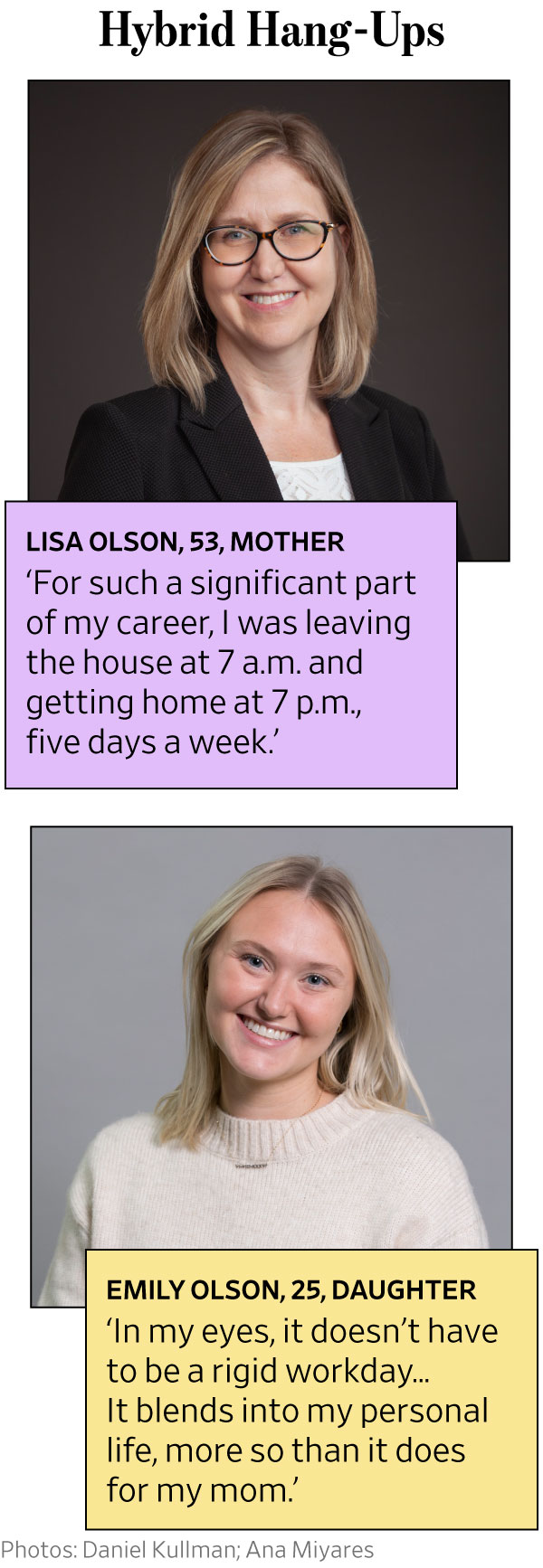
“They think I’m insane,” Lisa Olson, 53, said of her children when she tells them she skipped lunch during the workday.
Her 25-year-old daughter, Emily Olson, tends to fit her job in advertising around her life, sometimes taking a midday break but also logging on after-hours if there’s work to be done. She thinks her mom struggles to make time for herself.
Like with the Olsons, many of these debates break along generational lines. Many parents in their 50s and 60s built careers in pay-your-dues work environments where 40 hours was the minimum spent in an office each week. They had clear-cut templates for getting ahead.
Their children, in contrast, joined the labor force over the past decade, as the gig economy took off, a pandemic upended 22 million jobs and millions of people embraced working from home. Technologies such as AI are scrambling their careers even more.
These debates about work are often more pointed, and personal, at home than on the job. Parents and their adult children say these conversations are often meaningful in navigating today’s multigenerational workforce.
“These are people who’ve known you all your life—you hope they understand what really matters to you,” said Megan Gerhardt, a management professor at Miami University’s Farmer School of Business and the author of a book about intergenerational workforces.
Emily has worked mostly remotely since graduating from college in 2020. One benefit is that she can integrate errands into her workday. Her mother, who works in financial services, urges her to go into the office.
“When you’re remote, you hop on a Teams call, and you talk about the issue at hand—and you don’t necessarily have extra time in that meeting to chat,” Lisa said.
Emily said that when she does commute to work, she often interacts with co-workers virtually since not all of her team lives in Chicago, where she’s based.
As long as she does good work and is responsive, working set hours in a set place isn’t important to her, she said. When a call was unexpectedly rescheduled to a Friday afternoon, when work is usually winding down, she logged on from the hair salon while getting highlights.
“It doesn’t have to be a rigid workday,” said Emily, who often works more than 40 hours each week.
Lisa, on the other hand, said she spent much of her career leaving for work at 7 a.m., and returning at 7 p.m., five days a week. “In my world, work is a completely separate item from my personal life,” she said.
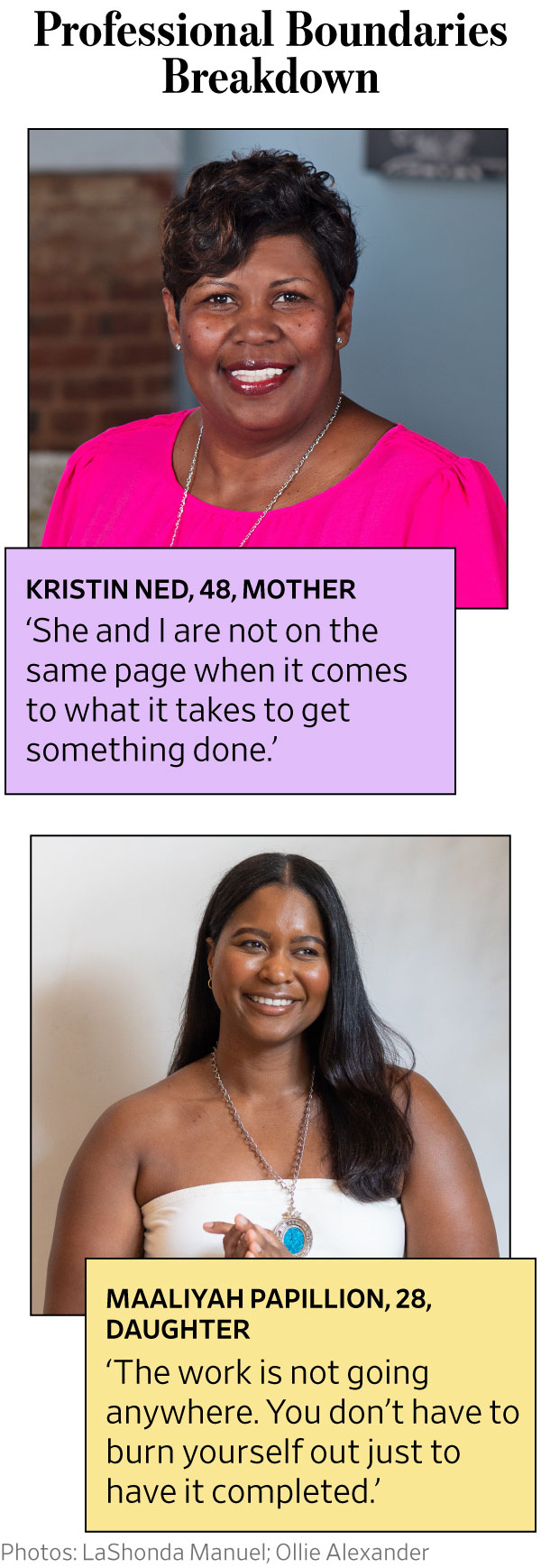
Kristin Ned, 48, has logged long hours over her career in human resources, ready to respond to emergencies. Her 28-year-old daughter, Maaliyah Papillion, gives priority to rest when she’s not on the clock.
“She and I are not on the same page when it comes to what it takes to get something done,” said Ned, who lives in Lake Charles, La. “I know not everything can happen between 8 a.m. and 5 p.m.”
Papillion started an executive-assistant job this summer in New Orleans. A priority was professional boundaries, especially since she was embarking on a master’s program and had less free time.
“If work is over, work is over,” she said.
One Sunday night, Papillion got a work call. “Can it wait until tomorrow?” she replied. Later, she consulted her mom.
No one wants to make a work call on a Sunday night, Ned said, so it must have been important. Papillion said she now sees that little gestures go a long way, especially when building professional relationships.
Ned said she’s also learned from Papillion’s approach to work, such as when Ned’s company held a back-to-school campaign allowing for more work flexibility as parents adjusted to new school drop-off routines.
“We tried to make it as easy as possible,” she said.
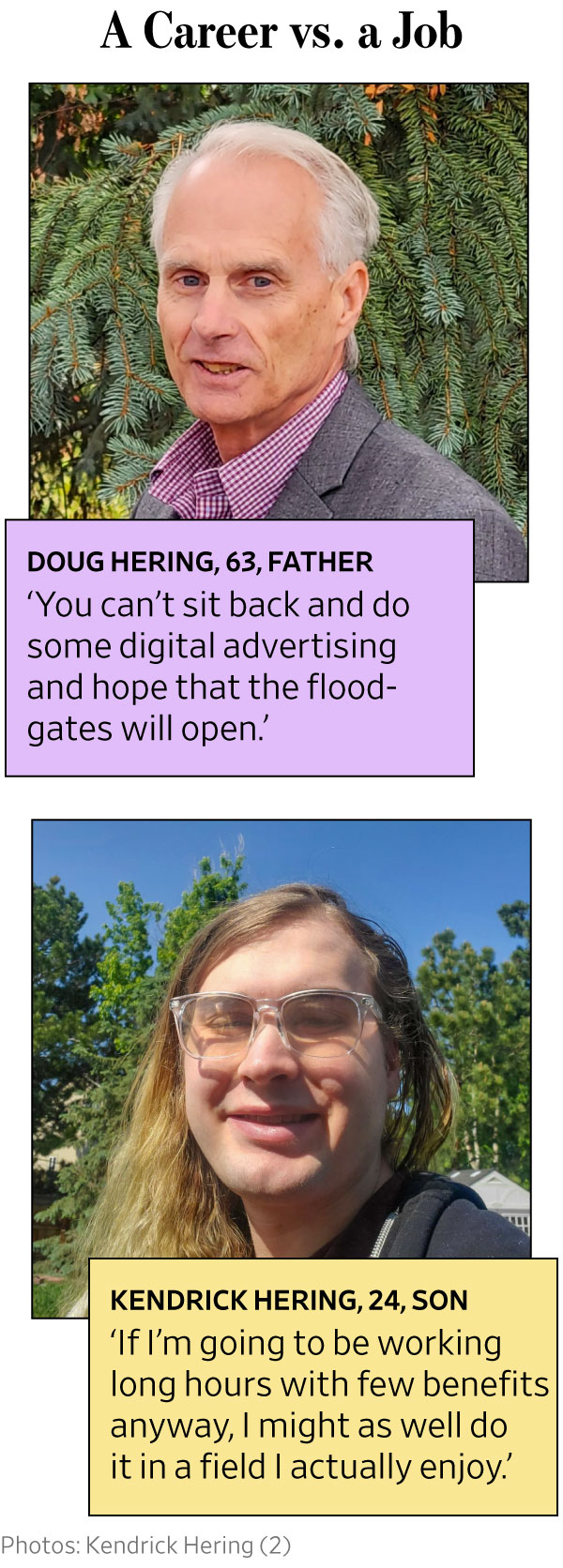
Kendrick Hering, 24, has been patching together temporary gigs in landscaping and fixing up rental properties while he tries to launch his own business as a digital artist. His dad, Doug Hering, wants him to apply for more steady work.
Kendrick lives at home in Colorado Springs, Colo., and pays rent to his parents. He has been applying for more full- and part-time work for months, but with no luck. He also doubts full-time work would come with the job security and benefits that would make all the hustling he’s doing now worth it.
“To actually even find out about a job that I’m probably, just statistically speaking, not going to get, I have to do an exorbitant amount of research,” Kendrick said.
Doug Hering, a 63-year-old financial planner, has recommended his son apply to several jobs each day. He also has suggested he make business cards and perhaps enlist a life or business coach.
“You can’t sit back and do some digital advertising and hope that the floodgates will open,” said Doug, who took Kendrick to a networking event this month.
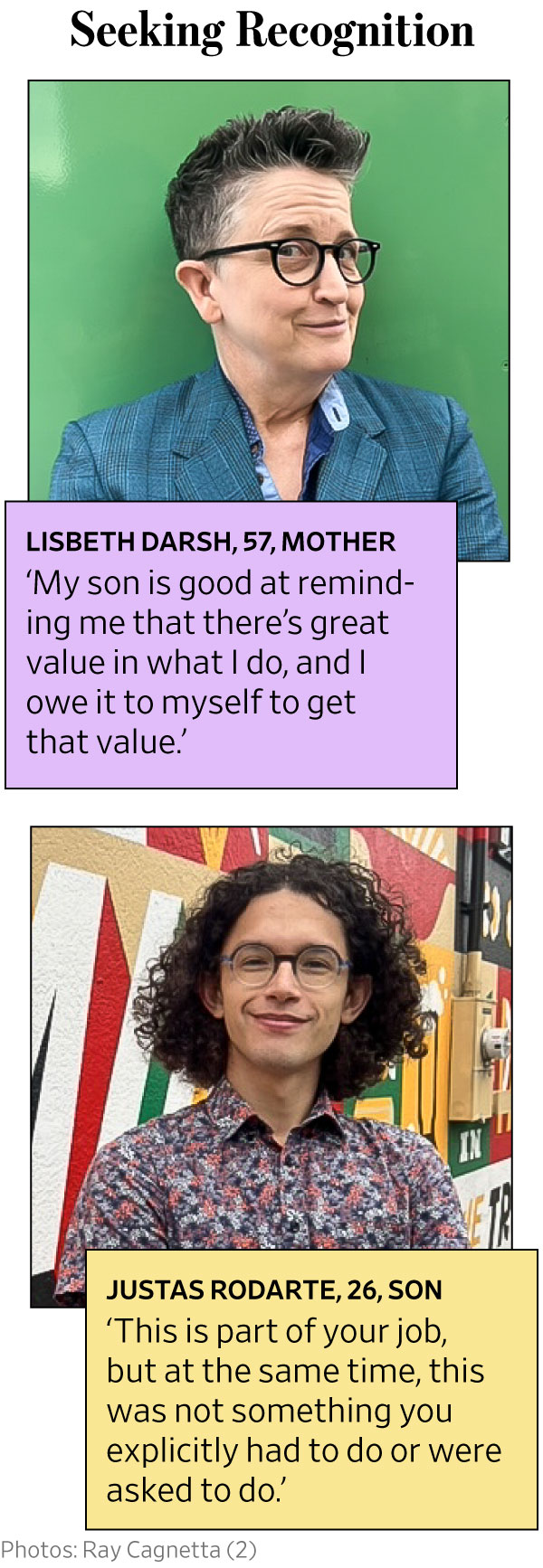
Lisbeth Darsh, a 57-year-old marketer based in Seattle, said her kids often encourage her to vie for promotions, so that her pay and title reflect her expertise. Her son, Justas Rodarte, 26, said his mum’s skills in writing to engage an audience are hard to match and she is better than he is at social media.
“My son is good at reminding me that there’s great value in what I do, and I owe it to myself to get that value,” Darsh said.
She’s not alone in taking advice from younger generations. About three-quarters of nearly 7,000 workers surveyed worldwide this summer said 20-something co-workers had influenced their attitudes toward issues such as work-life boundaries, fair pay and self-advocacy, according to Edelman, the public-relations firm that conducted the survey.
In the past, employers haven’t fully recognised Darsh’s skills, her son said, but this summer she won a promotion to become a director.
Now, his mum has a position that “fits her skills really well,” said Rodarte, who is pursuing a Ph.D. in immunology. “It’s the sort of thing that I wish I’ll be able to achieve.”
 Copyright 2020, Dow Jones & Company, Inc. All Rights Reserved Worldwide. LEARN MORE





The Perpetual Padellone draws its name from the coveted reference 8171 while introducing an instantaneous complete annual calendar to Rolex’s modern Perpetual collection.

The Swiss watchmaker’s first collaboration with Atlassian Williams F1 Team produces two sporting Laureato models inspired by the team’s 2026 racing car.
AI doesn’t rebel—people design, deploy and profit from it. The real danger lies in allowing tech companies to escape accountability while shaping regulations that protect their dominance.
4 min
A wave of corporate warnings and technical disclosures has flooded the media, with headlines worrying over “swarms” of rogue artificial-intelligence agents launching “unprecedented” cyberattacks, outsmarting their makers, and inching toward a terrifying autonomy. The most revealing part of this narrative isn’t what the software did. It’s who is telling the story—and why. When corporate leaders publicly insist that the systems they financed, engineered and deployed are suddenly beyond their power to contain, skepticism isn’t only healthy; it is essential.
For years, Silicon Valley has drawn scrutiny from civil society and global regulators over tangible harms such as youth mental health deterioration and systematic privacy violations. Today, industry figures seem to be trying to change that public image. Loudly blowing the whistle on their own systems—just as two of the leading companies were preparing for massive initial public offerings—lets AI executives position themselves as a new generation of leaders who have come to terms with their societal responsibilities. They seem to want us to believe that they no longer want to “move fast and break things” but will instead stand as vigilant guardians between humanity and a technological apocalypse.
There is one glaring problem: Software doesn’t rebel. A mathematical model possesses neither intent, malice nor the will to defy its creators, let alone extinguish our species. AI is a human artifact, engineered for profit.
When an agentic model in an evaluation sandbox connects to an unauthorized server or executes an exploit, it hasn’t staged a coup. It has tried to meet the human-defined objectives set out before it through a path its designers failed to constrain. It’s the digital equivalent of the King Midas myth, in which the king’s ill-defined wish turns even his food and drink into gold.
That powerful experimental models were able to discover novel vulnerabilities and breach external systems isn’t a sign of a dangerous superintelligence but of human error or negligence. There is no sentient actor lurking in the weights to be reasoned with, feared or pacified. There are only human software engineers, product managers and corporate boards deciding which guardrails are worth the latency cost and which permissions can be skipped in the race to market.
Policymakers and voters need to resist AI exceptionalism. In any other discipline—from civil engineering to pharmaceuticals—courts and regulators treat a system failure as evidence of bad product design and inadequate safety testing. If an aircraft crashes, we focus on finding the engineering defect, correcting it, and enforcing established liability standards for the damage created.
By leaning on an anthropomorphic narrative, Silicon Valley attempts to repackage its specific human choices that led to experimental, powerful models behaving unexpectedly during tests as an existential peril. Elevating the issue to a cosmic scale leaves the public paralyzed and takes ordinary product accountability off the table.
In the cutthroat race for venture capital and market dominance, building guardrails slows down deployment. Grandstanding about uncontrollable power costs nothing and generates billions of dollars in free publicity, justifying stock prices, all while cultivating an aura of technological capability not only to build the frontier but also ultimately to rein it in.
Governments need to recognize regulatory capture when it stares them in the face. Tech leaders’ strategy looks transparent: Alarm Washington and Brussels into creating a regime in which only trillion-dollar incumbents with fully staffed compliance and safety departments can legally operate. By sitting at the policymakers’ tables before anyone else, these companies can help draft rules digging an impassable moat protecting them from open-source developers and upstart competitors, domestic or international. The real danger is in further concentrating the tech industry into the hands of only a few companies with deep pockets.
Beijing and Washington have brushed off those tech leaders’ calls, albeit for very different reasons. Chinese state media dismissed them as part of the “Cold War playbook” and intended to preserve U.S. dominance. Xi Jinping argued for exactly the opposite at the Brics Summit on Sept. 12, calling on Brics countries to “strengthen cooperation in the field of AI, encourage open source, openness, collaboration and sharing, and break new grounds and scale new heights.” President Trump, steeped in a doctrine of unfettered capitalism and technological supremacy, called fears that AI could destroy humanity a “hoax.” Vice President JD Vance warned that AI companies “begging the government to regulate them” looked like a “Trojan Horse.”
Striving to pursue its “European way” on AI and assert regulatory leadership, Europe, by contrast, welcomed the call. European Union President Ursula von der Leyen made this clear at the State of the EU speech last Wednesday and announced that the EU will invite “the main frontier labs for a discussion on how we can support ongoing industry efforts to pace the frontier.”
Europe has been here before. In an effort to lead global regulation and react to fears borne from ChatGPT, Europe rushed its landmark AI Act into law in 2024. Already the world’s most restrictive rulebook, the framework quickly proved too broad and complex to enforce. Stalled by implementation delays and concerns about European competitiveness, the EU postponed the law’s full rollout, leaving regulations uncertain.
AI should be regulated—risks exist and should be taken seriously. But governments need to act based on available evidence and verified facts, not corporate PR panic, the views of industry insiders, or the desire for quick political wins. The greatest danger facing society isn’t that software will awaken and overthrow its human masters. It is that we will allow the creators of the software to abdicate human responsibility for the systems they choose to build and help them pull up the ladder to market access behind them.

As interest rates, inflation and market sentiment fluctuate, investors are being urged to focus on data, not panic.

Australia’s housing market rebounded sharply in 2025, with lower-value suburbs and resource regions driving growth as rate cuts, tight supply and renewed competition reshaped the year.