One in two credit card holders regret a purchasing decision they’ve made using plastic, with Australians racking up a record $34 billion on their cards per month.
Research by Finder found 52 percent of Australians have felt buyer’s remorse, with the top categories of rued expenditure being clothes, shoes and accessories (12percent), gambling products and services (8percent), other expenses (6percent), holidays (5percent) and entertainment including concerts and sports events (5percent).
The findings come amid a cost-of-living crisis caused by the highest inflation rate in decades and the highest official interest rates since 2012. Consumers are tightening their belts, with the latest retail trade figures showing turnover is still rising but at the slowest annual pace in 40 years, as we begin to see the typicallagged impacton household budgetsof 12 interest rate rises since May last year. The retail data from the Australian Bureau of Statistics shows people are restricting their spending on household goods but are still happy to pay for meals and drinks at cafes and restaurants.
“Considering how high inflation and strong population growth has added to retail turnover in the past year, the historically low trend growth highlights just how much consumers have pulled back in response to cost-of-living pressures,” said ABS head of retail statistics,Ben Dorber. Other ABS data shows household savings ratios have fallen to their lowest level since 2008, with Australians having now depleted record savings amassed during the pandemicdue to stimulus payments andperiods of lockdown.
Latest figures published by the Reserve Bank of Australia revealedconsumers spent a record $34.4 billion on their credit cards in August, up 6.8 percent on the same time last year. The Finder research showed Australians charge an average of $2,584 on their credit cards per month.
Finder’s credit card expert, Amy Bradney-George, said Australians should focus on theirlong-term patterns of spending rather than one bad purchase. “Millions have experienced buyer’s remorse, but the repercussions could be far reaching if these regrettable purchases become a habit. Many of us have bought something without considering our household budget, but with the rising cost of living, a bad buy now can hurt more than it might have a few years ago.”
Bradney-George said impulse buys or other unplanned purchases “can wreak havoc on your finances, especially if you don’t pay your credit card off in full each month.” She advised consumers to “sleep on it” to avoid impulse spending.“If you still want the item 24 hours later, it can be easier to justify and manage the cost.”She points out that somecredit card issuers allow consumers to set spending limits or blocks on certain types of transactions, which could help reduce temptation.
It is crucial that consumerspay off their credit cards in full every month, said Bradney-George. “This could mean timing repayments to match up with your payday, setting up automatic payments through your credit card account or putting reminders in your calendar.If consumers are struggling with credit card debt, it might be time to shop around for a 0% balance transfer deal which will allow them to pay off their debt without drowning in extra interest charges.”
The end of easy money is catching up with luxury brands. It took a long time, so the skills needed to protect their profit margins may be a bit rusty.
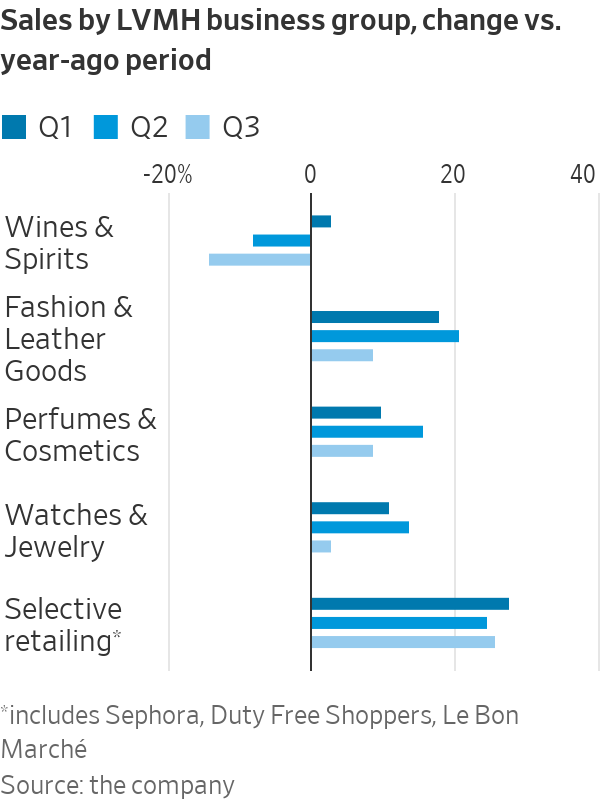
Shares in the world’s biggest luxury company, LVMH Moët Hennessy Louis Vuitton, fell 6% Wednesday after it reported a slowdown in sales for the third quarter the previous evening. LVMH grew sales by 9% for the three months through September compared with a year ago. That sounds impressive, but the business was growing at almost double this pace in the second quarter.
Demand for luxury goods has slowed for most products and in all major regions. One surprise was a 14% drop in sales at LVMH’s wines and spirits divisions. Shipments of cognac brands such as Hennessy have been weak in the U.S. all year as cash from pandemic stimulus checks runs out, but the trend is getting worse.
The slowdown is no longer limited to “aspirational” shoppers, as the industry lingo frames less wealthy buyers. Sales of LVMH’s expensive watch and jewellery brands were weaker than analysts expected. And wealthy European consumers who were spending freely on luxury goods early this summer turned cautious in the third quarter.
Investors knew that a slowdown was coming, but not how big it would be. After Wednesday’s share-price drop, LVMH has lost a quarter of its market value in roughly six months. The slump may be more severe at weaker rivals like Burberry or Gucci owner Kering, whose stocks also fell Wednesday. Recently, the entire luxury industry has fallen out of fashion with shareholders, who at the start of the year expected a bigger surge in Chinese demand after the country lifted all pandemic restrictions.
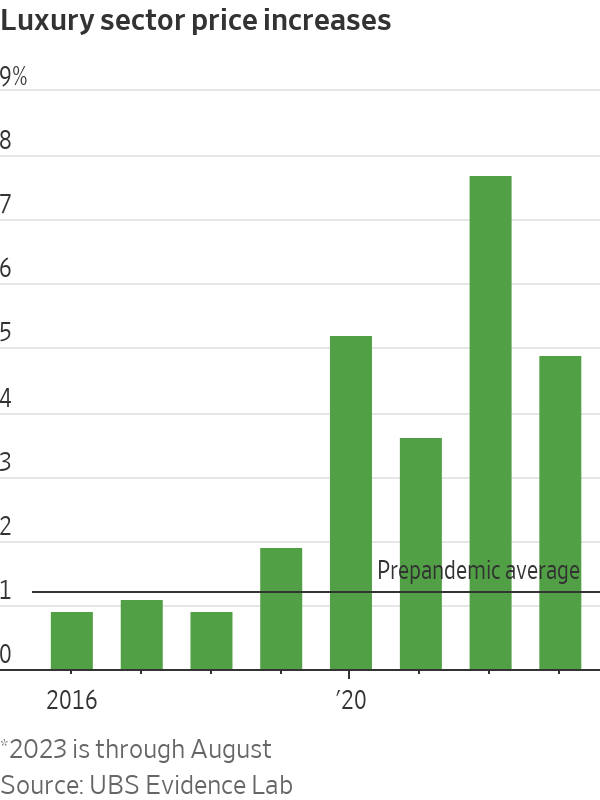
With business probably as good as it can get in China, there is no obvious place the industry can turn to for new growth. Weaker demand for luxury goods will damp brands’ ability to raise prices. Last year, exceptionally strong sales helped them lift prices by 8% on average, according to UBS estimates. This pricing power has been a big draw for investors, and boosted profit margins, but it is probably over for now. In the four years leading up to the pandemic, prices rose only 1.2% annually on average.
Luxury companies face a balancing act with their multibillion-dollar advertising budgets and store-rollout plans. They may need to save cash to protect margins. At the same time, they must continue to spend on advertising to maintain their trademark desirability.
Some perspective is necessary, though: Today, LVMH’s fashion-and-leather-goods division, its main profit driver, is 80% larger than it was in the third quarter of 2019, before the pandemic. The industry has had an amazing run and is expected to grow in 2024. Still, some of the sheen that made it particularly attractive to investors in recent years has faded.
Last month, LVMH was even dethroned as Europe’s most valuable company by Novo Nordisk, the Danish pharmaceutical company behind weight-loss drug Ozempic. Leaner times ahead.
The first year in retirement is often the most difficult. But it also can set the stage for how you’ll fill the years ahead—both financially and psychologically. Stephen Kreider Yoder, a longtime Wall Street Journal editor, joined his wife, Karen Kreider Yoder, in retirement a year ago. In this monthly Retirement Rookies column, the 66-year-olds chronicle some of the issues they are dealing with early in retirement.
Karen
In the kitchen, I look up at my woven companions—16 baskets atop the cabinets. They’re from a dozen countries, and they radiate warm memories.
But wait, do I need so many baskets? And 40 more are around the house, many as decorations or stored in closets.
I’m trying to get rid of stuff methodically early in retirement, and it’s beginning to feel like a steady job. There’s no urgency. But when the time comes for a smaller place, I want to be ready. That time could come any time.
I want to winnow our possessions before there’s a health crisis or moving van at the door, while I can do the hard work of organizing and categorizing, of identifying what I need long-term, what to disperse and what to pitch.
It’s partly psychological. As I age, I find I have less room in my head to keep track of things. And the sheer numbers of some possessions create a growing mental tension.
We were ahead of the game when we retired. We moved a dozen times in 44 years, each time purging a bit. Helping our parents downsize inspired us often to do a sweep of our own when we got home.
Now that we’re both retired, I’ve created some downsizing categories to keep me from being overwhelmed:
• Don’t use it, don’t need it. Old electronics and orphaned cords. Knickknacks without sentimental value. My 20 thimbles from around the world, only one of which I ever use. The 150 beautifully sharpened No. 2 pencils in a row of blue-and-white ceramic pots, one labeled “Pencil Collectors Society.”
I’ll use perhaps a dozen pencils the rest of my life. The others can be off to Goodwill now, along with everything else in this category.
• Things we use now but won’t in a smaller space. Some of the guest-room furniture, extra chairs, large house plants, the piano, a rusty wheelbarrow. We should do an inventory now and label what we’ll ditch when we move.
• Stuff only I can handle. My childhood report cards, recital programs, work accomplishments, letters and such are a priority for thinning out now. Nobody else can make sense of them, but it can feel like throwing away bits of myself.
“But Mom, you have to save all of that,” says our son Isaac. “It’s like your personal legacy.” Maybe I’ll keep more than I intended, for our boys to root through as a window into my youth. (But, I wonder, will they really care about those report cards?) At least, though, I should organise it.
• Family heirlooms and mementos. These, too, are hard to part with, imbued with family history and shared memories.
We aren’t antiquers, but we do have a few elegant old Japanese tansu cabinets the kids grew up with. And I have about 25 quilts, some I made starting at age 7, and many from family and friends. They are works of art and full of memories but too many to fit in a condo.
The boys say they want some but are still too mobile, so at least I should make a plan for who gets what.
• Things I want by my side through older years. Family photos. My Japanese pottery. Journals from our travels. My quilt frame.
And baskets. I have always cherished handmade baskets. My first is from South Dakota, where at 16 I learned willow-basket making from two local weavers. I can’t part with it.
When our son Levi is home, we eat sticky rice with our fingers out of little lidded Laotian rice baskets, recalling Laos when he was age 2 and clutched his sticky-rice basket as we bicycled around Luang Prabang.
In our guest-room closet is a Japanese backpack basket—a gift from a student’s family—whose weaver was a Japanese National Treasure. In my reading room is a basket we bought in a Philippines market in 1987, not knowing it was for a baby until locals pointed and laughed knowingly. It became a bassinet to our three babies, and it’s a treasure.
Five dozen baskets is too many now. How many is just enough?
Steve
A classical guitar in its case stares at me from a corner of the bedroom. “Play me,” it taunts, and I look the other way.
Maybe it’s time I got rid of my lonely 1972 Alvarez Yairi as part of our gradual downsizing.
A tougher thought: I should probably also downsize my pipe dream of someday playing a guitar even moderately well, along with dozens of other unrequited ambitions I’ve clung to for decades. And I’ve got a few erstwhile passions I might best surrender now as well.
Karen talks of ditching stuff, and I’ve got plenty of boxfuls to sacrifice—textbooks, decrepit power tools, hardware that definitely might come in handy some time.
I also should release one or both of my vintage Honda motorcycles, which I’m sentimentally attached to but haven’t ridden in ages.
But for me, downsizing is more than getting rid of stuff. It’s about getting rid of conceptions of myself—of who I was, who I am and who I want to be.
That is, I should sell my motorcycles not just because they take space, but also because I think I’ve permanently moved on from motorcycling, my passion for decades starting at age 12.
Same with my skis and skiing.
Retirement has had a way of giving me permission to begin letting go—of my professional identity, my urge to do financial planning without help, the delusion that I’ll be fit forever. That permission makes it a good time for some wanna-do triage.
There are things I still intend to get to, now that I have more time. I want to weld better, brush up my Spanish, improve my swimming, study more history and learn to drive an 18-wheeler. There are activities we’re already stepping up, like traveling more in Africa, cycling around America, visiting family and seeking long-term volunteering opportunities that match our skills.
But finding time for all of it requires that I liberate other I-will-get-to-its that are increasingly a mental burden. I will probably never learn Arabic and should forgive myself of that, and French. I can get rid of the beer-brewing equipment I bought when I was 23 and discharge the notion that I’ll ever learn to use it.
I will probably never write a book; may I free myself from that weight? I hereby declare I can die happy enough without visiting Machu Picchu, the Galápagos or Rome as I’d once hoped to do. There are plenty of other places we want to go, and not time for everywhere.
Our house is a standing to-do list of fun projects I’ve put off and may never get to—or shouldn’t, lest I fall off a ladder and meet an untimely demise. Let’s just release some of those projects, too.
When I bought the Alvarez in 1981, my guitar teacher said I had talent. His kind words kindled my decades-long conviction that I would learn to play it well, eventually. We moved to Japan the next year, and I took along the guitar but didn’t find a teacher—temporarily, I told myself.
The guitar moved with us many times until 2012, when Karen bought me lessons with a fabulous teacher for my birthday and I began learning again. I did pretty well, even playing in a few modest recitals. But I dropped it—temporarily, I said—when we moved out of town for a year.
Now there it sits. It’s time to set it free.
Or is it? I finally have the bandwidth. I just opened the case, and only one string is broken, a good omen. Maybe this time I really can learn to play it.
Of all the rooms in the house, it’s the kitchen where the job description has expanded the most.
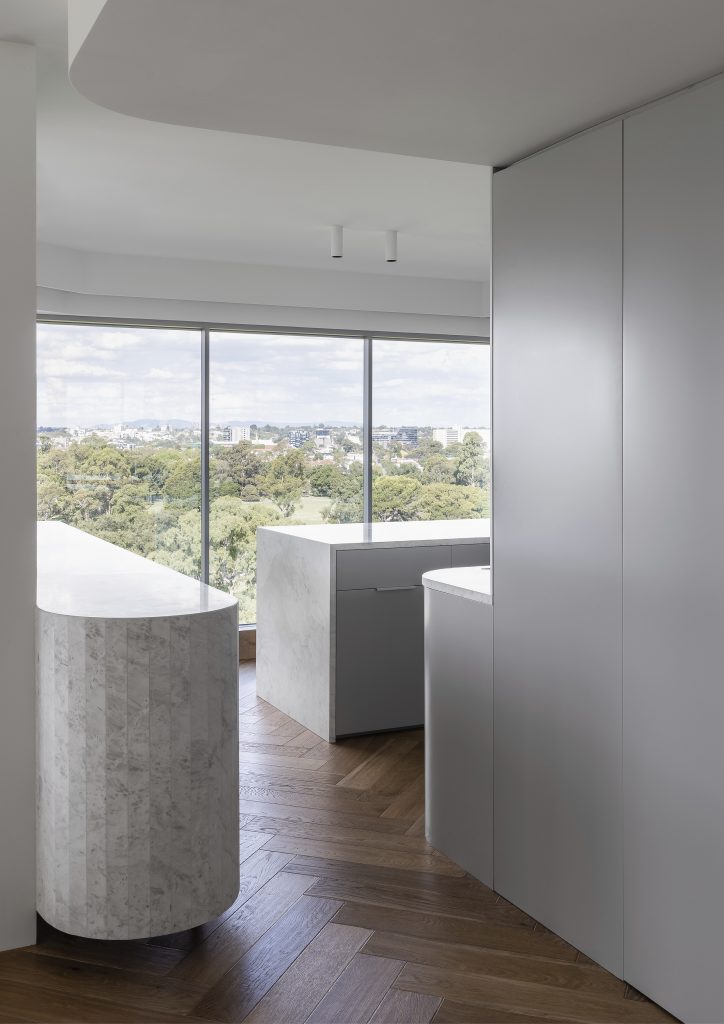
Part food preparation and service area, in many homes it also serves as a homework hub, home office and the key point of supervision and activity. Add to that its position in open plan design and it’s an extraordinary amount of pressure to put on one room to perform.
Photography: Timothy Kaye @timothykaye
The choice of appliances, then, is critical.
In this apartment in Melbourne’s desirable St Kilda, Wolveridge Architects have designed an open plan space that is as efficient as it is beautiful. Taking its design cues from the 1980s tower from the Parkside Apartment’s exterior architecture, custom designed joinery allows the spaces to flow seamlessly from living to kitchen, offering the perfect transition for entertaining guests as the action moves from the kitchen to the dining space and even onto the balcony.
Photography: Timothy Kaye @timothykaye
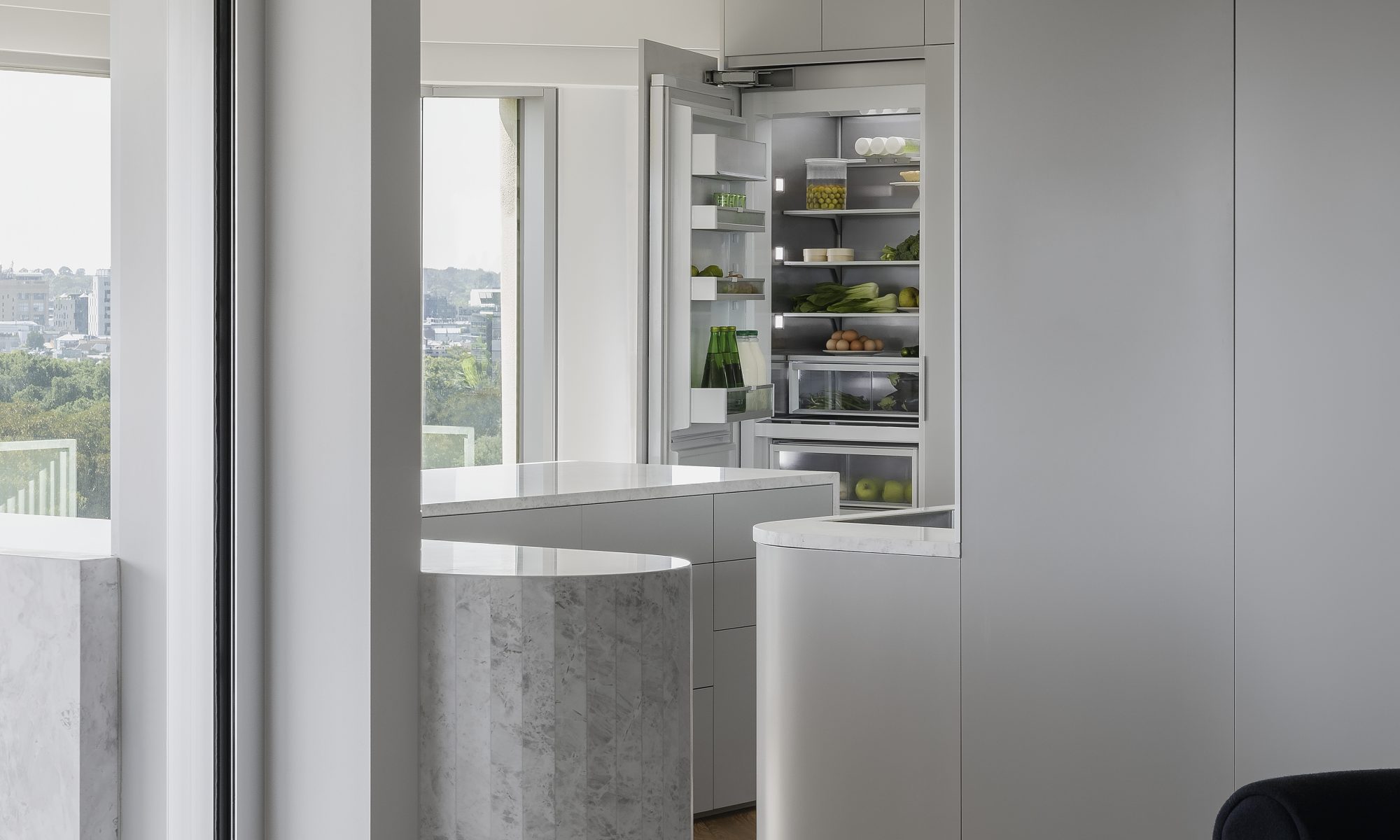
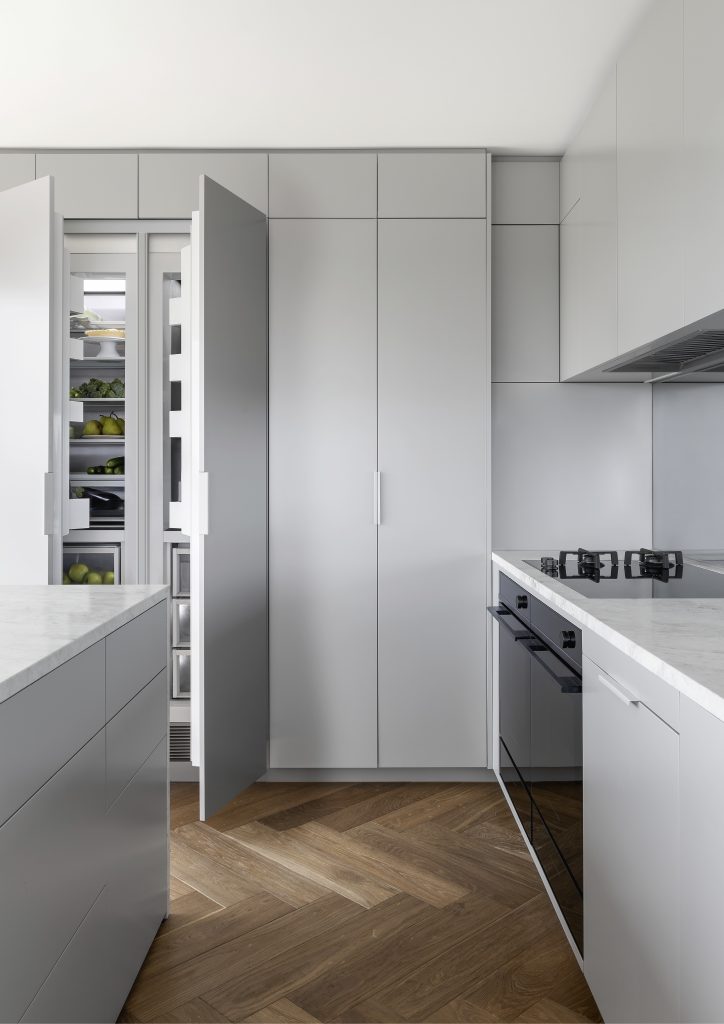
Inclusions such as the integrated Fisher & Paykel Column Freezer and Column Refrigerator designed into the cabinetry allow the living, dining and kitchen space to be read as one quietly elegant space ideal for intimate evenings at home, as well as hosting family and friends.
Photography: Timothy Kaye @timothykaye
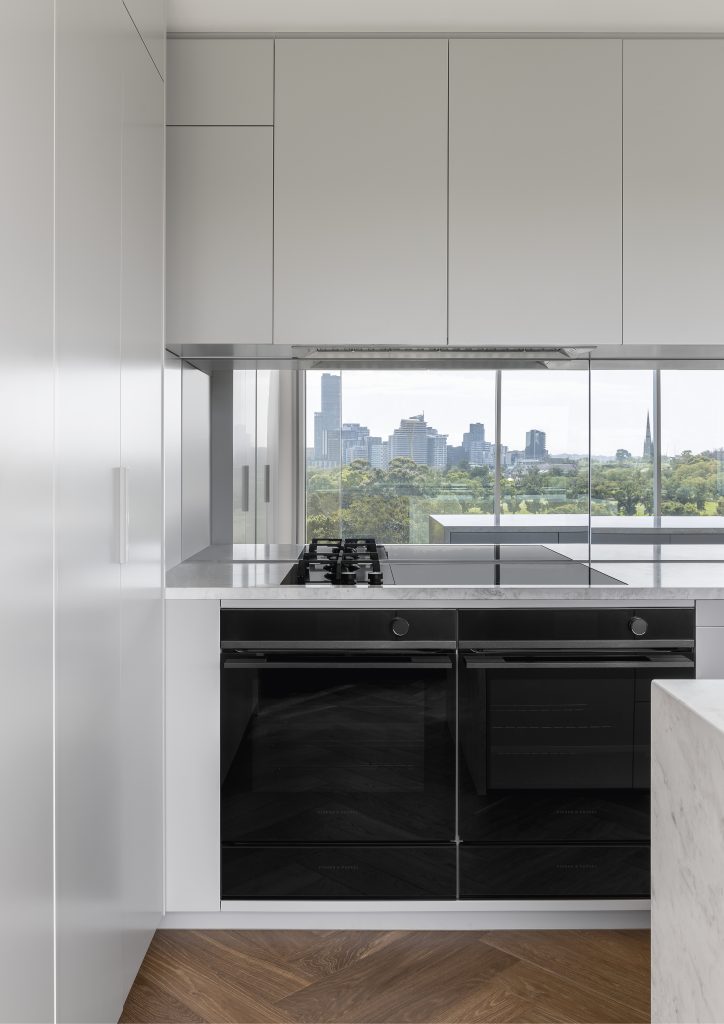
The decision to specify induction cooktops was a deliberate nod towards futureproofing the space as we move towards fossil-fuel free goals. A blueprint for how well adaptive reuse can be executed, this hardworking apartment now exudes an air of effortless luxury ideally suited for 21st century living.
Why has consumer spending proven so resilient as the Federal Reserve has raised interest rates? An important and little-appreciated reason: Consumers are getting older.
In August, 17.7% of the population was 65 or older, according to the Census Bureau, the highest on record going back to 1920 and up sharply from 13% in 2010. The elderly aren’t just more numerous: Their finances are relatively healthy and they have less need to borrow, such as to buy a house, and are less at risk of layoffs than other consumers.
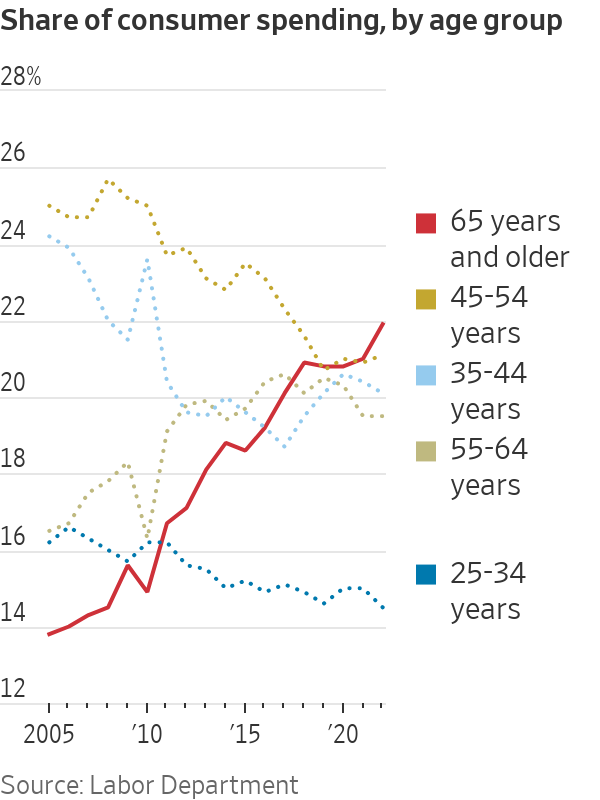
This has made the elderly a spending force to be reckoned with. Americans age 65 and up accounted for 22% of spending last year, the highest share since records began in 1972 and up from 15% in 2010, according to the Labor Department’s survey of consumer expenditures released in September.
“These are the consumers that will matter over the coming year,” said Susan Sterne, chief economist at Economic Analysis Associates.
“Our large share of older consumers provides a consumption base in times like today when job growth slows, interest rates rise and student-debt loan repayments begin again,” she said.
Seniors’ high spending propensities reflect health, wealth and perhaps lingering psychological effects of the pandemic.
“All my life it was, save for this, save for that,” said Maureen Green, 66, of Cape Cod, Mass. “Now there’s money in the bank and I’m spending in ways that bring me closer to friends and family than I did before.”
Green, a real-estate agent with four grown children living across the country, estimated she is spending 25% more and twice as much time traveling now compared with 2019. She recently traveled to Syracuse, N.Y., to catch a photo exhibit with friends, and toured Rhode Island with her son and his girlfriend.
“The one million Americans who didn’t survive Covid—that’s part of it. That taught me not to let time go by because before I know it, that time won’t be there anymore,” she said.
Living better, longer—and larger
“The lifestyle of the senior has changed dramatically—they’re more active than ever,” said Marshal Cohen, chief retail adviser of Circana, a research firm specialising in consumer behavior. That has expanded the menu of recreation on which to spend, he said. “They’re riding e-bikes, they’re hiking, they’re traveling. And they’re doing these things for longer than they’ve ever been done.”
The average household led by someone age 65 and older spent 2.7% more last year than in 2021, adjusted for inflation, according to the Labor Department, compared with 0.7% for under-65 households. Spending by older households is up 34.5% from 1982, compared with 16.5% for younger households.
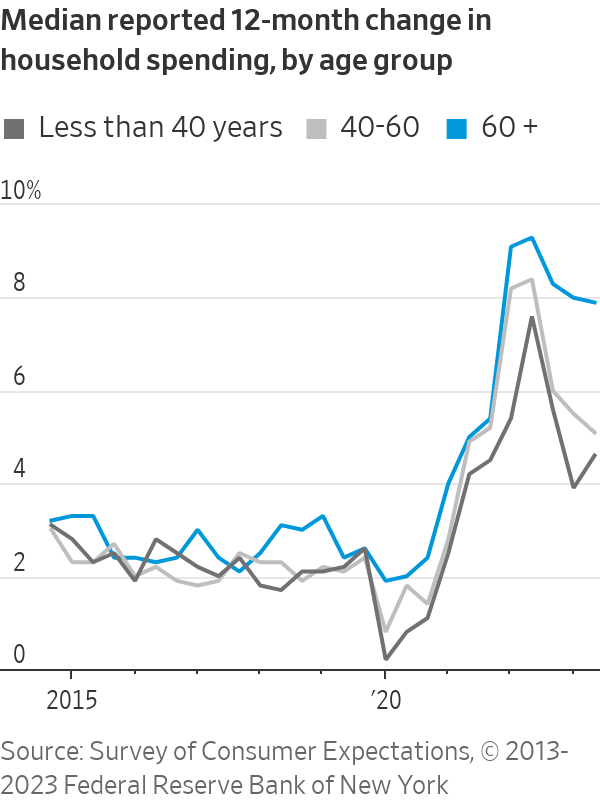
Comparable data isn’t available for 2023. However, consumers older than 60 reported spending 7.9% more in August than a year earlier, compared with a 5.1% increase among those age 40 to 60 and a 4.6% gain for younger consumers, according to a survey by the New York Fed. The data aren’t adjusted for inflation.
The growing yen to spend by the elderly is amplified by their sheer numbers. The unusually large cohort of baby boomers, the youngest of which are 59, are reaching their retirement years en masse.
American Cruise Lines, which gears its cruises toward older consumers, said it is seeing double-digit sales growth this year, driven largely by boomers. The Guilford, Conn., company this year added three ships to its fleet and expanded its season by a month for some popular routes.
“River cruising has traditionally attracted an older audience, and with more boomers retiring each year, we see both a rapid rate of growth and demand for longer experiences,” said Charles B. Robertson, the company’s president and chief executive.
The economy’s silver bullet
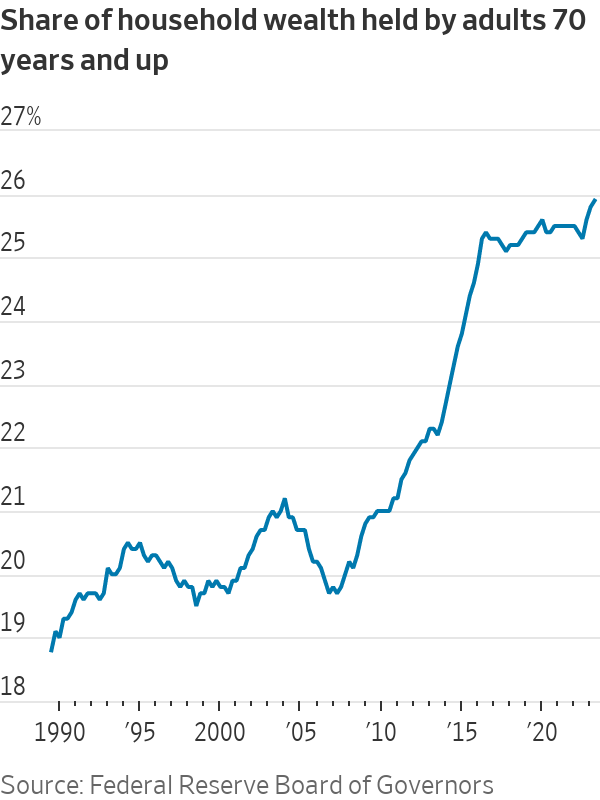
Another factor in the elderly’s favor: relatively strong finances. Americans age 70 and older now hold nearly 26% of household wealth, the highest since records began in 1989, according to the Federal Reserve.
While economists still see a relatively high probability of recession in the coming year, Ed Yardeni, president and chief investment strategist of Yardeni Research, isn’t one of them. An important reason: By the Fed’s reckoning, baby boomers alone have now amassed $77.1 trillion in wealth. “There’s a $77 trillion-wide hole in the theory that consumers’ running out of pandemic savings will sink the economy,” he said.
They have less consumer debt, minimal student debt and are more likely to own their homes outright. Many of those who have mortgages refinanced at the unprecedented low in mortgage rates after the pandemic hit. They are also less likely to need to move due to an expanding family or a new job than Gen Z and Millennials, shielding them from the impact of rising housing costs.
Retirees also received an 8.7% cost-of-living-adjustment bump to Social Security payments in January, the largest single-year increase since 1981, and an automatic adjustment to offset last year’s 9.1% inflation peak.
These factors have cushioned seniors from the twin scourges of inflation and high interest rates. And since most of them are retired, seniors’ spending is less vulnerable to the rise in unemployment that many economists anticipate in coming quarters.
Subscription demand for the Cincinnati Opera’s summer festival this year was surprisingly strong and driven by older patrons, said Todd Bezold, director of marketing.
“Despite the multiyear trend in subscriptions going down, down, down in every art form, we went up this year—by 3%,” he said. That jump in demand came despite a sharp rise in ticket prices to account for several years of inflation. “The vast majority of our subscribers are baby boomers; we know that much.”
If you like your Ferrari purchases to have only delivery miles on them, this sale might be for you.
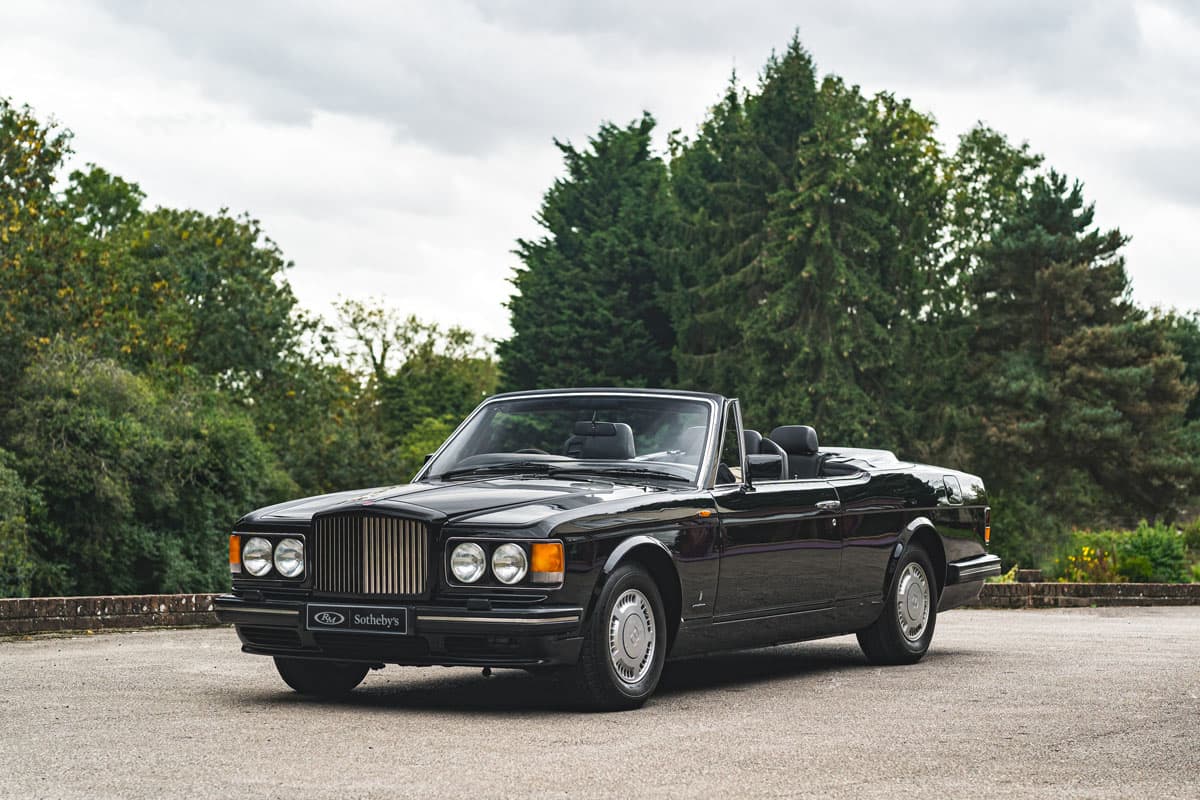
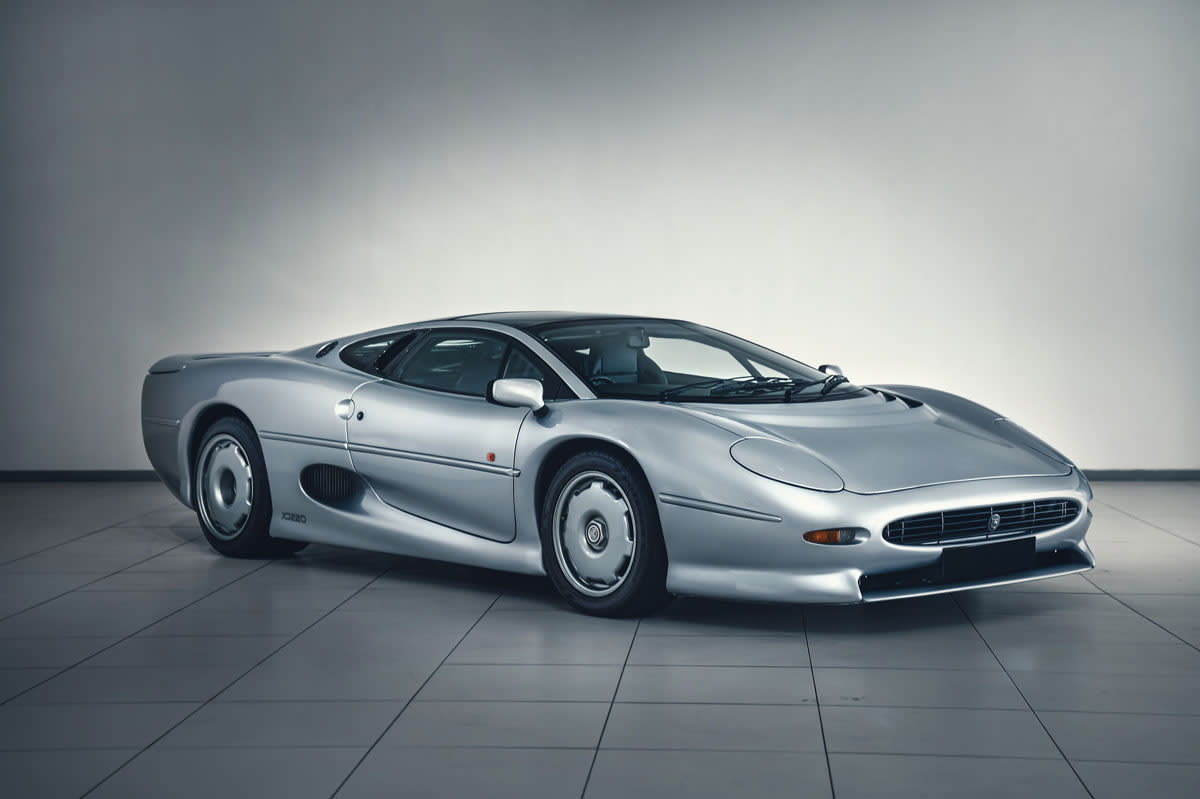
What RM Sotheby’s is calling the Factory Fresh Collection includes 17 Ferraris, many barely driven, as well as a rare Jaguar XJ220 supercar, a highly desirable E-Type roadster, and a Bentley Turbo R Drophead Coupé. The auction takes place at Marlborough House in London on Nov. 4, coinciding with the famous London to Brighton run for pre-1905 veteran cars the next day.
Pride of the Factory Fresh collection is this 1994 Ferrari 512 TR Spider with just 570 kilometers recorded. OneSavage/sgcarshoot, courtesy of RM Sotheby’s
The star of the collection is probably the 1994 Ferrari 512 TR Spider, just one of three built that year, and the only one in its combination of Blu Cobalto paint and Blu Scuro Connolly leather interior. The odometer shows just 570 kilometres (354 miles). In keeping with the as-delivered theme, the car comes with its service book, technical manual, and a spare key. Provided it’s been serviced for the road, the owner will in effect be getting a new car. The estimate is £2.1 million to £2.7 million (US$2.56 million to US$3.3 million).
“This a truly remarkable collection,” Peter Haynes, RM Sotheby’s marketing and communications director for Europe, the Middle East, and Africa (EMEA), tells Penta. “There are some very rare cars in their own right, but the standout feature across the majority of the cars is the very low mileage—barely driven in some cases. My personal highlights include the 1994 Ferrari 512 TR Spyder which is one of just three in existence, in addition to the 1992 Ferrari Mondial T, which reads a hardly believable one kilometre on the odometer.”There are two other 512 TRs in the collection, a 1992 (also blue) and a second 1992 in U.K. specification (right-hand drive) with only 3,904 miles recorded. The first of these has a high estimate of £275,000 and the second £320,000.
The 1990 Ferrari Testarossa has just 161 kilometres on the odometer. Courtesy of RM Sotheby’s
The 1990 Ferrari Testarossa has a surreal 160 kilometres, and is one of just 438 built in right-hand drive. The high estimate is £200,000. The 2001 Ferrari 550 Barchetta Pininfarina (high estimate £350,000) was one of 48 built with drive on the right side, and has traveled only 220 kilometers. One of the two 2008 599 GTB Fioranos has covered only 267 kilometers—making it one of the lowest-mileage in existence. Its high estimate is £180,000.
The Bentley Turbo R Drophead is a performance-oriented convertible. Robert Cooper, courtesy of RM Sotheby’s
Other Ferraris in the collection with their recorded mileage: 1994 Mondial T Coupé (one kilometre); 1992 348 TS (130 kilometres); a second 1992 348 TS (179 kilometres); 2007 F430 (104 kilometres); 1994 348 GTB (181 kilometres); 1983 400i (2,743 miles). A highly admired earlier Ferrari is a numbers-matching 1973 Dino 246 GTS by Scaglietti. Its high estimate is £450,000.
The 1993 Jaguar XJ200 two-seater is one of very few built. (sgcarshoot, courtesy of RM Sotheby’s)
Non-Ferraris include a very rare 1993 Jaguar XJ220, one of 282 produced. In keeping with the sale, it shows only 46 miles on the odometer. It’s been recently recommissioned for spirited driving, and is high-estimated at £425,000. A 1969 Jaguar Series 2 E-Type Roadster is also being auctioned, as is a 1991 Bentley Turbo R Drophead Coupé. The Bentley convertible, which is just out of extensive refurbishment by London specialist P&A Wood, has a high estimate of £475,000.
Buyers have the choice of keeping these cars in the garage—and preserving their low-mileage status—or forgetting about all that and driving them with alacrity.
The Australian property market has recovered all of its 2022 losses, with national home values reaching a new record high in the first month of the busy spring season. New PropTrak data reveals national home values rose by 0.35 percent last month to a median of $754,000.
National prices are up 3.75 percent over the past 12 months, with the combined capital cities recording a stronger rate of growth at 4.76 percent while the combined regions clocked up price gains of 1.28%. PropTrak senior economist Eleanor Creagh said the seasonal increase in the number of homes for sale this spring has done nothing to curtail price growth.
“Despite the uplift in the number of properties coming to market, national home prices have moved higher again, regaining 2022’s rapid price falls in entirety to reach a record high in September,” said Ms Creagh.
“While a sharp increase in the number of properties hitting the market in Sydney and Melbourne has been improving choice for buyers, strong demand has seen prices continue to lift.
“Choice for buyers remains limited in Brisbane, Adelaide and Perth, heightening competition and seeing prices hit fresh peaks in each of these markets in September.”
Strong buyer competition is keeping auction clearance rates high this Spring. CoreLogic data shows 2,436 capital city homes were taken to auction last weekend, with a preliminary clearance rate of 71 percent recorded. This time last year, the clearance rate was 60.6 percent.
The PropTrak report shows that among the capital city markets, price growth over the past 12 months has been strongest in Perth. Home values have risen 9.24 percent to a record median of $597,000. Adelaide prices are up 8.31 percent to a record median of $689,000, and Sydney prices are up 6.86 percent to a median of $1.057 million.
In the regions, annual growth has been strongest in regional South Australia, where the median price has risen 9.86% to a new peak median of $399,000. Regional Queensland prices are up 4.89 percent to a record $614,000, while regional Western Australia prices have risen 3.29 percent to $460,000. Ms Creagh said prices will continue rising, with the key drivers being record levels of net overseas migration, tight rental markets and an undersupply of housing.
“Looking ahead, interest rates have likely peaked and population growth is rebounding strongly,” she said. “Together with a shortage of new home builds, prices are expected to rise.”
The Federal Government is projecting a net increase of 715,000 migrants over the next two years at a time when Australia already has a housing deficit. The National Housing Finance and Investment Corporation estimates a shortfall of 106,300 homes over the next five years.
In the rental market, Domain chief of research and economics, Dr Nicola Powell said Australia needs 40,000 to 70,000 extra rentals to meet current demand and balance the market.
“That is like adding all of the dwellings in the LGA of Newcastle into the market,” she said.
Domain’s latest Rent Report reveals a record-breaking 10 consecutive quarters of growth in weekly house rents and nine consecutive quarters of growth in weekly apartment rents. CoreLogic data shows the pace of rental price growth is slowing in 2023 but it is still very difficult for tenants to find a rental, with the national vacancy rate now sitting at a record low of 1.1 percent.
When Shinjiro Torii founded the Yamazaki Distillery in 1923, few would have been able to forecast the enormous force his company, Suntory Whisky, would go on to become a century later.
Over the past decade in particular, Japanese whisky has evolved from a curiosity known only to connoisseurs into a powerhouse beloved in every corner of the whisky world. As chief blender for Suntory Whisky, Shinji Fukuyo has spearheaded this modern surge, and enjoys a unique position as the House of Suntory celebrates its 100-year anniversary.
“Witnessing the global impact of Suntory whiskies brings me great personal fulfilment and fuels my passion for creating beloved whiskies for everyone to enjoy,” Fukuyo says. Over the 100 years the company has been producing whisky, he is only the fifth person to hold the title of chief blender. He was named to the position in 2009 after an extensive history working for the company at the Yamazaki Distillery, Japan’s first whisky distillery.
Suntory has been hosting a year of celebrations in honour of its centennial, the highlight of which has been the release of a suite of Centennial Limited Edition whiskies. The lineup includes Yamazaki 18-year-old Mizunara (US$1,500), Hakushu 18-year-old Peated Malt (US$1,200), and a centennial bottling of Hibiki 21-year-old (US$5,000). Each of the three was blended by Fukuyo to showcase a unique flavour profile and characteristic that stands apart from its typical bottlings. The Yamazaki and Hakushu whiskies were released this May, while the Hibiki debuted in a separate release last month.
Suntory has been hosting a year of celebrations in honor of its centennial, the highlight of which has been the release of a suite of Centennial Limited Edition whiskies. The lineup includes a centennial bottling of Hibiki 21-year-old (US$5,000). House of Suntory
Another component of this year’s ongoing Suntory centennial fete was the Sofia Coppola directed Suntory Time tribute film, as well as the Roman Coppola directed docuseries, The Nature and Spirit of Japan, both of which starred Keanu Reeves. Elsewhere around Japan, other prominent businesses have been getting in on the fun as well. For instance, a 30-minute drive from the Yamazaki Distillery, Hotel the Mitsui Kyoto’s signature restaurant Toki—which happens to share the name of a Suntory Whisky product—has unveiled an elaborate Hibiki whisky pairing dinner, while its Garden Bar has offered an exclusive menu of Hibiki cocktails.
Fukuyo spoke with Penta about the century-long legacy of the House of Suntory, as well as the creation of this year’s honorary Centennial Limited Edition whisky releases.
Penta: What does this special occasion signify for you?
Shinji Fukuyo: Shinjiro Torii’s legacy began with a dream to create an original whisky that would suit the delicate palate of the Japanese consumers that is blessed with the riches of Japanese nature and craftsmanship. As chief blender, I am dedicated to upholding Suntory’s rich legacy and traditions, while expressing our craftsmanship through the whiskies that my team and I create.
As Japanese whisky has soared in popularity over the past decade, what are the qualities that define Suntory’s whiskies and have helped make them so special for drinkers around the world?
We use high-quality natural water, which has been nurtured over many years, to produce a delicate spirit. The natural environment and climate of where our distilleries sit in Japan also influences our whiskies. Our climate highlights the dynamic changes of the four seasons, including humid, hot summers and dry, cold winters to give our whisky a deep sense of maturity.
The quality of whisky is showcased in the flavour and aroma that is developed over time by producing a rich distillate from good raw materials and placing it in high-quality casks. Also, to bring out the harmony of flavour and aroma, we carefully proceed and blend various types of whiskies in a skilful balance, which I believe embodies the delicate Japanese craftsmanship.
What was your approach with this year’s limited-edition whiskies?
The existing Yamazaki 18-year is a product that combines American oak, Spanish oak, Mizunara oak, and smoky Yamazaki malt to express complexity while highlighting the character of Spanish oak. On the other hand, the limited-edition Yamazaki 18-year-old Mizunara uses only malt whiskies aged in Mizunara barrels for a minimum of 18 years and features cinnamon and nutmeg aromas, with undertones of Japanese incense, sandalwood, and dry coconut emphasised in the finish, with subtle spices.
For Hakushu, both our existing Hakushu 18-year-old and the limited Hakushu 18-year-old Peated Malt are blended with various whiskies aged in Hakushu, including American and Spanish oak, heavy peated and non-peated, for a smoky yet fruity and sweet finish. The limited edition is balanced with several peated Hakushu malt whiskies aged in American oak for over 18 years to produce a fresh and crisp smoky taste.
Celebratory bottles for existing core whiskies include a special Hakushu 12-year-old (US$185). House of Suntory
Looking ahead to the next few decades, how do you envision Suntory continuing to evolve? How about Japanese whisky as a category on the whole?
For these 100 years, we have been striving to create a culture where Japanese consumers can enjoy whisky. These are values we still prioritise today, as our team is constantly in the pursuit of enhancing our quality and craftsmanship. As we look to the future, we have seen a growing global interest in Japanese products and believe that there are further opportunities to spread the excellence of Suntory Whisky throughout the world.
This interview has been edited for length and clarity.
BOSTON—Harvard University’s Claudia Goldin is a labor economist, teacher and mentor. She is now also a Nobel Prize winner for her groundbreaking research on women in the workforce.
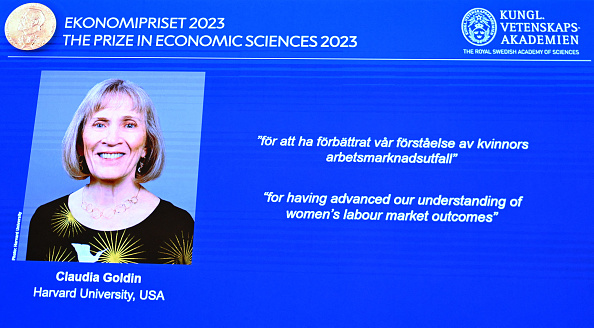
Goldin was awarded the Nobel Prize in Economic Sciences on Monday, the third woman to receive the economics prize since the award started in 1969. The 77-year-old Harvard economist has spent decades analysing troves of data to produce research illuminating the history of women’s job-market experiences.
Goldin’s expansive work portfolio includes pieces on the drivers of female labor-force participation, the origins of the gender pay gap and hiring biases against women. Her paper, “Why Women Won,” which documented the evolution of women’s legal rights, published this month.
The winner of the 2023 Prize in Economic Sciences in Memory of Alfred Nobel American economist Claudia Goldin is seen on a display at the Royal Swedish Academy of Sciences, in Stockholm on October 9, 2023. (Photo by Jonathan NACKSTRAND / AFP) (Photo by JONATHAN NACKSTRAND/AFP via Getty Images)
“Goldin’s discoveries have vast societal implications,” said Randi Hjalmarsson, professor of economics at the University of Gothenburg in Sweden.
Goldin was admittedly tired upon entering Monday’s press conference at Harvard. She was, after all, asleep when she received the early-morning call with the news of her Nobel Prize. Still, her passion regarding decades of research and relationship-building radiated as she spoke at a press briefing.
“The increase of women in economics is important for a host of reasons,” Goldin said. “For me personally it has been important because I have had the most wonderful co-authors.”
One such co-researcher, Claudia Olivetti of Dartmouth College, said Goldin’s body of work has shaped much of the current research on women and labor markets. Perhaps less well known, Olivetti said, is Goldin’s extraordinary mentorship of women.
Goldin “has been a source of inspiration to many women in economics, generously sharing her experiences and demonstrating the possibilities of success,” Olivetti said.
Some professors view themselves as researchers, rather than teachers. Not Goldin.
“I could never do research without doing teaching,” she said. “When I teach, I am forced to confront what I think is the truth.”
Goldin was the first woman to secure tenure in Harvard’s economics department. She follows Esther Duflo in 2019 and Elinor Ostrom in 2009 as female recipients of the economics Nobel Prize.
Goldin is married to Lawrence Katz, also a Harvard economist. Both are avid bird watchers and hikers, colleagues said. She has a 13-year-old golden retriever named Pika and no children.
Around the world, 50% of women have paid jobs, compared with 80% of men, although that gap is smaller in advanced economies. Across the developed economies, women earn 13% less on average and are less likely to play senior roles in the organisations they work for.
Goldin’s research questioned the assumption that women had steadily, or would inevitably, narrow those gaps. Using data that had previously attracted little attention, she established that far fewer women worked in paid employment in the early 1900s than in 1800, while that share rebounded as the 20th century advanced, albeit slowly.
Her writing includes 1990’s “Understanding the Gender Gap: An Economic History of American Women.” Examining 200 years of data, Goldin tracked the changing fortunes of women in the workplace as it changed from farm to factory to office.
She also identified some of the considerations that affected the decisions made by women about their participation in the workforce, as well as the constraints they faced at particular times. In one well-known paper, she examined the effect of the contraceptive pill on decisions about work and marriage.
The pay gap between male and female workers had long been attributed to differences in educational attainment, with women typically spending fewer years in formal education.
But that can no longer be true of many developed countries, where women are now better educated on average than men. Instead, Goldin’s work indicates that the gap in pay occurs with the birth of a first child, with women typically devoting more time to child care.
But darker forces are also at work. In one paper, Goldin and co-author Cecilia Rouse from Princeton University showed that the number of female members of the leading U.S. symphony orchestras rose sharply in the 1980s partly because of the adoption of “blind” auditions, where the candidate for an orchestra position auditioned behind a screen, concealing their gender or race from those doing the hiring.
In their paper, called “Orchestrating Impartiality: The Impact of ‘Blind Auditions’ on Female Musicians,” the authors found data across decades of hiring by symphonies both before and after the introduction of blind auditions to show that about a quarter of the increase in female members of orchestras over that time was due to blind auditions, suggesting previous bias.
Nadia Neuman continues the legacy her parents Fred and Maria started back in the 1960s at Mondial, striking out on her own as creative director of Mondial by Nadia. Here, on the 30th anniversary of Mondial’s flagship Queen Victoria Building store, she shares the story behind the Australian business and its association with the Argyle pink diamond mines that it built its reputation on.
Given your family background, were you always destined to create jewellery?
For many years, I tried to steer clear of it, but considering the profound passion I have for jewellery and the immense joy I get from doing what I do, then I’d probably say yes, it was always meant to be.
How did you get started?
I was always creative and happiest in a creative environment. I used to work part time in the boutique in the QVB from the age of 17 and studied and worked in advertising both locally and overseas.
When I was 25, I opened a café in Bondi. While working there, my father asked me to design a piece of jewellery for him to enter the De Beers Millennium Competition. I spent a few evenings sketching it, sent it off to the US and much to my surprise, we won an award for it. Looking back, my father had subtly dangled a carrot that was to eventually inspire many competition entries. There was never any pressure to join the family business, in fact, the opposite was true. I was discouraged from joining because my father believed there were many other jobs I could have that would be far more fruitful. I closed the café in around 2003 with absolutely no money, not knowing what my next steps were. I had painted these massive pot plants we had in the courtyard of the café in order to make some money. I drove around from restaurant to restaurant trying to sell the pot plants. It was a difficult time for me, my partner was sick and my business was closed. I found a strand of small Keshi pearls of my late mother’s and I bought myself a $25 strand of rose quartz. I cut up the strand of pearls and rose quartz and made myself a necklace to wear for a little self-love.
I was stopped on the street by two women who admired it and asked me to make them one each. I took a 50% deposit, made them their necklaces and with the profits, bought extra crystals and pearls. I then spent days at my dinner table, surrounded by these beautiful gems, with the sunlight streaming in, listening to music, creating necklaces. I didn’t have any money to buy jewellery rolls to wrap the necklaces in, so I cut up my leather pants, wrapped the jewels inside and carried them down to the nearest café to value while I had my morning coffee. I looked up to see a group of excited women surrounding me wanting to purchase some for themselves. They placed orders, I took deposits, and I went back to my supplier to buy more stones. My gemstone supplier asked if I could help her selling her gems at a trade fair and I made a deal with her that I’ll happily work for free on the condition I get to use half of her display for my own jewellery. I spent a few weeks making these beautiful jewels and we had queues of people wanting to buy my necklaces. I got orders from all over the country, so I bought my self some jewellery rolls and a bag to take them travelling and spent the next few years wholesaling around Australia, selling my jewels.
That was the beginning of my wholesale business. A few years later, I felt ready to join the family business. I had proven to myself that my eye was unique, that the quality and care of my craftsmanship was better than many already existing in the market and that I could run a business on my own.
Nadia Neuman’s personal style is unapologetically contemporary while being reflective of her past
What are your design influences?
I believe that a person’s inherent sense of style and design aesthetic is frequently shaped by their early surroundings and environment. Whether you find solace in the familiar or seek a style that stands in stark contrast, these influences play a pivotal role. In my case, I was raised by an unconventional mother. She was a remarkably proud and glamorous woman who adorned herself in extraordinary jewellery. Her jewellery was daring, vibrant and sculptural, a manifestation of her individuality. Each piece was distinctive, captivating, and exquisitely crafted and conveyed a narrative about who she was. This is how is perceive jewellery, that it’s a reflection of the individual wearing it!
My other design influences are the people and the businesses that share these similar values. That style is not about wearing big brands and owning the same things that multitudes of other people have, that design and style are personal and should be unique. That, to me, is luxury.
I like contemporary design. I like organic forms and simple and clean lines. I love natural materials, earthy tones and luscious yellow gold. It’s the natural world that inspires me the most and I find little touches of the things I love everywhere.
Has your style changed? In what way? Why?
My style has undergone a continuous evolution, and it still does as I age. With time, I’ve noticed that my style has become more refined. I have a clearer understanding of what resonates with me, why it does and what draws me in. I anticipate that this evolution will continue as I grow both professionally and personally.
Why strike out with Mondial by Nadia as a separate entity?
We were winning many design awards. It was great to be recognised for this, both within the industry and by the public. Mondial had already been established for a long time and was well known for being a specialist in coloured diamonds and beautifully made, fine quality pieces. My father had great instincts and took risks but there wasn’t a lot of focus on design. It made sense regarding Mondial’s evolution and what I could contribute to the family business, it came to a stage where there were other things I wanted to introduce with the business creatively.
We were great at listening to what the clients wanted and grew our business from there. There is a certain type of client that strolls through the beautiful Strand Arcade, they are looking for unique Australian craftsmanship, they’re design focused and they like old world charm as well as contemporary design. I wanted to offer a bespoke service so that we could make our clients something uniquely for them and about them, this service is now 90% of our business.
Your business relies heavily on personal service and design customisation. Do you have an instinct for what a client might like on first impressions or do people surprise you?
Both. I don’t know if you can call it instincts but rather an educated guess from years of experience and a keen desire to make the client happy. There are clients who come in with a clear idea of what they love and all we do is refine the details. Then there are clients that have very little idea about what they would like. These are the ones that really have no pre-existing relationship with meaningful jewellery and perhaps no clear idea of their own style and taste. I’ve learnt to know what questions to ask them to be able to get a better idea of the things they like. Asking whether they like contemporary, streamlined, simple design or vintage, detailed, old world romantic design is a good place to start. Then asking about shapes; if their preference is round organic forms or structured, linear shapes. Lastly, we ask about colour, then we move on from there. Once we get an idea of style, shape and colour, the rest is all in the finer details.
This is especially useful when we have a client come in wanting to purchase a surprise gift for their partner. If they don’t know what style, shape, colours their partner would like then I ask them to think about the contents of their home. The vases and bowls and picture frames they own reveal a lot about whether they like square lines or organic forms. Their favourite car, shoes and clothes are also usually consistent with their preference of shapes, whether rounded and flowing or structured and streamlined.
What is it about fine jewellery that evokes a strong emotional response from people?
Nothing truly holds profound significance unless it is imbued with meaning. People often develop a deep connection with jewellery through their formative years and it evokes a sense of nostalgia. It stems from witnessing their mother or grandmother adorned with beautiful jewellery, and from listening to the narratives surrounding these adornments, such as their origin and the sentiments they encapsulate. Fine jewellery, in essence, weaves narratives.
It serves as a vehicle to commemorate cherished moments in time, preserving the recollections of love, joy, and accomplishments. It weaves tales about the existences and principles of family members who have since departed, the bonds they formed, and the milestones they marked. It knits together life, people, and celebrations. It is an embodiment of quality and exceptional craftsmanship, a legacy passed down through generations, carrying with it these stories and fostering new ones. Jewellery is about the connection and fleeting moments that are meaningful to us.
What pieces of jewellery have special significance for you?
I wear my mother’s sapphire ring every day. It’s a 65ct cabochon sapphire from Kashmir. The only Kashmir sapphires currently in existence are from when the mine was operating between 1881 to 1887. It’s an exceptional and very rare stone. My mother designed the ring for it about 45 years ago. It’s a yellow gold sculptural design and she wore it on her pinkie finger. It is my favourite thing.
I have a beautiful red spinel that I discovered in the back of my fathers safe. When I was a teenager, I remember my mother designed a yellow gold lions head ring and set the red spinel in its mouth. She must have melted down the ring, kept the stone and I have designed a very modern ring for it to wear on my own pinkie.
I also have a 5ct marquise cut golden champagne diamond from the Argyle mine for my engagement ring. After my father passed away, I inherited some gold granules, I melted them down and made my ring. It’s a unique design that I love a lot, I got married a couple of months after he passed, and I consider it a little wedding gift from my folks.
What gems and precious metals do you enjoy working with most? Why?
I love working with coloured gemstones and coloured diamonds. Anything of very fine quality. I love stones that do what they’re supposed to do well. You assess the quality of the colour by the intensity and consistency of colour. You’ll generally find, the deeper the colour, the rarer and more valuable the stone but then it also needs to be a bright stone with a lot of life in it. That can sometimes rely heavily on the stone cutter bringing out the best in the gem. I love every coloured stone, my favourite being a deep rich green emerald. They are beautiful bright, happy stones with a regal feeling about them.
Is jewellery an investment?
I would say anything of exceptional quality is always an investment. The price of exceptional gemstones increases and so does gold. I think that anything that gets rarer over time is a good investment, but an investment is only as good as the market you want to sell it in.
I would say that owning a piece of beautiful, fine jewellery and the pleasure it brings you is far more satisfying than the money selling it could get you.
In a family business such as yours, how do you see your mother’s design legacy?
Its integral and has influenced every part of my business. Not just her design but the way her and my father conducted the business. It’s a beautiful way to run a business and one that I will endeavour to continue to the best of my ability.
What influence in terms of business and design has she had on you?
Regarding business, both of my parents ran a business that supported the jewellery community. My parents felt a responsibility to the jewellers, setters, polishers and gemstone suppliers they worked with. They were conscious of the fact that all these people had families to support. They ran their business on a handshake and that involved trust and being trustworthy. Reputation was everything, they were honest and generous and ran the business with integrity.
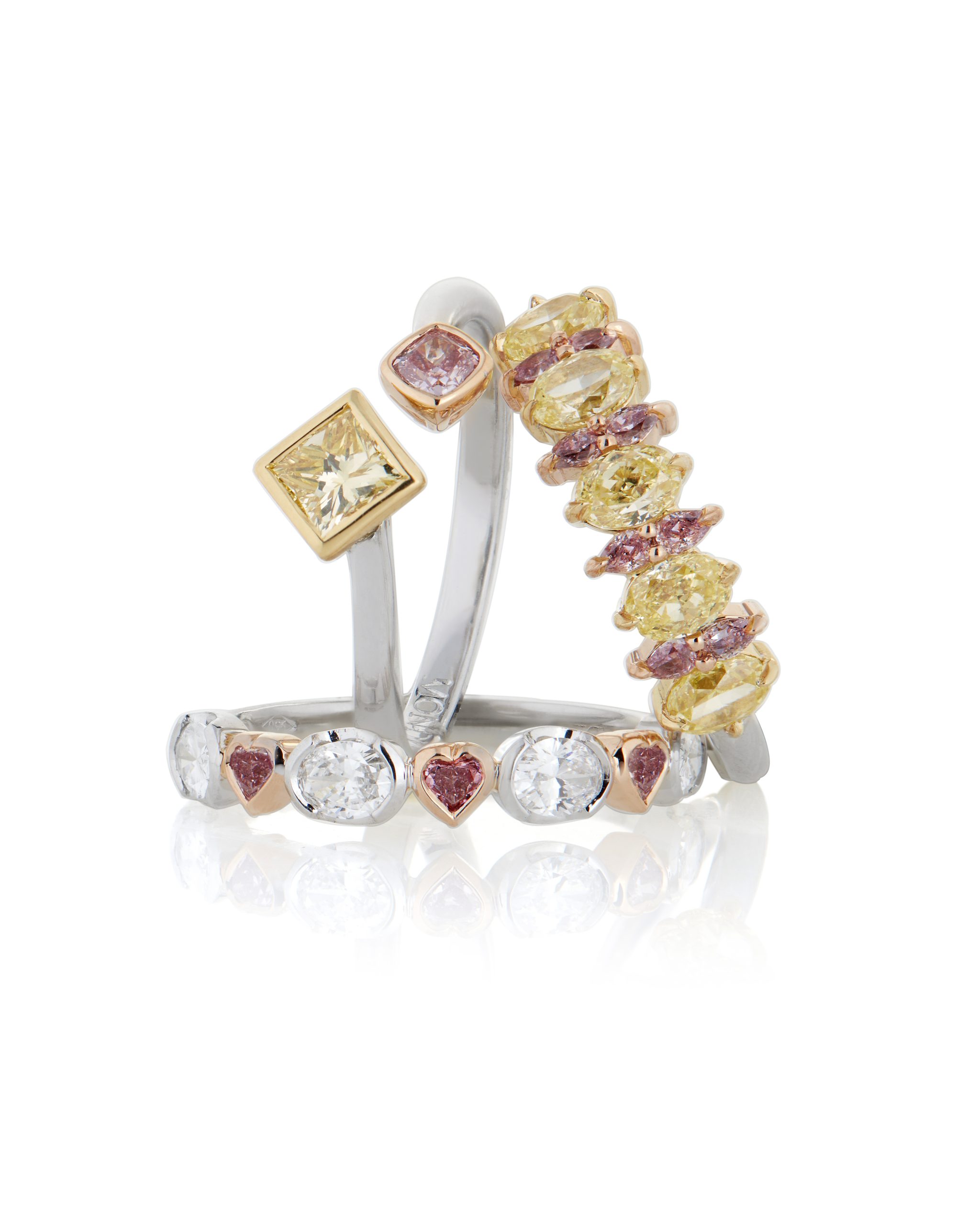
Mondial has built its reputation on its range of pink diamond jewellery.
Mondial is known for its access to pink diamonds. With the Argyle mine now closed, what do you see as the future for the business as the stockpile diminishes?
We’ve been established for a long time and have a very loyal client following. We will continue to take pride in the quality and craftsmanship of our work and the beautiful gems we source. We understand that our customers, both existing and new, are one of the main reasons we have come this far, and we will continue to offer them the best customer service we can. We will take these qualities with us into the future of Mondial with new designs and beautiful new creations. We will continue to listen to the collective consciousness, be open to change and curious enough to address these changes to the best of our ability.
The U.S. has long been the lender of last resort to the world. During the emerging-market panics of the 1990s, the global financial crisis of 2007-09 and the pandemic shutdown of 2020, it was the Treasury’s unmatched capacity to borrow that came to the rescue.
Now, the Treasury itself is a source of risk. No, the U.S. isn’t about to default or fail to sell enough bonds at its next auction. But the scale and upward trajectory of U.S. borrowing and absence of any political corrective now threaten markets and the economy in ways they haven’t for at least a generation.
That’s the takeaway from the sudden sharp rise in Treasury yields in recent weeks. The usual suspects can’t explain it: The inflation picture has gotten marginally better, and the Federal Reserve has signalled it’s nearly done raising rates.
Instead, most of the increase is due to the part of yields, called the term premium, which has nothing to do with inflation or short-term rates. Numerous factors affect the term premium, and rising government deficits are a prime suspect.
Deficits have been wide for years. Why would they matter now? A better question might be: What took so long?
That larger deficits push up long-term rates had long been economic orthodoxy. But for the past 20 years, interest-rate models that incorporated fiscal policy didn’t work, noted Riccardo Trezzi, a former Fed economist who now runs his own research firm, Underlying Inflation.
That’s understandable. Central banks—worried about too-low inflation and stagnant growth—had kept interest rates around zero while buying up government bonds (“quantitative easing”). Private demand for credit was weak. This trumped any concern about deficits.
“We had a blissful 25 years of not having to worry about this problem,” said Mark Wiedman, senior managing director at BlackRock.
Today, though, central banks are worried about inflation being too high and have stopped buying and in some cases are shedding their bondholdings (“quantitative tightening”). Suddenly, fiscal policy matters again.
To paraphrase Hemingway, deficits can affect interest rates gradually or suddenly. Investors, asked to buy more bonds, gradually make room in their portfolios by buying less of something else, such as equities. Eventually, the risk-adjusted returns of these assets equalise, which means higher bond yields and lower price/earnings ratios on stocks. That has been happening for the past month.
Sometimes, though, markets can move suddenly, such as when Mexico threatened to default in 1994 and Greece did default a decade later. Even in countries that, unlike Mexico or Greece, borrow in currencies they control, interest rates can become hostage to deficits, such as in Canada in the early 1990s or Italy in the 1980s and early 1990s.
The U.S. isn’t Canada or Italy; it controls the world’s reserve currency, and its inflation and interest rates are mostly driven by domestic, not foreign, factors. On the other hand, the U.S. has also exploited those advantages to accumulate debt and run deficits that are much larger than those of peer economies.
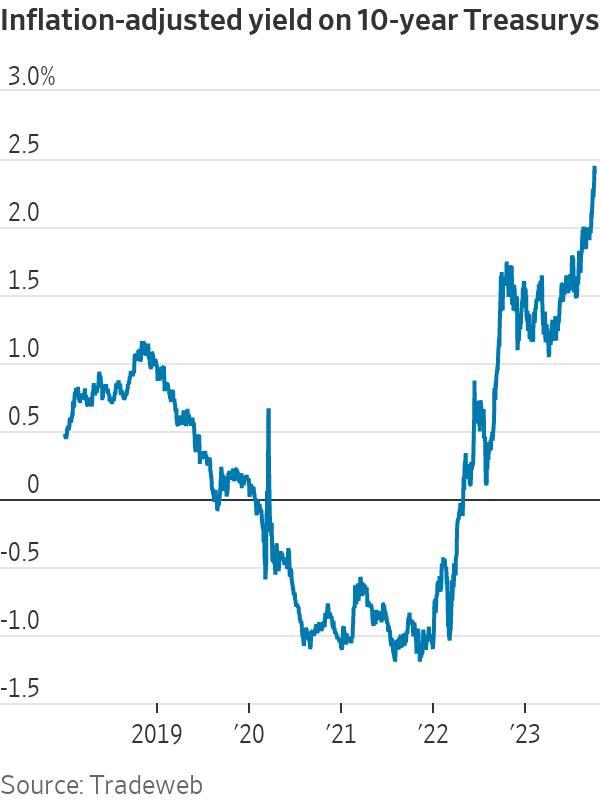
There’s not much sign that this has yet imposed a penalty. Investors still project that the Fed will get inflation down to its 2% goal. At 2.4%, real (inflation-adjusted) Treasury yields are comparable to those in the mid-2000s and lower than in the 1990s, when the U.S. government’s debts and deficits were much lower.
Still, sometimes bad news accumulates below investors’ radar until something brings their collective attention to bear. Could a point come when “all the headlines will be about the fiscal unsustainability of the U.S.?” asked Wiedman. “I don’t hear this today from global investors. But do I think it could happen? Absolutely, that paradigm shift is possible. It’s not that no one shows up to buy Treasurys. It’s that they ask for a much higher yield.”
It’s notable that the recent rise in bond yields came as Fitch Ratings downgraded its U.S. credit rating, Treasury upped the size of its bond auctions, analysts began revising upward this year’s federal deficit, and Congress nearly shut down parts of the government over a failure to pass spending bills.
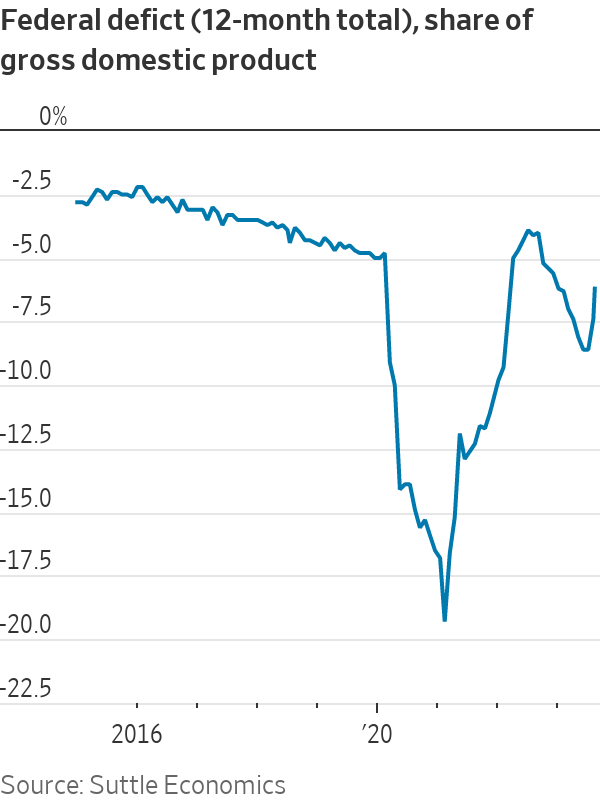
The federal deficit was over 7% of gross domestic product in fiscal 2023, after adjusting for accounting distortions related to student debt, Barclays analysts noted last week. That’s larger than any deficit since 1930 outside of wars and recessions. And this is occurring at a time of low unemployment and strong economic growth, suggesting that in normal times, “deficits may be much higher,” Barclays added.
Abroad, fiscal policy has clearly begun to matter. Last fall, a proposed U.K. tax cut triggered a surge in British bond yields; the government scrapped the proposal, then resigned. Italian yields have risen since the government last week delayed reducing its deficit to below European guidelines. Trezzi said that for the past decade the European Central Bank had bought more than 100% of net Italian government bond issuance, but that’s coming to an end.
Foreign investors, worried about inflation and deficits, have been selling Italian bonds, while Italian households have been buying, Trezzi said. “With a weakening economy, it is unclear for how long…households can offset the selloff of foreigners.”
Investors looking for U.S. political will to rein in deficits would take note that both former President Donald Trump and President Biden, their parties’ front-runners for the 2024 presidential nomination, have signed deficit-busting legislation and that both of their parties have pledged not to cut the two largest spending programs, Medicare and Social Security, or raise taxes on most households.
They would also notice that the Republican speaker of the House of Representatives was just ousted by rebels in his own party because he had passed a bipartisan spending bill to prevent the government from shutting down. True, the rebels wanted less spending. But shutdowns, Barclays noted, represent “erosion of governance.” This isn’t how a country trying to reassure the bond market acts.
It’s one thing to work long hours. It’s another to surrender your free time to swirling thoughts of office predicaments and projects hanging over your head.
Many of us can’t let work go. It’s sinking our mental health and damaging our relationships. We need to shift the approach in our heads.
Joe Mellin thought maybe a week alone in the woods would do it. He journeyed by plane, bus and minivan to a remote pocket of Colorado for a program that coordinates solo wilderness excursions. Armed with a toothbrush, a journal and some dried split peas, the 41-year-old hunkered down to meditate and find out who he was.
Turned out, he was someone who really liked obsessing about his job.
“I was literally saying, Joe, you’re in Colorado, you’re off work, you’re in the middle of a forest, stop thinking about work,” the Washington-based tech worker recalls. By hour 36, in the quiet of his sleeping bag under the moon, he gave in. Soon he was sketching PowerPoint presentations in his journal, filling 20 pages with notes before he was finally able to let go.
Whether you’re on a spiritual quest in Colorado or at the playground with your kids, internally troubleshooting next week’s client pitch or entertaining revenge fantasies about a colleague, there’s a cost.
“You’re getting aggravated anew each time,” says Guy Winch, a psychologist and author who fashioned a TED Talk on the subject.
We often think we have to fix our jobs to relieve our work stress. “You might,” he says. “But fix you first.”
Break the cycle
Start by tracking how much time you’re spending ruminating about work, Winch says. For many of his patients, that’s 10 to 20 hours a week—after-hours. (At the office, we’re generally too busy doing the job to perseverate about it, he says.)
To stop the cycle, tax your mental capacity with something more complex than Netflix or a walk. Try a memory task like naming all 50 state capitals or recalling the items in your fridge, Winch suggests. Two to three minutes is often enough for a reset.
Then, channel what you had been obsessing about into something useful. Ask yourself: What’s the actual problem to be solved? If you’re worried about workload, can you delegate to teammates or decline meetings?
If there’s nothing to be done about the situation—some co-workers are just annoying—try to find the silver lining, Winch adds. Maybe this is the spark you finally need to find a new, better job. Maybe you’re building skills that will help you in the future.
When you are your job
We’re bombarded with emails, Slack messages and back-to-back Zoom calls during the day, so it’s no wonder we can’t turn off our brains when we shut the laptop. We mentally brace for pings of all kinds, even when they’re not coming.
And some of this is on us. So many employees have tied their identities to their jobs.
“They’ve defined their whole value this way, so it makes it that much harder to let go of things,” Rebecca Zucker, an executive coach, observes of some of her clients. “Something that goes badly at work can feel annihilating.”
Lauren Orcutt, a 36-year-old in Sacramento, Calif., loves being a copywriter. Some of her friends and family don’t love constantly hearing about it, she says.
“I think about it so much, it just comes out,” she explains.
She’s often up at 3 a.m., galvanised by an idea for a new blog post or needled by the realisation she messed up an email. “I kind of felt like I was working all night” for months, she says. Her sleep suffered.
To reclaim her brain space, Orcutt started jotting down her thoughts in a lavender notebook she now keeps on the nightstand. Mistakes that are plaguing her get their own page, which she rips out in the morning.
“I am going to throw it away and move on with my life,” she says. Even capturing the good ideas calms her, helping her drift back to sleep.
Reprioritise your life
Ruminating about work can make it hard to fall and stay asleep, and damage our mood and mental health, says Verena C. Haun, a professor at the Julius Maximilian University in Würzburg, Germany, who studies psychological detachment from work. Depleted, we often perform worse at work the next day.
She suggests marking the transition from work with a simple ritual, like washing out your coffee cup or changing clothes. Find a hobby, or three, that make you truly forget about work while you’re doing them. Set a goal, say, an hour spent gardening, especially on stressful work days.
You can’t think about work when you’re trying not to crash a boat, Jackie Hermes, the chief executive of a marketing firm, says she discovered. When the onset of the pandemic caused her business’s revenue to drop 40%, she rethought her relationship, once all-consuming, with her job.
“Is this really what I’m dedicating my entire life to?” she asked herself.
She doesn’t work less hours now, but she has changed how she thinks about work, allowing herself more flexibility and trying new things in her personal life. During the day, she’ll sometimes pop into the boating club she recently joined or catch a Milwaukee Brewers game at the ballpark.
“Work isn’t the only priority anymore,” she says, noting that so much about our jobs is out of our control anyway.
Now she tells herself, “I’m not behind. It’s always going to get done.”
In the series How to Live With a Room You Hate, we ask design pros to solve everyday interior problems.
A ROOM with little or no closet space can leave you feeling bulldozed by your own belongings. “It’s unsettling when nothing has a home. Creating a system that maximizes your space can change your whole mood,” said Jamie Garson of Better Than B4, a custom organizing service in Manhattan. Here, six stuff-stowing techniques that offer relief when a bedroom is bereft of storage.
1. Increase Your Screen Time
When Gavin Smith, an architect with Perkins + Will, turned an attic space in his 1910 Craftsman home in Seattle into a bedroom for himself and his wife, he wanted to leave the space open and airy. So rather than building a traditional closet, he constructed cabinetry and clothing racks under the cathedral ceiling and shielded them behind a peek-a-boo screen of cedar slats supported by chic, blackened steel. “A solid drywall would be perceived very differently,” he said. “Because the screen is see-through, it creates a sense of depth.” Smith gave the partition—which also serves as a place to hang a flat-screen TV—a walnut stain to match a nearby dresser. If you want to skip construction, suggests Garson, tuck belongings behind a standing room divider.
2. Play Dress-Up
Interior designer Emilie Jacob gave a closet-less child’s bedroom in Dubai a clever theatrical fix by installing rods to hang clothing, many at a low level, and suspending drapes that, with a pull, can hide them on a whim. The drapes delineate a dressing area that lets the little girl don her duds in privacy. The curtains begin where a modular IKEA bed with underbed storage and attached wardrobe leaves off. “The linen curtains are really light, and there are no cords,” said Jacob, who founded local design firm Stella + the Stars and collaborated with Studio Tsubi, also in Dubai, on the room. “Any child can pull them open or closed.”
3. Broker a Separate Piece
When bad luck or circumstance has robbed you of a closet, a free-standing wardrobe makes for a classic solution. One with many benefits, contends Russell Pinch, the owner of Pinch, a furniture and lighting design firm in London. “It’s an investment…but one you can take with you.”
Freestanding wardrobes can solve the storage dilemma – and you can take them with you when you leave. Credit: Getty Images
And importing a wardrobe rather than constructing storage can be kinder to architecturally valuable spaces, like the bedroom in Pinch’s vacation home in Charente-Maritime, France, in an 18th-century structure that was originally a cow barn. “We wanted to preserve the….beautiful parquet floors and timbered ceilings,” he said. “A built-in would have dominated the architecture and reduced the size of the room.” The white wardrobe, which he designed, “is an elegant solution. It looks like plaster-relief work,” said Pinch. Next to the wardrobe a full-length mirror with drawers at the bottom offers additional storage and helps complete a dressing area.
4. Get a Side Hustle
In a London townhouse, local interior designer Andrea Benedettini fit a full-size bed into a relatively narrow room, and rather than flank it with nightstands used the tight space on either side to build matching full-height closets. Unwilling to forgo the benefits of traditional bedside tables, he hung sconces on the sides of the closets facing the bed and carved out niches (complete with concealed lighting) to create a ledge for a book, phone or water glass. “Simple design details like the niche elevate the design,” Benedettini said. “Applying a fabric to the closet door and bespoke bronze hardware helped create a calming and luxurious space.” A ceiling-height upholstered headboard bridges the closets, connecting them visually into a whole, so the bed appears to be tucked into its own soft alcove.
5. Let It Rock
According to organiser Garson, much of our wardrobes can live outside a closet quite nicely. She suggests openly displaying an amazing sneaker collection in a media unit, placing funky handbags on floating shelves or arranging hooks on a wall for an artful pattern of hats or scarves.
6. Let It Roll
For a bedroom with no closet, Hilary Matt lets it all hang out with a rolling rack for clothes. The trick to exhibiting your wardrobe (warning: this is not for slobs)? “Keep the [rest of the] décor clean and monochromatic so the room doesn’t feel cluttered,” said the Manhattan interior designer.
Open clothes racks can work well as long as they are kept tidy. Credit: Getty Images
The pop of colour from the apparel, which needs to be well-organized, adds to the room’s scheme “like a piece of art,” she said. Organiser Garson favours racks that match the style of the room, whether made of a fun acrylic or the more-masculine matte black metal.
The heel of Italy’s boot is its hospitable heartland, at least to a growing contingent of savvy travellers who find themselves turning to Puglia time and again, perhaps at first for its rusticity, but now for its lavish resorts. It’s been a long time coming for the historically overlooked region and its 500 miles of coastline, most of which is devoid of the crowds overstuffing other parts of the country.
“Puglia is authentic but contemporary, relaxing but full of vibrant energy,” says Aldo Melpignano, owner of Borgo Egnazia, a luxury resort that has helped put the region on the map for international travellers. “It’s becoming more and more an international travel destination, but you can still discover hidden gems and unspoiled places.”
Charming towns line the Adriatic coastline like whitewashed pearls on a string, from Lecce to Brindisi, onward to Ostuni and Monopoli, continuing north to Bari and Trani. The countryside in between showcases the remnants of conical trulli, traditional stone-hut residences, found amid endless olive groves. Its every facet has a distinct Puglian feel, an inimitable aura of charm and hospitality that cannot be replicated.
The Growth of Puglia’s Luxury Scene
“Sometimes when you are in a luxury resort in the Côte d’Azur or Sardinia or Mexico, you feel like you could be anywhere, you don’t have a sense of place” says Vito Palumbo, CEO of Tormaresca winery. “When you are in Borgo Egnazia or Torre Coccaro, though, you know you are in Puglia, you know that you’re in a masseria that has been revamped into a beautiful resort with a very strong Puglian identity.”
At Tenuta Bocco di Lupo, the long, sandy white road that serves as its entrance beckons travelers to its grand estate and cellar. Jake Emen
It’s been a quarter century since Tormaresca was acquired by wine conglomerate Antinori, whose financial backing and know-how helped modernize its efforts, transforming its distinctive terroir and native grapes—such as Primitivo, Negroamaro, Aglianco, and Fiano—into sought-after varieties. In more recent years, Palumbo has grown into a role as the face of Tormaresca, but also as the de facto ambassador for Puglia on the whole, dedicated to touting the appeal of his home region.
Puglia’s beloved masserias, or farm estates constructed in village-like fashion, replete with small walkways and central gathering plazas, offer a different spin on Italian luxury and hospitality, versus the villas of Tuscany, the cliff top properties along the Amalfi coast, or the grand dames of Venice and Florence.
One of the initial masserias to make a splash was Masseria Il Melograno, whose grounds are studded with gnarled and wizened 600-year-old olive trees and purple bougainvillea flowers. But when Borgo Egnazia opened in 2010, following a six-year, reported €150 million project, it set the region on a luxurious new path, gaining recognition as one of the top properties in Italy and across continental Europe.
With that kind of success, it was perhaps inevitable that large, international brands would follow course. Rocco Forte added Masseria Torre Maizza to its portfolio in 2018, and in early 2021, Four Seasons announced an Ostuni project, signalling it would be a new construction with direct beach access and 150 villa-style guest rooms. Around the same time, Belmond purchased Masseria Le Taverne, a 17th-century farm estate, and is amid extensive renovations while aiming to maintain the property’s heritage and character.
The best of both worlds can be found at a restaurant such as Osteria del Tempo Perso in Ostuni, Jake Emen
“Puglia’s popularity has grown significantly for those looking to explore a different part of Italy and to discover the region’s spectacular coastlines and beautiful beaches, rich history, and exceptional culinary offerings,” says Bart Carnahan, Four Seasons president of global business development and portfolio management.
The Roots Are in the Vineyards and the Olive Groves
At the heart of Puglia’s culinary movement is an appreciation for its local ingredients, from burrata to olive oil and a wealth of fresh seafood.
“Puglia is Italy’s most important region for extra-virgin olive oil production,” Palumbo says, citing overall output and a breadth of styles, with at least 60 types of olives found on millions of trees. Yet, as with the region’s wine, the quality of its olive oil was long overlooked, with the majority being sold in bulk. “Puglian olive oil is going places, and it’s the same story as the wine. There are more strong Puglian olive oil brands than Tuscan ones now.”
Travellers can spend a day on a farm or dairy learning how to make cheese or pressing their own olive oil, perhaps in between visits to its emergent wineries. At Tenuta Bocco di Lupo, the long, sandy white road that serves as its entrance beckons travelers to its grand estate and cellar. There, they can taste wines under its eponymous label, such as an Aglianico from Castel del Monte; Pietrabianca, made with Chardonnay and Fiano from Castel del Monte; and Fiano di Bocca Di Lupo.
Then there’s Tormaresca’s Calafuria, the best-selling rose wine in, and from, Italy. But it’s through the aforementioned offerings, along with bottles such as Torcicoda, a Primitivo from Salento, as well as the Masseria Maime Negroamaro, that Palumbo plans to establish the bonafides of his two estates in the region. What he and his winemakers have found is that Puglian wines made with intention, and reflective of their home place, are more than capable of great ageing potential, with rich character that consumers can expect to develop and unfold in the decade or two to come, while still being able to be poured today and enjoyed. “We want the Puglian influence,” Palumbo says.
Puglia’s restaurant scene has soared as well, with 10 Michelin-starred outposts in the region and scores of other fine-dining establishments. A prestige institution such as Quintessenza, in Trani, is helmed by the four Di Gennaro brothers, each of whom has a different role in the operation of a space devoted in full to showcasing and elevating Puglia’s bounty.
Bocca Di Lupo Jake Emen
The best eating though may be in casual, local spots with seaside views or beachfront settings, from the Coccaro beach club and restaurant, to the Trabucco Tormaresca in Trani, a sceney waterfront bar stylised as an old fisherman shack. The best of both worlds can be found at a restaurant such as Osteria del Tempo Perso in Ostuni, where classic Puglian dishes are showcased with the best ingredients, but without unneeded adornment or reinvention, with the service and setting that elevates food with humble origins into a destination dining experience.
Travellers to Puglia can indulge in it all: the excellent food and wine that will satiate the most discerning of palates and the luxurious accommodations that need not play second fiddle to anywhere else in the country, offered with the trademark embrace of the region’s hospitality.
“The ancient traditions of this region represent a unique heritage,” Melpignano says. “What really makes the difference in Puglia is the people: Always heart-warming, they have the sense of welcome in their blood.”
For sun seekers in search of the ideal holiday home, there’s always compromises to be made. The location might not be perfect, the house may be in need of work or it could be just too far from the closest capital city to make regular use viable.
Not with this elevated beachfront property on the NSW Central Coast.
The two-storey residence at 46 Kalakau Avenue, Forresters Beach is the kind of place guaranteed to make its owners popular among family and friends. With five bedrooms (and a possible sixth) as well as multiple living areas across two floors and two spacious, well-appointed kitchens to service each level, this is a house built for entertaining.
The floorplan has been carefully crafted for easy cross ventilation and natural light to capture the best of its beachside position with the addition of ducted aircon and a built-in fireplace to ensure the house is comfortable all year round.
Close attention has been paid to circulation between spaces while also providing opportunities for separation – a key advantage when guests come to stay. The predominantly white interior scheme is a perfect match for the seaside locale, offering the perfect ‘canvas’ for putting your own design stamp.
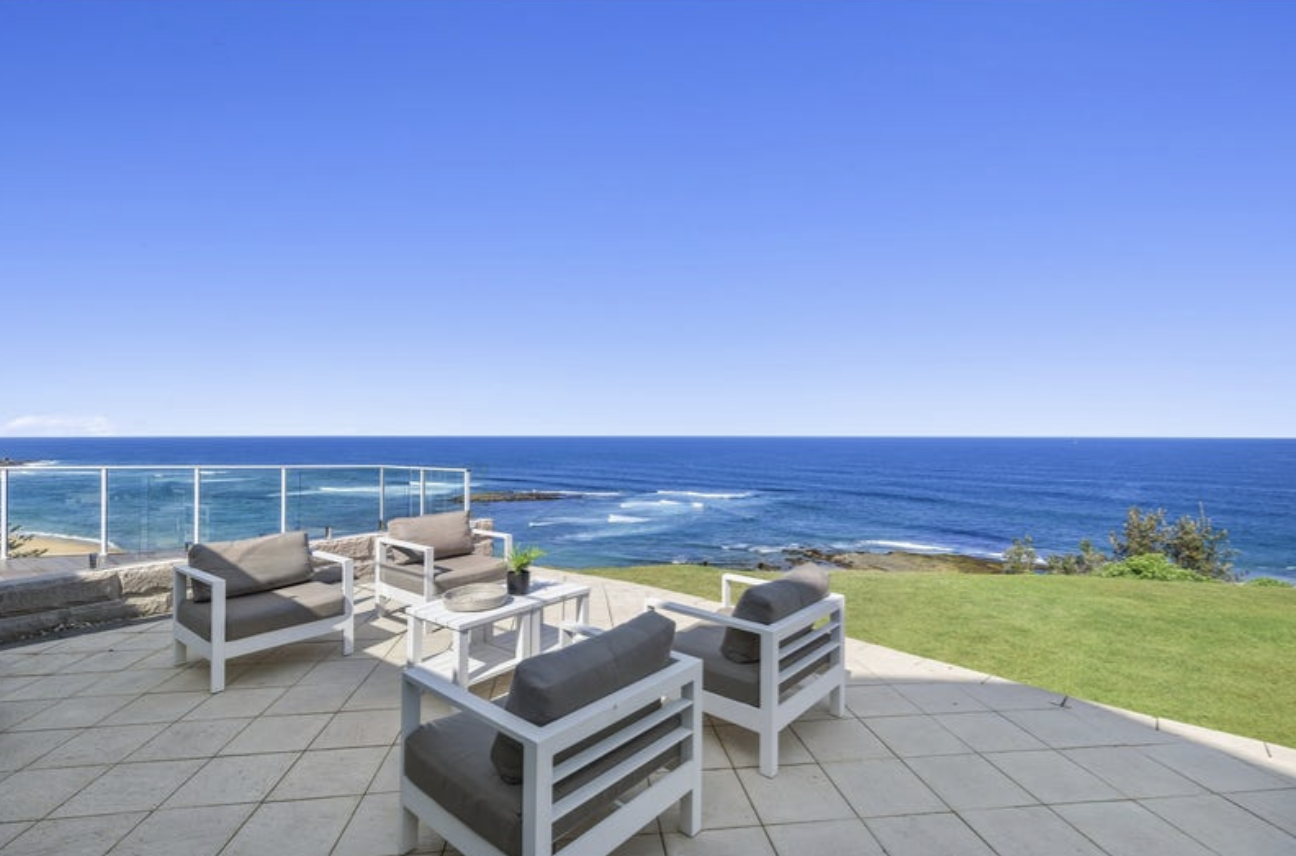
But while the accommodation is generous, it’s the location that really hits the mark with uninterrupted, never-to-be-built-out views of pristine Forresters Beach to enjoy from the spacious entertaining area on the ground floor and the balconies above.
The property has direct access through reserves to the beach via a set of stairs, the definition of luxury in a modern world. On those days when you’d prefer to stay at home, a private pool and spa is the perfect respite.
For Sydneysiders, it’s less than 90 minutes from the CBD, making weekend getaways an easy option. With a three-car garage on site, there’s room for everyone.
Address: 46 Kalakau Avenue, Forresters Beach
Next inspection: Saturday October 7, 11am-11.30am
Agent: Cathy Baker, Belle Property Central Coast 0414 241 005