‘Walking Europe’s Last Wilderness’ Review: A Carpathian Ramble
Rising along the line where eastern and western Europe divide, a forested mountain range is home to shepherds, villages and plenty of bears.

 4 min
4 min
The Carpathian Mountains are a horseshoe-shaped range that arcs from central to southeastern Europe. From their western edge in Austria and the Czech Republic, the Carpathians rise clockwise through Slovakia and southern Poland, curve around the Hungarian plains and through western Ukraine, run south into Romania, then turn back westward and finally protrude into northern Serbia. There are wild patches in Europe’s other major ranges, but the Carpathians have forests where the Alps have ski resorts and brown bears where the Pyrenees have the microstate of Andorra. The Carpathians are the last wild place in a crowded continent.
The Carpathians, Nick Thorpe writes in “Walking Europe’s Last Wilderness,” are the “geographical center of Europe.” Their peaks and ridges form the watershed between the Baltic Sea to the north and the Black Sea to the southeast. As geography shapes history and history shapes peoples, the mountains are a political “fault line between East and West.” Once contained within the Austro-Hungarian Empire, the Carpathians now curve through six European Union states, one candidate state (Serbia) and Ukraine, whose future is uncertain.
The cover art of “Walking Europe’s Last Wilderness” evokes John Craxton’s designs for Patrick Leigh Fermor’s travelogues “A Time of Gifts” (1977) and “Between the Woods and the Water” (1986). Though Mr. Thorpe describes the enduring exoticism of hospitable huts, historical grudges, handmade goat cheese and homebrewed pálinka fruit spirits, this is not a romanticizing epic from a lost era. Mr. Thorpe is a hiker and camper, and always ready to go barefoot in the meadows, but he lives in Budapest, one of the cities of the plains that surround the Carpathians. A BBC reporter, he launched a series of episodic explorations between 2018 and 2024. He has compiled a richly textured report on an ancient terrain that is being remade into a new political and economic landscape.
The nation-states of the region were created in the 19th and early 20th centuries by “unraveling the complex web of religious, cultural and linguistic threads that characterized Europe.” The nation-builders suppressed “local dialects, vernaculars and identities” and then the Soviets suppressed the nations. The mountains still hide the remnants of the peoples who neither attained statehood nor succumbed: Liptos, Lemkos, Boykos, Hutsuls, Bukovinians, Szeklers, Ruthenians. The revival of the nation-states and their economies after the Cold War threatens to erase the last traces of local identity.
Samo Hríbik, a shepherd in Slovakia, finds his flock by starlight without the help of a dog and fashions traditional fujara flutes, whose “long, shuddering notes,” Mr. Thorpe writes, suggest “the wind buffeting a thatched roof.” In western Ukraine, the 86-year-old Vasyl Kischuk puts on his traditional white smock and brown hat and demonstrates the trembita , the traditional Hutsul wooden trumpet, and a “deep, mournful sound fills the meadow.”
As memories and traditional crafts are fading, incomers are reviving them. Mr. Thorpe meets brewers, cheesemakers, environmentalists and animal lovers mapping migration corridors for brown bears amid the refugee crisis caused by the Ukraine war. Oreste Del Sol, a Paris-born anarchist who shows Mr. Thorpe around his farm and the local slow-food cheese factory in the Ukrainian village of Nyzhnje Selyshche, tells him that being a shepherd in Ukraine is “illegal, or a-legal.” The production and sale of cheese is unregulated. The cheese, Mr. Thorpe finds, is “magnificent.”
For Slovaks, it is the mountains that matter; their national coat of arms carries three stylized ranges. Hungarians, however, speak of the “Carpathian basin” as their homeland and its ring of mountains as a lost shield against invaders. Romanians, whose country is bisected north-south by the Carpathians’ eastern flank, trace their origins to the Dacians, one of whose ancient tribes, the Carpi, gives the name of the mountains. For all their governments, forestry is big business. There are still “primeval forests” in the Carpathians, untouched by humans. There are many “old-growth” forests that were too remote or located on terrain too steep to be exploited in the past. There are also “buffer zones” such as national parks. But the forestry companies now have modern cutting technology and transport, and satellite imagery.
The bouncy IKEA Pöang chair in Mr. Thorpe’s Budapest home is made from beechwood. Romania has two-thirds of Europe’s old-growth forests and IKEA is “the largest private forest owner in Romania.” On paper, IKEA is a “champion of sustainable forestry.” Environmentalists claim, however, that some of its beechwood is “illegally logged—or, at best, over-logged.” IKEA insists it practices “responsible forest management.” Mr. Thorpe goes to a hilltop near Romania’s border with Ukraine. Google Maps shows it “thickly forested.” Mr. Thorpe finds only stumps and scattered branches.
Romsilva, the state forestry company, manages about two-thirds of Romania’s forests. It is charged with both protecting national parks and exploiting a national asset. According to the Romanian Forestry Inventory, 18 million cubic meters (about 635 million cubic feet) of timber were legally felled annually between 2014 and 2017, but “a further 18 million cubic meters were cut illegally each year.” Between 2010 and 2020, 600 members of the Forestry Guard were assaulted after intervening to stop illegal logging. Six were killed.
When Mr. Thorpe leaves the Slovakian capital of Bratislava, he notices that a “gulf of sheer incomprehension has opened up between the village and the city.” The gulf never narrows. “The mountain people, those born and bred here, don’t do much walking in the mountains,” says Sergiu Frusinoiu, a Romanian working with a mountain rescue group. Romania’s “bear problem” is worsening as humans expand into the mountainous territory of its large carnivores: bears, wolves, lynx and jackals. New roads cut across bear migration routes. New towns increase human-carnivore contact. The bears are learning to see humans as a source of food. The Romanian government will allow “the hunting of nearly 500 bears by the end of 2025.” Foreigners, Germans especially, will pay up to 20,000 euros to kill a big male. But no one can agree how many bears there are in Romania, or whether there are really “too many.”
The mayor of Băile Tușnad has educated his townspeople, spent €10,000 on bear-proof trash cans, and cut down the fruiting apple and plum trees in his town. The bears no longer come into Băile Tușnad but, he says, neither do other Romanian mayors in search of advice. Many politicians and businessmen are deep in corrupt forestry deals. The U.S. and EU’s plans for postwar Ukraine include building a “circular road through the Carpathians” to open the mountains for further development. The oligarchs will build ski resorts “where the playboys and playgirls of the new Ukraine will glide effortlessly at high speed, while their brothers, or uncles, sit bitterly at home in wheelchairs.” Old-growth forests make new money, and slow food comes second to a quick buck.
 Copyright 2020, Dow Jones & Company, Inc. All Rights Reserved Worldwide. LEARN MORE





From making unpopular decisions to learning when to listen, leaders from five businesses reveal what nobody prepared them for — and how running a company has challenged their expectations.

Technology and semiconductor shares fell sharply as investors questioned the debt financing the AI infrastructure boom and confronted higher rates and Chinese competition.

Elon Musk is exploring a potential merger between Tesla and SpaceX, a deal that could reshape the future of AI, robotics, autonomous vehicles and space technology. With a combined valuation potentially reaching $3.5 trillion, the move could bring Musk’s vision of an interconnected technology ecosystem closer to reality, although a deal remains uncertain.
5 min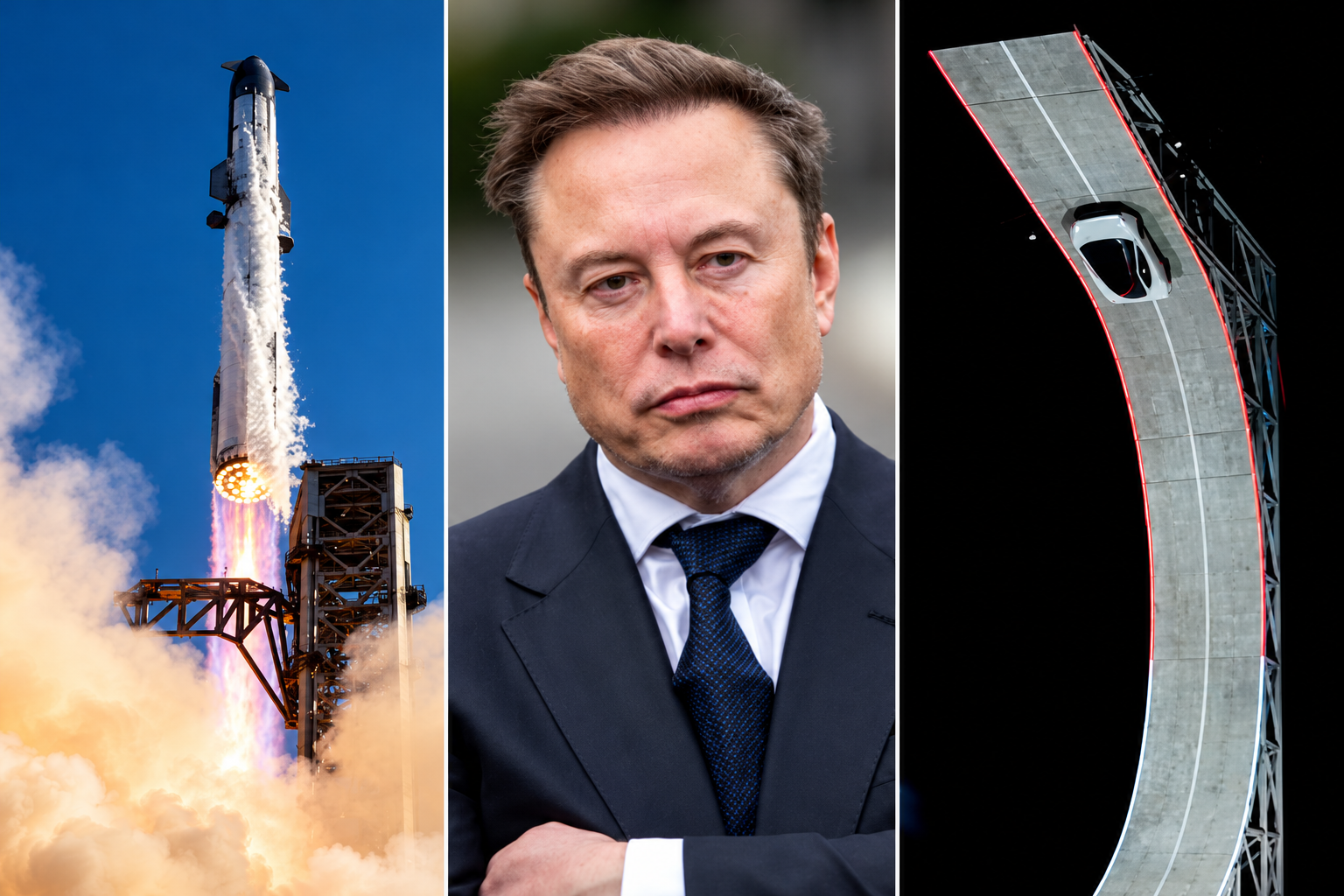
Elon Musk has engineered ties between Tesla TSLA 3.41%increase; up pointing triangle and SpaceX SPCX 7.79%increase; up pointing triangle that are hard to break, and now he wants to fuse them together permanently.
Musk has run both Tesla and SpaceX concurrently over the past two decades, using a schedule that dictated which days he spent focused on each business.
The companies have often shared resources and personnel, signaling their close ties. Last year, SpaceX looked into creating a spacesuit for Tesla’s humanoid robot Optimus, a person familiar with the matter said. Tesla last week showed off its new Roadster, a vehicle featuring SpaceX rocket thrusters that it hopes to soon bring to market.
And in recent months, Musk has repositioned both companies by expanding beyond their core operations toward a shared mission centered on artificial intelligence.
The world’s richest man on Tuesday signaled his interest in tying up SpaceX and Tesla, marking what would be the biggest corporate merger of all time. Because he serves as chief executive of SpaceX and Tesla, Musk said committees of independent directors at both companies are evaluating a possible deal, adding that a transaction might not come to fruition.
The committees will likely evaluate, with lawyers and bankers, how each company would fare in a potential deal and how a deal might best be structured. They then present their conclusions to their respective boards, who typically vote on whether to proceed.
“It’s an odd Kabuki dance where two groups of people are talking and I can’t be in the conversation,” Musk told SpaceX investors on Tuesday in response to an analyst’s question about a potential deal.
For Musk, the merger supports his vision of a world full of autonomous cars, humanoid robots and weekly rocket launches, as well as the data centers and satellites required to keep the whole thing running.
Some investors and analysts said they expect a transaction would be structured as an all-stock deal, with SpaceX potentially paying a modest premium for Tesla shares.
SpaceX, which has a market value of about $2 trillion, said it is seeing sharp growth in revenue across its businesses, which include operating data centers, launching rockets and operating satellite networks such as the internet service Starlink. Tesla is valued at about $1.5 trillion and is expanding its operations beyond its automotive and energy business. Shares in both companies traded higher following the news Tuesday.
Musk’s substantial ownership stakes in both companies, along with voting control at SpaceX, has enabled him to set the deal in motion. Analysts and investors said the deal will probably face regulatory scrutiny internationally, though some see Musk’s close relationship with the Trump administration as an asset to getting approval.
Blurred lines
The companies haven’t said which directors are on the special committees evaluating a potential deal. Several SpaceX and Tesla board members have either personal or business ties to Musk. And like Musk, venture capitalist Ira Ehrenpreis sits on both boards.
In a filing this week, Tesla outlined millions of dollars in business agreements with SpaceX and its subsidiaries last year, including $143 million in car sales to SpaceX, $3.3 million in advertising that it bought on the social-media platform X and $430 million in revenue from the sale of Megapack batteries for SpaceX’s data centers.
The companies also split the cost of resources including the use of Musk’s SpaceX jet and the bill for his personal security, which he runs through a private company.
Employees at both companies routinely move between companies to work on special projects, and some executives have dual roles, including Charles Kuehmann, vice president of materials engineering at both SpaceX and Tesla, and Ashok Elluswamy, the vice president of AI software at Tesla who runs a joint venture with SpaceX called Digital Optimus.
Over the years, Musk has launched new startups within his empire, including brain-implant company Neuralink, underground-tunnel developer the Boring Company and xAI, the AI startup that merged with SpaceX in February.
It is that AI business that Musk thinks can serve a market worth tens of trillions of dollars, justifying the need for a merger.
The business case goes like this: Tesla is developing robotaxis and robots, which it calls “physical AI.” SpaceX is working on the back end of physical AI: the data-center capacity and internet connection required for those robotaxis and robots to operate continuously.
“I don’t see what the value of Tesla is if it’s not merged with SpaceX,” said investment adviser Ross Gerber, a former Tesla bull turned critic invested in both companies. “If they don’t merge, the brains of everything that runs Tesla is owned by another company.”
On top of it all, both companies face constraints on the supply chains they need to make this world a reality, particularly when it comes to chips. To address this, Musk earlier this year announced a joint venture between Tesla, SpaceX and Intel to design and manufacture chips in Texas. “The most epic chip-building exercise by far,” he has said.
Musk at the wheel
For Musk, a merger would also solve two problems: demands on his attention and his lack of control at Tesla.
Tesla for years was Musk’s only public company, a status that came with greater scrutiny. There, Musk reports to a public board, as well as individual investors who make up around 30% of Tesla’s voting power, according to FactSet.
The question of Musk’s attention became a particular focus for investors and the board in recent years after he acquired Twitter in 2022 and launched xAI in 2023, and again in 2025 as he spent time in Washington, D.C., running the Department of Government Efficiency in the early months of President Trump’s second term.
As Tesla’s car business suffered in 2025, Musk threatened to take his AI ambitions outside the company if he wasn’t granted 25% voting control. Last November, Tesla shareholders approved a new pay package for Musk, which created a path for him to vastly expand his stake.
As of Sept. 30, Musk owned a roughly 20% stake in Tesla, according to the company’s proxy filing.
The SpaceX IPO gave Musk a different path. When SpaceX went public in June, the deal’s structure enabled him to have more than 80% voting power at the company—so much that he can’t be fired and decisions can’t be made without his support.
If SpaceX acquires Tesla, he will likely stay in control.

With two waterfronts, bushland surrounds and a $35 million price tag, this Belongil Beach retreat could become Byron’s most expensive home ever.

From Italian vegetable-tanned leather to real-world training insight, Australian brand PK9 Gear is redefining what luxury means for discerning dog owners.