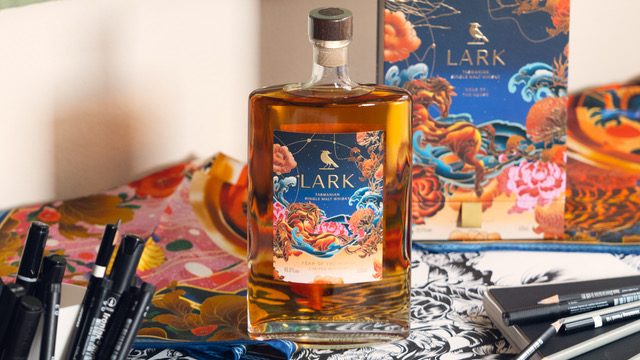
A whisky worth gifting: LARK’s Fire Horse Edition honours Lunar New Year in style
Tasmania’s LARK Distillery’s limited-edition single malt is shaping up to be one of the season’s most luxurious gifts.
If you’re hunting for a Christmas present that won’t end up re-gifted by February, LARK Distillery has delivered something genuinely special.
The Tasmanian whisky house has unveiled its 2026 Limited Edition Lunar New Year release, the Fire Horse Edition, a striking single malt that blends craftsmanship, culture and collectability.
Inspired by the Year of the Fire Horse, the release is as much an artistic object as it is a whisky.
Sydney artist Chris Yee has cloaked the bottle in a luminous wrap of symbolism and texture. His design fuses fire, wood and water, with Cradle Mountain and celestial motifs anchoring the scene.
Waves of movement and paths of connection run through the artwork, reflecting the journeys, traditions and family reunions that define the season.
Yee describes the concept in the release as an homage to the natural elements that shape both Asian and Australian cultures, saying he wanted to highlight how “fire, wood and water” sit at the heart of the distilling process and the stories we share.
Inside the bottle, the whisky is just as layered.
Matured in first-fill Sherry and Port casks, it opens with soft pear blossom and honeyed tea notes before moving through orange-spiced cake, apricot compote and treacle sponge pudding.
The finish lingers with hazelnut praline, glazed fruits and a whisper of highland peat smoke. It’s indulgent without being heavy; festive without being overly sweet.
LARK Master Distiller Chris Thomson captures the sentiment neatly in the release, saying the Fire Horse Edition “is about more than flavour, it’s about the feeling of coming together.”
The whisky holds the celebration in the glass, while the artwork reflects the journey home.
For those planning Lunar New Year drinks, LARK also suggests a few seasonal serves, including a Sencha Blossom Old Fashioned and a Toasted Fortune Highball with toasted sesame cordial.
With only a limited number available and strong gifting appeal, expect this one to move quickly.

From elevated skincare to handcrafted home pieces, this year’s most thoughtful gifts go beyond the expected.
A haven for hedge-fund titans and Hollywood grandees, Greenwich is one of the world’s most expensive residential enclaves, where eye-watering prices meet unapologetic grandeur.
At least for people who carry the APOE4 genetic variant, a juicy steak could keep the brain healthy.
Must even steak be politicised? The American Heart Association recently recommended eating more “plant-based” protein in a move to counter the Health and Human Services Department’s new guidelines calling for more red meat.
Few would argue that eating a Big Mac a day is good for you.
On the other hand, growing evidence, including a study last month in the Journal of the American Medical Association, suggests that eating more meat—particularly unprocessed red meat—can reduce the risk of Alzheimer’s in the quarter or so of people with a particular genetic predisposition.
The APOE4 gene variant is one of the biggest risk factors for Alzheimer’s.
You inherit one copy of the APOE gene from each parent. The most common variant is APOE3; the least is APOE2.
The latter carries a lower risk of Alzheimer’s, while the former is neutral. A quarter of people carry one copy of the APOE4 variant, and about 2% carry two.
APOE4 is more common among people with Northern European and African ancestry. In Europe the variant increases with latitude, and is present in as many as 27% of people in northern countries versus 4% in southern ones. God smiled on the Italians and Greeks.
For unknown reasons, the APOE4 variant increases the risk of Alzheimer’s far more for women than men.
Women’s risk multiplies roughly fourfold if they have one copy and tenfold if they have two. Men with a single copy show little if any higher risk, while those with two face four times the risk.
What makes APOE4 so pernicious? Scientists don’t know exactly, but the variant is also associated with higher cholesterol levels—even among thin people who eat healthily.
Scientists have found that cholesterol builds up in brain cells of APOE4 carriers, which can disrupt communications between neurons and generate amyloid plaque, an Alzheimer’s hallmark.
The Heart Association’s recommendation to eat less red meat may be sound advice for people with high cholesterol caused by indulgent diets.
But a diet high in red meat may be better for the brains of APOE4 carriers.
In the JAMA study, researchers at Sweden’s Karolinska Institute examined how diet, particularly meat consumption, affects dementia risk among seniors with the different APOE variants.
Higher consumption of meat, especially unprocessed red meat, was associated with significantly lower dementia risk for APOE4 carriers.
APOE4 carriers who consumed the most meat—the equivalent of 4.5 ounces a day—were no more likely to develop dementia than noncarriers. (
The study controlled for other variables that are known to affect Alzheimer’s risk including sex, age, physical activity, smoking, alcohol consumption and education.)
APOE4 carriers who ate the most unprocessed meat were at significantly lower risk of dying over the study’s 15-year period and had lower cholesterol than carriers who ate less. Go figure. Noncarriers, however, didn’tenjoy similar benefits from eating more red meat.
The study’s findings are consistent with two large U.K. studies.
One found that each additional 50 grams of red meat (equivalent to half a hamburger patty) that an APOE4 carrier consumed each day was associated with a 36% reduced risk of dementia.
The other found that older women who carried the APOE4 variant and consumed at least one serving a day of unprocessed red meat had a cognitive advantage over carriers who ate less than half a serving, and that this advantage was of roughly equal magnitude to the cognitive disadvantage observed among APOE4 carriers in general.
In all three studies, eating more red meat appeared to negate the increased genetic risk of APOE4.
Perhaps one reason men with the variant are at lower Alzheimer’s risk than women is that men eat more red meat.
These findings might cause chagrin to women who rag their husbands about ordering the rib-eye instead of the heart-healthy salmon.
But remember, the cognitive benefits of eating more red meat appear isolated to APOE4 carriers.
Nutrition is complicated, and categorical recommendations—other than perhaps to avoid nutritionally devoid foods—would best be avoided by governments and health bodies.
Readers can order an at-home test from any number of companies to screen for the APOE4 variant.
The Swedish researchers hypothesize that APOE4 carriers may be evolutionarily adapted to carnivorous diets, since the variant is believed to have emerged between one million and six million years ago during a “hypercarnivorous” period in human history.
The other two APOE variants originated more recently, during eras when humans ate more plants.
APOE4 carriers may absorb more nutrients from meat than plants, the researchers surmise. Vitamin B12—low levels have been associated with cognitive decline—isn’t naturally present in plant-based foods but is abundant in red meat.
Foods high in phytates (such as grains and beans) can interfere with absorption of zinc and iron (also high in red meat), which naturally declines with age. So maybe don’t chuck your steak yet.
Wealthy Aussies are swapping large family homes for high-end apartments, with sales of prestige units tripling over the past decade.
BMW has unveiled the Neue Klasse in Munich, marking its biggest investment to date and a new era of electrification, digitalisation and sustainable design.