Joby Aviation’s NYC Air Taxi Test Flight Is Proving Flying Cars Are Real
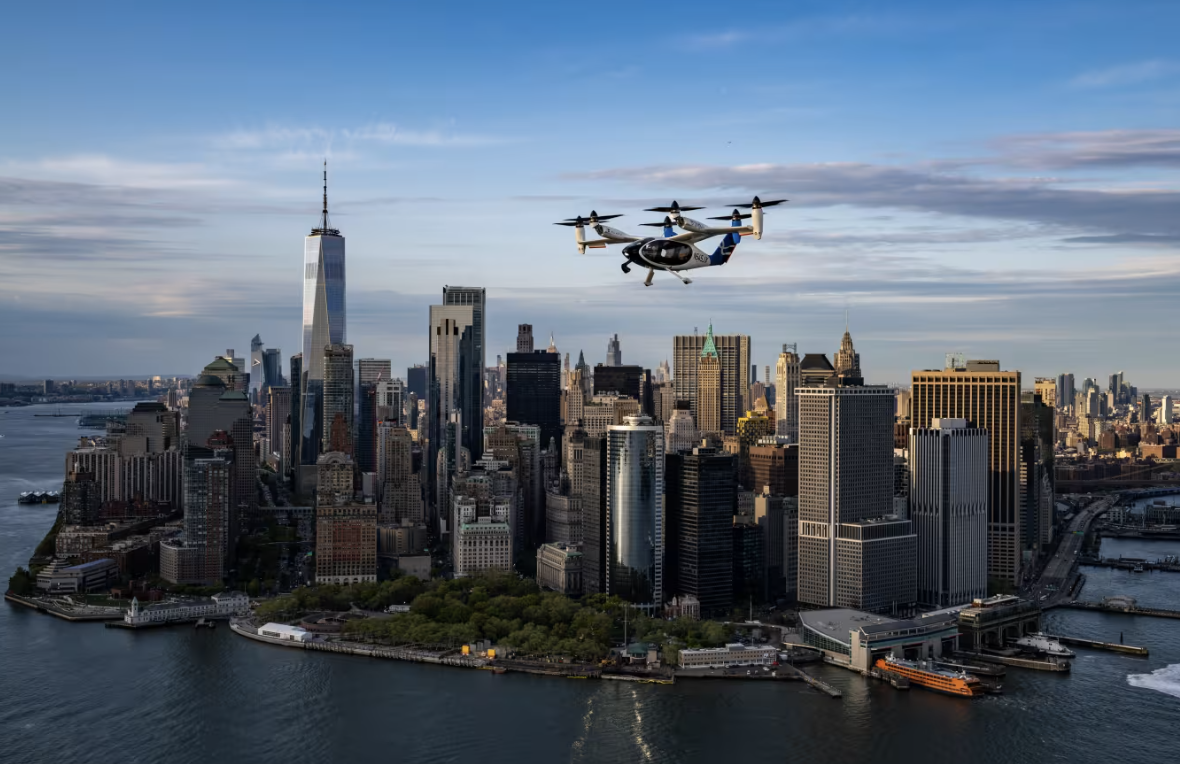
Joby Aviation has completed its first New York City air taxi test, signalling that flying cars are moving closer to reality.
As the song “New York, New York” made famous by Frank Sinatra puts it, if you can make it there, you can make it anywhere.
That’s what Joby Aviation is hoping. Its stock is rising in early trading on Monday following Joby’s announcement that it had completed the first point-to-point air taxi demonstration in New York City. The flight was the first in a week-long series of test flights.
Joby stock rose 6.4% on Monday, closing at $9.04, while the S&P 500 rose 0.1% and the Dow Jones Industrial Average fell 0.1%.
Joby’s aircraft left JFK Airport and landed at multiple sites across the city’s existing heliport network, including Downtown Skyport and the West 30th Street and East 34th Street heliports in Midtown, according to the news release.
The flights are part of the electric vertical takeoff and landing, or eVTOL, Integration Pilot Program, or eIPP, launched by the Transportation Department in 2025 to accelerate the development and adoption of air taxis.
Joby and its peers are working on eVTOLs, which are quieter and easier to operate than traditional helicopters, opening up potential urban air taxi markets. Urban air taxis are why Joby’s products are sometimes called flying cars.
Coming into Monday trading, Joby stock was down 36% year to date, but up 31% over the past 12 months.
Shares have been volatile . Joby doesn’t generate sales yet and trades largely on news flow related to aircraft certification and the start of commercial service in the Middle East. Both are expected in late 2026.
Middle East sentiment appears to be weighing on shares. Joby stock was down about 16% since fighting broke out in Iran.
Wall Street expects the company to post roughly $110 million in sales in 2026. Sales are projected to rise to $1.1 billion by 2029 and $2 billion by 2030. Predicting aircraft certification and demand has been hard for analysts. Three years ago, the 2029 sales estimate was closer to $3 billion.
Limited to 630 units, Lamborghini’s latest Urus Capsule pushes personalisation further than ever, blending hybrid performance with over 70 bespoke design combinations.
From snow-dusted valleys to festival-filled autumns, Bhutan reveals itself as a rare destination where culture, nature and spirituality unfold year-round.
Mexican dealers are selling cutting-edge Chinese cars that U.S. consumers can’t buy. Americans are warming to the idea of them.
CIUDAD JUÁREZ, Mexico—Just 5 miles from the U.S. border, a bustling commercial strip here offers the buzzy Chinese car brands currently blocked from the American market.
A Geely dealership features the all-electric EX2, a sleek compact that starts at only around $20,000. A bulky hybrid pickup truck sits next to a charger outside a BYD dealership. Great Wall Motors boasts some beefy gas-powered sport-utility vehicles, one advertised with the slogan “Be More Tank.”
Luis Hernandez, a Geely salesman, said he has poached many longtime Ford and Chevrolet owners attracted to the affordable sticker prices and whiz-bang Chinese technology.
He recently sold two Geely Emgrand sedans, which start at around $17,000, to a Mexican family for their two daughters to commute to college in El Paso, where the sleekest Chinese cars are now attracting attention.
“If they were allowed to be sold in the United States,” Hernandez boasted of the Chinese models, “they would destroy the American car market.”
U.S. automotive executives don’t entirely disagree. Without a clear plan to deal with Chinese competitors, some of them said in interviews, the arrival of affordable, high-tech Chinese cars could upend a U.S. industry that contributes $1.3 trillion to the economy each year.
“I’m telling you, it is very difficult—not to say impossible—to compete,” said Hyundai Motor Chief Executive José Muñoz . “We cannot compete at the same price as the Chinese in the market where we operate. Otherwise, we will be losing money.”
So far, the many Chinese car companies that want to expand into the U.S. have been kept at bay. The U.S. has applied sky-high tariffs to vehicles imported from China, and regulations make it nearly impossible for such vehicles purchased in Mexico to be registered in the U.S.
A trio of senators has urged the Trump administration this month to ban Chinese vehicles sold and registered in Mexico and Canada from entering the country; several dozen House lawmakers sent a similar letter this week. A Senate bill to prohibit China’s carmakers from building cars in the U.S. is being crafted.
“Whenever there’re market challenges, reality is, we’ll need to find a way to adapt to it,” said Brian Gu , vice chairman of Chinese carmaker Xpeng . “But our long term goal is to make our products available to as many customers as possible, including the U.S. customers.”
It’s no secret that Chinese EVs match up well against their American counterparts. After test driving a Xiaomi SU7 MAX, a Wall Street Journal columnist in January wrote a love letter to the car that isn’t yet available in the U.S.
But it isn’t just Chinese EVs that are keeping American car executives awake at night. Some of China’s biggest automakers have expanded into gas-powered and hybrid vehicles that are more in line with the American market.
“For me, it’s not only an EV problem,” said Christian Meunier , chairman of Nissan Americas, which competes with Chinese carmakers in Mexico.
The threat to the U.S. car industry, which notched more than 16 million new-vehicle sales last year, is unlike anything it has faced in decades. Having largely abandoned budget cars years ago, Detroit’s Big Three now rely heavily on expensive SUVs and pickup trucks that deliver fatter profits.
At the same time, fewer entry-level models are being offered to car buyers. No new car offered in the U.S. today has a sticker price below $20,000. The Chinese have vehicles ready to fill that market hole.
Auto executives and lawmakers say China has created an unfair playing field, with heavy government subsidies and ultralow labor costs. In addition to applying tariffs, the U.S. government banned Chinese-connected software in new cars.
BYD, Geely and Great Wall Motors are now among the biggest carmakers in the world. They have been gobbling up market share in Europe and other parts of Asia. In Mexico, Chinese vehicles account for a quarter of total sales. Soon, Canada will allow tens of thousands of inexpensive Chinese EVs to be imported.
Sen. Bernie Moreno (R., Ohio) said the bill he plans to introduce would “hermetically seal” the U.S. from Chinese automakers. Chinese cars from Canada or Mexico couldn’t be driven into the country.
American car companies couldn’t pursue joint-ventures with Chinese automakers. Chinese car companies that own U.S. brands, such as Geely-controlled Volvo and Polestar, would have to divest themselves of those brands by 2030.
U.S. consumers, though, are warming to the Chinese car alternative. About 30% of American car buyers would be open to buying a vehicle from China, up by 15 percentage points from a decade prior, according to a survey by Strategic Vision, a market-research firm.
Federal regulations allow Mexican residents and those with dual citizenship to drive their cars into the U.S., even if their vehicles aren’t compliant with relevant standards.
That is giving Americans along the border a firsthand look at the Chinese competition. undefined undefined Every week, 21-year-old Dario Araiza drives his Chinese BYD Song Pro plug-in hybrid across the border from Ciudad Juárez through El Paso to attend flight school. It’s a sleek four-door SUV.
BYD hooked him with affordability. Araiza paid about $31,500 for the vehicle last fall at the BYD dealer. The cabin technology is intuitive, he said. Airbags are labeled in both English and Chinese. A karaoke app—a hallmark of Chinese cars—is available for use while driving.
Araiza said no other automaker came close to offering something with as much value at that price. “Cars that were $35,000 were worse than what I had before,” he said.
At an El Paso car dealer network, Casa Auto Group, salespeople said prospective buyers have started asking why they don’t offer something as inexpensive as the Chinese cars sold just miles away in Mexico.
Ronnie Lowenfield, Casa’s chief executive, said that with new American cars now averaging $50,000, customers curious about Chinese cars mention affordability. That should sound the alarm for domestic automakers, he said.
“When manufacturers don’t have an interest in affordability, and they do have a financial interest—I will say, short-term financial interest—in producing a lot higher dollar vehicles, I think it’s a slow death,” he said.
The U.S. auto industry has been in this position before. In the 1970s, Toyota and other Japanese car companies began grabbing market share.
The subsequent entry of Hyundai and Kia undermined any lingering edge domestic carmakers had in the budget sedan market. The combined market share of General Motors and Ford Motor, once roughly 70%, declined sharply, and Chrysler nearly went bankrupt in the early 1980s.
That’s around when China’s auto industry got off the ground, helped by joint ventures with Western automakers.
In 2006, Geely showed up at the Detroit auto show with a dowdy sedan it hoped to sell in the U.S. within two years for less than $10,000. Car and Driver magazine deemed Geely’s vehicles “hopelessly outdated.”
At first, the U.S. industry shrugged off the new competition. In a 2011 interview, Tesla Chief Executive Elon Musk burst out laughing when asked about an EV that BYD hoped to bring to the U.S. “Have you seen their car?” Musk said.
But China continued to invest in automaking, bolstered by its access to crucial raw materials needed for components such as EV batteries and windshield wipers to work properly. Along the way, it continued to learn from the American industry, through the joint ventures that Beijing required of U.S. carmakers to operate in the country.
“They’ve had about 20 to 25 years of experience, and then it wasn’t a very big step for some of the entrepreneurial-focused ones—like BYD—to decide to go into business on their own,” said Bob Lutz, a former senior executive at Ford, Chrysler, BMW and GM, where he was vice chairman.
Earlier this decade, Lutz said, he had an epiphany about how advanced Beijing has become when he bought a China-made Buick Envision crossover, which GM exported to the U.S.
It rocked him—the fit and finish, the absence of road noise, the “total silkiness and sweet refinement” of the vehicle, he said. “I thought, ‘Boy, if they know how to make Buicks like this in China, they obviously know how to make great cars.’”
In the mid-2010s, BYD brought several dozen street-legal EVs into the U.S. as part of a pilot program for taxi fleets. Complying with U.S. safety and emissions standards proved tough, and repeated attempts at launching in America proved too difficult at the time for the company and its Chinese counterparts .
Other brands tried to push ahead. Great Wall Motors had a product plan sketched for building vehicles in the U.S., and it was preparing to launch before the pandemic hit, people familiar with the discussions said. U.S. tensions with China stalled the effort.
With the U.S. market closed off, China’s carmakers started blitzing other countries. BYD eyed Mexico, where it began selling cars in 2023, as a manufacturing toehold for North America.
Like Volkswagen and Nissan before it, BYD looked to build a factory in Mexico , where it could export to the U.S. After President Trump won the election that year, Mexico got skittish about the proposed project and BYD shelved the idea .
Geely gained a foothold in the U.S. after acquiring Volvo from Ford in 2010, and later launched the EV brand Polestar in the country. Its U.S. presence remains limited, though, despite now being one of the 10 biggest carmakers in the world. Geely said earlier this year it could announce plans to expand in the U.S. within two to three years.
Despite the current barriers keeping Chinese cars out of the U.S., there is resignation in the industry that they will eventually come.
In some ways, they are already here. Alphabet’s autonomous driving unit Waymo is currently outfitting purpose-built robotaxis made by Zeekr, a Geely-owned brand, which are imported and worked on at an Arizona plant.
Some Chinese-made Volvos have been exported to the U.S. A California-based startup, Faraday Future, has said it is trying to work with Chinese carmakers to help bring their cars into compliance for the American market, using its own factory.
Faraday has imported prototype vehicles from Zeekr to work on, according to trade-data firm ImportGenius.
This month, car-shopping platform Edmunds published a review of the Geely Galaxy M9, a plug-in hybrid with three rows of seats that’s built in China and not for sale in the U.S. Edmunds put the vehicle through a 227-point evaluation process and came away impressed, saying it would deliver a premium interior and cutting-edge tech and compete mightily at its price point.
The vehicle gets more than 100 miles of all-electric range—more than any plug-in hybrid on sale in the U.S. today—and an estimated 800 miles total once it kicks into hybrid mode.
“The question we wanted to answer is, is the American consumer missing out?” said Alistair Weaver, Edmunds’s editor in chief. “There’s nothing in the vehicle that would make you think this wouldn’t work in America.”
On the streets of Mexico’s Ciudad Juárez, the Chinese cars are already plentiful. On a recent weekday, a Chery Omoda 5 crossover drove past a pickup truck from Great Wall Motors.
At Geely’s dealership, Hernandez, the salesman, said the store’s top seller is the entry-level, gas-powered Emgrand, which would compete in America against compact cars such as the Nissan Sentra or Hyundai Elantra.
Hernandez said he was in the process of selling one to a Mexican local who works as a lifeguard in El Paso. “People come, they see the difference, and they’re impressed,” he said.
That is exactly what U.S. car executives are preparing for.
“The Chinese are going to find a way to get to the U.S. market,” said Nissan Americas Chairman Meunier. “It will happen.”
French luxury-goods giant’s results are a sign that shoppers weren’t splurging on its collections of high-end garments in the run-up to the holiday season.
Records keep falling in 2025 as harbourfront, beachfront and blue-chip estates crowd the top of the market.