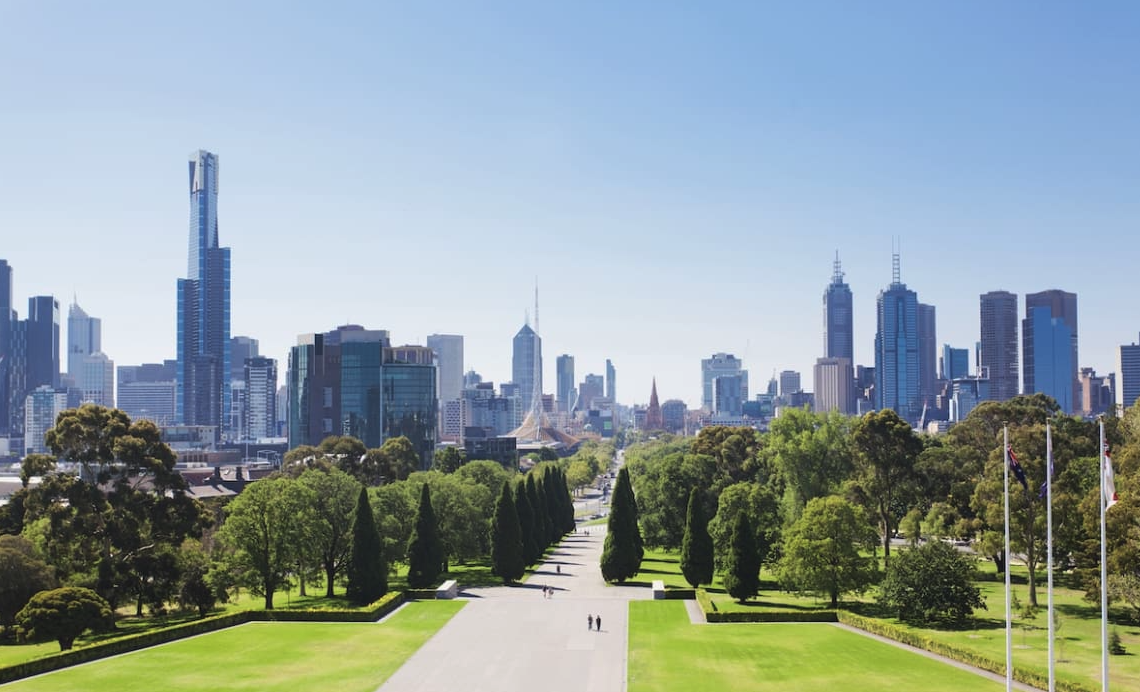
Melbourne set to overtake Sydney as Australia’s biggest city as property demand surges
Strong population growth, major infrastructure spending and comparatively affordable property are expected to cement Melbourne’s position as Australia’s most attractive long-term real estate market.
 2 min
2 min
Melbourne is poised to become Australia’s largest city within the next decade, with strong population growth, infrastructure investment and relative affordability driving long-term property demand.
A new research report from Knight Frank argues the Victorian capital remains one of the country’s most compelling markets for investors, businesses and residents.
The report highlights the city’s rapidly expanding population, diverse economy and major infrastructure pipeline as key factors underpinning future property growth.
Knight Frank Managing Director Victoria, Dominic Long, said Melbourne’s fundamentals continue to position the city strongly for long-term investment.
“Melbourne continues to stand out as one of Australia’s most compelling real estate markets,” he said.
“It is Australia’s strongest long-term growth city with the fastest growing population, the most diversified economy, world-class liveability and the most affordable major market for office, industrial and residential property.”
Population growth driving demand
Melbourne’s population has grown at an average rate of 1.8 per cent per year since 2000, faster than any advanced global economy, according to the research.
In the year to June 2025 alone, the city added about 123,500 residents, the largest annual increase of any Australian capital.
Population growth is expected to remain one of the key drivers of demand across residential and commercial property markets, including housing, offices and logistics space.
The report forecasts Melbourne’s population will overtake Sydney’s by the 2030s, reinforcing its position as the country’s fastest-growing major city.
Office market offering value
Melbourne’s CBD office market is also attracting renewed attention from investors.
Prime office rents remain significantly lower than in competing cities, with CBD office space about 46 per cent cheaper than Sydney and around 13 per cent cheaper than Brisbane.
That relative affordability is expected to drive long-term demand from occupiers and investors seeking value in Australia’s largest office markets.
The city’s office sector is also showing signs of recovery, with effective rents rising in 2025 and demand increasing for high-quality buildings in premium locations.
Industrial market benefiting from scale
Melbourne’s industrial sector continues to expand, supported by strong population growth, e-commerce demand and the scale of the city’s logistics network.
The city already hosts the country’s largest industrial market, with about 34 million square metres of warehousing stock and significant land available for future development.
Industrial rents remain competitive compared with other capitals, while Melbourne’s port handles the largest container volumes in Australia, further supporting demand for logistics space.
Infrastructure pipeline supporting growth
More than $200 billion in transport infrastructure investment between 2014 and 2036 is also expected to reshape the city and support future property values.
Major projects include the Metro Tunnel, the West Gate Tunnel, the North-East Link and the Suburban Rail Loop, which together will improve connectivity across Melbourne and its growth corridors.
Knight Frank’s Head of Research & Consulting, Victoria, Dr Tony McGough, said these investments would play a key role in supporting the city’s economic expansion.
“Melbourne is Australia’s most economically diverse city and has delivered stable growth for more than two decades,” he said.
“With strong population growth, a highly educated workforce and unprecedented infrastructure investment, Melbourne is well placed to remain one of Australia’s most attractive long-term property markets.”

Porsche’s Cayenne Turbo Electric produces up to 1,156PS and reaches 100km/h in a claimed 2.5 seconds.

BNW Developments has established a Sydney presence, joining Arada and Sobha Realty among the growing number of UAE developers pursuing Australian buyers and development opportunities.

Rising Australian bond yields are putting pressure on listed property and the cost of capital. Here’s why A-REITs can signal changes in property valuations before the direct market moves.
4 min
Most property investors spend considerably more time watching interest rates than bond markets.
That makes sense. The Reserve Bank cash rate has an obvious relationship with mortgage repayments, borrowing capacity and investor sentiment, while government bonds can seem far removed from what someone will pay for an apartment in Sydney or an office building in Melbourne.
But the bond market can provide one of the earliest indications that the price investors are willing to pay for property is changing.
That became evident last Thursday, when Australian shares suffered their worst trading session in months. The S&P/ASX 200 fell almost two per cent, with property among the rate-sensitive sectors caught in the sell-off as government bond yields moved sharply higher.
Australia’s 10-year government bond yield pushed to around 5.4 per cent, close to its highest level in 15 years, against a backdrop of rising global yields and renewed concern about inflation and the direction of interest rates.
For property investors, that matters because the government bond yield is effectively one of the reference prices for money.
An investor buying an Australian government bond is receiving a return while taking comparatively little credit risk. Property comes with tenants, vacancies, maintenance, leasing costs, illiquidity and the possibility that the underlying asset falls in value, so investors generally expect to be compensated for accepting those additional risks.
A property yielding five per cent therefore looks considerably more attractive when a 10-year government bond yields three per cent than when that same bond is yielding more than five per cent.
That does not mean property values automatically fall every time bond yields increase. Rental growth, scarcity, lease structures and the quality of an asset can all outweigh movements in rates, but it changes the return investors require and therefore what they may be prepared to pay.
SG Hiscock & Company made that point in an ASX Investor Update, arguing that real, or inflation-adjusted, bond yields can be particularly relevant to property because real estate is fundamentally a long-duration investment whose value is derived from future income.
The first place investors can often see that repricing is the sharemarket.
A house or commercial building does not have a price that changes every few seconds. An Australian real estate investment trust does.
A-REITs can own billions of dollars of shopping centres, offices, warehouses and other property, but their securities trade continuously on the ASX. When expectations around interest rates and bond yields change, investors can immediately alter what they are willing to pay for those property earnings.
That can create a situation where the value attributed to a portfolio on the sharemarket falls even though the underlying buildings have not changed hands and their independent valuations remain unchanged.
The two markets simply move at different speeds.
Mark Ferguson, Head of Charter Hall Maxim Property Securities, has previously described direct property valuations as lagging the listed market. Writing for Charter Hall during an earlier period of rising interest rates and bond yields, Ferguson noted that listed property was already pricing increases in capitalisation rates and falls in underlying property values before those adjustments had fully emerged in direct-market valuations.
The effect can be substantial.
Consider a commercial property producing $1 million a year in net operating income. At a five per cent capitalisation rate, that income implies a value of $20 million.
If investors subsequently require a 5.5 per cent return while the property’s income remains unchanged, the implied value falls to around $18.18 million. At six per cent, it falls again to roughly $16.67 million.
Nothing necessarily happened to the building. It could have the same tenant paying the same rent under the same lease. What changed was the return required by the person buying it.
That is also why income growth becomes so important.
A well-located property with constrained supply and strong rental growth can increase its earnings quickly enough to absorb some of the pressure from higher required returns. An ageing office building facing vacancies, refurbishment costs and an approaching debt refinancing could instead be hit from several directions at once.
Debt adds another dimension because property is one of the economy’s most capital-intensive asset classes.
Higher market rates can increase the cost of financing an acquisition or refinancing existing debt while simultaneously increasing the return investors expect from the property itself. For developers, the consequences can be even more pronounced because higher construction finance costs can coincide with lower anticipated end values.
If that happens, a project can be squeezed from both directions: it becomes more expensive to deliver at precisely the time investors become less willing to pay yesterday’s price for the finished asset.
The direct property market generally takes longer to reveal that adjustment.
An A-REIT can lose five per cent of its market value in a trading session. An office building may not transact for another year. Owners can reject lower offers, transactions can be withdrawn and valuers must wait for comparable sales to establish new evidence.
That lag is one reason listed property can be useful even for investors who have no intention of buying a REIT.
The same principle eventually extends to residential property, although houses and apartments are generally valued using comparable sales rather than capitalisation rates.
Residential property is particularly sensitive to credit. Higher bond and swap rates can influence bank funding and fixed mortgage pricing, while higher borrowing costs reduce the amount households can service.
If prospective buyers can borrow less, the number of people capable of paying yesterday’s price can shrink. Vendors may initially resist that adjustment, resulting in fewer transactions rather than immediate price falls, before motivated sales eventually establish new comparable values.
For investors, rental growth can provide an important buffer. Rising rents can help offset higher financing costs, just as increasing commercial rents can compensate for some expansion in capitalisation rates. Investors relying primarily on capital growth while accepting a low rental yield have considerably less protection when the cost of money rises.
That is why movements in listed property and bond markets deserve attention beyond the trading floor.
They provide a constantly updating view of how investors are pricing interest rates, debt, future income and property risk, often months before those changes become obvious in direct transactions.
For an A-REIT investor, that means looking at gearing, debt maturity, hedging, interest cover and the discount or premium to net tangible assets rather than simply chasing the highest distribution yield.
For a commercial property investor, it means testing what happens to valuations if capitalisation rates move 25, 50 or 100 basis points higher.
For residential investors, it means understanding mortgage costs, borrowing capacity, realistic rental income and how much of the investment case relies on future capital growth.
The cash rate will continue to attract most of the attention in Australian property. But investors looking for an earlier indication of how the market is repricing risk should also be watching the bond market.
Property prices might take months to respond to a changing financial environment. The price of money moves considerably faster.

Margot Robbie and Jacob Elordi star in an adaptation of the classic novel that respects the romance’s slow burn.

MAISON de SABRÉ’s new Spring Harvest Collection turns everyday produce into collectible leather charms and introduces fresh silhouettes in its cult Bucket bag family.