China’s Inflation Problem? It Has None

SINGAPORE—As Western central banks continue to jack up interest rates in an effort to douse stubbornly high inflation, China faces a growing risk of the opposite problem—deflation.

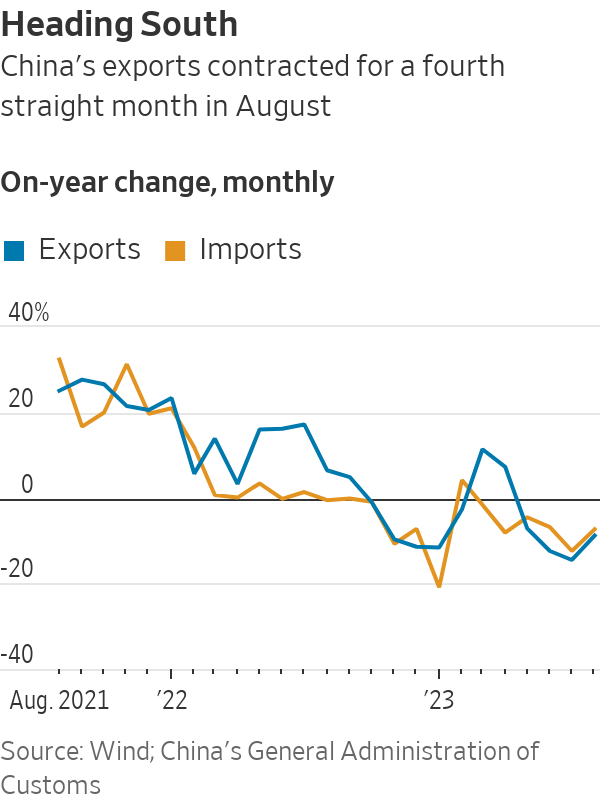
Prices charged by Chinese factories tumbled in May at their steepest annual pace in seven years, while consumer prices barely budged, fresh signs of the challenges faced by the world’s second-largest economy both at home and abroad.

Economists say the absence of inflationary pressure means China could experience a spell of deflation—a widespread fall in prices—if the economy doesn’t pick up soon.

Persistent deflation tends to throttle growth and can be difficult to escape. While a prolonged period of falling prices probably isn’t in the cards, Chinese policy makers will nonetheless need to do more to stave off that risk and get the economy motoring again, economists say, perhaps by trimming interest rates, weakening the currency or offering cash or other spending inducements to households and businesses.

Ting Lu, chief China economist at Nomura in Hong Kong, said in a note to clients Friday that he expects local banks to cut key lending rates as soon as next week.

In remarks made at a meeting Wednesday and published by China’s central bank after the release of monthly inflation data Friday, central-bank Gov. Yi Gang said he expects consumer-price inflation to edge up in the second half of the year and exceed 1% in December. He said the People’s Bank of China would use its tools to support the economy and promote employment.

Falling prices in China aren’t necessarily bad news for the global economy, as lower costs to import Chinese goods should help bring down inflation rates that for many economies are still uncomfortably high.

“In a sense, China is already exporting deflation to the world,” said Carlos Casanova, senior Asia economist at Union Bancaire Privée in Hong Kong. That could help ease the pressure on the U.S. Federal Reserve and other central banks that are battling to bring down inflation, he said.

China’s producer prices—what companies charge at the factory gate—fell 4.6% from a year earlier in May, the weakest reading since early 2016 and the eighth straight month of declines.

Consumer prices rose just 0.2%, China’s National Bureau of Statistics said Friday, slightly higher than the 0.1% annual gain recorded in April but still well below the 3% ceiling for annual inflation set by the government and central bank.

In the U.S., consumer-price inflation in April slowed to a 4.9% annual rate, but that was still more than double the Federal Reserve’s 2% goal. In the 20 nations that use the euro, annual inflation was 6.1% in May.

After soaring last year in the wake of Russia’s invasion of Ukraine, prices of crude oil, food and some other commodities have pulled back, partly leading to China’s subdued inflation.

But also behind China’s predicament, which stands in contrast to the experience of most other economies as they emerged from the Covid-19 pandemic, is a shortfall in spending both domestically and from overseas.

Chinese factories are cutting prices because foreigners aren’t buying their goods with the same gusto as before central banks started ratcheting up borrowing costs. A hoped for consumer spending binge that was supposed to propel growth in China hasn’t materialised. Real estate is in the doldrums, crushing investment.

Western policy makers and economists are exploring whether fat corporate profit margins are stoking inflation in their economies. In China, industrial profits are sinking.

The inflation data adds to a string of disappointing signals on the strength of China’s recovery, which had been expected to power global growth this year after Beijing ditched its draconian Covid controls at the close of 2022.

Chinese exports fell in May from a year earlier, the first annual decline in overseas shipments in three months. Business surveys showed factory activity shrank in May and services-sector activity softened. More than a fifth of young people are unemployed.

Still, most economists think China will meet or exceed the government’s goal of growing the economy by 5% or more this year, given the weak base of comparison with 2022, when sporadic lockdowns in major cities hammered the economy.

Zichun Huang, China economist at Capital Economics, said she doesn’t think China will experience broad deflation and expects consumer price growth to pick up in the coming months thanks to support from policy makers and an improving labor market.

—Grace Zhu in Beijing contributed to this article.

The Benefits of Eavesdropping on Office Conversations

It is one of the hardest things about working in an office: You are constantly overhearing other people. Sometimes it is just distracting chatter. Sometimes it is the proverbial “too much information” about people’s lives or projects. And, of course, sometimes other people are listening in on you.

But what if the ability to eavesdrop is a benefit for your work life, not a negative?

Workers can gain a host of insights from the buzz of conversations around them, some executives and researchers say. Eavesdropping not only can deliver information about what is happening at the company, it can help people understand their colleagues’ mind-sets, workloads and moods. It can help people learn who’s who in the organisational structure and pick up tips on how to have certain kinds of conversations. Some workplaces are even trying to create opportunities for this kind of informational osmosis to occur.

This new respect for eavesdropping is driven in part by the return to work after the pandemic. Employees are starting to realise how much they benefited from the information they absorb by seeing co-workers in person—anything from weekend plans to forthcoming work projects.

“They have more opportunities to listen in on the water-cooler conversations,” says Johnny Taylor, chief executive of SHRM, the Society for Human Resource Management.

Chattering classes

Robert Burns, a marketing director at Sunnking, an electronics recycler in Brockport, N.Y., says that he often eavesdrops on co-workers as they make their business calls. It helps him better understand how they speak about the company to clients or vendors, which, in turn, helps him pick up tips on what does and doesn’t work, he says.

After overhearing them, he also has given co-workers “talking points” to help them use less industry jargon when discussing the recycling business. The object, he says, is to make it easier for them to relate to clients. “It benefits me in this role and my team to hear what everyone is doing—whether they like it or not,” he says.

Burns is careful of what is said in more hushed tones around the office. When he overhears information being said in a whisper, he is more hesitant about bringing it up later or in meetings. “I can probably hear it, but I don’t need to acknowledge it,” he says. “It’s kind of an unwritten understanding.”

The biggest benefits to eavesdropping go beyond hearing what is said, according to researchers. Seeing who is talking to whom can make it easier to accurately map out other people’s networks, says Hillary Anger Elfenbein, professor of organisational behaviour at Washington University in St. Louis who studies the topic. With that knowledge, employees can better understand how to influence company decision makers based on whom they know or where to turn to find information.

In her research, she found that most employees find it difficult to accurately define these networks without in-person opportunities. Even if the chat is muffled, “you hear about the relationship between them,” she says, through cues like body language.

In recent years, when fewer people are in the office, being in a situation to overhear conversations is also “more valuable for the eavesdropper,” says Elfenbein. With fewer chances for in-person conversations taking place, every chance to listen in is all the more important.

Deploying design

Many companies are starting to see the benefits of promoting awareness of workplace behaviours, including overheard conversations, and are exploring office layouts that encourage the practice, says Brian Stromquist, who leads the technology workplace practice at design and architecture firm Gensler. Specifically, he is seeing more interest from companies that want eavesdropping to serve as an informal way of mentorship between junior and senior employees. A newer employee can benefit simply from overhearing a more senior person participating in a meeting, solving a problem or leading a project.

“Eavesdropping is seen as a subset of observation where junior employees can observe leadership qualities,” he says.

From a design perspective, that means Gensler is now creating more spaces where there are different areas that are explicitly designed to encourage and discourage listening, “allowing for a spectrum of acoustic privacy,” says Stromquist, who is based in San Francisco. For instance, an area of open desks may make it purposely simple to overhear conversations, while another part of the floor may use music or white noise to create an atmosphere more conducive to privacy, he says. Deep-focus spaces or quiet libraries are explicitly places where employees should not be listened to, he adds.

“As people are re acclimating to the office, they’ve kind of established this new set of protocols that really recommend how you might use new spaces within the office,” he says.

Mind your manners

Of course, no one recommends purposely seeking out private or personal conversations to listen in on. And you should only act on information that you overheard without violating somebody else’s privacy.

“You don’t want to create a culture where people feel like you’re big-brothering them and hearing everything they say,” says Adam Struck, founder of Struck Capital, a venture-capital firm based in Los Angeles.

It is possible that employees in certain roles are more likely to be in need of eavesdropping for success, says Leila Bighash, assistant professor of communication at the University of Arizona, who studies social eavesdropping. Previous research showed that nurses, physicians and hospital staff were more likely to consider eavesdropping at work as integral to their job because they could overhear information at a cardiac intensive-care unit that was critical to a patient’s health.

People in a cutthroat work environment may also benefit more from eavesdropping, Bighash says. In those workplaces, people may be more reluctant to share information in direct conversation with certain people. So employees who listen to others can learn about projects outside of their department, or potential conflicts or challenges.

Digital eavesdropping

Eavesdropping doesn’t have to be confined to in-person conversations. With so many people keeping in touch with far-flung co-workers digitally, there are now more companies replicating the office environment by offering more opportunities for digital eavesdropping, says Paul Leonardi, professor of Technology Management at UC Santa Barbara.

One opportunity to digitally eavesdrop is through Slack channels or other messaging apps that allow for many participants, he says. Another is for people to access company materials and presentations online or by listening to recorded Zoom calls that aren’t directly related to their work, says Leonardi.

Leonardi suggests using messaging apps, including Slack, to get a sense of other employees’ lives, especially outside of work. In his research, he finds that information from this kind of digital eavesdropping—such as details about a vacation—makes a good ice breaker when approaching these same workers offline.

“People’s comfort at reaching out to other people on whose information they have eavesdropped increases if they know stuff about them,” he says.

But be cautious when using overheard information, says Deborah Grayson Riegel, an executive coach in Chapel Hill, N.C., who works with large companies on communication. Much of the time, employees need to be aware that some of the information may be confidential, jeopardise company initiatives or simply be interpreted incorrectly.

“You need to understand that you are hearing it out of context, and it’s not the full story,” she says.

Buying Australian: why it’s no longer a sign of parochialism

Mention Australian made products to family and friends and it’s likely everyone will agree it’s a good thing to do. 

Polling by Roy Morgan as recently as February this year shows 80 percent of shoppers consider buying Australian made products important, mainly because it supports local jobs and the wider economy. The survey also found that 67 percent of shoppers reported buying Australian-made products ‘often’ or ‘always’.

But while most of us are happy to buy, say, Australian made peanut butter or even skin care products, we’re less inclined to choose a locally crafted table over an imported product, mainly because of the price. 

Canberra-based craftsman Rolf Barfoed says COVID changed attitudes to buying local. With many working from home and borders closed to everyone and everything — including many goods manufactured offshore — Australians began to reassess their buying practices, as well as their domestic environments.

“We got quite busy after COVID struck because people were forced to look inwards and instead of going overseas on holiday, they had a bit of money to spend locally,” Barfoed says of his workshop where he manages a team of three. “There were a lot of people working from home and they were looking at their homes more critically.”

Desks and bookshelves were a popular choice, as many looked to properly furnish home offices, while beds and bedside tables also rated highly, providing a sense of sanctuary and comfort during uncertain times.

However, as restrictions lifted and with more people growing concerned about rising cost of living pressures, Barfoed says he has noticed a shift in buying patterns.

“Ever since the threat of recession, things have tightened up and sales have slowed,” he says.

For more stories like this, order your copy of the latest issue of Kanebridge Quarterly magazine here

While some may be put off by the higher costs — a reflection of higher wages being paid to Australian workers — Barfoed says the final price is just the start of the story. He gains most of his work from Sydney and Canberra via word-of-mouth commissions, allowing buyers to connect with their piece of furniture from the start. And some connections are stronger than others.

“In Canberra there is a pool in Manuka and there was a big oak tree over the pool which came down in a storm,” he says. “We had people who had swum in that pool as children who asked if we could make something out of the tree for them, so we created two dining tables. It helps that the timber miller is well connected in town and he has the means to pick up trees like that.”

Most timber, however, is sourced through more traditional avenues, although local timbers have been harder to find since the 2019/2020 bushfires. 

For those after something unique and fit for purpose though, the experience of commissioning from a local maker is unmatched.

“The option for customisation is a big factor and we will tailor it to exactly what the client wants,” Barfoed says. “It is always a nerve wracking experience handing over a piece of furniture. You want the client to be happy with your work.”

Kate Stokes, co-founder of award-winning Melbourne lighting and furniture studio Coco Flip says ‘locally made’ also means shorter lead times and more reliable supply chains for retailers, designers and homeowners.

“We have really good relationships with all our manufacturers which means there’s a lot more quality assurance,” she says. “If something goes wrong, you just send it back to us. You can’t do that so easily if it’s arrived by ship.”

While the products, which include their Coco pendant light, Mayu floor lamp and Sequence dining tables often do cost more upfront than imported items, Stokes says they are better financial investments over the long term.

“We want to design things that people are not going to tire of in five years so our designs are classic, contemporary and able to fit into a range of styles and interiors,” she says. “Construction has to be robust and material choices have to be solid and last a long time.

“We want people to love them for a long time.”

Stokes and co-founder Haslett Grounds also work with longstanding manufacturers such as Specialty Pleaters in Williamstown, which was founded in 1925 and is now the last remaining pleating studio in Melbourne.

“We love working with local manufacturers and Specialty Pleaters have been in business for about 100 years but they are potentially facing closure because production is increasingly going off shore,” Stokes says.

Australian furniture manufacturing legend, Tony Parker, of Parker Furniture fame says if Australians don’t support locally made furniture and homewares, they will cease to exist — and those traditional skills will all but vanish.

“When you buy locally made, the goods are also serviced in Australia and the infrastructure to manufacture is here,” Parker says. “You have apprenticeships for training people in cabinetwork, upholstery and other skilled trades.”

He laments what he sees as the decline in quality of mass produced goods flooding the Australian market from overseas, not just because it means jobs are taken offshore, but that buyers are not getting value for money.

Australian furniture legend Tony Parker laments the quality of furniture imported into Australia

“They have slowly eroded quality,” he says. “Everyone closes on price. In actual fact, people are paying more than they were in the 70s, relative to wages, and it was better made then.

“The retailer is looking for a cheaper price and the customer is not looking at quality.”

Fred Kimel, founder of Handkrafted, which connects Australian makers directly with the public, says buying locally is an investment in the future, in more ways than one.

“The result is (a piece) typically much higher quality than the vast majority of furniture that is manufactured overseas,” Kimel says. Locally made bespoke furniture is made-to-last and will retain value as it can always be sold or passed on — it’s far less likely to find its way into landfill.

“On the sustainability front, our local regulations help to ensure that timber used by local makers is forestry certified and not from unregulated or illegally logged forest timber.”

And if it’s that lovely rush of endorphins experienced when you buy that floats your boat, buying an Australian made product has to be the ultimate shopping high.

Craftsman Josh Pinkus in his Sydney workshop. His work is available through Handkrafted.

“Perhaps one of the biggest draw cards is simply the enjoyable process of working so closely with a local maker,” Kimel says. 

“Clients will often visit their workshops and take much more interest in the selection of raw materials, design decisions and production methods. It’s an experience that lives on through the product.”

Advance Australia fair, indeed.

Job Applicants Can Support a Company’s Mission—and Still Ask for More Money

Want to work for a company that says it makes the world a better place? Be careful—you might feel guilted out of asking for higher pay.

Job postings today are peppered with language promoting an organisation’s mission, its purpose and the importance of making an impact. But those positive messages can have a chilling effect on applicants. In several studies, my colleagues and I found that the social messages in job postings make people think it would be a bad idea to ask for more money. They fear that the managers will think of them as selfish, or that company values make salary requests taboo.

Great reluctance

To be clear, the problem isn’t that companies advertise broad social initiatives—known as social impact framing—or that they want employees to genuinely care about the work itself. Longstanding research has even shown that corporate social programs can benefit employees, who enjoy a greater sense of motivation and meaningfulness when their work demonstrably makes a positive difference.

But this notion of higher purpose can make applicants wary of seeking higher pay.

My colleagues and I tested this idea over five experiments that measured how applicants handled salary negotiations with different companies: Some were described with phrases such as “mission orientation,” “higher purpose” and “giving back,” while others weren’t. We didn’t say whether the company was a nonprofit, engaged in charitable giving or could afford higher wages; our focus was on the language or framing used to describe the work, regardless of the company’s business model.

The results were remarkably consistent. Across the studies, job candidates exposed to social impact framing told us the company would see it as crass or inappropriate to ask for material rewards like a higher salary—so they avoided negotiating for more.

In the first study, 392 participants provided open-ended responses as to whether they would ask for higher pay at hypothetical companies, along with their rationale. Those who were given social impact framing were 32 percentage points less likely to say “yes” to negotiating. In addition, the group who gave negative responses was more than twice as likely as the control group to use phrases such as “doing so would be taboo,” “make you look selfish if you asked,” and “would likely make the organization less interested in hiring me.”

In the second and third studies, we tested the effect in real-world contexts. In one, we asked 438 undergraduate students whether they would ask for more money for a purportedly real on-campus job opportunity. In the other, we asked 1,525 online workers recruited from a crowdsourcing marketplace to bid for a purported writing-related task.

In each case, the odds of negotiating were approximately 42 percentage points lower when the work was framed in social impact terms. Survey responses showed that this was driven by workers’ perceptions that they would be violating the organisation’s expectations for employee motivation by showing interest in higher pay.

Our fourth study replicated the effects above, while our fifth study showed that effects held across a range of industries—from education to financial services.

A matter of perception

Why did this happen? We theorise that the applicants assumed that managers and companies had motivation purity bias—thinking that employees who are interested in a job’s material rewards care less about the work itself. And, indeed, previous research has shown that this bias does affect managers’ decisions.

That means few applicants want to be seen as the person who gives priority to money over more lofty, altruistic goals. You either love the work itself and want to help others or care about material rewards like higher pay. It can’t be both.

But that attitude is simply romanticising. Research shows that people often do their jobs better when they get a combination of extrinsic rewards like high salary and intrinsic ones like idealism about a mission.

The consequences of holding back on salary requests can be huge. Previous research has shown that fear of asking for even a small increase in starting pay can cost people hundreds of thousands of dollars over the course of a career. For companies, skimping on pay because of misguided beliefs can lead to missed opportunities to boost performance and productivity.

How to overcome the bias? Employees should do research on companies to see how the businesses react to salary requests. For their part, companies can create greater pay transparency, use objective criteria to set salary and train managers to watch out for bias.

Passion for work is wonderful. But we shouldn’t romanticise it as the only legitimate reason to take a job.

Eurozone Slides Into Recession as Inflation Hurts Consumption

The eurozone has slipped into recession as Germany, its largest economy, wobbled, suggesting that the impact of Russia’s war in Ukraine may have been deeper than expected earlier this year.

While the U.S. economy has so far brushed aside higher borrowing rates and continues to grow thanks to robust consumption, employment and an extended market rally, Europe is lagging ever further behind, stuck in the economic equivalent of long Covid. While the U.S. economy is now 5.4% larger than it was before the Covid-19 pandemic struck, the eurozone economy is just 2.2% bigger.

Inflation driven by a spike in energy costs and stubbornly high food prices has softened in Europe recently but remains much higher than policy makers would like and is affecting consumption negatively.

The weakness in Germany is a particular concern. In past decades, the country’s economy often managed to recover rapidly from economic shocks thanks to the strength of its highly competitive exporters.

But global trade has suffered under the Covid-19 pandemic and mounting geopolitical tensions, and it may not offer the same degree of support this time. Factory output in the country showed a steep drop in March. And the continuing war in Ukraine, a close neighbour, is another major source of uncertainty for the region.

Because of its size, the German economy on its own can drag the eurozone up or down. The eurozone’s slide into recession at the start of the year came in spite of growth in France, Italy and Spain, its other large economies.

Economists think all this points to a slow and protracted recovery for the continent later this year, where consumers and businesses are also feeling the drag from higher borrowing costs as the European Central Bank continues to raise interest rates to fight inflation. The eurozone’s slide into recession wasn’t so dramatic as to trigger a pause in the ECB’s rate-raising campaign, according to most analysts.

The European Union’s statistics agency said Thursday the combined gross domestic product of the countries that share the euro fell at an annualised 0.4% during the three months through March, having also declined in the final three months of last year.

Eurostat had previously estimated that the currency area’s economy grew slightly in the first quarter, but the sizeable change to the data from Germany and weakness in Ireland and Finland pushed it into contraction. This left the region with two consecutive quarters of shrinking output, matching the official definition of an economic recession.

Economists expect growth to resume in the three months through June as falling energy bills ease the pressure on household budgets, but any rebound is likely to be anaemic. The Organization for Economic Cooperation and Development on Wednesday said it expected the eurozone’s economy to grow 0.9% this year, roughly half as much as the U.S. economy.

The main difference between the eurozone and the U.S. is consumer spending. Americans are spending freely on the activities they skipped during pandemic lockdowns, such as travel, concerts and dining out. Unlike Europeans, they haven’t had to cut their spending on goods to be able to do so. In Europe, household spending fell in both the final quarter of last year, and the first quarter of 2023. Imports also fell sharply in both quarters, a sign that weakness in the eurozone is affecting businesses in other parts of the world.

One reason for the growing trans-Atlantic economic gap is the amount of savings Americans accumulated during the pandemic. Oxford Economics estimates that while excess savings in the U.S. stood at around 8.3% of annual economic output at the end of 2022, in the eurozone the equivalent was just over 5%. Americans have also been more willing to draw on those savings, with surveys showing Europeans are conscious of the uncertainties flowing from the war in Ukraine.

Back in Europe, while energy prices have normalised from their 2022 peaks, food prices have continued to rise at a rapid pace, weakening household spending on other goods and services. U.S. food prices have been rising half as quickly as their European equivalents so far this year.

The European Central Bank’s series of rate increases, which started in July last year, have now worked their way through the currency area’s financial system. The drag on growth from that source is likely to build during coming months, with the ECB signalling that it intends to raise its key interest rate for an eighth straight meeting next week.

“A peak in underlying inflation wouldn’t be sufficient to declare victory: We need to see convincing evidence that inflation returns to our 2% target in a sustained and timely manner,” ECB policy maker Isabel Schnabel said Wednesday. “We aren’t at that point yet.”

The OECD said it expects eurozone inflation to fall to 5.8% this year from 8.4% in 2022, but remain well above the ECB’s target at 3.2% in 2024.

One reason for the eurozone’s slide into recession is that Ireland—long the currency area’s fastest-growing economy—experienced a 44.7% decline in factory output during March, likely driven by U.S. pharmaceutical companies that operate in the country. That led to a 17.3% annualized fall in the country’s GDP during the first quarter.

Ireland’s statistics office hasn’t offered a reason for that drop in production, but figures it released Wednesday showed a rebound of 70.7% in April, suggesting the first-quarter contraction is unlikely to be sustained.

The eurozone’s poor economic performance so far this year partly reflects the costs of Moscow’s invasion of Ukraine last year. The Russian economy contracted 2% last year and the OECD expects it to shrink a further 1.5% this year and 0.4% in 2024. Ukraine’s economy shrank by a third in 2022, and is likely to have suffered further damage following the destruction of a dam and hydroelectric plant in the country’s south this week.

In the U.S., unlike in Europe, a weakening of the jobs market is required before the National Bureau of Economic Research, an academic group, declares a recession. That has yet to happen in the eurozone, with employment increasing 0.6% during the first quarter.

Keep your head in the clouds in a property with its heart in the city

It’s hard to think of another city in the world that offers the kind of diversity and amenity that Sydney delivers. While many focus on the stunning harbour, there’s a myriad of beautiful waterways providing a connection to the natural environment while also keeping a finger on the pulse of a vibrant city centre.

This recently completed penthouse apartment on the Parramatta River in the heart of Sydney’s second major city is a perfect example of luxury living. Located in The Lennox, a 46-storey apartment building designed by Marchese Partners and JPW Architects, the property at 4602/12 Philip Street, Parramatta has four bedrooms and three bathrooms, with 3m-high ceilings adding to the sense of space and gracious comfort. 

The open plan living and dining area features timber floors laid in a chevron pattern and leads onto an exceptionally well-equipped kitchen featuring Gaggenau appliances, a built-in coffee machine, a Vintec wine fridge and Zip hot and cold tap.

A generous, north east facing outdoor living area is accessible via bi-fold doors leading off the living area, offering commanding views of the surrounding area. The house-like proportions of the apartment allow for distinct sleeping and living zones, with three of the four bedrooms separated by the dedicated home office space. A fourth bedroom on the other side of the living area would be ideal for visiting guests.

In addition to the spacious apartment, the property is being sold with secure parking for three cars. There is also access to a 24-hour concierge service, as well as a 20m heated swimming pool, a fully equipped gym and a dedicated function room.


Address: 4602/12 Philip Street, Parramatta

Price guide: $4 million

Agent: Sunny Gandhi sunnyg@theagency.com.au 0421 336 689

Inspection: By appointment

China’s EV Juggernaut Is a Warning for the West

China rocked the auto world twice this year. First, its electric vehicles stunned Western rivals at the Shanghai auto show with their quality, features and price. Then came reports that in the first quarter of 2023 it dethroned Japan as the world’s largest auto exporter.

How is China in contention to lead the world’s most lucrative and prestigious consumer goods market, one long dominated by American, European, Japanese and South Korean nameplates? The answer is a unique combination of industrial policy, protectionism and homegrown competitive dynamism. Western policy makers and business leaders are better prepared for the first two than the third.

Start with industrial policy—the use of government resources to help favoured sectors. China has practiced industrial policy for decades. While it’s finding increased favour even in the U.S., the concept remains controversial. Governments have a poor record of identifying winning technologies and often end up subsidising inferior and wasteful capacity, including in China.

But in the case of EVs, Chinese industrial policy had a couple of things going for it. First, governments around the world saw climate change as an enduring threat that would require decade-long interventions to transition away from fossil fuels. China bet correctly that in transportation, the transition would favour electric vehicles.

In 2009, China started handing out generous subsidies to buyers of EVs. Public procurement of taxis and buses was targeted to electric vehicles, rechargers were subsidised, and provincial governments stumped up capital for lithium mining and refining for EV batteries. In 2020 NIO, at the time an aspiring challenger to Tesla, avoided bankruptcy thanks to a government-led bailout.

While industrial policy guaranteed a demand for EVs, protectionism ensured those EVs would be made in China, by Chinese companies. To qualify for subsidies, cars had to be domestically made, although foreign brands did qualify. They also had to have batteries made by Chinese companies, giving Chinese national champions like Contemporary Amperex Technology and BYD an advantage over then-market leaders from Japan and South Korea.

To sell in China, foreign automakers had to abide by conditions intended to upgrade the local industry’s skills. State-owned Guangzhou Automobile Group developed the manufacturing know-how necessary to become a player in EVs thanks to joint ventures with Toyota and Honda, said Gregor Sebastian, an analyst at Germany’s Mercator Institute for China Studies.

Despite all that government support, sales of EVs remained weak until 2019, when China let Tesla open a wholly owned factory in Shanghai. “It took this catalyst…to boost interest and increase the level of competitiveness of the local Chinese makers,” said Tu Le, managing director of Sino Auto Insights, a research service specialising in the Chinese auto industry.

Back in 2011 Pony Ma, the founder of Tencent, explained what set Chinese capitalism apart from its American counterpart. “In America, when you bring an idea to market you usually have several months before competition pops up, allowing you to capture significant market share,” he said, according to Fast Company, a technology magazine. “In China, you can have hundreds of competitors within the first hours of going live. Ideas are not important in China—execution is.”

Thanks to that competition and focus on execution, the EV industry went from a niche industrial-policy project to a sprawling ecosystem of predominantly private companies. Much of this happened below the Western radar while China was cut off from the world because of Covid-19 restrictions.

When Western auto executives flew in for April’s Shanghai auto show, “they saw a sea of green plates, a sea of Chinese brands,” said Le, referring to the green license plates assigned to clean-energy vehicles in China. “They hear the sounds of the door closing, sit inside and look at the quality of the materials, the fabric or the plastic on the console, that’s the other holy s— moment—they’ve caught up to us.”

Manufacturers of gasoline cars are product-oriented, whereas EV manufacturers, like tech companies, are user-oriented, Le said. Chinese EVs feature at least two, often three, display screens, one suitable for watching movies from the back seat, multiple lidars (laser-based sensors) for driver assistance, and even a microphone for karaoke (quickly copied by Tesla). Meanwhile, Chinese suppliers such as CATL have gone from laggard to leader.

Chinese dominance of EVs isn’t preordained. The low barriers to entry exploited by Chinese brands also open the door to future non-Chinese competitors. Nor does China’s success in EVs necessarily translate to other sectors where industrial policy matters less and creativity, privacy and deeply woven technological capability—such as software, cloud computing and semiconductors—matter more.

Still, the threat to Western auto market share posed by Chinese EVs is one for which Western policy makers have no obvious answer. “You can shut off your own market and to a certain extent that will shield production for your domestic needs,” said Sebastian. “The question really is, what are you going to do for the global south, countries that are still very happily trading with China?”

Western companies themselves are likely to respond by deepening their presence in China—not to sell cars, but for proximity to the most sophisticated customers and suppliers. Jörg Wuttke, the past president of the European Union Chamber of Commerce in China, calls China a “fitness centre.” Even as conditions there become steadily more difficult, Western multinationals “have to be there. It keeps you fit.”

How Hackers Can Up Their Game by Using ChatGPT

Consumers, beware: AI chatbots like ChatGPT are likely to drive an increase in the use and effectiveness of online fraud tools such as phishing and spear-phishing messages.

In fact, it could already be happening. Phishing attacks around the world grew almost 50% in 2022 from a year earlier, according to Zscaler, a cloud-security provider. And, some experts say, artificial-intelligence software that makes phishing messages sound more believable are part of the problem. AI reduces or eliminates language barriers and grammatical mistakes, helping scammers impersonate a target’s colleagues, friends or relatives.

“This new era is going to be worse than what we had before,” says Meredith Broussard, research director at the New York University Alliance for Public Interest Technology. “And what we had before was really, really bad.”

High stakes

AI chatbots have exploded in popularity, with perhaps the best-known being ChatGPT, developed by the AI-research company OpenAI, a strategic partner of Microsoft. But dozens of chatbots, using what are referred to as large language models, are becoming more widely available and can closely mimic human communication based on data they amass. These models can be used for many purposes, such as helping office workers create routine memos more quickly. But they can also be used by criminals—to defraud victims, for instance, or to spread malicious viruses.

Telltale signs of a phishing attack have long included mistakes in grammar or spelling. But AI can give a phishing attack more credibility—and reach—not just because of its ability to generate fluent, grammatical messages in many languages, but also because of its ability to mimic the speaking or writing styles of individuals.

“The whole point with large language models is their ability to emulate what humans sound like,” says Etay Maor, senior director of security strategy at Cato Networks, a cloud networking and security provider.

Thus, given the opportunity to learn the style in which a certain person writes emails and texts, Maor says, an AI program can be used to mimic communications from a company executive.

“It’s all about trust, and if I can make you think I’m one of you, you’re going to begin to do things with more trust and less skepticism,” says Roger Grimes, a computer-security professional with KnowBe4, a security-awareness training and simulated-phishing platform.

Using AI, Grimes says, criminals can quickly determine industry-specific terms that give them more ability to target companies such as hospitals, banks and fintech.

Targeted campaigns

AI’s usefulness in phishing and spear-phishing attacks doesn’t stop with its ability to mimic authentic human communication. The analytic skills of machine learning can also be useful in determining who best to target in an organization and how exactly to attack them.

Sean McNee, vice president of research and data at DomainTools, an internet intelligence company, offers a hypothetical example. Say an accountant at a company innocently posts on social media about his frustrations with a recent audit. AI could determine the accountant’s peers, his company’s reporting structure and who else at the company might be most susceptible to an attack. The attacker then could create a spear-phishing email purporting to be from the chief financial officer referring to a discrepancy in the audit and asking the recipient to open an attached spreadsheet that contains a virus.

Ramayya Krishnan, dean of Carnegie Mellon University’s Heinz College, recommends being proactive to protect against such attacks.

First, before acting on something, he says, people should always verify the legitimacy of the request through independent means. This means before clicking on a link or sending money, the recipient should call the individual through a familiar phone number or walk into the person’s office to confirm the request, Krishnan says.

Maintain a healthy dose of skepticism for everything you receive, Maor says. Ask yourself, why is my bank emailing me? Why is there a sense of urgency? Why is there an attachment to click on? It’s also advisable to hover over a link before clicking to see if it leads to an expected URL. “If you have some reason to think something is amiss, don’t click on it,” Maor says.

Other guardrails

Strong regulation of AI could also help, says Broussard, who is also an associate professor at the Arthur L. Carter Journalism Institute of New York University.

AI itself should also be enlisted to help identify malicious content with its origins in AI, says Dave Ahn, chief architect at Centripetal, a cybersecurity company. But first the models for doing so will have to evolve and the data will have to improve. Data on successful AI-based attacks will help cybersecurity experts train new models to identify malicious activity better, says Ahn.

Other possible security measures include giving users a way to distinguish their content as authentic. The use of hidden patterns known as “watermarks,” for instance, can be buried in AI-generated texts to help identify whether the words are written by a human or computer, Krishnan says. But the applicability of these tools is limited.

Says Krishnan, “We’re not near deploying them at scale where it’s a solution to the bad-actor potential we have today.”

RBA Governor explains the rate rises we had to have

Leaders in Australia’s property industry are calling on the RBA to hit the pause button on further interest rate rises following yesterday’s announcement to raise the cash rate to 4.1 percent.

CEO of the REINSW, Tim McKibbin, said it was time to let the 12 interest rate rises since May last year take effect.

“The REINSW would like to see the RBA hit pause and allow the 12 rate rises to date work their way through the economy. Property prices have rebounded because of supply and demand. I think that will continue with the rate rise,” said Mr McKibbin.  

The Real Estate Institute of Australia  today released its Housing Affordability Report for the March 2023 quarter which showed that in NSW, the proportion of family income required to meet the average loan repayments has risen to 55 percent, up from 44.5 percent a year ago.

Chief economist at Ray White, Nerida Conisbee, said while this latest increase would probably not push Australia into a recession, it had major implications for the housing market and the needs of ordinary Australians.

“As more countries head into recession, at this point, it does look like the RBA’s “narrow path” will get us through while taming inflation,” she said. 

“In the meantime however, it is creating a headache for renters, buyers and new housing supply that is going to take many years to resolve. 

“And every interest rate rise is extending that pain.”

In a speech to guests at Morgan Stanley’s Australia Summit released today, Governor Philip Lowe addressed the RBA board’s ‘narrow path’ approach, navigating continued economic growth while pushing inflation from its current level of 6.8 percent down to a more acceptable level of 2 to 3 percent.

“It is still possible to navigate this path and our ambition is to do so,” Mr Lowe said. “But it is a narrow path and likely to be a bumpy one, with risks on both sides.”

However, he said the alternative is persistent high inflation, which would do the national economy more damage in the longer term.

“If inflation stays high for too long, it will become ingrained in people’s expectations and high inflation will then be self-perpetuating,” he said. “As the historical experiences shows, the inevitable result of this would be even higher interest rates and, at some point, a larger increase in unemployment to get rid of the ingrained inflation. 

“The Board’s priority is to do what it can to avoid this.”

While acknowledging that another rate rise would adversely affect many households, Mr Lowe said it was unavoidable if inflation was to be tamed.

“It is certainly true that if the Board had not lifted interest rates as it has done, some households would have avoided, for a short period, the financial pressures that come with higher mortgage rates,” he said. 

“But this short-term gain would have been at a much higher medium-term cost. If we had not tightened monetary policy, the cost of living would be higher for longer. This would hurt all Australians and the functioning of our economy and would ultimately require even higher interest rates to bring inflation back down. 

“So, as difficult as it is, the rise in interest rates is necessary to bring inflation back to target in a reasonable timeframe.”

World Bank Brightens View of Global Growth This Year, Downgrades 2024

WASHINGTON—The World Bank sees better global economic growth than previously estimated in 2023, thanks to resilient U.S. consumer spending and China’s faster-than-expected reopening in the early part of the year.

The bank still expects slowing growth in the second half of this year and a muted expansion into next year, according to its forecast released Tuesday. It warned that stubbornly high inflation and interest-rate increases are weighing on economic activity around the world, particularly in developing countries.

The bank now projects the world’s economy will grow 2.1% this year, up from the 1.7% pace it forecast in January. The new estimate still marks a slowdown from last year’s 3.1% expansion.

“The global economy remains in a precarious state,” the multilateral lender said in the latest issue of its semiannual Global Economic Prospects report. The bank noted overlapping negative shocks from the pandemic, Russia’s invasion of Ukraine and the sharp tightening of monetary policy.

The bank forecasts growth of 2.4% next year—a pickup from this year, but not as much as its January estimate of 2.7%.

The somewhat improved 2023 outlook is consistent with other data showing the U.S. and much of Europe have so far avoided a recession that many forecasters expected heading into 2023.

Better-than-expected economic performances at the start of the year have helped keep inflation stubbornly high in many advanced economies. As a result, policy makers in the U.S. and other rich nations have continued to raise interest rates to tame inflation. The World Bank says that the impact is felt particularly acutely in many developing nations.

For many lower-income countries, higher rates are crimping growth, slowing investment and intensifying the risk of financial crises, the bank said.

“The possibility of more widespread banking turmoil and tighter monetary policy could result in even weaker global growth,” the World Bank said. Rapid U.S. rate increases since early 2022 have created a pocket of volatility in the otherwise stable banking system, contributing to the failures of Silicon Valley Bank, Signature Bank and First Republic Bank earlier this year.

The drag on economic activities from tighter monetary policy is growing more pronounced in interest-rate-sensitive sectors such as business and residential investments.

Emerging markets and developing economies outside of China are expected to see their growth slow to 2.9% this year from 4.1% last year.

“Besieged by high inflation, tight global markets and record debt levels, many countries are simply growing poorer,” said Indermit Gill, World Bank chief economist.

Some of the world’s poorest nations are particularly vulnerable. Many of their governments have been forced to spend growing shares of their limited resources to pay higher interest on their debts, putting their finances in precarious positions and raising risks of financial dislocations, the World Bank said.

The average ratio of debt to gross domestic product among the 28 poorest countries, those with per capita incomes below $1,085 annually, has grown to 67% from 36% in 2011. These countries spend just 3% of their revenues to support their poorest citizens.

Gill urged central banks, particularly those from rich countries, to communicate their intentions as early and clearly as possible to avoid the disruptive spillover to global financial markets. Monetary officials from emerging markets may need to tighten their own policies to limit capital outflow and currency depreciation, which could fuel inflation, he said.

Kirstie Alley Scratchiti and All—Bar From Set of ‘Cheers’ Fetches $675,000 at Auction

Sam, Coach, Norm, Cliff, Woody…everyone knows the names of the cast of Cheers, the 1980s NBC sitcom set in a Boston bar.

The set of that iconic pub sold for US$675,000 on Saturday night in Dallas, the culmination of a three-day sale helmed by Heritage Auctions.

Complete with brass hardware and the bar stools—as well as “engravings” on the bar’s surface by cast members like John Ratzenberger (Cliff) and Kirstie Alley (Rebecca), according to a video made with Ratzenberger and George Wendt (Norm) in advance of the auction—the set of the classic comedy was one of a collection of nearly 1,000 props, costumes, and sets from some of television’s most beloved shows.

MoreHoly ‘Grails’ of NFT Art Are up for Sale, and Collectors Are Clamouring for Them

The collection—amassed over more than three decades by James Comisar, an art market specialist focused on television artifacts—realized US$5.35 million, according to Heritage. More than 4,700 bidders participated, but Heritage declined to identify any of the buyers. Comisar conserved and preserved the items with plans to open a museum, but it never came to fruition.

“The auction’s success confirmed what I have always known: that television characters are cherished members of our extended family and that their stories and our own are inseparable,” Comisar said in a statement. “These pieces have finally been afforded the cultural significance they deserve.”

HA.com

Other highlights of the auction included the Batman and Robin costumes worn by Adam West and Burt Ward from the 1960s series of Batman, which were sold for US$615,000 on the first day of bidding; the set Johnny Carson used on NBC’s Tonight Show, complete with the desk, couch, and backdrop painting of downtown Burbank, Calif., realized US$275,000; and Archie and Edith Bunker’s chairs from both All in the Family and Archie Bunker’s Place fetched US$250,000.

There were also items from M*A*S*HGilligan’s Island, and Star Trek V: The Final Frontier.

“We knew from the moment we began working with James last year that this auction would be extraordinary, and thanks to Heritage’s client-collectors we were not wrong,” Joshua Benesh, chief strategy officer at Heritage, said in a statement. “These are amazing items with amazing stories.”

RBA Board pushes cash rate to 4.1 percent

The Reserve Bank of Australia has decided to raise the cash rate by a further 25 basis points in a meeting of the RBA Board today.

The interest rate now stands at 4.1 percent and represents the 12th increase since April last year.

In a statement by Governor Philip Lowe, the board noted that inflation had already peaked at 7 percent but it looked likely to remain stubbornly high for some time. With the understanding that it is likely to be an unpopular move with mortgage holders, Mr Lowe said the decision was taken to provide ‘greater confidence’ that inflation would fall to manageable levels within a reasonable time frame.

“High inflation makes life difficult for people and damages the functioning of the economy,” Mr Lowe said. “It erodes the value of savings, hurts family budgets, makes it harder for businesses to plan and invest, and worsens income inequality. 

“And if high inflation were to become entrenched in people’s expectations, it would be very costly to reduce later, involving even higher interest rates and a larger rise in unemployment.”

Although goods price inflation had slowed, he noted the impact of high services inflation, which remains high in overseas markets as well. Last week’s announcement by the Fair Work Commission that will see award wages rise by 5.75 percent and minimum wages by 8.6 percent from July 1 had further pointed to a likely rate rise. 

Mr Lowe said the Board would continue to monitor economic conditions, including household spending and productivity both here and overseas but foreshadowed ‘some further tightening of monetary policy may be required’.

“The Board is still seeking to keep the economy on an even keel as inflation returns to the 2–3 per cent target range, but the path to achieving a soft landing remains a narrow one,” he said.

A significant source of uncertainty continues to be the outlook for household consumption, he said. 

“The combination of higher interest rates and cost-of-living pressures is leading to a substantial slowing in household spending. Housing prices are rising again and some households have substantial savings buffers, although others are experiencing a painful squeeze on their finances. 

“There are also uncertainties regarding the global economy, which is expected to grow at a below-average rate over the next couple of years.”

PropTrack senior economist Eleanor Creagh said projected wage increases and persistently low levels of unemployment had given the board ‘further headroom’ to consider today’s decision to raise the cash rate.

“The labour market remains tight,” she said. “Despite the unemployment rate rising, it remains close to multi-decade lows. The pipeline of wage increases in the public sector and (the) minimum wage decision are expected to maintain wages pressure, potentially fuelling inflation to remain elevated.”

The risk of a wage-price spiral is an ongoing concern for the central bank, she said.

 
“The RBA expects it will take a couple of years before inflation returns to the top of the target range, with the statement highlighting that the board is ready to do more to get inflation back down should it be necessary.”

This is in addition to rises experienced in housing prices this year, despite consistent increases in the cash rate. Ms Creagh said the conditions for higher home prices remained, despite the interest rate hike.

“The factors precipitating stronger housing demand – population growth and tight rental markets – remain alongside an undersupply of new homes,” she said. “This may see home prices to continue to lift in the months ahead.”  

Why the U.S. Remains Far From Recession

More than a year after the Federal Reserve began rapidly raising interest rates to tame inflation, the hallmarks of a widely expected recession remain elusive.

Employers are hiring aggressively, consumers are spending freely, the stock market is rebounding and the housing market appears to be stabilising—the most recent evidence that the Fed’s efforts have yet to significantly weaken the economy.

Instead, the lingering effects of the pandemic have left consumers and employers still playing catch-up. That momentum could prove self-sustaining.

Americans are splurging on the activities they skipped during pandemic lockdowns, such as travel, concerts and dining out. Businesses are staffing up to satisfy the pent-up demand. Government policies in response to the pandemic—low interest rates and trillions of dollars in financial assistance—left consumers and businesses with lots of money and cheap debt. The same inflation that so worries the Fed translates into higher wages and profits, fuelling spending.

Many economists expect the Fed’s rate increases to cool the economy and price pressures over time, triggering a recession later this year. So far, however, the data keep coming in hotter than forecast.

Job gains, in particular, remain robust, pumping more money into Americans’ wallets. Payrolls grew by a surprisingly large 339,000 in May, and the increases for the preceding two months were higher than initially estimated, the Labor Department said Friday.

“I don’t think there’s any chance we’re in a recession,” said Justin Wolfers, professor of public policy and economics at the University of Michigan.

The National Bureau of Economic Research, an academic research group and the official arbiter of U.S. recessions, analyses a slew of economic data to help determine whether the economy is in a recession. Most of those indicators look healthy, Wolfers said.

Post pandemic labour market still recovering

Employers hiring last month included those in sectors such as healthcare, leisure and hospitality and government, which saw sharp job losses at the pandemic’s onset in spring 2020. State and local government—which includes public schools—and leisure and hospitality—a category that spans restaurants, hotels, entertainment and spectator sports—have yet to return to their pre pandemic employment levels amid continuing labor shortages.

Across the economy, job openings increased to 10.1 million in April from 9.7 million in March, far exceeding the 5.7 million unemployed Americans that month. The mismatch between job opportunities and job seekers continues to spur wage growth.

Average hourly earnings grew a solid 4.3% in May from a year earlier, similar to annual gains in March and April.

“I certainly did not think the labor market would remain this strong for this long,” said Carl Tannenbaum, chief economist for Northern Trust.

Courtney Wakefield-Smith is among those who have recently benefited from the strong labor market. The 33-year-old said she was promoted last year to an office job at a New Jersey water utility company. In her new role, she makes more than $25 an hour, well above her part-time jobs earlier in the pandemic that paid between $11 and $17 an hour.

Her higher wage and benefits including maternity leave are helping support her newborn son.

“This is my first child,” she said. “I don’t think I would have been able to afford a child before now to be completely honest.”

The job market could stay tight, largely because millions of former workers near retirement age have dropped out of the labor force since the pandemic began. The share of Americans age 16 and older working or seeking a job held steady last month at 62.6%.

Consumers have money to spend

Americans have about $500 billion in so-called excess savings—the amount above what would be expected had pre pandemic trends persisted, according to a May report from the Federal Reserve Bank of San Francisco.

That allows them to shell out for summer travel, concert tickets and cruises despite rising prices—and enabling companies to keep raising them.

Southwest Airlines Chief Executive Bob Jordan said recently the carrier sees strong demand in the next two to three months, the window during which most people book flights. American Airlines raised its projections for unit revenue in the second quarter, citing strong demand.

The number of people passing through U.S. airports during the Memorial Day weekend topped the pre pandemic figure from 2019, according to the Transportation Security Administration.

Brett Keller, CEO of travel site Priceline, a unit of Booking Holdings, said he has been surprised at the strength of travel demand when many consumers are paying more to book an airline ticket or reserve a hotel room.

Keller has seen examples for this summer, with round-trip fares from the East Coast to Boise, Idaho, exceeding $1,000, roughly double $500 a few years ago.

Economy’s resilience complicates Fed rate outlook

Economic activity and inflation haven’t slowed as much as Fed officials anticipated. Since March 2022, they have lifted the benchmark federal-funds rate from near zero to a range between 5% and 5.25%, a 16-year high.

Higher borrowing costs typically are felt first in rate-sensitive parts of the financial markets and economy, such as stocks and housing. The S&P 500, for example, fell about 25% from late December 2021 to last October as the Fed raised rates sharply. The broad index has since rallied about 20%, which wouldn’t typically happen if the economy were falling into recession.

Sales of existing and new homes fell sharply last year but have climbed since January. A shortage of homes for sale has helped drive home prices higher recently. Home builders are feeling more confident as a shortage of existing homes boosts demand for newly built residences. Residential and industrial construction firms added 25,000 jobs last month, up from a monthly average of 17,000 over the prior 12 months.

These signs of resilience suggest the Fed might need to raise interest rates further to push inflation down from its current rate around 5% toward the central bank’s 2% target.

Fed officials last week signalled an inclination to hold rates steady at their meeting this month. But Friday’s jobs report strengthened the likelihood that they would pair any such pause with a stronger preference to raise rates later this year.

“A decision to hold our policy rate constant at a coming meeting should not be interpreted to mean that we have reached the peak rate for this cycle,” Fed governor Philip Jefferson, said Wednesday. “Indeed, skipping a rate hike at a coming meeting would allow the committee to see more data before making decisions about the extent of additional policy firming.”

There are some signs higher rates are having an effect. Businesses slowed investment in the first quarter, cutting back on equipment spending particularly sharply.

The average workweek fell to 34.3 hours last month, the lowest since April 2020 and possibly reflecting that businesses are cutting hours instead of workers. The unemployment rate rose to 3.7% in May from 3.4% in April. The tech-heavy information sector cut 9,000 jobs in May.

Many economists and business executives say it is just a matter of time before interest-rate increases—which work with a lag—significantly sap the economy’s vigour.

Economists surveyed by The Wall Street Journal in April put the probability of a recession at some point in the next 12 months above 50%. But they have said that since October, and the recession appears no closer.

—Alison Sider and Chip Cutter contributed to this article.

Apple Releases Vision Pro Headset, First Major New Product in a Decade

Apple unveiled the Vision Pro headset, the company’s first major new product in a decade, a device capable of allowing users to experience virtual reality and digital apps, movies, personal photos or any content available on a computer monitor overlaid on the real world.

Chief Executive Tim Cook said in a video at the company’s Worldwide Developers Conference that the Vision Pro is “a revolutionary new product” capable of shifting “the way we look at technology and the role it plays in our lives.”

“This is a day that’s been years in the making,” he said. “Blending digital content with the real world can unlock experiences like nothing we’ve ever seen.”

Apple said the device, which will sell for $3,499 and won’t be available until early next year, would be a new way to interact with digital content in the physical space using the user’s hands, eyes and voice to interact with apps. Users can control the device with their hands and experience movies, TV shows and games in a more immersive way. Cook called it a new “spatial computing” platform.

The Vision Pro can project a massive movie screen into any environment for a user, as well as capture or play three-dimensional video, making it possible for a user to watch a movie on a giant screen or interact with life-size personal photos or videos projected into their living environment.

Apple’s headset launches into an uncertain market for virtual and augmented reality devices. Headset sales grew at a fast clip during the pandemic, doubling to nearly 11 million units shipped in 2021. But they dropped 21% to 8.6 million units in 2022, according to researcher International Data Corp.

Meta Platforms, which has mostly dominated the market to date with its Quest virtual-reality headsets, has struggled to keep existing users engaged, with more than half of the $400 entry-level Quest headsets not in use six months after they were purchased, The Wall Street Journal reported previously. Last week, Meta said the Meta Quest 3 headset, which the company is promoting as similar to Apple’s Vision Pro, will be available in the fall of this year for $499.

Apple announced a partnership with Walt Disney, which showed in a pre taped video what viewing experiences could potentially look like, including an immersive Star Wars TV show and a function allowing users to watch multiple sporting events simultaneously. A digital version of the Disneyland theme park could project into the user’s physical world.

“We’re constantly in search of new ways to entertain, inform and inspire our fans,” Disney Chief Executive Robert Iger said in a pre taped video. “We believe Apple Vision Pro is a revolutionary platform.” He said Disney’s streaming service would be available on the device as soon as it reaches users, which Apple said initially would only be in the U.S.

Apple showed the headset being used in work environments, including an ability to project a screen akin to a modern desktop in a way that could replace a computer monitor. Users can also use Bluetooth devices such as keyboards to type.

Some features on the device are meant to avoid isolating a user, Apple executives said. Vision Pro displays the user’s eyes on the outside of the device with a screen sitting on the front of the device. And if somebody comes nearby to someone with the headset on, it will show the person.

The headset will have the M2 chip found in the company’s Macs and will also have a new chip called “R1” for processing data from the many cameras, sensors and microphones in the device. This enables the Vision Pro to limit latency, a common issue in virtual-reality headsets that causes motion sickness. Apple said it would have a high-resolution display system so video would render in 4K and text would look sharp.

Apple has been working on the headset for seven years and has delayed the launch several times, the Journal previously reported. The headset is far more expensive than headsets sold by rivals, such as Meta Platforms’ most expensive Quest Pro headset at $1,000.

Although Apple showcased many potential features and uses of the Vision Pro headset, the company’s announcement at its software conference points to its interest in how third-party software makers can add new functions.

Hundreds of thousands of apps that already exist on iPad and iPhone operating systems will also be available through Vision OS, the Vision Pro’s operating system. Apple told developers that it is introducing tools to let them redesign existing apps on other Apple platforms for the Vision Pro, or create new types of three-dimensional apps.

The rest of the conference, which focuses on software providers who make applications for Apple’s ecosystem, will run through Friday. A large portion of the developer sessions for the week will be focused on developing for the headset, the Journal reported previously.

The applications, which might run the gamut from games to workplace apps, are critical to the company’s strategy of drawing potential new users to the technology, which has yet to take off among a broad consumer base.

In the weeks leading up to the conference, many software makers working on virtual reality and other similar applications have received invitations to the event held at Apple’s Cupertino, Calif., headquarters. Apple booked in-person demonstrations for some developers following the Monday keynote.

In addition to the headset, the company launched a number of new software features for its existing slate of devices, including a new iPhone app called Journal for users to help them write about their days. The app prompts users to “practice gratitude” and technology to help capture moments from photos or travel experiences. The Wall Street Journal previously reported about the new app.

In its Health app, the company added an ability to log a user’s mood and state of mind. Apple said this will help users to see their current risk for depression or anxiety. The company has been involved in studying potential signals of depression with the University of California, Los Angeles. The Journal previously reported on Apple’s work on mental health.

Apple’s iOS 17 has a number of updates to help improve communication features in the company’s phone app, FaceTime and messages, including new artificial-intelligence techniques to improve typing on the keyboard and dictation.

Apple showed off a new 15-inch MacBook Air, which has an M2 chip and sells for $1,299. The company unveiled other upgrades to its M-series of chips in other Mac products as well aimed at professional users. Sales of Macs have fallen off recently following a surge during the pandemic after the company unveiled the M-series of chips, which it designed. In the company’s most recently reported earnings for the quarter ended April 1, the Mac business shrank 31% from the prior year.

Apple’s new Mac operating system, called Sonoma, includes a number of new features designed to improve video games.

Japanese game developer Hideo Kojima showed up in a video to support the new gaming initiatives, announcing that his latest game, “Death Stranding,” would be launching on Macs later this year.

AirPods headphones also have new features, including software that automatically adjusts the AirPods to the environment the user is in, such as turning on noise cancellation if it is noisy.

Taking stories as old as time to a contemporary setting in the heart of Sydney

If Sydney is Australia’s premier destination, then Circular Quay is the gateway to the Emerald City. Best known for its access to the harbour, with the Sydney Opera House on one peninsular and the sandstone terraces of The Rocks on the other, it’s a hotspot for tourists and history buffs alike.

Unless, of course, your notion of history extends beyond the past 250 years.

In recent years, there’s been a move to reflect a more layered notion of the past that better reflects First Nations’ stories – a history that stretches back thousands of years. As this part of the city undergoes yet another renewal process, developers have taken the opportunity to engage with Indigenous artists to integrate stories that are thousands of years old into some of the newest buildings.

The latest edition are art installations that form part of Sydney Place, a new casual dining precinct connecting Pitt and George Streets near Circular Quay.

Following on from his success at the Venice Biennale, Indigenous artist Daniel Boyd was invited to create an interactive art installation as an entry point to the dining space at Sydney Place. Working with architect David Adjaye, Boyd has designed a soaring steel canopy on the George Street frontage featuring a roof punctuated with round holes to reflect the constellations of the night sky.

The art installation by Daniel Boyd reflects the night sky

The full extent of Indigenous understanding of astronomy is only just beginning to be revealed but the artwork stands as a reminder that even in the centre of the CBD, there are larger forces at play.

“I was trying to create a building and space that wasn’t static and trying to use light to take the building into motion,” Boyd said. “It’s macro and micro at the same time, understanding that point in time and space.”  

Boyd said the notion of layering histories over such a built-up site was one to be welcomed.

“It’s about acknowledging the history of the site in a more inclusive and equitable way,” Boyd said. “These opportunities to open spaces give First Nations people the chance to feel comfortable. 

“They don’t have to grapple with the language of the built environment because it’s an open space that invites layers of association.”

Kamilaroi man Dennis Golding and fellow artist Louise Zhang also created work for Sydney Place in a collaboration using neon lights combined with traditional Chinese and Indigenous motifs.

Golding said both he and Zhang drew on their family experiences as migrants – Zhang’s from China and Golding’s from Gamilaroi and Biripi country – to create an artwork in the heart of Sydney.

This artwork in Sydney Place is a collaboration between Dennis Golding and Louise Zhang

“My family moved to Redfern for affordable housing, work opportunities and education and that’s where that community grew from the late 60s as families moved into the city,” Golding said. “We all worked on the rails. It’s that shared experience of being from somewhere else and coming to Sydney for work.”

The latest works in Sydney Place are part of the growing Indigenous art presence, which includes five integrated artworks Wiradjuri/Kamilaroi man Jonathan Jones created for the nearby Quay Quarter Lanes redevelopment, as well as the bara, or fish hook sculpture, by Judy Watson on the Tarpeian Precinct Lawn on the edge of the Royal Botanic Gardens.

Tarpeian Way, Royal Botanic Gardens features bara by Judy Watson. This public artwork is part of the Eora Journey. Photo: Chris Southwood/City of Sydney

Curated by Hetti Perkins, bara is part of City of Sydney’s Eora Journey, and is designed to offer greater recognition of Indigenous culture and heritage.

It follows an international review of cultural interpretation undertaken by Perkins and architect Julie Cracknell in 2010. Public art is one of four components of the Eora Journey, which also includes access to education and employment and training opportunities.