Get Ready for the Full-Employment Recession

You would think from May’s blowout jobs report the economy was booming.

Here’s the puzzle: Other recent data suggest it is in recession.

The dichotomy emerges from the divergent behaviour of employment and output, two key indicators of economic activity.

In May, employers added 339,000 jobs, bringing the total number of jobs added this year to nearly 1.6 million, a gain of 2.5% annualised.

But real gross domestic income, a measure of total economic activity, shrank in both the fourth quarter and the first quarter. Two negative quarters of output growth are one indicator of a recession.

The economy has gone through periods where output has expanded faster than employment, but seldom the other way around, said Ryan Sweet, chief U.S. economist at Oxford Economics.

What explains these dissonant signals is productivity, or output per hour worked: It is cratering. That raises questions about whether the much-hyped technology adoption during the pandemic and, more recently, artificial intelligence are making a difference. It also raises the risk that the Federal Reserve will have to raise interest rates more to tame inflation.

Labor productivity fell 2.1% in the first quarter from the fourth at an annual rate, and was down 0.8% in the first quarter from a year earlier, the Labor Department said Thursday. That is the fifth-straight quarter of negative year-over-year productivity growth—the longest such run since records began in 1948.

Those calculations are derived from gross domestic product, which shows output rising at a 1.3% annualised rate in the first quarter. But another key measure—gross domestic income—declined, implying an even bigger productivity collapse.

GDI is the yin to GDP’s yang, measuring incomes earned in wages and profits, while GDP tallies up purchases of goods and services produced. In theory, the two should be equal, since someone’s spending is another’s income.

They never exactly match because of statistical challenges. Lately, though, the divergence is dramatic. “Over the past two quarters, real GDP shows the economy expanding by 1.0%, not far off potential growth, whereas GDI shows it contracting by 1.4%, which amounts to a decent-sized recession,” said Paul Ashworth, chief U.S. economist at Capital Economics. The divergence is ominous: GDI previously undershot GDP dramatically during the 2007-09 financial crisis and in the early 1990s recession, Ashworth said.

The second quarter is also shaping up to be weak. S&P Global Market Intelligence sees second-quarter real GDP expanding at a 0.8% annual rate; Morgan Stanley projects 0.3%. The Atlanta Fed’s GDPNow model estimates 2%. Most economists don’t forecast GDI.

Usually, employment plummets during recessions because as factories, offices and restaurants produce less, they need fewer workers. That clearly isn’t happening. “If you look at the early 2000s, that was what was called a ‘jobless recovery,’ because employment took a long time to come back even though the economy was growing,” said Sweet. “This time around it could be the opposite—the economy could be contracting, but you’re not seeing job losses.”

One reason could be labor hoarding. After struggling to hire and train workers during the pandemic-induced labor crunch, employers are now balking at letting them go, even as sales slip, given the labor market’s unusual tightness. There were 10.1 million vacant jobs in April, well above the 5.7 million people looking for work that month. Some firms—particularly services such as restaurants and travel-related businesses—ran short-staffed for the past couple of years and are still catching up.

A possible sign of this is hours worked per week, which in May fell slightly below the 2019 average, after having surged during the pandemic. This drop has been particularly sharp in retail and leisure-and-hospitality—industries that have been especially strapped for workers. The unemployment rate also rose in May, one sign of a potential cooling in the labour market.

It’s “not that technology got worse in the last year, but that businesses were selling less stuff and they’re nervous about their ability to attract employees, so they’re holding on to their employees,” said Jason Furman, an economist at Harvard University who served in the Obama administration. It is also plausible, he said, that the shift to working from home generated a hit to productivity, whose impact grows with the cumulative loss of creative exchange and mentoring.

Productivity growth is important in the long run because it is one of two engines of economic growth, the other being an expanding workforce. Sweet, the Oxford Economics economist, notes businesses have been spending on equipment, software and intellectual property, investments that should eventually raise productivity. Though it may take many years, so should recent advances in artificial intelligence.

A more imminent concern is that when workers produce more, companies can raise wages without increasing prices. When productivity falls, it is harder to keep inflation in check.

This could make things even more challenging for the Fed. “Companies probably have the ability to pass on higher prices to consumers if they want to,” said Neil Dutta, head of economic research at Renaissance Macro Research. “That would be problematic for the Fed.”

Moreover, if GDI is a better indicator of output than GDP, “it would mean that the economy has slowed more than we had thought, without bringing down inflation that much,” Furman said. That might mean it will ultimately take an even bigger economic pullback “to bring inflation down.”

The Rich Got a Bit Poorer Last Year

The wealthy took a big hit last year.

The global population of billionaires sank for the first time since 2018, dropping 3.5% to 3,194, while their wealth declined by 5.5% to US$11 trillion, London-based Altrata, a data firm focused on the rich, reported in its annual Billionaire Census earlier this week.

The drop in wealth was the second-largest fall in the last decade, although Altrata noted that it only partially offset a double-digit jump in billionaire wealth in 2021. The company’s report draws from data collected by its Wealth-X unit.

Zooming out, the global population of those with US$1 million or more in assets fell by 3.3% to 21.7 million individuals, while their wealth sank by 3.6% to US$83 trillion, Paris-based Capgemini, an information technology and services consulting company, said in its annual World Wealth Report released on Thursday. The drops are the biggest in 10 years, Capgemini said.

The population of the ultra-rich, those with at least US$30 million in assets, fell the most, sinking 4.6% last year after a 9.6% surge in 2021, the company said. The wealth of this group of 210,000 individuals fell by 3.7% last year.

Altrata noted that billionaires represent just 0.8% of those with at least $30 million or more in net worth, yet they have a 24% share of this group’s total wealth.

Both Altrata and Capgemini credit slumping economies, falling stock markets, rising interest rates, and geopolitical tensions as contributing to the declines. The reports also both noted that many of the world’s richest responded by turning to wealth preservation strategies.

Among billionaires, this had mixed results, Altrata said. Those who made their money in technology, healthcare, and real estate lost more than 5% of their wealth last year, while those whose wealth accumulated through aerospace and defense, construction and engineering, and food and beverage, saw their fortunes rise, the company said.

According to Capgemini, two-thirds of those with US$1 million or more turned to wealth preservation by cutting their stock holdings by nearly six percentage points to 23% of their total portfolios and boosting their cash and cash-equivalent holdings by almost 10 percentage points to 34% as of January this year.

While global and domestic economies, capital markets, and currency movements affect all the rich, Altrata noted that gains or losses are also due to individual strategies for business and investments, wealth planning, taxes, and philanthropy.

“No billionaire’s asset structure is the same as another’s, and the impact on their wealth will be different for each person,” the report said.

The Billionaire Census also reported that the richest of all, those with US$50 billion or more, lost 23.2% of their wealth, while those at the bottom of the pyramid, with US$1 billion to US$2 billion in assets (representing just over half of all billionaires), lost 3.2%.

Most billionaires, 955, live in the U.S., although the population dropped by 2.1% last year. There are 357 billionaires in China, down by 10.8% and 173 in Germany, down by 1.7%. The only population gains reported last year were in Singapore, which now has 54 billionaires, up by four; and in Moscow, which has 76 billionaires, up by one.

The average age of the world’s billionaires is 67, with those under 50 accounting for just 10% of the total, Altrata said. There are more female billionaires under 50 than over, although they comprise just under one-fifth of the under-50 group.

While the population of rich individuals, and their total wealth, dropped in Europe, Asia Pacific, and North America last year, both the population of the rich and their wealth rose in Africa, Latin America, and the Middle East, Capgemini said.

The number of rich in Latin America rose by 4.7% as their wealth increased by 2.1%; Africa’s rich gained 4.3% new members who combined wealth increased by 1.6%, while the Middle East’s rich gained 2.8% new members as their wealth rose by 1.5%, Capgemini said.

The New Math on Inheriting Your Parents’ House

One of the first things many people do when they inherit their parents’ home these days is put up a for-sale sign.

Deciding what to do with a family property is often both an emotional and financial decision, but the rising costs of renovations, property taxes and utilities are making it harder for adult children to hold on to the real estate, financial advisers say. Higher home prices and mortgage rates have often also made it impractical for heirs to buy out their siblings, said Dick Stoner, a Realtor in Rockville, Md.

The high home prices of the past few years have made the decision to sell even more attractive. If inheritors can unload a house in a hot location for a high price, the proceeds from the home’s sale can help secure their finances and fund goals such as retirement, advisers say.

“For inheritors, cash is king,” said Paige Wilbur, Wells Fargo’s head of estate services.

Cash over sentimental value

Leaving a home to children remains a common way to transfer wealth, according to financial advisers and estate planners. There is no recent data that tracks home inheritance nationally.

More than three-quarters of parents plan to leave a home to their children when they die, according to a 2023 Charles Schwab survey of more than 700 American investors between the ages of 27 and 95. Some children may be reluctant to sell for sentimental reasons, but finances and simplicity of unloading a property often win out. Nearly 70% of those who expect to inherit a home from their parents plan to sell it, the survey found.

When Heidi Whaley and her sister, Melissa Mills, inherited their parents’ home, they chose to put it on the market. They recently listed the Charleston home for just below $3.5 million. The sisters, both retired, felt some sadness letting go of the home they grew up in and where their parents hosted many waterfront parties.

“My father wanted to build a house that would be strong, one which would be passed from generation to generation,” said Whaley.

Both sisters are empty-nesters with their own nearby homes, and said they couldn’t justify the expense of maintaining a nearly 4,000-square-foot house for the sake of fond memories.

Rising costs are a bigger part of the calculus these days when heirs decide whether or not to keep an inherited house, real-estate agents say. For instance, the higher cost to insure coastal homes in the Southeast is pushing more heirs in the area to sell, said Ruthie Ravenel, a Realtor in Charleston.

Inflation has also made repairs and upkeep on older properties more expensive, leading some to favour newer properties that may be cheaper to maintain and insure, she said.

I’ll keep the vacation home, though

The declining interest in keeping Mom and Dad’s home is part of a broader generational trend among inheritors, estate planners say.

Some tangible assets aren’t considered as valuable as they were in the past, thanks partly to changing tastes, said Wilbur with Wells Fargo’s estate services.

Renovation is expensive and what one generation sees as on-trend, the other may not. For example, the younger generation of beneficiaries mostly don’t want older traditional furniture. Instead, they prefer the modern, farm-style chic look, said Wilbur.

“While Mom and Dad’s home might be nice, the children may not want to live in it and would consider it too costly to renovate to their style,” she said.

Vacation homes and secondary properties, however, are more likely to be kept by heirs, at least for a few years, especially if it is in an appealing location, financial planners say. If multiple family members are inheriting a vacation house, there needs to be a way to split maintenance costs fairly and create a usage schedule that is to everyone’s liking, said Jeff Fishman, a financial adviser in Los Angeles.

Consider the taxes

Taxes remain a key reason many heirs sell relatively soon, financial advisers say.

Aaron Buchbinder, a real-estate agent in Boca Raton, Fla., is working with three brothers who inherited their grandmother’s condominium this year in Boca Raton and none of them live in Florida. They discussed keeping it and renting it out, but none of them wanted to keep it long term and preferred to sell because of the carrying cost of the homeowners association fees and taxes, said Buchbinder.

Heirs who wish to buy out their other siblings will want to use a reasonable method for valuing the home, said John Voltaggio, a managing director at Morgan Stanley Private Wealth Management. The family may decide to use the value reported on the estate tax return if it is recent, or they may want to obtain a few appraisals and use an average, he said.

The family members inheriting the property will also want to make sure they aren’t getting in over their head financially, with mortgage rates hovering around 7%.

“Many financial decisions today are very rate-dependent, so remove emotions or risk doing something you may later regret,” said Fishman, the financial adviser in Los Angeles.

A home’s cost basis—which is the starting point for measuring a future taxable gain—resets to market value, typically its value at the date of death, said Eric Smith, a spokesman for the Internal Revenue Service.

Any increase in value after death is taxed as long-term capital gains, and those rates are lower than the rates on short-term gain. But if a home is sold quickly, there is likely to be little gain if any and little to no tax, said Smith.

The Hottest New Home Amenity? ‘It’s Brutal.’

Most mornings after Stephen Garten wakes up at his home in Austin, Texas, he goes into his backyard and starts pacing, preparing himself for what’s next. “It’s brutal,” says Garten, 37, the founder and CEO of social impact company Charity Charge. “It’s a real challenge every day.”

He’s talking about lowering himself into a 66-inch-long and 24-inch-wide stainless steel tub clad in customised zebrawood and submerging himself up to his neck in water that he sets at 39 degrees Fahrenheit, with water circulating at 1,400 gallons a minute. “It’s like being in a river,” he says of the flow rate produced by this particular vessel, a Blue Cube cold plunge.

It’s an experience that Garten typically tolerates for less than two minutes at a time, once or twice a day. And it comes at a price of $19,000. Blue Cube, based in Redmond, Ore., makes cold plunge units that cost between around $18,000 and $29,000.

“Cold plunging has made a profound difference in my life,” Garten says. He says it has brought him health benefits including stress management.

Previously the domain of athletes, bathing in cold water or ice has become a mainstream wellness trend across the U.S. The practice goes by many terms, like cold plunging, ice bathing and cold-immersion therapy. Water temperature below 59 degrees Fahrenheit is generally considered cold immersion. People who swear by it say they have experienced wide-ranging health benefits, like reduced anxiety, alleviated joint and muscle pain and boosted energy and focus.

But while many people are experimenting with do-it-yourself methods—like taking cold showers or filling kiddie pools, horse troughs and unplugged chest freezers with cold water or ice—some enthusiasts have levelled-up their at-home cold plunging setups with sophisticated receptacles priced at tens of thousands of dollars and up.

Developers, meanwhile, are adding cold plunges to amenity-rich luxury complexes like 53 West 53 in New York and Cipriani Residences Miami, betting that cold immersion is here to stay.

“Ice bathing seems like a trend, but people have been doing this for thousands of years,” says Jonathan Coon, co-founder of Austin Capital Partners, which is the developer of Four Seasons Private Residences Lake Austin, 20 minutes from downtown Austin, slated to open in 2026.

Stephen Garten and Katie Snyder’s Austin home. PHOTO: AMY MIKLER FOR THE WALL STREET JOURNAL
The couple in their house’s kitchen and main living room. PHOTO: AMY MIKLER FOR THE WALL STREET JOURNAL
They turned a downstairs room into a spare bedroom and family room. PHOTO: AMY MIKLER FOR THE WALL STREET JOURNAL

In addition to 188 residential units starting at $4.1 million, the Lake Austin property on 145 acres will have 76,000 square feet of indoor wellness and sports facilities, including a 12,000-square-foot orangery, 82-foot swimming pool, sauna, steam room and, of course, cold and hot thermal baths.

Amenities covering 100,000 square feet is a key reason that Onyx W.D. Johnson and Cristian Santangelo bought a $2.2 million two-bedroom, 1,123-square-foot apartment in New York’s One Manhattan Square, an 80-story building located on the Lower East Side. Facilities include a spa with a tranquility garden, 75-foot saltwater swimming pool, hot tub, sauna, steam room and hammam with a cold plunge set between 55 and 58 degrees Fahrenheit. The couple moved into the apartment in May 2021.

Johnson and Santangelo quivered at the idea of cold plunging until they started seeing other people dipping and discussing the health benefits. “We decided to give it a try,” Johnson says.

Cristian Santangelo and Onyx W.D. Johnson cold plunge in their building’s wellness area. PHOTO: RAYON RICHARDS FOR THE WALL STREET JOURNAL

Now cold plunging is part of their wellness regimen. Johnson, 50, who runs a management consulting firm, uses the hot pool, steam room and sauna, and then cold plunges for 45 seconds to a minute. He says this routine speeds up his training recovery time, helps him think clearer and improves his alertness and mood. Santangelo, 45, who is a management consultant, says the ritual helps him calm down and fight anxiety and stress.

Diamond Spas & Pools, based in Frederick, Colo., is a custom manufacturer of luxury pools, spas and soaking tubs for homeowners globally. The company added cold plunges to its portfolio in 2015 and saw one or two orders annually until 2019, when it experienced a sales surge. “Our cold plunge projects have increased 10 times since then,” says Mitch Martinek, the company’s design manager.

Martinek attributes the uptick to several factors. Today’s homeowners want gym and spa amenities at home and on-demand, cold therapy health benefits are better known now, and there are lingering pandemic concerns over public wellness facilities.

Onyx W.D. Johnson and Cristian Santangelo’s two bedroom apartment in One Manhattan Square, in New York. PHOTO: RAYON RICHARDS FOR THE WALL STREET JOURNAL
The couple’s bedroom. PHOTO: RAYON RICHARDS FOR THE WALL STREET JOURNAL
Cristian Santangelo, left, and Onyx W.D. Johnson at home. PHOTO: RAYON RICHARDS FOR THE WALL STREET JOURNAL

The company’s cold plunges, which chill water to between 40 and 55 degrees Fahrenheit, are made from stainless steel or copper and can be camouflaged in tile, stone or wood. The pools can go indoors or outdoors, come in any size and can work with home automation systems. The average cold plunge costs about $45,000, with elaborate projects running closer to about $65,000.

One of the company’s more unique cold plunges had an acrylic bottom and was in a high-rise building. “It was on a deck with a fire pit below,” Martinek says. “The homeowner wanted to be able to look up through the cold plunge.”

John Thorbahn bought a four-bedroom, 5,500-square-foot single-family home in Hingham, Mass., south of Boston, in March 2020 for $1.6 million. He owns a cold plunge from Phoenix-based company Morozko Forge, founded in 2018. Morozko Forge’s entry-level unit costs $12,850; its upgraded version costs $19,900.

Morozko Forge’s ice baths make ice. While the stainless steel tub is filled with cold water, an ice slab starts building at the tank’s bottom. At about 1-inch thick, the ice detaches and floats to the water’s surface. The ice can be broken up with an implement like a rubber mallet if needed.

Thorbahn, 63, who is the managing director at consulting company NFP, ice bathes most days for two to three minutes at 33 to 34 degrees Fahrenheit. His wife, Jana Thorbahn, 59, ice bathes, too. “The older you get, the more you want to live longer,” says Thorbahn, whose home also has a gym, sauna, red light therapy room and hot tub. “You start investing in protocols to help you be healthy.”

While many cold plungers have developed their own ice bathing rituals, choosing everything from their preferred water temperatures to time limits, Dr. Susanna Søberg, a Danish Ph.D. metabolic scientist and founder of the Soeberg Institute, is one of the world’s experts on the health benefits of cold immersion, which she has been studying for nine years.

In 2021, Søberg published research on cold exposure and hot exposure, which is called “contrast therapy” if the cold and hot exposures are performed in succession. Studying Danish winter swimmers, Søberg identified that a short plunge in cold, moving water combined with sauna use shifts the body’s nervous system and creates physiological changes, like boosting metabolism, lowering inflammation and releasing neurotransmitters that improve cognitive performance and mental health. “You are activating your whole body system,” Søberg says.

In a field that hasn’t been widely studied by the medical community, Søberg has developed what she says is the only scientifically backed cold immersion protocol for reducing stress using contrast therapy and breathing: 11 total minutes of cold immersion combined with 57 total minutes of heat, across two to three days a week. The goal of her method is to expose the body to the smallest amount of healthy stress needed to reap health benefits. “Staying in cold water or heat longer may not be beneficial or necessary,” she says.

Søberg says cold immersion carries the rare risk of cold water shock that can cause confusion or fainting, but the risk increases if a person does hyperventilating breathwork before or during cold water immersion. She also says cold plunging might not be good for people with heart disease or high blood pressure. Søberg advocates for cold plunging with others, and practicing slow, nasal breathing in the water.

The backyard pool at Tobias and Christine Lawry’s 1963 Midcentury Modern house in Dana Point, Calif. PHOTO: NATASHA LEE FOR THE WALL STREET JOURNAL
Their master bedroom opens up into their backyard. PHOTO: NATASHA LEE FOR THE WALL STREET JOURNAL
The Lawrys converted a bedroom into a wellness room that turns into an indoor-outdoor-fitness space. PHOTO: NATASHA LEE FOR THE WALL STREET JOURNAL

Contrast therapy is why Sausalito, Calif.-based company Yardzen says most of its cold plunge projects involve saunas. Yardzen is an online landscape and home-exterior design company that works with homeowners across the U.S. The company’s co-founder and CEO Allison Messner says wellness yards—encompassing everything from cold plunges to saunas to meditation spaces to forest bathing—is one of Yardzen’s top 2023 trends.

“Peak luxury is having both a cold plunge and a sauna in your yard so you can experience cold and hot therapy,” Messner says.

Tobias Lawry, 51, and his wife, Christine Lawry, 50, live in a three-bedroom 1963 Midcentury Modern house in Dana Point, Calif. They purchased it in October 2018. Between July 2021 and October 2022, they worked with architect Chris Light, designer Frank Berry and builder Crawford Custom Homes to renovate their 3,000-square-foot house to honor its original period intention while modernising it. This included turning a bedroom into a wellness room, which opens into a backyard with a pool, sauna and Blue Cube cold plunge.

The Lawrys, who run an estate-management and concierge services company called LPM, keep their Blue Cube at 47 degrees Fahrenheit. They typically cold plunge in the evening and on weekend mornings.

Stephen Garten in Austin also has a tricked-out wellness yard: In addition to his Blue Cube, he has a barrel sauna from Almost Heaven Saunas, which are manufactured in West Virginia and start around $7,500. He also has a stock tank pool from Cowboy Pools, an Austin-based company that has pool packages starting around $2,000.

He was inspired to create a backyard oasis where he and his fiancée, Katie Snyder, can have friends over. “It’s wellness,” Garten says, “but it’s entertainment too.”

Australian home values bounce back for third consecutive month

Home values continue their upwards trajectory, recording the strongest monthly growth in 18 months, CoreLogic data shows.

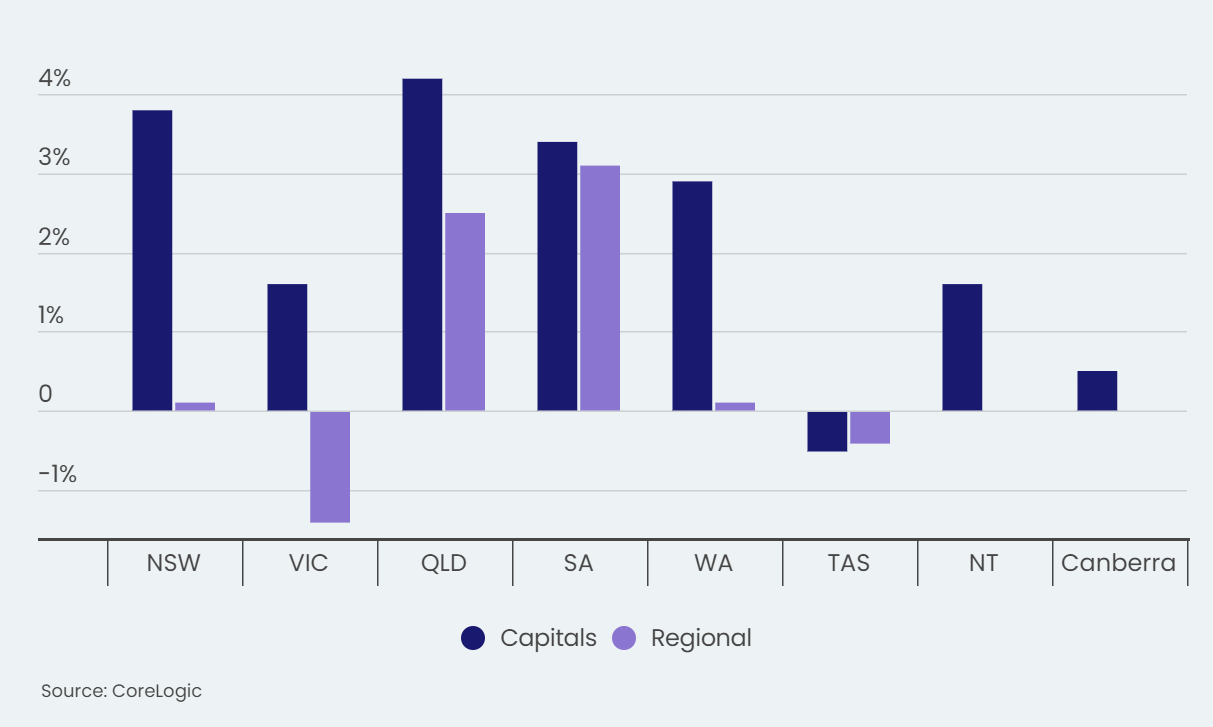
The property data provider reports that their Home Value Index has noted a third consecutive rise in values  in May, accelerating 1.2 percent over the past month. This is on the back of a 0.6 percent increase in March and 0.5 percent rise in April.

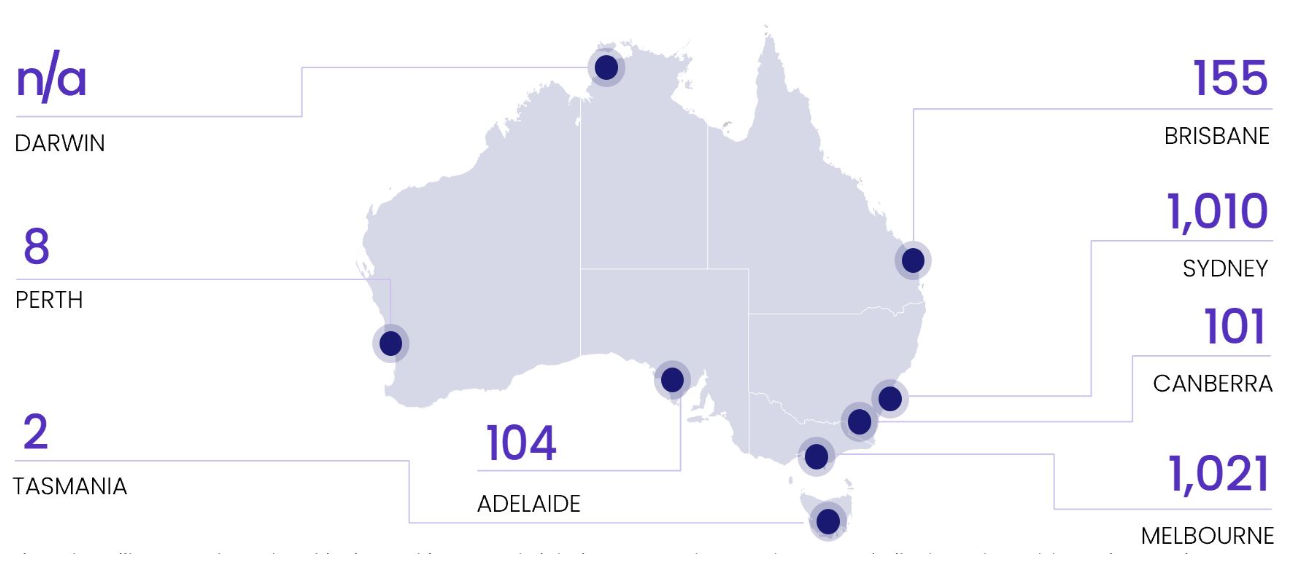
Sydney recorded the strongest results, up 1.8 percent, the highest recorded in the city since September 2021. The fall in Sydney’s home values bottomed in January but have since accelerated sharply by 4.8 percent, adding $48,390 to the median dwelling value.

Melbourne recorded more modest gains, with home values increasing by 0.9 percent, bringing the total rise this quarter to 1.6 percent. It was the smaller capitals of Brisbane (up 1.4 percent) and Perth (up 1.3 percent) that reported stronger gains.

CoreLogic research director Tim Lawless said the lack of housing stock was an obvious influence on the growing values.

 “Advertised listings trended lower through May with roughly 1,800 fewer capital city homes advertised for sale relative to the end of April. Inventory levels are -15.3 percent lower than they were at the same time last year and -24.4 percent below the previous five-year average for this time of year,” he said.

“With such a short supply of available housing stock, buyers are becoming more competitive and there’s an element of FOMO creeping into the market. 

“Amid increased competition, auction clearance rates have trended higher, holding at 70 percent or above over the past three weeks. For private treaty sales, homes are selling faster and with less vendor discounting.” 

Vendor discounting has been a feature in some parts of the country, particularly prestige regional areas that saw rapid price rises during the pandemic – and subsequent falls as people returned to the workplace in major centres.

The CoreLogic Home Value Index reports while prices appear to have found the floor in regional areas, the pace of recovery has been slower.

“Although regional home values are trending higher, the rate of gain hasn’t kept pace with the capitals. Over the past three months, growth in the combined capitals index was more than triple the pace of growth seen across the combined regionals at 2.8% and 0.8% respectively,” Mr Lawless said.

“Although advertised housing supply remains tight across regional Australia, demand from net overseas migration is less substantial. ABS data points to around 15% of Australia’s net overseas migration being centred in the regions each year. Additionally, a slowdown in internal migration rates across the regions has helped to ease the demand side pressures on housing.”


We Asked Workers Why They’re Not Coming Back to the Office

What’s still keeping American workers out of the office?

At a time when restaurants, planes and concert arenas are packed to the rafters, office buildings remain half full. Thinly populated cubicles and hallways are straining downtown economies and, bosses say, fragmenting corporate cultures as workers lose a sense of engagement.

Yet workers say high costs, caregiving duties, long commutes and days still scheduled full of Zooms are keeping them at home at least part of the time, along with a lingering sense that they’re able to do their jobs competently from anywhere. More than a dozen workers interviewed by The Wall Street Journal say they can’t envision returning to a five-day office routine, even if they’re missing career development or winding up on the company layoff list.

Managers say they will renew the push to get employees back into offices later this year. The share of companies planning to keep office attendance voluntary, rather than mandatory, is dropping, according to a survey released in May of more than 200 corporate real-estate executives conducted by property-services firm CBRE, one of the largest managers of U.S. office space.

A battle of wills could be ahead. The gap between what employees and bosses want remains wide, with bosses expecting in-person collaboration and workers loath to forgo flexibility, according to monthly surveys of worker sentiment maintained by Nicholas Bloom, a Stanford University economist who studies remote work.

Escalating expenses

One reason workers say they’re reluctant to return is money. Some who have lost remote-work privileges said they are spending hundreds, or in some cases thousands, of dollars each month on meals, commutes and child care.

One supercommuter who treks to her Manhattan job from her home in Philadelphia negotiated a two-day-a-week limit to her New York office time this year. Otherwise, she said she could easily spend $10,000 a year on Amtrak tickets if she commuted five days a week.

Christos Berger, a 25-year-old mortgage-loan assistant who lives outside Washington, D.C., estimates she spends $2,100 on child care and $450 on gas monthly now that she is working up to three days a week in the office.

Berger and her husband juggled parenting duties when they were fully remote. The cost of office life has her contemplating a big ask: clearance to work from home full time.

“Companies are pushing you to be available at night, be available on weekends,” she said, adding that she feels employers aren’t taking into account parents’ need for family time.

Rachel Cottam, a 31-year-old head of content for a tech company, works full time from her home near Salt Lake City, making the occasional out-of-town trip to headquarters. She used to be a high-school teacher, spending weekdays in the classroom. Back then, she and her husband spent $100 a week on child care and $70 a week on gas. Now they save that money. She even let her car insurance company know she no longer commutes and they knocked $5 a month off the bill.

Friends who have been recalled to offices tell Cottam about the added cost of coffee, lunch and beauty supplies. They also talk about the emotional cost they feel from losing work flexibility.

“For them, it feels like this great ‘future of work’ they’ve been gifted is suddenly ripped away,” she said.

Parent trade-offs

If pandemic-era flexible schedules go away, a huge number of parents will drop out of the workforce, workers say.

When Meghan Skornia, a 36-year-old urban planner and married mother of an 18-month-old son, was looking for a new job last year, she weeded out job openings with strict in-office policies. Were she given such mandates, she said, she would consider becoming an independent consultant.

The firm in Portland, Ore., where Skornia now works requests one day a week in the office, but doesn’t dictate which day. The arrangement lets her spend time with her son and juggle her job duties, she said. “If I were in the office five days a week, I wouldn’t really ever see my son, except for weekends.”

Emotional labor

For some, coming into the office means donning a mask to fit in.

Kenneth Thomas, 42, said he left his investment-firm job in the summer of 2021 when the company insisted that workers return to the office full time. Thomas, who describes himself as a 6-foot-2 Black man, said managing how he was perceived—not slipping into slang or inadvertently appearing threatening through body language—made the office workday exhausting. He said that other professionals of colour have told him they feel similarly isolated at work.

“When I was working from home, it freed up so much of my mental bandwidth,” he said. His current job, treasurer of a green-energy company, allows him to work remotely two or three days a week.

Lost productivity

The longer the commute, the less likely workers are to return to offices.

Ryan Koch, a Berkeley, Calif., resident, went to his San Francisco office two days a week as required late last year, but then he let his attendance slide, because commuting to an office felt pointless. “I’m doing the same video calls that I can be doing at home,” he said.

Koch, who works in sales, said his nonattendance wasn’t noted so long as his numbers were good. When Koch and other colleagues were unable to meet sales quotas in recent weeks, they were laid off. Ignoring the in-office requirement probably didn’t help, he said, adding he hopes to land a new hybrid role where he goes in one or two days.

Jess Goodwin, a 36-year-old media-marketing professional, turned down an offer to go from freelance to full time earlier this year because the role required office time and no change in pay.

Goodwin said a manager “made it really clear that this is what they’re mandating right now and it could change in the future to ‘you have to be back in five days a week.’”

Goodwin, who lives in Brooklyn, N.Y., calculated that subway commutes to Midtown Manhattan would consume more than 150 hours annually, in addition to time spent getting ready for work.

Goodwin’s holding out for a better offer. She said she would consider a hybrid position if it came with a generous package and good commute, adding: “And I would also probably need something in my contract being like, ‘We’re not going to increase the number of days you have to come in.’”

Investments in Solar Power Eclipse Oil for First Time

Investments in solar power are on course to overtake spending on oil production for the first time, the foremost example of a widening gap between renewable-energy funding and stagnating fossil-fuel industries, according to the head of the International Energy Agency.

More than $1 billion a day is expected to be invested in solar power this year, which is higher than total spending expected for new upstream oil projects, the IEA said in its annual World Energy Investment report.

Spending on so-called clean-energy projects—which includes renewable energy, electric vehicles, low-carbon hydrogen and battery storage, among other things—is rising at a “striking” rate and vastly outpacing spending on traditional fossil fuels, Fatih Birol, the IEA’s executive director said in an interview. The figures should raise hopes that worldwide efforts to keep global warming within manageable levels are heading in the right direction, he said.

Birol pointed to a “powerful alignment of major factors,” driving clean-energy spending higher, while spending on oil and other fossil fuels remains subdued. This includes mushrooming government spending aimed at driving adherence to global climate targets such as President Biden’s Inflation Reduction Act.

“A new clean global energy economy is emerging,” Birol told The Wall Street Journal. “There has been a substantial increase in a short period of time—I would consider this to be a dramatic shift.”

A total of $2.8 trillion will be invested in global energy supplies this year, of which $1.7 trillion, or more than 60% will go toward clean-energy projects. The figure marks a sharp increase from previous years and highlights the growing divergence between clean-energy spending and traditional fossil-fuel industries such as oil, gas and coal. For every $1 spent on fossil-fuel energy this year, $1.70 will be invested into clean-energy technologies compared with five years ago when the spending between the two was broadly equal, the IEA said.

While investments in clean energy have been strong, they haven’t been evenly split. Ninety percent of the growth in clean-energy spending occurs in the developed world and China, the IEA said. Developing nations have been slower to embrace renewable-energy sources, put off by the high upfront price tag of emerging technologies and a shortage of affordable financing. They are often financially unable to dole out large sums on subsidies and state backing, as the U.S., European Union and China have done.

The Covid-19 pandemic appears to have marked a turning point for global energy spending, the IEA’s data shows. The powerful economic rebound that followed the end of lockdown measures across most of the globe helped prompt the divergence between spending on clean energy and fossil fuels.

The energy crisis that followed Russia’s invasion of Ukraine last year has further driven the trend. Soaring oil and gas prices after the war began made emerging green-energy technologies comparatively more affordable. While clean-energy technologies have recently been hit by some inflation, their costs remain sharply below their historic levels. The war also heightened attention on energy security, with many Western nations, particularly in Europe, seeking to remove Russian fossil fuels from their economies altogether, often replacing them with renewables.

While clean-energy spending has boomed, spending on fossil fuels has been tepid. Despite earning record profits from soaring oil and gas prices, energy companies have shown a reluctance to invest in new fossil-fuel projects when demand for them appears to be approaching its zenith.

Energy forecasters are split on when demand for fossil fuels will peak, but most have set out a timeline within the first half of the century. The IEA has said peak fossil-fuel demand could come as soon as this decade. The Organization of the Petroleum Exporting Countries, a cartel of the world’s largest oil-producing nations, has said demand for crude oil could peak in developed nations in the mid-2020s, but that demand in the developing world will continue to grow until at least 2045.

Investments in clean energy and fossil fuels were largely neck-and-neck in the years leading up to the pandemic, but have diverged sharply since. While spending on fossil fuels has edged higher over the last three years, it remains lower than pre pandemic levels, the IEA said.

Only large state-owned national oil companies in the Middle East are expected to spend more on oil production this year than in 2022. Almost half of the extra spending will be absorbed by cost inflation, the IEA said. Last year marked the first one where oil-and-gas companies spent more on debt repayments, dividends and share buybacks than they did on capital expenditure.

The lack of spending on fossil fuels raises a question mark around rising prices. Oil markets are already tight and are expected to tighten further as demand grows following the pandemic, with seemingly few sources of new supply to compensate. Higher oil prices could further encourage the shift toward clean-energy sources.

“If there is not enough investment globally to reduce the oil demand growth and there is no investment at the same time [in] upstream oil we may see further volatility in global oil prices,” Birol said.

The war on inflation isn’t over yet says Philip Lowe

It’s too early to declare that inflation is under control, the head of the Reserve Bank of Australia said today.

Governor Philip Lowe has been giving evidence at the Senate estimate hearing in Canberra this morning, saying that 11 interest rate rises in just over a year were having a positive impact on inflation.

“We’ve increased interest rates, a lot of monetary policy is restrictive, and it’s working,” he said.

However, he stopped short of saying that the war to drive down inflation to more acceptable levels had been won.

“Whether we need to increase rates further, both depending on what happens with unit labour costs, what happens with the global economy, with inflation expectations, consumer spending, so they’re the variables that we’re looking at,” Mr Lowe said.

The RBA is due to meet next Tuesday for the last time this financial year. Three of the top four banks are predicting that rates have already peaked at 3.85 percent, with ANZ the only major lender to suggest a rise to 4.1 percent is likely before the end of the year.

The RBA has been under pressure to end further rises amid concerns that the steep rise in rates – the greatest monetary tightening program since the 1980s – could push Australia into a recession.

China’s Fading Recovery Reveals Deeper Economic Struggles

China’s era of rapid growth is over. Its recovery from zero-Covid is stalling. And now the country is facing deep, structural problems in its economy.

The outlook was better just a few months ago, after Beijing lifted its draconian Covid-19 controls, setting off a flurry of spending as people ate out and splurged on travel.

But as the sugar high of the reopening wears off, underlying problems in China’s economy that have been building for years are reasserting themselves.

The property boom and government over investment that fuelled growth for more than a decade have ended. Enormous debts are crippling households and local governments. Some families, worried about the future, are hoarding cash.

Chinese leader Xi Jinping’s crackdowns on private enterprise have discouraged risk-taking, while deteriorating relations with the West—exemplified by a new campaign against international due-diligence and consulting firms—are stifling foreign investment.

Economists say these worsening structural problems are hobbling China’s chances of extending the growth miracle that transformed it into a rival to the U.S. for global power and influence.

Instead of expanding at 6% to 8% a year as was common in the past, China might soon be heading toward growth of 2% or 3%, some economists say. An ageing population and shrinking workforce compound its difficulties.

China could drive less global growth this year and beyond than many business leaders expected, making the country less important for some foreign companies, and less likely to significantly surpass the U.S. as the world’s biggest economy.

“The disappointing recovery today really suggests that some of the structural drags are already in play,” said Frederic Neumann, chief Asia economist at HSBC.

China’s economy expanded at an annual rate of 4.5% in the first quarter, boosted by the end of Covid-era restrictions.

Yet more recent signals suggest the revival is ebbing. Retail sales rose 0.5% in April compared with March. A bundle of data on factory output, exports and investment came in much weaker than economists were expecting.

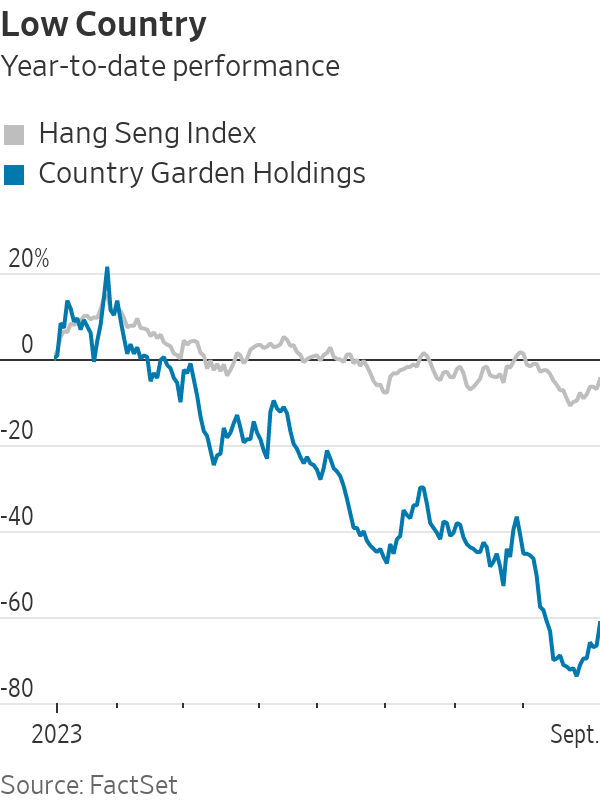
More than a fifth of Chinese youths aged 16 to 24 were unemployed in April. E-commerce companies Alibaba and JD.com reported lacklustre first-quarter earnings. Hong Kong’s Hang Seng Index, dominated by Chinese companies, is down 5.2% year to date, and the yuan has weakened against the U.S. dollar.

Most economists don’t expect China’s problems to lead to recession, or derail the government’s growth target of around 5% this year, which is widely seen as easily achievable given how weak the economy was last year.

McDonald’s and Starbucks have said they are opening hundreds of new restaurants in China, while retailers including Ralph Lauren are launching new stores.

A boom in electric-vehicle production allowed China to surpass Japan as the world’s largest exporter of vehicles in the first quarter. Beijing’s industrial policies and China’s manufacturing prowess mean it is still finding ways to succeed in some major industries.

“We still have confidence in the long-term growth story of China,” said Phillip Wool, head of research at Rayliant Global Advisors, an asset manager with $17 billion under management. He said the country’s transition to one that relies more on domestic consumption instead of exports will help keep it on track.

Still, many economists are growing more worried about China’s future.

The big hope for this year was that Chinese consumers would step up spending, as the main drivers of China’s past growth—investment and exports—languish.

But while people are spending somewhat more after almost three years of tough Covid-19 controls, China isn’t experiencing the kind of surge other economies enjoyed when they emerged from the pandemic.

Consumer confidence is low. More important, some economists say, is that Beijing hasn’t been able to meaningfully change Chinese consumers’ long-running propensity to save rather than spend—a response to a threadbare social-safety net that means families must sock away more for medical bills and other emergencies.

Chinese household consumption accounts for around 38% of annual gross domestic product, according to United Nations data, compared with 68% in the U.S.

“Consumer-led growth has always been a bit of an aspirational target” for China, said Louise Loo, China lead economist in Singapore at Oxford Economics, a consulting firm. Now, it might be even harder to achieve, she said, given how cautious Chinese consumers are coming out of the pandemic.

Although Beijing is trying to make it easier to borrow this year, lending data indicate households prefer to pay down debt than take on new loans.

In March, Zi Lu dipped into her dowry and paid off the remaining 1.2 million yuan, equivalent to about $170,000, on her mortgage for an apartment she bought in Shanghai two years ago. Working for an e-commerce retailer, she said sales have been underwhelming this year. Lu said she is anxious and wants to reduce her debt burden.

“I’m scared of getting laid off out of the blue,” she said.

Also looming over the economy is its massive debt pile.

Between 2012 and 2022, China’s debt grew by $37 trillion, while the U.S. added nearly $25 trillion. By June 2022, debt in China reached about $52 trillion, dwarfing outstanding debt in all other emerging markets combined, according to calculations by Nicholas Borst, director of China research at Seafarer Capital Partners.

As of last September, total debt as a share of GDP hit 295% in China, compared with 257% in the U.S., data from the Bank for International Settlements shows.

Viewing the debt buildup as a threat to financial stability, Xi has made deleveraging a centrepiece of his economic policy since 2016, weighing on growth.

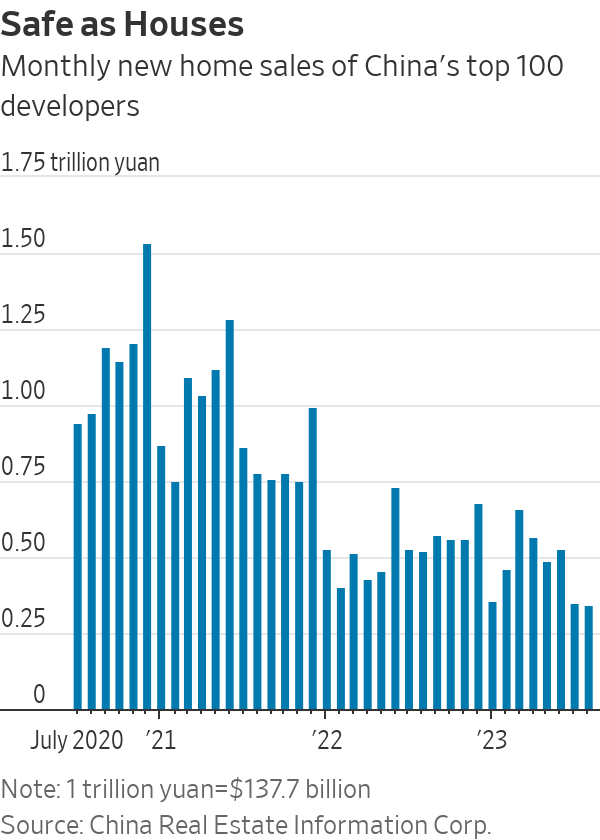
To help deflate the country’s housing bubble, regulators imposed strict borrowing limits for property developers from late 2020. Property development investment fell 5.8% in the first quarter of this year despite policy efforts to stem the pace of the slide.

Two-thirds of local governments are now in danger of breaching unofficial debt thresholds set by Beijing to signify severe funding stress, according to S&P Global calculations. Cities across the country from Shenzhen to Zhengzhou have cut benefits for civil servants and delayed salary payments in some cases for teachers.

These problems are deepening when China’s appeal as a destination for foreign firms is waning, data show, as tensions rise with the U.S.-led West.

Foreign direct investment into China tumbled 48% in 2022 compared with a year earlier, to $180 billion, according to Chinese data, while FDI as a share of China’s GDP has slipped to less than 2%, from more than double that a decade ago.

Competition for investment with countries including India and Vietnam is heating up as firms seek to diversify supply chains, partly in response to the risk of disruption from conflict between the U.S. and China.

Jens Eskelund, president of the European Union Chamber of Commerce in China, said uncertainty over China’s long-term economic prospects is another factor in companies’ investment decisions.

“Naturally, it dampens the willingness to go out and invest in additional capacity if you are not super optimistic about the economic outlook,” he said.

Reforms to foster more productive, private-sector activity have stalled under Xi, who is placing greater emphasis on security than economic growth. Beijing has tightened regulation of sectors including technology, private education and real estate, leaving many business owners unwilling to invest more.

In the first four months of this year, fixed-asset investment made by private firms grew 0.4% from a year earlier, compared with 5.5% growth in the same period in 2019.

Chinese leaders have dialled up rhetoric to reassure entrepreneurs and investors. Li Qiang, China’s No. 2 official and new premier, said in March that China will open further to foreign players, and told Communist Party officials to treat private entrepreneurs as “our own people.”

Economists are split over whether policy makers, who have held off on launching large-scale stimulus as they did in 2008 and 2015, will resort to more aggressive stimulus now. Some, including economists from Citigroup, expect China’s central bank to cut interest rates in the coming months to lift sentiment.

Others say that Beijing’s restraint stems from fear of compounding already-high debt levels, and that more stimulus might do little to trigger demand for credit anyway.

Jeff Bowman, chief executive of Cocona, which makes temperature-regulating materials used in apparel and bedding, said he is still optimistic about China. He said that during a recent two-week business trip to Taiwan and China, customers who were focused on China’s domestic market were far more upbeat than their counterparts exporting to the U.S. or Europe, who he said “are hurting for sure.”

He said that Cocona, based in Boulder, Colo., plans to set up a subsidiary in China to expand its business there.

But many analysts still wonder where the growth will come from.

“The big question is, have we reached the point where awareness of the structural slowdown is becoming a near-term issue for confidence? Then it’s a bit of a vicious cycle,” said Michael Hirson, head of China research at 22V Research, a New York-based consulting firm.

American Cities Are Starting to Thrive Again. Just Not Near Office Buildings.

While office towers sit empty and nearby businesses struggle to pay their bills, residential neighbourhoods in America’s biggest cities are bustling again.

The pandemic and remote work have done little to dent the overall appeal of cities such as New York, Chicago and Los Angeles, foot-traffic and rent data show. Instead, the pandemic has shifted the urban centre of gravity, moving away from often sterile office districts to neighbourhoods with apartments, bars and restaurants.

“We’re now back to what cities really are—they’re not containers for working,” said Richard Florida, a specialist in city planning at the University of Toronto. “They’re places for people to live and connect with others.”

At the height of the pandemic, some analysts predicted that big cities would enter a downward spiral as remote workers sought more space and cheaper places to live. That happened to some degree early on, but it didn’t last. While big metropolitan areas lost population during the first year of the pandemic, partly because of a drop in immigration from abroad, the losses have since slowed or reversed, according to a Brookings Institution analysis of census data.

Many residential neighbourhoods benefit from remote work. As people spend more time at home, they frequent local shops, gyms and restaurants, boosting the economy of places such as Brooklyn, N.Y.’s Ditmas Park and Williamsburg, as well as Washington, D.C.’s Georgetown.

Data from Placer.ai, which tracks people’s movements based on cellphone usage, shows a stark divide between office and residential districts. In Downtown Los Angeles, visitor foot traffic is 30.7% below pre pandemic levels, while Downtown Chicago’s visitor foot traffic is 27.2% lower. By contrast, in the residential areas of South Glendale and Highland Park near Los Angeles and in Chicago’s residential Logan Square neighbourhood, visitor foot traffic has been rising and is nearly back to pre pandemic levels.

Food delivery also illustrates the shift. In 2019, almost 95% of New York City corporate lunch orders came from the city’s business district, according to food-order app Grubhub. This year, it is down to around 85%. In Chicago, the central business district accounted for more than 80% of corporate lunch orders in 2019 but just over 60% this year.

Rent data, meanwhile, attests to strong demand for city living. In Manhattan’s Greenwich Village, median housing rent was 30% higher in April 2023 than in April 2019, according to Jonathan Miller, chief executive of real-estate-appraisal firm Miller Samuel. In the Brentwood neighbourhood of Los Angeles, the median rent is up 63%.

Big cities still face serious challenges. Vacant office buildings leave downtown shops and restaurants with too few customers, while falling commercial building values threaten property-tax revenues.

“The increased vibrancy of great urban neighbourhoods will never be enough to offset the decline in property-tax revenues caused by remote work and the falling values of commercial office buildings,” Florida said.

Housing shortages have pushed up rents. In the long run, replacing offices with apartments can help revitalise urban centres, but that will take time. Conversions are also often tricky and expensive. Crime is up in many places. San Francisco in particular has been slower to recover and its retail has come under pressure.

Still, anyone walking through New York’s Jackson Heights or Silver Lake in Los Angeles looking for a deserted hellscape will be disappointed.

In Manhattan, the pandemic ignited a retail renaissance in the Soho neighbourhood, with availability there now at its lowest level since 2014, according to real-estate services firm Cushman & Wakefield.

“Before the pandemic there was a disconnect between landlord expectations and what tenants could pay,” said Steven Soutendijk, executive managing director for the firm’s retail division. “Covid sort of shook that up a little bit, in a good way.”

Andrea Loscalzo, owner of the Italian restaurant Salumeria Rosi in Manhattan’s Upper West Side, said his eatery is as busy as before the pandemic. Many regulars left the neighbourhood and never returned, but young professionals in their 30s and 40s moved in to replace them, he said.

“Even as families decamp, New York’s magnetic pull on the young and the talented is now more than ever,” Florida said.

In Chicago’s central business district, retail vacancy rose to a record high of 28% last year compared with about 15% in 2019, according to Stone Real Estate, a local brokerage. Crime in the city remains a concern, and in April, Walmart said it would close four of its eight locations in Chicago after annual losses nearly doubled in five years.

The city’s residential and tourist neighbourhoods are performing considerably better. In River North, which has a mixture of residential, office and hotels, retail vacancy dropped by more than 2 percentage points, driven largely by the strength of its restaurants, said John Vance, principal at Stone Real Estate.

“The city blocked off some streets to traffic so we could have expanded outdoor dining,” Vance said. “River North feels vibrant.”

Lakeview, a neighbourhood within walking distance of Lake Michigan and Wrigley Field, is bustling with young residents, families and Cubs fans, said resident Naomi Polinsky. Its restaurants and bars were packed on a recent Saturday night.

“We walked next door to the sports bar, and there was not a single place to sit. We walked across the street to the wine bar, completely crowded,” she said.

Australian building approvals take another hit

The number of dwellings approved across Australia has continued to fall, the latest data reveals.

Information from the Australian Bureau of Statistics released today shows the total dwellings approved fell -8.1 percent in April, seasonally adjusted, following a decline of -1 percent in March. In the private housing market, seasonally adjusted estimates fell -3.8 percent in April to 7,939, following a -3.7 percent decline in March.

Across the states, Queensland has been hardest hit with total approvals dropping b y -22.8 percent, followed by Victoria (-18.6 percent) and WA (-5.8 percent).It’s better news in South Australia, where total approvals rose by 19.8 percent, NSW (12.5 percent) and Tasmania (3.5 percent).

Daniel Rossi, ABS head of construction statistics, said: “Total dwellings approved fell to the lowest level since April 2012. The overall decline was driven by a fall in approvals for private sector dwellings excluding houses, which fell 16.5 per cent, to the lowest level since January 2012. 

“Private sector house approvals also continued to decline, falling 3.8 per cent in April, following a 3.7 per cent decrease in March.”

Germany Enters Recession in Blow to Europe’s Economy

Germany slipped into recession during the first three months of the year, as households cut spending in response to sharply higher prices for energy and food.

With Europe’s largest economy now having shrunk for two quarters in a row, meeting the technical definition of a recession, the eurozone as a whole may also have also contracted in the first quarter.

The development doesn’t fundamentally alter economists’ views about the country’s immediate prospects, and any decline in output in the broader region is likely to have been modest.

Still, a recession in the eurozone would deflate some of the optimism that has built up around the currency area’s economic prospects in recent months. It could also inspire greater caution among policy makers at the European Central Bank as they prepare to raise interest rates further.

“A technical recession would be a change in the overall narrative on how resilient the eurozone economy has been over recent quarters,” said Bert Colijn, an economist at ING.

Germany’s statistics agency said Thursday that gross domestic product—a broad measure of the goods and services produced by an economy—was 0.3% lower in the three months through March than in the final quarter of last year. It had previously estimated that the economy flatlined in the first quarter, having contracted by 0.5% in the final quarter of last year.

The agency said a 1.2% fall in household consumption was the main reason for the contraction, as households saw their spending power eroded by a surge in food prices. In March, German households were paying 21.2% more for their food purchases than a year earlier.

In the months immediately following the invasion of Ukraine, economists had warned that Germany faced a high risk of sliding into recession, given its reliance on Russian supplies of natural gas. But economic data releases at the turn of the year appeared to indicate that Germany would avoid that fate.

The revised figures for the first quarter confirmed that the world’s fourth-largest economy had succumbed to recession, but one less severe than feared when the Kremlin cut gas supplies in summer 2022.

Business surveys have pointed to a return to growth in Germany during the second quarter. But the impact of higher borrowing costs and a weak expansion in many of its main export markets point to the possibility of a renewed contraction in the three months through September.

“Higher interest rates will continue to weigh on both consumption and investment and exports may also suffer amid economic weakness in other developed markets,” said Franziska Palmas, an economist at Capital Economics who expects declines in GDP during both the third and fourth quarters.

Should the estimates for growth in other eurozone members be unchanged, the new measure of GDP for Germany suggests the currency area’s economy as a whole contracted slightly in the first quarter. The European Union’s statistics agency currently estimates it grew at an annualised rate of 0.3%, after shrinking by 0.2% in the final quarter of last year.

While that change in measured output would be small, it may have an influence on the ECB’s interest rate decisions over coming months. The ECB’s economists raised their growth forecasts for this and subsequent years in March, partly in response to a picture of the eurozone economy at the turn of the year that now appears overly optimistic.

Why AI Will Make Our Children More Lonely

Scott Galloway, a founder of companies, board member of others, business-school professor and author, is outspoken in his criticism of today’s Big Tech-driven society. At the recent Wall Street Journal CEO Summit in London, he shared some of his views, along with an array of data points, in a wide-ranging, animated talk with Nikki Waller, coverage chief for life and work at The Wall Street Journal. Edited excerpts follow.

The unreal world

WSJ: How will AI change the home and family lives of people in this room?

GALLOWAY: You’ll get richer, and your kids will get lonelier and more depressed.

Most of the technologies we’re coming up with, or a lot of them, are pouring fuel on this flame of loneliness, where we’re finding reasonable facsimiles of a relationship. Social creates this illusion that you have a lot of friends, but you don’t experience friendship.

A lot of young men are self-selecting out of the real world. They believe they’re learning or investing on a trading app, and that’s just gambling. That’s just addiction. They think that they are having a relationship when they’re on Discord, or sharing information. They feel rejected on dating apps. If you’re a young man in the 50th percentile or below in terms of attractiveness, you have to swipe right or select 200 women and say, “I’m interested,” to get one match. If you match, you need five matches for it to turn into one coffee, because four of the five women who have a much finer filter in terms of selectivity, they’ll kind of melt away.

So most men have to match 1,000 times to get one coffee. And that validates that they are not attractive and not valued in the mating market. I think they’re going to increasingly turn to AI-driven relationships.

We have a series of replacements—fuelled by technology—for relationships, mentorships, the workplace, friendships, romantic relationships. And in the short term it sort of fills a void. But it’s empty calories, and I think you end up more depressed.

We’re mammals, and we’re supposed to be around each other. I worry that there’s a whole cohort of young people, specifically young men, who will withdraw slowly but surely from the world. And the output of that is they become really sh—y citizens. They’re more prone to misogynistic content. They’re less likely to believe in climate change. They don’t develop the skills to read a room and be successful at work. They don’t engage in romantic relationships, so they don’t have kids.

WSJ: How do you solve for this in the workplace if you’re a boss?

GALLOWAY: We need systemic solutions. We’ve taken away wood shop, auto shop, metal shop from high schools, and basically told young men in high school to be more like women. “Be organised, disciplined, sit in your seat.” And the education system is highly biased against men.

I think the labor force is quite biased against women still, especially once they have children. But the educational workforce is biased against men. Boys are twice as likely to be suspended than a woman on a behaviour-adjusted basis, the exact same infraction. A Black boy, five times as likely to be suspended.

What you can do as a CEO is, first, drop the fetishisation of elite colleges. There’s going to be two female graduates from college in the next five years for every male. And create more on ramps into your company for kids who don’t have traditional college certification. In terms of the workforce, I’m sort of the person that makes HR uncomfortable, because the No. 1 source of retention at a company is if the employee has a friend.

I’m a big fan of remote work for caregivers. We should have a new classification of worker: For someone who’s taking care of young children, ageing parents, someone who’s struggling with their own health, remote work is a huge unlock. But for people under the age of 40, I think the office is a feature, not a bug. And that is it’s a fantastic place to find friends, mentors and mates. We don’t like to talk about this, but one out of three relationships begins in the workplace.

Ninety-nine percent of relationships that began at work are consensual. And we talk about and we publicise some abhorrent behaviour, and those people deserve to be in prison. But the people who I find are most righteous about being against workplace relationships are already married. And if you’re going to ask a young person to work 12 hours a day in this competitive economy, where are they supposed to find mates?

Work/life balance

WSJ: Gen Z workers, in their first interviews, are asking about work/life balance. What’s the right way to think about that?

GALLOWAY: Work/life balance is a myth. I’ve taught 5,500 students at NYU, and I do a survey. “Where do you expect to be in five years economically?” And something like 90%-plus of them expect to be in the top 1% economically by the age of 30, right? I get it, it’s great. But it means you’re going to have no life other than work, or very little life. I don’t remember my 20s and 30s other than work. It cost me my hair, it cost me my first marriage, and it was worth it.

You can have it all. You just can’t have it all at once. If you expect to be in the top 10% economically, much less the top 1%, buck up. Two-decades-plus of nothing but work. That’s my experience.

The AI future

WSJ: What career advice would you give a young adult right now regarding AI?

GALLOWAY: I’m an AI optimist. But everything in the media on AI is total catastrophising. It’s, “This is the nuclear bomb.”

I’m like, “That’s not that helpful.” Anytime there’s a new technology it goes through the same arc. There’s some catastrophising, there’s some job destruction, and then the economy grows and there’s more jobs.

Automation destroyed a lot of jobs on the shop floor, the manufacturing floor. But we didn’t anticipate heated seats or car stereos, and we created more jobs. I think AI is going to be enormously accretive for society and our economy.

If I were a young person, think about which industry does it disrupt, which industry will have the greatest reshuffling of value? Think about targeting disruption.

I’m not sure people thought processing power would disrupt cable television. But it did, in the form of Netflix.

Netflix’s rise is directly correlated to increase in bandwidth and processing power, because your cable bill kept going up faster than inflation such that you could have Food Networks 3 and 4. So for $12 a month I can get a reasonable facsimile of what was costing me $120 a month.

So what’s next? What does AI kill or disrupt? And where would I invest my human capital as a young person?

The most disruptable industry in the world—as a function of prices increasing faster than inflation relative to the underlying innovation or lack thereof—is, hands down, U.S. healthcare.

I haven’t had health insurance in five years. And when I tell people I don’t have health insurance, it’s like, “You’re a bad citizen. You’re not a good dad.” No, health insurance is nothing but a transfer of wealth from the poor who can’t absorb a big shock to the rich who can.

That is ripe for AI to come in and look at you and say, “You know what? You’re better off taking 4% of your salary, putting into the 401(k), using it if you have a healthcare crisis, but not buying insurance.”

There’s going to be so many little AI-driven healthcare companies that go after the American healthcare complex.

AI for me, if I were 22, 25, 30, and wanted to invest my human capital, I would think, “Where is the real action going to be? A reshuffling of shareholder value?” It’s going to be AI-driven startups in the healthcare space.

Heat is on Australian rental markets as would-be buyers opt out

Pressure on Australia’s rental market continues to mount, with rental affordability at its highest level in almost a decade, new research has found.

The ANZ CoreLogic Housing Affordability Report has revealed that rent now accounts for almost a third of household income for a median income household, the highest level since June 2014. The situation for lower income households is even more stressed with those at the 25th percentile income level spending 51.6 percent of their earnings on rent.

Sydney topped the list of least affordable places in the country with on average 51.6 percent of income going to service a new mortgage, while it would take 12 years to save for a 20 percent deposit. The result is more would-be homebuyers are being pushed out of the housing market and into rentals.

The report also found that rental vacancy rates are at 1.1 percent nationally, down from a decade average of 3 percent.

CoreLogic Australia head of research Eliza Owen said there was no relief in sight for renters anytime soon as the construction industry felt the impact of interest rate rises.

“As rents have risen sharply, the increase in the cash rate, and pressures in the construction sector have slowed the rate of dwelling completions. This has meant investor conditions are not ideal, and has stemmed the flow of new rental properties to the market,” Ms Owen said. 

“Through February and March ABS lending data has shown signs of an increase in investment borrowing, but it will take some time for a supply response to ease pressures in the rental market.” 

ANZ senior economist Felicity Emmett said uncertain conditions had also impacted on the amount of existing housing stock going to market.

“Heightened economic uncertainty has seen a decline in sales volumes in the private market and an increase in those seeking rental accommodation. Paired with a decline in social housing, rental demand pressures are being felt in all income brackets,” Ms Emmett said. 

Wall Street’s Next Big Play Is Garbage

The green push by the U.S. and state governments is turning trash into treasure and boosting the firms that handle America’s garbage.

Shares of the biggest players in the U.S. trash business, Waste Management and Republic Services, have traded at record highs since President Biden signed the climate, tax and healthcare bill in August. A recent decline notwithstanding, the stocks are popular picks on Wall Street to ride the sustainability boom higher.

“They’re sitting in this extraordinary position,” said Michael Hoffman, an analyst at investment bank Stifel. “Garbage will be on the forefront.”

Efforts to reduce greenhouse-gas emissions and to reuse materials are making it more profitable to mine landfills for energy and sift through refuse for the hot commodities of the green economy, such as detergent bottles and cardboard boxes.

WM and Republic are building plants to isolate methane from the fumes emitted by rotting garbage and pipe it into the natural-gas grid to be burned in power plants, furnaces and kitchens. They are also equipping recycling facilities with the latest in automation to better sort and process materials for the consumer-goods companies that are under pressure to keep their packaging out of landfills and the ocean.

Landfill owners are forecasting hundreds of millions of dollars in additional profit from rising demand for recycled materials and tax incentives for making energy from emissions that would otherwise seep into the atmosphere.

“We’re blessed to be sitting right in the middle of a megatrend,” Republic Chief Executive Jon Vander Ark said. “We used to think about getting 5% top-line growth a year; now we’re in double-digit top-line growth mode.”

Republic, which has 206 active landfills, has a joint venture with a unit of BP to install gasworks at 43 of its dumps. The Phoenix firm has 65 landfill-gas plants. Some feed utility pipelines. Others generate electricity on site.

Republic is also spending about $275 million to build four polymer-processing facilities that will sort the plastic it collects kerbside and turn it into flakes for new bottles and jugs.

Vander Ark said consumer-product companies face minimum post-consumer-content mandates in California, Washington and other states, as well as their own sustainability goals. Republic’s first plastics plant is scheduled to open later this year in Las Vegas. Customers lined up.

“There’s fighting among customers about who gets what,” Vander Ark said.

Analysts say one risk is that adding exposure to volatile markets for commodities and renewable-fuel credits might spook investors interested in the steady and predictable profits involved in dumping garbage into landfills. Executives say the sustainability businesses are supplementary and moneymakers even when commodity prices are low, like now.

“Yes, there’s a year-over-year impact, but recycling is still profitable,” said Tara Hemmer, WM’s chief sustainability officer. “It still is one of our highest return-on-capital investments.”

WM, which operates more than 250 landfills, is in the second year of a four-year plan to spend $1.2 billion adding 20 trash-gas plants as well as $1 billion expanding and automating its recycling business.

The Houston company expects new and upgraded facilities to increase its recovery of reusable materials 25% by 2025. Having machines do the dirty work also cuts labor costs, executives say.

A lot of hard-to-fill jobs will be replaced by optical sorters, which use infrared cameras to spot valuable materials in the jumble and blow the desirable bits into separate bins with pinpoint puffs of air, Hemmer said.

“In the past we might have had mixed-paper bales that had cardboard embedded in them,” she said. “Now we’re able to pull more of that cardboard out, it goes in the cardboard bale, and the price point on cardboard is much higher than mixed paper.”

WM says the blended commodity value from its automated material recovery facilities is about 15% higher per ton. Not only do the machines amass more of the valuable stuff, the company says the material emerges cleaner and can fetch more than messy bales.

The recycling investments will add $240 million to its bottom line over the next four years, WM says. It has higher expectations for its gas business.

WM says it will boost landfill-gas output eightfold and generate more than $500 million in additional earnings before interest, taxes, depreciation and amortisation through 2026.

That profit forecast assumes two prices associated with every million British thermal units of gas. WM is counting on the actual fuel selling for $2.50, which is lately about the price of gas from geologic wells. Another $23.50 is anticipated from renewable-fuel credits, which is in line with recent trading, according to energy-information firm Platts.

The outlook doesn’t count the $250 million or more of tax credits WM expects for building new gas plants.

Last year’s climate bill sweetened the economics of trash gas. A federal proposal to offer additional credits for biogas projects that produce power for electric vehicles could make the incentives even stronger.

Waste-company executives and analysts say that many are worth building anyway and that the incentives make it economical to install gasworks at smaller, less-gassy landfills.

“Landfill gas is essentially the only scalable biofuel that doesn’t have a food-for-fuel trade-off,” said Goldman Sachs analyst Jerry Revich. “These projects don’t need any subsidies, but they will take the free money.”