Australia’s top state economy just did it again

South Australia has performed an economic hat trick, once again coming out on top as the best performing state in the country.

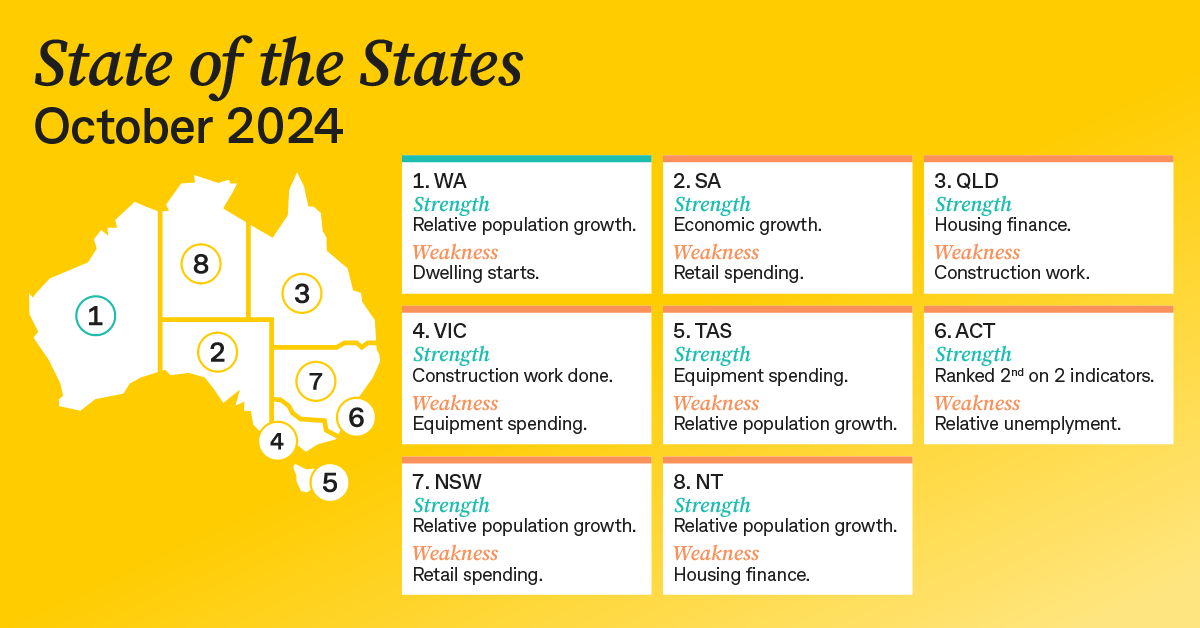
The latest CommSec State of the States reported South Australia was the most consistent performer, sitting in top spot for the third consecutive quarter, followed not far behind by Western Australia and then Victoria. New South Wales languished in seventh position, just ahead of the Northern Territory.

South Australia was number one in three of the report’s eight key economic indicators of relative unemployment, completed construction work and dwelling starts. However, Western Australia was snapping at the heels, leading on relative population growth and home lending.

Senior economist at CommSec, Ryan Felsman, said the economic performance of Australia’s states and territories was backed by strong employment and population growth during a period of ‘higher-than-desired’ inflation.

“South Australia’s continued high-ranking is being driven by a solid job market and construction activity,” he said.

“While South Australia retains first place, Western Australia is seeing the strongest annual economic momentum, so it will be interesting to see how this plays out in the coming quarters.”

“New South Wales, Tasmania and Queensland slipped down the rankings this quarter. Generally speaking, state economies have slowed as consumers respond to higher borrowing costs and price pressures. The future economic path will be dependent on the resiliency of the job market and interest rates.” 

CommSec assesses and ranks the economic performance of each state and territory on a quarterly basis using eight key indicators including economic growth, retail spending, equipment investment, unemployment, construction work done, population growth, housing finance and dwelling commencements.

Luxury Brands Are in a Winner-Takes-All Phase

Louis Vuitton’s owner designed the medals for the Paris Olympic Games. It can’t be easy to see rival Hermès make off with gold in the second-quarter sales heat.

France’s three most powerful luxury-goods companies reported very mixed second-quarter results last week. On Tuesday, LVMH Moët Hennessy Louis Vuitton said sales in the three months through June rose by a disappointing 1% compared with the same period last year. Gucci owner Kering followed with an 11% fall for the quarter and issued a profit warning. Hermès left its competitors in the dust with a 13% increase in sales over the same period.

Hermès captured more than 100% of the incremental growth in the industry in the latest quarter. Luxury shoppers spent €440 million—equivalent to $477.6 million at current exchange rates—more in the French brand’s stores than they did in the same period of last year. They spent €400 million less on all other luxury brands combined, based on analysis by Bank of America.

This points to a double whammy for high-end brands, which face challenges at both ends of the consumer spectrum they serve.

It has been clear for months that middle-class shoppers in the U.S. and China, the luxury industry’s two most important markets, have reined in their purchasing.

Chinese consumers are saving rather than spending because the value of their homes is falling. Lower-income and middle-income Americans who developed a taste for luxury during the pandemic have pulled back sharply as they have burned through excess savings.

Now, wealthy consumers, too, seem to be getting choosier about which brands they will and won’t buy. Hermès Chief Executive Axel Dumas said there is a “flight to quality” under way in the luxury industry. This shift is benefiting the Birkin handbag maker , which has a reputation for timeless designs.

Chinese buyers in particular are avoiding flashy and logo-heavy brands as worries about the country’s economy and real-estate challenges grow.

Jewellery sales are also holding up as shoppers look for goods that are more likely to hold their value than clothing or handbags. Cartier’s owner Richemont said its jewellery sales rose 4% in the quarter, although the company’s overall sales were weighed down by weak demand for its watch and fashion brands. Kering jewellery labels Boucheron and Pomellato were rare bright spots in its portfolio.

The outlook is harsh for brands such as Gucci and Burberry that are in turnaround mode. The latter issued a profit warning earlier this month and replaced its CEO in an admission that a years-long push to make the British trench-coat maker more exclusive had failed. Its shares have fallen to levels not seen since 2010.

Both brands face an uphill battle to lure shoppers. Neither Gucci nor Burberry is known for the classic designs now in vogue. The labels might also have exacerbated the slump, as the sharp price increases that luxury brands implemented in recent years have sidelined aspirational shoppers.

Luxury stocks are diverging. Shares in Richemont and Hermès have gained 15% and 8% respectively so far this year, with everyone else in the red.

Investors are taking their cue from wealthy shoppers: In troubled times, the most exclusive brands are the safest bet.

Driving Lamborghini’s $600,000 Ultra-Powerful Plug-In Hybrid

No longer are supercars powered strictly by muscular V8 and V12 engines, producing a mighty roar as they burn gallons of gas at a ferocious rate. Today’s entries can have hybrid, plug-in hybrid, or pure electric drive. But they’re still awesomely fast, with neck-snapping acceleration.

The new Lamborghini Revuelto, a novel form of plug-in hybrid, puts out an eye-opening 1,001 horsepower (with 739 pound-feet of torque) via a combination of three electric motors (two on the front axle) and a mid-mounted—and exposed to the elements—V12 that, by itself, produces 825 horsepower. It manages to produce more power with some beneficial weight loss. That’s coupled to an eight-speed dual-clutch automatic (with manual paddles) and a 3.8-kilowatt-hour battery pack (with LG cells) that gives the Revuelto five or six miles of all-electric travel.

Hybrid drive in the Revuelto is not so much to achieve better fuel economy, though that’s one result, but is primarily a way of boosting power output as needed. It also yields all-wheel drive. Sales started early this year, and Lamborghini plans to produce about 1,500 to 1,600 Revueltos annually (with the supply limited by the company’s ability to produce its carbon-fiber structure). The inventory is sold out until 2026. As is true of many supercar companies, the SUV is the biggest seller—Lamborghini produces about 5,000 Urus SUV models each year.

The Lamborghini Revueltos in convoy in the Hudson Valley.
Lamborghini photo

The list price of the 2024 Revuelto is US$604,363. As tested, with the biggest option being US$13,100 for the special grayish paint, the bottom line was US$681,258. Lamborghini handed over the Revuelto keys at the 140-acre Wildflower Farms resort in Gardiner, N.Y., for a 90-minute drive around the scenic Hudson Valley. Although the car is capable of a stated 217 miles per hour in the right context, it was still huge fun to drive it at much more moderate speeds on the curvy local roads.

Matteo Ortenzi, product line director for the Revuelto, explained that having two motors up front increases the opportunity for effective torque vectoring, which improves handling by delivering power to the individual wheels as needed. “The feel is of a lighter and more powerful car,” Ortenzi says. “We didn’t build the Revuelto just to say we did a hybrid.”

As in other hybrids, the Revuelto returns power to the battery on deceleration, a process called “regenerative” braking or in Ortenzi’s words, “using negative torque.” After the 90-minute drive, the Revuelto still had a 90% charge. Lamborghini doesn’t think owners will need to plug it in often, though it provides a charging cord. The charge portal is actually under the front hood, a “frunk” where the car has its limited luggage space.

A row of Revueltos with scissor doors up.
Jim Motavalli photo

Entering through the vertically opening scissor doors requires some agility, but soon becomes second nature. Leg room is good, and the bolstered seats hold the driver in firmly—a good thing considering the speeds and g-forces the car can achieve. The gauges are brightly digital, with huge single-digit numbers for the gear selected. There’s an 8.4-inch touchscreen mounted centrally, and a third 12.3-inch unit for the passenger. The start-stop button is under a military-grade protective cover.

The drive started in EV mode, yielding a quiet getaway that didn’t disturb resort guests. Small dials on the dash control the driving modes. Città (city) is for city electric, Strada (street) for comfortable cruising, Sport (self-explanatory), and Corsa (race, for total performance).

All the modes were sampled, but Strada was a nice balance of performance and driving pleasure. Sometimes using paddles seems not worth the bother, but in the Revuelto the big flippers provided instant gear changes and a nice feeling of control. Slowing down, the transmission acts on its own to downshift. Everything works together: the tight steering (with rear-wheel steering, too), the firm but not harsh suspension, and the hugely reassuring carbon-ceramic brakes. The engine barks out a very Italian song. It’s quite a driver’s car, though not one that can take the family to Disneyland.

The Revueltos engine is exposed to the elements.
Jim Motavalli photo

In the classic muscle car, huge V8 engines were stuffed under the hoods of regular passenger vehicles, sometimes without much thought as to how the powerful result would get around corners or stop. The Revuelto, despite that fearsome 1,001 horsepower, seems to have been fully engineered to handle what it puts on the ground. It can reach 62 miles per hour in 2.5 seconds, with the driver in firm control.

Plug-in hybrids like the Revuelto are a big step toward battery EVs. Lamborghini showed the Lanzador, a fully electric concept car, during Monterey Car Week in 2023. Exactly when a production model will appear is unclear. “It’s not when, but how,” Ortenzi says. “The world doesn’t need just another electric car; it needs an electric Lamborghini.”

Population of the World’s Ultra-Rich Grew 7.6% Last Year, With Continued Concentration at the Top

The ultra-wealthy rebounded in size and influence last year.

The global population of the ultra-rich rose by 7.6% to 426,300 individuals last year, with a correlating 7.1% jump in net worth to US$49.2 trillion, according to Altrata’s annual report on those with at least US$30 million in investable assets.

The majority of this group (80%) have a net worth between US$30 million and US$100 million, while those worth US$100 million to US$1 billion make up most of the remaining 20%. Billionaires represent only a sliver of the ultra-rich population (0.8%), but hold 24% of all wealth.

The largest percentage of wealthy individuals in the world live in North America. Their numbers continued to rise last year, increasing by 11.9% to 161,280. This increases the region’s global share of ultra rich  to 37.8%. The collective net worth of this group rose by a similar percentage, to US$18.6 trillion.

The U.S. continues to far outpace any other nation in terms of wealth. The country saw a 13% rise in its ultra-wealthy population making it home to a little more than one-third of the global ultra-wealthy population, according to the report.

Meanwhile, the pace of wealth growth in Asia appears to  be shifting. Hong Kong was the only Chinese city to make the  top 10 of the world’s wealthiest locales amid a “structural slowing” of China’s economy and the mainland’s tightening grip on the city. Hong Kong which saw no material change in its wealth status, ranked second behind New York in terms of number of wealthy individuals.

In contrast, the report said that three of the fastest-growing cities among the top 10 for the ultra wealthy in the next five years will be in India. Bengaluru, Hyderabad, and Delhi are expected to grow at an annual average rate of 14% to 16%.

In other regions, the populations of the ultra-rich declined by almost 6% in the Middle East and by nearly double digits in Africa. But more individuals reached the upper wealth tiers in Europe, where the ultra-rich gained 9.4% more members, and in Central and South America, which gained 18.2% more.

The world’s wealthiest also account for a significant amount of global spending and giving. The report said the group spent US$118 billion on personal luxury goods last year, equivalent to 30% of all spending in the category. They also accounted for US$190 billion of philanthropic donations, equal to 38% of all giving.

Looking ahead, the report predicts that this ultra-wealthy population will grow to more than 587,000 individuals by 2028 (an increase of more than 160,000 from 2023 figures), adding US$19 trillion of newly created wealth.

Navigating Paris Real Estate Can Feel Like an Olympic Sport. Here’s How to Win Gold.

PARIS —Paris has long been a byword for luxurious living. The traditional components of the upscale home, from parquet floors to elaborate moldings, have their origins here. Yet settling down in just the right address in this low-rise, high-density city may be the greatest luxury of all.

Tradition reigns supreme in Paris real estate, where certain conditions seem set in stone—the western half of the city, on either side of the Seine, has long been more expensive than the east. But in the fashion world’s capital, parts of the housing market are also subject to shifting fads. In the trendy, hilly northeast, a roving cool factor can send prices in this year’s hip neighborhood rising, while last year’s might seem like a sudden bargain.

This week, with the opening of the Olympic Games and the eyes of the world turned toward Paris, The Wall Street Journal looks at the most expensive and desirable areas in the City of Light.

The Most Expensive Arrondissement: the 6th

Known for historic architecture, elegant apartment houses and bohemian street cred, the 6th Arrondissement is Paris’s answer to Manhattan’s West Village. Like its New York counterpart, the 6th’s starving-artist days are long behind it. But the charm that first wooed notable residents like Gertrude Stein and Jean-Paul Sartre is still largely intact, attracting high-minded tourists and deep-pocketed homeowners who can afford its once-edgy, now serene atmosphere.

Le Breton George V Notaires, a Paris notary with an international clientele, says the 6th consistently holds the title of most expensive arrondissement among Paris’s 20 administrative districts, and 2023 was no exception. Last year, average home prices reached $1,428 a square foot—almost 30% higher than the Paris average of $1,100 a square foot.

According to Meilleurs Agents, the Paris real estate appraisal company, the 6th is also home to three of the city’s five most expensive streets. Rue de Furstemberg, a secluded loop between Boulevard Saint-Germain and the Seine, comes in on top, with average prices of $2,454 a square foot as of March 2024.

For more than two decades, Kyle Branum, a 51-year-old attorney, and Kimberly Branum, a 60-year-old retired CEO, have been regular visitors to Paris, opting for apartment rentals and ultimately an ownership interest in an apartment in the city’s 7th Arrondissement, a sedate Left Bank district known for its discreet atmosphere and plutocratic residents.

“The 7th was the only place we stayed,” says Kimberly, “but we spent most of our time in the 6th.”

In 2022, inspired by the strength of the dollar, the Branums decided to fulfil a longstanding dream of buying in Paris. Working with Paris Property Group, they opted for a 1,465-square-foot, three-bedroom in a building dating to the 17th century on a side street in the 6th Arrondissement. They paid $2.7 million for the unit and then spent just over $1 million on the renovation, working with Franco-American visual artist Monte Laster, who also does interiors.

The couple, who live in Santa Barbara, Calif., plan to spend about three months a year in Paris, hosting children and grandchildren, and cooking after forays to local food markets. Their new kitchen, which includes a French stove from luxury appliance brand Lacanche, is Kimberly’s favourite room, she says.

Another American, investor Ashley Maddox, 49, is also considering relocating.

In 2012, the longtime Paris resident bought a dingy, overstuffed 1,765-square-foot apartment in the 6th and started from scratch. She paid $2.5 million and undertook a gut renovation and building improvements for about $800,000. A centrepiece of the home now is the one-time salon, which was turned into an open-plan kitchen and dining area where Maddox and her three children tend to hang out, American-style. Just outside her door are some of the city’s best-known bakeries and cheesemongers, and she is a short walk from the Jardin du Luxembourg, the Left Bank’s premier green space.

“A lot of the majesty of the city is accessible from here,” she says. “It’s so central, it’s bananas.” Now that two of her children are going away to school, she has listed the four-bedroom apartment with Varenne for $5 million.

The Most Expensive Neighbourhoods: Notre-Dame and Invalides

Garrow Kedigian is moving up in the world of Parisian real estate by heading south of the Seine.

During the pandemic, the Canada-born, New York-based interior designer reassessed his life, he says, and decided “I’m not going to wait any longer to have a pied-à-terre in Paris.”

He originally selected a 1,130-square-foot one-bedroom in the trendy 9th Arrondissement, an up-and-coming Right Bank district just below Montmartre. But he soon realised it was too small for his extended stays, not to mention hosting guests from out of town.

After paying about $1.6 million in 2022 and then investing about $55,000 in new decor, he put the unit up for sale in early 2024 and went house-shopping a second time. He ended up in the Invalides quarter of the 7th Arrondissement in the shadow of one Paris’s signature monuments, the golden-domed Hôtel des Invalides, which dates to the 17th century and is fronted by a grand esplanade.

His new neighbourhood vies for Paris’s most expensive with the Notre-Dame quarter in the 4th Arrondissement, centred on a few islands in the Seine behind its namesake cathedral. According to Le Breton, home prices in the Notre-Dame neighbourhood were $1,818 a square foot in 2023, followed by $1,568 a square foot in Invalides.

After breaking even on his Right Bank one-bedroom, Kedigian paid $2.4 million for his new 1,450-square-foot two-bedroom in a late 19th-century building. It has southern exposures, rounded living-room windows and “gorgeous floors,” he says. Kedigian, who bought the new flat through Junot Fine Properties/Knight Frank, plans to spend up to $435,000 on a renovation that will involve restoring the original 12-foot ceiling height in many of the rooms, as well as rescuing the ceilings’ elaborate stucco detailing. He expects to finish in 2025.

Over in the Notre-Dame neighbourhood, Belles demeures de France/Christie’s recently sold a 2,370-square-foot, four-bedroom home for close to the asking price of about $8.6 million, or about $3,630 a square foot. Listing agent Marie-Hélène Lundgreen says this places the unit near the very top of Paris luxury real estate, where prime homes typically sell between $2,530 and $4,040 a square foot.

The Most Expensive Suburb: Neuilly-sur-Seine

The Boulevard Périphérique, the 22-mile ring road that surrounds Paris and its 20 arrondissements, was once a line in the sand for Parisians, who regarded the French capital’s numerous suburbs as something to drive through on their way to and from vacation. The past few decades have seen waves of gentrification beyond the city’s borders, upgrading humble or industrial districts to the north and east into prime residential areas. And it has turned Neuilly-sur-Seine, just northwest of the city, into a luxury compound of first resort.

In 2023, Neuilly’s average home price of $1,092 a square foot made the leafy, stately community Paris’s most expensive suburb.

Longtime residents, Alain and Michèle Bigio, decided this year is the right time to list their 7,730-square-foot, four-bedroom townhouse on a gated Neuilly street.

The couple, now in their mid 70s, completed the home in 1990, two years after they purchased a small parcel of garden from the owners next door for an undisclosed amount. Having relocated from a white-marble château outside Paris, the couple echoed their previous home by using white- and cream-coloured stone in the new four-story build. The Bigios, who will relocate just back over the border in the 16th Arrondissement, have listed the property with Emile Garcin Propriétés for $14.7 million.

The couple raised two adult children here and undertook upgrades in their empty-nester years—most recently, an indoor pool in the basement and a new elevator.

The cool, pale interiors give way to dark and sardonic images in the former staff’s quarters in the basement where Alain works on his hobby—surreal and satirical paintings, whose risqué content means that his wife prefers they stay downstairs. “I’m not a painter,” he says. “But I paint.”

The Trendiest Arrondissement: the 9th

French interior designer Julie Hamon is theatre royalty. Her grandfather was playwright Jean Anouilh, a giant of 20th-century French literature, and her sister is actress Gwendoline Hamon. The 52-year-old, who divides her time between Paris and the U.K., still remembers when the city’s 9th Arrondissement, where she and her husband bought their 1,885-square-foot duplex in 2017, was a place to have fun rather than put down roots. Now, the 9th is the place to do both.

The 9th, a largely 19th-century district, is Paris at its most urban. But what it lacks in parks and other green spaces, it makes up with nightlife and a bustling street life. Among Paris’s gentrifying districts, which have been transformed since 2000 from near-slums to the brink of luxury, the 9th has emerged as the clear winner. According to Le Breton, average 2023 home prices here were $1,062 a square foot, while its nearest competitors for the cool crown, the 10th and the 11th, have yet to break $1,011 a square foot.

A co-principal in the Bobo Design Studio, Hamon—whose gut renovation includes a dramatic skylight, a home cinema and air conditioning—still seems surprised at how far her arrondissement has come. “The 9th used to be well known for all the theatres, nightclubs and strip clubs,” she says. “But it was never a place where you wanted to live—now it’s the place to be.”

With their youngest child about to go to college, she and her husband, 52-year-old entrepreneur Guillaume Clignet, decided to list their Paris home for $3.45 million and live in London full-time. Propriétés Parisiennes/Sotheby’s is handling the listing, which has just gone into contract after about six months on the market.

The 9th’s music venues were a draw for 44-year-old American musician and piano dealer, Ronen Segev, who divides his time between Miami and a 1,725-square-foot, two-bedroom in the lower reaches of the arrondissement. Aided by Paris Property Group, Segev purchased the apartment at auction during the pandemic, sight unseen, for $1.69 million. He spent $270,000 on a renovation, knocking down a wall to make a larger salon suitable for home concerts.

During the Olympics, Segev is renting out the space for about $22,850 a week to attendees of the Games. Otherwise, he prefers longer-term sublets to visiting musicians for $32,700 a month.

Most Exclusive Address: Avenue Junot

Hidden in the hilly expanses of the 18th Arrondissement lies a legendary street that, for those in the know, is the city’s most exclusive address. Avenue Junot, a bucolic tree-lined lane, is a fairy-tale version of the city, separate from the gritty bustle that surrounds it.

Homes here rarely come up for sale, and, when they do, they tend to be off-market, or sold before they can be listed. Martine Kuperfis—whose Paris-based Junot Group real-estate company is named for the street—says the most expensive units here are penthouses with views over the whole of the city.

In 2021, her agency sold a 3,230-square-foot triplex apartment, with a 1,400-square-foot terrace, for $8.5 million. At about $2,630 a square foot, that is three times the current average price in the whole of the 18th.

Among its current Junot listings is a 1930s 1,220-square-foot townhouse on the avenue’s cobblestone extension, with an asking price of $2.8 million.

Australia’s weak economy causing ‘baby recession’ not seen since the 1970s

Australia is in the midst of a baby recession with preliminary estimates showing the number of births in 2023 fell by more than four percent to the lowest level since 2006, according to KPMG. The consultancy firm says this reflects the impact of cost-of-living pressures on the feasibility of younger Australians starting a family.

KPMG estimates that 289,100 babies were born in 2023. This compares to 300,684 babies in 2022 and 309,996 in 2021, according to the Australian Bureau of Statistics (ABS). KPMG urban economist Terry Rawnsley said weak economic growth often leads to a reduced number of births. In 2023, ABS data shows gross domestic product (GDP) fell to 1.5 percent. Despite the population growing by 2.5 percent in 2023, GDP on a per capita basis went into negative territory, down one percent over the 12 months.

“Birth rates provide insight into long-term population growth as well as the current confidence of Australian families, said Mr Rawnsley. “We haven’t seen such a sharp drop in births in Australia since the period of economic stagflation in the 1970s, which coincided with the initial widespread adoption of the contraceptive pill.”

Mr Rawnsley said many Australian couples delayed starting a family while the pandemic played out in 2020. The number of births fell from 305,832 in 2019 to 294,369 in 2020. Then in 2021, strong employment and vast amounts of stimulus money, along with high household savings due to lockdowns, gave couples better financial means to have a baby. This led to a rebound in births.

However, the re-opening of the global economy in 2022 led to soaring inflation. By the start of 2023, the Australian consumer price index (CPI) had risen to its highest level since 1990 at 7.8 percent per annum. By that stage, the Reserve Bank had already commenced an aggressive rate-hiking strategy to fight inflation and had raised the cash rate every month between May and December 2022.

Five more rate hikes during 2023 put further pressure on couples with mortgages and put the brakes on family formation. “This combination of the pandemic and rapid economic changes explains the spike and subsequent sharp decline in birth rates we have observed over the past four years, Mr Rawnsley said.

The impact of high costs of living on couples’ decision to have a baby is highlighted in births data for the capital cities. KPMG estimates there were 60,860 births in Sydney in 2023, down 8.6 percent from 2019. There were 56,270 births in Melbourne, down 7.3 percent. In Perth, there were 25,020 births, down 6 percent, while in Brisbane there were 30,250 births, down 4.3 percent. Canberra was the only capital city where there was no fall in the number of births in 2023 compared to 2019.

“CPI growth in Canberra has been slightly subdued compared to that in other major cities, and the economic outlook has remained strong,” Mr Rawnsley said. This means families have not been hurting as much as those in other capital cities, and in turn, we’ve seen a stabilisation of births in the ACT.”   

Preparing for the Next Worldwide Tech Outage

As tech leaders race to bring Windows systems back online after Friday’s software update by cybersecurity company CrowdStrike crashed around 8.5 million machines worldwide, experts share with CIO Journal their takeaways for preparing for the next major information technology outage.

Be familiar with how vendors develop, test and release their software

IT leaders should hold vendors deeply integrated within IT systems, such as CrowdStrike , to a “very high standard” of development, release quality and assurance, said Neil MacDonald , a Gartner vice president.

“Any security vendor has a responsibility to do extensive regression testing on all versions of Windows before an update is rolled out,” he said.

That involves asking existing vendors to explain how they write software, what testing they do and whether customers may choose how quickly to roll out an update.

“Incidents like this remind all of us in the CIO community of the importance of ensuring availability, reliability and security by prioritizing guardrails such as deployment and testing procedures and practices,” said Amy Farrow, chief information officer of IT automation and security company Infoblox.

Re-evaluate how your firm accepts software updates from ‘trusted’ vendors

While automatically accepting software updates has become the norm—and a recommended security practice—the CrowdStrike outage is a reminder to take a pause, some CIOs said.

“We still should be doing the full testing of packages and upgrades and new features,” said Paul Davis, a field chief information security officer at software development platform maker JFrog . undefined undefined Though it’s not feasible to test every update, especially for as many as hundreds of software vendors, Davis said he makes it a priority to test software patches according to their potential severity and size.

Automation, and maybe even artificial intelligence-based IT tools, can help.

“Humans are not very good at catching errors in thousands of lines of code,” said Jack Hidary, chief executive of AI and quantum company SandboxAQ. “We need AI trained to look for the interdependence of new software updates with the existing stack of software.”

Develop a disaster recovery plan

An incident rendering Windows computers unusable is similar to a natural disaster with systems knocked offline, said Gartner’s MacDonald. That’s why businesses should consider natural disaster recovery plans for maintaining the resiliency of their operations.

One way to do that is to set up a “clean room,” or an environment isolated from other systems, to use to bring critical systems back online, according to Chirag Mehta, a cybersecurity analyst at Constellation Research.

Businesses should also hold tabletop exercises to simulate risk scenarios, including IT outages and potential cyber threats, Mehta said.

Companies that back up data regularly were likely less impacted by the CrowdStrike outage, according to Victor Zyamzin, chief business officer of security company Qrator Labs. “Another suggestion for companies, and we’ve been saying that again and again for decades, is that you should have some backup procedure applied, running and regularly tested,” he said.

Review vendor and insurance contracts

For any vendor with a significant impact on company operations , MacDonald said companies can review their contracts and look for clauses indicating the vendors must provide reliable and stable software.

“That’s where you may have an advantage to say, if an update causes an outage, is there a clause in the contract that would cover that?” he said.

If it doesn’t, tech leaders can aim to negotiate a discount serving as a form of compensation at renewal time, MacDonald added.

The outage also highlights the importance of insurance in providing companies with bottom-line protection against cyber risks, said Peter Halprin, a partner with law firm Haynes Boone focused on cyber insurance.

This coverage can include protection against business income losses, such as those associated with an outage, whether caused by the insured company or a service provider, Halprin said.

Weigh the advantages and disadvantages of the various platforms

The CrowdStrike update affected only devices running Microsoft Windows-based systems , prompting fresh questions over whether enterprises should rely on Windows computers.

CrowdStrike runs on Windows devices through access to the kernel, the part of an operating system containing a computer’s core functions. That’s not the same for Apple ’s Mac operating system and Linux, which don’t allow the same level of access, said Mehta.

Some businesses have converted to Chromebooks , simple laptops developed by Alphabet -owned Google that run on the Chrome operating system . “Not all of them require deeper access to things,” Mehta said. “What are you doing on your laptop that actually requires Windows?”

‘Are There Any Parisians Left?’ The Olympics Have Residents Fleeing the City.

As Paris makes its final preparations for the Olympic games, its residents are busy with their own—packing their suitcases, confirming their reservations, and getting out of town.

Worried about the hordes of crowds and overall chaos the Olympics could bring, Parisians are fleeing the city in droves and inundating resort cities around the country. Hotels and holiday rentals in some of France’s most popular vacation destinations—from the French Riviera in the south to the beaches of Normandy in the north—say they are expecting massive crowds this year in advance of the Olympics. The games will run from July 26-Aug. 1.

“It’s already a major holiday season for us, and beyond that, we have the Olympics,” says Stéphane Personeni, general manager of the Lily of the Valley hotel in Saint Tropez. “People began booking early this year.”

Personeni’s hotel typically has no issues filling its rooms each summer—by May of each year, the luxury hotel typically finds itself completely booked out for the months of July and August. But this year, the 53-room hotel began filling up for summer reservations in February.

“We told our regular guests that everything—hotels, apartments, villas—are going to be hard to find this summer,” Personeni says. His neighbours around Saint Tropez say they’re similarly booked up.

As of March, the online marketplace Gens de Confiance (“Trusted People”), saw a 50% increase in reservations from Parisians seeking vacation rentals outside the capital during the Olympics.

Already, August is a popular vacation time for the French. With a minimum of five weeks of vacation mandated by law, many decide to take the entire month off, renting out villas in beachside destinations for longer periods.

But beyond the typical August travel, the Olympics are having a real impact, says Bertille Marchal, a spokesperson for Gens de Confiance.

“We’ve seen nearly three times more reservations for the dates of the Olympics than the following two weeks,” Marchal says. “The increase is definitely linked to the Olympic Games.”

Worried about the hordes of crowds and overall chaos the Olympics could bring, Parisians are fleeing the city in droves and inundating resort cities around the country.
Getty Images

According to the site, the most sought-out vacation destinations are Morbihan and Loire-Atlantique, a seaside region in the northwest; le Var, a coastal area within the southeast of France along the Côte d’Azur; and the island of Corsica in the Mediterranean.

Meanwhile, the Olympics haven’t necessarily been a boon to foreign tourism in the country. Many tourists who might have otherwise come to France are avoiding it this year in favour of other European capitals. In Paris, demand for stays at high-end hotels has collapsed, with bookings down 50% in July compared to last year, according to UMIH Prestige, which represents hotels charging at least €800 ($865) a night for rooms.

Earlier this year, high-end restaurants and concierges said the Olympics might even be an opportunity to score a hard-get-seat at the city’s fine dining.

In the Occitanie region in southwest France, the overall number of reservations this summer hasn’t changed much from last year, says Vincent Gare, president of the regional tourism committee there.

“But looking further at the numbers, we do see an increase in the clientele coming from the Paris region,” Gare told Le Figaro, noting that the increase in reservations has fallen directly on the dates of the Olympic games.

Michel Barré, a retiree living in Paris’s Le Marais neighbourhood, is one of those opting for the beach rather than the opening ceremony. In January, he booked a stay in Normandy for two weeks.

“Even though it’s a major European capital, Paris is still a small city—it’s a massive effort to host all of these events,” Barré says. “The Olympics are going to be a mess.”

More than anything, he just wants some calm after an event-filled summer in Paris, which just before the Olympics experienced the drama of a snap election called by Macron.

“It’s been a hectic summer here,” he says.

Hotels and holiday rentals in some of France’s most popular vacation destinations say they are expecting massive crowds this year in advance of the Olympics.
AFP via Getty Images

Parisians—Barré included—feel that the city, by over-catering to its tourists, is driving out many residents.

Parts of the Seine—usually one of the most popular summertime hangout spots —have been closed off for weeks as the city installs bleachers and Olympics signage. In certain neighbourhoods, residents will need to scan a QR code with police to access their own apartments. And from the Olympics to Sept. 8, Paris is nearly doubling the price of transit tickets from €2.15 to €4 per ride.

The city’s clear willingness to capitalise on its tourists has motivated some residents to do the same. In March, the number of active Airbnb listings in Paris reached an all-time high as hosts rushed to list their apartments. Listings grew 40% from the same time last year, according to the company.

With their regular clients taking off, Parisian restaurants and merchants are complaining that business is down.

“Are there any Parisians left in Paris?” Alaine Fontaine, president of the restaurant industry association, told the radio station Franceinfo on Sunday. “For the last three weeks, there haven’t been any here.”

Still, for all the talk of those leaving, there are plenty who have decided to stick around.

Jay Swanson, an American expat and YouTuber, can’t imagine leaving during the Olympics—he secured his tickets to see ping pong and volleyball last year. He’s also less concerned about the crowds and road closures than others, having just put together a series of videos explaining how to navigate Paris during the games.

“It’s been 100 years since the Games came to Paris; when else will we get a chance to host the world like this?” Swanson says. “So many Parisians are leaving and tourism is down, so not only will it be quiet but the only people left will be here for a party.”

The top 10 motivators for Australian investors

Less work and more play are key themes revealed in new research showcasing the 10 biggest motivations for Australians to invest their hard-earned money in assets such as shares and property.

Online trading platform Stake surveyed more than 2,000 Australian investors and found the biggest motivation to invest was a self-funded retirement in which people could live off their investments. The second biggest motivation was supplementing salaries with investment income, reflecting a separate finding that investors feel slow wage growth is a key barrier to reaching their financial goals.

Cutting back on working hours was another motivator, perhaps reflecting the mindset of 46 percent of respondents who said asset ownership was a more effective means of building wealth than how hard they worked in today’s economy.

While trends such as ‘quiet quitting’ may have drawn criticism, they could reflect a feeling that work is just not compensating people as they need,” according to the report.

Almost one in five survey respondents expected no pay rise over the next 12 months, reflecting the likelihood that higher-for-longer interest rates will eventually lead to a weaker jobs market. The latest data showed a slight uptick in unemployment to 4.1 percent in June.  

Homeownership was another reason prompting Australians to invest spare money in the share market or other asset classes to generate additional income or capital gains. The ‘deposit hurdle’ remains a key challenge for first home buyers, particularly as home values continue to rise at a faster rate than wages. In FY24, the median Australian home price rose by $59,000, according to CoreLogic.

The research also revealed that milestone experiences were prompting some people to invest, with funding a holiday or extended travel one of the most popular motivations. Some investors said they were pursuing other lifestyle goals, such as earning enough investment income to enable them to fully pursue a hobby or passion, renovate or upgrade their homes, or simply buy more things.

Health and family considerations, such as supporting physical and mental health, or starting a family, were also motivating some Australians to invest. This is noteworthy given Australia’s long-term declining birth rate and the impact of the current cost-of-living crisis on household budgets.

KPMG urban economist Terry Rawnsley says: “With the current rise in living expenses applying pressure on household finances, many Australians have decided to delay starting or expanding their families.

In terms of investment strategies, Morningstar senior investment specialist, Shani Jayamanne, said “an inaccessible property market” was prompting more investors to look to the share market. “The relatively low barriers to entry, and the history of strong market returns over the long term, mean stocks are an attractive option for those working towards a more comfortable future,” she said.

In FY24, share market investments delivered very similar returns to real estate. The ASX 200delivered 12.1 percent total returns, incorporating share price growth and dividend income, while property delivered a median 12.2 percent in capital growth and rent, according to CoreLogic data.

Google Fails to ‘Wow’ as AI Bills Mount

It’s good to be Google these days. But it isn’t easy, and it will keep getting harder.

Second-quarter results from parent company Alphabet on Tuesday afternoon showed strength in advertising and cloud revenue along with a record high in operating profit as the Silicon Valley titan, once known for lavish employee perks, continues to clamp down on most costs, save for those designed to build out generative artificial intelligence capabilities .

But the results also offered “no excitement,” in the words of Jefferies analyst Brent Thill . Overall revenue exceeded Wall Street’s consensus projection by just 0.6%—the lowest beat percentage in at least five years, according to FactSet. YouTube advertising revenue also came in lower than analysts expected. Alphabet’s previous report, three months ago , offered bigger positive surprises in both revenue and earnings growth, with the announcement of the company’s first-ever dividend thrown in for good measure. Alphabet’s stock had jumped nearly 17% since that report; the shares gave up about 4% in premarket trading on Wednesday.

Tuesday’s results also set the stage for what might be a more challenging second half of the year. For one, comparisons will be tougher as the second half of last year had Google nearly recovered from an earlier advertising slump. Google also didn’t fully ramp up its spending on AI infrastructure until well into the second half of 2023; capital expenditures in the first half of 2023 were barely half of the $25.2 billion the company has spent in the first half of this year.

That spending won’t be taking a breather any time soon, even as Google has pared back other costs and even brought its head count down by more than 1,300 positions in the most recent quarter. Alphabet said Tuesday that capex will be at or above $12 billion a quarter for the second half of the year, likely leading to a total outlay of more than $49 billion for the year—84% higher than what the company has averaged annually over the past five years.

“Look, obviously we are at the early stage of what I view as a very transformative area,” Alphabet Chief Executive Sundar Pichai said during Tuesday’s earnings call when asked by an analyst about the company’s AI investments. He added that “the risk of underinvesting is dramatically greater than the risk of over investing for us here,” not mentioning the record amounts of capex that tech rivals Microsoft , Amazon.com and Meta Platforms are pouring into the same thing.

Google has the resources: Alphabet’s net cash pile of nearly $98 billion is substantially bigger than those of even its deep-pocketed peers. But putting that money to work is getting to be a challenge. The Wall Street Journal reported Monday that Google’s talks to acquire cybersecurity startup Wiz have fallen apart. The purported $23 billion deal would have been Google’s largest ever and most certainly would have drawn the type of close regulatory scrutiny that has lately been keeping tech mergers in limbo for 18 months or more. Such an uncertain payoff reportedly was a concern among Wiz and its investors; Google’s acquisition of Fitbit in 2021 for less than one-tenth that price took nearly 15 months to close.

Google is also going back to the drawing board on a long-running plan to phase out the use of internet tracking technology known as “cookies,” despised by privacy advocates but depended upon by advertisers. Google was building up an alternative technology called “privacy sandbox,” but that plan drew a lot of opposition from advertisers and regulators worried that it would further cement the company’s internet advertising dominance. Google said Monday it would instead offer users a prompt to allow them to opt out of cookie tracking.

That move is unlikely to dent Google’s powerful search ad business. But that and the failed Wiz talks show the growing constraints the company is operating under as regulators look even more closely at big tech’s position, and judges and juries start weighing in. A verdict in the federal government’s antitrust case against Google is expected before the end of the year and could result in a ruling that would seek a breakup of the $250-billion-a-year advertising juggernaut.

Google’s latest results were good, but good isn’t always enough.

Penthouse Atop a French Riviera Hotel that Hosted Ernest Hemingway to Coco Chanel Lists for €40 Million

A lavish penthouse on the French Riviera within a former Art Deco hotel that was frequented by a veritable who’s who of writers, artists and actors has hit the market for €40 million (US$43.4 million).

The three-level unit sits atop Le Provençal, a residential development converted from the Hôtel Provençal, which was built in the mid-1920s at the direction of American millionaire Frank Jay Gould.

In its prime, the 290-room hotel in the resort town Juan-les-Pins was the place to see and be seen.

“Chanel invented pyjamas as beachwear there. Ernest Hemingway sat at the bar, and Edith Piaf partied in the ballroom. Picasso painted the beach scenes, and Man Ray photographed them,” according to The New York Times.

The penthouse has a private pool.
Caudwell

The hotel shuttered in 1977, and its transformation into 39 residences by British developer Caudwell is expected to be completed next year.

Entered via private elevator and spanning upward of 9,000 square feet, the six-bedroom penthouse, which hit the market earlier this week, spans the east wing of the building across the eighth, ninth and 10th floors.

Caudwell

For its interiors, the developer aimed to channel the glamour for which the area is renowned, and turned to the outfits of famous names who frequently visited, along with the colours of the French Riviera, as inspiration.

The primary bedroom suite, for example—which has two bathrooms, dressing rooms and a private terrace—pays homage to the pink hues of the surroundings and the elaborate caftans that Elizabeth Taylor wore on one of her many visits to the area.

The interiors are inspired by the glamour of the area.
Caudwell

The home also boasts a family room, a home cinema, a gym, a family kitchen and breakfast room, a sculptural oval staircase, vast living and entertaining spaces, and impressive views along the French Riviera.

Caudwell

There’s a whopping 3,789 square feet of private terraces across the home—making its outdoor space larger than many single-family homes—a private pool and six parking bays in the development’s secure parking garage.

“With their private terraces, swimming pools and far-reaching panoramic views the penthouses at Le Provençal are the jewels in the [development’s] crown,” said Lars Christiaanse, group director of sales at Caudwell.

Alexa Is in Millions of Households—and Amazon Is Losing Billions

Amazon.com ’s Echo speakers are the type of business success companies don’t want: a widely purchased product that is also a giant money loser.

Chief Executive Andy Jassy is trying to plug that hole—and move away from the Amazon accounting tactic that helped create it.

When Amazon launched the Echo smart home devices with its Alexa voice assistant in 2014, it pulled a page from shaving giant Gillette’s classic playbook: sell the razors for a pittance in the hope of making heaps of money on purchases of the refill blades.

A decade later, the payoff for Echo hasn’t arrived. While hundreds of millions of customers have Alexa-enabled devices, the idea that people would spend meaningful amounts of money to buy goods on Amazon by talking to the iconic voice assistant on the underpriced speakers didn’t take off.

Customers actually used Echo mostly for free apps such as setting alarms and checking the weather. “We worried we’ve hired 10,000 people and we’ve built a smart timer,” said a former senior employee.

As a result, Amazon has lost tens of billions of dollars on its devices business, which includes Echos and other products such as Kindles , Fire TV Sticks and video doorbells, according to internal documents and people familiar with the business.

Between 2017 and 2021, Amazon had more than $25 billion in losses from its devices business, according to the documents. The losses for the years before and after that period couldn’t be determined.

It is a high-stakes miscalculation the tech giant made under founder Jeff Bezos that current CEO Jassy, who took the helm in 2021 , is now trying to change. As part of a plan to reverse losses, Amazon is launching a paid tier of Alexa as soon as this month, a move even some engineers working on the project worry won’t work, according to people familiar with those efforts.

An Amazon spokeswoman said the devices division has established numerous profitable businesses and is well-positioned to continue doing so, adding: “Hundreds of millions of Amazon devices are used by customers around the world, and to us, there is no greater measure of success.” The company declined to make Jassy or Panos Panay, who leads devices, available for an interview.

As Jassy tries to fix it, he is rethinking the obscure Bezos-era metric inside Amazon that helps explain why Echo and other devices could accrue such huge losses for so long with little repercussion. Called “downstream impact,” or DSI, it assigns a financial value to a product or a service based on how customers spend within Amazon’s ecosystem after they buy it.

Downstream impact has been used across Amazon business lines, from its Prime membership program to its video offerings and music.

The metric was developed in 2011 by a team of economists including an eventual Nobel Prize winner. In some instances, the model worked clearly. When customers buy Amazon’s Kindle e-reader—one of Amazon’s profitable devices—they are very likely to then buy ebooks to read on that device. Ebooks are part of the books business, not the devices business, but Amazon leaders said it made sense for the Kindle team to claim part of revenue when assessing their product’s internal value.

Similarly, some revenue from advertisements displayed on Fire TV streaming devices is also claimed as Fire TV revenue.

Some Amazon devices can count on direct revenue, such as by selling users subscriptions attached to the product. More than half of customers who buy smart-camera doorbells from Ring, another profitable Amazon device that the company bought in 2018, purchase security subscriptions.

In other cases—especially Echo devices—the downstream impact idea broke down, said the people familiar with the devices business.

Unlike the revenue, operating profit and other financial metrics Amazon and other companies report publicly, downstream impact is an estimate used internally, and not a particularly scientific or precise one.

Echo and other devices are generally sold at or below the cost to make them. The devices team, in internal pitch meetings to senior management, would claim the top end of a range of estimated revenue from downstream impact, some of the people said. The team relied heavily on the metric to justify costs related to Echo and other devices and the growing size of staff devoted to the business, which at one point swelled to more than 15,000 employees across all its products.

The system also enabled divisions to count the same revenue more than once, according to former executives. For example, if a customer bought an Echo device and Amazon’s Fire TV streaming stick, and then signed up for Amazon Prime, both the Echo team and the Fire TV team could claim cuts of the revenue from the Prime subscription.

Other downstream impact revenue that helped Echo devices look financially better on paper internally came from Amazon Music, a Spotify competitor with a $10 monthly subscription version.

The devices team also claimed a piece of shopping revenue, because people can use Alexa to order or reorder goods—though former employees on the Alexa shopping team say that doesn’t contribute meaningful e-commerce revenue.

The Amazon spokeswoman said more than half of Echo owners have used it to shop but declined to answer questions on how much they buy or how often they do so.

“Basically DSI was the golden thing that kept us all afloat all these years,” said a former longtime Amazon employee who worked on Echo.

Racing Google

Amazon’s devices operation was a pet project of Bezos, and the Alexa voice assistant and the Echo speakers through which it communicated were inspired by his interest in the spaceship computer in “Star Trek.”

“When launching products back then, we didn’t have to have a profit timeline for them,” said a former longtime devices executive. “We had to get the system in people’s homes and we’d win. Innovate, and then figure out how to make money later.”

To do that, the team had to keep prices low. Amazon sometimes even gave away versions of the smart speaker as part of promotions in a bid to get a larger base of users.

“We don’t have to make money when we sell you the device,” former Amazon devices senior vice president Dave Limp told The Wall Street Journal in 2019. “Instead, we make money when people actually use the device.”

Amazon was up against competition from giant rivals including Google, whose line of smart speakers was priced very low. Both companies were trying to grab space in as many homes as possible. “We were constantly checking their pricing. There would be water cooler talk like ‘what are we trying to [do], race Google to the bottom?’” said a former person on the Echo team.

Bezos protected the devices team, even as losses mounted, said people familiar with the unit, continuing investment and expanding staffing.

In 2018, devices lost more than $5 billion. It was spending lavishly to develop devices such as an in-home robot eventually named Astro that could act as a smart butler. Unveiled in 2021 but still sold only by invitation, Astro boasts a $1,600 price tag and more than $1 billion in total development costs. This month, Amazon killed off its Astro for Business product.

An Amazon spokeswoman denied Bezos shielded the devices business or treated it any differently than Amazon’s other businesses.

Despite Bezos’ well-known mantra to take risks and “fail fast,” the losses racked up over years. Customers weren’t shopping on the device, and attempts to sell services such as security through Alexa also floundered. Pushing advertisements through the smart speakers bothered users, so Amazon limited their use.
In 2019, device losses increased to more than $6 billion, according to internal documents. Still, the device team introduced new products, such as the Luna gaming streaming service with corresponding devices and the Halo fitness tracker.

Jassy’s profitability review

Jassy, who had headed Amazon’s lucrative cloud-computing business before becoming CEO, has a reputation as an operator laser-focused on profits.

Soon after taking the reins from Bezos three years ago, he did a profitability review of Amazon’s business lines, from retail and logistics to advertising. He zeroed in on the money-losing devices business , the Journal has reported.

Teams working on new devices without a clear path to profitability were disbanded. Those working on more mature products that weren’t showing revenue or profits were instructed to develop revenue streams. Jassy often asked leaders to demonstrate a path to profitability without using downstream impact as a crutch, according to people familiar with the discussions.

In October 2022, Amazon killed off Amazon Glow, a video-calling gadget that was losing money on each sale—and wasn’t recouping the losses when customers used it or paid a fee for content. The product had launched only a year earlier. Jassy had told the team that he wanted it to be profitable before downstream impact.

The Amazon spokeswoman said the company plans to continue measuring the success of its businesses in part by how they help other parts of the company grow.

In late 2022, Amazon’s senior team put plans in place to begin laying off corporate employees in order to shore up profits across Amazon. Devices were a focus of the cuts.

More devices were shut down last year, including the Halo, Amazon’s fitness wearable. In late 2023, Limp, the Amazon devices head, left Amazon after more than 13 years at the company. He said in a note to employees that “It’s not because I am less bullish about the devices and services business.”
Jassy’s team also zeroed in on Alexa and the Echo device. While the technology behind Echo is wildly popular—there are more than 500 million Alexa-enabled devices globally—Jassy urged the teams to find ways to monetise the device and its technology.

A group was assembled under Amazon vice president Heather Zorn to create a way to charge customers a fee for Alexa. Code-named “Banyan,” like the tree, the group has been working to create a product called “Remarkable Alexa,” that would be built on an entirely new technology stack and have more capabilities than the current version of Alexa installed on Amazon devices, according to people familiar with the matter. Business Insider previously reported some details about Remarkable Alexa.

The new technology would more seamlessly allow users to control functions like smart home devices using their voices rather than opening an app. It will also incorporate generative artificial intelligence more than the current Echo experience. Bezos hinted at a new version of Alexa in a podcast interview in December. “Alexa is about to get a lot smarter,” he told the host.

Zorn’s team is slated to launch the new Alexa subscription service as soon as this month, and the team is still figuring out what it should charge, according to one of the people.

One person who worked on the team said some members were skeptical about whether customers would want to pay for yet another subscription in an age of cord-cutting, since people already pay a la carte for subscriptions such as Netflix, Spotify and even Amazon’s own services Prime and Amazon Music. The person also said some members worried that the new Alexa didn’t offer a compelling enough product worth paying for.

“The technology isn’t there, but they have a deadline” to launch the product, the person said.

The Amazon spokeswoman said that Amazon is closer than ever to building the world’s best personal assistant and that the opportunity is greater than what would appear on a balance sheet.

The Top 10 highest paid CEOs of the ASX 200 revealed

The CEOs of the ASX 200 were paid a little less in FY23 compared to the year before, but bonuses appear to have become the norm rather than a reward for outstanding results, according to the Australia Council of Superannuation Investors (ACSI). ACSI has released its 23rd annual report documenting the CEOs’ realised pay, which combines base salaries, bonuses and other incentives.

The highest-paid CEO among Australian-domiciled ASX 200 companies in FY23 was Greg Goodman of Goodman Group, with realised pay of $27.34 million. Goodman Group is the ASX 200’s largest real estate investment trust (REIT) with a global portfolio of $80.5 billion in assets. The highest-paid CEO among foreign-domiciled ASX 200 companies was Mick Farrell of ResMed with realised pay of $47.58 million. ResMed manufactures CPAP machines to treat sleep apnoea.

The realised pay for the CEOs of the largest 100 companies by market capitalisation fell marginally from a median of $3.93 million in FY22 to $3.87 million in FY23. This is the lowest median in the 10 years since ACSI began basing its report on realised pay data. The median realised pay for the CEOs of the next largest 100 companies also fell from $2.1million to $1.95 million.

However, 192 of the ASX 200 CEOs took home a bonus, and Ed John, ACSI’s executive manager of stewardship, is concerned that bonuses are becoming “a given”.

“At a time when companies are focused on productivity and performance, it is critical that bonuses are only paid for exceptional outcomes,” Mr John said. He added that boards should set performance thresholds for CEO bonuses at appropriate levels.

ACSI said the slightly lower median realised pay of ASX 200 CEOs indicated greater scrutiny from shareholders was having an impact. There was a record 41 strike votes against executive pay at ASX 300 annual general meetings (AGMs) in 2023. This indicated an increasing number of shareholders were feeling unhappy with the executive pay levels at the companies in which they were invested.

A strike vote means 25 percent or more of shareholders voted against a company’s remuneration report. If a second strike vote is recorded at the next AGM, shareholders can vote to force the directors to stand for re-election.

10 highest-paid ASX 200 CEOs in FY23

1. Mick Farrell, ResMed, $47.58 million*
2. Robert Thomson, News Corporation, $41.53 million*
3. Greg Goodman, Goodman Group, $27.34 million
4. Shemara Wikramanayake, Macquarie Group, $25.32 million
5. Mike Henry, BHP Group, $19.68 million
6. Matt Comyn, Commonwealth Bank, $10.52 million
7. Jakob Stausholm, Rio Tinto, $10.47 million
8. Rob Scott, Wesfarmers, $9.57 million
9. Ron Delia, Amcor, $9.33 million*
10. Colin Goldschmidt, Sonic Healthcare, $8.35 million

Source: ACSI. Foreign-domiciled ASX 200 companies*

Is ‘Rizz’ the Secret to Getting Ahead at Work?

Great leaders have it. Gen Z has a new word for it. Can the rest of us learn it?

Charisma—or rizz , as current teenage slang has anointed it—can feel like an ephemeral gift some are just born with. The chosen among us network and chitchat, exuding warmth as they effortlessly hold court. Then there’s everyone else, agonising over exclamation points in email drafts and internally replaying that joke they made in the meeting, wondering if it hit.

“Well, this is awkward,” Mike Rizzo, the head of a community for marketing operations professionals, says of rizz being crowned 2023 word of the year by the publisher of the Oxford English Dictionary. It’s so close to his last name, but so far from how he sees himself. He sometimes gets sweaty palms before hosting webinars.

Who could blame us for obsessing over charisma, or lack thereof? It can lubricate social interactions, win us friends, and score promotions . It’s also possible to cultivate, assures Charles Duhigg, the author of a book about people he dubs super communicators.

At its heart, charisma isn’t about some grand performance. It’s a state we elicit in other people, Duhigg says. It’s about fostering connection and making our conversation partners feel they’re the charming—or interesting or funny—ones.

The key is to ask deeper, though not prying, questions that invite meaningful and revealing responses, Duhigg says. And match the other person’s vibes. Maybe they want to talk about emotions, the joy they felt watching their kid graduate from high school last weekend. Or maybe they’re just after straight-up logistics and want you to quickly tell them exactly how the team is going to turn around that presentation by tomorrow.

You might be hired into a company for your skill set, Duhigg says, but your ability to communicate and earn people’s trust propels you up the ladder: “That is leadership.”

Approachable and relatable

In reporting this column, I was surprised to hear many executives and professionals I find breezily confident and pleasantly chatty confess it wasn’t something that came naturally. They had to work on it.

Dave MacLennan , who served as chief executive of agricultural giant Cargill for nearly a decade, started by leaning into a nickname: DMac, first bestowed upon him in a C-suite meeting where half the executives were named Dave.

He liked the informality of it. The further he ascended up the corporate hierarchy, the more he strove to be approachable and relatable.

Employees “need a reason to follow you,” he says. “One of the reasons they’re going to follow you is that they feel they know you.”

He makes a point to remember the details and dates of people’s lives, such as colleagues’ birthdays. After making his acquaintance, in a meeting years ago at The Wall Street Journal’s offices, I was shocked to receive an email from his address months later. Subject line: You , a heading so compelling I still recall it. He went on to say he remembered I was due with my first child any day now and just wanted to say good luck.

“So many people say, ‘Oh, I don’t have a good memory for that,’ ” he says. Prioritise remembering, making notes on your phone if you need, he says.

Now a board member and an executive coach, MacLennan sent hundreds of handwritten notes during his tenure. He’d reach out to midlevel managers who’d just gotten a promotion, or engineers who showed him around meat-processing plants. He’d pen words of thanks or congratulations. And he’d address the envelopes himself.

“Your handwriting is a very personal thing about you,” he says. “Think about it. Twenty seconds. It makes such an impact.”

Everyone’s important

Doling out your charm selectively will backfire, says Carla Harris , a Morgan Stanley executive. She chats up the woman cleaning the office, the receptionist at her doctor’s, the guy waiting alongside her for the elevator.

“Don’t be confused,” she tells young bankers. Executive assistants are often the most powerful people in the building, and you never know how someone can help—or hurt—you down the line.

Harris once spent a year mentoring a junior worker in another department, not expecting anything in return. One day, Harris randomly mentioned she faced an uphill battle in meeting with a new client. Oh!, the 24-year-old said. Turns out, the client was her friend. She made the call right there, setting up Harris for a work win.

In the office, stop staring at your phone, Harris advises, and notice the people around you. Ask for their names. Push yourself to start a conversation with three random people every day.

Charisma for introverts

You can’t will yourself to be a bubbly extrovert, but you can find your own brand of charisma, says Vanessa Van Edwards, a communications trainer and author of a book about charismatic communication.

For introverted clients, she recommends using nonverbal cues. A slow triple nod shows people you’re listening. Placing your hands in the steeple position, together and facing up, denotes that you’re calm and present.

Try coming up with one question you’re known for. Not a canned, hokey ice-breaker, but something casual and simple that reflects your actual interests. One of her clients, a bookish executive struggling with uncomfortable, halting starts to his meetings, began kicking things off by asking “Reading anything good?”

Embracing your stumbles

Charisma starts with confidence. It’s not that captivating people don’t occasionally mispronounce a word or spill their coffee, says Henna Pryor, who wrote a book about embracing awkwardness at work. They just have a faster comeback rate than the rest of us. They call out the stumble instead of trying to hide it, make a small joke, and move on.

Being perfectly polished all the time is not only exhausting, it’s impossible. We know this, which is why appearing flawless can come off as fake. We like people who seem human, Pryor says.

Our most admired colleagues are often the ones who are good at their jobs and can laugh at themselves too, who occasionally trip or flub just like us.

“It creates this little moment of warmth,” she says, “that we actually find almost like a relief.”

Where Do Economists Think We’re Headed? These Are Their Predictions

The Wall Street Journal’s latest quarterly survey of business and academic economists shows forecasters remain firmly optimistic about the economic outlook, despite some hints of weakness in recent data.

The following graphics show what economists are thinking now and how their forecasts—and the economy—have evolved over recent months and years. After looking at the charts, see if you can guess how economists answered questions about when the Federal Reserve will cut interest rates and how the election could affect the deficit, inflation and interest rates.

Welcoming normalisation

For about two years, economists consistently underestimated the strength of the U.S. economy, forecasting the economy would grow slower than it did.

That changed recently when growth was lower than expected in the first three months of the year. Still, most economists believe that a slowdown was inevitable after a period of rapid expansion and too-high inflation. The economy, they argue, is normalising rather than deteriorating.

Seeing no acceleration in unemployment

In another shift, the unemployment rate has also recently climbed a little faster than economists were expecting—rising to 4.1% in June from 3.4% in early 2023.

Demand for workers seems to be cooling even as job growth remains solid, thanks in part to increased immigration. Again, economists are optimistic that this represents a return to a more stable environment.

Slow but steady progress on inflation

The Journal’s latest survey of economists concluded July 9, two days before consumer-price index data showed inflation easing substantially in June. That may partially explain why inflation forecasts nudged a bit higher since the last survey in early April.

The difference, though, is marginal. Current forecasts—like previous forecasts—show strong confidence that the Fed will succeed in bringing inflation down to its 2% target. The question has been what it would take to get there.

Higher-for-longer interest rates

The recent uptick in the unemployment rate and decline in inflation has rekindled hopes among investors that the Fed could cut short-term interest rates as many as three times this year—starting most likely in September.

Still, the recent good news on inflation has only come after a series of disappointing readings, including one that came out just after the April survey was conducted. As a result, the latest survey of economists shows a slightly higher path for rates.

Economists’ optimistic outlook can be seen in the dispersion of rate forecasts. The Fed would likely cut rates more aggressively if it were worried about a recession . However, 22% of survey respondents think that rates will fall below 3.75% by June 2025—down slightly from 25% of respondents in April.

Test yourself against the economists

We asked survey respondents a number of questions on the economy. Select an answer to see how economists responded.

In their own words

Here’s what some of the survey respondents said about the economy.

Who participates

The Wall Street survey has been publishing consensus forecasts from a panel of academic, business and financial economists for nearly 40 years. Not every economist answers every question.