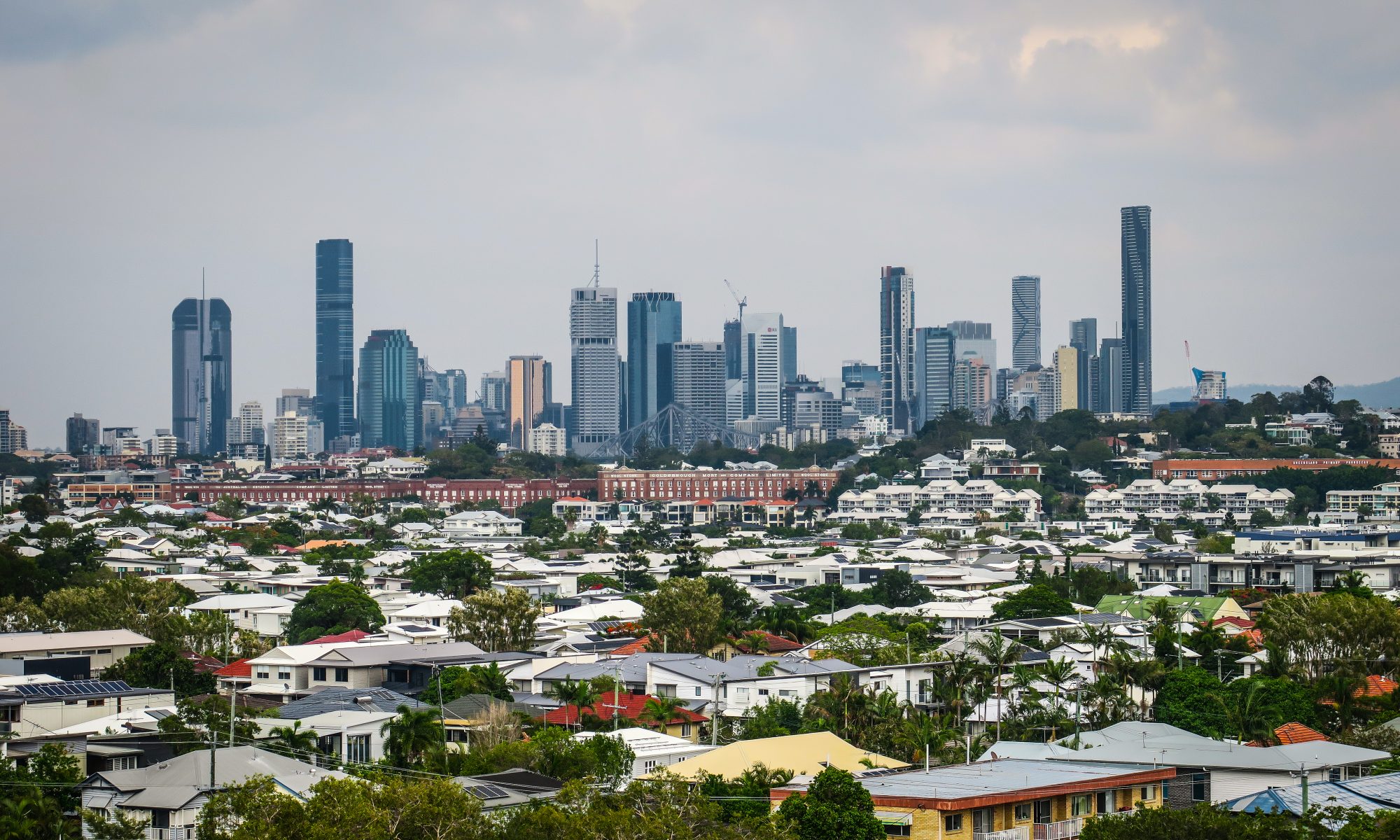
A low supply of homes for sale was a key factor pushing prices higher last year, in defiance of well-established historical trends in which home values always fall when interest rates rise. But the tide may be turning in buyers’ favour, with PropTrack data showing a 22 percent increase in new listings coming onto the market across the combined capital cities last month compared to February 2023.
Senior REA economist Angus Moore said the 22 percent lift was the highest increase in new listings across the capitals for the month of February since 2012. “Property markets in capital cities, Sydney and Melbourne especially, saw a strong start to 2024, with the busiest January and February since 2012 across the combined capital cities,” Mr Moore said.
“Supporting this busier start to the year … was strong demand, unemployment that remained low by historical standards, strong population growth, tight rental market conditions, and a more stable outlook for interest rates.”
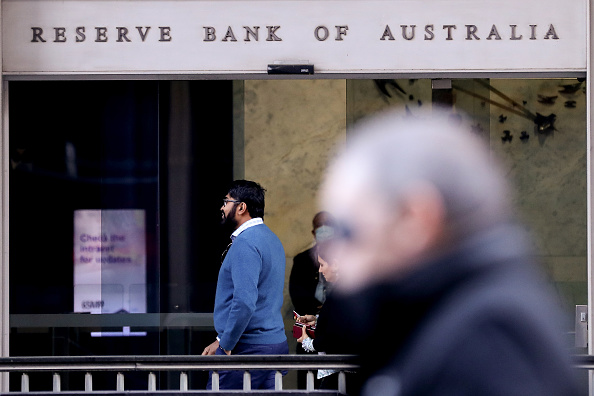
The Reserve Bank announced on Tuesday that interest rates would remain on hold for a third consecutive month at 4.35 percent.
“Markets are no longer expecting a further increase in interest rates, with an expectation of cuts as soon as the second half of this year,” Mr Moore said.
The biggest increases in new listings were seen in Melbourne with 35.4 percent more homes for sale, along with Sydney at 33.6 percent and Canberra at 32.2 percent. There was an 8.5 percent increase in listings in Brisbane, and only a 2.1 percent increase in Perth and a 1.1 percent increase in Adelaide. Listing numbers dipped slightly in Hobart and Darwin.
There was a 7.8 percent increase in new listings across the combined regional areas, with last month’s volume broadly in line with the pace of activity that has been typical for the month of February over the past decade. The biggest increases in new listings were in regional Victoria at 12.8 percent, regional NSW at 12.2 percent and regional Tasmania at 9.8 percent. Mr Moore said that while new listings increased only 1.6 percent in regional Queensland, this was the first year-on-year increase in new listings recorded since August 2022.
Senior REA data analyst Karen Dellow said recent data from realestate.com.au’s Residential Audience Pulse Survey showed homeowners were feeling more confident to sell. The survey revealed that one in ten owners were contemplating selling their property when the survey was taken in January. Seller confidence has shot up, with 43 percent of respondents considering it a favourable time to sell, up from 34 percent last year.
“Western Australia has the highest seller sentiment, with 63 percent of respondents expressing optimism about the current market, marking a substantial 70.3 percent increase from last year,” Ms Dellow said. “NSW, Queensland, and South Australia have also witnessed substantial growth in seller sentiment over the past year, with NSW up 53.8 percent.”
Ms Dellow said the primary drivers behind increasing seller confidence were rising prices and growing buyer demand. More than a third of sellers anticipated further price rises in the next six months, the survey showed.
“Lifestyle changes, such as relocating to a different area or seeking a property with specific amenities like a pool or more space, were the primary motivations for selling. Downsizing ranked second, reflecting the preferences of Australia’s ageing population seeking properties better suited to their evolving needs.”
On Central Park South, retired entrepreneur Ron Pobuda has relisted his two-bedroom apartment for $8.95 million, a dramatic 40% reduction from its first asking price in Sept. 2020. Twenty blocks north, on the Upper East Side, real-estate agent James Morgan found a buyer for an $18 million penthouse before he could even get the property listed online.
In the wake of the Covid pandemic and interest-rate hikes—and amid an AI-driven stock market climb—buyers and sellers are having a hard time deciphering the New York City luxury real-estate market.
Ask a broker in Miami and they’ll say New York is dead. Ask a residential tower developer in New York, they’ll say that is nonsense. Ask a local real-estate agent, and he’ll say the market has rarely felt so hit-or-miss.
“It’s a mixed bag. Some things sell in two days. Other things sit there for two years,” said Leonard Steinberg, a luxury real-estate agent with Compass .
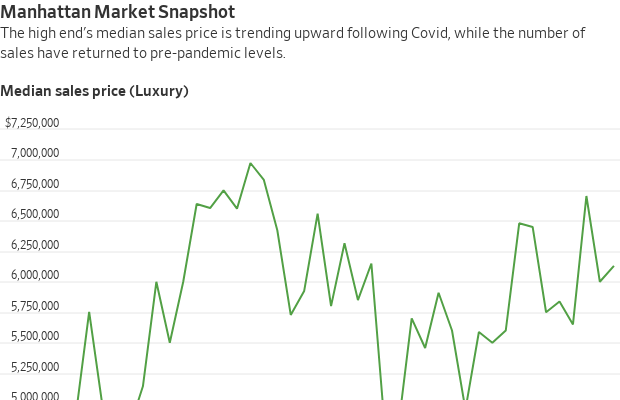
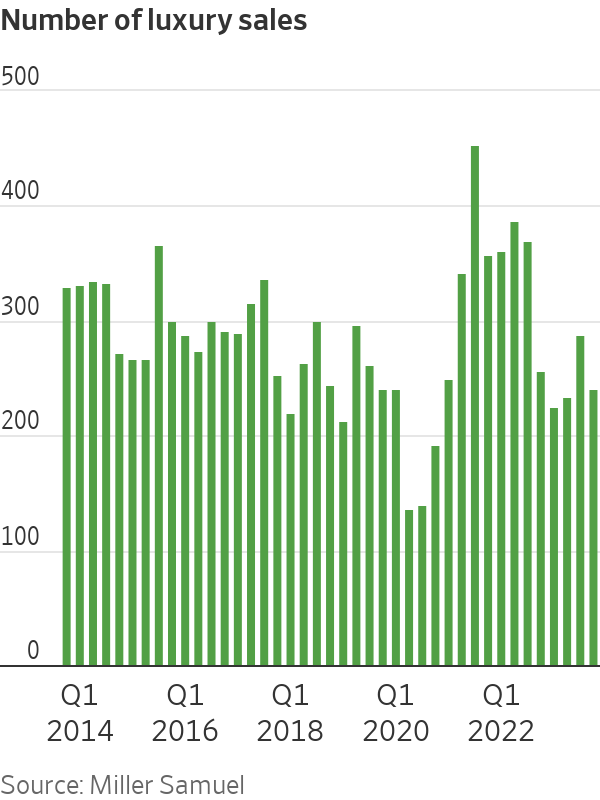
The Manhattan numbers point to a post-Covid luxury market that likely bottomed out in 2023, said appraiser Jonathan Miller . A report he prepared for brokerage Douglas Elliman shows that, in the fourth quarter of 2023, sales of luxury Manhattan homes (defined by the report as the top 10% of all sales ) were down by 5.9% compared with the same period a year prior.
It seems to be improving. So far in 2024, luxury contract activity has ticked up incrementally, according to local agents, who cite a decrease in inventory and a rising stock market. Liquidity pace, a measure of the rolling previous 30 days of signed-contract volume, was up by 9% so far in 2024 through Feb. 26 for apartments priced at $5 million and up, compared with the same period last year, according to real-estate data firm UrbanDigs.
“It looks like 2024 will be better, but it won’t be a boom,” Miller said.
Thanks to higher interest rates, all-cash deals are dominating the market, with roughly 68% of all Manhattan transactions unfinanced in the fourth quarter, according to Miller. That is up from the usual average of around 50%, Miller said.
Here’s a closer look at New York’s contrary, confusing high-end property market.
Where the sales are
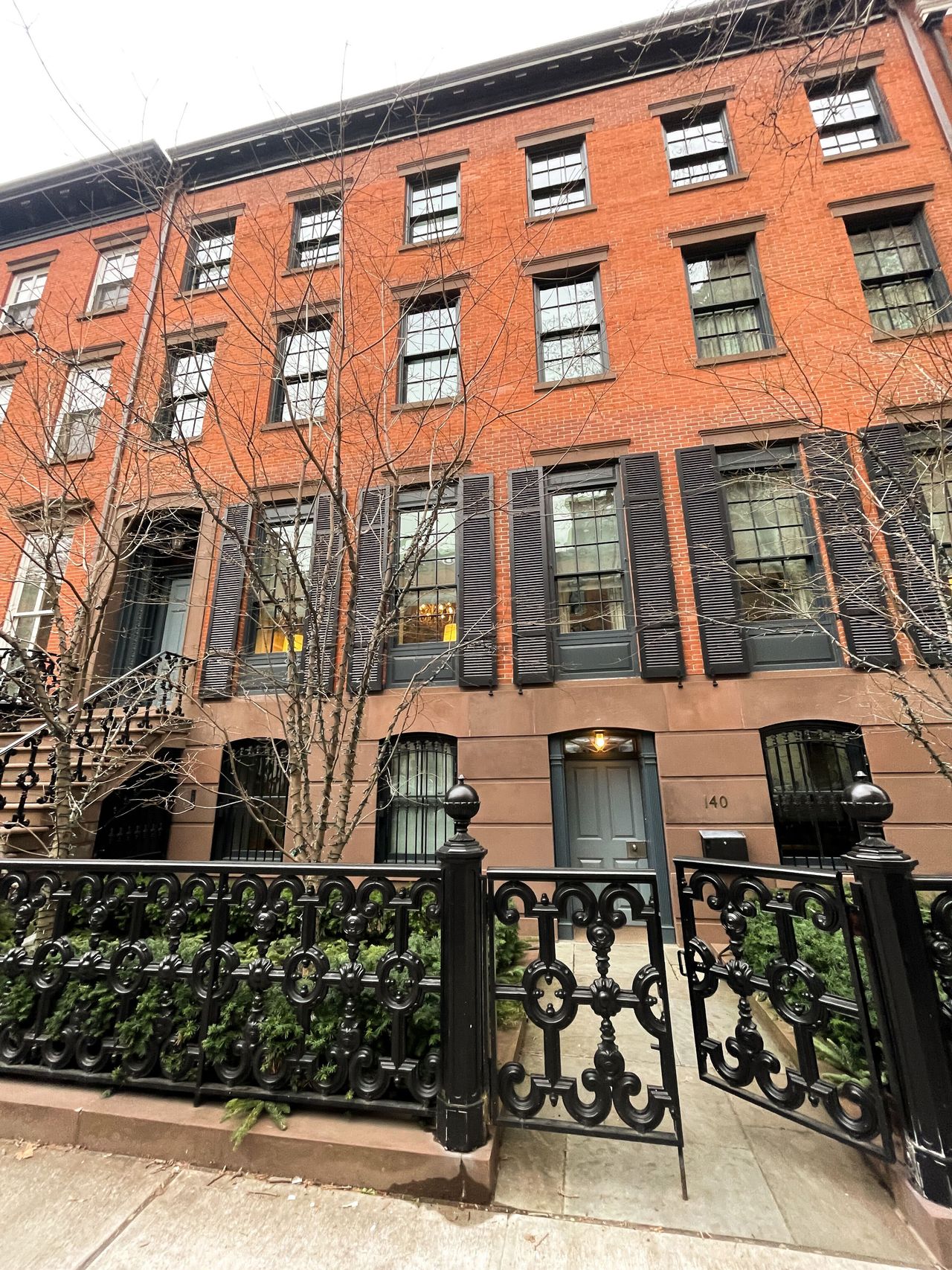
The sale of a roughly 12,000-square-foot Greenwich Village mansion owned by Dexter Goei , the former chief executive of telecommunications company Altice USA , set a new price record for Downtown Manhattan. (NYC brokers define Downtown as south of 34th Street. It is more commonly defined as south of 14th Street.) It traded off market for $72.5 million in January. The price was more than double the $30.9 million that Goei paid for it in 2016, records show.
A West Village townhouse recently set a Downtown record when it sold for $72.5 million. PHOTO: MARCY AYRES/THE WALL STREET JOURNAL
The deal added to a string of major Downtown transactions that propped up the Manhattan market in 2023. In July, a penthouse at 150 Charles Street, a successful West Village condominium project, sold for $52 million . The seller was a company tied to former Credit Suisse executive Robert Shafir . In June, a Soho penthouse tied to Stefan Kaluzny, managing director of the private-equity firm Sycamore Partners, sold for $50 million , one of the largest deals ever recorded in Soho.
Clayton Orrigo, who worked on the $72.5 million Greenwich Village deal, said his team at Compass has closed or signed contracts on more than $500 million in real estate since the beginning of the year, with about 80% located south of 30th Street, and he expects the Goei property to be the first of a handful of major house sales in the neighbourhood. Other major Downtown properties that have been shopped for sale at similarly ambitious price points in recent years include financier Steve Cohen’s fortresslike, single-family mansion on Perry Street, which is said to have asked around $150 million in off-market conversations.
“I do believe that it’s a pioneer,” Orrigo said of the $72.5 million deal, declining to confirm the identity of his clients. “I don’t think it’s the last and I don’t think it will be the most expensive.”
Orrigo attributed the rise of Downtown prices to a lack of available inventory. Sought-after Downtown neighbourhoods like Greenwich Village, the West Village and Tribeca don’t see the same levels of new development as other Manhattan neighbourhoods, thanks in large part to height restrictions tied to their designations as historic districts. He said many of his moneyed clients who visit the city eventually look to buy pieds-a-terre in the area because they are unsatisfied with the hotel offerings. Airbnb listings in New York City have also all but disappeared as the city cracks down on short-term rentals .
In addition to the city’s stepped-up enforcement of short-term rental rules, many condo and co-op boards don’t allow owners to rent their properties at all, even if the rental wouldn’t be subject to the city’s short-term rental regulations. “When they realise how hard it is, they end up buying,” Orrigo said.
Orrigo said the buyer pool is made up of tech titans and “the nepo community,” meaning the children of wealthy individuals. “We’re seeing a tremendous amount of inherited wealth,” he said.
Luxury agent Sarah Williams of Societe Real Estate said she recently had a client sign a $41,000 a month, long-term rental deal when they couldn’t find a home that met their criteria in the West Village or Tribeca.
“There’s this widespread misunderstanding about New York, that it’s struggling,” she said. “New York is so sought after, it’s just that people cannot get what they want.”
One of the most successful new condos of 2023 was also located Downtown at 450 Washington Street. A rental-to-condo conversion by the Related Companies, it posted roughly $240 million in sales across 85 transactions in 2023, the developer said. Units were priced between $1 million to $15 million for studio to four-bedroom homes. Bruce A. Beal Jr., Related’s president, said the project had the “right pricing” and that buyers, the majority of whom were local, “understood the product.”
Where it’s still tough to sell
While Downtown is thriving, Midtown has been hobbled by excess inventory, remote work and a decline in foreign buyers, who have historically gravitated toward Midtown apartments, agents said.
When Pobuda, the entrepreneur with the Central Park South apartment, listed his longtime unit, a sprawling two-bedroom with a large terrace overlooking the park, in late 2020, he first asked $15 million. While ambitious, the price reflected the property’s trophy views and location, next door to 220 Central Park South , the most expensive building in the city. He got no offers.
“It was really obvious very quickly that nothing was going to happen, so I said, ‘Let’s just pull it off the market.’ ” Pobuda said.
The new asking price is a reflection of how the market has moved in response to interest rates and is strategically pegged just under $10 million to put it in a different bracket for New York’s mansion tax, said Peter McLean of the Corcoran Group, who is listing Pobuda’s unit. “We’re throwing as many incentives to the buyers as possible,” McLean said. (The tax, paid by the buyer, starts at 1% beginning with properties of $1 million or more and gradually increases to a maximum of 3.9% for properties purchased for $25 million or more.)
Pobuda’s story is typical of Midtown sellers, many of whom have had to slash prices on luxury properties to make a deal. Compass agent James Morgan said he recently lost a listing for a three-bedroom apartment at Museum Tower on West 53rd Street after the seller refused to consider reducing the $4.25 million price. Meanwhile, his high-end listings on the more inventory-constrained Upper East Side, such as the $18 million sale of a penthouse at 135 East 79th Street, are moving quickly.
“We’re still dealing with the Covid effect in Midtown,” he said. “People are working from home and they want to be in areas that are considered more neighborhoody.”
Midtown also has the largest concentration of high-end, unsold new development units in Manhattan. Much of the unsold inventory is on the Billionaires’ Row strip south of Central Park. It sits in buildings such as Extell Development’s Central Park Tower, the 1,550-foot-tall glassy behemoth at 217 West 57th Street, which launched sales in 2018 and has roughly 77 unsold units priced at $5 million and up as of late February, according to real-estate data and analytics company MarketProof. While 53w53, the Jean Nouvel-designed tower next to the Museum of Modern Art, which has struggled to find buyers since launching in 2015, has about 65 units remaining priced at $5 million and up as of late February, as per MarketProof.
Units at both towers are routinely selling for significant discounts. A roughly 3,700-square-foot two-bedroom unit at 53w53 recently sold for $7.85 million, 32% less than its original $11.5 million asking price in 2016, records show.
Sales hobbled by rules
While the condo and townhouse markets are generally showing signs of life, agents say the city’s co-op market remains muted. Many of them blame antiquated co-op board rules that restrict a resident’s ability to sublet their units or renovate them. Some posh buildings insist on approving contractors, for instance, or fine residents if their renovations take too long, said luxury agent Donna Olshan.
Anne Hendricks Bass in 2010 PHOTO: MIMI RITZEN CRAWFORD FOR THE WALL STREET JOURNAL
The subletting rules seem particularly egregious post-Covid, said Williams, the luxury agent, since many high-net-worth individuals moved to Florida and want more flexibility to use their units as pieds-a-terre.
“They want to live in Miami, they want to live in London. They don’t want to be tied down,” she said.
Some of the city’s priciest co-ops have seen their prices reduced in recent months. A Manhattan apartment long owned by the late pharmaceutical executive Martin Howard Solomon is now asking $45 million, down from the original $55 million when it listed in 2022. The longtime Fifth Avenue home of the late oil heiress and philanthropist Anne Hendricks Bass also got a $10 million price chop to $60 million in November. Both remain on the market as of March 18.
“Even the best of these addresses are going for ridiculously low prices,” Olshan said “It’s amazing that the shareholders don’t file activist lawsuits to try to motivate their boards to change.”
A new development drought
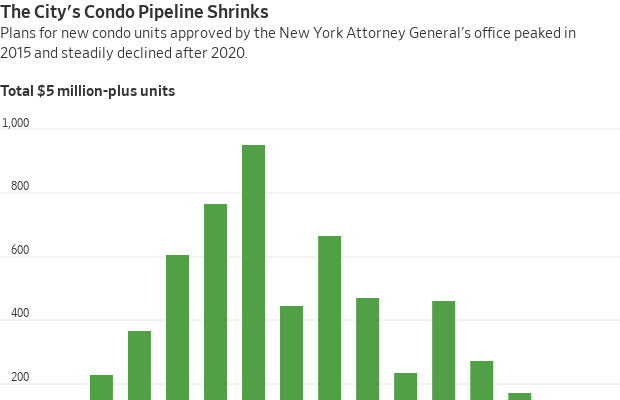
For the past few years, the Manhattan market has suffered from a serious oversupply problem, appraiser Miller said. For now, overall inventory remains high outside of a few select neighbourhoods, but that likely won’t last. That is because filings for new luxury condos have plummeted.
Plans approved by the New York Attorney General’s office for units priced $5 million and up peaked in the mid-2010s and have dropped since 2020, according to MarketProof. In 2015, offering plans were approved for 952 units at that price point. In contrast, there were just 57 approved in 2023.
“In the years since Covid, so many things stood in the way of new inventory,” said Kael Goodman, co-founder of MarketProof. “There was supply chain, Covid shutdowns, a perception of oversupply and a high cost of capital. There was also an attention shift from New York to Miami.”
As of the close of February in Manhattan, there were close to 1,400 developer-owned units for sale at prices over $5 million, with an average asking price per square foot of $3,820, according to analytics firm MarketProof.
Outside of Midtown, neighbourhoods with significant new development inventory at that price range include West Chelsea, Lincoln Square and the Financial District. Again, that is thanks to a handful of megaprojects, including Chelsea’s One High Line and Macklowe Properties’ One Wall Street.
After a slow start marred by controversy, One High Line was among the top-selling buildings of 2023. It posted 35 closings with an average price per square foot of around $3,000, according to a spokeswoman for the developer. That brought the total number of sales to around 80, she said. Formerly known as the XI, the 235-unit condo project first launched sales in 2018, but the original developer, HFZ Capital Group, faced financial distress and the project stalled. Witkoff and Access Industries took over the project in 2022 and rebranded it.
Meanwhile, industry sources say sales have been slow at One Wall Street, the former headquarters of the Irving Trust Company bank. Sales launched at the 566-unit building in September 2021 and there were still 467 units remaining as of late February, according to MarketProof. A spokeswoman for the project didn’t respond to a request for comment.
Gary Barnett of Extell Development, the firm behind Central Park Tower, said that while “inventory is gradually getting eaten up” across the city, his company is now being “very careful to pick the right projects.”
“You don’t want to be in a situation where your cost basis is so high that you have to make $6,000 or $7,000 a foot to make money,” he said.
While he has plenty of inventory remaining on Billionaires’ Row, another of the company’s projects, 50 West 66th Street, a roughly 125-unit project off Central Park on the Upper West Side, is close to 50% sold without having even formally launched sales, he said.
Barnett pointed to the project as evidence that “if you have the right product in the right location, you can still get very real and serious prices.”
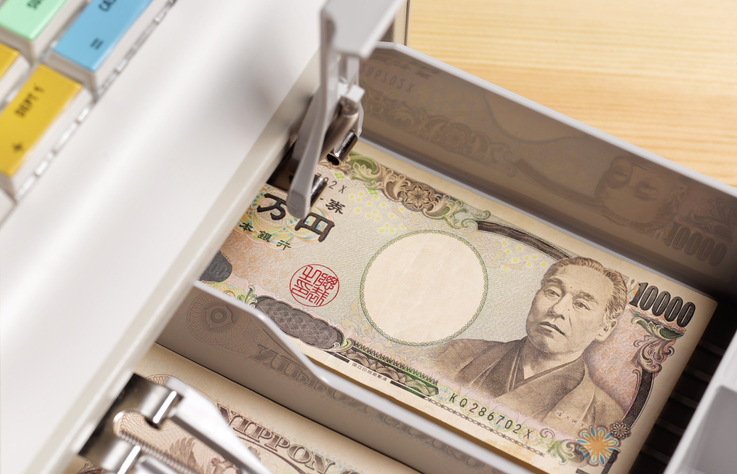
TOKYO—The Bank of Japan on Tuesday ended negative interest rates after eight years and unwound most of its unorthodox monetary easing policies, saying a new era of stable inflation is in sight in Japan.
The decision marks the end of a global era of negative interest rates that began in the 2010s. Other central banks that had introduced negative rates in the 2010s, including the European Central Bank and the Swiss National Bank , have already moved back into positive territory amid inflation triggered by the Covid-19 pandemic and the war in Ukraine.
For a generation, the Japanese central bank served as a laboratory for monetary-policy experimentation as it addressed the country’s chronic stagnation, which was marked by flat or falling prices.
On Tuesday, BOJ Gov. Kazuo Ueda said those policies have fulfilled their roles and the principal ones will be ended. The Bank of Japan is moving its key target for short-term rates to a range of 0% to 0.1%, its first rate increase since 2007.
Ueda said the move was justified by steadily rising wages and prices in Japan. The central bank “judged that sustainable and stable achievement of our 2% inflation goal has come into sight,” he said.
The BOJ said it removed a target for the yield on 10-year Japanese government bonds. And it is halting its purchases of assets such as stocks, real-estate investment trusts and corporate bonds that don’t typically go onto the books of central banks. The Bank of Japan has amassed the equivalent of hundreds of billions of dollars in such assets since the global financial crisis of 2008-09.
Market reaction was restrained because Bank of Japan officials had telegraphed their intentions. The Nikkei Stock Average closed up 0.7%, while the yen was down.
“Accommodative financial conditions will likely continue, and these accommodative financial conditions will firmly support the economy and prices,” Ueda said at a news conference. He said he didn’t expect to raise interest rates rapidly.
Prime Minister Fumio Kishida welcomed the continuation of easy money, saying it was too soon to declare an end to deflation.
The BOJ had already begun to ease away from its unconventional policies. In September 2016, it set a target of around zero for the yield on 10-year government bonds. After initially enforcing that target strictly, the bank last year loosened its control , allowing the yield to move higher amid a surge in global bond yields. As of late Tuesday, the 10-year yield was 0.725%.
The Bank of Japan’s move to restore traditional monetary policy tools is one example of how Japan’s economy has recently reverted to conditions not seen in more than three decades.
However, the Bank of Japan’s economic assessment pointed to some warning signs. With China’s economy struggling recently , the BOJ said Japan’s economy “is expected to be under downward pressure stemming from a slowdown in the pace of recovery in overseas economies.”
Two of the BOJ’s nine-member policy board dissented from the decision to end negative rates, saying the economy’s recovery was too fragile to allow for a rate increase.
Katsutoshi Inadome, senior strategist at SuMi Trust, said the BOJ probably saw a window to act after the recent good news on wages, but he said there was a chance Tuesday’s rate increase was premature.
“In a textbook approach, this is timing the bank would have done better to avoid,” Inadome said. He pointed to sluggish consumption in Japan, which Ueda acknowledged as a risk.
Ueda said if the economy received shocks in the future, the central bank would consider using policy tools it has used previously.
“The Bank of Japan is unlikely to make additional rate increases because there will gradually appear more headwinds such as the lack of strength in prices,” said Mizuho Securities chief market economist Yasunari Ueno.
When architect Phillip Mathieson first walked members of Third.i property group through the interiors he had designed for their Kurraba Point “super penthouse”, there were a few raised eyebrows. It wasn’t the million-dollar kit-out of furniture and decor by French luxury brand Liaigre that was disconcerting his clients — it was the art. Not the Brett Whiteley linocut of a dove, or the intricately patterned larrakitj (memorial pole) by Yolngu artist Malaluba Gumana, but the yellow mirrored work by young queer artist Tay Haggarty, which appeared to be pinioned to the wall by four white socks.
Find more stories like this in the latest issue of Kanebridge Quarterly magazine, Australia’s best resource for property, money and living. Order your copy here.
Mathieson, whose architecture firm was charged with the interiors for all 24 residences in Third.i’s new Sydney Harbour-side development (including 21 harbourfront apartments and two sub-penthouses), was given free rein on choosing the art for the penthouses, and engaged the expertise of Artbank: a governmental body whose collection of more than 10,000 Australian artworks spans from the 1920s to now, all available to lease. In the super-penthouse, the selection includes a monumental work in black Belgian marble by the late Melbourne artist Joel Elenberg (who smashed the sales record for Australian sculpture in August 2023 with a similar work, which sold for $925,000) and a mix of abstract and figurative works by significant artists such as Bronwyn Oliver and Marion Borgelt.
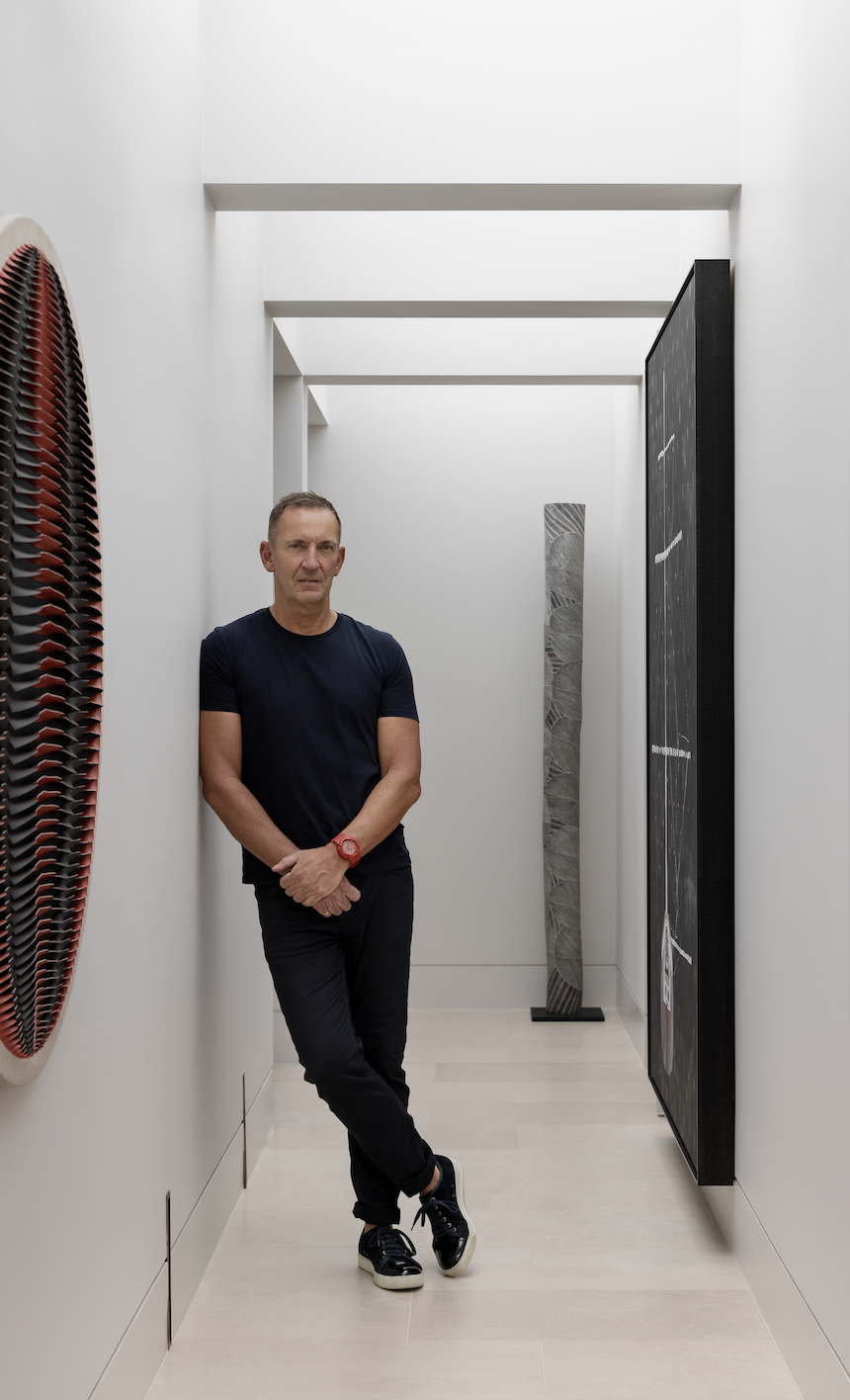
Architect Phillip Mathieson at the Kurraba Penthouse. Elton John was recently suggested as a possible buyer for the property, claims which were firmly denied by his representative.
Amongst these, Haggarty’s piece stands out: “It’s quite a controversial piece to have in there, given that it’s a very high end development,” says Artbank consultant Carey Corbett, who worked closely with Mathieson Architects to select the works. “I imagine the expected clientele is not so familiar with their work, being a younger artist — and possibly not the sort of artist that some of those prospective buyers would have in their homes.”
But Haggarty’s piece, titled Sun on Bare Back, provides a moment of delicious, cheeky dissonance within the elegant surroundings.
Tay Haggarty’s Sun on Bare Back is a controversial choice, Artbank consultant Carey Corbett says.
It’s the kind of memorable moment designed to cut through at the top end of the market.
As Mathieson says: “Quite often what happens when there’s a display suite for a project, or even when a project is finished, either it’s left empty or it’s furnished with rental items, and you end up with a bad reproduction poster on the wall; it’s all very generic. The Kurraba project was unusual in that the developer, I think partly because of the market that they were going after and the calibre of the location and the apartment itself, saw the value in buying furniture -— and therefore the natural extension of that was to fully provide the experience of how someone might live.
“The art is part of that.”
Lachie Gibson, founder and CEO of Melbourne developer ANGLE, agrees. His outfit prides itself on providing a holistic package of high quality location, architecture, landscape and interiors — and he sees art as a “crucially important” extension of that. ANGLE champions Australian creatives, partnering with emerging talent (including furniture designer Thomas Lentini, before he broke into the big league) and local heroes such as Dinosaur Designs, design firm Flack Studio, commercial galleries and Artbank, to create distinctive interiors for their high-end residential developments, including the multi-award-winning Fenwick, in Kew.
“We’ve had success over the yearsselling off the plan, but at the end of a project you might have a $6 million penthouse [not yet sold] and so you’re styling it for sale — and the difference between the kind of generic property stylist that the real estate companies use and partnering with someone like Artbank, is huge,” Gibson says.
Even when apartments are sold off the plan, ANGLE typically brokers relationships between buyers and interior designers, who will then do a full furniture and art fit out. “Obviously it’s awesome for the client — it elevates their space and makes it feel incredible. But also for us as a developer, the photographs of those completed spaces become almost our number one marketing tool,” Gibson says.
“It’s pretty easy to go and render something up, but having a built space that’s got amazing artwork is hugely advantageous to us.”
For their latest development, Fenhurst, ANGLE is partnering with Artbank to select hero pieces for the common areas, and with Melbourne gallery Daine Singer for apartment artworks — which will be shown in marketing renders, but available to see in the flesh (and purchase) from the developer’s Harold Street Gallery: a multi-purpose space in Camberwell that was designed by Fleur Sutherland and showcases ANGLE’s regular collaborators alongside a rotating selection of pieces from Artbank and Craft Victoria.
It’s not just developers harnessing art for a competitive edge. When Simon Hakim, CEO of creative agency Hunter, and his wife decided to put their stunning home “Rail House” in Melbourne’s Northcote on the market, they knew they needed art for the massive walls in their central living area.
“Over the years, we’d been talking about putting artwork up there, and had a built-in rail installed specifically for art [but] we couldn’t ever decide on what we liked,” he says. Then a neighbour introduced Hakim to Artbank, which has short and long-term and annual leasing plans that range from $165 to $5500 per annum.
“It was a really good way to test out the art wall — and to see massive works that we were able to display [on the rail] but couldn’t afford,” Hakim says.
In the end, they leased a series ofprints by photographer Bill Henson.
“It filled an empty void; it made a huge impact on the house. [And] we had a lot of comments about the work [from prospective buyers],” says Hakim.
Bill Henson’s Untitled 36/105
Sydney property agent Georgia Cleary, of McGrath Paddington, says there’s an increased appreciation of art across the market these days, and in the prestige end of the market in particular: “People will pay tens of thousands of dollars to style their properties, and you can’t put prints into those homes.”
McGrath generally asks stylists not to put art on the walls, and instead partners with local artists and galleries to select high-end pieces. “We’ve found that the market responds really well to original works [rather than reproductions or prints],” says Cleary. “It elevates the perception of the property as ‘prestige’.”
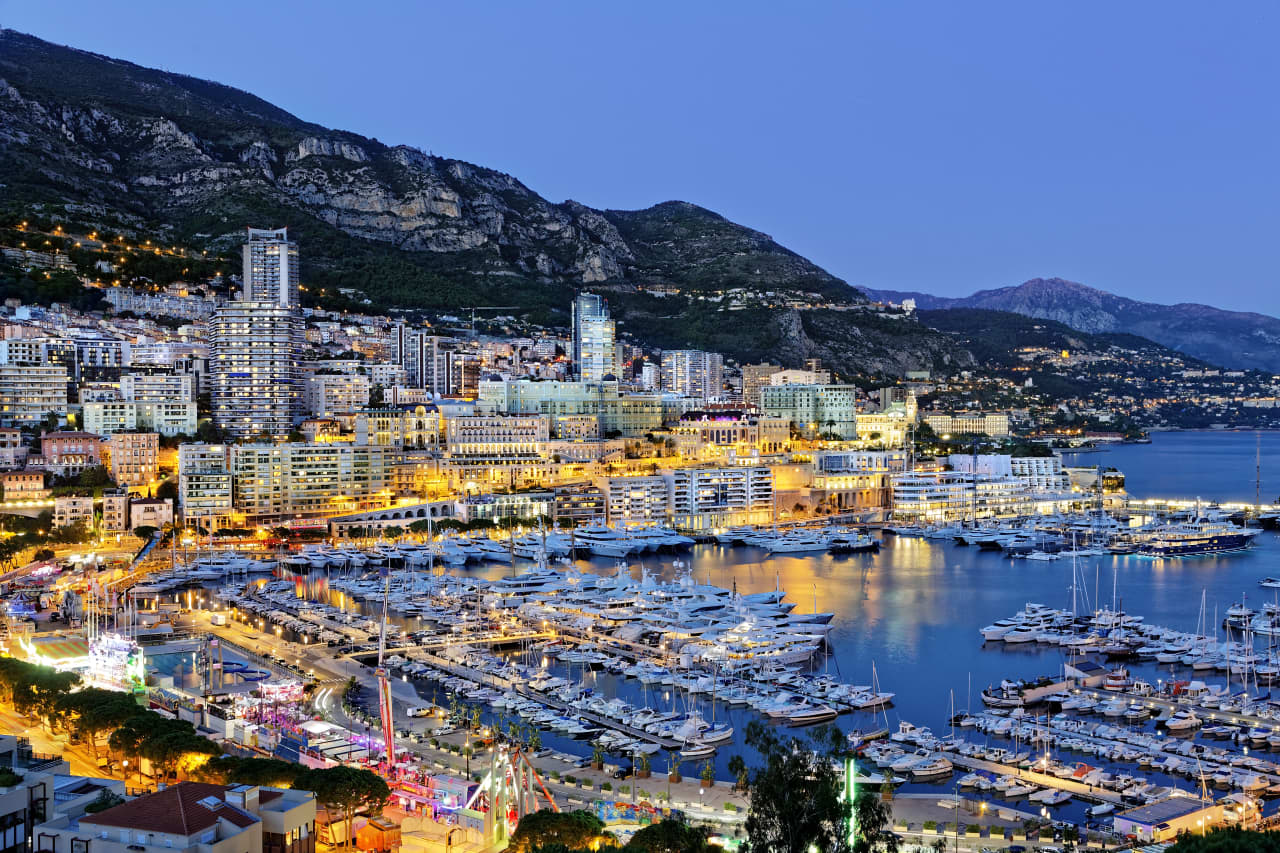
Monaco’s prime real estate market remained strong despite global macroeconomic challenges and became the most expensive prime property market in 2023, according to a report Monday from Savills.
The price per square metre in the principality may have grown just 0.9% during 2023, but that increase, however slight, left the average price per square metre at €51,418 (US$55,852).
In comparison, the price per square metre was €39,100 in Hong Kong, €25,300 in New York, €18,900 in London and €8,400 in Dubai.
There were 416 transactions across the principality in 2023, which represented a decline of nearly one-fifth compared to the previous year. However, the total transaction value declined by a smaller amount than the number of transactions, which indicated that fewer but higher value transactions were recorded in 2023.
In examining the total sales by price point, the proportion of apartments selling for more than €5 million increased 2% in 2023, while the share of apartments sold priced below that same threshold fell by an equal amount, according to the report.
Interest in Monaco has risen since the pandemic, contributing to space constraint issues in the principality. Residence card applications also now require a property’s size to match the intended occupying family’s size, which has resulted in greater scrutiny, Savills said.
In response to this rule, many new-build projects are offering larger apartments. The sales of more spacious apartments with three or more bedrooms accounted for over 60% of new-build sales and 22% of the resales across the principality in 2023.
“The number of resales in Monaco has returned to pre-pandemic levels, and this rebound has largely been driven by the increase in sales of larger apartments,” Kelcie Sellers, associate director of world research at Savills, said in the report.
Potential buyers don’t just want to live in Monaco. They are very specific when it comes to choosing a particular district or even development. Together, Monte Carlo and La Rousse comprise over 40% of the total housing area in the principality, yet they accounted for more than 60% of resale transactions in 2023.
In fact, the mean price for resales increased to an all-time high in five out of seven Monaco districts in 2023. Jardin Exotique and La Condamine saw the highest price-per-square-metre growth of 19% and 22%, respectively. Larvotto maintained the top spot for most expensive district by square metre, according to the report.
In an effort to meet the high demand for real estate in this principality, which is smaller than New York’s Central Park, construction projects are in progress. Two large communities are expected to launch this year: Mareterra and Bay House Monaco. These projects will add a combined 166 new apartments and 15 villas to the Monaco market.
Prospective buyers around the world are approaching the current market with caution as they wait to see how macroeconomics, inflation and interest rates play out. However, as Monaco offers somewhat of a safe haven, it may attract buyers who would have purchased property elsewhere, which would continue to drive demand in the coming months, Savills said.
SYDNEY—The Reserve Bank of Australia said Tuesday that it still can’t rule out the possibility that interest rates will need to be raised further, adding that inflation remains too high and is expected to remain elevated for some time yet.
The RBA left its official cash rate on hold at 4.35% at its policy meeting. The decision was widely expected by economists.
“While recent data indicate that inflation is easing, it remains high. The board expects that it will be some time yet before inflation is sustainably in the target range,” the RBA’s policy setting board said Tuesday.
“The path of interest rates that will best ensure that inflation returns to target in a reasonable timeframe remains uncertain and the board is not ruling anything in or out,” it added.
The RBA’s guidance was little changed from its policy announcement in February, and will buy it time before the release of first-quarter inflation and economic growth data in coming weeks.
The threat of further interest rate increases stems from the fact that while inflation has fallen to its lowest level in two years, it remains significantly above the RBA’s 2%-3% target band at a time when there is still pressure building under wages, while the center-right Labor government will hand out income tax cuts in the middle of the year.
“The board needs to be confident that inflation is moving sustainably towards the target range. To date, medium-term inflation expectations have been consistent with the inflation target and it is important that this remains the case,” the RBA said.
Inflation continues to be fueled by things like soaring rents and rising electricity and insurance costs, areas of the economy the RBA’s policy instrument of interest rates can only affect at the margin.
The RBA will continue to lag behind many other major central banks that are already pointing toward the probability that interest rates could fall soon.
The lag in Australia is partly due to the fact that interest rates weren’t raised by the same amount seen in other countries, as the RBA wanted to protect employment.
The RBA isn’t forecasting inflation to return to its target band until early 2026, which means inflation will have been outside of the band for close to four years.
Still, the likelihood that the RBA actually does deliver a further increase in interest rates appears low given that the economy’s growth rate is at its slowest in 30 years, while unemployment has risen quickly over recent months.
“The RBA stuck to its hawkish guns at today’s meeting but we think it will pivot towards policy easing by August this year…but the board clearly isn’t letting down their guard,” said Marcel Thieliant , head of Asia-Pacific operations at Capital Economics.
If you’re a first homebuyer, owner/occupier or investor, you might feel that the property market is slim pickings in some of your favourite city suburbs. Either there’s no supply or the reserve is well above your budget threshold. However, for those property-savvy individuals prepared to look harder, there’s a growing number of suburbs in Australia’s major cities that are proving to be great investment opportunities…
—…you just need to know where to find them.
Independently-owned real estate agency, Little Real Estate, has released its annual report for the best Australian suburbs for investing. Investors searching for affordability, cash flow, and capital growth potential are being encouraged to consider regional locations, including four in Queensland.
“In 2024, we anticipate a surge in property prices fuelled by the relentless demand for housing outpacing the available supply,” says Little Real Estate executive general manager of sales, James Kirkland. “An exceptionally strong rental market, coupled with a shortage of housing, continues to exert upward pressure on house prices nationwide.”
Real estate analyst Hotspotting’s National Top 10 Positive Cashflow Hotspots echoes the findings of Little Real Estate’s annual report. Its analysis found that Queensland locations showed exponential capital growth, with the Sunshine State securing half of the top 10 locations.
“Cash flow has become increasingly important over the past two years, given the much higher mortgage repayments in play,” says Hotspotting director, Terry Ryder. “It is imperative that investors seek out areas that also offer capital growth prospects, often due to their booming local economies across a diverse range of industries.”
—
Which location is best for a property investment?
It depends! According to Little Real Estate, in 2024, the Sydney suburbs of Wiley Park and Kensington come out on top, along with Caloundra West and Southport in South East Queensland, and Carlton and Moonee Ponds in Melbourne.
What is the most in-demand suburb in Sydney?
The property market is certainly inflated in Sydney in comparison to other states but investors can still find some gems in certain pockets of the city. Take Penrith, for example. According to REA data, the average cost of a unit in Penrith costs $540,000, with a rental yield of 4.3%.
Which state is best for investment property in Australia?
It’s hard to go past Queensland as one of Australia’s best states for investment properties. With four out of ten suburbs in Queensland appearing in Little Real Estate’s annual report—including Southport, Caloundra West, Coomera and Bulimba—Queensland and its surrounding suburbs, typically regional, are presenting as great investment opportunities.
“Whether you’re an investor, a family looking for a new home, or a professional seeking the ideal work-life balance, these suburbs are the ones to watch for growth and potential in the upcoming year,” says Kirkland.
What is the fastest growing suburb in Australia?
According to Smart Property Investment, the fastest growing suburb in Australia is Chelmer, Queensland – a south-western suburb in the city of Brisbane, with a quarterly price growth of 29.33 per ent. This is followed closely by Frenchs Forrest in NSW, and Greenmount in Queensland.
Japan’s stocks have reached levels that haven’t been seen for 34 years . The country is likely to hit another milestone soon: Its central bank could raise interest rates for the first time in 17 years as soon as Tuesday.
Higher, and positive, Japanese rates won’t reshape markets overnight. But the long-term effects could be profound, particularly if U.S. growth heads structurally lower for any reason, further narrowing the yield advantage of many U.S. assets. Japan is the single largest overseas holder of U.S. Treasurys, a major overseas lender, and an export heavyweight whose corporate earnings—and stocks—have been significantly supported by the ultra cheap Japanese yen. More Japanese capital staying at home could eventually impact the price of everything from U.S. mortgages to infrastructure finance in the developing world.
For much of the past two years, Japan has swum against global monetary tides, maintaining its ultra low interest-rate regime. But now, as most other major central banks are about to cut rates, the Bank of Japan is poised to break the trend again. Domestic media reported over the weekend that Japan’s central bank will end its negative interest rates, which have been in place since 2016, during its policy board meeting on Monday and Tuesday.
The decision would come after mounting evidence that the job market is on an increasingly strong footing , after years of stagnant wage growth. Unions secured an average salary increase of 5.28% , according to the first-round results of Japan’s annual spring wage negotiations, the Japanese Trade Union Confederation said last week. For the entire decade ending in 2022, the final annual increase never exceeded 2.4%.
Much likely won’t change in the short term. The Bank of Japan will probably pace its rate increases slowly: The past couple of years have, if anything, reaffirmed its reputation for moving slowly and deliberately. Moreover, while inflation is still high by Japanese standards—2.2% in January—it has already cooled from the peaks of last year.
Japanese bond yields have picked up, but they are still substantially lower than in the U.S. The rate differential between 10-year government bonds in the U.S. and Japan stands at 3.5 percentage points. That is significantly lower than the 4.2-percentage-point gap of a few months ago, but still way higher than the 1.5 percentage points of three years ago.
Even so, a narrowing rate gap—especially if the Fed cuts rates later this year, as seems likely—will support the Japanese yen . That could damp enthusiasm for rip-roaring Japanese stocks . They would become more expensive in dollar terms for foreign investors, who have been significant drivers of the rally. A stronger yen would also hit profits at some Japanese companies , especially big exporters.
Likewise, gradual interest-rate increases in Japan probably won’t change investment flows much in the short term. But it could be a different story down the road if the shift back to positive rates proves sustainable.
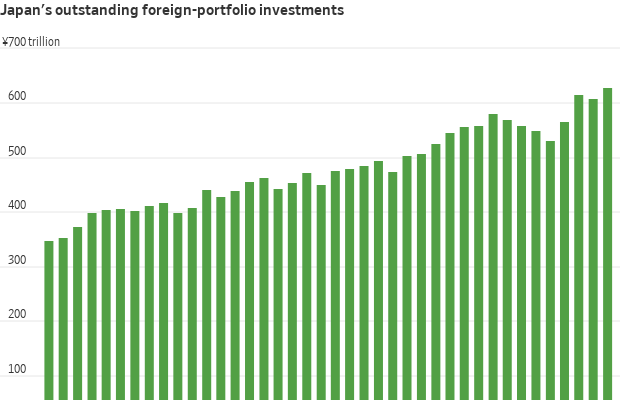
Japanese individuals and companies have been big investors abroad in search of higher yield for decades. The country’s foreign-portfolio investments stood at the equivalent of $4.2 trillion at the end of last year. A big chunk of that comes from Japanese pension funds and insurers, who would suddenly have more attractive options at home. Japanese investors, for example, hold around $1.1 trillion of Treasury bonds, making them the largest foreign owner.
Japanese investors have been scouring the globe for better returns for as long as most investors can remember. If that starts to change, the effects will be felt nearly everywhere—sooner or later.
There’s an opportunity for education as tourists return to Maui while it rebuilds from last summer’s devastating wildfire, says Kalikolehua Storer, a Lahaina resident and the area cultural and training advisor for Hyatt’s Maui resorts.
Designated a National Historic Landmark in 1962, the Lahaina Historic District—once a lush Hawaiian capital and retreat for Hawaiian monarchs—is beloved by residents, explored by tourists, and has a deep-rooted heritage. Storer was working on the opposite side of the island when the blaze started last August. She scrambled to connect with family and friends. And like so many others, she grappled with the utter chaos that rapidly destroyed her hometown.
Storer’s home was spared, but the fire ultimately claimed 115 lives and destroyed or damaged more than 2,300 structures, including culturally significant sites like the Na ‘Aikane o Maui Cultural and Research Center, which housed invaluable Hawaiian artefacts (books signed by kings, genealogy, maps, and more).
Kalikolehua Storer, a Lahaina resident and the area cultural and training advisor for Hyatt’s Maui resorts Courtesy of Hyatt
Historically, Lahaina thrived from mauka to makai (mountain to ocean), with waterways nourishing native ecosystems and communities. However, years of water redirection and climate-related drought set the stage for such a disaster, and according to Storer, the fire underscored the erosion of Hawaiian control over land and natural resources, spotlighting issues like land degradation, water misappropriation, and tourism’s stronghold on Maui.
Tourism makes up a substantial part of Maui’s GDP. The wildfire led to a 51.4% drop in visitor arrivals between August and October 2023 compared to 2022, triggering a sharp 87.1% rise in unemployment, according to government statistics.
The sector’s dominance highlights the need for a more balanced and sustainable model. Moreover, the fire’s impact on tourism underscores the urgency to diversify Hawaii’s economy for greater growth and resilience. Lahaina’s water management issues, such as the historical diversion for sugar cane cultivation, have drastically altered local ecosystems.
With only 23% of water allocated for public use and the majority consumed by the private sector (resorts, golf courses, and some agriculture, for instance), the ecological imbalance has had severe consequences for indigenous environments. Storer said she believes the aftermath of the fires and the strain on Maui’s tourism highlight the interconnectedness of ecological health and economic stability.
In response to the crisis, Maui Mayor Richard Bissen formed a five-member advisory team to lead the recovery efforts, with Storer as a key participant. Storer also sits at the table of Maui’s Office of Recovery Natural and Cultural Resources, which helps to shine light on issues impacting air, water, and land. Storer collaborates with partners from federal, state, and county levels, along with Lahaina’s cultural practitioners, to facilitate Lahaina’s recovery post-wildfire.
Storer shared visions of Maui’s rebuild with Penta , and the balance between tourism, ecology, and the road to sustainable solutions.
Penta: With such a huge road ahead, how are you embracing hope? And what is your ideal vision for Maui?
Kalikolehua Storer: I know that I can get caught up in the end result of what will or will not work, but in the moment, our community needs to be heard, and this is my part to lean into what they are sharing. People have envisioned Lahaina as a walking town with cultural sites, a cultural marketplace, and restoring Mokuʻula, the site of the private residence of King Kamehameha III from 1837-1845. It has since been buried under a baseball field.
We also need to diversify the economy. This is a big task, but with Hawaiian leaders in all sectors, I am confident that this can be accomplished. We have nowhere else to go but up, so all ideas are worth a conversation. My ideal Lahaina is to rebuild our historical sites, churches, and learning centres, and better care for the ocean, land, and air. To be better stewards, we need to educate and make it a priority. All of us, including visitors, need to know the importance. The issues we have about water and land need to be resolved.
Explain more about the land and water and how they are pivotal parts of recovery.
The West Maui Mountains are home to the Pu’u Kukui Watershed and Mauna Kahalawai Watershed Partnership (caretakers of the mountain area directly above the impact zone), which used to flow through waterways and land divisions ( ahupua’a ) to enrich the ecosystems. However, when the sugar cane and pineapple industry arrived, that water was diverted and went straight to those farms. The water never went back to the way it was, and because of this, the indigenous ecologies have been drained. So, water needs to be returned to streams, and a greater percentage needs to be given for public use. This is a major issue and needs to be resolved. The waterways are there, but they need to be cleaned and prepared for water to flow. That has to start upland of the watershed. Looking at an aerial map of Kauaula Valley, most of the area is dry, but along the river where the Palakiko family lives is very lush. They prepared the stream area, and it came back. However, that took years because of private-sector control.
“Asking people how they are doing, looking them in the eye, and caring about them can make a huge difference,” Storer says. Courtesy of Hyatt
Many people believe that tourism is the biggest problem. Is that true?
Right after the fire, many people encouraged tourists to stay away. And people listened. Our economy dropped because people stopped coming. Unemployment shot up, and the economy, as a whole, suffered. Our island is so dependent on tourism, and that is part of the problem. I believe we need to diversify the economy.
How can we educate tourists, and how can hotels be better stewards?
It truly is all about education and visitors engaging in cultural experiences and even conservancy programs, so that they have a better understanding of people and place when they visit. At Andaz and the other Hyatt hotels in Maui, I’ve developed very strong, culturally driven programs to engage our guests in authentic Hawaiian activities. Things like lei making, coconut weaving, hula lessons, celestial navigation, taro demonstrations, and Natural Cultural Resources programming with the Pu’u Kukui Watershed Preserve, Kipuka Olowalu, and the Ma Ka Hana Ka ‘Ike at Mahele Farms.
At Andaz, the lūʻau experience is called the Feast at Mōkapu and focuses on the journey of the Polynesian ancestors arriving on Maui and settling in the ahupua’a where the resort sits. We don’t hold back in that storytelling. We dive into history that isn’t normally spotlighted at luau, and the uncomfortable truth of settlers to Hawaii is really important. After the fires, this education became even more important, and I encourage tourists to participate in experiences like this.
Hotels play a huge role in this and can provide cultural sensitivity sessions for their guests.
How can tourists play a role in the rebuilding?
It’s important now more than ever for visitors to consider what happened, and that their waiter, housekeeper, bartender, front desk attendant, dive instructor, store clerk, literally everyone was somehow impacted by this. Asking people how they are doing, looking them in the eye, and caring about them can make a huge difference. Also, if you choose to visit Maui, there are ways to volunteer and donate. We’re not just looking at physically rebuilding here, we’re looking at emotional wellness, history, and so much more that is going to take years. So, I would say donating to Maui Strong and taking a few hours of vacation time to volunteer can greatly help.
Allocation of funds and policies that help to financially sustain our agencies that do the work in the watersheds, waterways, farmers, and ocean agencies. The work they do today is the key to this turnaround. I believe that visitor taxes should be allocated for our Natural and Cultural Resources effort.
How can tourists be a “good tourist” and still visit in a conscientious way?
Be kind without being maha’oi (being forward in asking) and asking so many questions. A nice, genuine smile and encouraging words in passing can uplift someone. Also, those who own vacation rentals. We need help from that sector. We need to take a look at the things that got us into this crisis to begin with. Unfortunately, we are having to work through policies written years ago, not ever thinking we would be in this situation.
Deciding on a home loan is never an easy undertaking. When adding it to the growing checklist of things to do to either jump on or move up the property ladder—amid rising interest rates and soaring property prices, nonetheless—doing your home loan due diligence is imperative in order to gain the greatest benefits your individual circumstances.
In 2024, the average home loan in Australia was $615,174, showing a 2.3% increase when compared to January 2023, according to the Australian Bureau of Statistics (ABS) data. For first-time home buyers, the average loan amount rose from $485k to $514k, revealing borrowers are taking on bigger debts than ever before to secure their dream of home ownership.
ABS Data
ABS Data
For those seeking to refinance their mortgage, activity remains high as borrowers look to switch lenders to better manage persistently high interest rates. In June 2023, the value of total refinancing between lenders was 12.6 per cent higher compared to June 2022, according to ABS data.
While Australian borrowers started the year with a 4.35 % rate, Dean Sacco, director and finance specialist at Urban Finance Co, says that the Reserve Bank of Australia has changed its language in recent months, with the expectation that the cash rate has peaked, giving buyers more confidence with their home loan repayments.
“Low stock levels are proving difficult for buyers but those who are motivated, with good incomes and good credit, will be successful in 2024,” says Sacco.
Here’s what you need to know.
What is a home loan?
When purchasing a home, a bank or a loan provider will lend money to the borrower in order to finance the purchase of a property. This is what home loan is, at its core. Of course, home loans come with certain caveats, such as a timeframe that the lender and borrower will agree on for the loan to be paid back. A payment schedule will also be decided on, which could be fortnightly or monthly, which can impact the amount of money repaid over time. And in addition, a borrower will be required to pay interest, which will be determined by the lender.
And what is refinancing? How does it work?
In its simplest form, refinancing is when you switch from your current loan to a new one, either with the same provider or a new one in order to obtain better terms on your mortgage. There are two types of refinances, which include external refinance, when you leave your current lender and switch to a new lender, and internal refinance, when you stay with your current lender, but make changes to your loan agreement.
In 2024, which bank is best for refinancing options?
While each case will be different and specific to the individuals at hand, according to Sacco, there are several banks in Australia currently offering great cashbacks for refinancing, such as ANZ and ME Bank.
“Gateway Bank, Heritage Bank and Adelaide Bank are also offering some competitive variable rates at the moment for owner occupiers,” he adds. “And Teachers Mutual, Beyond Bank and ubank are offering some competitive variable rates at the moment for investors.”
Is it better to refinance with the same lender?
If you’re looking to refinance, often, you can avoid certain refinancing costs if doing so with the same lender, but it’s always smart to shop around and compare offers available. When looking to refinance, certain lenders will also offer competitive products and rates which could prove beneficial.
Is it good to refinance a loan?
At the end of the day, you want your loan (your mortgage) on terms that work best for you. Refinancing a loan allows you to obtain better terms on your mortgage, and in the process, can not only save you money but can help you pay off your home loan sooner. “You can also access equity to pay out higher interest debts, purchase a car or invest in property,” adds Sacco.
There are some drawbacks, however. Most notably, the potential for refinancing fees which, in some cases, are unavoidable.
Does refinancing hurt your credit?
There’s a misconception that refinancing automatically affects your credit score – it’s not always the case.
“Multiple credit enquiries in a short period of time or applying for buy now, pay later debts are two examples that lower your credit score,” explains Sacco. “This signals to new lenders that you are potentially a higher risk borrower.”
—
If you are looking to for the very best home loans to consider right now — or perhaps looking to refinance to suit your current needs — here are ten home loans to consider in 2024.
1. ANZ
Variable home loan
Variable rates from 6.64% p.a.
No ongoing fees
$0 ANZ set up
2. ubank
Variable home loan
Variable rates from 6.14% p.a.
Free extra repayments
$0 application
$0 ongoing fees
Redraw available
3. Macquarie Bank
Fixed home loan
3 year fixed rates of 5.99% p.a
$0 application fee
$0 ongoing fee
4. IMB Bank
Fixed home loan
2 year fixed rates of 5.99% p.a
$449 application fee
$0 ongoing fee
Eligible refinancers can get $2,000 cashback when switching their loan of at least $500k to IMB
5. ING Bank
Variable home loan
Variable rates from 6.14% p.a.
$0 application
$0 ongoing fees
6. Bendigo Bank
Variable home loan
Variable rates from 6.01% p.a.
$0 application
$10 per month ongoing fees
Redraw available
7. Newcastle Permanent
Variable home loan
Variable rates from 6.04% p.a.
$595 application fee
$0 ongoing fees
Eligible refinancers who apply online and borrow $250K+ (LVR 80% or lower) can get a $3,000 cashback
8. BCU Bank
Fixed home loan
2 year fixed rate of 5.99% p.a.
No establishment or annual ongoing fee
5% deposit required
9. HSBC
Variable home loan
Variable rates from 6.09% p.a.
Enjoy free extra repayments, online redraw and no ongoing monthly service fees
10. UP
Fixed home loan
4 year fixed rate of 5.80% p.a
10% deposit required
No application, monthly or annual fees
Talk to a broker or financial advisor for advice specific to your needs
Asdownsizing has given way to rightsizing, a new breed of homeowner is exercising their right to outsource. From dog walking to gift buying, personal drivers to private chefs, today’s concierge services have become so much more than the glorified parcel-minding amenities of yore. Time poor homeowners are increasingly seeing the value of bringing the hotel lifestyle home by happily handing over daily tasks — and the real estate industry is taking note.
The global concierge services market was valued at US$647.30 million in 2022, and is predicted to hit $1.1 billion by 2032 according to Allied Market Research data. While there are no comparable Australian-only statistics, anecdotal evidence suggests our local market is set to explode as stretched-thin professionals seek out additional at-home help.
Interested in more stories like this? Order your copy of Autumn 2024 Kanebridge Quarterly magazine here.
Concierge on call
Comprehensive concierge services are now a hot commodity in lavish new residential developments, especially those targeting “rightsizers” relocating from big family homes to lock-up-and-leave apartments. Once just a smiling face in the lobby of upmarket inner-city unit blocks, the role of a concierge in 2024 goes beyond simply signing for packages and surveilling security cameras.
The Landmark in Sydney’s Lower North Shore is a $1.4 billion development offering residents access to its Club 500. The exclusive club includes traditional aides such as house keeping, restaurant bookings and car washing, with additional high end helpers like chauffeurs, event managers, interior decorators and personal shoppers.
The music room in the Landmark on Sydney’s Lower North Shore is just one of several services available to residents.
On the riverfront in Melbourne’s Docklands precinct, Seafarers (a joint venture between Riverlee and 1 Hotels) is part five-star hotel, part residential development giving permanent residents the opportunity to cash in on the hospitality. Homeowners at the $550 million project set to open in late 2024 can tap into all the guest services of the luxury accommodation.
“Residents will benefit from a blend of the best hotel amenities with curated residential offerings, including organic pantry stocking, botanical and pet care, eco-conscious housekeeping, private chefs, in-room massages and access to the hotel’s event programming,” says Riverlee’s development director, David Lee. “The breadth of services on offer combines convenience, luxury, and responsibility into an unparalleled residential experience.”
Lee says Australian’s desire for concierge services is increasing as the needs of local luxury property buyers continue to evolve.
“As a developer, we saw a need to cater to this demand and provide residents with access to the services that allow them more time to enjoy life and experience luxury within the comfort of their homes,” he adds. “As we navigate the new norm post-pandemic, integrated services have become an enabler of a more balanced lifestyle, and we recognise that people are looking for a complete lifestyle upgrade, which begins in the home.”
A life of service
Evan Cannan, operations manager with building management company Lefand, has been a professional concierge for more than two decades, first in five star hotels and now in a residential setting. Lefand will provide building services at new residential development Akoya, a 55s project in Greenwich, Sydney.
“The types of services and facilities are becoming more high end, especially over the past five to 10 years, compared with the concierges we remember from the 1980s and 1990s,” Cannan says. “These additional services mean apartments are achieving a higher price point, but with that comes higher strata fees.
“However, most buyers are happy to pay for it because they’ve reached that stage of their lives when they appreciate it.
“These people have seen the benefits of having a concierge within their office space, or they’ve travelled the world and experienced luxury concierges in places like Dubai and Singapore.”
The Akoya development by Lefand will have a virutal driving range, complete with bar.
Although there was once a great divide between a hotel concierge and an apartment concierge, Cannan says the lines have now blurred.
“A great concierge needs to have a wealth of information at their fingertips. Without even looking having to look it up they should be able to know the best restaurants in the area, what events are on and where, and just be able to advise residents with personal requests.”
He says the job calls for plenty of patience and discretion.
“I’ve had no limit of extraordinary requests over the years including one lady who used to send me off with her ATM card to get large sums of money out for her, but sometimes it’s as ordinary as looking something up on Google Maps when you know they could have found the information themselves,” he says.
Moving forward, Cannan predicts concierge services will likely be shaped by client demand as apartment buildings become vertical villages.
“Just looking at what’s available within services around the world, I think there’s still a lot more to come to Australia,” he says. “A good concierge service is regularly having those discussions with residents about what they want and don’t want.”
Helping hand at home
Brand new apartment developments aren’t the only bricks and mortar getting the concierge treatment. Melbourne-based real estate agency Kay & Burton launched its in-house concierge service two years ago with a handful of offerings. What started as a service organising removalists and connecting homeowners with tradespeople has morphed into more than 100 preferred partners and associates.
Cath Stubbings, director of Kay & Burton’s concierge team, says due to overwhelming demand for a suite of lifestyle requirements, the team has grown exponentially.
“It started with us wanting to service our clients with their property-related needs. As a result of finding trades for them we naturally started getting asked for more lifestyle-related things,” she says, adding that the evolution has stemmed from a desire for a better work/life balance.
Director of Kay & Burton’s concierge team, Cath Stubbings
“Many of our clients have fairly senior roles, or run their own businesses, and they’re reevaluating what’s the best use of their time. Those working quite long hours see the value of outsourcing tasks they may have normally done themselves.”
Since COVID lockdowns, Stubbings says her clients are spending more time travelling so are seeking a professional shoulder to lean on.
“We look after their home while they’re away, which involves anything from visiting the property regularly to checking mail, watering gardens, turning lights on and off, putting blinds up and down, meeting trades, arranging cleaners or even putting food in the fridge.
“The idea is when they return they’ve got a welcoming house to come back to and it gives them peace of mind.”
As the sector grows, Stubbings says the requests are also becoming more bespoke.
“Now we even have people asking us to stock their cellars,” she says. “There’s a trade on our platform specialising in building cellars so they liaise with the client to get an idea of what types of wine they like, what balance they want, and then go about sourcing those wines and building the cellar up from scratch.”
Stubbings says with the work from home phenomenon, the need for help at home will likely continue to grow.
“Over the next three to five years we’re going to see more people calling on a wide range of concierge services as individuals travel more or spend time building businesses,” she says.
“It’ll become more common to seek out people like us who can support you getting things done around the home.”
Bulgari celebrated its 140th anniversary this week with a trio of Octo Finissimo Sketch limited editions dedicated to the art of trompe l’oeil.
The French art history term translates to “deceive the eye,” a reference to the artist’s ability to fool the viewer into thinking they are looking at something real when it’s simply an artistic illusion.
Bulgari’s Sketch series debuted in 2022 with an Octo Finissimo Automatic and an Octo Finissimo Chronograph GMT featuring “sketched” dials depicting the original hand drawings. This time, Bulgari flips the script with dials bearing illustrations of the interior movements, mirror images of the actual calibers that can be viewed through sapphire crystal case backs.
Limited to 280 pieces in steel (€17,800/about US$19,400) and 70 pieces in 18-karat 5N rose gold (€51,000/about US$55,500), the new Octo Finissimo Automatic Sketch depicts the in-house BVL 138 caliber’s micro-rotor, escapement, bridges, rubies, and intricate finishing details, such as Côtes de Genève and circular graining.
undefined Each monochromatic piece measures 40mm in diameter and 6.4mm thick, in keeping with Octo Finissimo’s ultra-thin theme. The sapphire crystal case back is engraved to commemorate the anniversary.
The third piece is a Chronograph GMT Sketch (€20,800/about US$22,600), featuring a 43mm polished steel case measuring 8.75mm thick. In 2019, the original Octo Finissimo Chronograph GMT broke an ultra-thin record with a 3.33mm-thick caliber incorporating a 30-minute chronograph and central second in addition to a second time zone at 3 o’clock.
Limited to just 140 pieces, this edition’s dial features a sketch that blends dial and movement elements. The Tri-Compax chronograph dial display (GMT at 3 o’clock, 30-minute counter at 6 o’clock, small seconds at 9 o’clock) is combined with a balance between 4 and 5 o’clock, the chronograph column wheel at 8 o’clock, and finishing details on the bridges and gears.
Those who follow the Instagram account of Fabrizio Buonamassa Stigliani, Bulgari’s product creation executive director, will instantly recognize the stylistic signature of his fast-motion freehand sketching videos. Before joining Bulgari as a designer in 2001, he designed cars for the Fiat and Alfa Romeo brands at Centro Stile Fiat, where he honed his precise yet spontaneous fast-sketching technique using a pen or marker on paper.
Each monochromatic piece measures 40mm in diameter and 6.4mm thick, in keeping with Octo Finissimo’s ultra-thin theme. Bulgari
In 2014, he re-envisioned Gérald Genta’s Octo design with the goal of creating the world’s thinnest mechanical watch. The resulting Octo Finissimo line went on to set nine ultra-thin records, including a number of complications, such as the world’s slimmest tourbillon, minute repeater, automatic chronograph, and perpetual calendar. In 2022 it went to extremes with the futuristic Ultra, measuring just 1.80mm thick. (Ultra was ultimately bested in 2022 by Richard Mille’s UP-01 Ferrari at 1.75mm thick.)
Such accomplishments represented daunting technical feats that brought Buonamassa Stigliani’s sketches into reality. When Bulgari acquired the Gérald Genta and Daniel Roth brands in 2000, it also secured the technical know-how to create such record-breaking ultra-thin watches. (LVMH acquired Bulgari in 2011 and has relaunched the Genta and Roth brands separately.)
Bulgari’s Sketch series pays homage to the importance of hand-drawn renderings in art history. Since the Renaissance, Italian artists kept their schizzi (sketches) for their students and their archives as references to use in the quest to improve upon an original design.
The incidents have been unsettling: a homeowner’s thermostat raised to 90 degrees by hackers with no way to turn it down, baby monitors used by online stalkers to spy on families, webcams and other home devices hijacked to help take down corporate computer networks.
Thanks to the boom in “smart home” devices, we now live with vastly more connected gadgets: internet-linked TVs; camera-equipped doorbells; online thermostats, door locks and lightbulbs; web security cameras; and even refrigerators, dishwashers and ovens with Wi-Fi. Each online link provides a tempting target for a hacker.
The problem isn’t simply that somebody can hack a refrigerator or dishwasher, of course. It’s that once a bad actor breaches one of these devices, he or she potentially could control every other device on your home network. What’s more, these gadgets pose privacy concerns since their cameras, microphones and motion sensors could be used to monitor you.
As sales of smart-home devices continue to grow, consumers need to be cautious. Here are some questions and answers about how to thwart digital vandals.
How big a cybersecurity risk are smart-home devices?
Every new digital device introduced into your home comes with security risks. Most are connected to your Wi-Fi network and many come with an app that links them to your phone via Wi-Fi or your cellphone network. All of these are potential pathways for a hack—and the device with the weakest security could provide a way for hackers to reach the others.
In other words, you are only as safe as your weakest device.
“A lot of these devices don’t even have basic security features or protections,” says Wendy Frank , U.S. cyber internet-of-things leader for consulting firm Deloitte. Most lack virus protection and other security software that is common in personal computers and phones. Many don’t offer automatic updates of software or firmware (the coding that controls devices’ basic functions) from the manufacturer to fix security flaws, also standard with phones and PCs.
What kind of damage could hackers inflict?
Smart-home devices can be exploited to hack into the owners’ private information or attack a website.
In 2016, hackers controlling hundreds of thousands of internet-connected devices, believed to include webcams, smart TVs, printers and even baby monitors, unleashed several massive attacks that knocked out dozens of popular websites, including those of Twitter, Netflix , Amazon and Visa. Such “distributed denial-of-service” attacks instruct the devices to send millions of requests in unison to overwhelm a computer system, causing it to shut down.
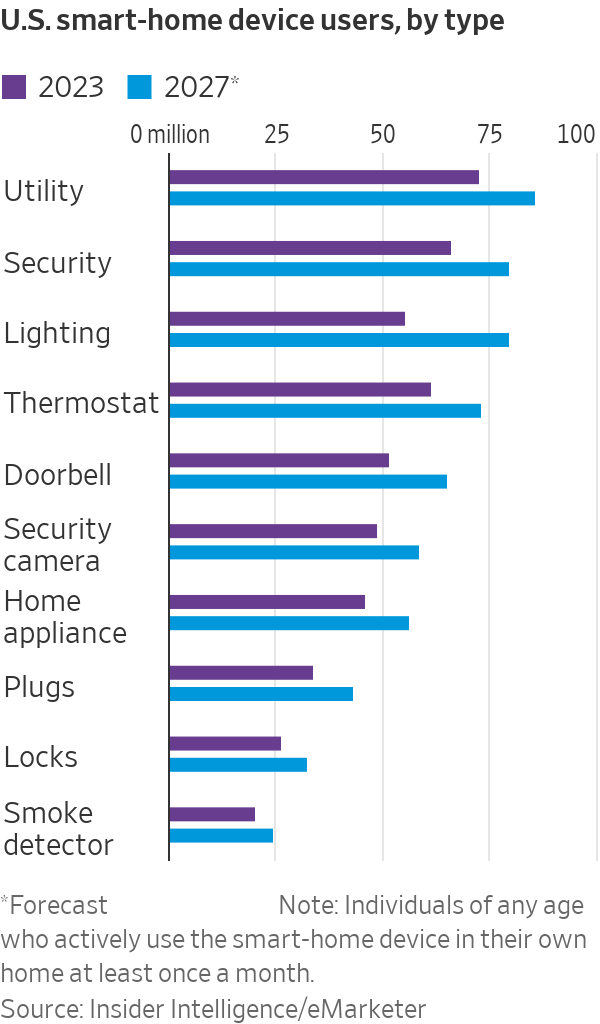
Considering the enormous number of U.S. homes with smart devices—more than 60 million—and their low levels of security precautions, they are likely to continue to be tempting targets for all kinds of attacks, says Yuvraj Agarwal , an associate professor of computer science at Carnegie Mellon University. It’s “a disaster waiting to happen,” he says.
Among the potential risks experts cite: People could be locked out of their house by hackers who tapped the security system seeking a ransom. Burglars could listen in over smart speakers to figure out when you aren’t home. Smart lightbulbs could be used as a way to break into personal information on a phone.
What steps can we take to protect devices from hackers?
First, make sure your Wi-Fi router is secure—the router is the key to your digital home. Use the website or app that controls your router to check that it isn’t using the default password—that same password could have been given to many other customers. Give the router a unique password you use only for that device.
Next, ensure that the router’s security feature called a firewall is turned on, and that it is using encryption called WPA2 or the newer WPA3. And turn on the control to allow automatic software updates, if provided.
What about settings on the smart devices themselves?
As with routers, don’t use the default password they came with. Instead, use a different password for each device, so that if someone were able to figure out, say, the password for your smart doorbell, he or she wouldn’t have access to everything else.
And if a device allows two-factor authentication, be sure to use it. This means that to log in to the device you will need to type in a code sent by text or email, or generated by a device called an authenticator, in addition to the password. That extra step, while annoying, could keep out a hacker.
Is it risky to put smart devices on the same home Wi-Fi network you use for your computer and phone?
Yes. Someone could hack into one of your smart devices as a way to break into your Wi-Fi router, and from there could attack your computer, phone and everything else on the same network.
Instead, set up a guest network on your router that has its own unique password and use that network to connect your smart devices. Many routers include such a second network, but you may need to take a few steps to turn it on. Guest networks generally are sealed off from the main Wi-Fi network, so a hacker couldn’t leap from it to the main network.
When shopping for these devices, how do you know which are safer than others?
Check the makers’ security policies online before buying. Look for manufacturers’ statements that they periodically send security updates to the devices and encrypt the communications between the devices and their cloud service. Seek out products that offer two-factor authentication.
Are there certain types of smart devices to avoid?
Hundreds of types of internet-connected gadgets are sold online by innumerable companies, often at very low prices. “If it costs $5 for a smart plug, most of it is not going toward thinking about security and privacy first,” says Carnegie Mellon’s Agarwal, who does research on smart-device security.
Stick to devices from mainstream makers, since they are more likely to take security considerations seriously and spend the time and money to periodically update these features, he says. These companies don’t want to risk tarnishing their brands with products of questionable security.
What else can consumers do?
Limit how many smart devices you own—the more you have means more pathways for hackers to try to break in. Get fewer, more-secure devices rather than having insecure, cheaper devices in the whole home, says Deloitte’s Frank.
While you might find an Alexa or Google digital assistant useful on the kitchen counter, avoid putting one in a home office where you might talk about confidential financial or work-related topics that could be a juicy reward for a hacker, she adds.
Moreover, disable functions you don’t use or need on the devices, such as the camera on a digital assistant or the ability of the device to save recordings of your voice commands. “Having those turned on creates a larger attack surface” for a hacker, Frank says.
Do proprietary home networking systems provide more security than plain Wi-Fi?
While networks such as Google Home, Apple HomeKit and Amazon Alexa likely have enhanced security, in most cases they also use your home Wi-Fi to connect to their cloud services that run the networks. That raises the same security concerns as relying solely on Wi-Fi, Agarwal says.
Why don’t device makers build more security into their products?
A big factor is cost, says Deloitte’s Frank. Adding the level of security found in a laptop computer to a $15 internet-controlled lightbulb could make its price uncompetitive.
Moreover, she says, device makers want their products to appeal to ordinary consumers, so “they need to prioritise convenience, prioritise ease of use. Security often takes somewhat of a back seat.”
What is the smart-device industry doing to prevent hacks?
One effort is an industry standard called Matter from a consortium that includes Apple, Amazon, Google, Samsung and others, which works to make networked home products interoperate with each other. The Matter standard has security and privacy safeguards built in, says the group behind the standard. Products that meet the standard are being rolled out gradually and can carry its logo .
What is the government doing?
A project by the Biden administration aims to have makers of digital home devices label their products to indicate their security and privacy protections. Called the Cyber Trust Mark , it’s akin in some ways to the government’s Energy Star certification for the efficiency of home appliances.
The voluntary program, overseen by the Federal Communications Commission, is still under formation; the White House said last year it expected it to be in place in 2024. Under the proposal, device makers seeking to use the label would need to certify that their products meet certain standards by having them tested by an accredited lab. Agarwal says he has provided input to the government effort based on a Carnegie Mellon program to devise a similar label for smart products.
They came, they saw, they conquered work. Then they shrugged.
Some strivers who piled up money and status say they’re over the endless hustle and are embracing what they call a “post-achievement” lifestyle with family, health and passion projects taking priority over career accomplishments.
Another promotion? Too busy surfing. Deferred compensation that’s oh-so-close to vesting? Slipping the golden handcuffs is less painful than you might think.
Post-achievement professionals aren’t necessarily retired, even if they’re financially set for life. Many have transitioned to roles with fewer hours and responsibilities to make time for pursuits they find more meaningful such as podcasting, meditating and playing guitar.
Rather than grab every available dollar and accolade, Kevin Dahlstrom quit a seven-figure, round-the-clock job in 2018. He prefers to be seen as a bold, slightly mysterious figure who could have risen higher but opted out on his own terms.
“I’d be lying if I said that doesn’t stroke my ego,” says Dahlstrom, who left a chief-marketing-officer role and moved to Boulder, Colo., to rock climb. Professional acquaintances sometimes refer to him as a legend because he jumped off the corporate ladder in a way that most people only dream about. “Who wouldn’t like being called a legend, right?”
At age 53, he estimates that he passed up more than $10 million of future earnings but says he doesn’t need to make another penny. He recalls an executive meeting where he looked around the room, saw high-powered colleagues who seemed unhappy, and thought: What’s the point of grinding if it doesn’t bring joy?
He’s still ambitious and recently accepted a more flexible marketing-executive position at a smaller company that allows him to be on task as needed, and on a mountain whenever climbing conditions are good.
“To me, that’s nirvana because I still want to do hard things and work on fun projects,” he says. “But I also want that to be only one part of my life—and not the biggest part of my life anymore.”
Less money, more passion
Here’s the thing about getting to post-achievement status: You have to earn it by doing something impressive first.
The former go-getters I’ve met aren’t the types who could have coasted through middling careers from day one, despite being full of potential. (That would make them quiet quitters or, perhaps, masters of work-life balance .) They needed to prove, to themselves and others, that they could excel at high levels. Only then—with killer résumés and F-you money—could they make dramatic life changes.
Khe Hy , who helped popularise the term post-achievement on his website and YouTube channel , RadReads, says it’s hard not to look back. He left his job as a hedge-fund managing director in 2015 and still feels the occasional pang of envy when he considers the riches that former colleagues have accumulated. Hy, 44, says he’s sitting on about $5 million, probably enough to retire to a frugal lifestyle, but likely not enough to sustain his family forever in pricey, coastal California. Had he remained on Wall Street for a few more years, he might never have to work again.
Still, he moves past those feelings by remembering how numb he’d become to big paydays in finance.
“The key moment is when you realise that no next achievement will significantly change your baseline happiness,” he says. “I consider myself post-achievement because I’m not really striving for anything.”
That’s not entirely true. Hy is trying to bulk up but struggles to add weight to his 155-pound frame. Between running 25 miles a week and surfing almost daily, it’s tough to sculpt more than a lean six-pack, you know?
His RadReads business, which includes coaching for hard-charging professionals who want to rebalance their lives, generates about $200,000 annually. He works about 35 hours a week but controls his schedule and no longer fixates on career advancement.
Rachel Barek , 44, isn’t ready to step down as chief executive of Said Differently, the marketing agency she co-founded, anytime soon. But the majority stake she and her partner sold to a private-equity firm comes with a lifetime of financial security, she says.
“I could very easily fall into the trap of being a serial entrepreneur. I was born that way,” she says. “A lot of serial entrepreneurs are scared of the white space in their lives, and I’m really excited by that white space.”
In her future post-achievement phase, Barek plans to do something radically different: beauty school. She developed the interest while cutting her son’s hair at home during the pandemic and wants to offer pro bono barber services for children with special sensory needs and others who can’t afford to pay. But she concedes her clipping skills could use some work.
Avoiding the success trap
Kristopher Abdelmessih says he was six months shy of collecting about $1 million of deferred compensation when he walked away from his job as an options trader in 2021.
“Maybe it was rash, but I’ve replayed this in my head many times, and I don’t think I would do it any differently,” he says. “I was done.”
Abdelmessih, 45, was motivated to succeed by his modest upbringing in an immigrant household. There would be no safety net if he sputtered professionally, so he picked a field that paid well, played to his strengths and didn’t require graduate school.
But trading was never a calling. Leaving wasn’t so much about losing ambition as it was about a desire to chase fulfilling interests, like tutoring low-income students, gaining the confidence to play guitar on stage for the first time and traveling with his family six to eight weeks a year.
He and a business partner are in the early stages of developing a trading software tool that Abdelmessih hopes will become profitable. If it takes off and demands more of his time someday, that’s OK with him because it’s a passion project.
Jason Chow , a financial-services firm vice president, isn’t post-achievement yet, but he wants to be. Chow, 45, and many others say they’ve climbed high enough to realise each progressive rung brings new hassles and fleeting satisfaction.
“It resonates with me because my life is work, and I know there’s more,” he says. “I just haven’t found what that is yet.”
Suzanne Lovell, a Chicago-based designer, had already worked with her clients—who are in their late 50s and work in the boating industry—on a condo in Chicago and a 15,000-square-foot penthouse in Naples, Fla., when the husband called with a special request. “He had just purchased a car condo about 5 miles from their Naples residence,” Lovell says. “And he asked me to design the coolest man cave ever.”
The car condo is in a gated community, but instead of front doors, there are garage doors. The units don’t have bedrooms. Instead, there is generous space for cars and for entertaining—complete with bathrooms and wet bars—making a car condo the perfect place to host a Formula One viewing party. The double unit, which the couple bought in 2021 and would cost about $3 million in today’s market, is about 3,400 square feet. The second-floor entertaining space overlooks the ground floor, which has space for five of the owner’s 20 cars, including a 1957 Porsche Speedster, a 1962 Ferrari 250GT and a 1961 Facel Vega. Along with multiple seating areas, the entertainment floor also has a race simulator and a room for the owner’s custom slot car track. The couple spent about $1.2 million to outfit the space. Cars not included!
Eames Lounge Chairs After a little research, Lovell discovered Racing & Emotions will customize classic Eames lounge chairs in Ferrari racing red, complete with the owner’s race number. “I was able to pair classic furniture with a classic car collection,” Lovell says. // Price: $US25,000 for bothMural Lovell’s client suggested she work with artist Marcus Zotter to create a wall mural in the space. “When I met with Marcus, we talked about making it feel like you’re on a racetrack, in the race,” she says. “That’s what inspired the painting on the walls.” The client chose his favorite cars to be pictured in the mural that covers three of the walls. // Price: $US75,000Desk The space includes an area for the owner to work. Lovell outfitted it with a CEO Cube desk designed by Lella and Massimo Vignelli for Poltrona Frau. Says Lovell, “I’ve wanted to do that desk for so long, and to do it in red was fabulous.” // Price: $US35,000