Elon Musk has some new company on the list of the world’s richest people: Taylor Swift, who’s now reached her billionaire “era.”
Buoyed by the rise in Tesla stock and the surge in SpaceX’s valuation, Musk has reclaimed the title of the world’s richest person in an annual ranking of billionaires.
Musk’s US$231 billion fortune catapulted him above Amazon executive chairman Jeff Bezos (US$185 billion) and LVMH CEO Bernard Arnault (US$175 billion), who ranked second and third, respectively, on the 13th Hurun Global Rich Report, an annual survey from China-based media and research firm Hurun. This year marked Musk’s third time in four years at the top of the roster.
Swift made her debut on the list, her wealth, estimated at US$1.2 million, propelled by her Eras Tour and royalties from re-recording her albums.
Mark Zuckerberg (US$158 billion), CEO of Meta Platforms Inc., trailed at No. 4, but added more wealth than anyone on the list, as Meta shares more than doubled, the report said.
Miami-based entrepreneur Ryan Breslow (US$1.3 billion), the 30-year-old chairman of fintech platform Bolt, entered the list this year as its youngest self-made billionaire. While 66 is the average age of billionaires on the list, 93 billionaires ranked are 40 or younger.
The list ranked 3,279 billionaires, up from 3,112 the previous year. The number of billionaires increased by 5% and their total wealth was up 9%, Hurun said in a news release. The wealthiest hail from 2,435 companies and 73 countries.
The wealth calculations are through Jan. 15 of this year.
For the first time, more than half the new wealth on the list was generated by the boom in AI, the report said.
“AI has been the major driver for wealth growth,” Rupert Hoogewerf , Hurun’s chairman and chief researcher, said in a statement. “Whilst [Nvidia president] Jensen Huang has grabbed many of the headlines as Nvidia broke through the US$2 trillion mark and catapulting him into the Hurun Top 30 as a result, the billionaires behind Microsoft, Google, Amazon, Oracle and Meta have seen significant surges in their wealth as investors bet on the value generated by AI.”
Despite losing 155 billionaires, China still claims the most, with 814, the report said. The U.S. added 109 billionaires, for a total of 800. India added 84, and now has almost double the number of billionaires as the U.K., the report said.
If there’s a billionaire capital, it’s New York, where more reside than any other city; London ranked second, and Mumbai third, edging out other locales to become Asia’s hub for billionaires.
Overall, the world’s wealthiest made their money in financial services (10%), followed by consumer goods (8%), and food & beverages (7%) and real estate (7%), Hurun said. By sector, it was a “good year” for media and entertainment, which added US$226 billion, outpacing software and services at US$149 billion, financial services at US$118 billion, and retail, at US$104 billion.
Not everyone was a winner. The report said 1,346 billionaires saw their wealth decrease; 278 of them dropped off the list, with 208 of those hailing from China.
“Wealth creation in China has gone through deep changes these last few years, with the wealth of billionaires from real estate and renewables down,” Hoogewerf said in a statement. “Whilst as many as 40% of the Hurun Global Rich List from the high water mark two years ago have lost their billionaire status, China has added 120 new faces to the list.
The report called the latest rankings a “bad year” for healthcare, where billionaires in the field shed US$75 billion; followed by industrial products, declining US$46 billion; food & beverages, losing US$40 billion; and real estate, dropping by US$32 billion.
Three years ago, everything seemed to be going right for Blake Xu.
The 33-year-old entrepreneur and his family had built a portfolio of properties during China’s real-estate boom. His wife was expecting their first child. He had just sold an apartment, and put almost half of the proceeds into the stock market.
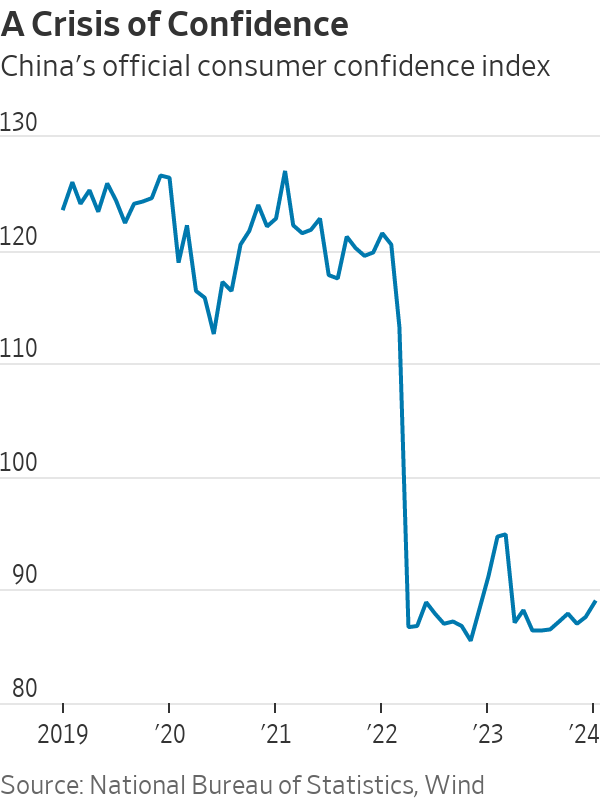
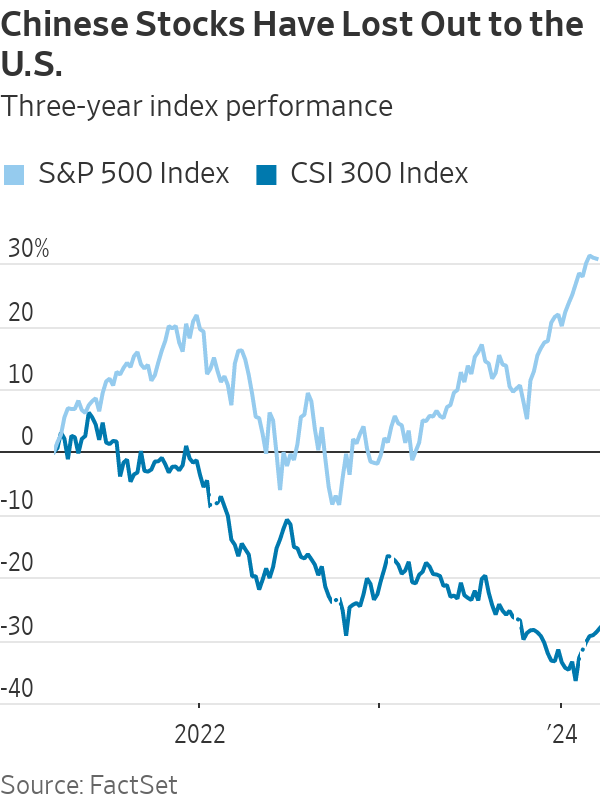
Since then, the property market has entered a years long downturn, the country’s benchmark CSI 300 stock index has lost around a third of its value and the economy has become increasingly vulnerable, suffering from moribund consumer confidence, weak private-sector investment and sky-high youth unemployment.
Xu has already pulled almost all of his money out of China’s stock market. His next exit may be from China itself. undefined undefined “I don’t know where the future path lies,” said Xu, who lives in Shanghai. “Once our child grows a little older, we intend to send him abroad, and perhaps we will also go.” undefined undefined For most of their lives, China’s new generation of middle-class citizens could take a booming economy for granted. But the property rout, the stock-market slump and the wider economic downturn have forced them to confront a difficult question: Are China’s boom years over for good?
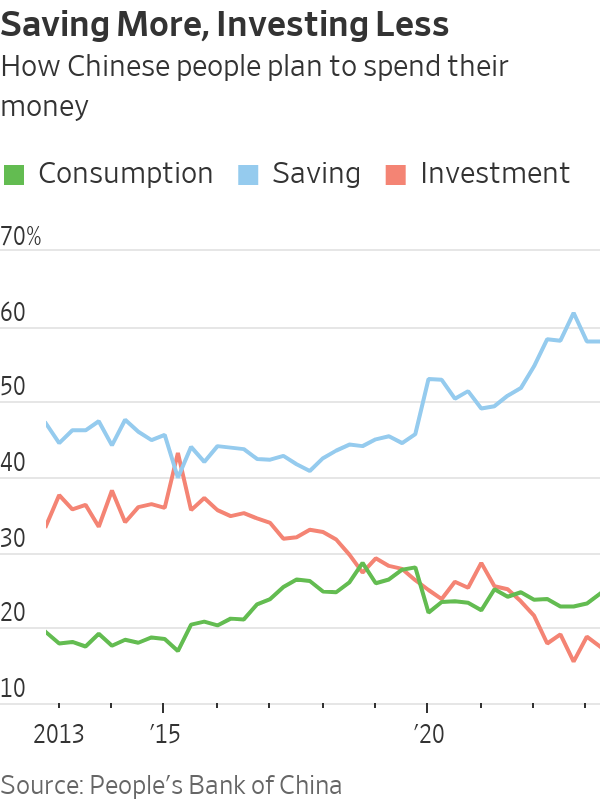
Chinese citizens are spending less, saving more and shying away from risky investments. Household savings in the country reached $19.83 trillion by February, the highest figure on record, according to data from the central bank. Consumer confidence is near its lowest level in decades.
The increasing sense of nervousness among China’s city-dwellers and white-collar workers could be a major problem for Beijing. China’s government has for years derived legitimacy from its reputation for sound economic management. undefined undefined Now, that reputation looks increasingly shaky.
Finding an exit strategy
Hugo Chen, 30, was born during the early stages of China’s remarkable economic transformation, which came after former leader Deng Xiaoping rolled back the worst excesses of Maoism and opened the doors to global trade.
Chen, who was raised in the wealthy coastal city of Shenzhen, studied for a master’s degree in the U.K. He moved back to China in 2017 to work in finance and, like many Chinese citizens, decided to play the stock market. He also bought bonds and invested in insurance products.
But last year, he made a decision: no more Chinese shares.
Chen, a banker, had previously helped an insurance company manage its money. He knew more than most about investing—and China no longer seemed like a smart place to invest money.
By the end of 2023, the CSI 300 index had fallen for three years in a row. Even worse, stocks in the U.S., Japan and elsewhere had surged. It was supposed to be China’s century , but the economy and the stock market were losing ground to those in other countries.
“Becoming poor is one thing. Becoming poor while others get rich is another,” said Chen.
He shifted most of his investments into funds that buy U.S. stocks.
China has more than 220 million individual investors, meaning stock-market moves can have a big impact on the national psyche. These small investors once had a reputation as gamblers. After the slump of the past few years, they have scaled back their bets and increasingly shifted to safer assets such as money-market funds.
The real-estate sector has done even more damage to confidence. What started as an attempt by Beijing to rein in excessive debt in the sector around three years ago has morphed into a multiyear crisis, pushing dozens of developers to the brink of collapse and pulling the rug out from under one of China’s main drivers of economic growth.
The price of existing homes in China’s most developed cities fell 6.3% in February compared with the same month last year— the biggest year-over-year decline on record.
Xu, the entrepreneur, sold a second property in a process he described as extremely painful. But he has no regrets: The money will give him the flexibility he needs to leave the country if things get worse, he said.
“Emotionally, I hope for the best for this country,” said Xu. “However, if this team of leaders stays, to be frank, I have to have an exit strategy, as the outlook is worrisome.”
That is precisely the kind of sentiment that will unsettle officials in Beijing. Although China’s government keeps a tight grip on power, it is acutely sensitive to the public mood.
China’s population has a history of public displays of dissent, including public protests against banks and companies . Beijing has tolerated at least a degree of dissent, as long as its citizens follow one overriding principle: Don’t blame the central government.
But some people in the country do blame Beijing for the current economic troubles, pointing to policy U-turns on internet companies, private education and real estate, and a strict approach to containing Covid-19 that has dealt lasting damage to confidence in the country.
The shift toward low investment and high savings is fuelling a vicious cycle, where the economic slump erodes confidence levels and, in turn, low confidence worsens the downturn, said Yasheng Huang, professor of global economics and management with MIT Sloan School of Management and a fellow at the Wilson Center.
“When a society settles on a particular psychology, it’s not easy to shift,” he said.
From hope to fear
Scarlett Hu, 37, remembers how it felt to be back in China in 2014. She had just returned from studying abroad, and took a job in Shanghai’s luxury-goods sector.
“At that time everyone in the society was full of hope. There was this promising sentiment around,” said Hu. “When we went out to relax after work, we believed that tomorrow would be better and let’s have fun today.”
Hu bought an apartment in Shanghai in 2017 and started buying mutual funds that invest in the stock market in 2020, before the birth of her son. She hoped the money would help pay for his education. At the time, it seemed like a smart bet: The real-estate market was booming, and stocks were nearing a record high, cheered on by China’s bullish state media.
Her apartment has now lost 15% of its value, and her mutual-fund portfolio is down 35%.
“Now we talk about concrete plans and measures to secure a more certain future, focusing on ways to enhance our sense of security. You don’t feel that kind of ambition any more,” she said.
China’s government has taken steps to tackle the downturn, including easing lending rules for battered real-estate firms, cutting borrowing rates and pledging to resolve the debt problems of local governments. But Beijing appears reluctant to adopt the sort of direct stimulus Western governments embraced in the wake of Covid-19, when direct payments to consumers helped get spending back on track.
In early March, Chinese Premier Li Qiang said the government was targeting growth of around 5% for 2024, and there have been recent signs of improvement.
But economists think Beijing will find it difficult to hit this growth target, and some people in the country worry that things are about to get worse.
A 40-year-old equity analyst based in Beijing said she lost her job last August when the consulting firm she worked for closed. She has two children to care for, her husband’s income is unstable, and she is bracing herself for more pain to come.
“Everyone is saying that this year might still be the best in the next decade, so we should be prepared for a long period of hardship,” she said.
The number of home loans in arrears are less than one percent of all borrowers, defying predictions of dire outcomes from a ‘mortgage cliff’ and the impact of high interest rates and cost of living pressures.
Most borrowers are making their home loan repayments on time, and although the number of loans in arrears has increased since late 2022, they represent only a tiny portion of the market, according to the Reserve Bank (RBA). Less than 1 percent of all housing loans are 90 or more days in arrears, which is lowerthan the pre-pandemic peak.
In its latest Financial Stability Review released this month, the RBA said households remain under pressure from high inflation and interest rates, with consumer sentiment very weak. More Australians than usual are seeking support from community organisations, and lenders have a small but rising number of borrowerson temporary hardship arrangements.
“Based on their latest assessment of the economic outlook, banks expect arrears rates to increase a bit further from here but remain low relative to history,” the RBA said.
The RBA notes that since the start of 2022, real disposable income has fallen by about 7 percent to be near its pre-pandemic level in per capita terms. Most mortgagors have seen30-60 percent increases in their minimum home loan repayments since rates began rising in May 2022. However, only about 5 percent of variable-rate owner-occupier borrowers today have expenses exceeding incomes, giving them a cash flow shortfall.
Households are coping well due to a strong labour market, which is allowing them to increase their hours or get a second job if necessary. They are also drawing on large savings buffers, partly created by pandemic stimulus and lower spending during lockdowns, and have reduced their discretionary spending as necessary.
The loan arrears rate is highest among highly leveraged borrowers, however it is still very small at less than 2 percent. The share of mortgagors estimated to have a cash flow shortfall combined with low savings has risen over the past two years but still represents less than 2 percent of variable-rate owner-occupier borrowers. Unusually, the arrears rate among recent first home buyers is lower than average, possibly reflecting the Bank of Mum and Dad enabling young buyers to purchase properties with less debt.
The arrears rate among borrowers who rolled over from low fixed rates to variable rates in one hit – an event labelled ‘the mortgage cliff’ which was expected to hit hardest late last year – are managing their repayments just as well as other borrowers. “This resilience partly reflects that these borrowers were able to build up savings buffers over a longer period of unusually low interest rates,” the RBA said.
High income earners are depleting their pandemic savings at the fastest rate because they tend to be servicing greater debt. But they still have the highest savings and are likely using some of it to support continued discretionary spending. Conversely, the lowest-income mortgaged households grew their savings in 2023.
The RBA says nearly all borrowers should be able to service their loans even if inflation is more persistent than expected and interest rates remain higher for longer. While the RBA expects a rise in unemployment, it noted that historically mortgagors areless likely to lose their jobs. Many mortgagor households also have multiple incomes, and about half of all borrowers have enough savings to service their debts and essential expenses for at least six months. Lenders can also offer temporary support to borrowers who lose their jobs.
The RBA said most borrowers also have strong equity positions, which protects them from default and limits risk for lenders. Rising property prices last year gave homeowners more equity and banks have been issuing fewer high loan-to-value (LVR) loans since 2021. These types of loans are now at near-historical low levels.
“The share of loans (by number or balances) estimated to be in negative equity at current housing prices remains very low,” the RBA said. “While usually a last resort and very disruptive for owner-occupier borrowers, this would allow almost all borrowers to sell their properties and repay their loans in full before defaulting.”
Hypothetically, in a severe economic downturn during which housing values fell 30 percent, the RBA estimates that the share of loans falling into negative equity would increase to about 11 percent. The RBA said significant losses for lenders would only materialise if more borrowers became unable to service their loans.
The ESG brand probably has its best days behind it.
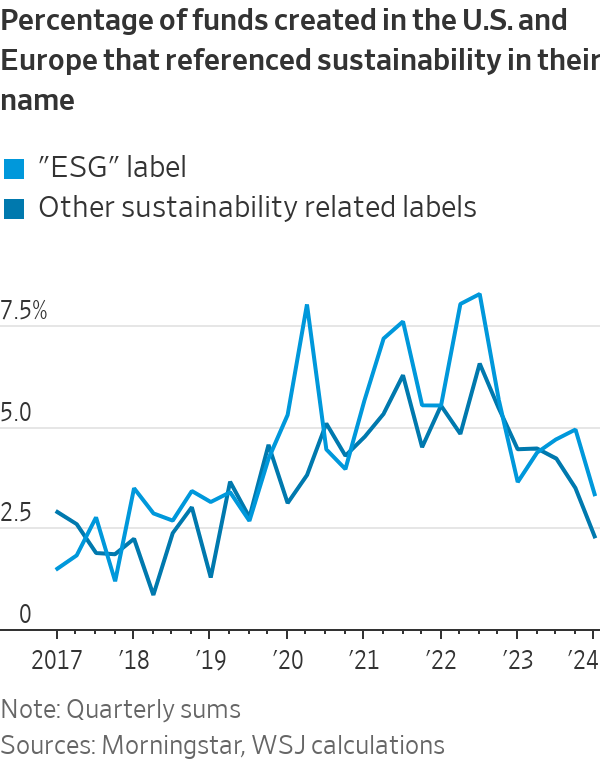
Following a three-year craze for investment products focused on environmental, social and corporate-governance concerns, the percentage of newly created funds in the U.S. and Europe with ESG in their name has fallen from a peak of 8.3% to just 3.3%, according to an analysis of quarterly data by Morningstar Direct.
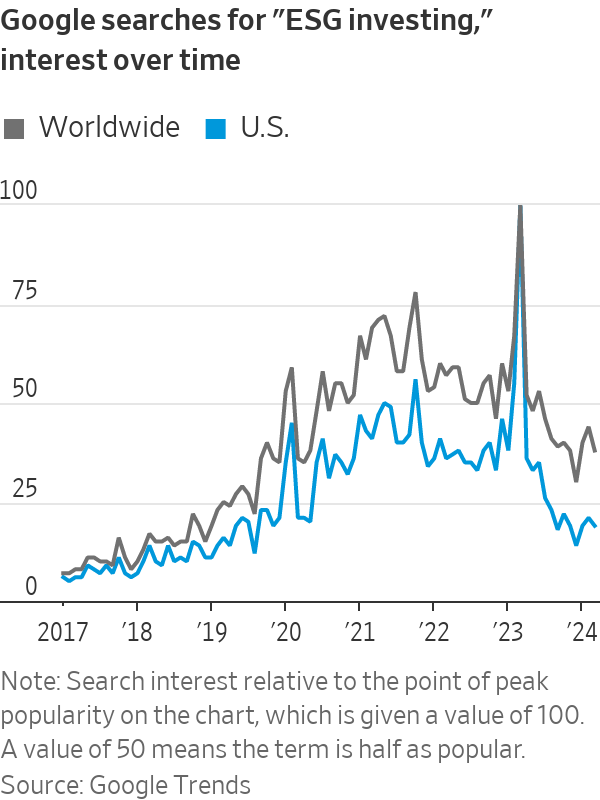
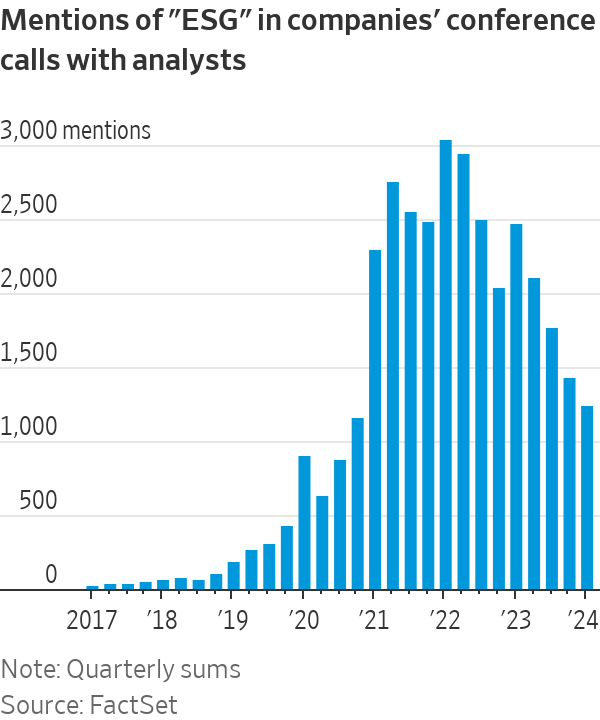
Likewise, online searches for “ESG investing” have plummeted back to mid-2019 levels, according to Google Trends. Mentions of the term in company analyst calls have dropped 59% from their quarterly peak in 2022, FactSet data suggest.
One explanation is the collapse of the clean-energy stocks most readily associated with the ESG movement. Flagging growth in electric-vehicle sales has hit sector behemoth Tesla . The S&P Global Clean Energy index, which lists solar-panel maker First Solar and Danish wind-turbine giant Vestas among its top constituents, has lost 31% since the start of 2023 as renewable-energy projects have been shelved. That compares with returns of 27% for global stocks.
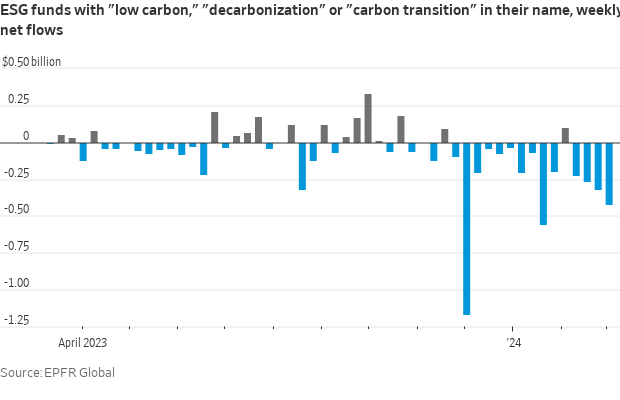
The rise of ESG investing between 2019 and 2022 coincided with a surge in clean-tech valuations, and now the reverse is happening. Investors have pulled $2.2 billion from funds dedicated to decarbonisation since the start of the year, according to EPFR, and the outflows are getting larger every week.
There is a risk that ESG was an investment fad rather than a financial revolution extending across all industries.
The term was the product of an uneasy three-way alliance. On one side were ethically driven investors, who are particularly widespread in Scandinavia and include pension funds, universities and religious organisations united in wanting to shun contentious firms. On another were institutions such as the United Nations that aimed to channel money to industries that benefit society. Finally, there were investors who wanted to profit from the green revolution.
Asset managers jumped at the chance to cater to all three simultaneously. ESG allowed them to differentiate their products, revitalise the case for active management and, at a time of declining fees, charge more for stock screens that often lead to only small changes in allocations . Among U.S. equity funds, ESG strategies have an asset-weighted average fee of 0.52%, compared with 0.33% overall, Morningstar Direct data shows.
But the confusion of motivations made for contradictions and a lot of doublespeak. Neither ethical objectives nor bets on decarbonisation square logically with fund managers’ claims that ESG is a broad path to higher, safer returns.
Yes, an ESG focus can help active managers account for risks such as a regulatory backlash or governance blow up, which in some cases might be highlighted by new company disclosures. This month the European Union cleared the way toward requiring firms to better report and address sustainability impacts.
However, the assumption that integrating ESG criteria into their screening will lead to better stock picking seems flawed . The very popularity of ESG makes it unlikely that the market is under appreciating the risks. The rush of money into firms like Vestas, whose stock hit a price-to-earnings ratio of 534 in 2022, illustrates the risk that shares with high sustainability scores can get too expensive, leading to lower returns.
Ethical investors might be fine with this, but that just shifts the focus to what counts as ethical. Tellingly, interest in ESG has dropped more in the U.S., where the politicisation of EVs and culture wars surrounding Bud Light beer show how easily corporations can become ideological battlegrounds.
ESG ratings aren’t much help in navigating these issues. Different providers give wildly different scores to the same companies, even within the specific “E,” “S” and “G” factors, according to a February paper by the Leibniz Institute SAFE. Researchers also found that environmental concerns tend to explain most of the overall score.
This is another hint that the ultimate driver of the pandemic-era ESG craze might have been a hunger for thematic investment. It has since found better sources of sustenance, as demonstrated by the breakneck growth of firms such as Global X, which is delivering increasingly granular offerings such as tracker funds for electric batteries, cloud computing and ageing populations.
Buyers of these products can be fickle and jump to the next theme—often too quickly for their own good, a Morningstar analysis showed last November. It is possible that the overly generic ESG brand will never recover its appeal, with the different parts of it eventually rebranded to suit their specific client bases. BlackRock , the world’s largest asset manager, has already dropped it and is now emphasising transition themes over ethical stewardship of companies.
Sustainable investing isn’t going anywhere. But a broad tent covering too many interests serves none of them well.
When a Swedish startup launched a new material made from recycled textiles in late 2022, the fashion industry hailed it as a game changer in its efforts to lessen its environmental impact.
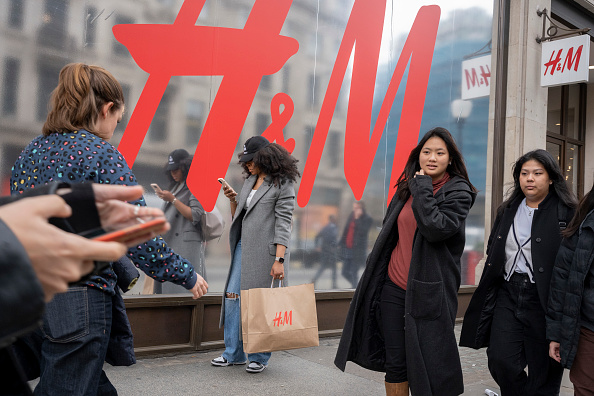
Last month, the company, Renewcell, filed for bankruptcy. While some big retailers, including H&M and Zara, were enthusiastic backers, not enough brands committed to buying its material. Having misjudged how quickly the fashion industry would switch to more sustainable sourcing, the company was left with a costly factory running far below capacity.
The plight of Renewcell illustrates the fashion industry’s hesitancy in adopting new materials that may be better for the environment but typically cost more, at least in the short term. It is also another sign of how some companies are putting less emphasis on green initiatives amid a more challenging economic climate.
“There’s a disconnect” between some companies’ stated sustainability ambitions and what they actually do, said Tricia Carey , Renewcell’s chief commercial officer. “Fashion brands have the intention,” Carey said, “but many are lacking the road map to make it happen.”
Making clothes uses a large and growing amount of the planet’s resources. More than 100 billion garments are produced annually and that number is set to rise by one-third by 2030, according to the Ellen MacArthur Foundation, a nonprofit. It says the average garment is worn only 10 times before being discarded, often ending up in the trash . The fashion industry is responsible for as much as 8% of global greenhouse-gas emissions, according to the United Nations Alliance for Sustainable Fashion.
Fashion brands have come under growing pressure from consumers and regulators to reduce their environmental impact, posing a dilemma for an industry hardwired to keep increasing sales by churning out more clothes.
To burnish their green credentials, brands have encouraged consumers to repair, recycle or sell old clothes rather than throw them away. They have also invested in so-called next-generation materials that promise to use fewer resources and, in some cases, have the potential to be recycled again and again.
Inditex , the parent company of Zara, says it wants a quarter of the fiber it uses to be made from next-generation materials by 2030. To foster new materials, the company has worked with more than 300 startups, also including Renewcell, through a Sustainability Innovation Hub that it set up four years ago.
H&M says it wants recycled fibers to constitute half of the material it uses by 2030. The company has invested in more than 25 sustainability startups, including Renewcell.
So far, the uptake of greener material has been sluggish. Recycled materials made up 7.9% of global fibre production in 2022, down from 8.5% the year before, according to the Textile Exchange, a nonprofit that advocates the adoption of more environmentally friendly materials. Much of that came from recycled plastic bottles, with less than 1% of all fibre coming from recycled textiles.
That’s despite next-generation materials attracting more than $3 billion of investment over the past decade, according to the Material Innovation Initiative, with dozens of new-textile companies launched during that time.
Founded in 2012, Renewcell became the first chemical textile-to-textile recycler to start producing material on a commercial scale.
Its material is called Circulose, which is produced by treating old textiles with chemicals to create a cellulose pulp. This is dried into sheets, which fibre producers can then dissolve to produce viscose and other materials that are used to make clothes. Unlike mechanically recycled fibres, which fray and ultimately disintegrate, Renewcell’s chemical process breaks old textiles down to the level of individual molecules from which strong, new fibres are made. These can be recycled indefinitely via the same process.
With many fashion companies pledging to invest in new textiles to be more sustainable, Renewcell bet on strong demand for its material.
The company raised $158 million, mostly through a 2020 listing in Stockholm, and invested $125 million to convert an old paper mill in eastern Sweden into a Circulose factory capable of producing 60,000 metric tons a year.
Renewcell also outlined plans for two additional factories that would increase its output sixfold by 2030.
Besides Inditex and H&M, Calvin Klein and Tommy Hilfiger owner PVH committed to buying significant quantities of fiber made from Circulose.
But Renewcell hit a brick wall in talks with other big brands. In meetings, brand executives would often express excitement and agree to pilot projects, only to balk at placing commercial-scale orders, said Carey.
Jolts to the economy, such as Russia’s invasion of Ukraine, and shaky consumer confidence had made brands risk averse.
Would-be customers fixated on how fiber made from Circulose cost 20% to 45% more than the virgin fibers they typically bought, as well as uncertainty about integrating a new material into their supply chains, Carey said. Fiber typically accounts for about 5% of the retail price of a finished garment.
Renewcell needed its factory to reach full output quickly to become commercially viable, but it achieved only 30% capacity last year as anticipated orders failed to materialize.
By October, the company was running out of cash, and in January it laid off a quarter of its 130 staff. It filed for bankruptcy in February after failing to secure fresh investment.
Renewcell is now seeking a buyer to repay its debts and restart production.
The company’s predicament is a grim sign for a clothing industry that claims to want to transform itself, said Claire Bergkamp, managing director of the Textile Exchange.
“My hope is this will be a wake-up call for the industry,” she said.
Unless fashion companies commit to paying higher prices for new, greener materials, other fiber startups could also struggle, Bergkamp added.
While the transition from gasoline cars to electric vehicles has benefited from billions of dollars in subsidies, the move to new textiles has received practically no government support, making startups reliant on private funding.
That has left some big clothing companies, notably H&M and Inditex, shouldering a relatively large share of the burden of supporting new-material startups.
H&M invested in Renewcell in 2017 and was the first retailer to launch products containing Circulose. It currently sells around three dozen products containing the material.
The retailer wanted to invest more but decided not to commit more cash in recent weeks because of the lack of support from other companies, said H&M Chief Executive Daniel Ervér .
Earlier this month, H&M announced a new investment in Syre, a startup developing a polyester-fabric recycling process, and pledged to buy $600 million worth of its material over seven years—assuming it achieves commercial production.
Demand for recycled polyester is already established, with material made from recycled bottles already commonly used to make clothes. But textile-to-textile recycled polyester is similar to Circulose in that the technology is untested at scale.
To drive a shift to next-generation materials, other companies need to invest and commit to buying new textiles at scale, Ervér said.
“H&M alone cannot provide the scale that is required,” Ervér said. “The industry needs to commit.”
You don’t have to be an automotive expert to know that the future of the automotive industry at large is going to be heavily reliant on battery-electric power – “electrification” is the new buzz word in town. But while car manufactures look to transition to this exciting new electric future, there are still a few key factors to consider when entertaining the EV conversation.
The biggest debate in the car industry right now is the hybrid v electric discussion: which to consider in 2024? Is one option better than the other? For the uninitiated, sales of hybrid cars, including hybrid and plug-in hybrid (PHEV) vehicles, remain the obvious choice for consumers in Australia, with new sale records reached in 2023. Data published by the Federal Chamber of Automotive Industries (FCAI) reported that 98,439 hybrid and 11,212 plug-in hybrid were sold in Australia in 2023, up 88.8 per cent from the previous year. Sales of fully-electric vehicles, on the other hand, also saw massive growth, with a total of 87,217 vehicles sold in 2023. Out of the three main types of ‘electrified’ vehicles in Australia—hybrid, plug-in hybrid and electric—plug-in hybrid (PHEV) vehicles were the least popular.
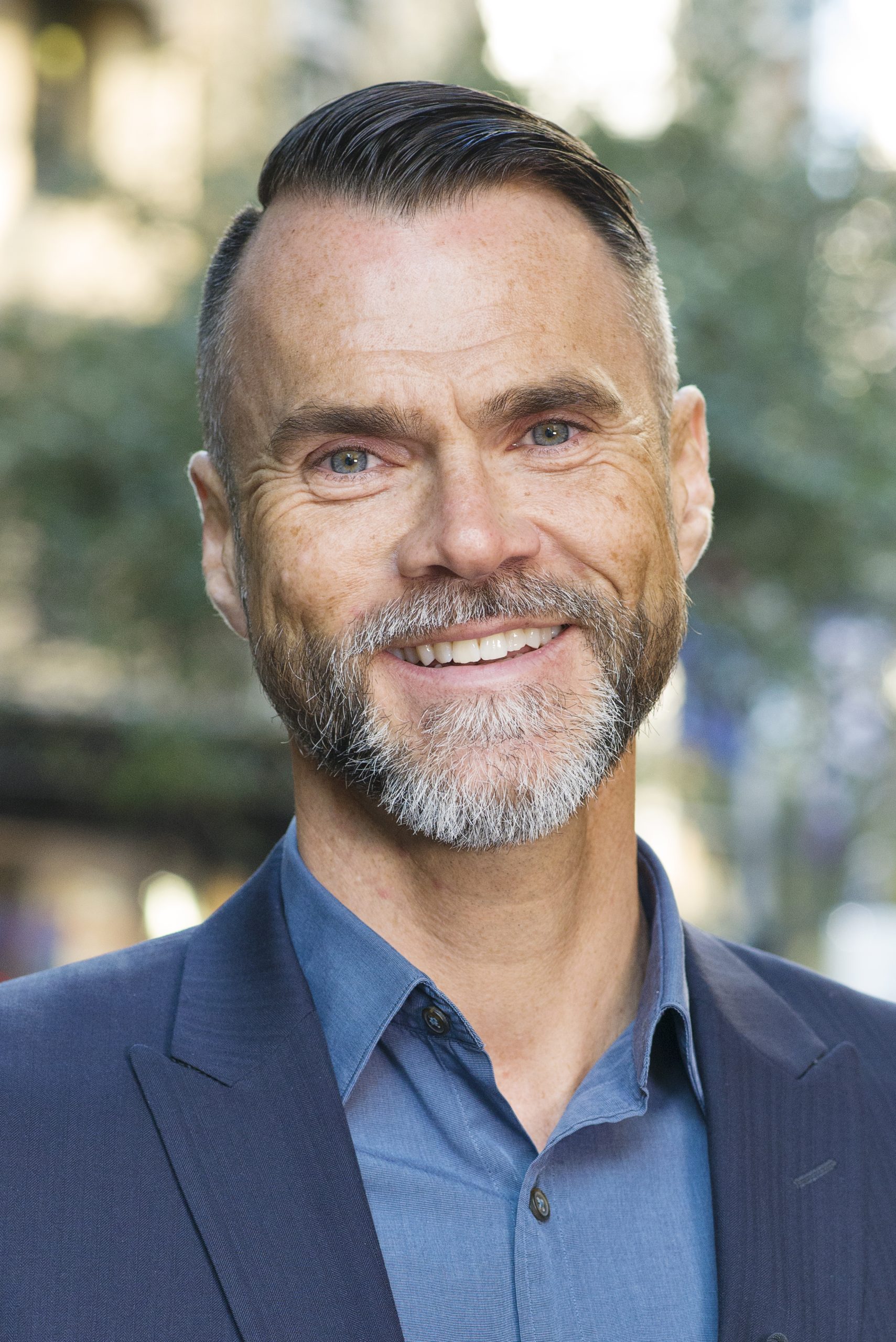
According to Jeff Mannering, Audi Australia CEO, it’s one of the most exciting times to be a part of the automotive industry.
“Australia is undoubtedly in the midst of a significant transition towards electric mobility. Whilst the journey to a fully electric industry is ongoing and advancing at a rapid rate, we’re lucky to be in a unique situation whereby we are seeing technological advancements in both hybrid and fully electric platforms,” explains Mannering.
“At Audi, we see this transition as a multifaceted evolution, with both hybrid and electric vehicles playing pivotal roles in shaping the future of sustainable transportation.”
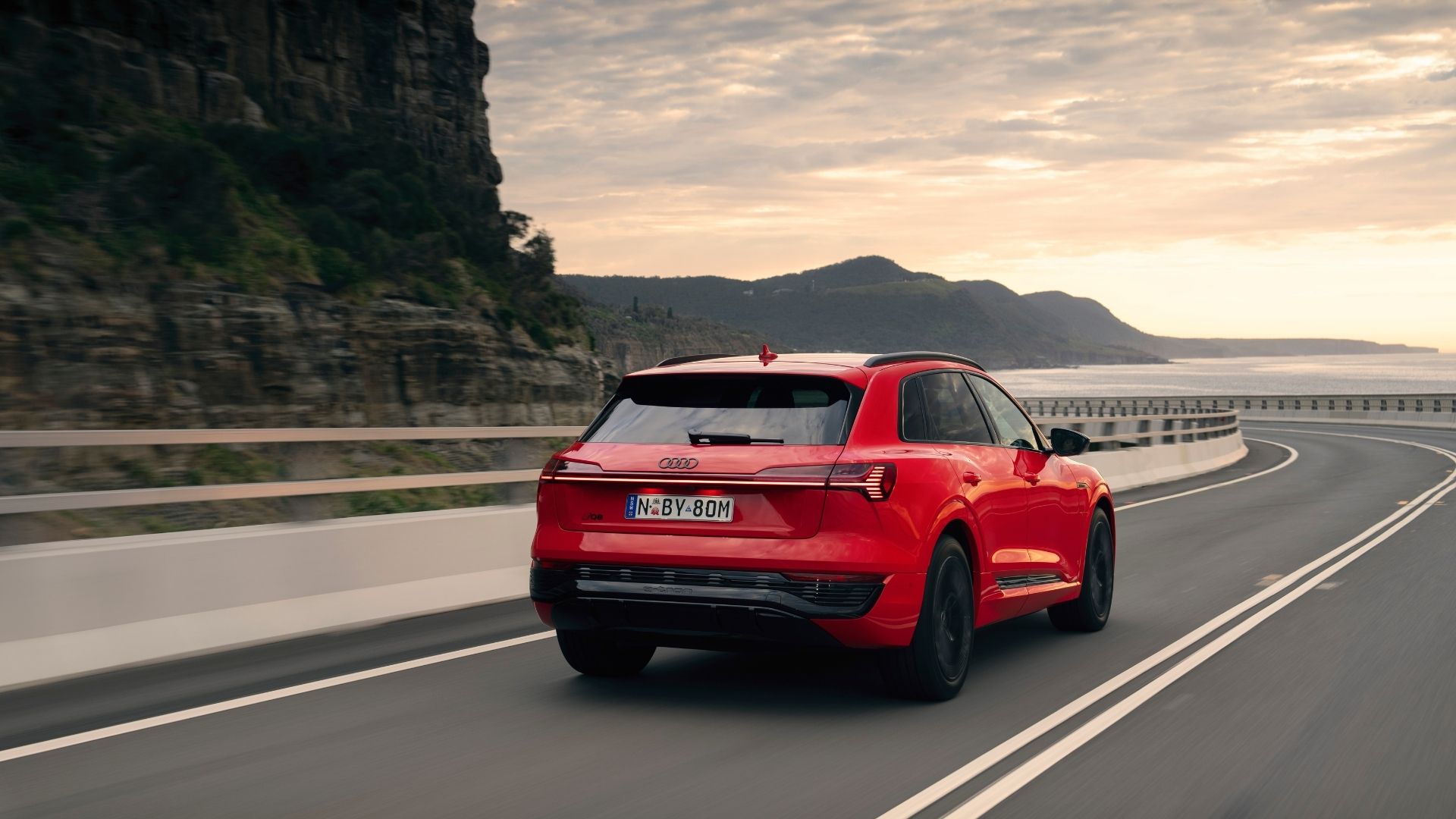
In the luxury sector, Audi is making waves with its offerings, seeing the demand for its electric models hit an all-time high in 2023, delivering more than 178,000 fully electric vehicles to customers globally, with particularly strong demand for the Q4 e-tron, Audi’s compact electric SUV offering.
So, with all the buzz around electric vehicles, are consumer’s ready to take the plunge into the world of electrification? Mannering seems to think so, but a number of considerations still need to be factored in.
“Consumer readiness varies based on numerous factors, just a few of those being accessibility, infrastructure, and individual preferences. However, if sales figures and sentiment are anything to go off, we’ve seen a growing interest in, and uptake of, both hybrid and electric vehicles,” says Mannering.
“This increased demand results in the introduction of a number of new models and choice for Australian consumers, with more and more electric vehicles arriving on each incoming ship. It’s crucial to acknowledge that consumers are increasingly considering these options as viable alternatives, especially with the expanding availability of charging infrastructure and the advancement of battery technology.”
If you’re entertaining a new vehicle and want to make it electric, here’s some things you might want to know beforehand…
Audi
—
What is an electric vehicle?
An electric vehicle—or ‘EV’— is powered by electricity and uses one (or more) electric motors powered by a battery pack to accelerate and drive, as opposed to traditional fossil fuels like petrol or diesel. Depending on the type of EV, the electric motor(s) either assist a conventional internal combustion engine (ICE) or power the car completely.
What are the different types of electric vehicles?
In the grand conversation of electrified vehicles, there’s three main types to consider: battery electric vehicles (BEV), hybrid electric vehicles (HEV), and plug-in hybrid vehicles (PHEV).
Are hybrids better than electric?
It depends on your individual needs, and as Mannering mentioned, on various factors such as accessibility, infrastructure, and individual preferences. While both hybrid and electric vehicles respectively present as great alternatives to your traditional combustion engine, factors need to be assessed, including driving habits, distance and range, access to charging infrastructure, and budget constraints. However, considering that 110,000 new car sales in Australia in 2023 were hybrid or plug-in hybrid—compared to 87,000 electric vehicles—it’s obvious hybrid vehicles present as a viable solution for those seeking to steer away from traditional cars, but might not be ready to plunge fully into the electric world.
“Hybrids offer a transitional solution for those who may not yet have access to extensive charging infrastructure or require longer driving ranges,” adds Mannering.
What is the downside of a hybrid car?
As we’ve made clear by now, hybrid cars offer several advantages, such as improved fuel efficiency and reduced emissions compared to traditional petrol-powered vehicles. However, there are some trade offs, like:
Cost: currently, hybrid models are associated with more complex systems across controls and batteries. While they incorporate both an internal combustion engine and electric motor, such complexity can often result in higher manufacturing costs (and potentially maintenance costs, too).
Not fully electric: As most hybrid vehicles typically have a limited range of electric-only propulsion before the combustion engine kicks in, the environmental benefits of using electric power and somewhat limited, both short-term and long-term.
Charging Infrastructure: As hybrid cars do not require charging from an external power source—unlike plug-in hybrid vehicles or fully electric vehicles—owners won’t be able to take advantage of the growing infrastructure of charging stations around the country.
Should I choose electric or hybrid car?
Again, it depends on your particular needs and circumstances. Currently, hybrid vehicles offer improved fuel efficiency without the range limitations of electric vehicles—you won’t need to rely on finding or planning for a recharge station on your next trip—but electric vehicles will, sooner or later, be the most prominent form of automotive transportation.
“On the other hand, electric vehicles represent the pinnacle of sustainable mobility and a high level of uncompromised performance, offering zero-emission driving with advanced battery technology and an ever-expanding charging network,” concludes Mannering.
Is charging an electric vehicle easy?
Easy enough! In fact, EV charging can be as easy as plugging in your phone to charge. However, you need to ensure there is a suitable charging station available. While a lot of car manufactures will offer you a charging station to install at home with your purchase, such as Tesla and Polestar, in recent years, there has been wide concern over the scarcity of electric charging infrastructure in Australia.
Typically, you will find electric charging stations at different public locations, like supermarkets, public carparks, highway service centres, and some accommodation venues. However, with the growing number of EV sales in Australia alone, the system needs stronger charging infrastructure that is robust and reliable—and readily available— and this will come down to a number of industry stakeholders and government bodies coming together to supply the demand.
Concerns about modern slavery usually focus on the garment and technology sectors but new research in Australia has focused on ways of identifying and dealing with the scourge in construction supply chains.
The Property Sector’s Modern Slavery Act Response Research Project is a joint project between Bond University, Better Sydney and Informed 365, an Australian tech company focused on monitoring compliance and supply chain transparency under the Australian Modern Slavery Act 2018.
The Act mandates annual reporting for companies with revenues of more than $100 million. The Global Slavery Index 2022 estimates that modern slavery accounts for nearly 50 million worldwide. Since the Act was introduced, company boards have been held responsible for public statements made by their companies on their abilities to assess and manage the risk of modern slavery in supply chains. The construction industry is considered to be particularly vulnerable thanks to the lack of visibility over long and complex supply chains, as well as the high demand for a low-skill labour force.
The research project, released to coincide with the International Day of Remembrance for the Victims of Slavery, was tasked with examining the Australian industry’s ability to cope with assessing and managing reports of slavery in the supply chain. It follows on from the launch of the Property Council Supplier Platform in 2019 by the Property Council of Australia and Informed 365 to provide a digital platform for the local property and construction sector to collect, compare and understand supply chain data on human rights and modern slavery.
Supply chain slavery issues are notoriously complex to identify but Property Council national policy director Francesca Muskovic said modern slavery in construction impacts millions of people in Australia and abroad and needed to be addressed at a national level.
“Our industry provides jobs for more than 1.4 million Australians – more than mining and manufacturing combined. This extensive influence places us in a unique position to address the social impacts of our activities and improve people’s lives,” Ms Muskovic said.
She said despite the challenges, the Australian construction and property industry sought to improve human rights outcomes both here and overseas.
Property Council national policy director Francesca Muskovic
“Our supply chains are geographically diverse, multi-tiered and complex. Understanding the human rights and modern slavery risks within them is essential in helping the industry make their supply chains more ethical and sustainable,” Ms Muskovic said.
“The property sector has forged a world-leading position on environmental sustainability, and it is pleasing to see leaders continue to step up their efforts on social sustainability.”
The research revealed that while 88 percent of suppliers to Australia’s leading construction and property firms understand what modern slavery is and 44 percent reported they had processes in place if a human rights incident or modern slavery was identified, smaller firms were less prepared.
“Many smaller firms were not aware of supply chain issues due to a lack of engagement, resources or audits, so there were mixed results in terms of supply chain mapping and risk assessment,” said Robin Mellon, CEO of Better Sydney, Board member for the UN Global Compact Network Australia, and Project Manager for the Property Council’s Human Rights and Modern Slavery Working Group.
CEO of Better Sydney Robin Mellon
“The report found 56 percent of suppliers who assessed their supply chains beyond their own immediate suppliers found some human rights issues or concerns, showing how important it is to investigate all levels of supply chains.”
Designed to better understand the challenges, strengths and opportunities for the property sector to improve its response to slavery, the research is part of Australia’s ongoing contribution to eradicating it worldwide.
Mr Mellon said access to resource materials are key to helping property and construction businesses stay informed.
The pandemic may already feel like a distant memory, but it had many lessons for the way we live — some with long standing impact.
For designers, architects and builders, one of the biggest takeaways was the value of supporting Australian design and manufacturing. With supply chains severely compromised, extending delivery times from a few weeks to several months, those who could design and make high quality furniture, flooring and lighting on Australian shores found themselves in high demand. And it was not just delivery times that were driving renewed interest in Australian design and manufacturing. Superior products designed for local conditions, as well as the ability to customise products to suit each clients’ needs showed the market for Australian products is significant, particularly at the upper end of the residential market where the desire to ‘connect’ directly with makers continues to grow.
It’s long overdue recognition for a sector dominated by imports, even at the highest end of the residential sector.
THE NEXT GENERATION
The long-term success of Australian design and manufacturing depends on supporting the next emerging generation of designers, which is why Kanebridge Quarterly magazine has partnered with Australia’s Next Top Designer this year, offering a cash prize of $10,000 to the winner for the first time.
Launched in 2022 by Design Show Australia, Australia’s Next Top Designers was created to shine a spotlight on emerging designers, makers and creatives with breakthrough products and concepts shaping the future of design.
Editor in chief of Kanebridge Quarterly, Robyn Willis, says the prize provides opportunity for emerging designers to develop prototypes, invest in marketing or further their education, formally or through travel experiences.
“It’s genuinely exciting for Kanebridge Quarterly to be partnering with Australia’s Next Top Designer this year,” she says. “The awards offer a platform for the next generation of emerging designers to showcase their work to industry while the prize is a practical pathway to help them on their way to the next stage of their career.”
DESIGN TITLE WITH A DIFFERENCE
Kanebridge Quarterly magazine is a seasonal title distributed across Australia focusing on the three pillars of Property, Money and Living. Aimed at a curated, engaged audience, it’s a beautiful publication, low on jargon but high on information about everything to make your residential design project successful.
Each year it dedicates an issue to all things Australian made. Stories about Australian designers, innovators, thought leaders, destinations and more highlight the depth and breadth of local talent in a beautifully packaged publication designed to have a long shelf life.
As part of its collaboration with Australia’s Next Top Designer, Kanebridge Quarterly magazine is running editorial spreads in its Winter 2024 edition to coincide with the show, followed by a focus on the category winners in the Spring 2024 issue.
“It’s part of our ongoing commitment to stand with industry and bring the work of local designers, makers and innovators to a wider audience thirsty for practical ways to integrate quality furniture and lighting into their residential spaces.
We’re delighted to be a part of The Design Show and Australia’s Next Top Designer.”
Learn more about Australia’s Next Top Designer Awards and apply to enter at designshow.com.au/antd. Submissions close Thursday, 4 April 2024.
Stay above the noise and ahead of the crowd with Australia’s best advice and inspiration on property, investing and residential design inKanebridge Quarterly magazine.
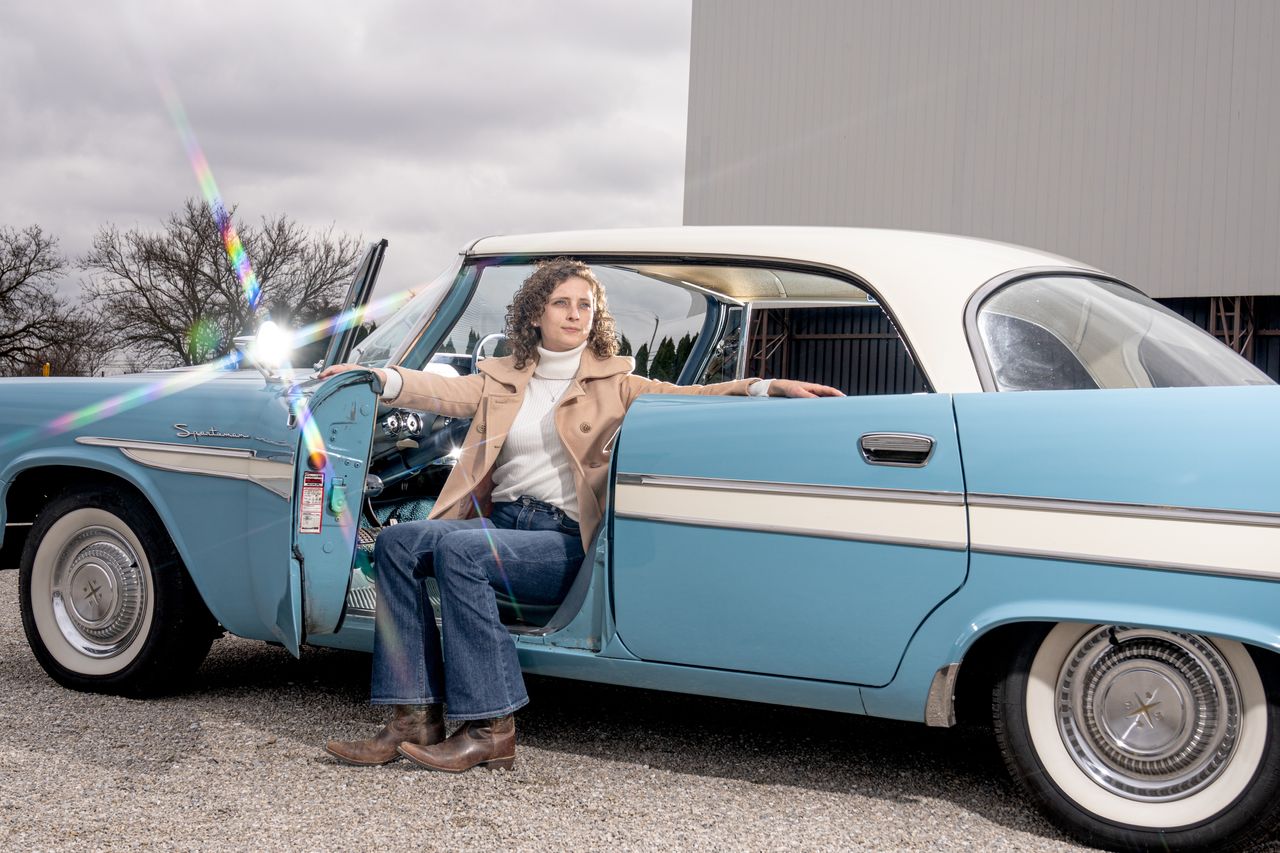
Christina Park, 24, a genetic counselling assistant at a children’s hospital who lives in Columbus, Ohio, on her 1958 DeSoto Firesweep Sportsman, as told to A.J. Baime.
My father started his company dealing in classic car parts when he was about 15, so since I was born, I have been around it. He was always rotating cars, new ones coming all the time. When I was 11 or 12, a DeSoto showed up on a trailer. I was just getting to the age where I was noticing cars, and what I liked and didn’t like. I liked fins, chrome and pretty colours. This DeSoto was all of that. I fell in love with it instantly, and, ever since, DeSotos have been close to my heart.
Most people, even up to my parents’ age, don’t know what DeSoto is, since DeSoto ended production in model year 1961. DeSoto was its own make of cars under the Chrysler umbrella, just like Dodge and Plymouth.
One weekend in 2016, my dad asked me if I wanted to go to an estate sale, which was a pretty common thing. When we got there, we found this DeSoto Firesweep Sportsman in the back of a garage, and it was for sale. Not too many people were there, and it was clear that no one had tried to start this car in many years. The colours were beautiful, and the car was similar to the DeSoto I had fallen in love with years earlier.
The Firesweep ended up coming home with us. I was 16, and, from the start, my dad said he would teach me what I needed to know to get it running and take care of it myself. But also, that it would be my car to do with what I wanted. When we started working on it, we were not sure how it was going to go. It needed a lot of TLC. We went through the usual mechanics. When we took off all the original belts and hoses, they cracked in our hands like pretzels. We put new tires on and polished the chrome. A year after we brought it home, it started right up.
It wasn’t my daily driver, but I started driving the DeSoto and, occasionally, taking it to school. Even people who were not car fans thought it was cool because of the paint and the chrome, and how different the styling was from anything you saw at the time. People were a little astonished by it.
Now, I have three DeSotos, but two of them are project cars that are not roadworthy. The Firesweep Sportsman gets stored through the Midwestern winters. But this time of year, I begin getting it ready for summer. I drive it to car shows and anywhere I can. Last summer, I put 1,600 miles on it. It is almost always the only DeSoto at a car show, so getting to show it off and talk about the brand is very rewarding.
I joined the National DeSoto Club even before I owned a DeSoto, and for the past two years, I have taken my car to the national conventions. It is a great community. A lot of the members are older, but there are younger people, and it’s so great to hang out with people who share this passion. The community is also very helpful if you have to find a rare part or need help doing something mechanically.
At the first national convention I went to, in 2022, I met the club’s magazine editor, David Frank. We started meeting up at other car events, and now we are two years into our relationship. He has a 1959 DeSoto Fireflite and, while he lives in Wisconsin and I live in Ohio, twice we have had our cars together. I guess I have gotten more than I ever could have expected out of my love for DeSoto.
The risk of running out of money in retirement rises for those with lower pay, longer lives or no partner.
Millions of single women wrestle with all three.
Women earn less than men on average during their working years and are more than twice as likely as men to leave the workforce for more than one year to care for children or ageing parents , according to a survey of 5,261 Americans that Goldman Sachs plans to release Monday.
This shortfall compounds in retirement. Social Security checks are 20% smaller for women who first claim at 62 to 64 years of age, compared with men the same age.
Single women, in particular, have smaller 401(k) and IRA nest eggs . On average, single women between 55 and 64 have about $88,600 in retirement savings, compared with $136,685 for single men and $423,800 for married couples in the same age group, according to Boston College’s Center for Retirement Research.
Women also tend to live longer , raising the projected total cost of retirement as they have to stretch their smaller savings over more years.
Despite these financial obstacles, single women find ways to pursue new ambitions in retirement, including launching businesses and traveling the world. They could have more time if their caregiving responsibilities have ended. With more freedom than many of their married counterparts, some women can make big changes without needing to compromise or negotiate.
We spoke in depth with four single women who have retired. Some have sizeable nest eggs, while others rely on Social Security benefits or earnings from part-time gigs. Each has found fulfilling ways to define retirement for herself.
Deb Hallisey saved diligently during her career as a consultant, and sought help from a financial adviser.
As a single woman, the Lawrenceville, N.J., resident said, “I knew it was going to be on me to provide for myself.”
All that planning was thrown off track after her father died in 2015. She had to put her work with clients on hold to help her mother—who was blind—find live-in help. When her billable hours dropped that year, she lost her job.
Hallisey, 66, sent résumés to consulting contacts, but she was tired of traveling and craved a new challenge.
She found it in becoming a caregiver for her mother, who died in 2022. In addition to handling her mother’s finances and medical appointments, Hallisey spent half of her weekends at her mother’s house to give her mom’s paid caregiver time off.
Angry and resentful, Hallisey quickly realised something had to change.
“When I was angry, my attitude gave Mom an attitude, and we’d start the weekend off wrong. There is a moment when you say, ‘I can’t keep doing that,’ ” she said.
Her mother urged her to write about her caregiving experiences, something Hallisey threw herself into in 2016, after meeting a successful blogger.
She soon launched a website, Advocate for Mom and Dad, and has written two books about caregiving. She speaks frequently on the topic and does consulting for families.
Hallisey saved $600,000 for retirement and built a $50,000 emergency account she used after the layoff. She currently takes $2,500 a month from her retirement savings and earns $500 a month from her business.
Thanks to the strong stock market, her balance is $525,000. Her home is valued at about $500,000 and she has paid off her mortgage.
In June, Hallisey plans to claim Social Security and use her $3,400 monthly benefit for living expenses. Her goal is to leave her IRA for emergencies, including future caregiving expenses.
She recently hired a financial professional to serve as her power of attorney if she becomes unable to manage her finances. After having done that for her mother, she said, “I could not in good conscience ask a friend to do that for me.”
She spends about $2,200 a month, including $260 for home and car insurance and $250 for food. She sets aside $750 a month for property taxes.
She never expected to tap in to retirement savings early, but has no regrets.
“I’m not making enough to support myself,” said Hallisey, who plans to write another book. “But I love it.”
Marianne Simpson retired slowly.
She chose to wind down her financial advisory business over three years, using the transition to test drive retirement while continuing to build up her nest egg. All this still didn’t fully prepare her, she said, for the moment she put her longtime home up for sale and closed the deal on her new life.
She left the Cleveland area and her 25-year career behind and bought a new place in Chicago close to her daughter, son-in-law and two young grandchildren.
With $2 million in retirement savings and a $3,800 monthly Social Security check, she’s in much better shape than most retirees. She also knows better than most how one’s health and lifespan can largely dictate how long money lasts.
“My daughter tells me to spend more on myself, but my mother lived to 101 so I want to make sure I don’t run out of money,” Simpson said.
As a single adult, she said it is critical that she can manage any future healthcare challenges independently and not have to rely on friends or family.
She now spends about $11,000 a month, around half of which goes to setting aside reserves for large expenses such as taxes and insurance. Her big yearly expenses are about $10,000 for insurance including her long-term care and personal umbrella policies, $10,000 to charity and $15,000 in property taxes. Simpson spends roughly $12,000 a year on travel, including her recent two-week trip to Spain.
She volunteers in her church’s shelter for Venezuelan migrants, cooking dinners and doing laundry. She also volunteers several times a month at a local secondhand store where all of the receipts go to local charities.
“The volunteer work helps give me a new sense of purpose,” she said.
Simpson has met new friends, though socialising as a single woman isn’t always easy, she said.
“Much of the world still moves in couples,” she said.
Stephanie Perry retired at age 41.
Perry was inspired by the FIRE movement, which stands for Financial Independence, Retire Early. Those in it save aggressively and pare spending so they can leave work decades ahead of schedule.
“Retirement is the freedom to be anywhere in the world at any time,” she said.
When she told her parents she was quitting her pharmacy tech job to live the rest of her life traveling the world, they worried about her mental health. Eight years later, her parents see how happy she is and have come around to the idea, she said.
Perry does work, but no more than 10 to 20 hours a week on average. She earns money through house sitting, a YouTube channel, virtual coaching and co-hosting events for Black women. She only takes on projects she likes.
Early retirees often call this part-time approach “barista FIRE.”
Since her early retirement, she has saved more than $100,000 in a Vanguard IRA. She has no debt and all her various side hustles add up to a six-figure income, she said. Perry has traveled to more than 30 countries, including Australia, South Africa and Cambodia.
Now 49, Perry never pictured this life when she was in her 20s and 30s.
Perry said she was miserable working the overnight shift at the pharmacy. She revenge-shopped and ran up debt to temporarily soothe her spirit. The bank foreclosed on her house.
She began following YouTubers who were enjoying early retirement and an itinerant lifestyle. She wanted to retire, too.
She spends about $2,500 a month, on average, including travel medical insurance, her cellphone and food. She lives out of two suitcases and stores the rest of her belongings at her parents’ home in Delaware, where she visits three or four times a year.
Perry checks in with family and friends in the U.S. regularly through video calls. She goes on the occasional date, but has no plans to get married.
Perry never wants to own a home again and has no plans to live full time in the U.S. She’s working on a book for Black women about how they can leave their 9-to-5 jobs. She would like to settle down in Mexico or Costa Rica one day but hasn’t immediately made preparations for retiring from working entirely.
“I’m never going back to my old life,” she said.
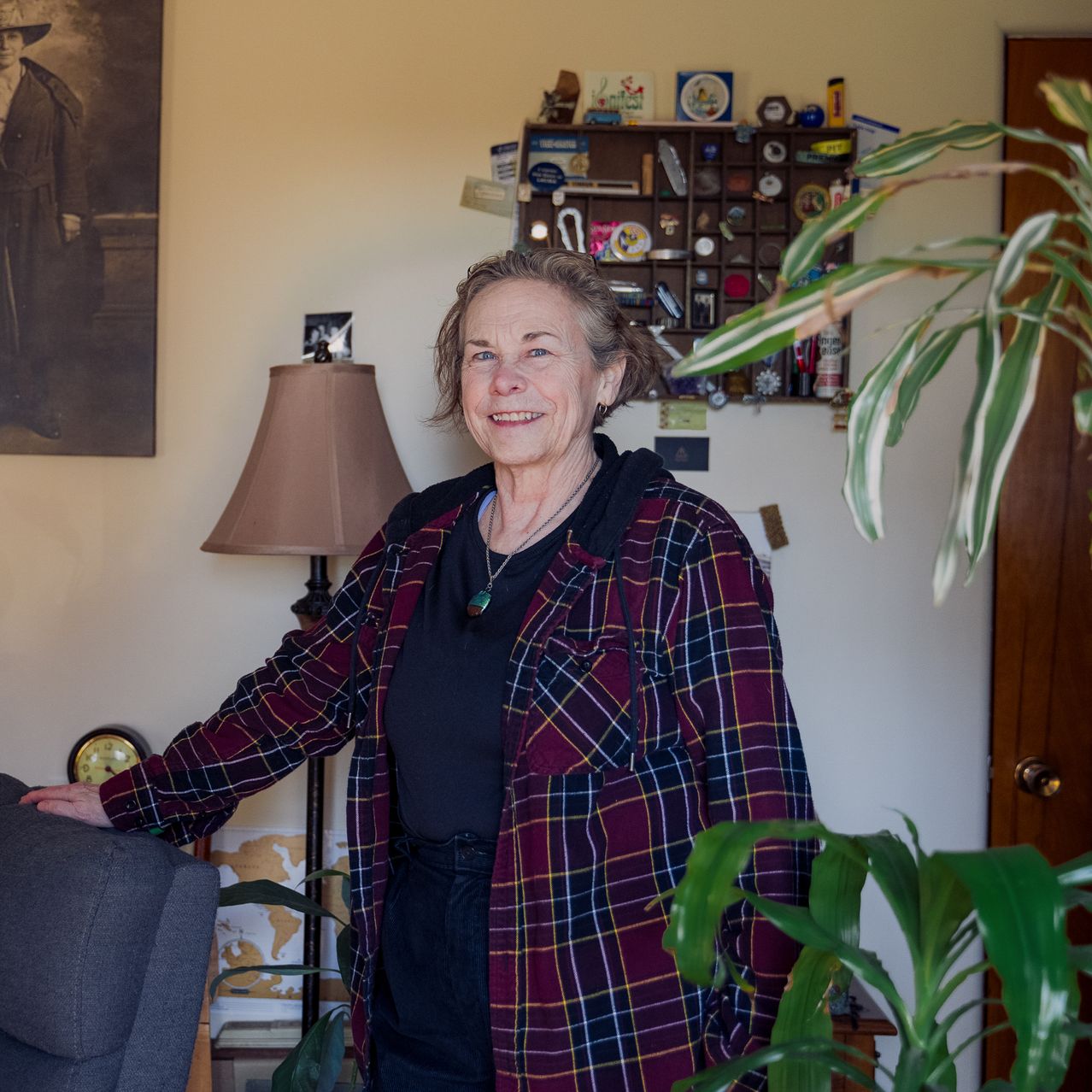
Lori Renee Fye in her home. PHOTO: CHLOE TADDIE FOR THE WALL STREET JOURNAL
Lori Renee Fye , 65, joined the U.S. Air Force after high school, serving in a mobile radar unit in Germany and at bases across the U.S.
She continued traveling after the military, working in administrative jobs for a conservative pundit in Washington, D.C., an apple baron in Texas, and the chairman of a Native American tribe in California. After her divorce in 2014, she sought refuge in European travel.
After her younger brother’s divorce in 2018, she returned to the Canton, Ohio, area where she grew up. She came to provide emotional support and never left.
“This is the place that made me, gave me my work ethic and basic values,” said Fye. “There is a thing called a sense of place. I’ve realised I’m back in my place.”
Canton is more diverse than she remembered. No one is shocked anymore at the sight of a woman riding a motorcycle, as Fye used to do, she said.
This fall, Fye began volunteering about 30 hours a week at a newly opened LGBTQ+ community centre, Queer in Canton. She gives tours and helps organise the cafe and a clothing donation closet.
Though she says she’s an introvert, Fye enjoys meeting new people, even a group of teens that gathers weekly at Queer in Canton.
“Young kids usually get on my nerves,” she said. But “seeing them hang out together is one of the greatest joys I get from the place. It gives them a place to go and be with other kids who are different and not be bullied.”
Fye, who earned about $70,000 at the peak of her career, lives on her Social Security check of $1,665, plus the $100 her former spouse sends her each month.
She wishes she had worked a little longer to boost her Social Security benefit.
She pays monthly rent of $500 to her brother, who owns the two-family home they share, bordering a woodsy area with a creek.
“I feel very secure here. He pays for the water and Wi-Fi. I pay for the trash collection and the bulk of the mortgage,” she said. “It’s nice to be with someone I can trust to be there for me. Everybody needs one person. My brother is my person in a lot of respects.”
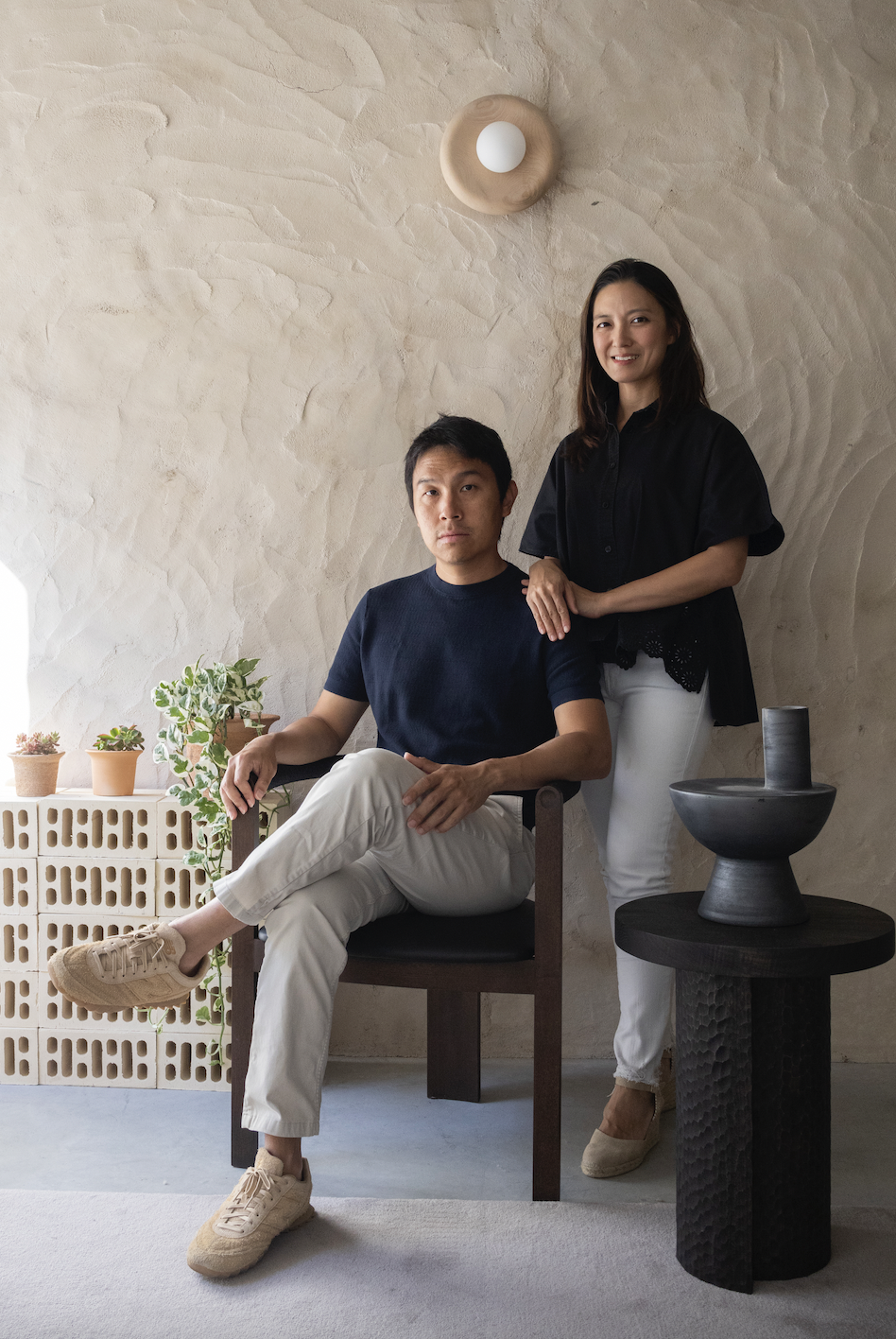
While the rest of the world was hunkering down in 2020 as the reality of COVID set in, Gabriel Tan was moving house — halfway around the world.
The Singaporean designer and his heavily pregnant wife Cherie Er relocated with their five-year-old son to Porto, on the coast of Portugal. It was a bold move given Tan had an established studio in Singapore, but the couple decided it was worth the risk to be in the heart of the design centres in Europe and the US.
“It was difficult because we had a good business in Singapore and my wife had a really good job — she was running the Asia Pacific sales for Credit Suisse,” he says. “We threw everything in the basket and moved to Portugal.
“We decided that this design business has to work.”
For more stories like this, order your copy of Kanebridge Quarterly magazine here.
By the time Tan, who decided on a career in design while doing his national service in the navy, left for Portugal, he was already a name in Singapore and Japan, first with Outofstock, which he started with two friends, then his own studio before working with Japanese brand Ariake.
“I met them when they were still doing contract manufacturing and they were a local brand that wasn’t even known in Tokyo,” he says.“Originally the plan was just for me to design a few products for them. I told them that’s not going to move the needle for them if you are just going to add my products to your current collection so I suggested something more ambitious.
“I kind of appointed myself as the creative director.”
Origin story
The experience with Ariake spurred Tan onto build his own brand, Origin Made, designing products and taking on interior design projects, but he was keen to continue to extend himself.
Over time, living and working in a country of 5.5 million people was beginning to feel limiting.
With more of his time and attention being directed towards brands in Italy, Scandinavia and the United States, it made sense for Tan to make a permanent move to a location with easier access to Europe as well as North America. It was also an opportunity for a fresh start in design terms.
“I felt I was getting pigeon holed a little bit before COVID because people felt my work was very minimalist Japanese/Scandinavian, but it was because I was designing for Japanese clients,” he says. “When you work with a company, it is 50 percent them and 50 percent you. You bring part of yourself but at the same time, you can’t ignore the brand, their culture and their customers.”
Life in lockdown
Like much of the rest of the world, Portugal was in lockdown when Tan and Er arrived and their rental accommodation was not entirely comfortable for the family. As some work dried up in Singapore, Tan found himself with time to think.
“We were spending a lot of time in front of the TV and we were all wishing we had a more comfortable couch in our apartment,” he says.
“I was still waiting for my home to be finished construction so we were in a very uncomfortable spot.
“I really prioritised comfort when I was designing this sofa so I really went for it and tried to think ‘what is the craziest, most comfortable form we could get’.”
The Luva, meaning ‘glove’ in Portuguese, draws inspiration from a boxing glove and Japanese futon. It is now part of the Herman Miller range, alongside classics such as the Eames lounge and ottoman.
The sofa is the Luva (Portuguese for glove), a modular design taking its inspiration from Japanese futon beds and western boxing gloves. The backrest has the ability to extend for full lounging or to fold down to create a ‘fist’ for more support. It’s a deliberate attempt at cross cultural pollination.
“You have the eastern influence of the futon and the western sport of boxing and I tried to get an aesthetic that different cultures would be familiar with whether they are from Asia, Europe or the US,” he says. “You will find this shape is familiar to you and you will be naturally drawn to it.”
Build your own
While the lounge is in keeping with a contemporary aesthetic and comfort levels, it also embodies the practicality that is an integral part of Tan’s approach. Each piece is available individually, allowing the user to ‘build’ the lounge to suit their needs, whether they live in a large house or a small apartment.
“I have lived in apartments all my life,” he says. “You can see how narrow the stairwells can be, and you have to carry the sofa up.
“Whenever we are doing interior design for clients we know the consideration when you’re buying a sofa. If it’s modular, if you can get it through doorways and narrow hallways, it’s going to be much easier to convince the client to buy.”
It’s also a design that the user can add to over time, extending the usefulness and longevity of the sofa. Tan took it to product design director at Herman Miller, Noah Schwarz, who was quick to recognise its applications.
“He would often ask what I was working on so I showed him this sofa and immediately he was like ‘this could be something for us’,” says Tan.
“He thought it might be something for the MillerKnoll group but which brand he couldn’t tell yet.
“But he said ‘definitely don’t show it to other people’.”
The Luva has since been joined by the Cyclade tables, a trio of coffee and occasional tables designed to work equally well together or singularly. Other collaborations have followed, including work with major European brands such as B+B Italia, Menu, Abstracta and Design Within Reach while still maintaining his Singaporean office.
The Cyclade tables, named for the group of islands in Greece, have been designed for flexibility.
Cutting down travel times has meant more time on the ground.
“Here I travel quite a lot to meet with different companies I am working with and that helps because to me these distances are super short,” he says. “For designers living in Europe they might not want to go to Denmark because it’s a 3.5 hour flight but to me, even if I have to transit, five hours is no problem.”
Leap of faith
Although the move to Europe was risky, Tan has no regrets. While he admits his Portuguese is still a work in progress, his two sons (Er delivered a baby boy not long after arriving in Portugal) are quickly learning the language and the family has now moved into a traditional townhouse, which Tan has renovated, and where their office is based.
Tan and his wife Cherie Er work and live in the house they recently finished building in Porto.
Being in the heart of Europe has opened up a world of opportunity for Tan that has been both invigorating and challenging.
“I am designing for companies of different countries and I get to learn more about other ways of life and how people from other countries see design and see their homes and their spaces and how people do business in different parts of the world,” he says. “Coming from Singapore, it can be very stifling because it is so small. It’s really such a joy to experience these different cultures through design collaborations.”
Moving away from family and friends was a leap of faith but it gave him the push he needed. For a designer whose work is all about comfort, he is not one taking the safe path and staying home.
“It’s a good business model for revenue but you are not going to leave a mark on design history, you are not going to touch the lives of that many people if you are working with regional brands,” he says. “I really wanted to work with the international brands that have the reach with customers worldwide and I think if I hadn’t moved I would not have had that clarity of mind and that focus to really go for it.”
Stanley has spent the past few years turning a vacuum-insulated, 40-ounce water bottle into one of the most-desired womenswear accessories on the planet. Now it is widening its focus to include the customer it was first designed for more than 110 years ago—men.
The company, which is owned by Chicago-based HAVI, next year plans to release new products geared toward guys beyond its current male audience of outdoor enthusiasts.
The new Stanley man might not require a steel canteen to take into the wilderness, but he might want a sleek water bottle to take from the office to the gym to date night in a wine bar, according to Jenn Reeves, Stanley’s vice president of global brand marketing.
“He’s not a fashionista, but he cares about how he’s put together. He’s into grooming and how he looks, and into sports,” Reeves said. That hypothetical male customer wants water bottles that are a little sleeker and subtler than the brightly coloured giant flasks coveted by Stanley’s female audience, she said.
The bid for diversification comes as Stanley looks to hold on to the brand equity it has accrued in a remarkably short time.
Stanley’s annual revenue jumped to around $750 million in 2023 from $73 million in 2019, and scores of articles and think pieces have in the past year been written to explain how a company originally targeting construction workers became one of the trendiest brands of the moment. Much of the success comes down to the recent rise of the brand’s 40-ounce Quencher, which it introduced in 2016. The $45 metal cup with a straw and a handle has become a status symbol among women and tweens, caused new-product frenzies in stores, and generated a “Saturday Night Live” skit lampooning women who drink out of comically “big dumb cups.”
Imitators and competitors for thirsty consumers are hot on Stanley’s heels. They include cooler-maker Yeti , which last year introduced a 42-ounce straw mug similar in design to the Quencher.
Stanley’s latest release is a collection of cooler bags and a carryall holder for its 40-ounce Quencher bottle, slated for release in April. The wearable coolers were developed in response to women’s complaints that the market’s existing offerings were too heavy, too clunky and too ugly, and the crossbody was designed to ease the burden of carrying a water bottle and a purse around all day.
Beyond hammertone green
The Stanley customer only became known internally as a “she” in 2020, when Terence Reilly, the former chief marketing officer of Crocs, joined as president. Reilly, who liked to say his team had turned Crocs’ divisive shoes “from a meme to a dream,” learned that the Quencher was becoming popular among a group of women in Utah, a few of whom ran a shopping blog called the Buy Guide , according to one of the blog’s co-founders.
The group, along with a female Stanley sales account manager, suggested that the company start selling its cups in colors outside of black, white and its signature hammertone green, and it did. Sales lifted, while the company began to lean more on real women to spread the word about its products.
The Stanley marketing team has grown slowly since Reilly’s arrival but is still tiny by industry standards: only seven full-time staff members across advertising, brand, marketing, media and social media, said Reeves, who joined in 2022. The company spends money on traditional direct marketing, such as email campaigns, but its biggest focus is social media and working with real women and influencers who promote Stanley to their followers.
Stanley got a big, unexpected break in November, when a TikTok user named Danielle Lettering posted a video claiming that the only item to survive her car fire was her Stanley Quencher. The clip went viral, and Stanley bought her a new car and covered related costs including taxes.
Influencing men
Many of Stanley’s male consumers are already Quencher fans, Stanley said, and guys sometimes feature in its ads. The company heading into 2025 has to translate its social-media momentum among women into a marketing strategy designed to attract more men with the planned sleeker range.
The typical male consumer is also swayed by the recommendations of influencers, but he often spends time on different platforms than his female counterpart, said Chris Anthony, the chief revenue officer of media company Gallery Media Group, which works with social-media content creators. He is likely to track interests, teams and channels, as opposed to following specific influencers across all platforms the way some women do, he said.
“Guys rely more on their feed versus the people,” Anthony said. “And letting the influencers tell their stories, and not being so prescriptive, will especially resonate with guys in the right way.”
Some of those influencers might be Stanley’s current best customers, Reeves said. “We have the women, and they love us,” she said.
Australia’s population grew by 2.5 percent to 26.8 million people over the 12 months ending 30 September, according to new figures from the Australian Bureau of Statistics (ABS). This was an annual increase of 659,800 people, with migrants making up 83 percent of the increase at 548,800. Natural increase, which is births minus deaths, contributed to a net gain of 111,000 people.
Natural increase was 3.9 percent lower than the same period in 2022, reflecting a trend in Australian women having fewer babies. Migration was 60.3 percent higher than the same period in 2022, however the data from this period was impacted by the border closure until February 2022. Most migrants arriving in the 12 months to 30 September 2023 wereinternational students and workers on temporary visas. The overwhelming majority of migrants are coming from India, China, and the Philippines. Of the 548,800 net migrants that relocated here over the 12 months, 34 percent settled in New South Wales, 29.5 percent settled in Victoria and 16 percent settled in Queensland.
Western Australia had the fastest population growth rate, up 3.3 percent, followed by Victoria at 2.9 percent, Queensland 2.7 percent, New South Wales 2.3 percent, Australian Capital Territory 2.1 percent and South Australia 1.7 percent. The lowest growth was in Tasmania at 0.3 percent.
Drivers of Western Australia’s highest population growth rate since 2009 include record employment and a booming economy. The state government upgraded its state final demand forecasts for FY24 from 3 percent to 4.5 percent in December.
While the biggest contributor to the state’s population growth is international migration,Professor Amanda Davies, Head of Social Sciences at the University of Western Australia, comments that strong interstate migration is resulting from “‘push’ factors operating in major east coast states, and in particular high costs of living and housing.”Strong buyer demand has pushed the Perth median house price up 18.6 percent, which is the strongest annual rate of growth anywhere in Australia.
The Perth median house price is $718,560, according to CoreLogic. Real Estate Institute of Western Australia CEO Cath Hartcommented: “We can expect to see house prices and rents continue to rise, homes to sell and lease quickly, and the rental vacancy rate to remain low for some time yet.”
The ABS also tracks interstate migration, which is the movement of Australian residents between states and territories. Over the 12 months to 30 September, Queensland had the highest rate of net interstate migration at 32,625 people, followed by Western Australia with 11,233.
The state that lost the most residents was New South Wales, with a net 33,302 people moving elsewhere and the bulk of them departing Sydney. This net outflowis much higher than other parts of Australia. The second highest loss through interstate migration was in the Northern Territory with 3,606. Victoria lost just 1,119 people. NSW Productivity Commissioner Peter Achterstraat AM recently warned that Sydney is losing many residents aged in their 30s and 40s due to unaffordable property values. He says Sydney“could become known as the city with no grandchildren”.
One of the largest names in the ski world is taking steps to make the industry more sustainable.
“The outdoors is our business,” says Kate Wilson, vice president of environmental and social responsibility at Vail Resorts.
Vail Resorts, a mountain resort company with a network of 41 ski resorts across four countries, set out to make a major commitment to their sustainability efforts in 2017. The intent was to achieve a net-zero operating footprint by 2030. This “Commitment to Zero” includes the ambitious goal of zero net emissions, zero waste to landfill, and zero net operating impact on forests and habitat.
“On day one, we didn’t have the road maps and plans on how we were going to get there, but we’ve since built those,” Wilson says. “And we’ve brought others in the industry with us.”
Just six years later, Vail Resorts is ahead of schedule to reach its emissions goals and on track to achieve the zero net operating footprint by 2030. The company reached 100% renewable electricity for the second year and hit its 2030 energy-efficiency target early.
Offsets are another way Vail Resorts is supporting sustainability. They have reforested over 200 acres of land since 2017 and support wind farms across the country. Plum Creek is a large-scale wind farm enabled by Vail Resorts. In its 2023 fiscal year, it produced 350,177 megawatt hours of renewable electricity, equivalent to the electricity needed to power 48,286 homes for one year.
“Sustainability and the way it is integrated into our business and operationalised with every decision that we make is something I’m really proud of,” Wilson says. “We’re not just thinking about how we, as a resort, can make an impact on climate change but how we can use our voice across our resorts, our industry, and beyond.”
Commitment to Zero gives the Vail Resorts properties one central sustainability focus. With one common goal, the company can lean into and take advantage of their enterprise network.
“At every resort we’re sharing lessons learned: ‘We did this thing in Whistler, we should do it in Park City,’” Wilson says. “That’s the power of the network and coming together to say, ‘what can we do that’s bigger than each of our resorts?’”
To further that goal of sharing lessons and ideas, Vail Resorts spearheaded The Mountain Collaborative for Climate Action in 2019. Now with over 76 resorts in the collaborative, the group works together on innovative solutions to help spread sustainability across the ski industry. Vail Resorts also partners with the National Ski Areas Association on quarterly meetings to discuss items related to green initiatives and share its experiences with an even larger group.
“There are smaller resorts that don’t have sustainability resources. We can share lessons learned, come up with solutions where we tell them, for example, how we recycle our nitrile gloves and turn them into pellets that become playgrounds,” explains Wilson. “We don’t need to own these things we want to share with others so they can take action, too.”
Developing innovative solutions for recycling and reducing landfill waste is a key part of this sustainability strategy. Initiatives to collect and upcycle waste can be easily replicated at multiple resorts. A project to collect and recycle soft plastics into decking is being piloted at various properties across the Vail Resorts mountains.
Other innovative solutions Vail Resorts has implemented include the ski industry’s only gondola-based waste removal system, a custom-designed recycling center at Vail Mountain, and a resource-efficient snowmaking system.
Vail Resorts also leans on strategic partners to assist with their green efforts. The company worked with PepsiCo, their on-mountain beverage partner, to develop a program to upcycle candy and snack wrappers into furniture and terrain park features. There’s now a Mountain Dew wallride in the terrain park at Breckenridge crafted from recycled bottles and snack packaging materials.
The company also joined together with Helly Hansen to turn old ski resort work uniforms into tote bags and ski patrol backpacks. The products were sold on behalf of their EpicPromise Employee Foundation, which provides hardship and education grants to teammates.
The employee foundation is one way Vail Resorts is expanding its efforts beyond environmental initiatives. The company has a large youth access program and hosted more than 11,000 youths across 32 properties in the 2022-23 season, according to the resort.
“We really believe the future of the sport is inclusion. We care deeply about removing some of those barriers to have people try the sport for the first time,” Wilson says.
It’s impossible to go 202 miles per hour on Manhattan’s Park Avenue (and you shouldn’t try) but that’s where Aston Martin’s opulent showroom is, just down the road from Ferrari. The cars follow the money, and the new Vantage that had its North American debut in New York this month carries a price tag of US$191,000.
Aston is aiming to produce “the definitive front-engine, rear-wheel drive sports car,” powered by a four-litre AMG-sourced twin-turbo V8 engine producing 655 horsepower and 590 pound-feet of torque. Shifting through an eight-speed ZF automatic gearbox (there’s no manual option), it can reach 60 mph in 3.4 seconds. The Vantage can be ordered now, with deliveries this summer.
In other words, the Vantage is a traditional supercar in an age of rapid electrification. There isn’t an auto company in the world that isn’t aware of what’s ahead. And according to Alex Long, who was in New York and heads product and market strategy for Aston, the company is collaborating with California-based Lucid on an electric Aston that will appear in 2026. They’re having the naming discussions now, but few details are available. Lucid, which fields the ultra-fast Air Sapphire , is a pioneer in developing lighter and smaller components for EVs.
The two-seat Vantage has a lot of overlap with the DB12 (a 2+2, meaning it has two decent sized seats in the front and two smaller ones in the back] and it’s a venerable name in the Aston Martin universe, going back 70 years. The new model has been greatly reworked, with modifications to the chassis, engine, body design (the grille is 30% larger), and an all-new interior and bespoke in-house infotainment system with the company’s first touchscreen. Horsepower is up 30% and the torque is up 15%.
The DB12, seen in convertible form, is a Vantage relative that offers 2+2 seating. Jim Motavalli
Technical types can thrill to such revelations as “a stiffer-yet-lighter front engine cross brace for increased torsional rigidity and lateral stiffness between the front suspension towers,” as described by Aston Martin.
The new Vantage is indeed techy for an Aston Martin, and offers active vehicle dynamics, adaptive shock absorbers from Bilstein, and an electronic rear differential. There’s a launch control system that manages torque to keep the car planted when it takes off for the horizon.
“[Owner] Lawrence Stroll has made a huge investment in Aston Martin,” Long says. “He believes that in supercar positioning, we have to go all the way.” The Vantage on display was certainly gorgeous in eye-popping Podium Green, which has some blue in it. Apparently the tried-and-true but dark British Racing Green comes off as black in photographs. The vivid green contrasts with a neon-like Lime Essence stripe around the rocker panels and tail.
There was no driving component, but racing driver Darren Turner, a three-time Le Mans winner and an Aston Martin development driver, was on hand.
“I’ve been with the Vantage development program from the beginning,” Turner says. “Our aim with the driving modes [which include Sport, Sport Plus, and Track] was precision behind the wheel.” There’s no “comfort” mode—if you want to commute or buy groceries, you use Sport which, Turner says, “is not too hard on the suspension.”
Long says the Vantage is “practical” because it has a big trunk, but it’s young couples and empty-nesters who won’t mind the absence of a back seat. As for what’s under the hood, Aston’s customers are still thrilling to the sound of a V8 engine and are not pushing for an EV. But with a European ban on internal combustion by 2035, and similar directives in American states, EVs are inevitable under the Aston banner.
Inside the Vantage, with a new infotainment system. Jim Motavalli
Meanwhile, Aston has other models coming. The ultra-exclusive Cosworth V12-powered Valkyrie (priced at up to US$3.5 million for the track AMR Pro version) will be replaced by the even-more-potent Valhalla at the end of this year. Only 999 Valhallas will be built. The 937-horsepower Valhalla, with an AMG V-8 and two electric motors, will be Aston’s first plug-in hybrid and priced around US$800,000. The Valkyrie was a huge hit in terms of garnering publicity for the brand, and the Valhalla will similarly serve. Just 150 Valkyrie coupes and 85 Spyders are being built, and production should be done by the end of 2024.
The DBX was an instant big seller for Aston Jim Motavalli
Aston has put considerable effort recently into Formula One and GT racing, and there’s also the Vantage GT4 competition car, which (because of strict rules) shares about 80% of the road car’s structure and mechanicals. But the bonded aluminium chassis gains a custom roll cage.
Aston Martin sold 6,620 cars in 2023. When the company introduced its first SUV, the DBX, it quickly became the company’s runaway bestseller despite a high price tag, now at US$200,086. The DBX 707 (the number is the horsepower rating) ups the ante. SUV leadership is a common result among supercar enterprises that grit their teeth and build SUVs to fulfil consumer demand.
It may be a while before Aston Martin is an all-electric brand. Right now, it’s keeping the order books filled with AMG-powered supercars. But transition is ahead.