The Anti-Status Watch: Why Men in Finance Love Cheap, Cheesy Watches
The ultimate trading-floor flex? A Snoopy Swatch. Or a Casio calculator. Why lots of money men (still) favour novelty watches.

 3 min
3 min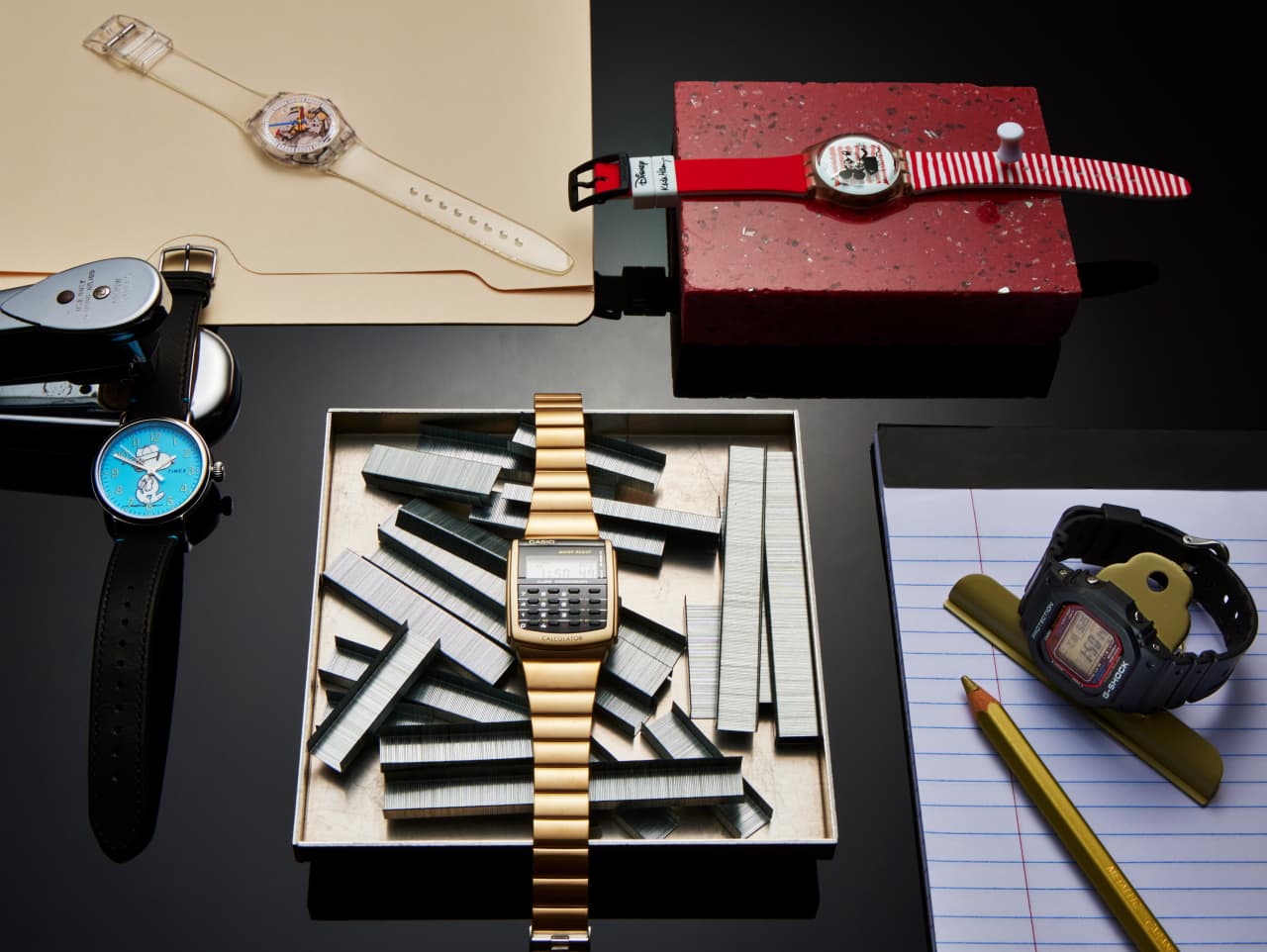
How do you tell the time? Neal W. McDonough, the COO of a finance and policy startup in Ho-Ho-Kus, N.J., looks to Charlie Brown, the loveable, miserable “Peanuts” protagonist. An illustration of the character occupies the exec’s watch dial, Brown’s stout arms acting as the minute and hour hands.
McDonough, 55, bought the kooky Timex for a Valentine’s Day trip about five years ago, along with a matching model depicting Lucy van Pelt (Brown’s frenemy) for his then-girlfriend. To his surprise, he kept wearing the $150-ish ticker after the trip. “It’s now my business watch,” he said, adding that such a non luxury model can telegraph that he’s under no obligation to be flashy. “I have nothing to prove to anyone,” he said. “And the fun thing is, a lot of people notice [my watch].”
Though finance guys famously flaunt Rolexes or Patek Philippes on their wrists, an established subspecies of money men goes the other way entirely. In place of a sleek steel case and elegant ceramic dial? Mickey Mouse. SpongeBob SquarePants. Fanta-orange rubber straps.
Over the years, highfliers have made headlines for sporting Swatches. (See: Blackstone Group CEO Stephen A. Schwarzman or former Goldman Sachs CEO Lloyd Blankfein .) That “wealthy guy, cheap watch” ethos continues to resonate in boardrooms and on trading floors, with men of all seniority levels embracing plasticky, offbeat designs, from superhero models to calculator Casios. Many resemble something you might win in a claw machine. Priced from $30 to a few hundred bucks, they’re a bit of fun and a different sort of flex, conveying an “I don’t need a Rolex” bravado that comes from having made it. Call them anti-status watches.
Patrick Lyons, the managing partner of a family office in New York, rotates two contrasting watches: a 1988 Santos de Cartier and a Nickelodeon “SpongeBob SquarePants” model with a tangerine strap.
The Cartier, a family heirloom, is a slice of French sophistication; the Nickelodeon dial features a giant image of a pink starfish named Patrick Star who lives under a rock. Lyons, 35, likes that the second watch is idiosyncratic—and that its starfish shares his name. “I wear that more often than my Cartier,” he said, adding that he hopes to pass down both models to future offspring.
Leroy Dikito, 42, an executive director at JPMorgan Chase in New York, chose his $450 “Avengers” watch from Citizen because it reminds him of his father, who loved comic books. Though its stainless-steel strap reads urbane enough, its cheerfully garish dial slices together images of the Hulk, Iron Man, Captain America and other superheroes. Working in finance, you need to be “serious all the time,” so a fun watch brings welcome levity, said Dikito. “People need to know there is more than the big job and the title.”
Since a suit can only inject so much color, a watch offers that rare opportunity to “show off your personality,” said Eli Tenenbaum, 36, the director of corporate development for a New York private-equity firm. Plus, he noted, “If you wear a fancy watch, chances are someone else may be wearing the same one.” Tenenbaum runs little risk of twinning with a colleague when he straps on his Mickey Mouse or Snoopy Swatches, worn with premium Brioni or Zegna suits.
Evan Vladem, 37, considers his Casio calculator watch a neat “ice breaker” when schmoozing, a professional obligation for the partner at a financial advisory in Fort Lauderdale, Fla. “It came in handy to break up awkward moments,” he said of the black, $30-ish design, a Casio classic. At a dinner with an insurance partner a few years ago, he recalls, the conversation petered out after an exchange about a client’s situation, which involved some financial arithmetic. “I pulled out my wrist and said, with a smile, ‘Well, I’m happy I have my trusty calculator watch to help me here,’” said Vladem. “We both laughed. [It] kicked off another conversation.”
Even men who have invested heavily in high-end horology seem to be falling for cheap, kitschy designs. Scott Jay Kaplan, 44, a film producer and financier for Brooklyn company CoverStory, owns pricey models from Rolex and Audemars Piguet. But for daily wear he’s currently favouring a super-chunky $25 watch he bought in Argentina this past winter, a model similar to a G-Shock but by an unfamiliar brand. He says he has received a lot of compliments on it, and it has held up surprisingly well. “I bought it because it looked silly,” he said. “Not for clout.”
McDonough, the Charlie Brown fan, urges anyone considering a novelty ticker to follow just one rule: Don’t splurge. “I think the whole idea of luxury watch brands coming out with ‘kitsch’ watches is…a little bit absurd,” he said. “So anything over, say, $500 would be out.”
Prop styling by Marina Bevilacqua
The Wall Street Journal is not compensated by retailers listed in its articles as outlets for products. Listed retailers frequently are not the sole retail outlets.
 Copyright 2020, Dow Jones & Company, Inc. All Rights Reserved Worldwide. LEARN MORE





From making unpopular decisions to learning when to listen, leaders from five businesses reveal what nobody prepared them for — and how running a company has challenged their expectations.

Technology and semiconductor shares fell sharply as investors questioned the debt financing the AI infrastructure boom and confronted higher rates and Chinese competition.
Elon Musk is exploring a potential merger between Tesla and SpaceX, a deal that could reshape the future of AI, robotics, autonomous vehicles and space technology. With a combined valuation potentially reaching $3.5 trillion, the move could bring Musk’s vision of an interconnected technology ecosystem closer to reality, although a deal remains uncertain.
5 min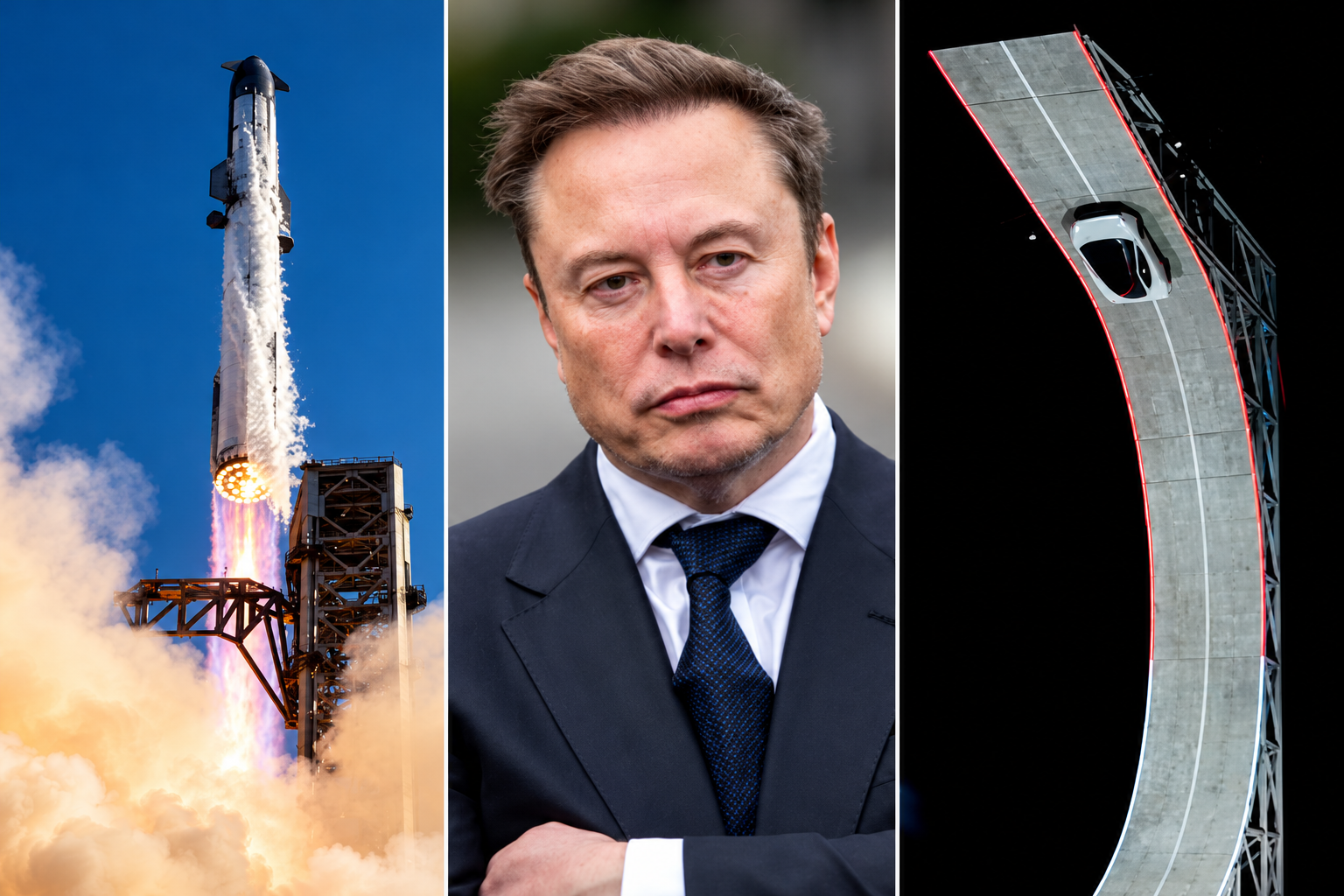
Elon Musk has engineered ties between Tesla TSLA 3.41%increase; up pointing triangle and SpaceX SPCX 7.79%increase; up pointing triangle that are hard to break, and now he wants to fuse them together permanently.
Musk has run both Tesla and SpaceX concurrently over the past two decades, using a schedule that dictated which days he spent focused on each business.
The companies have often shared resources and personnel, signaling their close ties. Last year, SpaceX looked into creating a spacesuit for Tesla’s humanoid robot Optimus, a person familiar with the matter said. Tesla last week showed off its new Roadster, a vehicle featuring SpaceX rocket thrusters that it hopes to soon bring to market.
And in recent months, Musk has repositioned both companies by expanding beyond their core operations toward a shared mission centered on artificial intelligence.
The world’s richest man on Tuesday signaled his interest in tying up SpaceX and Tesla, marking what would be the biggest corporate merger of all time. Because he serves as chief executive of SpaceX and Tesla, Musk said committees of independent directors at both companies are evaluating a possible deal, adding that a transaction might not come to fruition.
The committees will likely evaluate, with lawyers and bankers, how each company would fare in a potential deal and how a deal might best be structured. They then present their conclusions to their respective boards, who typically vote on whether to proceed.
“It’s an odd Kabuki dance where two groups of people are talking and I can’t be in the conversation,” Musk told SpaceX investors on Tuesday in response to an analyst’s question about a potential deal.
For Musk, the merger supports his vision of a world full of autonomous cars, humanoid robots and weekly rocket launches, as well as the data centers and satellites required to keep the whole thing running.
Some investors and analysts said they expect a transaction would be structured as an all-stock deal, with SpaceX potentially paying a modest premium for Tesla shares.
SpaceX, which has a market value of about $2 trillion, said it is seeing sharp growth in revenue across its businesses, which include operating data centers, launching rockets and operating satellite networks such as the internet service Starlink. Tesla is valued at about $1.5 trillion and is expanding its operations beyond its automotive and energy business. Shares in both companies traded higher following the news Tuesday.
Musk’s substantial ownership stakes in both companies, along with voting control at SpaceX, has enabled him to set the deal in motion. Analysts and investors said the deal will probably face regulatory scrutiny internationally, though some see Musk’s close relationship with the Trump administration as an asset to getting approval.
Blurred lines
The companies haven’t said which directors are on the special committees evaluating a potential deal. Several SpaceX and Tesla board members have either personal or business ties to Musk. And like Musk, venture capitalist Ira Ehrenpreis sits on both boards.
In a filing this week, Tesla outlined millions of dollars in business agreements with SpaceX and its subsidiaries last year, including $143 million in car sales to SpaceX, $3.3 million in advertising that it bought on the social-media platform X and $430 million in revenue from the sale of Megapack batteries for SpaceX’s data centers.
The companies also split the cost of resources including the use of Musk’s SpaceX jet and the bill for his personal security, which he runs through a private company.
Employees at both companies routinely move between companies to work on special projects, and some executives have dual roles, including Charles Kuehmann, vice president of materials engineering at both SpaceX and Tesla, and Ashok Elluswamy, the vice president of AI software at Tesla who runs a joint venture with SpaceX called Digital Optimus.
Over the years, Musk has launched new startups within his empire, including brain-implant company Neuralink, underground-tunnel developer the Boring Company and xAI, the AI startup that merged with SpaceX in February.
It is that AI business that Musk thinks can serve a market worth tens of trillions of dollars, justifying the need for a merger.
The business case goes like this: Tesla is developing robotaxis and robots, which it calls “physical AI.” SpaceX is working on the back end of physical AI: the data-center capacity and internet connection required for those robotaxis and robots to operate continuously.
“I don’t see what the value of Tesla is if it’s not merged with SpaceX,” said investment adviser Ross Gerber, a former Tesla bull turned critic invested in both companies. “If they don’t merge, the brains of everything that runs Tesla is owned by another company.”
On top of it all, both companies face constraints on the supply chains they need to make this world a reality, particularly when it comes to chips. To address this, Musk earlier this year announced a joint venture between Tesla, SpaceX and Intel to design and manufacture chips in Texas. “The most epic chip-building exercise by far,” he has said.
Musk at the wheel
For Musk, a merger would also solve two problems: demands on his attention and his lack of control at Tesla.
Tesla for years was Musk’s only public company, a status that came with greater scrutiny. There, Musk reports to a public board, as well as individual investors who make up around 30% of Tesla’s voting power, according to FactSet.
The question of Musk’s attention became a particular focus for investors and the board in recent years after he acquired Twitter in 2022 and launched xAI in 2023, and again in 2025 as he spent time in Washington, D.C., running the Department of Government Efficiency in the early months of President Trump’s second term.
As Tesla’s car business suffered in 2025, Musk threatened to take his AI ambitions outside the company if he wasn’t granted 25% voting control. Last November, Tesla shareholders approved a new pay package for Musk, which created a path for him to vastly expand his stake.
As of Sept. 30, Musk owned a roughly 20% stake in Tesla, according to the company’s proxy filing.
The SpaceX IPO gave Musk a different path. When SpaceX went public in June, the deal’s structure enabled him to have more than 80% voting power at the company—so much that he can’t be fired and decisions can’t be made without his support.
If SpaceX acquires Tesla, he will likely stay in control.

Set on one of the city’s last absolute riverfront sites, The Riversdale by Mosaic combines irreplaceable waterfront ownership with one of Brisbane’s most significant residential opportunities.

A bold new era for Australian luxury: MAISON de SABRÉ launches The Palais, a flagship handbag eight years in the making.