Luxury Buyers Drifted North, But the Tide May Be Turning
New data shows Sydney and Melbourne underperformed during the lifestyle-migration boom, but shifting price gaps suggest prestige buyers may be circling back.
 3 min
3 min
Australia’s luxury housing map has been flipped on its head over the past five years, but the pendulum may finally be swinging back toward the big cities.
According to Ray White Group Senior Data Analyst Atom Go Tian, the pandemic years reshaped where prestige buyers put their money.
“If you were speaking about luxury houses five years ago, you wouldn’t even consider markets outside of Sydney and Melbourne,” he says.
But when COVID accelerated lifestyle migration and buyers were suddenly free to look elsewhere, the country’s wealthiest house hunters proved highly mobile.
“Luxury buyers proved themselves to be the most flexible and flocked away to where luxury was still sold at a discount,” Tian says. The result: Sydney and Melbourne were largely overlooked while regional prestige markets surged.
Both major cities saw their luxury prices spike briefly in 2021 as the COVID boom lifted the entire country, but the gains evaporated almost as quickly.
Rising interest rates and the lure of discounted luxury in the regions saw Sydney and Melbourne lose roughly half their 2021 uplift the following year.
The recovery since has been patchy. Tian says Sydney “grew six per cent between 2024 and 2025 after growing just two per cent between 2023 and 2024 to finally reach a new peak luxury price of $4.5 million”.
Melbourne, meanwhile, still hasn’t clawed back its pandemic peak. Luxury prices there rose five per cent between 2024 and 2025 after falling one per cent the year prior, ending 2025 at $2.6 million.
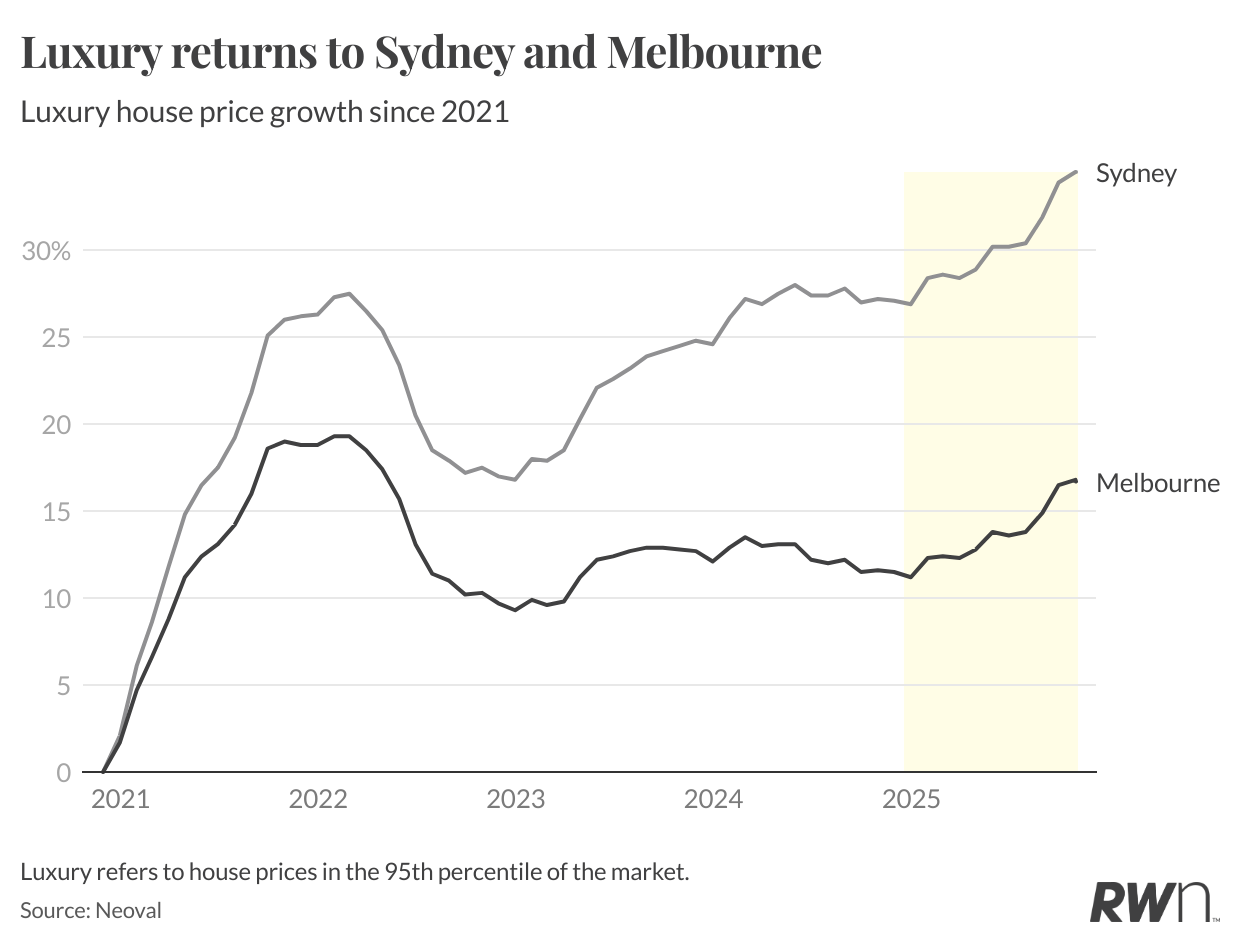 Over five years, the two major cities have been dwarfed by the east-coast lifestyle markets that stole their thunder. Sydney grew 35 per cent and Melbourne just 17 per cent.
Compare that with Brisbane (+77 per cent), Perth (+76 per cent), Adelaide (+73 per cent), the Gold Coast (+72 per cent), and the Sunshine Coast (+68 per cent).
That surge allowed the Sunshine Coast ($2.76 million) and Gold Coast ($2.86 million) to overtake Melbourne ($2.62 million) as the second and third most expensive luxury markets in the country.
Brisbane ($2.32 million) and Perth ($2.30 million) are now only 12 per cent cheaper than Melbourne, a huge shift from 2020 when both were 43 per cent cheaper.
Many assumed this decentralised luxury map was the new normal. But Tian says the last 12 months hint at a potential reversal.
“It’s easy to assume the new normal is a decentralised luxury market, but if the last 12 months signal what’s to come, luxury buyers may just be beginning to rediscover the value of Sydney’s prestige waterfront streets and Melbourne’s leafy inner suburbs.”
The price gaps that once tempted buyers north and west have narrowed. In 2020, Sydney was twice as expensive as the Gold Coast and Sunshine Coast.
Now the gap is closer to 1.5 times. Against Brisbane and Perth, the premium has shrunk from 2.5 times to 1.9. “Sydney’s premium looks more justified than overpriced,” Tian says.
Melbourne is a more complicated story. Its long lockdowns hit confidence harder than anywhere else, sending affluent buyers to other states. But Tian believes that weakness may now be its strength.
“At only 17 per cent growth over five years, it significantly underperformed relative to its fundamentals as Australia’s second-largest city.”
If interest rate cuts arrive and confidence lifts, he says the very buyers who abandoned Sydney and Melbourne could return to find relative value they haven’t seen in years.
Victorian auction buyers will soon receive a piece of information that has traditionally been withheld until bidding reaches it: the vendor’s reserve price. Under new property-sale and underquoting laws, agents must publish the agreed reserve at least seven days before an auction or fixed-date sale. Most changes begin on 1 October 2026 and apply to …
Continue reading “Victoria’s New Auction Rules Will Force Reserve Prices Into the Open”
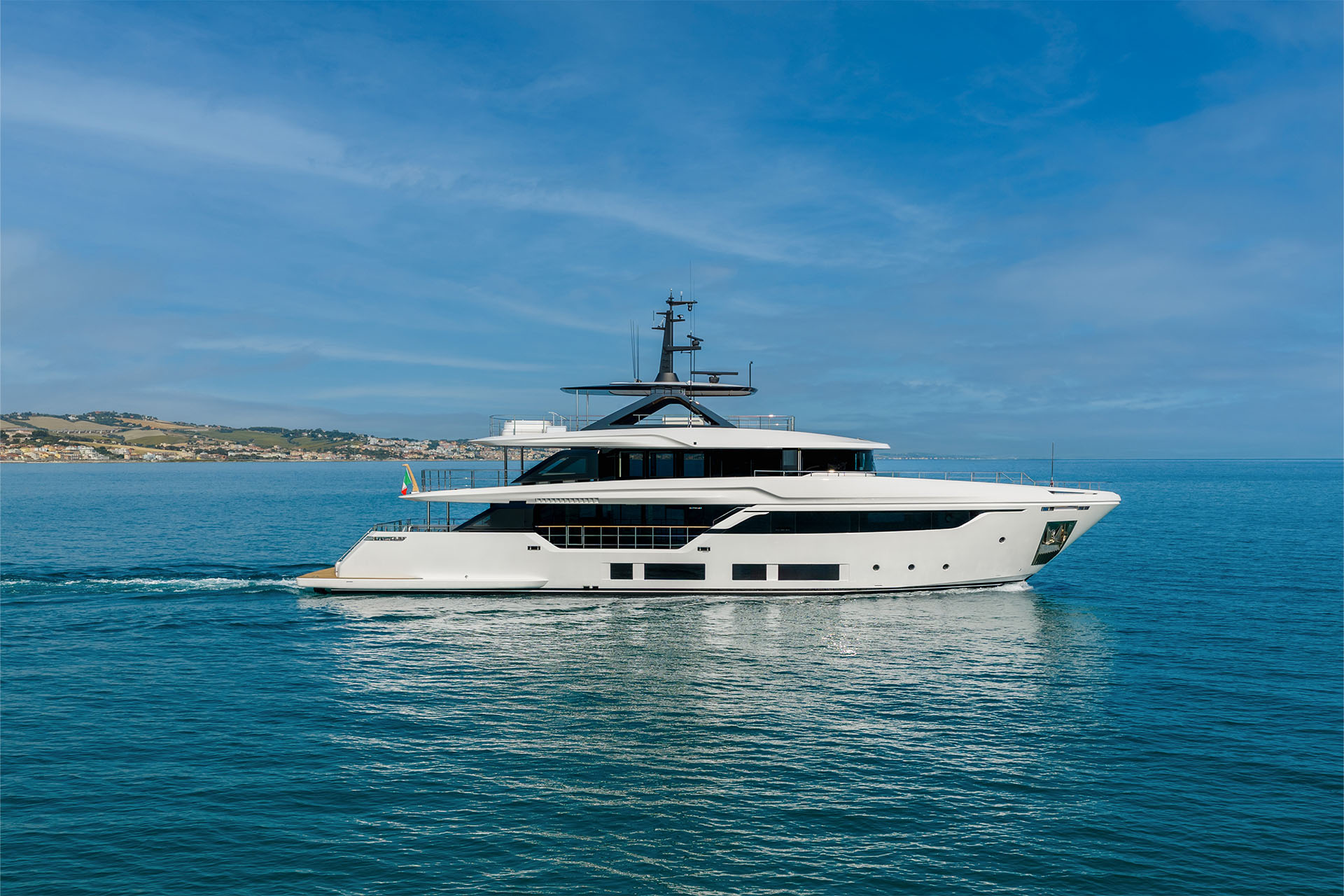
Four decks, 34.5 metres and a made-to-measure interior: step aboard the new Custom Line Navetta 35, unveiled at Cannes.
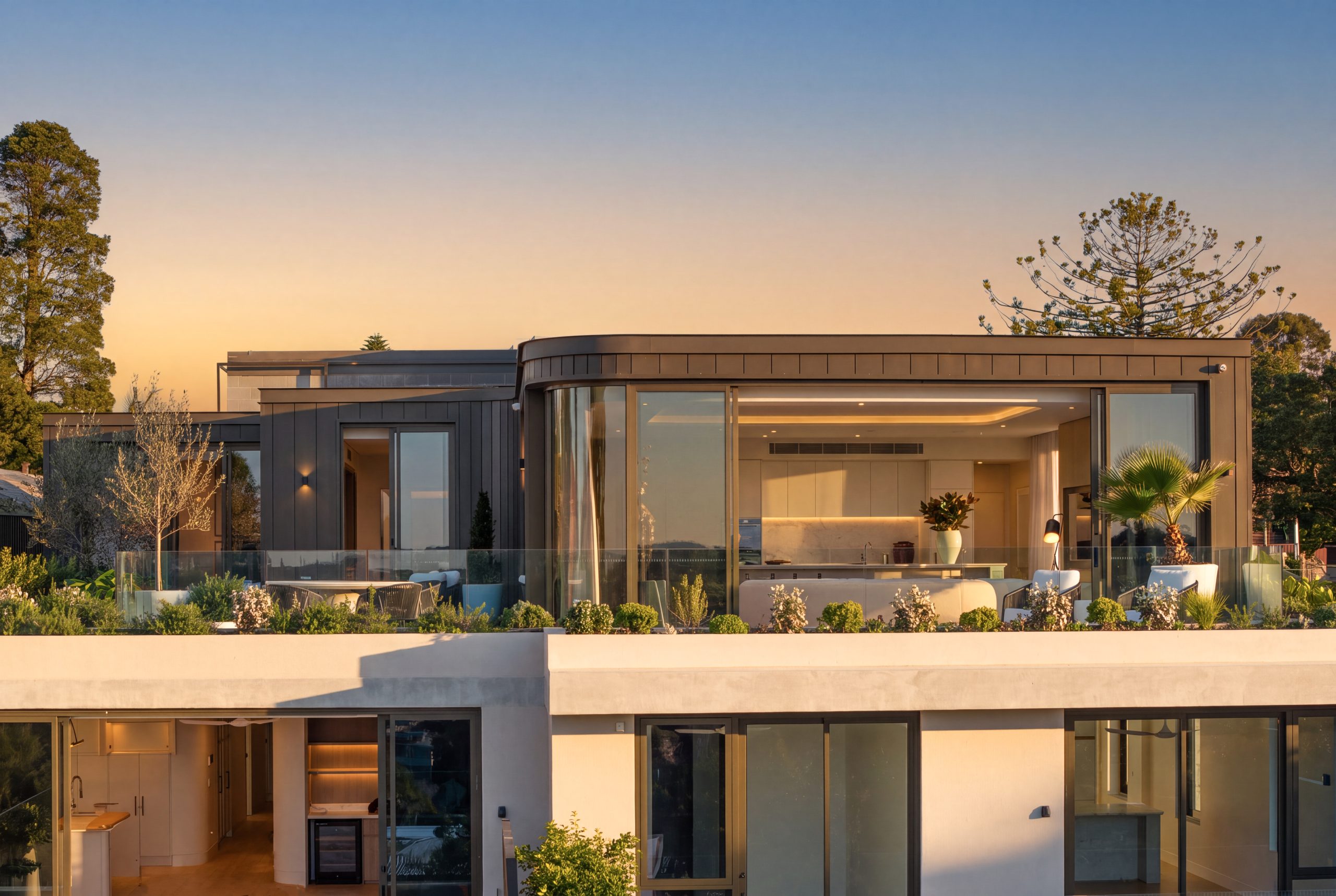
New detached-home sales fell 10% nationally in August, led by a 27% decline in Victoria, raising concerns about construction starts in 2027.
2 min
Australia’s hoped-for recovery in housing construction is losing momentum before it has had time to close the national supply gap.
Sales of new detached homes fell 10 per cent nationally in August, according to the Housing Industry Association’s survey of major volume builders across the five largest mainland states. It was the fourth consecutive monthly decline.
The fall was broad rather than isolated. Victoria recorded the largest retreat, down 27 per cent, followed by Queensland at 20.2 per cent, New South Wales at 17.5 per cent, South Australia at 10.8 per cent and Western Australia at 8.2 per cent.
Across the three months to August, sales were 19.3 per cent below the preceding three-month period and 7.7 per cent lower than the equivalent period a year earlier.
New-home sales matter beyond the immediate fortunes of volume builders. They are an early indicator of future starts: buyers sign contracts, finance is finalised, approvals are secured and construction follows months later. A sustained sales decline during the middle of 2026 is therefore likely to weaken commencements during 2027.
The slowdown reflects the collision of several pressures. Households have absorbed multiple interest-rate rises, reducing borrowing capacity and increasing the repayment cost attached to a new build. Established-home prices have softened in some markets, weakening the relative appeal of waiting through a construction period. Builders continue to face elevated labour and material costs.
The Reserve Bank’s August analysis showed new-dwelling construction prices increased 1.8 per cent during the June quarter and 5.3 per cent over the year. It attributed part of the pressure to oil-derived building products and other conflict-related costs.
Policy uncertainty can also cause buyers and investors to defer large commitments. But the precise contribution of any single tax or regulatory change is difficult to isolate from rates, confidence, land prices and construction costs. The HIA survey should be read as an indicator from large builders rather than a complete count of every dwelling sale.
The figures complicate progress towards the Housing Accord target of 1.2 million homes. The National Housing Supply and Affordability Council reported 308,000 completions since the Accord began and 244,000 dwellings under construction in the March quarter. Approvals and commencements had improved, but falling sales risk undermining the next wave.
For developers and governments, the warning is that planning approvals alone do not create homes. Projects need finance, viable construction pricing and buyers able to settle. If one part fails, approved supply can remain on paper.
Data box
National August new-home sales: Down 10 per cent
Three months to August: Down 19.3 per cent from the preceding three months
Year-on-year three-month comparison: Down 7.7 per cent
Victoria: Down 27 per cent
Queensland: Down 20.2 per cent
New South Wales: Down 17.5 per cent
South Australia: Down 10.8 per cent
Western Australia: Down 8.2 per cent

Rugged coastal drives and fireside drams define a slow, indulgent journey through Scotland’s far north.
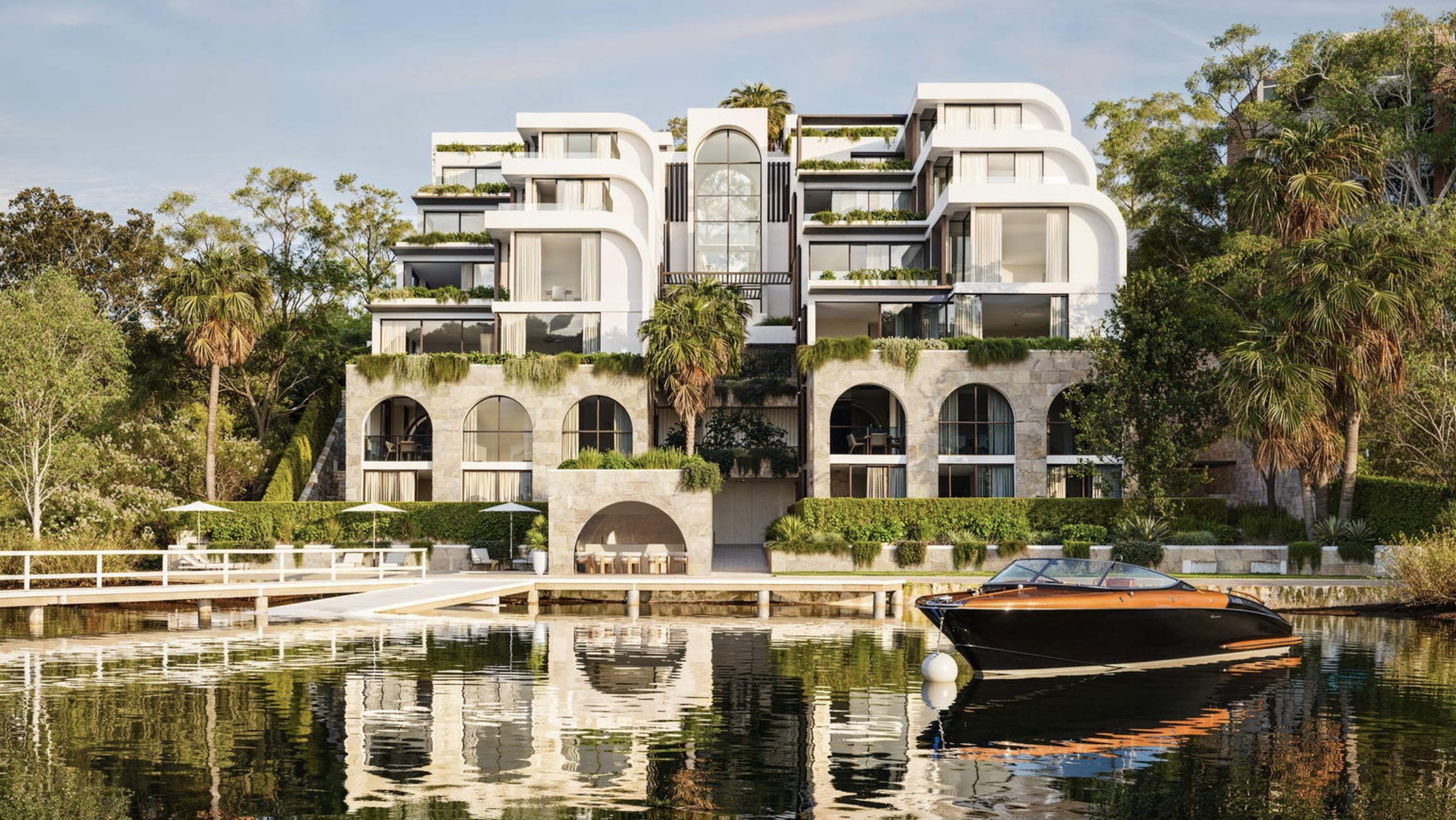
Advertising legend John Singleton unveils an exclusive 16-residence Caroline Bay development, marking his latest high-end property play on the Central Coast.