Apple Releases Vision Pro Headset, First Major New Product in a Decade
Announcement at Worldwide Developers Conference is first to introduce users to ‘spatial computing,’ CEO Tim Cook says

 4 min
4 min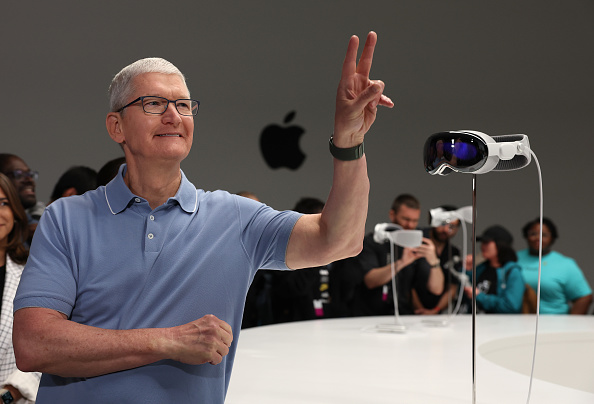
Apple unveiled the Vision Pro headset, the company’s first major new product in a decade, a device capable of allowing users to experience virtual reality and digital apps, movies, personal photos or any content available on a computer monitor overlaid on the real world.
Chief Executive Tim Cook said in a video at the company’s Worldwide Developers Conference that the Vision Pro is “a revolutionary new product” capable of shifting “the way we look at technology and the role it plays in our lives.”
“This is a day that’s been years in the making,” he said. “Blending digital content with the real world can unlock experiences like nothing we’ve ever seen.”
Apple said the device, which will sell for $3,499 and won’t be available until early next year, would be a new way to interact with digital content in the physical space using the user’s hands, eyes and voice to interact with apps. Users can control the device with their hands and experience movies, TV shows and games in a more immersive way. Cook called it a new “spatial computing” platform.
The Vision Pro can project a massive movie screen into any environment for a user, as well as capture or play three-dimensional video, making it possible for a user to watch a movie on a giant screen or interact with life-size personal photos or videos projected into their living environment.
Apple’s headset launches into an uncertain market for virtual and augmented reality devices. Headset sales grew at a fast clip during the pandemic, doubling to nearly 11 million units shipped in 2021. But they dropped 21% to 8.6 million units in 2022, according to researcher International Data Corp.
Meta Platforms, which has mostly dominated the market to date with its Quest virtual-reality headsets, has struggled to keep existing users engaged, with more than half of the $400 entry-level Quest headsets not in use six months after they were purchased, The Wall Street Journal reported previously. Last week, Meta said the Meta Quest 3 headset, which the company is promoting as similar to Apple’s Vision Pro, will be available in the fall of this year for $499.
Apple announced a partnership with Walt Disney, which showed in a pre taped video what viewing experiences could potentially look like, including an immersive Star Wars TV show and a function allowing users to watch multiple sporting events simultaneously. A digital version of the Disneyland theme park could project into the user’s physical world.
“We’re constantly in search of new ways to entertain, inform and inspire our fans,” Disney Chief Executive Robert Iger said in a pre taped video. “We believe Apple Vision Pro is a revolutionary platform.” He said Disney’s streaming service would be available on the device as soon as it reaches users, which Apple said initially would only be in the U.S.
Apple showed the headset being used in work environments, including an ability to project a screen akin to a modern desktop in a way that could replace a computer monitor. Users can also use Bluetooth devices such as keyboards to type.
Some features on the device are meant to avoid isolating a user, Apple executives said. Vision Pro displays the user’s eyes on the outside of the device with a screen sitting on the front of the device. And if somebody comes nearby to someone with the headset on, it will show the person.
The headset will have the M2 chip found in the company’s Macs and will also have a new chip called “R1” for processing data from the many cameras, sensors and microphones in the device. This enables the Vision Pro to limit latency, a common issue in virtual-reality headsets that causes motion sickness. Apple said it would have a high-resolution display system so video would render in 4K and text would look sharp.
Apple has been working on the headset for seven years and has delayed the launch several times, the Journal previously reported. The headset is far more expensive than headsets sold by rivals, such as Meta Platforms’ most expensive Quest Pro headset at $1,000.
Although Apple showcased many potential features and uses of the Vision Pro headset, the company’s announcement at its software conference points to its interest in how third-party software makers can add new functions.
Hundreds of thousands of apps that already exist on iPad and iPhone operating systems will also be available through Vision OS, the Vision Pro’s operating system. Apple told developers that it is introducing tools to let them redesign existing apps on other Apple platforms for the Vision Pro, or create new types of three-dimensional apps.
The rest of the conference, which focuses on software providers who make applications for Apple’s ecosystem, will run through Friday. A large portion of the developer sessions for the week will be focused on developing for the headset, the Journal reported previously.
The applications, which might run the gamut from games to workplace apps, are critical to the company’s strategy of drawing potential new users to the technology, which has yet to take off among a broad consumer base.
In the weeks leading up to the conference, many software makers working on virtual reality and other similar applications have received invitations to the event held at Apple’s Cupertino, Calif., headquarters. Apple booked in-person demonstrations for some developers following the Monday keynote.
In addition to the headset, the company launched a number of new software features for its existing slate of devices, including a new iPhone app called Journal for users to help them write about their days. The app prompts users to “practice gratitude” and technology to help capture moments from photos or travel experiences. The Wall Street Journal previously reported about the new app.
In its Health app, the company added an ability to log a user’s mood and state of mind. Apple said this will help users to see their current risk for depression or anxiety. The company has been involved in studying potential signals of depression with the University of California, Los Angeles. The Journal previously reported on Apple’s work on mental health.
Apple’s iOS 17 has a number of updates to help improve communication features in the company’s phone app, FaceTime and messages, including new artificial-intelligence techniques to improve typing on the keyboard and dictation.
Apple showed off a new 15-inch MacBook Air, which has an M2 chip and sells for $1,299. The company unveiled other upgrades to its M-series of chips in other Mac products as well aimed at professional users. Sales of Macs have fallen off recently following a surge during the pandemic after the company unveiled the M-series of chips, which it designed. In the company’s most recently reported earnings for the quarter ended April 1, the Mac business shrank 31% from the prior year.
Apple’s new Mac operating system, called Sonoma, includes a number of new features designed to improve video games.
Japanese game developer Hideo Kojima showed up in a video to support the new gaming initiatives, announcing that his latest game, “Death Stranding,” would be launching on Macs later this year.
AirPods headphones also have new features, including software that automatically adjusts the AirPods to the environment the user is in, such as turning on noise cancellation if it is noisy.
 Copyright 2020, Dow Jones & Company, Inc. All Rights Reserved Worldwide. LEARN MORE





Two coming 2027 models – the first of the “Neue Klasse” cars coming to the U.S. early next year – have been revealed.

A&K Sanctuary unveils Kitirua Plains Lodge, a sustainability-focused luxury property shaped by landscape, local craft and contemporary safari architecture.

Four one-off Cullinan commissions draw on the design language of yachting, blending marine craftsmanship with Rolls-Royce’s signature bespoke detailing.
< 1 min
Rolls-Royce has revealed a new series of bespoke Cullinan motor cars inspired by the world of yachting, with four individually commissioned vehicles reflecting the materials, movement and design codes of life at sea.
Presented at Goodwood in the UK, the Cullinan Yachting collection comprises four one-off vehicles themed around the cardinal directions, North, South, East and West, each expressed through distinct exterior finishes and interior detailing.
The commissions lean heavily into maritime influence, a space Rolls-Royce says is closely aligned with its global client base.
Each vehicle features marine-grade teak, hand-painted fascia artwork inspired by the wake of a tender cutting through water, and intricate marquetry compass motifs made from more than 40 individual pieces of wood veneer.
Hand-painted elements have become an increasingly sought-after feature among Rolls-Royce clients, with the brand employing dedicated artisans to develop bespoke interior compositions.
For the Cullinan Yachting series, the painted wake effect required months of experimentation to achieve a natural sense of movement.
Inside, the vehicles are finished in Arctic White and Navy Blue leather, with hand-stitched detailing designed to echo the structure of nautical ropework. A signature Rolls-Royce Starlight
Headliner has also been reimagined, with fibre-optic constellations arranged to reflect Mediterranean wind patterns.
Each car’s exterior colour has been developed to align with its directional theme, ranging from lighter blue tones evoking northern waters to deeper hues referencing warmer southern seas and storm-lit horizons.
Rolls-Royce said the collection reflects a longstanding relationship between the marque and the world of yachting, dating back to its co-founder Charles Rolls, whose family owned a steam yacht and travelled extensively through the Mediterranean.
The release underscores the growing demand for highly personalised vehicles among ultra-high-net-worth buyers, with Rolls-Royce increasingly positioning its cars as part of a broader luxury lifestyle that extends beyond the road.

Now complete, Ophora at Tallawong offers luxury finishes, 10-year defect insurance and standout value from $475,000.

Warmer minimalism, tactile materials and wellness focused layouts are redefining luxury interiors as homeowners design for comfort, connection and lasting appeal.