





Business Schools Are Going All In on AI
American University, other top M.B.A. programs reorient courses around artificial intelligence; ‘It has eaten our world’

 4 min
4 min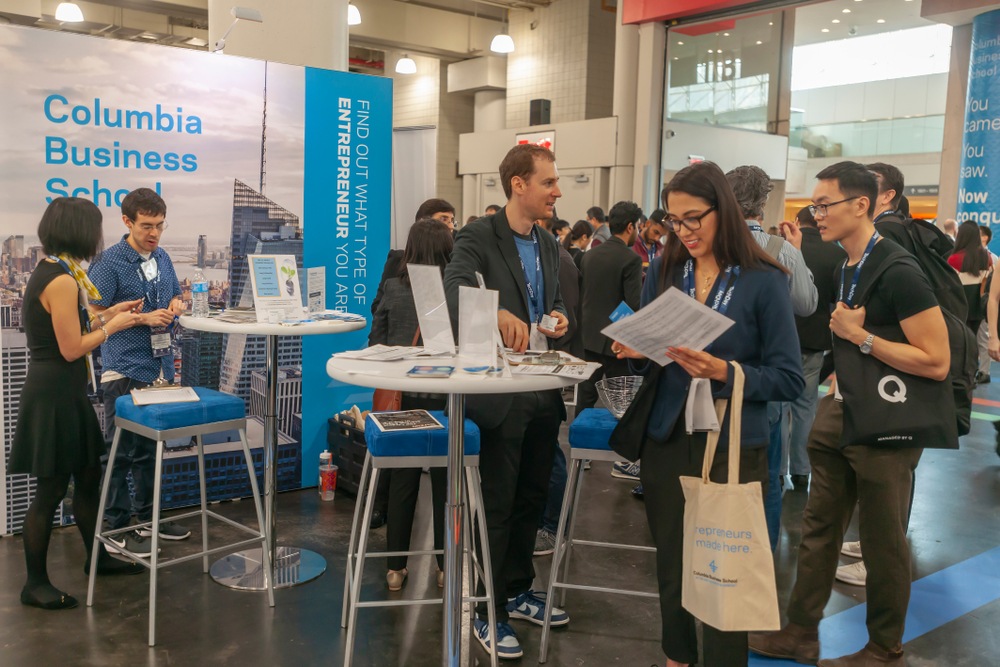
At the Wharton School this spring, Prof. Ethan Mollick assigned students the task of automating away part of their jobs.
Mollick tells his students at the University of Pennsylvania to expect to feel insecure about their own capabilities once they understand what artificial intelligence can do.
“You haven’t used AI until you’ve had an existential crisis,” he said. “You need three sleepless nights.”
Top business schools are pushing M.B.A. candidates and undergraduates to use artificial intelligence as a second brain. Students are eager for the instruction as employers increasingly hire talent with AI skills .
American University’s Kogod School of Business is putting an unusually high emphasis on AI, threading teaching on the technology through 20 new or adapted classes, from forensic accounting to marketing, which will roll out next school year. Professors this week started training on how to use and teach AI tools.
Understanding and using AI is now a foundational concept, much like learning to write or reason, said David Marchick, dean of Kogod.
“Every young person needs to know how to use AI in whatever they do,” he said of the decision to embed AI instruction into every part of the business school’s undergraduate core curriculum.
Marchick, who uses ChatGPT to prep presentations to alumni and professors, ordered a review of Kogod’s coursework in December after Brett Wilson, a venture capitalist with Swift Ventures, visited campus and told students that they wouldn’t lose jobs to AI, but rather to professionals who are more skilled in deploying it.
American’s new AI classwork will include text mining, predictive analytics and using ChatGPT to prepare for negotiations, whether navigating workplace conflict or advocating for a promotion. New courses include one on AI in human-resource management and a new business and entertainment class focused on AI, a core issue of last year’s Hollywood writers strike.
Officials and faculty at Columbia Business School and Duke University’s Fuqua School of Business say fluency in AI will be key to graduates’ success in the corporate world, allowing them to climb the ranks of management. Forty percent of prospective business-school students surveyed by the Graduate Management Admission Council said learning AI is essential to a graduate business degree—a jump from 29% in 2022.
Many of them are also anxious that their jobs could be replaced by generative AI. Much of entry-level work could be automated, the management-consulting group Oliver Wyman projected in a recent report. That means that future early-career jobs might require a more muscular skillset and more closely resemble first-level management roles .
Faster thinking
Business-school professors are now encouraging students to use generative AI as a tool, akin to a calculator for doing math.
M.B.A.s should be using AI to generate ideas quickly and comprehensively, according to Sheena Iyengar, a Columbia Business School professor who wrote “Think Bigger,” a book on innovation. But it’s still up to people to make good decisions and ask the technology the right questions.
“You still have to direct it, otherwise it will give you crap,” she said. “You cannot eliminate human judgment.”
One exercise that Iyengar walks her students through is using AI to generate business idea pitches from the automated perspectives of Tom Brady, Martha Stewart and Barack Obama. The assignment illustrates how ideas can be reframed for different audiences and based on different points of view.
Blake Bergeron, a 27-year-old M.B.A. student at Columbia, used generative AI to brainstorm new business ideas for a project last fall. One it returned was a travel service that recommends destinations based on a person’s social networks, pulling data from their friends’ posts. Bergeron’s team asked the AI to pressure-test the idea, coming up with pros and cons, and for potential business models.
Bergeron said he noticed pitfalls as he experimented. When his team asked the generative AI tool for ways to market the travel service, it spit out a group of very similar ideas. From there, Bergeron said, the students had to coax the tool to get creative, asking for one out-of-the-box idea at a time.
Professors say that through this instruction, they hope students learn where AI is currently weak. Mathematics and citations are two areas where mistakes abound. At Kogod this week, executives who were training professors in AI stressed that adopters of the technology needed to do a human review and edit all AI-generated content, including analysis, before sharing the materials.
Faster doing
When Robert Bray, who teaches operations management at Northwestern’s Kellogg School of Management, realised that ChatGPT could answer nearly every question in the textbook he uses for his data analytics course, he updated the syllabus. Last year, he started to focus on teaching coding using large-language models, which are trained on vast amounts of data to generate text and code. Enrolment jumped to 55 from 21 M.B.A. students, he said.
Before, engineers had an edge against business graduates because of their technical expertise, but now M.B.A.s can use AI to compete in that zone, Bray said.
He encourages his students to offload as much work as possible to AI, treating it like “a really proficient intern.”
Ben Morton, one of Bray’s students, is bullish on AI but knows he needs to be able to work without it. He did some coding with ChatGPT for class and wondered: If ChatGPT were down for a week, could he still get work done?
Learning to code with the help of generative AI sped up his development.
“I know so much more about programming than I did six months ago,” said Morton, 27. “Everyone’s capabilities are exponentially increasing.”
Several professors said they can teach more material with AI’s assistance. One said that because AI could solve his lab assignments, he no longer needed much of the class time for those activities. With the extra hours he has students present to their peers on AI innovations. Campus is where students should think through how to use AI responsibly, said Bill Boulding , dean of Duke’s Fuqua School.
“How do we embrace it? That is the right way to approach this—we can’t stop this,” he said. “It has eaten our world. It will eat everyone else’s world.”
 Copyright 2020, Dow Jones & Company, Inc. All Rights Reserved Worldwide. LEARN MORE





The pandemic-fuelled love affair with casual footwear is fading, with Bank of America warning the downturn shows no sign of easing.

The megamansion was built for Tony Pritzker, heir to the Hyatt Hotel fortune and brother of Illinois Gov. JB Pritzker.


With interest booming, wellness experts and pool builders have seen more homeowners hoping to take cold therapy immersion into their own backyards.
4 min
Cold plunges have gone from fringe curiosity to full-blown cultural phenomenon, the wellness world’s equivalent of a headline-grabbing breakout star.
Adherents slip into icy water on a daily basis, chasing an electric jolt of clarity that feels like a flip has been switched inside your brain.
Dedicated cold plunge practices are everywhere from upscale fitness studios and pro sports locker rooms to renowned wellness destinations such as Mountain Trek Health Reset Retreat in British Columbia.
Considering the ever-expanding assortment of companies flooding the market with cold plunge tubs and other custom devices dedicated to achieving icy bliss—with costs potentially reaching into the tens of thousands—some homeowners are tempted to use their swimming pools as an alternative.
“We’re absolutely seeing more homeowners use their pools as year-round cold plunges, especially in colder climates,” said Nick McNaught, CEO and co-founder of Toronto-based Stay Unbounded, which offers cold exposure workshops, retreats and certifications.
“The motivation is often simplicity and cost. If the water is already cold, people see value in keeping the pool open longer or winterizing it differently to support cold exposure.”
Suzanne Vaughan, president of Massachusetts-based pool builder SwimEx, points out the inherent convenience that comes with taking a frosty dip out back.
“From what homeowners tell us, the appeal of a cold plunge at home is less about chasing extremes and more about having a simple ritual that’s always available,” she said.
“It’s quick, accessible and easy to build into a daily routine.”
Among new clients Vaughan works with, year-round cold plunge use is usually planned from the start rather than as an afterthought.
“More are choosing indoor pools or small attached structures because that makes temperature control, equipment protection and day-to-day use much easier in colder climates,” she said.

If someone is thinking about using an existing home pool as a cold plunge, the main questions are likely to involve practicality and protection.
“Larger volumes of water take more energy and time to keep at colder temperatures, and you need a plan to protect plumbing, finishes and equipment from freeze–thaw cycles,” she added.
“Whatever the design, you want a system that’s built for the temperature range you have in mind, and a pool professional who can help you winterize safely.”
One such professional is Hunter Gary, a certified master pool builder and owner of H2 Outdoor Living in Tennessee.
“Most everyone has a ‘number’ in degrees when it comes to cold plunging. When a client asks our company to design a cold plunge for them, I ask ‘what’s your number?’” Gary said.
“A smaller body of water or cold plunge vessel may be much easier for maintaining a balanced temperature…but if using a pool gets you excited about a more serious approach to inviting this wellness experience in your life, then go for it.”
Amy McDonald, owner and CEO of Under a Tree, a wellness consultancy, said transforming a pool into a plunge might not be worth time and investment
“It is almost impossible to retrofit a standard swimming pool into a cold plunge,” she said.
“The energy and money to do it properly is greater compared to just creating a complimentary contrast circuit.”
A proper setup needs to be exceptionally cold, she noted, so depending on where the pool is located it might not get chilly enough to provide optimal health benefits.
“That could work in northern areas of the U.S., but it takes a lot for a pool to generate and keep that kind of cold, not even considering if the pool ices over,” she said.
McNaught echoed those concerns, citing how home pools aren’t designed specifically for cold plunging, so temperature consistency, cleanliness, ease of access and safety become important factors.
“Dedicated cold plunge setups offer more control, smaller volumes and lower ongoing maintenance,” he said.
“For many people, a pool works as an entry point. Over time, those who commit to the practice transition to a dedicated setup because it better supports frequency, comfort and long-term use.”
Beyond geography and climate, industry experts pointed out other challenges homeowners are likely to face.
“Pools are saturated with chlorine and other chemicals that directly absorb into the bloodstream. The advantage of many cold plunges is that no chemicals are required for residential use,” said David Haddad, as the co-founder of Oregon-based BlueCube Wellness.
“Constant ozonation and filtration is enough to kill organic compounds without exposure to sanitizing chemicals.”
Most cold-plunge systems are monitored to stay between 50-60 degrees Fahrenheit—with experienced plungers often preferring lower temperatures.
While “the ultimate experience might be a glacial lake in Finland, unfortunately that’s a bit out of reach for most of us,” said Andreas Stelluti, co-founder at Texas-based Colderatti, whose vessels feature the world’s first chemical-free cold plunge technology, powered by a triple filtration system that removes 99% of impurities to provide a system with drinking-quality water.
“Having a cold plunge at home brings that experience to your backyard, making it very easy and accessible, so you have the ability to make it part of your lifestyle,” he added.
Stelluti noted that as spring arrives and clients’ home pools start to warm up again, they begin to miss the cool water.
“Many say ‘I really need this to be part of my lifestyle year-round’ and that desire for consistent, accessible cold immersion is what motivates them to invest in a dedicated cold plunge setup,” he explained.
“Unfortunately, you can’t use your pool as a year-round cold plunge during the summer. Especially not here in Texas.”

From Italy’s $93,000-a-night villas to a $20,000 Bowral château, a new global ranking showcases the priciest Airbnbs available in 2026.

Australia’s market is on the move again, and not always where you’d expect. We’ve found the surprise suburbs where prices are climbing fastest.


