





LOW-FOOTPRINT LUXURY REDEFINES SOUTHERN AFRICA’S SAFARI EXPERIENCE
Exclusive eco-conscious lodges are attracting wealthy travellers seeking immersive experiences that prioritise conservation, community and restraint over excess.
 2 min
2 min
Luxury travel in Southern Africa is undergoing a quiet but profound transformation. Where sprawling resorts and visible opulence once defined status, a new generation of high-end travellers is gravitating towards smaller, low-footprint lodges that deliver exceptional experiences while preserving the environment around them.
This shift reflects a broader recalibration of priorities among affluent travellers, who are increasingly placing sustainability alongside comfort and exclusivity when selecting destinations.
Industry reports from Virtuoso and American Express Travel highlight growing demand for accommodation that supports conservation, limits environmental impact and contributes meaningfully to local communities.
For operators such as Isibindi Africa, this approach has long been central to their philosophy. Its flagship properties, Thonga Beach Lodge in South Africa and Tsowa Safari Island on the Zambezi River, demonstrate how thoughtful design and operational restraint can enhance rather than diminish the luxury experience.
DESIGNED TO DISAPPEAR INTO THE LANDSCAPE
Set within the UNESCO-listed iSimangaliso Wetland Park, Thonga Beach Lodge is defined by its deliberate invisibility. Guest numbers are strictly capped, and the lodge’s timber structures are elevated on stilts to minimise disruption to the fragile dune ecosystem.
Lighting is carefully controlled to avoid interfering with turtle nesting along the coastline, ensuring wildlife encounters remain entirely natural.
“Low-footprint luxury starts with knowing when to stop,” says Lucy Cooke, Group Marketing Manager at Isibindi Africa. “Guests notice when a place feels considered rather than overbuilt, and many now expect that.”
That same restraint extends to construction and daily operations. Traditional thatched roofs and local building techniques allow the lodge to blend seamlessly into its surroundings, while refillable amenities, reusable containers and the elimination of single-use plastics reduce waste.
POWERED BY NATURE, NOT EXCESS
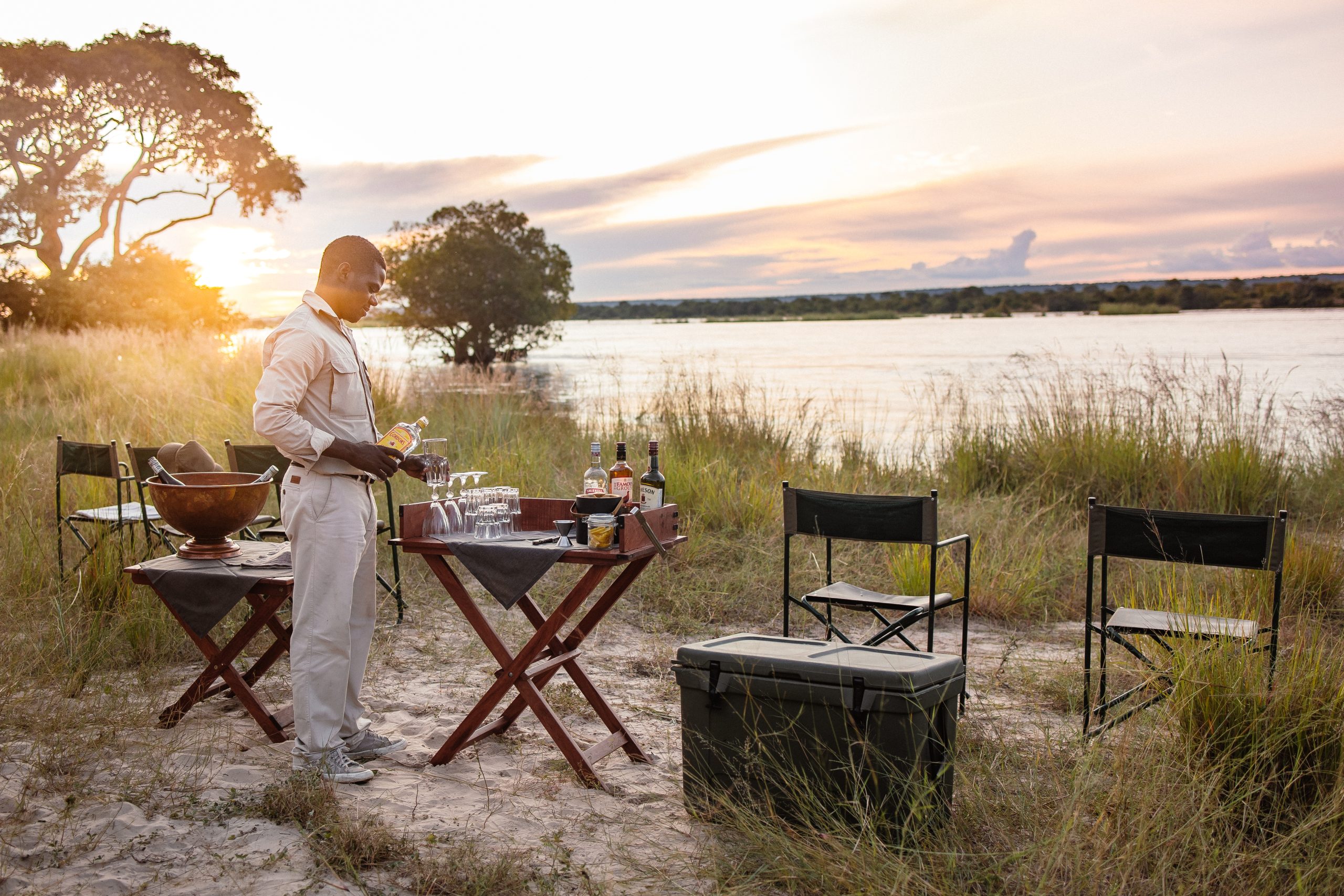
On the Zambezi River, Tsowa Safari Island offers an equally refined yet restrained experience. Limited to just nine safari tents and a maximum of 18 guests, the camp operates entirely on solar power, with water sourced from the river, filtered onsite and returned through environmentally sensitive systems.
The lodge was built without removing a single tree, with structures carefully positioned around existing vegetation to preserve the island’s natural character.
This intentional scarcity enhances the sense of exclusivity while ensuring the environmental footprint remains minimal.
COMMUNITY AND CONSERVATION AT THE CORE
Beyond environmental sensitivity, these lodges also reflect a deeper integration with local communities. At Thonga Beach Lodge, more than 90 per cent of staff come from the nearby Mabibi community, supported through training and long-term employment opportunities.
The lodge also supplies clean water to approximately 800 households each month, alongside investment in local schools, infrastructure and conservation initiatives.
Tsowa Safari Island similarly supports surrounding communities through water access programmes, agricultural support and anti-poaching partnerships with park authorities.
THE FUTURE OF LUXURY IS LESS, NOT MORE
As luxury travellers become more discerning about the true impact of their journeys, exclusivity is increasingly defined by authenticity, privacy and environmental sensitivity rather than scale.
These new-generation lodges demonstrate that luxury no longer requires excess. Instead, the most desirable experiences are those that tread lightly, preserve what makes a place special and offer guests a deeper connection to the natural world.
In Southern Africa, restraint has become the ultimate luxury.
Exclusive eco-conscious lodges are attracting wealthy travellers seeking immersive experiences that prioritise conservation, community and restraint over excess.

Margot Robbie and Jacob Elordi star in an adaptation of the classic novel that respects the romance’s slow burn.


Margot Robbie and Jacob Elordi star in an adaptation of the classic novel that respects the romance’s slow burn.
3 minThe most 2026 element of the latest screen adaptation of 1847’s hottest novel, “Wuthering Heights,” is the scene in which Heathcliff repeatedly asks the young lady he’s undressing, “Do you want me to stop?” even as she writhes with lust, indicating an affirmative response is unlikely.
Previously understood as a notorious brute even by 19th-century standards, Heathcliff now exhibits signs of having earned perfect grades in today’s campus training modules.
There’s also a reference to septicemia, which is writer-director Emerald Fennell’s perhaps too-technical stab at explaining the nonspecific Victorian disease that afflicts one character.
Mostly, however, Ms. Fennell has done an admirable job of not modernising a dark and moody romance. If most of today’s filmmakers crave hearing, “This is not your mother’s (fill in the blank)” when adapting classic material, this pretty much is your mother’s “Wuthering Heights,” or at least one she will recognise.
Catherine Earnshaw, played with great soapy gusto by Margot Robbie, is still the same judgment-impaired social-climbing drama queen as ever, and Ms. Fennell frequently associates her with a rich, decadent red—the colour of the bordello—to suggest that she has unwisely traded her body for riches.
Ms. Fennell, who won an Oscar for writing the feminist parable “Promising Young Woman,” doesn’t bother suggesting that Catherine is a victim of society’s impossible expectations for women, which allows her to focus on the core story without intrusive mutters of disapproval for 19th-century mores.
The plot is a template for every Harlequin romance about a woman caught between a sexy beast and a languid but wealthy wimp.
Catherine, who lives with her frequently drunken father (Martin Clunes) on a struggling Yorkshire estate called Wuthering Heights, grows up with a wild, apparently orphaned boy adopted by her father after being found hapless in the street.
The boy at first doesn’t even talk, and seems to have no name, so Catherine calls him Heathcliff. As an adult, he is played by Jacob Elordi , an excellent match for Ms. Robbie, both in comeliness and star power.
The pair grow up best friends and even sleep in the same bed. The desperate attraction between them is evident to both, but Catherine has her sights set on a higher-status mate than this mere stable boy.
After much figurative and literal peering over the walls of the posh neighbouring estate, Thrushcross Grange, she twists an ankle and becomes a six-week houseguest of the gentleman who owns it, the wealthy Edgar Linton (Shazad Latif). He lives with his ward, Isabella (Alison Oliver). Heathcliff, in agony, moves away without notice while Catherine marries Edgar.
Ms. Fennell has greatly streamlined the complicated plot of Emily Brontë’s novel, eliminating the framing device, the supernatural element, several peripheral figures and a second generation of characters.
Other adaptations have made similar excisions, and yet the latest version is luxuriantly long, fully half an hour longer than the much-loved 1939 film by William Wyler that starred Merle Oberon, Laurence Olivier and David Niven.
Ms. Fennell is a millennial who might have been expected to make the material slick, hip or at least fast; she has done none of that.
The story is a slow burn, as it should be, an extended sonata of moaning winds, crackling storms, smouldering glances and heaving bosoms. When you’ve got two actors as luminous as Ms. Robbie and Mr. Elordi, you don’t need them to say clever things, and they don’t.
Having simplified matters, Ms. Fennell sloughs off the psychological depth of the novel and instead lavishes attention on the heavy breathing and the decor, exhibiting much interest in the ornate mansion in which the Linton family lives (one room is set aside for ribbons only) and the costumes and accessories with which Ms. Robbie is gloriously draped.
Catherine essentially becomes a character in a Sofia Coppola movie who grows increasingly trapped and anguished in proportion to her cosseting. A slate of songs by Charli XCX captures Catherine’s tragic self-absorption without seeming jarringly modern.
The movie is very much aimed at female viewers, and Heathcliff (whose bare-chested form Ms. Fennell’s camera adoringly takes in) is less robustly drawn than in some previous iterations, driven mainly by carnal lust rather than a more all-encompassing rage.
Olivier’s demonic anger at the world came through clearly, whereas Mr. Elordi’s Heathcliff seems as though he’d be content to simply peel away Catherine from Edgar. And though Nelly (Hong Chau), Catherine’s maid and confidante, plays an essential role in developments, her character remains a bit frustratingly hazy.
Still, in the wake of adaptations such as 2012’s “Anna Karenina,” with Keira Knightley , and 2013’s “The Great Gatsby,” with Leonardo DiCaprio, that were all sizzle and flash, “Wuthering Heights” is a worthy throwback.
Deeply felt longing is its own kind of sizzle.

A cluster of century-old warehouses beneath the Harbour Bridge has been transformed into a modern workplace hub, now home to more than 100 businesses.

In the lead-up to the country’s biggest dog show, a third-generation handler prepares a gaggle of premier canines vying for the top prize.


