




One Man’s Quest to Reunite With His First Love: A 1971 VW Bug
Jeff Siegrist couldn’t take his mind off the car he sold in 1996. So he set out to track it down.

 3 min
3 min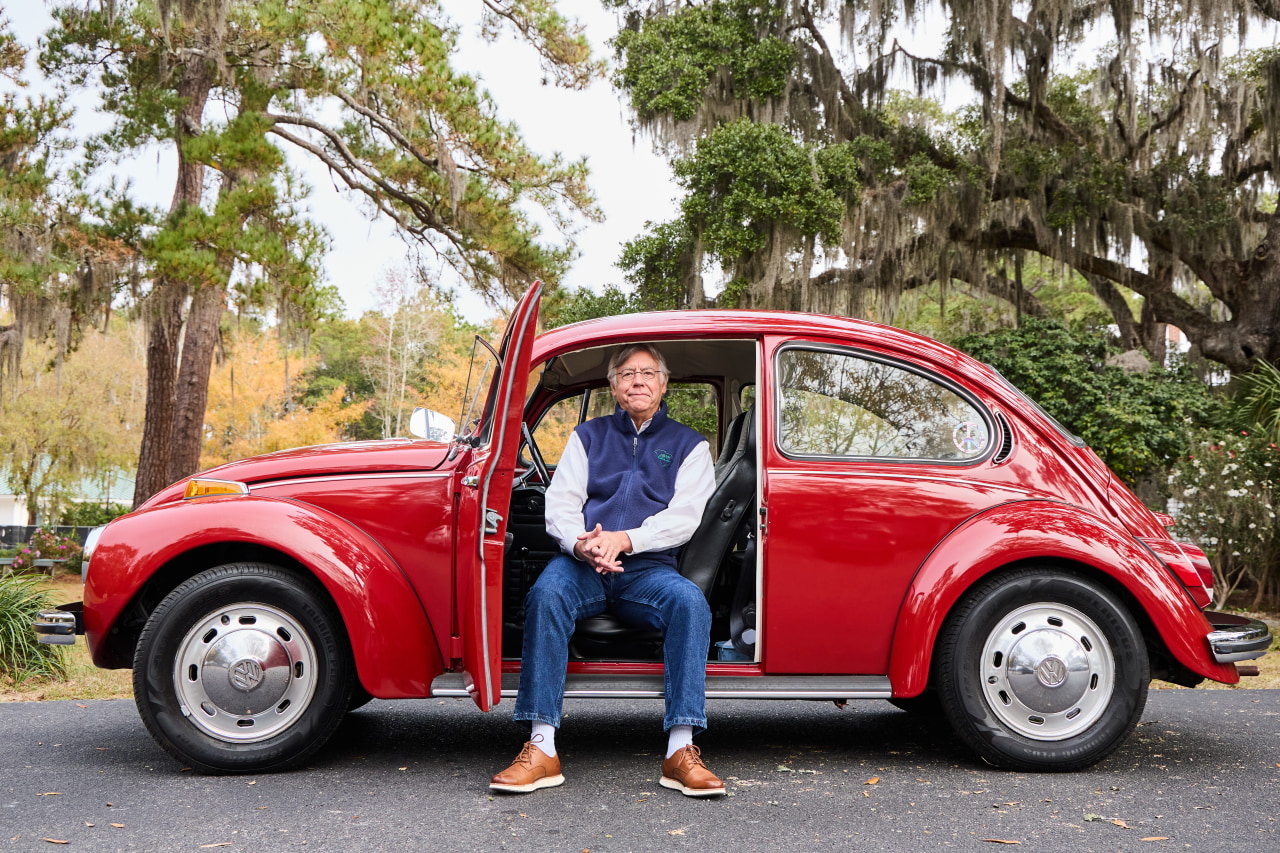
Locals in Pawleys Island have a special affection for classic vehicles. The coastal South Carolina town is home to many nostalgic retirees, and on weekends its streets see plenty of restored ‘60s-era muscle cars.
Of all the classics motoring past Parlor Doughnuts on Ocean Highway, none has captured the community’s attention like Rudolph the Red-Nosed Volkswagen.
“Everybody in town rubber necks and waves when this Beetle drives by,” says Rev. Wil Keith, a 47-year-old priest. “It’s one of the much-adored cars in our little town right now.”
It is a 1971 red Super Beetle and its story is special.
Jeff Siegrist was a student at the University of Tennessee when he first set eyes on her at a Knoxville dealership.
Siegrist pounced, handing over his father’s old Ford Falcon and $2,278.54 for the Bug. He kicked in $67.45 for an AM radio and $5.95 for a cigarette lighter.
“So that was my car from that day forward,” says Siegrist, an executive search consultant specialising in the forest products industry.
The Beetle was a sales phenomenon and a pop-culture hit that ushered in the era of mass European auto imports. It was also a Hollywood star, thanks to Herbie from the “Love Bug” movie franchise.
Siegrist road-tripped his Beetle all over. When he met his future wife, Mary, he took her on a first date in the red Bug. When the couple had their first child, the baby boy came home in the backseat.
“It was part of the family,” says Siegrist. Mary gave the car its name, around Christmas time in 1972: Rudolph.
The couple had two more children and ultimately sold the car in 1996. “It just wasn’t practical anymore,” he says. “There were tears in my eyes.”
Up to this point, the story isn’t much different from many of the more than 21.5 million original Beetles that Volkswagen sold.
But during the pandemic, things got interesting.
“I kept thinking, ‘Boy, I wish I knew where my old Beetle was,’” says Siegrist. “I wondered whether other people loved it the way my wife and I did.”
Eventually he got serious. He dug up the car’s original bill of sale, which had a vehicle identification number. He had sold the car to someone in Georgia, a quarter century earlier.
So he called the Georgia department of motor vehicles. Turns out the car was still registered and on the road. But that’s all the office would say.
Siegrist got an attorney involved. Two weeks later, the lawyer called with a name and a phone number for a woman he believed to be the current owner. So Siegrist called.
“I was shocked,” says Tracy Swift, who teaches dental hygiene at Albany State University in Georgia. “He started the conversation with, ‘You’re going to find this phone call very weird.’” Swift thought she had a stalker, and recalls Siegrist saying, “I’m not crazy, I promise. Just let me tell you my story.”
Swift did drive a 1971 Beetle. She checked the VIN number and it was a match.
Siegrist traveled to Georgia, met Swift at her office, and drove the car in the parking lot. “I didn’t want to sell the car,” she says, “but because of his story, I felt like it needed to go back to its owner. It was the sweetest story.”
They agreed on a price (he says “many times over the original cost”) and the car showed up on a truck in Siegrist’s driveway days later. It was just before Christmas in 2022.
The first thing Siegrist and his wife did was drive around the block, with tears in their eyes. “Rudolph is back!” his wife yelled as they drove.
Siegrist went digging in a bucket full of coins and junk for a key chain. At the bottom, he found Rudolph’s original key. He didn’t remember saving it.
The Beetle needed restoration. So Siegrist asked advice from someone he trusted. Enter Keith, the rector at Siegrist’s church.
“When you’re at church,” Keith says, “and the service is over and everyone is filing out, that’s when folks share, often, important information about their lives.”
Keith, it turns out, had grown up the son of a car restorer and worked on cars himself in his garage. He was not a professional. He worried if he would have enough time. But a parishioner needed help. How could he say no?
It took about a year. “Aside from the paint and some engine work,” Keith says, “I ended up doing more than I was expecting, with no complaints whatsoever. In some ways, it was like I gained a parishioner. Only it was a car.”
In 2024, Siegrist began driving Rudolph around Pawleys Island. “Rarely can I go anywhere where somebody doesn’t stop me,” he says.
“Because probably 50% of the people of my generation have owned a Beetle or have had an adventure in a Beetle. People want to know the car’s story. So I tell it.”
As for Keith, he says, “It’s a point of pride that I had a hand in it.” Like most classic car stories, this one continues.
“As soon as Jeff stops finding little things for me to fix, then the story will be over,” he says. “But he keeps finding things for me to do! Which I don’t mind one bit.”
 Copyright 2020, Dow Jones & Company, Inc. All Rights Reserved Worldwide. LEARN MORE




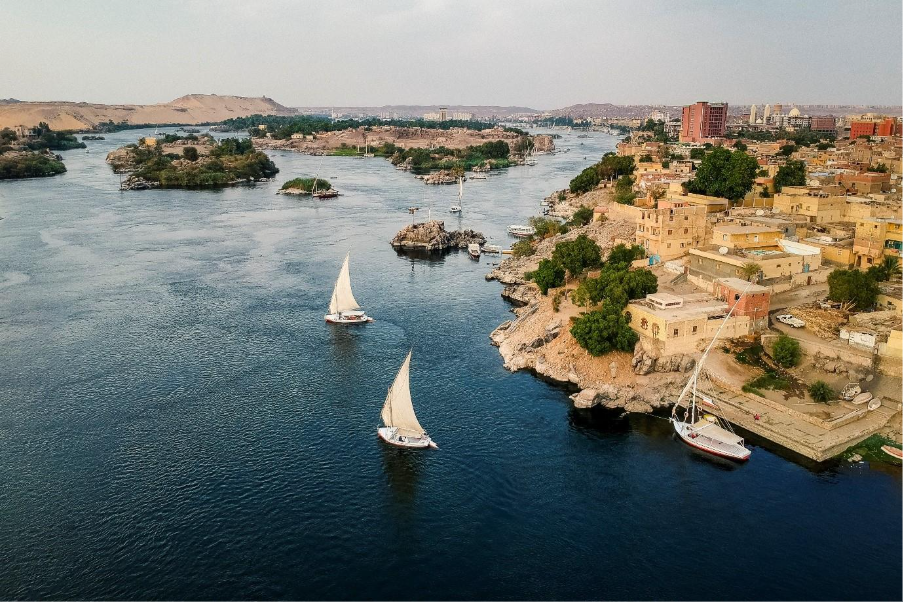
A resurgence in high-end travel to Egypt is being driven by museum openings, private river journeys and renewed long-term investment along the Nile.

In the lead-up to the country’s biggest dog show, a third-generation handler prepares a gaggle of premier canines vying for the top prize.
A resurgence in high-end travel to Egypt is being driven by museum openings, private river journeys and renewed long-term investment along the Nile.
2 minAbercrombie & Kent says demand for Egypt is rising sharply across its key markets, with the destination now ranking among the company’s top performing regions for 2026.
The luxury travel group reports strong year-on-year growth across the UK, US and Australia, spanning private journeys, small group itineraries and high-end celebration travel.
Some Egypt itineraries in the US market have more than doubled compared with last year, while forward bookings already extend into 2027.
Industry observers point to a renewed confidence in Egypt as a destination, underpinned by significant cultural investment and a growing appetite for deeper, more personalised travel experiences.
One of the main catalysts has been the opening of the Grand Egyptian Museum, located beside the Giza Plateau.
The museum, the largest in the world dedicated to a single civilisation, brings together the full collection of Tutankhamun’s treasures for the first time and has reignited interest in Cairo as a standalone cultural destination rather than a gateway stop.
Abercrombie & Kent’s Senior Vice President, Egypt, Amr Badr, said: “The opening of the Grand Egyptian Museum has been transformative – we’ve seen a significant surge in enquiries since November, and the calibre of traveller is remarkable.
“These are culturally curious guests seeking genuine immersion rather than surface-level touring.
“They’re booking private after-hours access to the museum, arranging consultations with Egyptologists, and approaching Egypt with the same intentionality they’d bring to any major cultural pilgrimage.
“Egypt has always been extraordinary, but 2026 feels like a renaissance moment – the perfect convergence of world-class infrastructure and a new generation discovering why this civilisation has captivated humanity for millennia.”
According to Abercrombie & Kent, British travellers are increasingly pairing museum-led experiences in Cairo with classic Nile journeys, while demand is also rising for private dahabiya charters and bespoke river itineraries.
In Australia, repeat high-spend travellers are returning to Egypt for milestone celebrations, often opting for private touring and exclusive access experiences.
The company is responding with further long-term investment along the Nile. Later this year it will launch Nile Seray, a new luxury riverboat that will feature in a private journey debuting in 2026.
A second vessel has already been commissioned, signalling confidence in sustained demand for high-end river travel in the region.
Egypt occupies a central place in the company’s history. Founder Geoffrey Kent first introduced Nile cruising to the brand in the late 1970s with the SS Memnon, laying the foundations for what has since become one of its most enduring destinations.
Nile Seray is now accepting reservations for departures from October 2026, with four-night voyages priced from USD $3,125 per person.

From office parties to NYE fireworks, here are the bottles that deserve pride of place in the ice bucket this season.

The PG rating has become the king of the box office. The entertainment business now relies on kids dragging their parents to theatres.


