US: The building boom has helped push unemployment to around its lowest level in more than 50 years. That is perplexing investors who want to see the Federal Reserve switch course on interest rates.
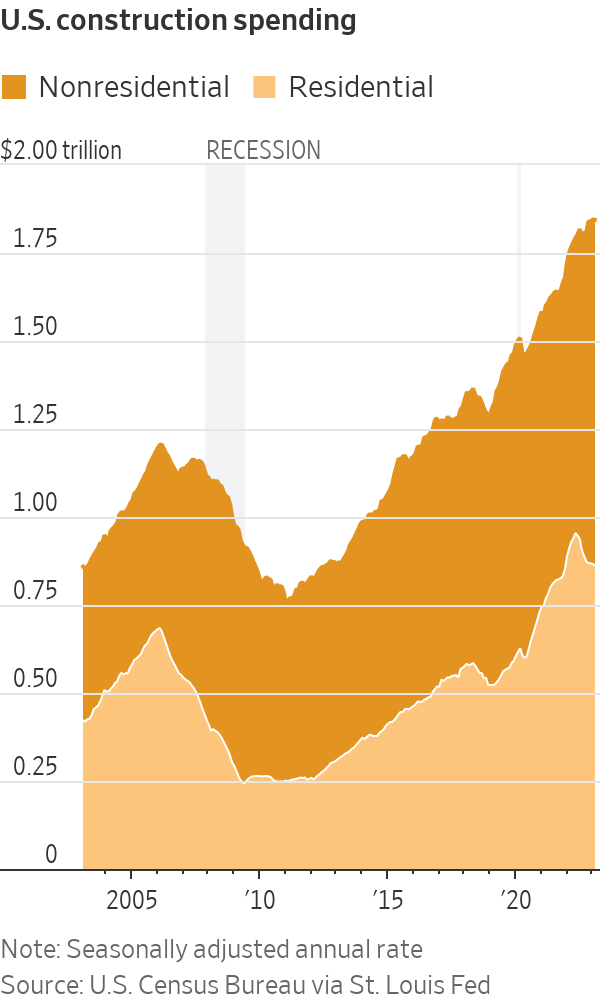
Construction spending and employment have risen to new records this year, boosted by government outlays for infrastructure, a domestic manufacturing renaissance and a wave of apartment building that got off to a slow start during the pandemic when prices for building materials, such as lumber, were sky high.
Construction companies with jobs ranging from airport overhauls to bathroom renovations say they have enough work booked to maintain payrolls—for years in some cases. Even home builders, who slowed down last year when rates began to rise, are ramping up into spring.
The persistent strength in a sector that is usually among the first to suffer job loss when borrowing costs rise is undermining investor hopes that the Fed’s aggressive interest-rate increases would quickly slow inflation and rejuvenate the stock market.
It also threatens to upend bets in the market that recession and lower rates are on the horizon. Investors are trading government bonds as if rate cuts will come within the next year and buying technology stocks, bitcoin and other speculative assets that surged when borrowing costs were near zero.
The issue for investors is that the longer it takes for construction activity and employment to decline, the longer it will be before the central bank can cut rates.
“Through this whole cycle, many have expected a much faster slowdown than has occurred,” said Bob Elliott, co-founder and chief executive of asset manager Unlimited. “Macroeconomic cycles take years to play out.”
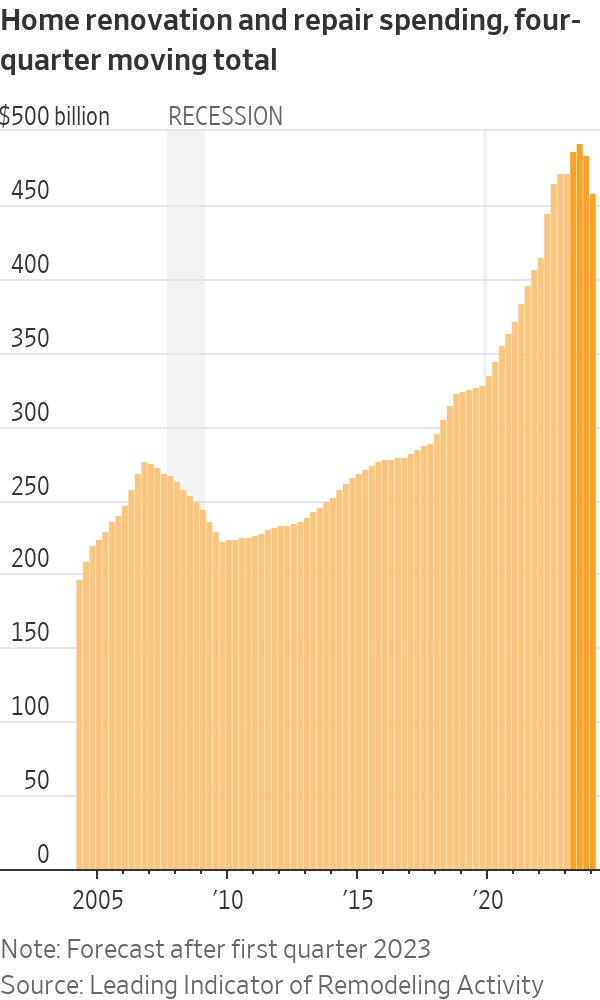
There are signs of slowdown, to be sure. Apartment construction is expected to decline once the latest batch of buildings is finished. Problems at regional banks are drying up financing for some projects. Spending on home improvement and repairs is forecast to decline over the next year, the first contraction since the depths of the foreclosure crisis in 2010, according to a closely watched barometer of the remodelling industry.
“Maybe we’re starting to see the effects of higher cost of capital on interest-rate-sensitive sectors,” said Anirban Basu, chief economist at trade group Associated Builders and Contractors, which said its measure of construction backlog declined in March to the lowest level since August. “The Federal Reserve raises rates until something breaks and something is starting to break.”
Even when construction employment declines, the effects might not be felt immediately in the broader economy. During the relatively fast-crashing 2008 financial crisis, the number of people working in residential construction peaked in April 2006 and had fallen roughly 15% before overall employment began to drop about two years later, Bureau of Labor Statistics data show.
The 2008 crash kicked off a deep recession and a years long home-building slump that left the U.S. severely short of housing.
Meanwhile, millions of homeowners are locked into historically low mortgage rates, which is keeping existing homes off the market and stoking demand for new construction, builders and analysts say. New-home sales climbed 9.6% in March, the Census Bureau said.
PulteGroup Inc., the country’s third-largest home builder, Tuesday reported record first-quarter revenue after selling 6% more houses at a 9% higher average price than a year earlier. Executives said they are adding sales and construction staff and building more spec homes, especially those aimed at first-time buyers.
“They don’t have a home to sell. And so they are not hampered by the low interest rate,” said Chief Executive Ryan Marshall. Pulte’s shares are up 47% this year and among the leaders of the S&P 500 stock index, which has gained 8.6%.
Employment in residential construction has been buoyed by the biggest burst in apartment building since the mid-1980s. Apartment projects were delayed after the Covid lockdown because of the budget-straining expense of building materials, such as lumber, which shot to more than twice the pre pandemic high and added millions of dollars to construction costs.
“People couldn’t build their projects, so they kicked the can down the road,” said Ivan Kaufman, chairman and CEO of Arbor Realty Trust Inc., which lends to landlords.
Though prices for lumber and other materials have come down, developers now face construction financing that is about twice as expensive as it had been and landlords are unlikely to be able to offset greater borrowing costs with rent increases, which should hinder new projects, said Mr. Kaufman.
So far, the roughly $50 billion decline in residential construction spending over the past year has been more than made up for by gains in commercial projects, including highways, hotels and hospitals. A record $108 billion was spent building factories last year, and the amount has risen this year, to a seasonally adjusted annualised rate of about $141 billion in February, according to Census Bureau data.
Some, such as those in fields that the Biden administration has made national priorities, such as semiconductors and electric vehicles, are supported by government incentives. Others are being built by big companies that can fund projects without borrowing.
Graphic Packaging Holding Co. is building a plant in Waco, Texas, to recycle old cardboard into new paperboard and said it would cover the $1 billion cost with cash over three years of construction. A similar facility that Graphic completed last year in Kalamazoo, Mich., required as many as 1,200 workers from 38 states.
The 2021 infrastructure bill and last years’ climate, tax and healthcare law are pumping money into industrial projects—such as renewable-energy facilities and railroad expansions—that promise to keep workers busy for years.
John Fish, CEO of the Suffolk construction firm, said the Boston-based company is focusing more on government-supported construction, such as airport upgrades. Suffolk employs roughly 2,500 and contracts with another 25,000 or so. It has three or four years of work lined up, including the renovation of Terminal C at Dallas Fort Worth International Airport, which won’t start until next year and isn’t scheduled for completion until 2026.
Home remodeller Jay Cipriani said his staff of 34 has plenty of kitchens and bathrooms to work through this year. But he said he’s getting fewer calls for new jobs and expects a slowing economy could make some prospective clients think twice about nonessential projects: “Maybe we don’t put in that fish pond this year.”
As the saying goes, they don’t make them like this anymore.
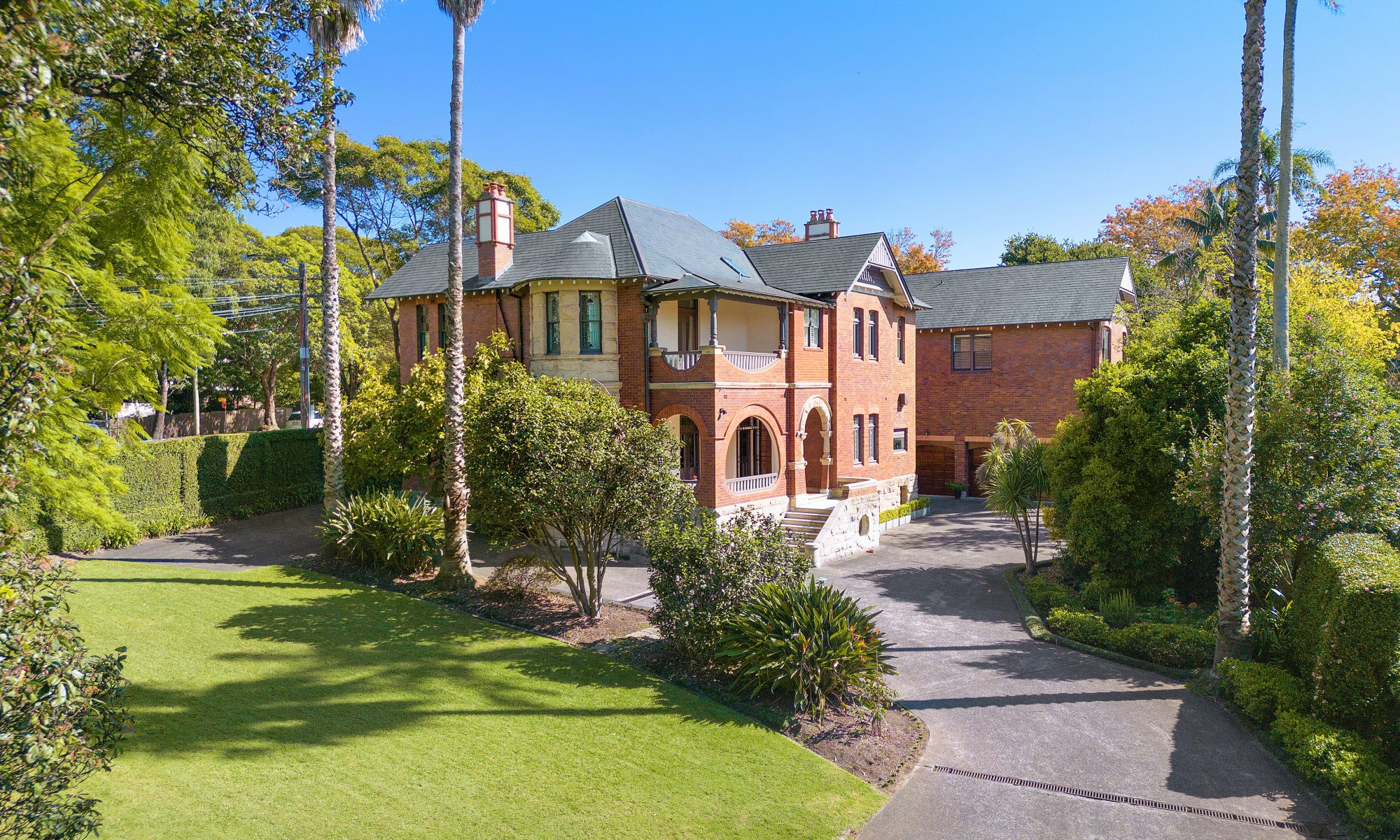
But while this Federation-era home on Sydney’s north shore is a step back in time, it has everything a family could wish for in a contemporary home.
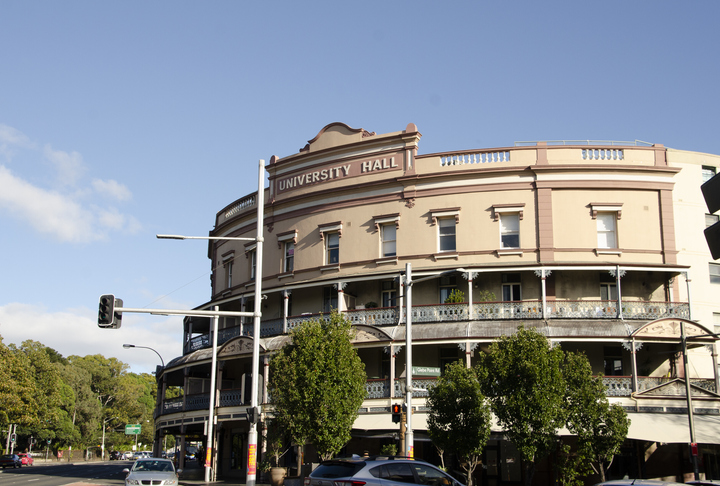
Located at 39 Marian Street, Killara, ‘Goorawin’ is a two-storey, eight-bedroom, six-bathroom home designed by early 20th century firm, Robertson and Marks, who were responsible for some of Sydney’s best known homes.
Beautifully crafted from brick and slate, with exterior architectural detail in sandstone, the house is just as stunning inside, with a grand cedar staircase, patterned ceilings and Art Nouveau leadlight windows.
Among the multiple formal and informal living areas placed around the house, there’s a dedicated ‘coffee room’ as well as a private home office. Bedrooms are across both floors, providing flexibility for guests, adult children or in-laws.
Key areas of the home have been updated, including the Calacutta marble kitchen and bathrooms.
Positioned on 2,036sqm of landscaped gardens, the house enjoys a northerly aspect, allowing abundant natural light into the interiors.
DINING ROOM décor gone awry can kill appetites. Whether your guests are flinching from an eerie portrait their chairs face or squeezing into too-tight seats, bad decorating can take the joy out of even the most well-concocted meal.
Los Angeles-based designer David Netto believes dinner guests are rarely eager to enter these stuffy rooms. “So what a dining room must have, above all, is atmosphere,” he said. Here, interiors pros detail five mood crushers in dining rooms, and palate-pleasing alternatives.
1. Blinding Lights
Ample light helps diners distinguish between mashed yams and potatoes, but cruelly aggressive bulbs inspire squinting, not conviviality. “Nothing will kill the vibe of a dinner party faster than harsh overhead lighting,” said Marina Medina, a Vancouver-based interior designer. No one feels good under 5000K LED bulbs, says Susane Jory, a designer in London, Ontario, “and few of us look good bathed in it.”
Instead: Kelly Finley, a designer at Joy Street Design in Oakland, Calif., relies on “recessed lighting on a dimmer, a chandelier with soft lightbulbs and wall sconces” for a softer shine. Mark Eckstrom votes for the old-timey romance of candlelight. Said the co-founder of Studio Eckström, in Omaha, Neb., “Every guest at your table should have faces aglow.”
2. Tasteless Walls
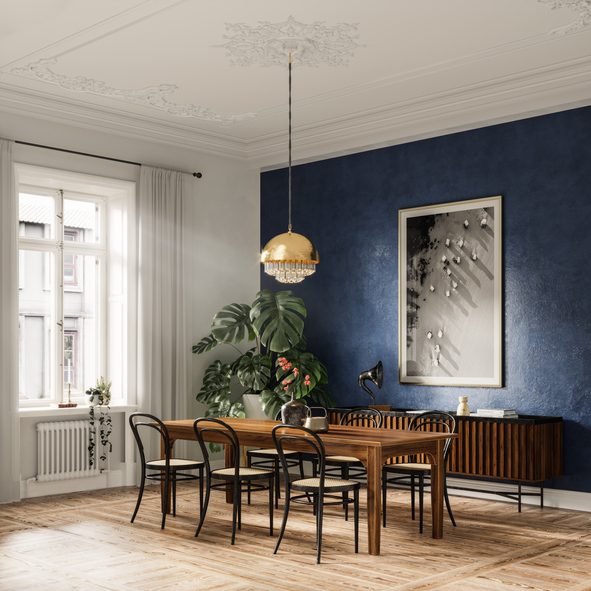
Think of a dining room’s walls as a platter on which dinner is served. Sterile white dishes with a hospital vibe often don’t flatter food. Nor do chaotically patterned ones. Similarly, when it comes to walls, some color can help, but Mr. Eckstrom returns to the effect décor has on complexions: “Sorry, but nobody looks good in a yellow or chartreuse room.” And Brian del Toro, a New York City interior designer, warns against surfaces with “overly active patterns, colours which are too bright or distracting, and combinations of the two, which aren’t soothing.”
Instead: Save the pattern-on-pattern alchemy for the powder room, and pursue colors like terracotta, rose and aubergine that Mr. Eckstrom says “stimulate appetite and reflect well on guests’ skin.” But know that naked walls don’t make people feel comfortable and sociable either. “Every seat should have a view—a window, art, sculpture, wallpaper, mirror, flowers,” he said.
3. Prissiness
You won’t feel inspired to plop down at your dining table for a casual brunch if it’s surrounded by austere crystal chandeliers and dusty mahogany sideboards. Mr. del Toro finds that most dining rooms skew too formal, dark and “limited,” appealing only for an evening dinner.
Instead: “Most of us lead relatively informal lives,” said Mr. del Toro, who likes dining rooms casual enough for sipping a smoothie or morning latte. Chris Goddard, an interior designer in Springdale, Ark., said he’s partial to installing weathered wood tables that, while inherently chillaxed, can be “dressed to the nines for a festive dinner.”
4. Sound-Bouncing Surfaces
When you ponder your dining room’s décor, remember that happy repasts aren’t silent. Poor acoustics can turn animated chatting into cacophony, said Olle Lundberg, a San Francisco designer. “Hard surfaces like stone flooring, plaster walls and large windows all bounce the sound back into the space, creating reverberation,” warned Mr. Lundberg.
Instead: For a more discussion-friendly space, Mr. Eckstrom prescribes a blend of softer materials like drapery, carpet, tapestries or a tablecloth “that help absorb echoes and promote conversation.” Mr. Lundberg goes further, endorsing the idea of covering walls with fabric or draping it from the ceiling. Many textiles come in “large formats and can often be installed seamlessly,” he said.
5. Failures of Scale
In a dining room, ill-fitting furniture is more than an eyesore—it can result in stubbed toes and dry-cleaning bills. “If you’ve placed a giant table in a small room,” said Ms. Jory, “your guests will invariably be wearing the soup as you squeeze behind them with the gazpacho.”
Even the size of a carpet can throw a wrench in the roast. “Rugs that are too small pinch the overall vignette,” said Jessica Lynn Williams, founder of Hendley & Co, in Newburgh, N.Y., who adds you should never force your guests to scooch their chairs awkwardly over the edge of a too-tiny rug.
Instead: An occupied chair should ideally have 3 feet of space behind it for proper circulation and flow, said Meg Lavalette, founder of Lava Interiors in New York City. And carpets should accommodate sliding chairs—without giving them any lip. Laura W. Jenkins, an interior designer in Atlanta, says that when it comes to light fixtures and rugs, she prefers to err on the side of a little too big.
DIGESTION IMPOSSIBLE
Designers recall meal-spoiling decorating gaffes
“Once I saw a light fixture that hung so low and so close to the edges of the table that even the older kids in that family complained about bonking their heads against it!” —Noz Nozawa, interior designer, San Francisco
“I tried to convince [a client that] even though red was his favourite colour, it wasn’t a great choice for a dining space and that we could bring it in through other avenues—décor, rugs, wallpaper. We ended up not taking him on because he couldn’t get past the red for the dining room, but it was so bad.” —Shaolin Low, interior designer, Honolulu
“I was once seated in a dining room with a table that was too small. The chairs were covered in Fortuny, but not even the chicest choice of fabric could keep my knees from bumping against the person who was sitting next to me.” —Michelle Nussbaumer, interior designer, Dallas
Come to my meeting. Plan my bachelorette party. Help with this project that’s totally not in your job description.
Please?
We’ve all been there, trying to persuade people to do things they don’t have to do, and probably don’t want to either. Or, we’re staring down a painful request ourselves.
“Inside, you’re questioning, like, how did I get here?” says Matt Brattin, a software company executive based in Fresno, Calif.
Over the years, he has been talked into everything from taking notes at meetings that had nothing to do with his job to donning a giant gnome costume at an employee event in the Texas summer heat. (He was working for Travelocity—whose mascot was a gnome—at the time.)
“Is this a thing I even have an option to say no to?” he wondered.
Definitely. It’s time to learn the delicate art of ‘voluntelling’: persuading people to help, or, if you’re the one always being voluntold, getting out of it.
The power of silence
Scoring the answer you want starts with asking the right questions, says Jonah Berger, an associate professor of marketing at the University of Pennsylvania’s Wharton School.
You want to pose queries that guide the person down a path that inevitably ends at the destination of your choosing. Aren’t you excited about so-and-so’s new baby? (Yes!) Shouldn’t we have a shower for her? (Of course!) Can you help me plan it?
Make sure to pause frequently as you encourage the person toward your conclusion, says Prof. Berger, the author of a book about the magic words we can use to persuade others. A moment of silence is a cue for the other person to shake their head yes or mutter “uh huh.”
“They are implicitly starting to agree with what you’re saying,” he says. “You’ve given them that space.”
Best to also give the person choices. Would he rather be in charge of finding a venue, or coordinating the food? We all want to feel like we have autonomy, Prof. Berger says. Confronted with specific options, we’re more likely to focus on the possibilities we’ve been given, not declining altogether.
Skip the apologies
Don’t be tentative or apologetic with your request, says Bob Bordone, who coaches executives on negotiation. Saying sorry gives the person an easy window to say no.
“I’d be super grateful if you could help us out with this,” Mr. Bordone recommends saying.
Tap in to the other person’s perspective to make the offer one that they want to say yes to. What’s important to them? What do they care about?
When Wassia Kamon, a finance professional in the Atlanta area, noticed the supply-chain team at a former job was putting wrong data into her accounting system, she knew confronting the team’s leader with accusations and demands wouldn’t get her anywhere. The group didn’t report to her, and the executive had years more experience than she did.
Instead, she explained she wanted the departments to work better together, and help the company run more smoothly. After the pair held a group meeting with both departments, the supply-chain workers stopped making mistakes, and Ms. Kamon’s relationship with the executive got more cordial, not less.
“How can we form little alliances?” she asks herself.
Add some peer pressure
You can build additional momentum by winning support from people who are close to the person you’re ultimately trying to convince, says Allison Shapira, the chief executive of Global Public Speaking, a firm that trains managers to communicate persuasively. Think about who the person you need the yes from trusts. Get them on board first.
“Now all she’s doing is joining her colleagues in this, as opposed to standing out,” Ms. Shapira says.
Giving a specific deadline can also help, making the request feel less nebulous and open-ended.
If you suspect the person is going to be resistant, you can briefly acknowledge the road blocks or pressures she’s facing. You know she has another project on her plate, or that staffing is tight. Then quickly pivot back to potential solutions. Ms. Shapira recommends asking questions like, “What would make it easier for your team to attend this meeting?”
Say no with conviction
Sometimes, we’re on the other side, our hand raised for us.
Even when we feel we’ve already been roped into something, we still have the power to decline, says Vanessa Patrick, a marketing professor at University of Houston and author of a coming book about the science of saying no.
Avoid making excuses, she advises. At some point in the future, the excuse won’t be applicable. Instead, tie your no to your identity, using the word “don’t.” I don’t lend money to family members. I don’t volunteer in my kid’s classroom during the workday.
Research from Prof. Patrick and a colleague finds that using “don’t” instead of “can’t” increases the chances the person will respect your no, and adds to your resolve.
Worried about sounding harsh? Buffer the direct language with nonverbal cues, such as smiling, leaning forward, using your body language to communicate warmth, she says.
If you’re still tempted to go along with the demand, buy yourself some time by saying it’s your policy to take 24 hours to consider requests. Remind yourself of the opportunity cost. What will you miss out on if you begrudgingly agree to do this?
After all, convincing others to say yes is a valuable skill. But so is saying no when the moment calls for it.
Bjorn Farrugia admits he had nothing but drive when he left Australian shores in the early 2000s to pursue his dream to be the next Roger Federer. Named for Swedish tennis star Bjorn Borg, at the age of 21, Farrugia had never been on a plane before making his way to the US state of Georgia on a scholarship. When his tennis career stalled, he pivoted, seeking his fortune in New York and eventually finding his place in the luxury real estate market of Los Angeles. How he managed to climb one of the most competitive markets in the world is a story of determination and hard work for the Melbourne boy made good.
He spoke with Kanebridge News not long after the passing in March of his friend and business associate, Melbourne property developer Jonathan Hallinan. Here he reflects on what it takes to be successful in business without compromising your integrity, and the joy of being able to buy your mum a house.
How long since you’ve been in Australia?
Despite having lived in the US for two decades, I make an effort to return to Australia at least once a year. During my most recent trip in December 2022, I had the chance to visit one of my closest friends who was battling an illness. Although he has since passed away, I cherish the memories of the time we spent together. In addition to spending time with my friend, I also took the opportunity to explore Melbourne once again. It truly is one of the greatest cities in the world.
So you’re used to American coffee? That must be tough for a Melbourne boy.
Although I love coffee, I happen to be one of those people who are “naturally caffeinated.” As a result, I’ve learned to enjoy green or chamomile tea instead. I do compensate for this by maintaining an incredibly extensive collection of my favourite Australian chocolates in my home. A section of my kitchen has practically transformed into an Australian lolly shop.
How did you come to terms with not being a top tennis player?
At first, it was really difficult for me to accept that I wasn’t going to make it as a professional tennis player. I had invested a lot of time and effort into the sport, and I was disappointed that I wasn’t able to achieve the level of success that I had hoped for.
For a while, I was really down about it. I didn’t want to play tennis anymore, even though it was something that I loved to do. In time, I realised I could channel my competitive energy into something else that I was passionate about: my career in real estate.
I threw myself into my work, I found that I was still able to satisfy that same desire to compete, even though it wasn’t on the court. Over time, I started playing tennis again, just for fun. It wasn’t about being the best anymore – it was just about enjoying the game and spending time with friends. Tennis has been one of the greatest joys and has taught me so many life lessons that I am forever grateful for.
You’ve said that Roger Federer is your favourite player. What was it about his game that appealed to you?
I have always been drawn to Roger Federer’s game. There is something about the way he moves on the court that is simply mesmerising. His style of play is elegant and graceful, and his precision is unmatched. Watching him play is like watching a work of art in motion.
What really sets him apart, in my opinion, is his demeanour on and off the court. He is the epitome of sportsmanship and grace under pressure. He never loses his cool, even in the most intense moments of a match. And he always shows respect and kindness to his opponents, win or lose.
As someone who strives to be a good sport and a kind person, Roger has always been an inspiration to me. I admire his dedication to his craft, his humility, and his unwavering commitment to being the best he can be. He truly embodies what it means to be a champion, both on and off the court and that is something that I have learned to carry on in my life and in my career.
How did you get from being a promising tennis star who had to reassess life to a real estate king?
My journey from tennis to real estate wasn’t an easy one. When I was younger, I was on the trajectory to becoming a promising tennis star with dreams of becoming a professional player. Unfortunately, those dreams didn’t pan out. It was a difficult time in my life, and I had to reassess my goals and figure out what I wanted to do next.
In time, I discovered my passion for real estate. I found that I loved the challenge of negotiating deals, building relationships with clients, and finding creative solutions to problems. I started out small, but with hard work and dedication, I eventually built my real estate career and while I am definitely not a real estate king yet, I feel I am getting closer and closer to my ultimate goal every day.
Of course, there were challenges along the way. Real Estate is a tough industry, and it takes a lot of grit and determination to succeed. I never gave up, even when things got tough. I kept pushing forward, always looking for new opportunities and ways to grow my business.
Now I feel proud of what I’ve accomplished. I may not have become a tennis star, but I found my true calling in real estate. And I know that with my drive and determination, I can continue to achieve great things in the years to come.
What are those attributes?
In my opinion, to excel in working with people, I think it’s essential to possess the skill of connecting with them, managing diverse personalities, and upholding integrity and amiability. Many people have complimented me on these skills, and I find it easy to strike up a conversation and establish a connection with someone, which is a common trait among Aussies.
In any business venture, there are a few key things that you must excel at to be successful. Firstly, you need an unquenchable thirst for success and be relentless in your pursuit. Secondly, you must believe that you deserve to succeed and not let “no” deter you from reaching your goals. To achieve this, you must live, breathe, eat, and dream about your objectives. You need to be passionate and committed, and you must work hard every day to make your dreams a reality.
Sometimes, you may face rejection, but it’s crucial to remain undaunted and pick yourself up, even when someone tells you “no”. With a combination of hard work, perseverance, and a refusal to give up, you can achieve great success in any field you choose.
Former Melbourne local Bjorn Farrugia left Australia to pursue a tennis career but has since found his mojo selling luxury real estate in Los Angeles.
Has it been particularly difficult breaking through in LA?
After school, I decided to pursue a professional tennis career, but eventually transitioned to finance when I moved to New York City. Although it wasn’t a financially lucrative experience, it helped shape who I am today. I took a big leap of faith when I left my family in Australia and moved to the other side of the world, where I knew nobody and had never even been on a plane before. At the time, I was inexperienced and naive, but determined to succeed.
Living in New York City taught me that when you come from nothing and have nothing, you have to be proactive and work tirelessly to achieve your goals. Moving to Los Angeles presented a new set of challenges, but I knew that I had to work just as hard to succeed.
Throughout my journey, I have always maintained a big vision for my future. I am a very competitive person, but I only compete with myself. I don’t get caught up in what others are doing. My mentality is simple: always try your best and give it your all.
I have been fortunate enough to have an incredible support system around me. My fiancé has played a huge role in helping me build my business from the ground up. I also have a dedicated team and loyal clients, and a group of great friends who have always had my back – many of whom are from Australia.
One of your ambitions was to buy a house for your mum. How was that moment?
Since I was just a little boy, I always dreamed of buying my mum a house. I was able to make one of my dreams come true— I even went a step further and purchased the neighbouring home to give her two homes next to each other. The act of buying the home for my mum was amazing, but giving it to her was even more rewarding for me. Reflecting on where I came from, it was truly special to fly back home to help my mum move in. I didn’t even see the house before I bought it, but I knew it was in the perfect neighbourhood as it’s where I grew up. Handing over the keys to my mum and watching her move in was such a profound moment. It felt like I was the one receiving a gift instead of her. Coming from the background that I did, I am extremely proud and grateful for being able to make this happen for her and my family.
You’re in one of the most competitive real estate markets in the world. What still gets you out of bed in the morning?
For me, it’s about legacy and family. I wake up every morning driven by the desire to succeed and be the best version of myself. When I first started in this competitive real estate market, my goal was to accumulate vast wealth. I have a burning desire to win and always strive to come out on top. Losing is not an option for me, and I always have high expectations for myself. Sometimes those expectations may seem absurdly unrealistic, but that’s what sets me apart from the rest. I refuse to settle for mediocrity or conform to the norm. However, my best mate, Jonathan Hallinan, taught me that there’s more to life than just money. My ultimate goal is to live a fulfilling and happy life. Don’t get me wrong, I’m still incredibly hungry for success but spending time with my family and enjoying the special moments is way more important to me.
Are you looking at returning to Melbourne anytime soon?
I recently lost my best mate in Melbourne, so it may be a while before I return there. However, I have always imagined owning a holiday house somewhere like Sorrento or Rosebud. While I am starting to establish myself in America, I still hold a deep affection for Australia because it has shaped me into the person I am today.
What would you say to someone who is looking to enter real estate now, who has that kind of drive to succeed?
As someone who has experienced success in real estate, my advice to someone who is looking to enter the industry now and has the drive to succeed is to first work on a team. It’s important to work with people who are doing deals and producing results, so you can see firsthand what a successful agency looks like and get exposed to deal flows.
Next, find someone you trust and want to emulate, someone who has a good moral compass, and work with them. Read a lot of books on how to start in real estate. There’s one book in particular I highly recommend called The Millionaire Real Estate Agent by Gary Keller, Dave Jenks, and Jay Papasan. Gary Keller is the founder of Keller Williams Realty, and the principles he outlines in that book can be applied to any business.
When I first started in real estate, I called every major real estate agent and asked them to have coffee with me. I told them I wanted to learn from them and asked them how they became successful. I called one guy 17 times, but eventually, I met all of them except for three. By taking one thing from each person and incorporating it into my own approach, I was able to develop an incredible set of tools to help me succeed.
It’s important to remember that success in real estate takes time and effort, but if you stay focused, work hard, and learn from those who have come before you, there’s no limit to what you can achieve. Even though people might tell me I’m at the top, I believe I’m just getting warmed up and have so much more to learn and accomplish in this industry.
What’s important to you now?
Right now, the most important thing to me is my family and spending time with my fiancé and my three-year-old son. While money is certainly important, I value the freedom it can provide more than the material possessions it can buy.
Recently, I was up working at 6am and learned that Roger Federer was retiring; four days later, I was in London to witness his last match (in September 2022). I just had to be there to see this special moment. I was lucky that my hard work gave me the freedom and opportunity to see Roger play in his last tournament. At the same time, I recognise that having the freedom to take my son to the park on a Tuesday afternoon is just as important. I enjoy being able to balance my career aspirations and my family – and of course have the time to work on my tennis swing.
TOPSHOT – Switzerland’s Roger Federer brings the curtain down on his spectacular career in a “super special” match alongside long-time rival Rafael Nadal at the Laver Cup in London in September 2022. (Photo by GLYN KIRK/AFP via Getty Images)
What’s your message for people who want to achieve what you have?
My message to those who aspire to achieve what I have is to never give up on your dreams, no matter how difficult the journey may seem. It takes a lot of hard work, dedication, and perseverance to make your dreams a reality. Don’t be afraid to take risks and step out of your comfort zone. Surround yourself with supportive people who believe in you and your goals. And most importantly, always remember why you started and let that drive you forward. With enough passion, determination, and a willingness to learn and grow, you can achieve anything you set your mind to.
“Cities are really just a series of villages sewn together,” says Kit Kemp, founder and creative director of Firmdale Hotels, an assortment of boutique luxury properties in London and New York, with an addition—Warren Street Hotel—opening in Tribeca in 2023. “We like to think of our hotels as part of that village feel.”
Kemp, along with her husband, Tim, also owns eight restaurants within the properties, and the Caribbean hideaway, Rossferry, on the prestigious Sandy Lane estate in St. James, Barbados. Each Firmdale hotel has a deep connection to its locale, with Kemp aiming to avoid the culture of sameness, she says. “In large hotels, you know what to expect, but if you know too much about what to expect, you don’t feel what it’s like to arrive.”
Kemp’s upbringing near Southampton, England—perusing street markets every Saturday—largely impacted her design sense and style. “Being a port, there were so many different nationalities,” she says of her hometown. “I used to find it exciting to see that vitality and street life.”
That liveliness carries into her design work. Her bold use of colour and pattern, impeccable attention to detail, and whimsy, readily seen in her vignettes and table settings, are signatures. “I have always been scared of beige,” she muses.
The designer has a keen eye for placing art; her properties feature impressive and sometimes avant-garde collections. Combing the galleries she visits on her travels, Kemp sometimes frames unusual objects, making art out of the unexpected. But textiles are perhaps her greatest influence. “Every textile tells the story of where it comes from, whether Guatemala, India, Mexico, or the Baltic countries,” she says. “That gets my creative juices going.”
Penta recently chatted with Kemp, who shared her favourite things.
The person who inspired me to do what I do is… Leszek Nowicki, a Polish architect I worked for. He had a very organic way of working and an unusual eye for design inside and out. He also loved vodka.
The one thing I can’t live without in my home is… Jugs of flowers and hopefully a garden I can pick them in. I find it very restful and fulfilling to collect flowers and put them into an assortment of jugs bought in junk shops.
If I were to buy a piece of art it would be… by Joe Tilson, who has an upcoming exhibit at Cristea Roberts Gallery in London. He was originally a pop artist in the 1960s and broke every rule in the book. He was also a great craftsman and carpenter, so he combined art and carpentry in his work. He loved mythology and was interested in harmony with the earth and sustainability way before anybody else.
What I love about London is… walking to my design office from my home every day down Exhibition Road, through Imperial College and past the Victoria and Albert Museum, the Science Museum, and Natural History Museum, seeing all the people about to visit the exhibitions. Every age group on a day out in London every season of the year, emerging from the Tube station or off a red bus. Every day is a holiday.
The restaurant in my hometown I love to take a visitor to is… Brumus Restaurant in the Haymarket Hotel in London. It is named after our dog Brumus. Also, the restaurants in the Royal Opera House in Covent Garden. We love to go to the ballet and eat in the intervals and take friends there.
A passion of mine few people know about is… I have taken piano lessons for the last 15 years and am still having trouble with “The Woodchopper’s Song.” No talent, but my granddaughter of 14 months is a great help and joins in when I play.
My favourite hotel in the world is… Il Convento in Puglia because you walk through the kitchen to get to the dining room, and there are sacks of apricots drying, Kilner jars of delicious things, and the best bread in the world. Athena McAlpine, the owner, sits in a deckchair in her bathing costume and a man-sized shirt overseeing the proceedings in the most elegant way. At night, there are a million candles. It is romantic.
If I could travel anywhere right now, it would be to… Bujera Fort in Udaipur, India, because Richard Hanlon, a friend, built it himself. It’s a cross between a fort and a palace. It is a masterpiece.
If I could have a meal anywhere with anyone, it would be… Salvador Dali. Maybe we could go up in a hot air balloon that had a huge mustache painted on the side with a pair of lips underneath. We would have lobster and land on Lord’s Cricket Ground to listen to the wonderful sound of the crack of the cricket ball on the willow cricket bat. All the players would be wearing old-fashioned caps and immaculate white baggy trousers and shirts with SD monogrammed on them.
This interview has been edited for length and clarity.
Lisa Donovan was juggling pings from multiple Slack channels and email windows when she inadvertently sent a sensitive company document to the wrong person.
The part-time accountant for a Virginia-based academic coaching firm toggles between 30 instant-messaging channels, four client-email accounts and at least a dozen phone or video calls a day, she says.
“It’s, like, ‘Are we on Zoom? Are we on Teams? Did I respond to that? Did I say it right?’” says Ms. Donovan, who works from Richmond, Texas.
There are so many ways to communicate at work that our communication is breaking down. Bosses say missed messages and crossed signals waste time and trigger mistakes, while research suggests that so much virtual communication makes it easier to snipe at or ignore co-workers. Then there’s the stress of having to stay on top of so many different channels all the time.
Microsoft Corp.’s Teams use has surged to more than 280 million monthly active users. Zoom Video Communications Inc.’s business customers have nearly tripled to more than 210,000 since the start of the pandemic, and Salesforce Inc.’s Slack is also growing. In many cases, the clients of each overlap and use the tools on top of emails, texts and in-house messaging forums.
All of it is enough to make workers long for the days of complaining about email-inbox overload.
“It’s overwhelming,” says Wendy Weinberger, Ms. Donovan’s boss and head of the firm. The company’s IT department was able to successfully recall the sensitive email.
In a 2022 Harris Poll survey of more than 1,200 workers and executives, bosses estimated that their teams lost an average 7.47 hours—nearly an entire day—to poor communications a week. Based on an average salary of $66,967, the lost time translates to a cost of $12,506 per employee a year, according to the report conducted on behalf of Grammarly, a proofreading software company.
A new study from executive-search firm Korn Ferry found that communication misfires have helped to make some work relationships less pleasant and collegial. Among 357 professionals surveyed in recent weeks, nearly half said that remote work made it easier for colleagues to get away with rude behaviour such as interrupting on calls and not returning emails.
Remote work has accentuated colleagues’ different communication habits, and their potential to clash, some employees say.
“These tools that are meant to make communication easier have a dark side,” says Michele Simon, a Los Angeles-based lawyer specialising in workplace trauma. A new Pepperdine University study on workplace toxicity that surveyed 800 office workers found that 35% cited communication problems as the top barrier to getting ahead in today’s workplace—ahead of office politics (29%), small budgets (26%) or ineffective plans (20%).
Michelle Sooknanan says that at her previous job as a sales manager for a Florida food manufacturer, her boss would often call her impromptu via video as she worked from her home office in Portsmouth, N.H.
She says she found the unscheduled calls to her desktop computer stressful and asked that, outside of scheduled calls with the team, she be contacted only by email or instant message. Her manager emailed a couple of days later that her request couldn’t be accommodated, and that video would sometimes be necessary.
Ms. Sooknanan says the tension contributed to her eventual departure. The company didn’t respond to requests for comment.
Multiple modes of communication get more complex as the number of people on a conversation thread grows, says Jessica Carlson, a former director of supply-chain operations at Nestlé SA who left the company in March. Wrestling with post-Covid supply-chain challenges often took place over multiple time zones and forums.
“You could have an email chain, a text thread, a videoconference call and an in-person one-on-one about the same topic all within 24 hours,” says Ms. Carlson, who has since founded consulting firm headStrat Solutions.
Many companies have largely left it to teams and co-workers to sort out how they communicate, which can add to the confusion. For workers feeling overwhelmed, making a clear choice ahead of time can help, says Sally Susman, chief corporate affairs officer at Pfizer Inc. and author of a recent book on improving workplace communications.
She suggests asking teammates or other colleagues what their communication preferences are, while also being unafraid to state your own.
In the absence of in-person social cues, she adds, the voice becomes more important. Use it to transmit collegiality and other positive qualities that would ordinarily be picked up in person. Even in email or text messages, small touches like “Hi there” can exude warmth in formats that ordinarily feel cold and transactional.
Some companies are trying to come up with new ways for workers to get messages across. Archer Daniels Midland Co. has corralled its modes of communication by linking instant messaging, email, video and social-media style updates into one central hub.
It’s “air-traffic control,” says Brett Lutz, vice president of global communications at Archer Daniels Midland. He says the forum, powered by workplace communications software company Firstup, lets workers see stories, images and other updates.
Shopify Inc., the e-commerce and retail technology company, recently instructed staff to shift to Meta Platforms Inc.’s Workplace, which combines instant messaging, videoconferencing and other communications tools.
“Email hasn’t evolved in the last 30 years. And it still sucks,” Shopify Chief Operating Officer Kaz Nejatian wrote in a January memo to staff.
To get there, though, employees would have to check their email for an invitation to join. “Didn’t get that email? Check Okta or ping #help-chaos,” he continued, referring to two more ways employees could inquire about an invite.
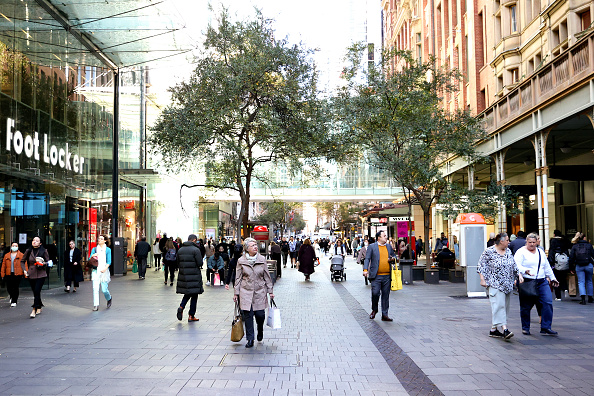
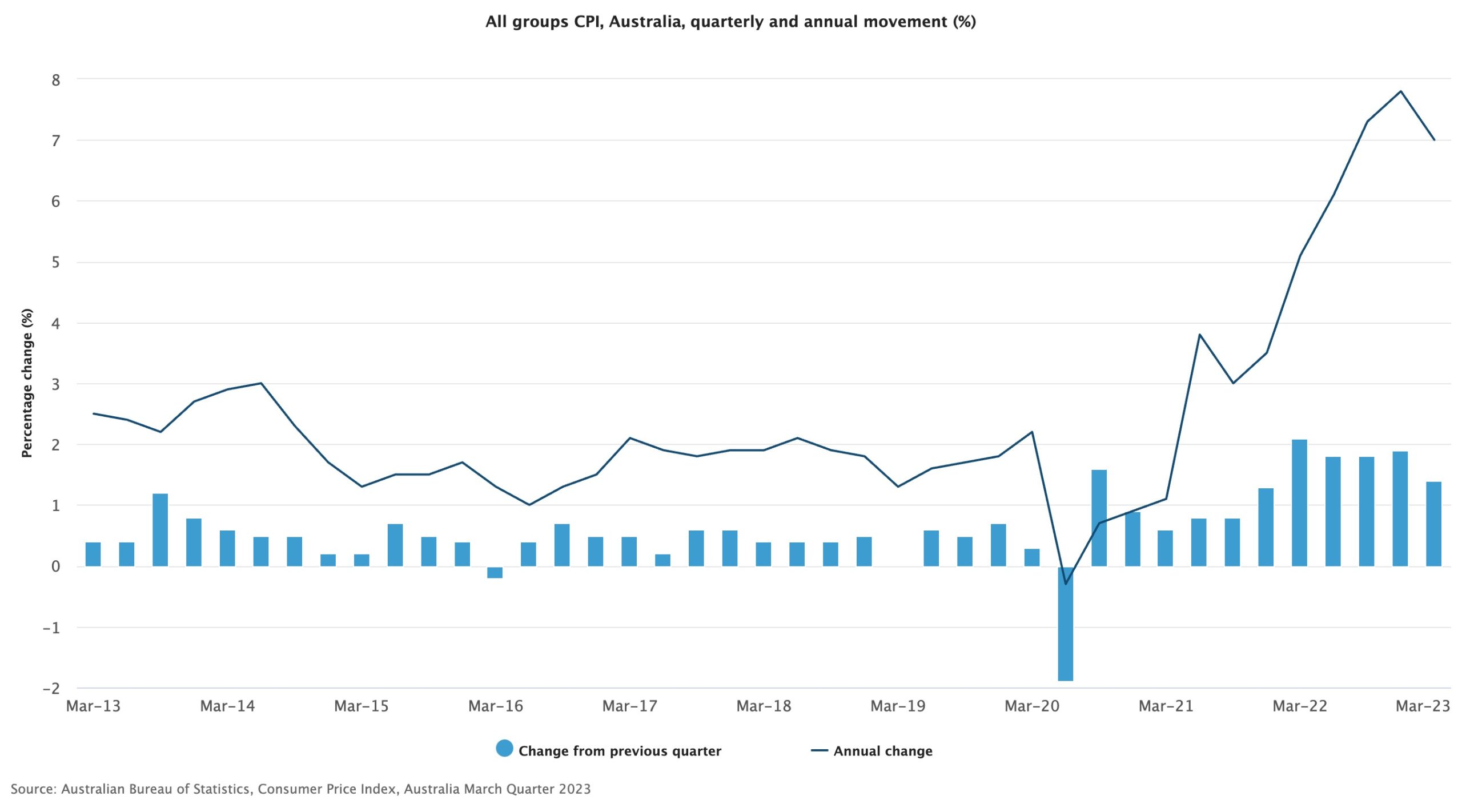
Inflation levels are now at 7 percent in Australia, data from the Australian Bureau of Statistics has shown, down from a 30-year high of 7.8 percent in the December quarter.
Rising education, energy and medical costs are leading the way, with gas and other household fuels accounting for a 14.7 percent increase.
Rising inflation in education is coming predominantly from the tertiary sector, which rose 9.7 percent. The ABS noted that this has been partially offset by moves at Federal and State Government levels to provide 180,000 fee-free places at TAFE in 2023.
In good news for potential homebuyers, new dwellings price growth has continued to ease. The ABS puts this down to a softening in demand for new construction and improvements in supply chains. The news was less positive for renters, with rental prices rising to their highest levels since 2010 as pressures on demand and low vacancy rates prevail.
The cost of goods, such as furniture, clothes and appliances has eased, largely thanks to discounting, following two years of steady increases, while annual inflation on services recorded its biggest rise since 2001, largely the result of holiday travel, medical services, rents and eating out.
The desire to drive down inflation to more comfortable levels of two or three percent has been the main driver behind the Reserve Bank of Australia’s consecutive interest rate hikes over the past year. Industry groups have been calling for a halt to further increases to allow for the economy to absorb existing rises and ease cost of living pressures for mortgage holders.
The backyard has never had more significance than it has in the past few years. Make the most of your outdoor spaces with modifications, renovations and extensions to create an outdoor room you can really embrace.
Easy Access
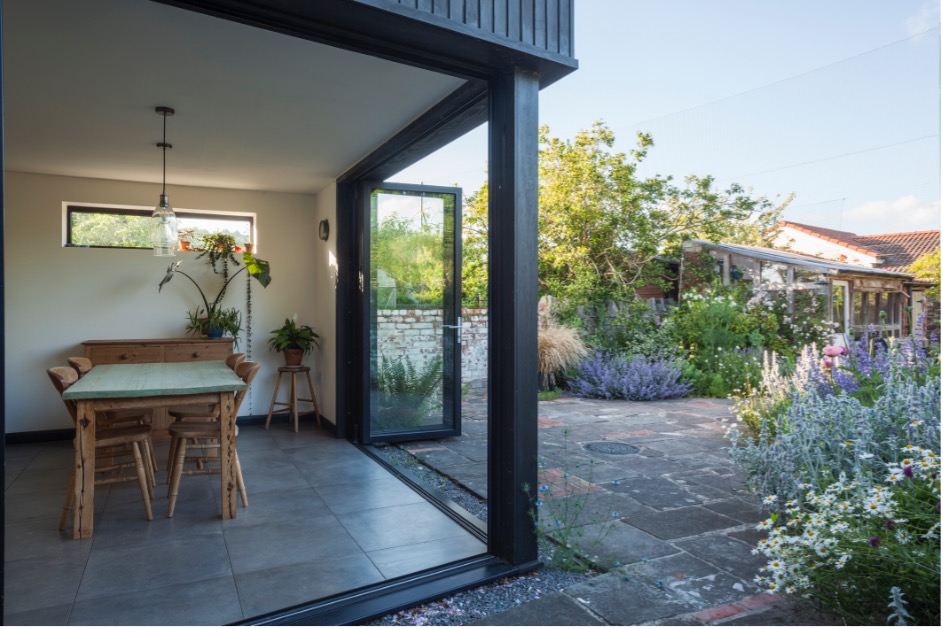
Nothing beats an easy exit – especially when it’s to an outdoor paradise. It’s all about connection – so glass is king. Steel doors are the thing offering strength and versatility in design – fabulous in edgy modern homes, as well as traditional country estates.
Throw some shade
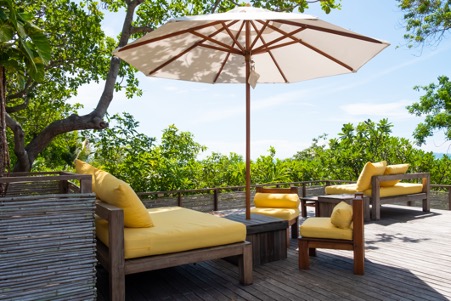
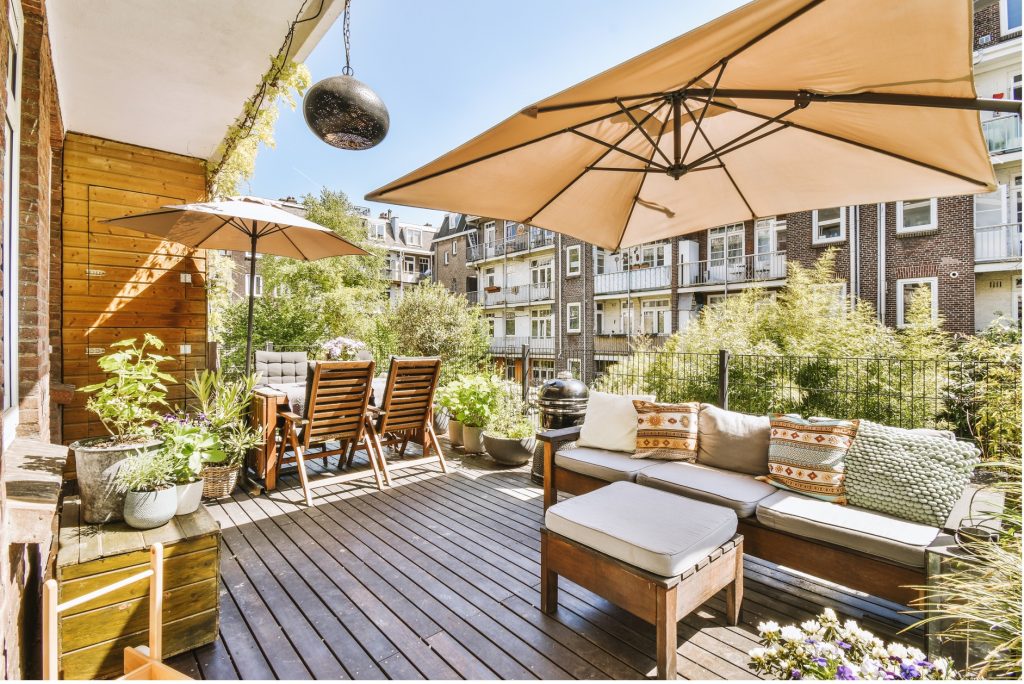
Enjoying the outdoors is easier if you aren’t being blinded by glare; and nothing is more flattering than the light under a shade. Generous, colourful market umbrellas, or vast cloth shades that can be extracted from a cassette on a wall, or remote controlled louvres.
Dive into a sunken courtyard
Phillips Garden
When a pool is no longer a drawcard, some clever designers have turned them into sunken lounges, it’s re adaptive use, with an intimate space for those memorable get togethers.
Fill it with a purpose
For families, it’s an absolute ball to spend time outside together, and a little coaxing with playground equipment makes the garden absolutely magnetic. Add a little, or a lot. It is an investment in beautiful memories, that last a lifetime.
Outside can be anywhere – not just the backyard
Reclaiming space down the side of a terrace house is absolutely brilliant. Top outside living spaces can be reclaimed from boring walls in narrow kitchens. Superb extensions of indoors, yet with all the chill value of being outdoors, achieved in such a small space.
The power of the labyrinth
Giving outdoor spaces a pathway and a purpose is an ideal design for outdoor peace. Meander a curving pathway, or be a geometry geek and create parterre garden. Either way, letting a path lead you, through a labyrinth of any size, makes your stress dissolve, and peace will follow each of your steps.
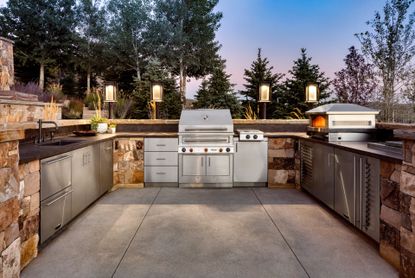
Now THAT’S a bar be que
Image credit: Kalamazoo Outdoor Gourmet
Eating outside? Everything tastes better in the outdoors, and manufacturers know it. Outside ‘kitchens’ offer a purpose to be outside, while anchoring your space. Go the whole hog with plumbing and TV, or simple, with deck chairs and an old-fashioned barbie. Soak it in, and eat it up.
Pool your resources
Designer: J. Brownlee Pool Builder: Watermark Pool & Spa
A swimming pool is hard work (unless you have the great fortune to be able to sub it out), but absolutely worth the fun and beauty it brings to the table. Night time around a garden pool is nothing short of perfection. And how about watching the steam rising off heated water? Ethereal.
Invite friends over – the ones with feathers.
The perfect outside space is often shared with wild friends – and if we build it, they will come. Birdbaths, birdhouses, ridiculously over the top feeders all add texture and adventure to an outdoor space, plus a never-ending soap opera to watch from dawn to dusk.
Hide in plain sight in an ideal outside space
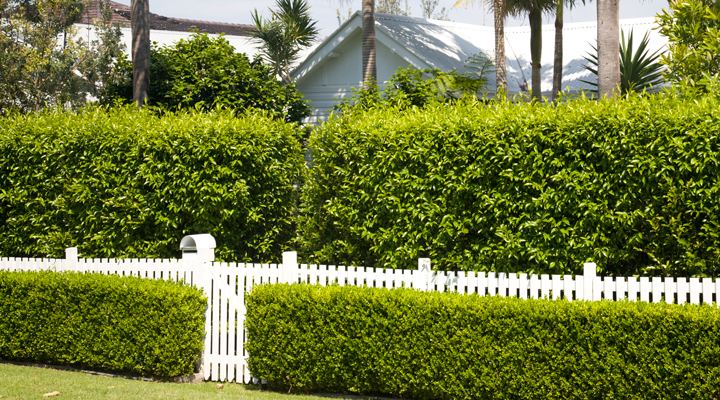
Landscape architects and designers have made playing hide and seek a profitable game. Getting rid of prying neighbour eyes is vital to that feeling of privacy. From green walls to exotic screens, even outdoors in high density can become a private oasis.
Moving water is a salve for the soul
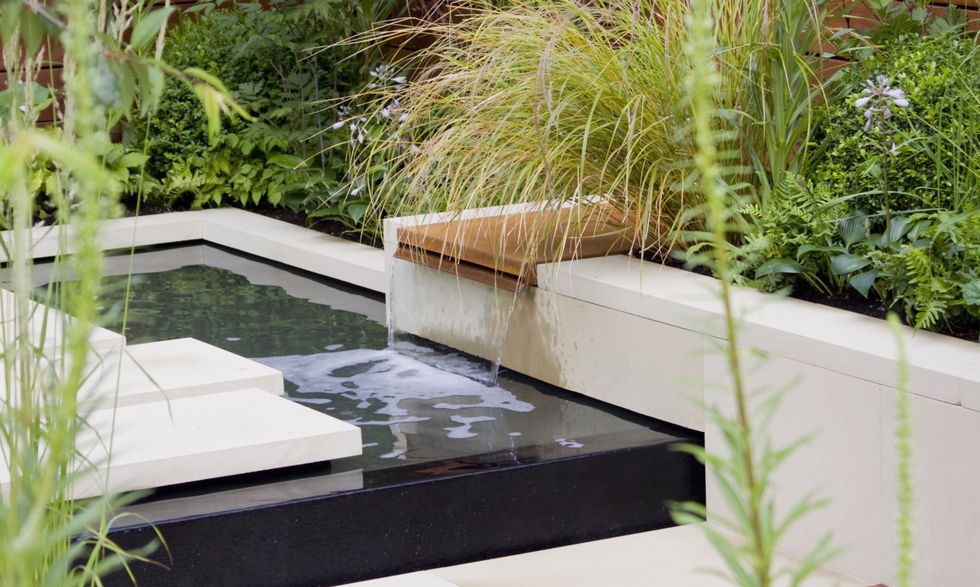
Even the sweetest, most petite water feature can transform an uninviting space into a well of well-being. Up the size and up the response. With or without fish, having water move around you while experiencing the outdoors is an absolutely primal delight.
Embrace the exuberance of being outside in the cold
You feel alive in the cold – for a little while. However, you feel completely alive in the cold outdoors entertaining space, when there’s a fire pit warming the cockles of your heart. A fire brings focus to a get together – comradeship thrives in the glow of a fire.
Furnish, or fit out – lounging is a top priority
Built-in benches are an instant draw card – throw a few scatter cushions about, pop the umbrella up and you have rustic escapism. But, but, if you can be bothered with stacking lounge pillows under cover, a full-on lounge suite is the ants’ pants in outside luxury.
Nightime is light time
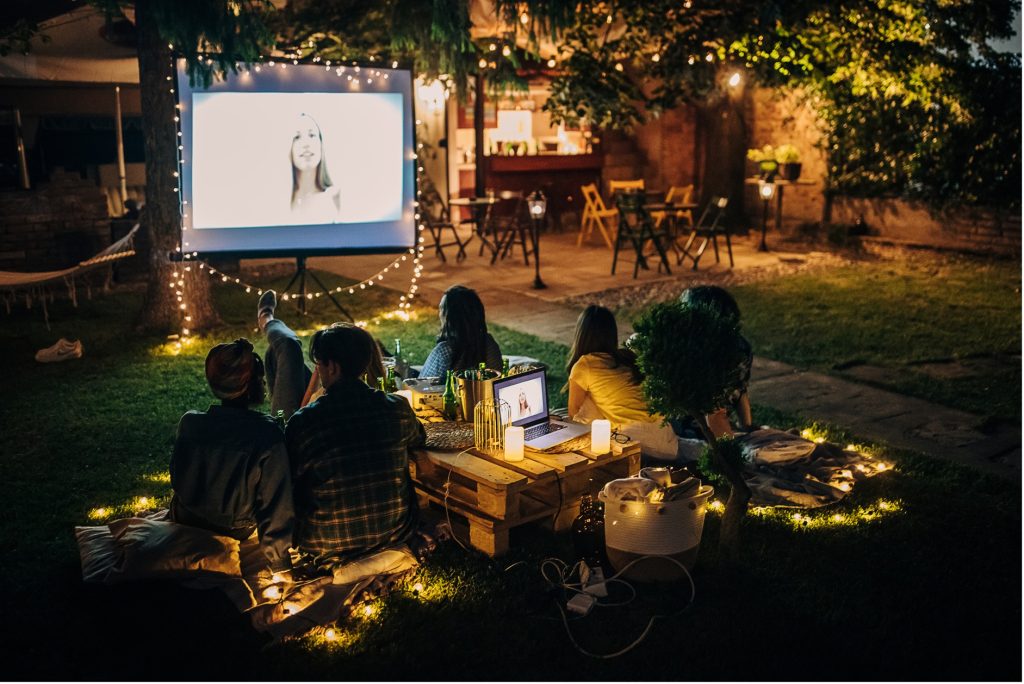
Nights can be transformative – for you and the space. Suspended festoon lighting, or masses of twinkling bud lights wrapped around the trees, or strategic up lights and subtle under seat lighting – all perfect while watching a movie on the drop down screen.
If you live in a space where all this is simply a field too far…
Visiting someone else’s outside space, lolling about in their chairs, inspecting their gardens, watching their dogs romp across the lawn is an indulgently lazy way to experience the joy of the perfect outside lifestyle
There’s a reason why Sydney is a world class city. Along with its bustling CBD and thriving satellite cities, it’s a place of unparalleled natural beauty, offering stunning views and exceptional recreational opportunities.
This two-bedroom apartment at 5/150 Ocean Street Narrabeen is in a boutique block just two minutes’ walk from popular Narrabeen Beach on Sydney’s Northern Beaches.
Built circa 2006, the light-filled apartment has been designed to capture the sea breezes and comes with everything required for easy modern living, including built-in robes in the bedrooms, Smeg appliances in the kitchen and beautiful, easy care Caesarstone benchtops.
Located on the upper floor of the two-storey block named Seascape, the apartment has a spacious balcony directly off the living area facing towards the ocean, as well as another balcony at the rear, looking towards Narrabeen Lagoon.
There’s also a large private rooftop ideal for entertaining larger groups of friends or just enjoying the views.
In addition to the living spaces, the property also has a secure undercover car space and storage cage in the basement.
While this would make an ideal home for professionals, it could also be a significant investment opportunity for the right buyer.
Address: 5/150 Ocean Street Narrabeen
Price guide: $1.6m to $1.75m
Next open for inspection: Wednesday, April 26 4.30pm-5.15pm
Agent: Anthony Malek 0467 064 270 Blueprint Property
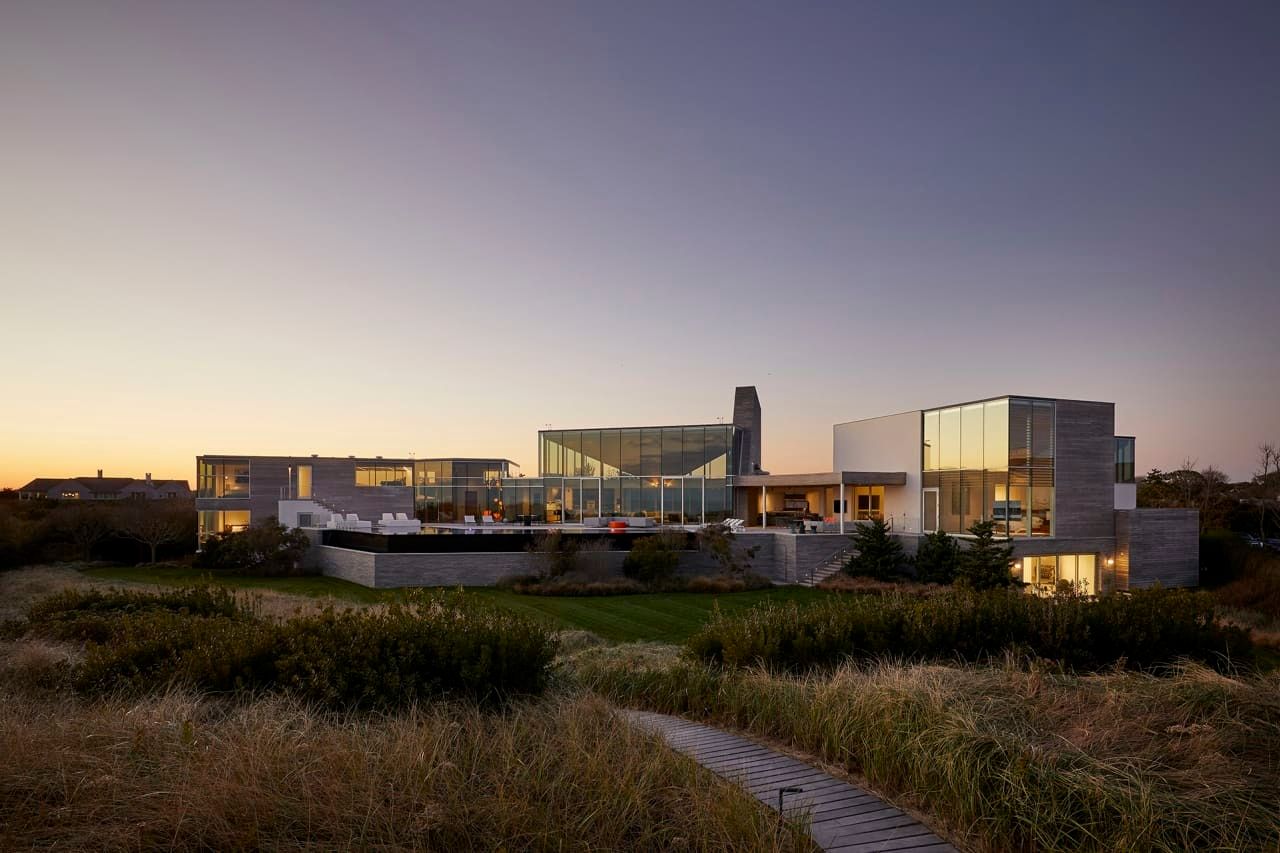
An uber-contemporary waterfront home in the Hamptons, the exclusive pocket of New York’s Long Island beloved by the well-to-do set, has come to the market for $55 million.
The angular and glass-covered house may look familiar to eagle-eyed viewers of HBO’s “Succession.” In season three of the award-winning series, the house starred as the beachfront mansion owned by billionaire investor Josh Aaronson, played by Adrien Brody, and visited by Kendall and Logan Roy.
However, “its celebrity status has relatively little impact,” said Cody Vichinsky, founding partner and president of Bespoke Real Estate, which listed the home earlier this week. “Buyers of such high-end assets are more interested in the nuances that create unique value than in the celebrity factor.”
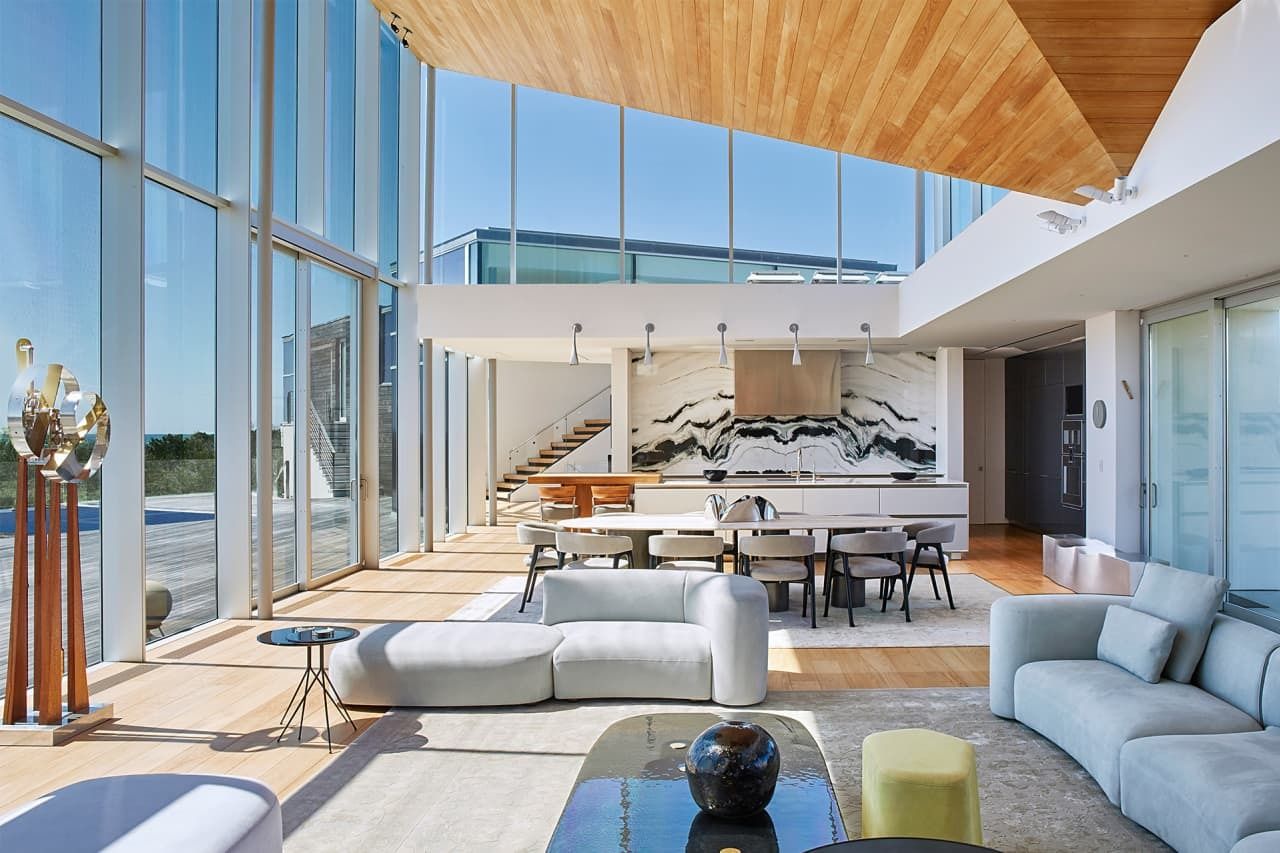
The open-plan great room is flooded with light from walls of windows. BESPOKE REAL ESTATE
Luckily, off screen, the house is every bit as lavish as it was portrayed.
Built in 2018 in the hamlet of Wainscott, the property was designed by Barnes Coy Architects.
They designed the roughly 11,000-square-foot house to be broken down “into three smaller pavilions attached by an elongated breezeway, almost as if three smaller beach houses—each with its own distinctive character—had been joined at the hip,” according to the architecture firm’s website.
Each pavilion houses something different. The primary suite is in one; the middle is the communal space; and the third has the remaining five bedrooms.
A particularly distinct feature is in the giant open-plan living, dining and kitchen space, where the home’s jaunty inverted roofline translates inside to an upside-down teak pyramid in the centre of room.
The custom kitchen occupies one end of the space with a statement marble backsplash—which made an appearance in the show. At the other end is a towering stone fireplace—you’ll spot that during the episode, too.
The scale of the space, “with [its] double-height walls of glass that capture the ocean views in one of the most impressive ways we have ever seen, was likely the defining reason why this setting was chosen to be a home on Succession,” Mr. Vichinsky said.
Macall B. Polay/HBO
The primary suite has vaulted ceilings, more walls of glass and two bathrooms.
On the lower floor, meanwhile, all the bells and whistles can be found, from a screening room with stadium seating, to a concrete-floored gym and a spa with a steam room, according to Dirt, which first reported the listing.
Outside, the home has a covered deck with an outdoor kitchen and a private path leads straight to the beach.
The house last changed hands in December 2021, when it was snapped up by a limited liability company for $45 million, records with PropertyShark show.
“Oceanfront properties, specifically turn-key oceanfront ones, have become increasingly rare, while the costs and time required to build them have significantly increased,” Mr. Vichinsky added. “This, coupled with the pedigree of the location and architecture, positions this property to continually increase in value.”
This article originally appeared on Mansion Global.
ÄLMHULT, Sweden—Amid IKEA’s colourful staged living rooms, piles of umlaut-laden housewares and endless rows of flat-pack boxes is furniture that can have shoppers wondering: How does that chair cost only $35?
IKEA grew into a furniture behemoth with a relentless focus on keeping costs low, but that goal has become more challenging. The price of metal, glass, wood and plastic have spiralled up, as have shipping costs. Inflation has squeezed consumers’ wallets. Managers at IKEA knew that something had to change to keep prices down and profits up, so in the past couple of years they have taken some of their products back to the drawing board.
Designers experimented with ways to reduce IKEA’s reliance on wood—even in its trademark wooden furniture—to cut material and shipping costs. Lighter, less expensive plastics, they discovered, could be used instead in cabinet doors and drawers.
They learned that they could substitute less expensive recycled aluminium for zinc, which had doubled in price over two years to $4,371 per metric ton after the start of the Ukraine war. Recycled aluminium is now going into bathroom hooks and other products.
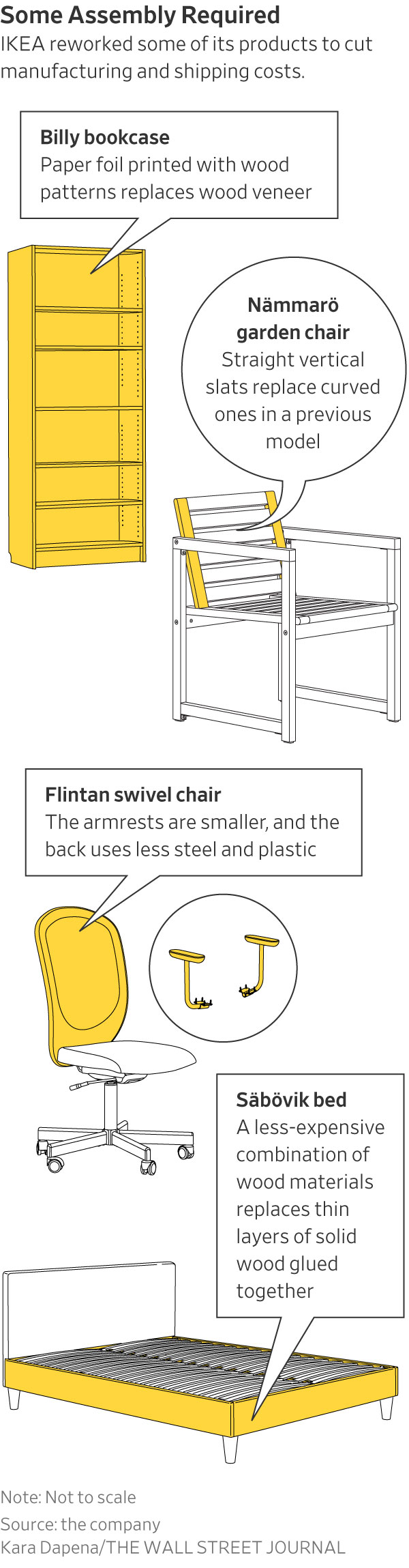
When they turned to packaging, they cut freight costs by purging flat packs of “fresh air and wasted space,” said Fredrika Inger, IKEA’s global range manager. On the new Nämmarö garden chair, the curved wooden slats featured on a previous model were straightened, which allowed the components to be packed more tightly together.
“Our budget is the customer’s wallet, and their wallets are smaller than ever,” said Susanne Waidzunas, global supply manager at Inter IKEA Holding BV, the company that owns the IKEA brand, develops its products and manages its supply chain.
Based in Älmhult in southern Sweden, where the late Ingvar Kamprad founded the company eight decades ago, IKEA is today the world’s biggest seller of furniture, with 460 mostly franchise-operated stores spread across 62 countries that carry some 9,500 products. Its in-store canteens serve 1 billion Swedish meatballs with cream sauce and lingonberry jam each year.
Mr. Kamprad, who died in 2018, believed in “democratic design”—essentially that everyday products should be attractive and functional, but also affordable. It was, in part, a hard-nosed strategy designed to maximize sales.
The challenges started with the disruptions of the Covid-19 pandemic, compounded by Russia’s invasion of Ukraine. Then high inflation presented many companies with a dilemma: raise prices to offset growing costs and risk alienating customers, or keep prices down and sacrifice profit margins. IKEA did some of both last year, and its annual profit halved, to 710 million euros, equivalent to $778 million, despite record sales.
As part of its push to boost profits, the company said last week it would spend 2 billion euros to open new U.S. locations over the next three years—its largest-ever investment in new American stores.
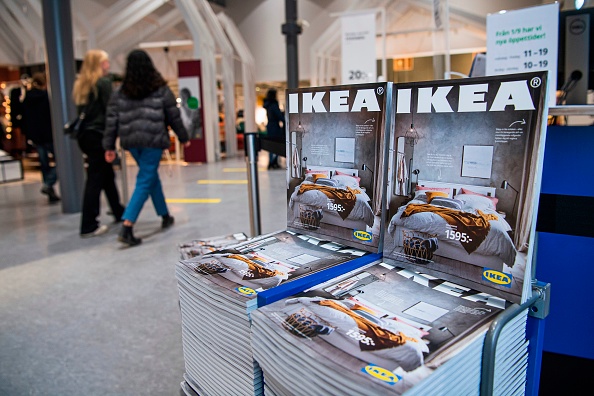
One of the company’s chief weapons in its fight to cut costs is the Billy bookcase, a bestseller considered the “heart of IKEA,” said Jesper Samuelsson, the product’s manager. Over 140 million units have been sold since it first appeared in the 1979 edition of the IKEA catalog. The company says someone, somewhere buys a Billy every five seconds—which comes out to around 6.3 million sales a year.
According to IKEA’s official history, the Billy’s original design was scribbled on a napkin after its creator, Gillis Lundgren, was inspired by criticism from IKEA’s then-advertising manager that the company’s bookcases lacked simplicity.
Now, Mr. Samuelsson said, IKEA colleagues have a game they play: “If you’re a product in IKEA, which one are you? I’m Billy—it’s a very simple, straightforward product.”
The Billy comes in two styles: white and wood finish. Its last major overhaul came in 1999, when the company changed its method for producing the white version. IKEA designers knocked a fifth off the unit’s price by replacing its white lacquer coating with a melamine foil.
It has been significantly cheaper than the wood-finish version ever since. In the U.S., the model that measures roughly 6½ feet tall and 2½ feet wide retails at $89.99 in white and $109.99 in wood finish. IKEA executives wanted to make the latter version less expensive, too, said Mr. Samuelsson.
Targeting a cost savings of 25% to 30%, Mr. Samuelsson and his colleagues focused on a solution that IKEA had been developing for years: the replacement of wood veneer with paper foil.
IKEA’s wooden furniture isn’t typically made of solid wood. Instead, it has traditionally used veneer, a thin slice of wood less than a millimetre thick that is glued onto a main structure of particleboard. Particleboard is formed from compacted wood chips and sawdust, and is significantly less expensive and lighter than solid wood.
Mr. Samuelsson knew that getting rid of the costly veneer would be key to savings, he said. The paper foil is less expensive, less wasteful and much quicker to apply than veneer, which speeds up the rate of production, Mr. Samuelsson said. Wrapped around the particleboard structure and printed with wood patterns, it looks like a wooden surface, he said.
IKEA first began to develop paper foil for use on its furniture around 2004, and has since steadily made the material less expensive and more reliable, gradually deploying it on other furniture lines, including the Pax wardrobe, one of the company’s bestselling bedroom closets.
By the time Mr. Samuelsson and his team of a dozen designers set about reworking the Billy in 2020, IKEA leaders had enough confidence in the paper foil to use it on their prize bookcase, he said. The Billy redesign brought some functional changes—including the replacement of metal nails with user-friendly plastic fasteners—but the switch from veneer to foil generated the cost savings that managers had been hoping for, he said.
The global rollout of the reworked version of the bookcase—produced in Sweden, Germany, Slovakia and China—has faced obstacles. Factories in Europe were already running at capacity, so the company would need to move slowly and carefully to introduce the new version without disrupting output. IKEA also realised its demand for paper foil would balloon, which required lengthy preparations to help suppliers build up their output.
Production of the new version started last year in China, where the local manufacturer had spare capacity and could implement the new production system sooner. The Billy is the country’s No. 1 IKEA product. There the wood-style bookcase is priced at 499 yuan, equivalent to about $72, down from 699 yuan—a 29% reduction. The white version sells for 399 yuan. The new Billy hits stores in the U.S. and Europe in early 2024.
These kinds of design changes are unlikely to alienate IKEA consumers, who typically don’t focus on how their furniture is made, said Tom Higgs, a furniture designer and lecturer at London’s Brunel University. “IKEA’s customers are looking for affordable, replaceable and convenient furniture,” he said.
For one of IKEA’s most popular office swivel chairs, the Flintan, smaller armrests and less steel and plastic in the back cut manufacturing costs. The new Flintan, which hit stores in 2021, is roughly the same size as its predecessor, but it’s much more efficient to ship after designers tweaked its components to make them fit more snugly into a flat pack. IKEA can now squeeze 6,900 Flintans into one shipping container, up from 2,750.
Even so, the company said that costs have increased so much that it decided to hold the chair’s price at $119 in the U.S. Without the design tweaks, the price would have risen significantly, it said.
IKEA designers likewise reworked the Säbövik bed, available in Europe but not the U.S., by changing the construction of its wooden frame. It was previously made of so-called sandwich board, comprising thin layers of wood glued together. Designers experimented with new material mixes before settling on a less expensive and lighter combination of solid wood, plywood and a compressed structure of wood strands and glue called oriented strand board.
The Säbövik used to come flat-packed in three cardboard boxes, but now fits into just two more compact boxes, enabling the company to cram twice as many flat-packed beds into a shipping container.
Tasked with developing a new extendible dining table that wouldn’t be prohibitively expensive, IKEA designers tried a novel approach.
Earlier IKEA tables typically used solid wood legs for strength and stability. In developing the new Rönninge table, which launched last year, designers created a leg made from hollow wood veneer with solid-wood inserts at the top and bottom to add strength. This approach significantly reduces material and freight costs since each leg now contains 90% less wood than if it had been made of solid wood, the company said. The Rönninge retails at $499 in the U.S.
Most global executives think greenwashing is widespread in their industry, and despite customers becoming more vocal about preferring sustainable brands, many companies are cutting corners on their environmental, social and corporate governance initiatives.
Nearly three-quarters of executives said most organisations in their industry would be caught greenwashing if they were investigated thoroughly, according to a survey of nearly 1,500 executives across 17 countries and seven industries conducted in January by the Harris Poll on behalf of Google Cloud.
The risk of greenwashing is increasing with crackdowns on overstated green claims on both sides of the Atlantic. Despite that threat, the figures are consistent with last year’s findings: Nearly 60% say their own organisation is overstating its sustainability methods. While for some it may be intentional, most say it is instead often due to setting sustainability goals or pledges without a concrete plan to reach them.
“There are actors that are maybe intentionally overstating what they’re doing, but I honestly think for the most part, companies are sincere—they’ve set their goals, they’re working towards them, but they don’t always have the data to be transparent,” said Kate Brandt, chief sustainability officer at Google.
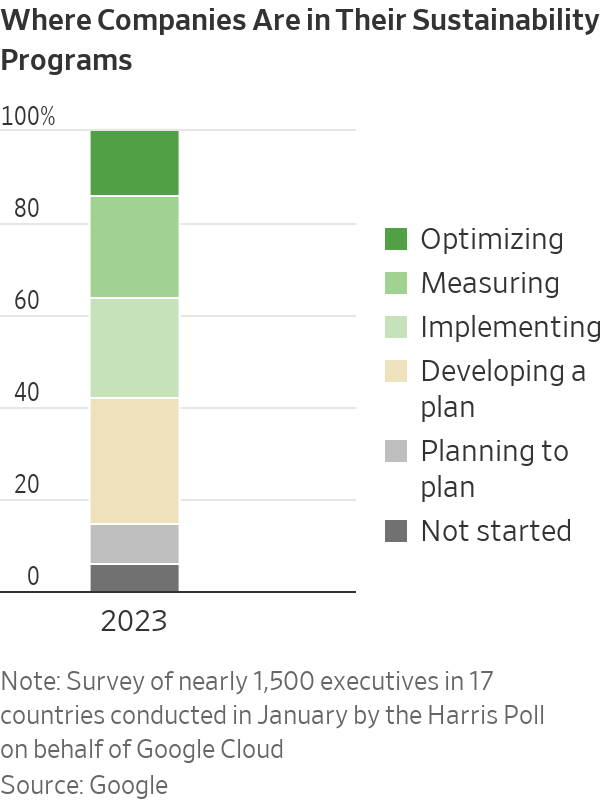
The survey gives insight into where companies are in their sustainability efforts. A little more than a quarter are developing their sustainability programs, 22% have a plan they are implementing, another 22% are able to measure its impact, and 14% are in the final stage of optimising their plan based on measured outcomes. In contrast, nearly a tenth plan to start developing their sustainability plan in the near future, while the remaining 6% don’t have a plan or any intention to come up with one soon.
Nearly three-quarters of executives said they want to advance sustainability efforts but don’t actually know how to go about doing it. Top tools identified to improve their ability were having a dedicated sustainability leader, support from senior management, advanced measurement tools, and education for employees and executives. And the two main ways they expect advancement is through technology innovation as well as investment in sustainable operations or services.
With nearly a decade of experience as a CSO, Ms. Brandt said the survey findings reinforced her point of view on how a company can set itself up to be successful. Businesses need strong governance powered by good data and metrics and a dedicated sustainability leader to be the center of gravity but one who can also embed sustainability inside business functions.
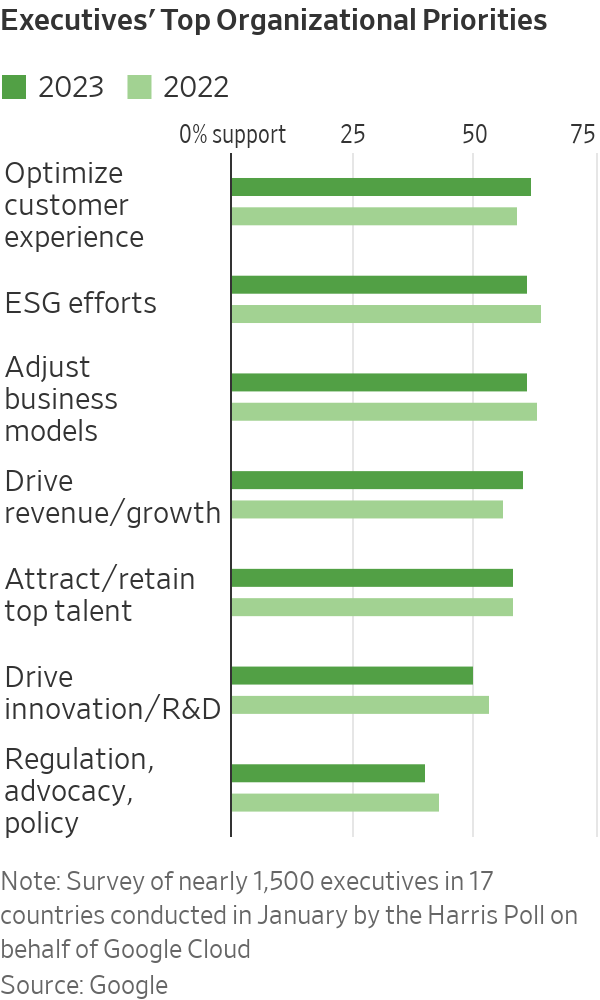
Most executives surveyed—85%—said customers and clients are becoming more vocal about their preference for engaging with sustainable brands. However, economic uncertainty means that business leaders have increased their focus on customers, revenue and growth, although ESG issues remain one of businesses’ top three priorities.
While an earlier survey by industrial conglomerate Honeywell International Inc. found that sustainability budgets at most companies were relatively insulated from cuts, the more recent Google Cloud survey indicates things may have changed. Two-thirds of executives in the latest survey said they are having to cut corners on sustainability initiatives and 45% said the economy is negatively affecting their organisations’ sustainability efforts.
“Essentially when times are getting hard, you get to see who’s serious about this agenda and those who are paying lip service or perhaps accidentally overstating their efforts,” said Justin Keeble, managing director of global sustainability at Google Cloud.
As a response to the emergency financial and health environment caused by COVID-19, central banks around the world dropped interest rates to an all-time low and provided generous fiscal programs to businesses on a scale we have not previously witnessed. Quantitative easing (‘QE’) was applied to buy existing bonds and provide market liquidity, whilst governments issued new Treasury Bonds to raise the much-needed capital for these emergency COVID-19 programs.
The sheer scale of this coordinated global economic response completely dwarfs the measures used by governments during the GFC (approximately 6.5x in size and scale across developed countries). In the aftermath, we Australians now find ourselves fighting the steepest inflation in over three decades. It is my belief that this period will be studied by economic historians with the tagline and conclusion – “Excess money supply equals high inflation” – affirming the late Milton Friedman’s own body of work into this subject matter.
As the old saying goes – “There is no such thing as a free lunch”; we are certainly paying for it now. We are paying for dinner as well – WITH dessert.
Banks Buying up Treasury Bonds
The COVID-19 stimulus packages led to banks around the world seeing increased deposits. With the banks needing to invest this surplus money somewhere, and the lending environment not being favourable to them, the banks resorted to purchasing newly issued government bonds at near-zero coupon rates. Buying treasury bonds was encouraged by regulators and was seen as prudent practice given that the treasury bond is one of the least risky assets to hold on your balance sheet amid a financial crisis. This low risk is due to the government essentially being a guarantor of the capital – in other words, the government will give you back your money with certainty. Buying treasury bonds also has the benefit of meeting the capital adequacy requirement imposed by regulators.
It has surprised everyone that the economy recovered so rapidly, fuelled by pent-up demand and surplus savings. Unfortunately, this fast-paced recovery unleashed inflation, leading to the fastest and most consecutive interest rate increases in Australia’s modern economic history.
Now, let us shift our focus back to the so-called “risk-free” treasury bonds. Most government bonds have a fixed income stream linked to the official interest rates at the time of issue. As the official cash rate increases, these assets diminish in value. The S&P/ASX Australian Government Bond Index has shown a greater than 10% fall since August 2021, with some of individual bonds falling in value up to 20%
If the income stream for a government bond is say, 1%, this would be less attractive than the current cash rate of 3.60%. Therefore, the face value (price) falls as the cash rate rises, allowing the bond to be traded with the appropriate numbers. Despite this, government bonds are still safe and secure. The government’s sovereignty backs the income stream. It is easily traded in the money market and considered as good as liquid cash for banks, with regulators requiring significant exposure to these instruments as part of the credit creation function performed by banking institutions. For example, every dollar held in bonds, allows four dollars to be lent to borrowers.
The Misleading Safety of Government Bonds
Here comes the iceberg. The only asset on the bank’s balance sheet that does NOT reflect actual value is government bonds. This is due to accounting standards and reporting requirements; that is, we do not know the exact scale or concentration of government bonds held on the balance sheet of any particular bank. There are now two issues at hand here: profitability and liquidity. Poor profitability relates to the fact that the bank has poorly performing returns on assets relative to returns available on other similar assets in the market. As a result, it will need to squeeze this extra profit from somewhere else, most likely from the borrower, thus increasing the cost of capital.
While this occurs, banks are increasingly concerned about the borrower’s side of the ledger. Banks must be wary of loan arrears picking up at an alarming pace due to the higher interest rates, cost of living pressures and asset prices falling due to rising interest rates. Therefore, there is ‘credit rationalising’ by lenders. In other words, they are getting tougher and reluctant to lend new money; a classic recipe for an inevitable credit crunch.
The second half is banks that are overweight in government bonds trading below their fair value are particularly vulnerable if there is a run on their money; that is, a very large number of depositors wanting to withdraw their money in a short time frame and the bank not having the cash available to satisfy this demand immediately. This is a major liquidity issue for the particular bank in question, as well as the entire banking system if the flow-on effect is of sufficient magnitude. The commonalities between the GFC and the current crises are confidence and liquidity. However, the difference is that the GFC was predominantly caused by banks holding bad loans.
The cause of this current crisis is that banks are holding too many good loans (government bonds) that have now turned bad due to their fixed rates during a time of rapidly rising rates.
Mary Poppins and the Collapse of SVB
Just as Mr Banks in the Mary Poppins film tries to teach his son the importance of saving and investing money wisely, banks also encourage customers to deposit their money and keep it safe in their accounts. However, if there is a sudden panic or loss of confidence in the banking system, customers may rush to withdraw their money all at once, similar to how Michael Banks ran to spend his tuppence feeding the birds.
The lesson here is that just as individuals need to save and invest wisely, it is also essential for banks and regulators to maintain a stable and trustworthy financial system that can withstand sudden shocks and crises. Due to the sudden increase in interest rates, many banks have become vulnerable and illiquid. The very purpose of government bonds held on their balance sheet is to provide liquidity. However, as has been made evident in the past few weeks, this basic contingency plan has failed.
In the case of Silicon Valley Bank (SVB) in the US, the bank announced that it had lost $1.8b in the fire sale of assets to meet withdrawal demands. The bank then looked to raise $2.25b to shore up its balance sheet and restore investor confidence in the bank’s liquidity and operations. Within 48 hours, an astounding sum of $48b had been withdrawn from the bank out of fear and panic. This placed the financial institution on a pathway to collapse as further sales of government bonds could not be sustained.1
This led to other regional banks looking vulnerable. A central bank would only dare pause increasing interest rates if the act upholds confidence. However, this economic environment certainly supplies ample justification. The fragility of the banking system relies on deposit holders maintaining sufficient confidence in the banking system and wider economy. Raising interest rates leads to devaluing bond portfolios, only making banks more vulnerable and placing additional pressure on them to withstand a run on their capital, placing the entire banking system in jeopardy. Importantly the US Treasury has guaranteed all deposits in these banks to restore confidence in not only the national banking system, but the expansive regional banking system in the US.
Contagion and Credit Suisse
Although the ultimate demise of Credit Suisse was well on its way before the more recent events, the collapse of SVB put the final nail in in the Swiss bank’s coffin by escalating a run on depositor funds. Despite its share price having slumped for quite some time due to multiple scandals, including losses on highly leveraged loans to drug dealers to launder money in Bulgaria, entanglement in a Mozambique corruption case, the collapse of Greensill Capital and the failure of New York-based investment firm Archegos Capital Management.
All of these problems led to billions being lost by the bank. Despite disastrous past performance, if there had been no run on capital, the bank would have survived as it was still adequately capitalised. The Swiss government intervened in the Credit Suisse matter by placing UBS into a forced marriage with them through the provision of a handsome dowry (providing a $162b line of credit) paid by taxpayers, whilst wiping out $25b in bondholders (debt investors) and paying $4.9b (a steal) to shareholders in priority to the bondholders.
This breaks so many rules. Firstly, how can shareholders be paid in priority to bondholders whilst using the Swiss government’s money for the commercial benefit of UBS? Secondly, how is it paid for via QE?
The issuance of government bonds is only more inflationary. The unintended consequences of this action can be quite significant. Firstly, the Swiss government’s intervention undermines trust in the system; investors are less likely to invest in banks and this compounds fear for the next bank that misses expectations, with a potential run on capital to follow.
We have already been seeing some concern with Deutsche Bank following the controversy around bondholders being given priority in the aforementioned Credit Suisse saga. This is despite Deutsche Bank’s business fundamentals being in much better shape than that of Credit Suisse.
Australian Banks and the Future
Unsurprisingly, Jim Chalmers, Philip Lowe and John Lonsdale (chairman of APRA), have all come out in unison, stating that Australian banks are the strongest globally. Indeed, Australian banks are operating in an oligopolistic environment which is well regulated and funded, backed by an economy based on vast resources and immigration. The oligopoly feature of our banking environment works in our favour as it means lower competition, hence less of a necessity to lower rates and sacrifice margin in conjunction being highly regulated with capital. On the other hand, the US has over 4,200 banks and Europe has 5,171 banks.17 The small ecosystem in which Australian banks operate are the reason they are both highly profitable and there is need to take higher risk, with the regulators being able to keep close eye over the banking system.
Our banks will continue to attract depositor funds and have sufficient capital to meet withdrawals. In other words – WE ARE SAFE.
However, the world’s central banks are now fighting two separate battles on two separate fronts: inflation on the one side and fragility in the banking system on the other, which is weakened by higher interest rates and diminished confidence. It is our view that we have reached the top of the interest rate cycle. The importance of the May budget has not been this critical for decades. The government needs to be fiscally responsible in their coming budget to ensure they do not add to inflation, and the RBA may need to accept slightly higher inflation even if it is persistently above 3% for the next 2-3 years so as to not trouble the government bonds held by our banks.
In short, I expect the cash rate to remain unchanged at 3.60% for at least 4-6 months.
Final Thoughts
In the past month, we have seen a change in tone. The government is cooperating in its obligation to create a policy that helps not inflame inflation. In contrast, Philip Lowe has raised concerns regarding housing and rental inflation directly caused by a lack of property supply and increased migration. This is the government’s responsibility, which paves the way to accept higher inflation as long as wage inflation is anchored.
Ultimately, disciplined fiscal and monetary policy is required on the Australian front to ensure our banks are healthy, inflation is kept at bay, and that banking troubles in the rest of the world do not reach our shores. There is no doubt that that recent new bank collapses have completely changed the scope in which the central banks are operating within, ultimately this will lead to a credit crunch, increasing the cost of capital as banks will need and want to increase margins for risk, this will slow down the economy. Rather than worrying about higher interest rates we might have official cash rates drop quicker than anticipated.
Msquared Capital is a private credit provider with investment opportunities backed by quality property along the Eastern Seaboard; we ensure that all investment opportunities are based on risk-to-reward as our core offering and performance. Mortgage funds perform well during volatile times, and the preservation of capital is regular, with reliable monthly income that gives our investors peace of mind.
The number of foreign students returning to Australia is on the rise, spelling good news for suburbs with high levels of student accommodation.
Data from Ray White shows that 140,000 foreign students returned to Australia in February, with NSW and Victoria leading the way.
During the height of the pandemic in 2021, areas with higher levels of student accommodation saw significant falls, with Melbourne CBD recording the highest drops. Ray White chief economist Nerida Conisbee said rental levels in that city fell by 23 percent and prices dropped by 7 percent during 2021, which had a flow-on effect to commercial property in those areas, such as retail properties that relied on that market. Ray White data showed that prior to the pandemic, the numbers of foreign students rose steadily from just under 300,000 in 2006 to more than 800,000 in 2020 before falling to less than 100,000 during COVID.
However, figures show that 49,160 students arrived in NSW in February, with another 47,970 students heading to Victoria. Queensland was the next most popular destination, with 19,300 students arriving ahead of the start of the academic year, followed by Western Australia with 11,850.
Ms Conisbee said rents had already begun to rise quickly, reaching pre pandemic levels, although values had not kept a similar pace. That is expected to happen later this year, she said, noting she is hopeful it will spark a new construction cycle for further affordable student housing.