Why Disney Is Plowing Cash Into a Cruise Line Expansion

Chief Executive Bob Iger had christened the 1,119-foot-long Disney Treasure the previous evening while 1,000 drones hovered overhead in the shape of a Champagne bottle. The fleet of drones transformed into shapes of images from “Aladdin,” “Coco,” “Moana” and other movies as pop star Jordin Sparks belted out a song written specially for the new ship.

The spectacle was a coming-out party of sorts for a business that for years has played a bit part in Disney’s overall entertainment empire, but is now increasing in prominence. Growth is slowing in the entertainment company’s parks businesses, and its legacy TV business is suffering from cord-cutting , but Disney fans worldwide can’t seem to get enough of cruises.

When Disney announced plans last year to “turbocharge” investment in its Experiences division, which includes theme parks, resorts and consumer products, the company said 20% of the $60 billion over the next decade would go toward its cruise business and other projects that haven’t been announced yet. Disney plans to more than double its fleet from six to 13 ships by 2031 and further expand its service internationally. undefined undefined “Given the fact that we are still a relatively small player and we see this strong demand, it’s only natural and actually the best time to invest in this business,” said Thomas Mazloum , who leads the part of Disney’s Experiences division that includes cruises.

Cruise travel overall surpassed prepandemic levels last year, attracting 31.7 million passengers, up from 29.7 million in 2019, according to the Cruise Lines International Association, a trade group.

More affluent millennials are choosing cruises over land-based vacations in part because a host of new, larger ships with premium amenities make them feel they get good value for the money, JPMorgan Chase said in a June research note. Rising international airfares have also made cruises that leave from ports in their home country more attractive to some overseas families.

Most cruise lines offer chaperoned children’s activities. On the Disney Treasure, parents can sunbathe with cocktails by the pool while children are entertained until as late as midnight with activities such as playing in a “Star Wars”-themed workshop, completing hero’s missions set in the Marvel Comics universe or designing a virtual theme-park ride to their specifications.

The Disney Treasure offers “Moana” and “Beauty and the Beast” themed stage shows, a piano bar themed after the movie “The Aristocats,” and a Mexican eatery where you can watch mariachi musicians sing songs from “Coco” while you sip a margarita and eat enchiladas. On a typical Disney cruise, costumed characters such as Pluto, Goofy and Donald Duck roam the decks and movie theaters show Disney films that are playing on land in cinemas.

Disney is betting that interest in cruises will prompt travelers to pay more for its cruises, which tend to cost more than mass-market cruise lines such as Royal Caribbean or Carnival. A four-day cruise to the Bahamas for a family of four on the Disney Wish ship, leaving from Florida’s Port Canaveral during a popular spring-break week next April, starts at $7,692. On Royal Caribbean, a much larger cruise line, a comparable trip starts at $3,368.

“You’re paying up to cruise with Mickey,” said Matt Hochberg, editor of Royal Caribbean Blog, which focuses on the cruise industry and isn’t affiliated with the cruise line.

Disney says that some of the cost of cruise tickets comes from docking fees charged at ports, which are largely passed on to the customer. Entertainment and dining options and even free unlimited soda—a perk harder to come by on competitors’ cruises—are part of the value proposition that passengers find attractive, the company said.

“You want it to feel like part of the mythology,” said Danny Handke, one of Disney’s parks and attractions designers who helped create the Haunted Mansion-themed bar aboard the Treasure.

The company discloses certain financial metrics for its cruise business but doesn’t share its full financials. In the year ended in September, Disney said a 5% increase in revenue for the Experiences division that includes cruises was driven in part by higher average cruise line ticket prices.

“Passenger cruise days,” the number of passengers aboard Disney ships multiplied by the days they spend on voyages, rose 14% in the company’s 2023 fiscal year (the most recent time period for which such figures are available) and 32% the previous year.

Mazloum, the head of the division that includes cruises, said that with only 5% of the Caribbean market and 2.5% of the global market, Disney is still a small player in cruising. But among Disney’s menu of entertainment options, it is one of the experiences that rates the highest among guests.

Consumer satisfaction surveys show that 82% of Disney’s cruise passengers intend to take another and that sea journeys are the highest-rated experience in Disney’s Entertainment division portfolio, Mazloum said.

At Disney’s busiest cruise port, Port Canaveral, two of the line’s ships launched 157 voyages that were on average 92.4% full in the year ended in September, publicly available port information shows. That metric, the average number of passengers per vessel as a proportion of each vessel’s maximum capacity, has returned to prepandemic levels for Disney.

Disney is now increasingly focused on the Asian market, where hundreds of millions of potential Disney Experiences customers live without a nearby theme park.

Launching next year, the Disney Adventure, which can hold up to 6,700 passengers and will initially operate in Southeast Asia, is Disney’s biggest ship yet. It will sail out of Singapore—the company’s first-ever service there—and aims to attract affluent Indian, Indonesian and Malaysian travelers.

Trump Plans to Appoint Musk Confidant David Sacks as AI, Crypto Czar

President-elect Donald Trump named a Silicon Valley investor close to Elon Musk as the White House’s artificial intelligence and cryptocurrency policy chief, signaling the growing influence of tech leaders and loyalists in the new administration .

David Sacks , a former PayPal executive, will serve as the “White House A.I. & Crypto Czar,” Trump said on his social-media platform Truth Social.

“In this important role, David will guide policy for the Administration in Artificial Intelligence and Cryptocurrency, two areas critical to the future of American competitiveness,” he posted.

Musk and Vice President-elect JD Vance chimed in with congratulatory messages on X.

Sacks was one of the first vocal supporters of Trump in Silicon Valley, a region that typically leans Democratic. He hosted a fundraiser for Trump in San Francisco in June that raised more than $12 million for Trump’s campaign. Sacks often used his “All-In” podcast to broadcast his support for the Republican’s cause.

The fundraiser drew several cryptocurrency executives and tech investors. Some attendees were concerned that America could lose its competitiveness in emerging areas such as artificial intelligence because of overregulation.

Many tech leaders had hoped the next president would have a friendlier stance on cryptocurrencies, which had come under scrutiny during the Biden administration.

“What the crypto industry has been asking for more than anything else is a clear legal framework to operate under. If Trump wins, the industry will get this, and more innovation will happen in the U.S.,” Sacks posted on X in July.

The tech industry has also pressed for friendlier federal policies around AI and successfully lobbied to quash a California AI bill industry leaders said would kill innovation.

Sacks’ venture-capital firm, Craft Ventures, has invested in crypto and AI startups. Sacks himself has led investment rounds in many. He has previously invested in companies such as Slack, SpaceX, Uber and Facebook.

Sacks was the former chief operating officer of PayPal, whose founders included Musk and Peter Thiel . The group, called the “PayPal mafia,” has been front and center this election because of its financial muscle and influence in drumming up support for Trump.

Property of the week: 205 Wahring Murchison East Rd, Wahring

Legend has it that opera icon Dame Nellie Melba performed in the minstrels’ gallery and current-day hitmaker Tones and I filmed a music video at Noorilim estate. The high profile property has even been the breeding ground for multiple Melbourne Cup winners including 1910 champion, Comedy King, who was laid to rest within the grounds.

In 1998, prominent art dealer and entrepreneur behind Menzies International, the late Rod Menzies and his wife Carolyn, bought Noorilim for $3.325 million and set about restoring the Italianate mansion to its former glory.

Today, the 65ha property in the heart of the Goulburn Valley is on the market for only the third time in the past 50 years via Sean Cussell of Christie’s International Real Estate with a price guide of $15m.

During the Menzies’ ownership, the glamorous country estate was a venue for weddings, concerts, and private events, welcoming a long list of international guests. Chart-topping artist Tones and I filmed the video for her song Bad Child at the estate, and the period property has played its part in numerous films and television series. Singer and actor Ted Hamilton, known for roles in Division 4, Homicide, The Love Boat, M*A*S*H and Hawaii Five-O, was also a regular performer at the address.

Given its stately grandeur, Noorilim was even a successful auction centre for fine art with works by Brett Whiteley, Sidney Nolan and Jeffrey Smart sold under the hammer at the property.

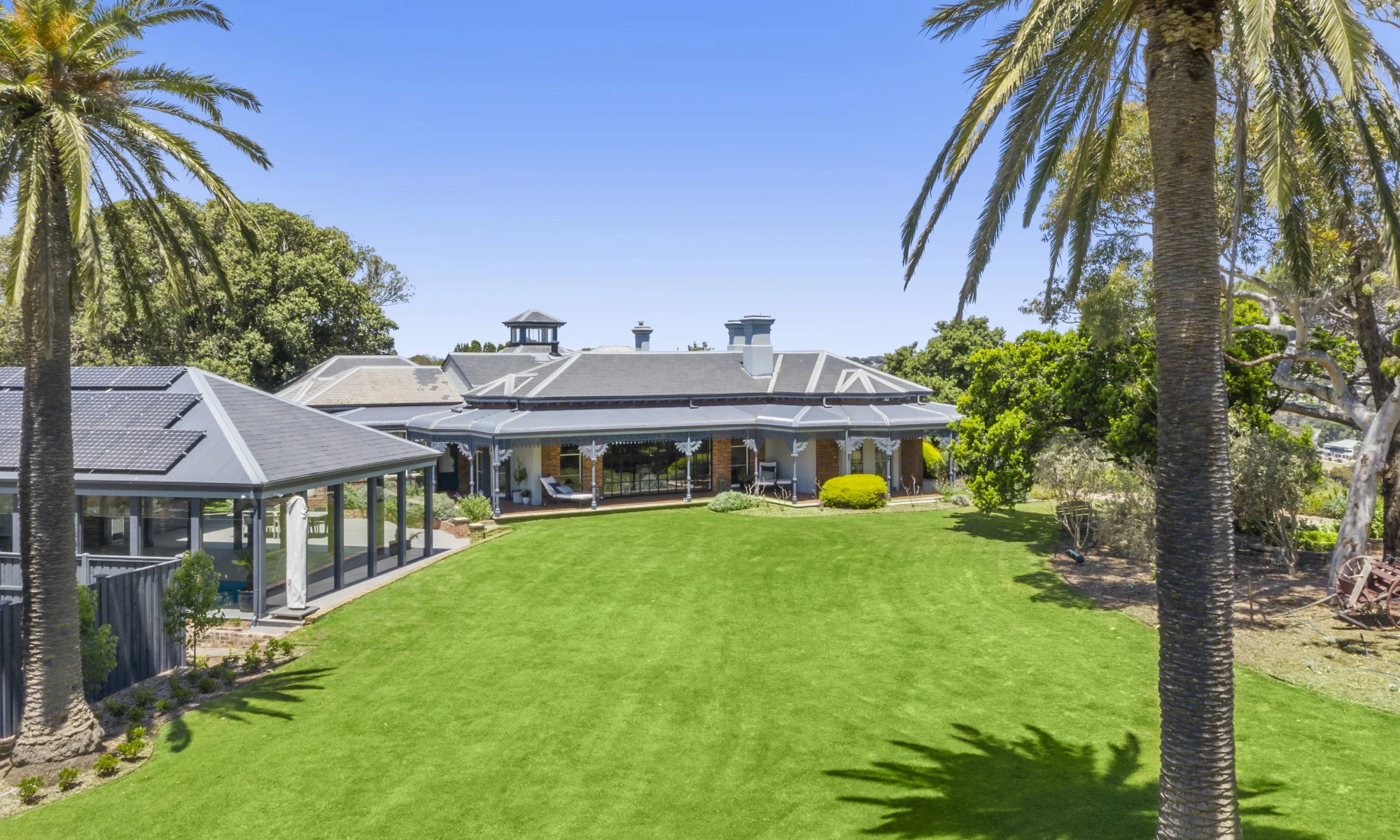
Built in 1879 by celebrated architect James Gall for parliamentarian William Winter-Irving, Noorilim is a prime example of post-Gold Rush prosperity in Victoria. At the time of its construction in the mid to late-1800s, Australia had been labelled one of the richest nations on earth and Melbourne’s monied elite were spilling out of the city looking to build country estates to rival those in Great Britain. The nouveau riche began commissioning lavish ornamental houses shadowing the Gothic, Italianate and Queen Anne designs of Europe.

Noorilim’s facade is a striking example of this “boom style” architecture featuring an asymmetrical tower, ornate balustrades and grand arched loggias that frame sweeping views of the estate’s manicured grounds.

Inside, the vast 1022sq m residence has 5m ceilings and lavish period features, including 15 fireplaces, seven staircases, and intricate Corinthian columns.

At the heart of the mansion its grand hall has Minton tiles imported from England and laid by Italian artisans who were shipped out specifically for the job. There is a turret lookout, a billiard room, 10 bedrooms, four bathrooms, an office and grand formal rooms such as a lounge, library and dining room all with expansive windows showcasing views of the gardens and vineyard.

Noorilim’s name is derived from the Indigenous Yorta Yorta language and means “place of many reeds” reflecting the estate’s connection to its natural surroundings. Complementing Gall’s vision, renowned landscape designer William Guilfoyle — who worked on Melbourne’s Royal Botanic Gardens — crafted Noorilim’s standout gardens.

The grounds are home to echidnas, kangaroos and koalas, more than 300 mature trees including ancient Moreton Bay figs, a rose garden with a central fountain, an ornamental lake, a boathouse, and even a private beach on the banks of Goulburn River. There is also an extensive wine cellar, numerous outbuildings and barns, as well as a heritage-listed water tower. The working vineyard produces Chardonnay, Shiraz, Cabernet, and Merlot grape varieties.


Noorilim, near Nagambie, is 150kms north east of Melbourne at 205 Wahring Murchison East Rd, Wahring. The property is listed with Sean Cussell from Christie’s International Real

Australian property buyers the winners in a spring market

Australian property buyers have been the big winners this spring, according to new data released this week, with more stock available and a drop in sales volumes.

CoreLogic’s Housing Chart Pack for December showed sales were down 4 percent on the historic average while total listings volumes nationally increased 10.6 percent during spring.

Homes also took longer to sell through spring. The national median number of days on market in the three months to November was 32 days, up from 27 days for the same period last year.

CoreLogic economist Kaytin Ezzy said the trends combined to create a more favourable market for buyers rather than sellers.

“Between higher stock levels and lower-than-usual sales volumes, the data for the end of November shows that buyers were the winners this spring (just), and sellers generally saw softer market conditions over the past few months,” she said. “The increase in selling times has coincided with higher stock levels, and softer sales volumes year-on-year. 

“The median time on market increased by four days year-on-year across both the combined capital cities and regional market.” 

The best performing areas for home value growth continued to be in the 25 percent most affordable markets of Adelaide, up 4.7 percent, Perth (4.5 percent) and Brisbane. At the other end, the top quarter of homes in Darwin (-2.7 percent), Melbourne (-1.4 percent) and Sydney (-1.6 percent) saw the greatest falls over the same period.

In good news for renters — and less welcome for existing investors — the report found rental growth also slowed this year. Rents increased by 5.3 percent over the year to November, the slowest increase since April 2021. At the same time, the RBA reported the average household size has risen across Australia’s capital cities, suggesting more renters are moving into shared housing to offset cost of living concerns.

“The gradual slowdown in net overseas migration could also be contributing to the stabilising in rent values, and as the backlog of Homebuilder work moves into completion, this could also take some demand out of the rental market,” Ms Ezzy said. 

“Rental growth may rebound a little through the seasonally strong first quarter of 2025, but beyond any seasonality, it looks increasingly like the rental boom is over.” 

The ‘new frontier’ in Australian property is not where you think

The Australian housing market is rapidly evolving, with new research revealing changing activity in regional and city areas.

The latest Regional Movers Index from the Commonwealth Bank showed the exodus from Australian cities to the regions is significantly exceeding pre-COVID movements, sitting at 19.8 percent higher. Even more revealing is data which showed relocations are 1.8 percent up on the average recorded during the height of the lockdowns. At the same time, people in regional areas are staying put.

The report is a partnership between the Commonwealth Bank and the Regional Australian Institute. RAI CEO Liz Ritchie said the regions have become the permanent home of choice for more Australians.

“The inter-regional migration index —which tracks regional to regional relocations — has fallen by 5.1 percent, suggesting that more regional residents are content to stay where they are. With the continuing strong jobs market across regional Australia, increasing city property prices and ongoing cost-of-living pressures, it’s no surprise the regions remain desirable,” Ms Ritchie said. 

She said this had significant implications for planners, with a better understanding of infrastructure needs required by planners.

“Regional Australia is truly the nation’s new frontier. There are so many opportunities in our regional communities, but likewise we know there are challenges. Housing for example remains a key ongoing concern in many communities,” she said. “Regional Australia is growing and for that to continue we need adequate foundations. The time to lay them is now.” 

Among the areas to benefit from this shift over the past quarter was the Hunter Valley city of Maitland in NSW which saw a 3.4 percent increase in net migration from the cities and other regional areas. Long seen as the less desirable locale in the wine growing region, Maitland has attracted more buyers looking for an affordable home with lifestyle benefits. CBA Executive General Manager Regional and Agribusiness Banking Paul Fowler said it was an area on the rise.

“There is significant development happening around Maitland, with extensive land releases for residential, industrial, commercial and retail fuelling strong employment and construction industry opportunities,” Mr Fowler said.  

“Maitland is also set to benefit from major investments in the area including the nearby Newcastle Airport which will welcome international flights from 2025, further enhancing the region’s accessibility and economic profile.”   

And while Melbourne property prices continue to experience a lull, it’s a different story outside the capital, with regions closer to main city centres performing particularly well.

“A move to regional Victoria remains on trend among those relocating, with the state’s regional areas experiencing the largest surge in popularity in the 12-month period to September 2024, with its share of net regional inflows rising from 21 percent to 30 percent,” Mt Fowler said. “Trending scenic LGAs like Queenscliffe on the coast, as well as Moira, Wangaratta and Strathbogie located further north, offer attractive and more affordable lifestyle opportunities for many Australians. 

“With more corporate employers setting up or relocating to Geelong, Queenscliffe’s proximity to Greater Geelong and the Melbourne CBD means more regional Australians can enjoy diverse employment opportunities while living in a beautiful location with enhanced lifestyle opportunities.” 

This Company Won Big With Bitcoin and AI. Why It’s Now Favoring One Over the Other

Austin, Texas, company Core Scientific went from bankruptcy to stock market darling this year by betting on two technologies: Bitcoin mining and AI data centers. Shares are up 400%.

But if given the choice of whether to invest more in one business over the other, executives answer without hesitating: the data centers.

“We really just value long-term, stable cash flows and predictable returns,” Chief Operating Officer Matt Brown said in an interview. The company began life as a Bitcoin miner. Even though Bitcoin has been a great asset lately, it’s very volatile. By comparison, Core Scientific can earn steady profits for years by hosting servers owned by companies that sell cloud services to AI providers, Brown said.

This year, you couldn’t go wrong betting on either. Bitcoin is up 116%, and data centers are in high demand because tech companies need them to power their AI applications.

The two technologies seem to have little in common, but they both depend on the same thing: access to reliable power. Core Scientific has a lot of it, operating nine grid-connected warehouses in six states with access to so much electricity they could serve several hundred thousand homes. Other Bitcoin miners have similarly transitioned to data center hosting , but few with quite so much success.

Core Scientific’s business didn’t look quite so good at the start of the year. The company started 2024 under the shadow of bankruptcy protection. It had too much debt on its balance sheet after going public through the SPAC process in 2022 and succumbed to a Bitcoin price crash. But the company’s fortunes quickly turned around after it emerged from bankruptcy on Jan. 23 with $400 million less debt.

The company started the year focused entirely on crypto mining, but quickly pivoted as it saw demand surge for electricity for AI data centers.

In June, the company signed a deal with a company called Coreweave to lease data center space for AI cloud services. Coreweave has since agreed to lease 500 megawatts worth of space. Core Scientific says it will get paid $8.7 billion over 12 years under the deal.

Privately held Coreweave is one of the fastest-growing companies behind the AI revolution. It was once a cryptocurrency miner, but has since transitioned to offering cloud services, with a particular focus on artificial intelligence. It’s closely connected to Nvidia , which has invested money in Coreweave and given the company access to its top-end chips. Coreweave expects to be one of the first customers for Nvidia ’s upcoming Blackwell GPUs.

Core Scientific’s quick success in this new world has surprised even the people who are driving it.

“Every once in a while I need to pinch myself, to see I’m actually not dreaming,” Brown said.

Core Scientific’s success does create a high bar for the stock to keep rising. The company is expected to lose money this year, largely because of a change in the value of stock warrants—an accounting shift that doesn’t reflect underlying earnings. Analysts see the company becoming profitable in 2025, when more of its data center deals start to hit the bottom line. They see EPS jumping tenfold by 2027. Shares trade at about 13 times those 2027 estimates.

The data center opportunity should only grow from here, as tech companies build more powerful AI systems. Of the 1,200 megawatts worth of gross power capacity Core Scientific has contracted, about 800 megawatts are going to data center computing deals and 400 megawatts toward Bitcoin mining.

Brown said the company has good relationships with its power suppliers and can potentially add more capacity without having to buy more real estate. It expects to be able to secure about 300 more megawatts worth of power at existing sites, perhaps by the end of the year.

It’s also in the hunt for new sites, including at “distressed” conventional data centers that have lost their tenants. Core Scientific has figured out how to quickly spiff up bare-bones data centers and turn them into high-tech sites with resources like liquid cooling equipment and much higher levels of electricity.

A single server rack in a standard data center might need 6 or 7 kilowatts of power. A high-performance data center can use as much as 130 kilowatts per rack; Core Scientific is working on increasing capacity to 400 kilowatts. The company likens the process of upgrading the warehouses to turning a ho-hum passenger vehicle into a Formula One racing car.

Core Scientific’s transformation from a broken-down jalopy to a hot rod has been a wild story. Its fate next year will depend on just how quickly the AI revolution unfolds.

Chinese EV Demand Sets Record. December Should Be Huge

Monthly electric vehicle deliveries at NIO , XPeng , and Li Auto set a record in November. Things are looking even better for December.

EV demand isn’t an issue in China. Pricing, however, continues to be a struggle.

Sunday, NIO reported 20,575 deliveries for November, up about 29% from a year ago. Based on recent guidance, given with third-quarter earnings , NIO expects to deliver about 32,000 cars in December, a record, and up about 77% from a year ago.

Li reported 48,740 deliveries for November, up about 19% from a year ago. Based on recent guidance from Li’s third-quarter earnings , the company should deliver about 65,000 cars in December, up 29% from a year ago.

XPeng delivered 30,895 vehicles in November, up about 54% from a year ago. The midpoint of its fourth-quarter guidance, given on its third-quarter earnings report, was 89,000 cars, implying December deliveries of about 34,000 units.

December’s implied numbers would be a record for all three auto makers. EV demand in China is still solid. The bigger problem is competition. Citi analyst Jeff Chung recently wrote that the Chinese car market is still concerned about a “potential price war in 2025.”

He projects 2024 all-electric vehicle sales of 7.8 million units, up about 28% from 2023. Sales in 2025 should be up another 17% to 9.1 million cars. The problem: The industry has the capacity to make 28 million all-electric cars annually, according to Chung’s calculations. Capacity utilization that low typically isn’t great for profit margins.

At least there is demand. Combined, the three Chinese EV makers sold 100,210 vehicles in November. That’s a monthly record. December guidance implies about 131,000 cars sold, another record.

Coming into Monday trading, NIO stock was down about 51% this year while the S&P 500 was up about 26%. XPeng and Li shares were down 17% and 37%, respectively.

Steam comes out of the market as Australian property values cool

Australian capitals experienced their smallest rise in home values since January 2023, new data from CoreLogic has revealed.

The property data provider’s Home Value Index showed values rose by 0.1 percent over spring after 22 months of consecutive rises. CoreLogic predicted this could be close to the last rise in this cycle, with both the Sydney and Melbourne markets showing signs of cooling.

“The downturn is gathering momentum in Melbourne and Sydney,” said Tim Lawless, CoreLogic’s research director.“While the mid-sized capitals, which have dominated the growth cycle of late, are also losing steam.”

The trend was most obvious in Melbourne, with housing values recording drops in 10 of the past 12 months. Melbourne values fell by -1.0 percent in November, while Sydney experienced a fall of -0.5 percent. The report indicated that Sydney values had most likely peaked in August this year.

Some of the smaller capitals were also showing signs of a weakening in values, with Darwin down -0.7 percent and Canberra recording a drop of -0.3 percent.

“The mid-sized capitals and most of the regional ‘rest of state’ markets continue to provide some support for growth in the national index, but it is clear momentum is also leaving these markets,” added Mr Lawless.

However, it was a different story on the other side of the country, with Perth home values experiencing further growth. CoreLogic data showed values in the Western Australian capital up 1.1 percent over the month and 3.0 percent over the quarter. While the increases in values were the strongest amongst the capitals, CoreLogic noted that they were less than half that recorded in the June quarter, where they were at a robust  6.7 percent.

Mr Lawless pointed to a lack of movement in core inflation, as well as the diminishing likelihood of an interest rate cut early next year as factors in the subdued capital gains. Leading Australian economists are predicting a cut somewhere between February and May 2025.

“A lower cash rate will be a positive factor for housing markets,” Mr Lawless said. “Lower mortgage rates will provide a lift to borrowing capacity, and, along with lower inflation, should see an improvement in serviceability assessments and see a further rise in consumer sentiment.”

“A couple of rate cuts might be enough to shore up a declining trend in home values, but it is hard to see any material upward pressure returning until interest rates reduce more substantially and affordability barriers are less formidable.”


UNRIVALLED LUXURY IN THE HEART OF WAHROONGA

Sydney has its fair share of trophy homes, but when it comes to a mansion with every modern must-have, few could compete with this reinvented Wahroonga residence that’s been five years in the making.

Owned by actuary Julian Lipman and listed with David Walker of Ray White Upper North Shore, the extraordinary estate is expected to sell in the vicinity of its $18 million price point.

From the tennis court built to Australian Open standards to the award-winning swimming pool; the home dance studio to the imported greenhouse, this lavish property has plenty of wow factor at every turn.

Curated to be the ultimate entertainer’s retreat, the dream house doesn’t disappoint with an unparalleled home theatre by Signature Cinemas, built to standards rarely seen in a private home.

Alberto Vangi of Signature Cinemas said there is an extraordinary level of detail used to create the space.

“We created a room within a room to give it the ultimate acoustic treatment and to soundproof it with the least chance of any vibration. It has silk leather seating, and four-way masking so that no matter if you’re watching normal TV content, or a CinemaScope movie, the masking can move in four directions, giving you the ultimate size screen,” he explained, adding that the cinema also has a separate projection room.

“There are cinema-grade speakers specifically chosen to give you the most realistic sound possible. The time, detail and work that went into this project is next level.”

The fully appointed space has a commercial-grade projector, extensive acoustic treatments, ATMOS surround sound and a 4.9m screen.

On a vast 4047sq m parcel with a head-turning 1271sq m of internal living space, the grand homestead is a whole lot of house over three levels.

Beyond the stately double height entry foyer, the ground floor footprint alone is larger than the average Aussie house with a collection of elaborate entertaining areas for all occasions. The open plan lounge and dining zone is anchored by a statement Real Flame gas fireplace separating the formal and casual spaces and sliding doors spill out onto the expansive grounds.

A commercial-grade kitchen is home to Valcucine cabinetry, granite and timber surfaces, two fridges, an under counter freezer, Washtech dishwasher, osmosis water filter, Waldorf gas cook tops, a teppanyaki plate and Rational combi oven. There is also a huge butler’s pantry, island bench and a breakfast nook, as well as a full outdoor kitchen overlooking the pool.

That unique 25m heated infinity pool by Premier Pools earned a gong from the Master Builders Association back in 2023 and features in-floor cleaning, waterfalls, automated pool covers, sound speakers, a spa and lane markings.

Beside the pool, the neighbouring Plexicushion Prestige north/south-facing tennis court, which has an adjoining cabana with a wet bar, is suitable for professional play. Throughout the designer gardens there are established plants, a vegetable patch, a Hartley Botanic green house with heat lamps, lighting and SONOS sound, plus golf course-rated Sir Grange lawns.

There is an abundance of additional living space on the ground floor including a combined play room and study for the kids, a separate home office, a media room, a professional gym or dance studio complete with sprung floor, as well as TV systems, speakers and mirrored walls. A guest bedroom on the same level offers privacy with a walk-in wardrobe, a courtyard and shower ensuite.

Upstairs, a wide balcony overlooks the grounds and there are four more bedrooms with walk-in wardrobes and ensuites, however the primary suite is the real showstopper. It includes a dressing room with backlit display shelving, ensuite with a solid cast-iron bathtub, Onyx fireplace and a personal terrace.

The list goes on with a host of five-star inclusions such as a climate-controlled 2500-bottle wine cellar and tasting room, a 100sq m workshop beside the four-car garage featuring two EV chargers, a Crestron home automation system, a lift to all levels, zoned ducted air-conditioning and filtered air, hydronic under floor heating of all tiled areas, 21mm solid Tallowwood flooring, Louis Poulsen imported light features, Markilux electric awnings and electric blinds, Toto Neorest toilets, 60,000L buried rainwater tank.

The estate is close to Wahroonga Public School, the local train station, Knox Grammar, Barker and Abbotsleigh.

The Carrington Rd home is listed with David Walker on 0414 184 911 and Belinda Edwards on 0451 672 977.

The Australian regions where property buyers are cleaning up

Savvy property investors might do well to head to the regions for their next purchase, if market trends are correct.

That’s the news from CoreLogic’s quarterly regional Market Update, with data showing regional housing markets continuing to outperform properties in capital cities.

Mining regions in Queensland and Western Australia lead the charge once again, with regional towns in those states taking out the top 10 spots.

The Queensland town of Mackay was the top performer over the quatter, with 8.3 percent growth, followed by Geraldton in WA (8.2 percent) and Townsville (6.6 percent). Geraldton also experienced the strongest annual growth, up 28.7 percent. Western Australian regional towns also delivered the highest gross rental yields.

Report author and CoreLogic Australia economist Kaytlin Ezzy said affordability was a strong factor in the growth these areas had experienced.

“Regions like Mackay, Geraldton, and Townsville are seeing exceptional growth, driven

by affordability advantages compared to our major cities, as well as lifestyle appeal,”

Ms Ezzy said.

“This will have contributed to the strong demand but even with the impressive growth,

for those with the capacity to service a mortgage, they still remain attainable with

medians less than $600,000.”

However, CoreLogic noted that not all regional housing markets were showing signs of growth with Batemans Bay on the NSW far south coast the worst performer, seeing a fall in housing values of -2.7 percent. The Victorian town of Warrnambool was right behind, down -2.6 percent. The once-prosperous gold rush town of Ballarat in Victoria experienced the greatest fall over the year, down -6.3 percent.

Office Conversions Find New Life After Property Values Plunge

Developer efforts to convert emptying office towers into residential buildings have largely gone nowhere. That may be finally changing.

The prospect of transforming unused office space into much-needed housing seemed a logical way to resolve both issues. But few conversions moved forward because the cost of acquiring even an aging office building remained too high for the economics to pencil out.

Now that office vacancy has reached record levels, sellers are willing to take what they can. That has caused values to plunge for nothing-special buildings in second-rate locations, making the numbers on many of those properties now viable for conversions.

Seventy-three U.S. conversion projects have been completed this year, slightly up from 63 in 2023, according to real-estate services firm CBRE Group. But another 309 projects are planned or under way with about three-quarters of them office to residential. In all, about 38,000 units are in the works, CBRE said.

“The pipeline keeps replenishing itself,” said Julie Whelan , CBRE’s senior vice president of research.

In the first six months of this year, half of the $1.12 billion in Manhattan office-building purchases were by developers planning conversion projects, according to Ariel Property Advisors.

While New York,  Chicago  and Washington, D.C., are  leading the way, conversions also are popping up in Cincinnati, Phoenix, Houston and Dallas. A venture of General Motors and Bedrock announced Monday a sweeping redevelopment of Detroit’s famed Renaissance Center that includes converting one of its office buildings into apartments and a hotel.

In Cleveland, 12% of its total office inventory is either undergoing conversions or is planned for conversion. Many projects there are clustered around the city’s 10-acre Public Square. The former transit hub went through a $50 million upgrade about 10 years ago, adding fountains, an amphitheater and green paths.

“You end up with so much space that you paid so little for, that you can create amenities that you would never build if you were doing new construction,” said Daniel Neidich, chief executive of Dune Real Estate Partners, a private-equity firm that has teamed up with developer TF Cornerstone to invest $1 billion on about 20 conversion projects throughout the U.S. in the next three years.

Conversions won’t solve the office crisis, or make much of a dent in the U.S. housing shortage . And many obsolete office buildings don’t work as conversion projects because their floors are too big or due to other design issues. The 71 million square feet of conversions that are planned or under way only account for 1.7% of U.S. office inventory, CBRE said.

But city planners believe that conversions will play an important part in revitalising depressed business districts, which have been hollowed out by weak return-to-office rates in many places.

And developers are starting to find ways around longstanding obstacles in larger buildings. A venture led by GFP Real Estate is installing two light wells in a Manhattan office-conversion project at 25 Water St. to ensure that all the apartments will get sufficient light and air.

Cities such as Chicago, Washington, D.C., and Calgary, Alberta, have started to roll out new subsidies, tax breaks and other incentives to boost conversions.

The projects are breathing new life into iconic properties that no longer work as office buildings. The Flatiron Building in New York will be redeveloped into condominiums. In Cincinnati, the owner of the Union Central Life Insurance Building is converting it into more than 280 units of housing with a rooftop pool, health club and commercial space.

In the first couple of years of the pandemic, office building owners were able to hold on to their properties because of government assistance and because tenants continued to pay rent under long-term leases.

As leases matured and demand remained anaemic, landlords began to capitulate and dump buildings at enormous discounts to peak values. In Washington, D.C., for example, Post Brothers last year paid about $66 million for 2100 M Street, which had sold for as much as $150 million in 2007.

Washington, D.C., has been particularly hard hit by the office downturn because the federal government has been especially permissive in allowing employees to work from home .

“We’re able to make it work as a conversion because it was no longer priced as though it could be repositioned as office,” said Matt Pestronk , Post’s president and co-founder.

Increasingly, more deals are taking place behind the scenes as converters reach deals with creditors to buy debt on troubled office buildings and then push out the owners. GFP Real Estate reduced costs of its $240 million conversion of 25 Water Street by buying the debt at a discount and cutting deals with tenants to exit the building before their leases matured.

One of the first projects planned by the venture of Dune and TF Cornerstone likely will be the Wanamaker Building in Philadelphia. TF Cornerstone just purchased the debt on the office space in the building and is in the process of taking title.

“The banks are foreclosing and doing short sales,” said Neidich, Dune’s CEO. “There’s a ton of it going on.”

In Washington, D.C., a conversion of the old Peace Corps headquarters building near Dupont Circle is 70% leased just four months after opening, said developer Gary Cohen . Rents are higher than expected.

“If that’s the way to get people downtown, that’s what we have to do,” Cohen said.

Not all developers agree that the economics of conversions work, even at today’s low prices. Miki Naftali , who has converted more than five New York properties over the years, said he has been very actively looking at conversion candidates but hasn’t yet found a deal that works financially.

One of the issues facing converters is that even if an office building is dying, it often has a few existing tenants who would need to be relocated. Some buildings would need atriums to ensure that all the apartments have sufficient light and air.

“When you start to add everything up, if your costs get close to new construction, that’s when you get to the point that it doesn’t make financial sense,” Naftali said.

Some landlords are including clauses in leases that give them the right to evict tenants to make room for a major conversion. Others are keeping a small ownership stake when they sell buildings so that they can learn the conversion process for future buildings.

“The world is looking at these assets in a different way,” said developer William Rudin , whose company decided to learn the conversion process by keeping a stake in 55 Broad Street, a downtown New York office building it sold last year to a converter.

Hong Kong Is Becoming Hub for Financial Crime, U.S. Lawmakers Say

Leading China hawks in the U.S. House of Representatives are calling for a rethink on whether Hong Kong should continue to enjoy the cozy banking relationship it has with the U.S., saying the city is becoming a hub for money-laundering and sanctions evasion.

Hong Kong has turned into a major centre for the export of controlled Western technology to Russia; the creation of front companies to buy Iranian oil; the managing of “ghost ships” that serve North Korea, as well as other violations of U.S. trade controls, the bipartisan leaders of the House Select Committee on the Chinese Communist Party said in a letter to Treasury Secretary Janet Yellen .

The letter was signed by Rep. John Moolenaar , a Michigan Republican who chairs the committee, and Rep. Raja Krishnamoorthi , an Illinois Democrat who is the committee’s ranking member. The Wall Street Journal reviewed a draft of the letter, which was publicly released Monday.

“Hong Kong has shifted from a trusted global financial centre to a critical player in the deepening authoritarian axis of the People’s Republic of China, Iran, Russia and North Korea,” the lawmakers said. “We must now question whether longstanding U.S. policy towards Hong Kong, particularly towards its financial and banking sector, is appropriate.”

The lawmakers cited research, for example, that shows that nearly 40% of goods shipped from Hong Kong to Russia in 2023 were high-priority items such as semiconductors that Russia could use to prosecute its war in Ukraine.

Both lawmakers have worked extensively in the past with President-elect Donald Trump ’s pick for secretary of state, Sen. Marco Rubio of Florida, on China-related issues, including efforts to force TikTok’s Chinese owners to sell the app.

The allegation that Hong Kong is a money-laundering hub is unfounded, a spokesman for the Hong Kong government said. The spokesman added that Hong Kong has a vigorous enforcement system to prevent the illegal diversion of strategic commodities. A representative for Yellen didn’t respond to a request for comment.

The two lawmakers, whose committee focuses on competition with China and frequently makes bipartisan calls for a tougher approach to the country, asked Treasury for information on how it intends to combat money-laundering and sanctions evasion that use Hong Kong’s financial system.

Hong Kong, which has a special status within China, has seen its role as a global financial hub increasingly come into question as Beijing has muscled the city closer into its orbit, driving an exodus of expatriates. U.S. officials in particular have condemned Hong Kong authorities’ crackdown on dissidents under a tough national security law, though many Western banks have continued to do some business there.

Last week, a court in Hong Kong sentenced dozens of pro-democracy advocates for what Communist Party leadership viewed as subversion under that law. The Biden administration has called for their immediate and unconditional release. The government of the Hong Kong special administrative region said attacks on the “fair and open” sentencing are smears.

The same day, a Hong Kong government-sponsored financial summit played host to a number of global financial leaders, including Goldman Sachs Chairman David Solomon , Citi Chief Executive Jane Fraser and State Street CEO Ronald O’Hanley , according to a program of the event. Leaders from HSBC , BNP Paribas and other institutions also attended.

Banking leaders didn’t publicly discuss the court proceedings on the summit’s panels. A spokesman for State Street confirmed O’Hanley’s attendance. A spokeswoman for Citi declined to comment. Representatives for the other banks didn’t respond to requests for comment.

Earlier this month, Moolenaar and Krishnamoorthi called on the Biden administration to sanction Hong Kong police, judges and prosecutors for their role in the arbitrary detentions of human-rights activists.

The exclusive club more Australians are joining

Australia has one of the highest proportions of millionaires in the world, new research has found. Finder’s Wealth Building Report 2024 has shown that one in 8 or 2.8 million Australians are members of the millionaires club, mostly thanks to growing home values. That figure more than halves to 1.1 million Australian when their principal place of residence is removed from net worth calculations.

The report delved into ways Australians are building wealth and discovered many were using similar strategies to get ahead. The top methods were:

  • Budgeting (38 percent of respondents)
  • Investing frequently (12 percent)
  • Paying off debt (9 percent)

Those with more than $1 million in net wealth were also more likely to have at least one passive income source.

Personal finance expert at Finder, Sarah Megginson, said most of the strategies were practical at any economic level.

“A lot of the habits and tactics of the rich are very practical things that can be implemented no matter how much you earn,” she said.

Ms Megginson suggested options such as investing in low cost options such as ETFs or salary sacrificing to pre tax make superannuation contributions as effective ways to build wealth over time.

“Reaching that coveted millionaire status might feel out of reach, but many investors started with nothing,” she said.

“Building wealth is a marathon, not a sprint. The sooner you cross the starting line, the better off you will be later in the race.”

What’s Flying Higher Than Bitcoin? The Software Company Buying Up Bitcoin

Bitcoin prices have surged about 40% since Election Day. MicroStrategy has climbed even faster.

The software company turned itself into a bitcoin buying machine in 2020 and now holds some $37 billion worth of tokens. For many individual investors, the stock is a more popular bitcoin play than the cryptocurrency itself and they are willing to pay up for it.

With a $91 billion market value, MicroStrategy is trading at more than twice the value of its underlying bitcoin. The shares have soared more than sixfold this year and 77% since Nov. 5, with traders betting that the digital-assets industry will flourish under President-elect Donald Trump . Bitcoin prices are hovering just below $95,000, after trading near $100,000 last week.

“MicroStrategy found a way to outperform bitcoin,” Michael Saylor , the company’s founder and executive chairman, said in an interview. “The way that we outperform bitcoin, in essence, is we just lever up bitcoin.”

And Saylor says he is just getting started. He unveiled an audacious plan just days before the election to hire investment banks to raise $42 billion in capital over three years through stock and bond offerings to buy more tokens. His company had $4.3 billion in convertible debt outstanding as of Oct. 29.

MicroStrategy’s mix of bitcoin maximalism and Wall Street-style financial engineering has paid off for its investors, but skeptics question whether it is sustainable.

Saylor’s heavy use of leverage, or borrowed money, to buy bitcoin backfired during the 2022 crypto-market meltdown when the collapse of Sam Bankman-Fried ’s FTX dragged bitcoin prices below $16,000. Quarter after quarter, MicroStrategy incurred mounting losses tied to bitcoin and Saylor stepped down as CEO, a position he had held since 1989.

“This stock has become detached from reality,” said Andrew Left, a prominent short seller and founder of Citron Research.

Left describes himself as bullish on bitcoin itself and praised MicroStrategy in 2020 when it first began amassing bitcoin. But in a Thursday post on X , Left said he had taken out a bet against MicroStrategy, which caused its stock to tumble.

Some analysts warn MicroStrategy’s stunning run-up is part of a broader investor euphoria for speculative assets and will inevitably collapse. David Trainer, founder of research firm New Constructs, said MicroStrategy is a bad business by conventional metrics—for instance, it has posted a net loss for the past three quarters.

Michael Saylor’s heavy use of borrowed money to buy bitcoin backfired during the 2022 crypto-market meltdown. Photo: Alyssa Schukar for WSJ

“It’s symptomatic of a market that has become obsessed with believing in get-rich-quick schemes,” Trainer said. “If you like bitcoin, go buy bitcoin. But don’t invest in a company that’s losing money and also buying bitcoin, because then you’ve sort of doubled your risk.”

Some traders say a key part of the stock’s appeal is its volatility, which can help amplify their gains over a short period.

Garrett Shirey , a barber in Florence, Ala., bought one share of MicroStrategy at $436.53 in his retirement account Tuesday afternoon and sold it at $472.40 Wednesday morning, notching a quick profit.

Restricted from purchasing bitcoin in his Roth IRA account, the 39-year-old crypto enthusiast has had to settle for bitcoin proxies like MicroStrategy stock and bitcoin exchange-traded funds. He holds some shares of the Bitwise Bitcoin ETF .

“I don’t think bitcoin went up 8% in the last 24 hours, but MicroStrategy did,” said Shirey, who has been investing in cryptocurrencies since the pandemic.

Saylor said he came up with the bitcoin strategy in 2020 when Covid-19 forced lockdowns and the Federal Reserve cut interest rates to zero. MicroStrategy was competing with tech giants such as Microsoft and falling behind. The company was under pressure to return cash to shareholders through stock buybacks and dividends.

“It was either a fast death or a slow death, or take a risk, do something out of the box,” he said.

Saylor has often boasted about MicroStrategy’s volatility. “When you embrace volatility, then you’re outperforming the S&P,” he said during last month’s earnings call.

MicroStrategy’s volatility has helped it find ready buyers for its repeated issuances of convertible bonds—debt that can eventually be converted into shares, if the stock price rises to a specified level. Such bonds are often purchased by hedge funds that protect themselves against a collapse in the stock’s price by going short, or placing a bet that the stock will fall. Such funds generally don’t focus on whether the company is a good long-term investment, and instead seek to profit from the volatility of its stock.

MicroStrategy is an attractive trade for convertible-bond arbitragers, said Vadim Iosilevich, a veteran hedge-fund trader in New York.

“We can definitely agree that the volatility will be there,” he said.

Some investors are turning to ETFs that seek to amplify the return of MicroStrategy shares using borrowed money or derivative contracts. One such fund, the Defiance Daily Target 2x Long MSTR ETF aims to double the daily return of the stock and has attracted $1.8 billion in assets since it launched in August. Other funds allow traders to make inverse bets.

Chase Furey , a 25-year-old trader in Newport Beach, Calif., said he started buying bitcoin-related stocks including Coinbase Global, MicroStrategy and BlackRock’s bitcoin ETF in October. Hoping to turbocharge the gains, he moved all of his investments, worth about $112,000, into the Defiance ETF instead and has grown his portfolio to about $400,000.

The Harvard graduate, who studied economics in college, convinced his parents to let him manage $700,000 of their retirement assets. He said he came up with a “less dangerous and smarter” plan for them, investing 27% of their portfolio in the Defiance ETF and the rest in MicroStrategy shares. The money has more than doubled to $1.8 million, he said.

“I think bitcoin could hit $400,000 and I think MicroStrategy could possibly 10x from where it is now by the end of next year, so that’s kind of my game plan with that,” he said.

Even some bitcoin bulls have expressed unease about the risks investors face by betting on MicroStrategy. Mike Novogratz , the billionaire CEO of crypto-trading firm Galaxy Digital , warned in an interview on CNBC Thursday that bitcoin could fall 20% after peaking at $100,000—in part because of leveraged bets on MicroStrategy available through some exchange-traded funds.

“The crypto community is levered to the gills right now, so there will be a correction,” Novogratz said.

Warren Buffett Donates Another $1 Billion. He Has Estate-Planning Advice for Everyone.

At age 94, Warren Buffett is reflecting on life, wealth and mortality.

The legendary investor’s company, Berkshire Hathaway , said Monday that Buffett will again give a portion of his Berkshire shares, in this case worth about $1.15 billion, to four family foundations. The donations leave him holding 206,363 Class A shares worth about $148 billion.

As he did last November, Buffett is converting 1,600 Class A shares into 2.4 million Class B shares, which hold less voting rights, before donating them to the Susan Thompson Buffett Foundation, named for his late first wife, and to foundations led by his children.

The Thanksgiving-time donations supplement annual gifts to the four foundations, as well as to the Bill & Melinda Gates Foundation, that Buffett has made since 2006, when he unveiled plans to make major gifts throughout his lifetime.

In a message accompanying Monday’s news of the donations, Buffett discussed his plans for his three children, Susie, Howard and Peter Buffett , to distribute the Berkshire shares he owns at his death. Buffett told The Wall Street Journal in June that the Gates Foundation had no money coming after he dies.

The three Buffett children, now in their 60s and 70s, will need to decide unanimously what philanthropic purposes their father’s money serves. Buffett said in his new comments to shareholders that the requirement will give his children some degree of protection from an expected bombardment of requests.

“Those who can distribute huge sums are forever regarded as ‘targets of opportunity,’ ” Buffett wrote. “This unpleasant reality comes with the territory. Hence, the ‘unanimous decision’ provision. That restriction enables an immediate and final reply to grant-seekers: ‘It’s not something that would ever receive my brother’s consent.’ And that answer will improve the lives of my children.”

Buffett wrote that while potential successor trustees have been chosen, he hopes that Susie, Howard and Peter Buffett are themselves the ones to distribute all of his assets.

“I know the three well and trust them completely,” he wrote.

Buffett’s huge position in Berkshire means a rapid selling of his stock could jolt the share price. He wrote that his children should distribute his holdings gradually, and in a manner that “in no way betrays the exceptional trust Berkshire shareholders bestowed upon Charlie Munger and me.”

Buffett offered a suggestion for all parents, wealthy or not: “When your children are mature, have them read your will before you sign it.” He said it is better for children to be able to ask questions when a parent is still able to respond.

In discussing his fortune, Buffett, ever the teacher, highlighted the importance of compounding, especially after many years of investing.

“The real action from compounding takes place in the final twenty years of a lifetime,” he wrote. “By not stepping on any banana peels, I now remain in circulation at 94 with huge sums in savings—call these units of deferred consumption—that can be passed along to others who were given a very short straw at birth.” undefined undefined Berkshire’s Class B shares have rallied 34% this year, compared with a 26% gain by the S&P 500. Earlier this year the company joined a small club of U.S. businesses worth more than $1 trillion.