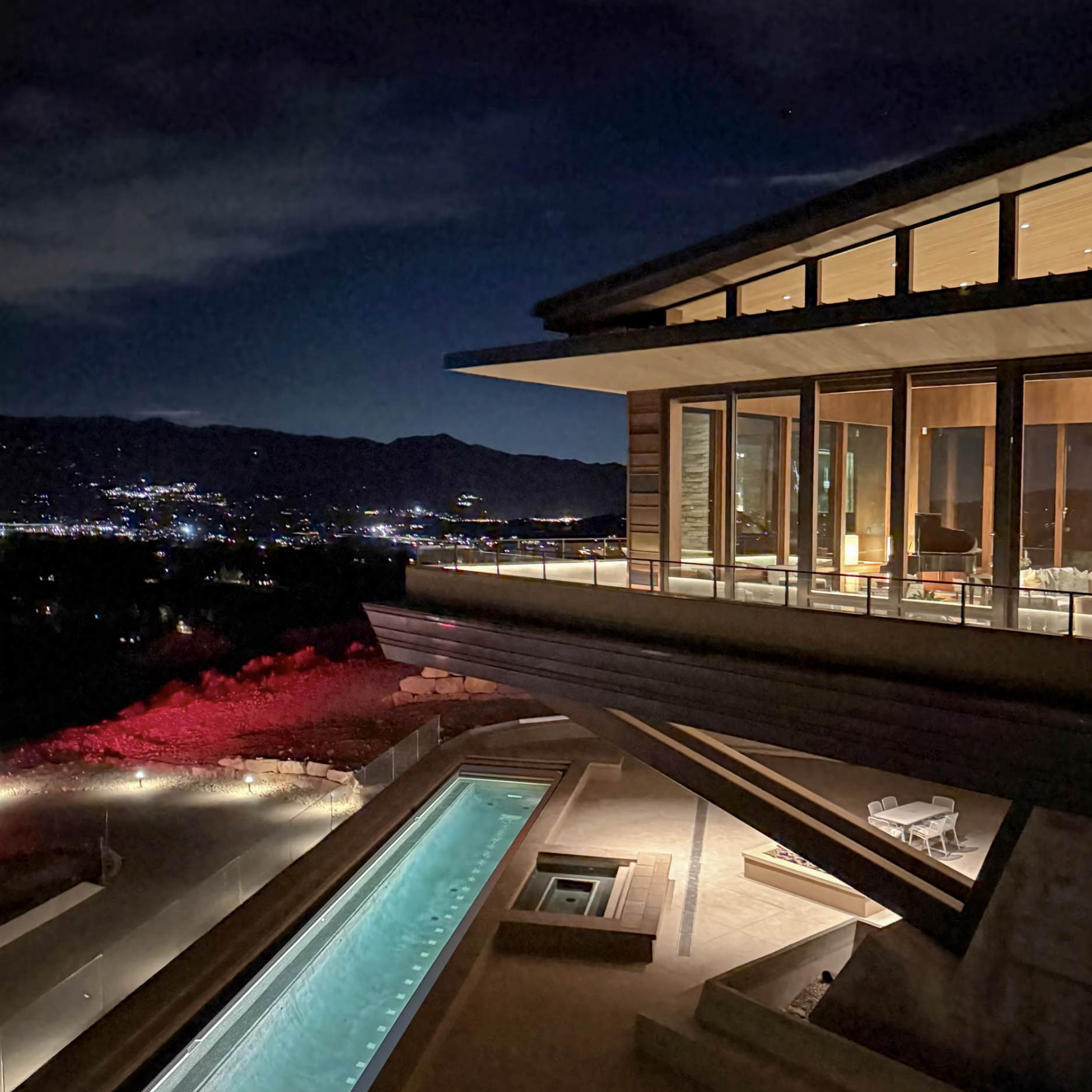
‘Full House’ Creator’s L.A. Mansion, Complete With a 35-Foot Waterslide, Relists for $50 Million
Screenwriter and TV producer Jeff Franklin built the lavish residence on the homesite where the 1969 Manson Family murders took place.

 2 min
2 min
A Beverly Hills megamansion, complete with a backyard grotto and a lazy river, that was built by “Full House” creator Jeff Franklin is returning to the market with a multimillion-dollar price cut.
The Southern California home will list on Wednesday for just shy of $50 million, a more than 40% price cut from its initial asking price of $85 million from 2022.
The home has also been occasionally available for rent, asking as much as nearly $250,000 a month.
It sits on the site where Sharon Tate and four others were murdered by the Manson Family in 1969.
That since-demolished home, which Tate and her husband, director Roman Polanski, were renting from music producer Terry Melcher, was torn down in the mid-1990s by a developer, from whom Franklin bought the property before it was completed, according to The Wall Street Journal.
Franklin took the developer’s partially built house and tore it down to the studs to build his own custom home, working with “King of the Megamansion” Richard Landry to do so. The mansion, which has been Franklin’s primary residence for nearly two decades, was completed in 2006.
Dubbed Villa Andalusia, the 21,000-square-foot megamansion combines Andalusian style with South-Asian influences, which was a “fun design challenge,” Landry said in a statement. Listing agent Adam Brawer of Compass likened the home’s design and scale to a palace.
“The interiors combine my love of European architecture and Asian culture, but curated to maximize the California lifestyle,” Franklin wrote in an email.
Amenities throughout the home range from a wood-paneled billiards and poker room to a large aquarium dividing the sitting room and dining room—fish included in the sale.
“It feels like a James Bond villain’s lair,” Brawer said. “Architecturally, it feels like a throwback to a much older time, except it has all the creature comforts of 2025—it’s fully smart.”
With 3.6 acres, the mansion sits on an unusually large lot for Beverly Hills Post Office. It also has wide-ranging views, overlooking the entirety of the city to the Pacific Ocean, and as far as Pasadena on a clear day, Brawer said. Both the property size and its views are what attracted Franklin to it.
“I loved the spectacular views, and the size of the lot allowed me to be creative in designing the unique backyard oasis,” Franklin said.
That backyard oasis is made up of two pools —a wading pool and an infinity pool—which are connected by a lazy river.
Each pool has its own hot tub, with the wading pool’s tucked into a grotto behind three waterfalls. A 35-foot waterslide flows into another waterfall—there are six in total, and there’s also a koi pond, a fire pit and a swim-up bar.
“This is one of the most exciting pools we have ever designed,” Landry said.
Franklin built the home—which has nine bedrooms and 18 bathrooms—with hosting large gatherings in mind, Brawer said.
In addition to the lavish backyard, there are also multiple bars, a game room and a home theater inside, and many of its living spaces lead directly out to the backyard. There’s also two garages, including one underground, and a large motor court, allowing the property to fit at least 20 cars.
Franklin, 70, created the sitcom “Full House” in 1987 and served as showrunner until 1992. He also created its sequel series, “Fuller House,” for Netflix in 2016. Franklin previously owned the San Francisco house that was used for the exterior of the Tanner family home in “Full House.” He remodeled it, also with Landry, and sold it in 2020.
 Copyright 2020, Dow Jones & Company, Inc. All Rights Reserved Worldwide. LEARN MORE





Australian shares fell on Thursday as Wall Street weakness, rising oil and persistent rate concerns weighed on most of the market. The S&P/ASX 200 declined 0.72 per cent to 8,702. The All Ordinaries lost 0.66 per cent to finish at 8,897. Mining stocks were hit particularly hard, while real estate also dragged on the index. …
Continue reading “ASX falls 0.7 per cent as miners and property stocks retreat”

Borrowers cannot control the Reserve Bank, but they can control how exposed their household budget is to its next decision. The RBA meets on 29 September with inflation concerns still elevated and major-bank economists increasingly bringing forward their rate-rise calls. Fixed mortgage rates have also been moving, reducing the value of waiting for perfect certainty. …
Continue reading “What mortgage holders should do before the next RBA decision”

A five-bedroom Palo Alto home designed by Steven Ehrlich is listed for $44 million, making it the city’s most expensive listing. Built around a dramatic concrete spine, the home features four courtyards and a pool.
3 min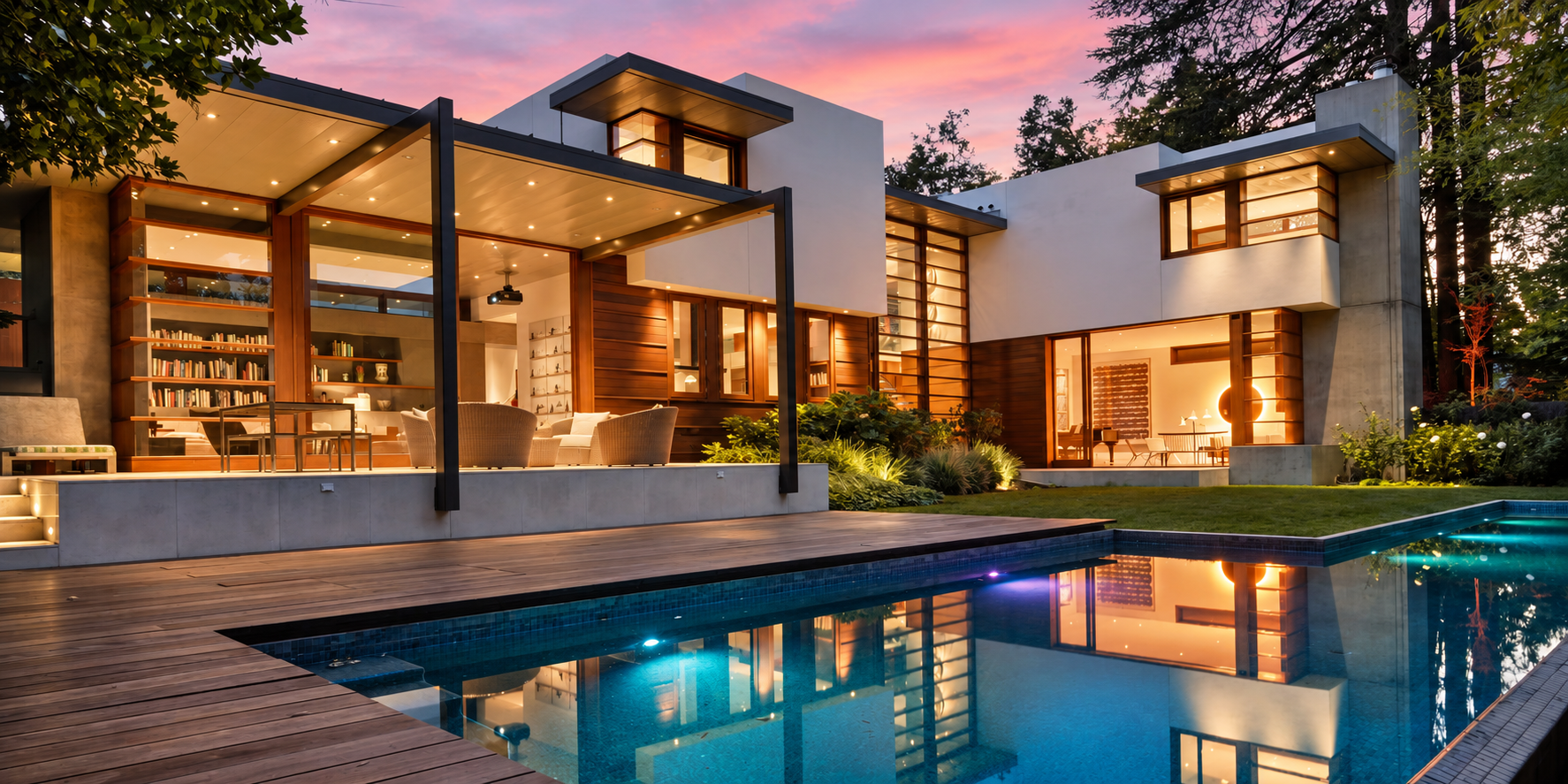
For years, tech entrepreneur Asher Waldfogel and his wife, Helyn MacLean, dreamed of building a modern house in Palo Alto, Calif.
The couple, however, worried about clashing with the Mediterranean-style architecture typically associated with their neighborhood of Old Palo Alto.
So they tapped architect Steven Ehrlich to create a design that paid homage to its surroundings with stucco, mahogany and titanium zinc cladding. They spent $20 million over several years building the house, completed in 2005.
Now looking to be closer to their adult daughter on the East Coast, they are putting the five-bedroom home on the market for $44 million—the most expensive listing in Palo Alto.
Waldfogel is an angel investor who co-founded Redback Networks, a telecommunications-equipment company. MacLean previously had a career in fundraising.
The couple purchased the roughly 0.4-acre site for $7.1 million in 2000 and demolished a circa-1930s Spanish Colonial home. The house they built pinwheels around a central staircase. It has 7,900 square feet of livable space, with four distinct courtyards and a pool.
A key feature of the home is a cast-in-place concrete wall, or spine, that is two stories high and about 80 feet long. “There’s a little bit of controlled chaos in what comes out of the form,” unlike a perfectly uniform surface, Waldfogel said. “If you want that, you do it in plastic.”
Waldfogel said he and his wife are thinking about the next phase of life now that their daughter is grown, although they have not decided where they will move. They also have a home in Sun Valley, Idaho.
“Right now we’re just trying to emotionally let go and decide what to do next,” he said.
Palo Alto, an epicenter of venture capital and tech startups in Silicon Valley, is home to some of the country’s biggest tech titans. Sales volume and prices are rising, with a median sale price of $3.5 million for the three months ending in August, up 5.8% year-over-year, according to real-estate brokerage Redfin.
Arthur Sharif of Sotheby’s International Realty—San Francisco Brokerage has the listing.

On October 2, acclaimed chef Dan Arnold will host an exclusive evening, unveiling a Michelin-inspired menu in a rare masterclass of food, storytelling and flavour.
From warmer neutrals to tactile finishes, Australian homes are moving away from stark minimalism and towards spaces that feel more human.