Beauty Slowdown Reflects Cracks in Consumer Spending

Makers of consumer goods have been bracing for a slowdown in consumer spending after ebullient pandemic times. Ulta Beauty is now saying that the decline is happening faster than it expected.

The entire beauty category is experiencing weaker spending across price points and product segments, said Dave Kimbell , Ulta’s chief executive, at an investor conference Wednesday. The retail chain is among beauty companies that reported strong growth in revenue and profits over the past three years as consumers stepped up purchases of makeup, perfumes and skin-care items.

“Things that are going on in our consumers’ lives has led to a bit slower growth than we had anticipated in the category,” Kimbell said.

Ulta also isn’t expecting much growth in comparable sales in the current quarter from the first quarter last year. Comparable sales reflect sales at Ulta stores open at least 14 months and from e-commerce.

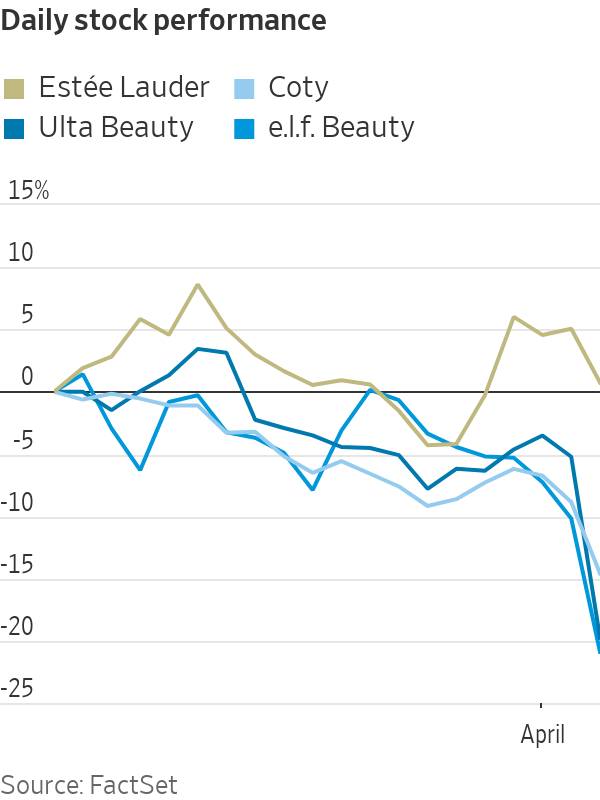
The comments helped send Ulta shares down 15% in Wednesday trading. Other beauty companies, including e.l.f. Beauty , Coty and Estée Lauder , also fell.

Ulta’s shares have lost about a fifth of their value after closing at a record of $567.18 on March 13, the day before the company released its fourth-quarter earnings.

“We do expect a normalisation to occur this year in the category,” said Jessica Ramirez , senior research analyst at Jane Hali & Associates. “However, we believe the consumer will continue to prioritise the beauty category as products across skin care and wellness are replenishable.”

The competitive landscape is also shifting in beauty. Sephora, the LVMH Moët Hennessy Louis Vuitton -owned rival to Ulta, is expanding its bricks-and-mortar presence in Kohl’s stores. Other retailers are also increasing their presence in the beauty business, Ulta executives said. New products are expected to help drive traffic to Ulta, including those from tennis star Serena Williams ’s new line Wyn Beauty, executives said.

U.S. retail sales are expected to rise this year from 2023, but at a slower pace than during the Covid-19 pandemic period, according to the National Retail Federation. The trade group forecast that retail sales would increase between 2.5% and 3.5% this year, just below the 10-year average of 3.6% before the health crisis.

“The foundation of the economy is relatively sturdy and still on a sustainable path,” NRF Chief Economist Jack Kleinhenz said Wednesday. “Barring unexpected shocks, it should continue growing in 2024, although not spectacularly” as a result of slower job and wage gains.

Other consumer-goods companies are bracing for a slowdown. PVH , the company behind brands Calvin Klein and Tommy Hilfiger, said on Tuesday that it has taken a cautious approach to planning in 2024 as a result of softer consumer spending in January and February. It forecast overall revenue this year would fall between 6% and 7% from 2023.

Property versus Shares: which is a better investment in 2025?

Stocks v Property

For those on the hunt to find the perfect investment opportunity in 2024, two of the main sources of potential investment income to consider are shares, and the property market. The latter, currently, is gaining momentum again in Australia, coupled with stabilising interest rates, and inflation on a downward trend compared to this time last year.

On the other hand, if  entering the property market is out of the question right now and you’d rather start small, investing in shares is a great alternative to consider. Naturally, there are always going to be dangers and risks associated with any type of investment, be it property or shares, but with some research and guidance, you’ll be better suited to make a decision.

“One thing all investors should do in the beginning is understand the asset class they want to invest in. If your personal interest is in building a property portfolio, then researching property investing and understanding the ins and outs is key,” David Pelligra, director & mortgage broker at Wealth Point Lending, says. 

“The same goes for shares. If you are someone who enjoys the nuances of the share market and the inner workings of a publicly listed company, then again, researching that particular part of the market is important. My biggest piece of advice when investing is to speak with professionals that understand the market you are wanting to invest into.”

So, in 2024, which is your best option for starting your investing journey? What are the pros and cons of each? These are the questions you must ask before investing your money in either sector.

What are the pros of investing in shares?

The idea of investing in shares as a means for potentially earning high returns has long enticed those looking to increase their capital growth over a long period of time. Shares also present the opportunity for ownership in companies with shareholders enjoying particular voting rights and dividend potential. Those who invest in shares often have a degree of flexibility and control, which is a comfort when investing large sums of money. For example, should you wish to access your funds at any point in time, often you can do so instantaneously. This cannot be done with property.

“Shares are a liquid asset, meaning you can sell parts or all of your portfolio, allowing for quick access to cash,” Pelligra says.

When investing in shares, individuals — novice or otherwise — should consider adding blue chip shares to their portfolio. These are shares issued by a large corporation, often one of notoriety, with an excellent reputation and experience in market capitalisation. Blue chip shares are often safe and risk-adverse, however any financial gain is usually in the long-term.

What are the cons of investing in shares?

As Warren Buffett once said, “the first rule of an investment is don’t lose (money). And the second rule of an investment is don’t forget the first rule. And that’s all the rules there are.”

Despite their advantages, it’s essential to remember that investing in shares also carries with it risks, including the potential for the loss of capital. Price volatility is also another important factor to consider — where shares prices rise and fall rapidly over the space of days or months. Those who invest in high risk shares — although seeking higher returns in a short amount of time — have to be prepared that they could lose a large sum of money depending on which way the market swings.

Naturally, when endeavouring to invest in shares, it’s important to conduct thorough research. This includes seeking advice from financial professionals before making large investment decisions.

What are the pros of investing in property?

Somewhat a no-brainer, investing in property offers a number of benefits, from capital growth (should the property rise in value over time), through to reduced volatility (historically, property prices only go up). If you’re planning on owning a property as an investment—and plan on leasing it—you can generate continual cash flow to cover your property expenses. Unlike shares, investing in property is a physical endeavour, in that it’s something people can see and touch, which is always favourable.

For those that are looking long-term and don’t necessarily need the instant cash flow (yield) renting a property can provide, investing in property for capital gain is also a great way to increase your finances considerably. Depending on where you buy, residential properties have the potential to rise in value in a relatively short period of time, and as a result, can offer owners a significant gain should they look to divest at the right time.

“Investing comes with an inherent risk, but the key is to look at past performance. Property, for example, has consistently performed in Australia for the last 30 years, so you could feel quite safe if you were investing,” says Pelligra.

“Property is also a physical asset that you can either live in, or earn an income from if you are to rent it out.”

What are the cons of investing in property?

There are a number of potential pitfalls that come with investing in property. No one can predict where the property market is going to go, whether interest rates will rise or fall, and if you plan on renting your property, whether your tenants do the right thing in the way of upkeep, making regular payments, and so forth. Properties can also have additional costs attached, such as maintenance, repairs and upgrades, as well as insurance. For those looking to gain capital on an investment property they don’t live in, you also need to consider the capital gains tax, which naturally reduces savings and investment incentives.

Of course, there are ways of mitigating the risks of investing in property by doing thorough research, and speaking to the professionals who can assist you on your journey.

—

All commentary made is considered general advice. It is recommended to seek financial advice from a professional before making decisions associated with investing.


Inflation Victory Is Proving Elusive, Challenging Central Banks and Markets

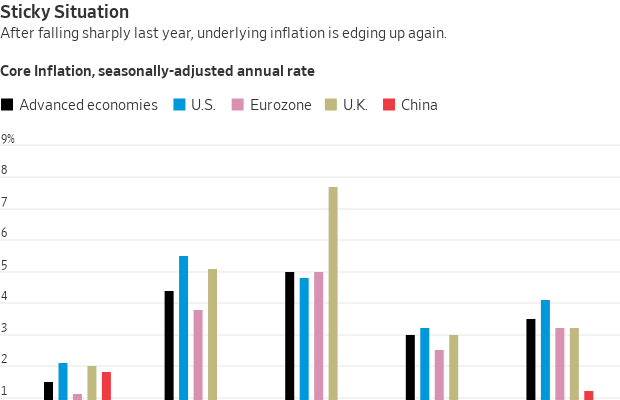
Inflation is proving stickier than expected in the U.S. and Europe, creating a headache for central bankers and sowing doubts on whether investors are too optimistic about the world economy.

The decline in inflation from highs of around 9% to 10% across advanced economies in 2022 represent the easy gains, as supply-chain blockages eased and commodity prices, especially for energy, normalised.

The “last mile” is proving tougher . Underlying inflation, which excludes volatile food and energy prices, slowed to 3% in the second half of last year across advanced economies but has since moved up to 3.5%, according to JP Morgan estimates.

That is forcing investors to rethink bets that inflation would steadily decline to central banks’ targets, generally around 2%. There are even concerns it could surge again, mirroring the second wave that characterised the high inflation of the 1970s.

Economists’ and central banks’ forecasts of sustained falling inflation depend on “strong gravitational forces that are not yet validated in global labor costs, short-term expectations, or in recent signals from commodity markets,” JP Morgan wrote in a note. Services inflation remains elevated while goods prices, which had fallen last year, are now moving higher, it noted.

Waiting on the last mile

Central bankers say they expected the last mile of falling inflation to be bumpy. Yet they are also signalling their willingness to wait before cutting interest rates. Fewer, or no, rate cuts would have sweeping repercussions for the global economy and markets, whose recent rally began after a narrow majority of Federal Reserve officials recently reaffirmed projections to cut interest rates three times this year.

On Friday, the U.S. Commerce Department reported that the price index of personal-consumption expenditures, the Fed’s preferred indicator of inflation, rose a relatively tame 2.5% in the 12 months through February, up modestly from 2.4% in January. Beneath the surface, the trend was less comforting. The index excluding food and energy climbed by 3.5% on an annualised basis in the three months through February, up from around 2% late last year.

“These shorter-term inflation measures are now telling me that progress has slowed and may have stalled,” Fed governor Christopher Waller said in a speech Thursday, before the latest inflation data.

“In my view, it is appropriate to reduce the overall number of rate cuts or push them further into the future,” Waller said.

Fed Chair Jerome Powell struck a more balanced note Friday, saying inflation is on a sometimes bumpy path toward 2%, and strong economic growth allows policymakers to wait. “Is progress on inflation going to slow for more than two months?…We’re just going to have to let the data tell us that,” Powell said in an interview at the San Francisco Fed.

Joachim Nagel , president of Germany’s Bundesbank and a member of the European Central Bank’s rate-setting committee said in late February that underlying inflation in the eurozone was still 2 percentage points higher than its 1999 to 2019 average.

“If we reduce interest rates too early or too sharply, we run the risk of missing our target,” and might need to raise interest rates again, he said. He highlighted a recent International Monetary Fund report that found four out of every 10 inflation shocks since the 1970s had yet to be overcome even after five years.

In Italy, underlying inflation climbed to 2.4% in March from 2.3% the previous month, according to data published Friday. French headline inflation cooled to 2.3% in March, but services prices remained sticky, rising by 3% from a year earlier.

Why is inflation proving stubborn?

Despite the sharp interest-rate increases of the past two years, economic growth is resilient, especially in the U.S. The Atlanta Fed said Friday its real-time indicator of first quarter U.S. economic growth ticked up to 2.3% from 2.1%. Consumer spending, adjusted for inflation, increased by around 5% on an annual basis in February, the Commerce Department said.

“The unexpected strength of real consumption” means “there is still no rush to cut interest rates,” said Paul Ashworth , an economist with Capital Economics.

While Europe’s growth has stalled since late 2022, recent business surveys suggest the outlook is brightening. Meanwhile, job creation has been strong on both sides of the Atlantic, and wage growth remains high, partly reflecting tight labor markets. Wages are an important input to services-price inflation in the eurozone, which has been running at a 4% annual rate since November.

March inflation data for the entire eurozone will be published on Wednesday. ECB officials have indicated they could start to cut interest rates in June from the current 4% level, while the subsequent pace of cuts after that is unclear.

Central banks may be part of the problem

Central banks themselves may be inadvertently adding to inflation pressure. By signalling a pivot toward interest-rate cuts last fall, they pushed global borrowing costs down and asset prices up, supporting spending.

Some factors favour inflation declining further. In both the U.S. and Europe, a surge of immigration could help keep a lid on wage increases.

The U.S.—but not Europe—is also seeing big increases in productivity, that is output per worker, which helps to offset high wage growth. It is unclear, however, how long that will last. The pandemic might have changed how Americans work and use technology, but “once we have made those changes, they’re done, so I don’t see this as a driver of sustained productivity growth,” the Fed’s Waller said.

Meanwhile, oil prices have risen recently, which could push up headline inflation.

To offset a slumping property market, China has dramatically boosted manufacturing capacity and exports, which have weighed on global goods inflation. But its export prices have recently started to increase, according to JP Morgan.

If central banks react to stubborn inflation by backing away from rate cuts, that would put pressure on both heavily indebted governments and employers. That could test central banks’ will to finish the last mile and push inflation all the way to target.

Higher government spending on defence and green energy, and geopolitical tensions that crimp global trade, are likely to pressure central banks to tolerate higher inflation over the coming years, according to a Brookings Institution paper published in March.

“A strengthening of central bank independence combined with a more credible public debt policy is likely needed,” said the paper, by economist Kenneth Rogoff of Harvard University and three co-authors.

The Psychologist Who Turned the Investing World on Its Head

Daniel Kahneman explained investors to themselves.

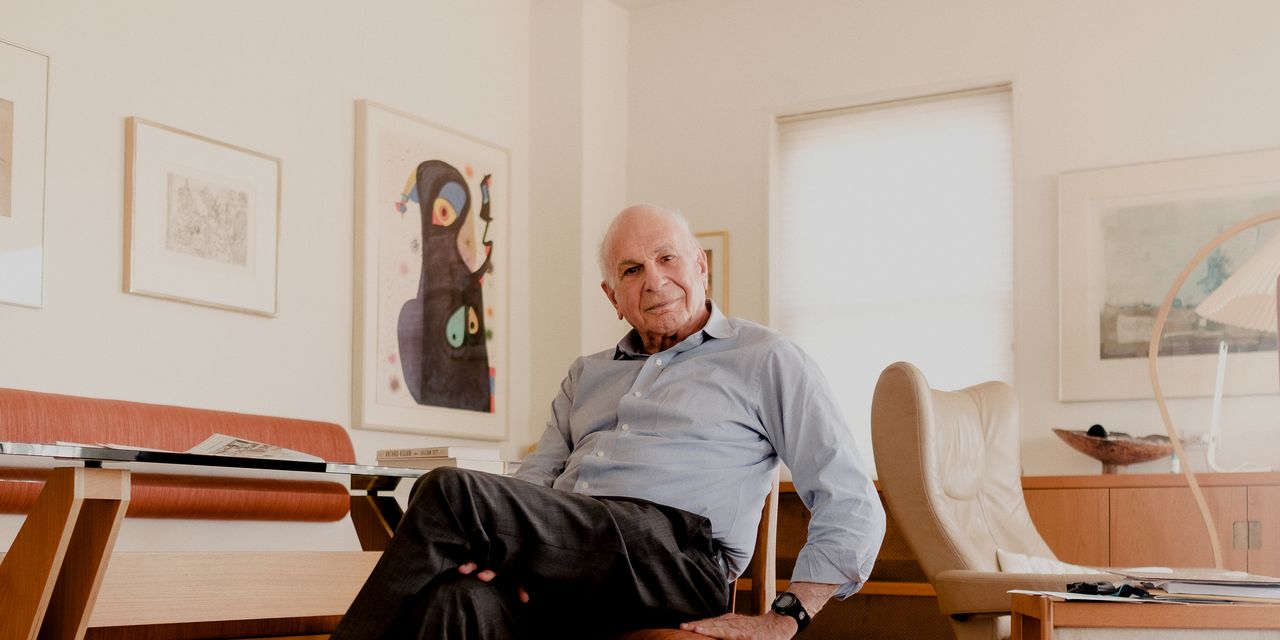
A psychologist at Princeton University and winner of the Nobel Prize in economics, Kahneman died on March 27, age 90.

Before the pioneering work done by Kahneman and his research partner, Amos Tversky, who died in 1996, economists had assumed that people were “rational,” meaning we are self-interested, use all available information to make unbiased decisions, and our preferences are consistent.

Kahneman and Tversky showed that’s nonsense. Their findings, directly or indirectly, inspired change across the business world, including the redesign of organ-donation programs and improvements in planning for multibillion-dollar infrastructure projects .

Kahneman was a pioneer of what became known as behavioural economics, although he always saw himself as a psychologist. Investors who take Kahneman and Tversky’s lessons to heart can minimise fees, losses and regrets. Kahneman may well have had more influence on investing than anyone else who wasn’t a professional investor.

I first met Danny, as everyone called him, at a conference on behavioral economics in 1996. For years, as an investing journalist, I had wondered: Why are smart people so stupid about money?

About five minutes into Danny’s presentation, I realized he had the answers—not only to that question, but to nearly every mystery of financial behavior.

Why do we sell our winners too soon and hang onto our losers too long? Why don’t we realize that most hot streaks are just luck? Why do we say we have a high tolerance for risk and then suffer the torments of the damned when the market falls? Why do we ignore the odds when we know they’re stacked against us?

Danny paced softly back and forth at the front of the room, his blue-green eyes sparkling with amusement as he documented these behaviors and demolished conventional economic theory.

For decades, he and Tversky had conducted experiments, almost childlike in their simplicity, to see how people really think and behave.

No, Danny said, money lost isn’t the same as money gained. Losses feel at least twice as painful as gains feel pleasant. He asked the conference attendees: If you’d lose $100 on a coin toss if it came up tails, how much would you have to win on heads before you’d take the bet? Most of us said $200 or more.

No, people don’t incorporate all available information. We think short streaks in a random process enable us to predict what comes next. We think jackpots happen more often than they do, making us overconfident. We think disasters are more common than they are, making us suckers for schemes that purport to protect us.

Ask people if they want to take a risk with an 80% chance of success, and most say yes. Ask instead if they’d incur the same risk with a 20% chance of failure, and many say no.

Noting that the stocks people sell outperform the ones they buy, Danny joked that “the cost of having an idea is 4%.”

I wasn’t just struck by his insights; I was stricken by them. I immediately bought all three of the books he had edited. For days, I sat in a windowless room, reading feverishly, red pen in hand, scribbling notes, underlining entire paragraphs, peppering the margins with arrows and exclamation points.

In 2001, a year before Danny won the Nobel, I wrote a long profile of him .

“The most important question to ask before making a decision,” he told me, “is ‘What is the base rate?’”

He meant you should begin every major decision by figuring out the objective odds of success, given the historical range of outcomes in similar situations.

If you’re thinking of starting a new business, your gut might tell you there’s no way you can fail. According to the Bureau of Labor Statistics, however, half of new businesses die within the first five years . That base rate comes from millions of startups, each of which also expected to succeed. You, on the other hand, are a sample of one.

Knowing that the base rate is 50/50 shouldn’t deter you from trying, but it should prevent you from being unrealistically optimistic.

Danny knew base rates weren’t quite everything. He told me that before he proposed to his second wife, Anne Treisman, he said to her: “I’m Jewish, you’re not. I’m neurotic, you’re not. Almost half of all marriages end in divorce. The base rates are against us.”

“Oh, who cares about base rates!” she replied. Their marriage lasted four decades; Treisman died in 2018.

In 1969, Danny was teaching at the Hebrew University in Jerusalem when he asked Tversky, a mathematical psychologist and colleague there, to visit his class.

In his guest lecture, Tversky argued humans aren’t that bad at estimating risks and probabilities.

“I just don’t believe it!” exclaimed Danny, who was studying visual perception. He already believed that just as optical illusions fool the eye, cognitive illusions fool the mind.

The two men continued their debate over lunch—and for many years after . Amos was organised, confident, quantitatively brilliant. Danny was untidy, self-doubting, astoundingly intuitive. Together, they were intellectual lightning in a bottle.

In 1971, to decide whose name would be listed as lead author on the first scientific paper they published together, the two men flipped a coin. Over the next quarter-century, they published more than two dozen papers together.

In 2006, Danny asked me to help him write a book . I auditioned for a few months, coming up with several different proposals for how to structure the project. We finally got started in early 2007.

What eventually emerged was “ Thinking, Fast and Slow ,” published late in 2011: an internationally bestselling memoir that also offered an encyclopedic explanation of how the human mind works.

Early on, Danny took me to lunch with his wife near the Princeton campus. When he stepped away, I asked Anne, “Do you think Danny is crazy for wanting to do this book with me?”

“No,” she said. “But you might be crazy for wanting to do it with him.”

In the beginning, I wrote the first drafts of chapters that never saw the light of day. Gradually, Danny took over the writing, agonizing over every sentence, as I rewrote and edited.

Late in 2007, as we were polishing the chapter called “The Illusion of Validity,” I woke up one night in an icy sweat, pulse racing, gasping for air. My wife rushed me to the emergency room. It turned out I hadn’t had a heart attack; I’d had a panic attack, the only one in my life before or since.

Danny was even more alarmed than I was.

In 2008 I moved on, joining The Wall Street Journal. Neither of us would ever publicly discuss our book divorce; Danny finished the final third of the book without me.

“Collaborations don’t always end well,” he’d warned me on our first day of work together, “so I want to make sure you will always think of me as a mensch,” a good person.

And so I do—the most complicated mensch I’ve ever known.

Working on the book exposed me to three of Danny’s qualities I hadn’t previously encountered in their full intensity. Only years later did I realize that I’ve internalized them as a journalist and an investor. Or so I hope.

First, Danny saw everything through a child’s eyes or, as some people call it, “beginner’s mind.” No one else I’ve ever known has so often asked: Why? Instead of assuming the status quo is valid, Danny always started by wondering whether it made any sense.

He was also relentlessly self-critical. I once showed him a letter I’d gotten from a reader telling me—correctly but rudely—that I was wrong about something. “Do you have any idea how lucky you are to have thousands of people who can tell you you’re wrong?” Danny said.

Finally, Danny could rework what we had already done as if it had never existed. Most people hate changing their mind; he liked nothing better, when the evidence justified it. “I have no sunk costs,” he would say.

One of his favorite words, while working on the book, was “miserable.” He used it to describe whatever we had just written; the process of writing a book; and, above all, himself.

Danny’s misery was largely rooted in the decades he and Amos had spent exploring the failings of the human mind by picking apart their own errors of thought and judgment.

Taking the outside view on everything else had given Danny the outside view on himself. He embodied the ultimate form of self-knowledge: to distrust yourself above all.

He knew full well how smart he was, but he also knew how foolish he could be. Noticing that he intuitively stereotyped a bespectacled child as “the young professor,” Danny realized people extrapolate the future from almost no data at all. After buying an expensive apartment, he laughed at knowing that he would also overpay to furnish it.

Born in 1934 in what today is Tel Aviv, Israel, while his mother was visiting there, Danny was raised in France. He spent much of his childhood hiding from the Nazis in barns and chicken coops in the French countryside.

He insisted that didn’t explain much about him; after all, not every survivor of the Holocaust had become a self-critical psychologist fascinated by financial behavior.

Instead, he credited his success to hard work—but even more to luck, especially meeting Tversky.

Danny also insisted that studying the pitfalls and paradoxes of the human mind didn’t make him any better at problem-solving than anybody else: “I’m just better at recognising my mistakes after I make them.”

For all his knowledge of how foolish investors can be, Danny didn’t try to outsmart the market. “I don’t try to be clever at all,” he told me. Most of his money was in index funds. “The idea that I could see what no one else can is an illusion,” he said.

“All of us would be better investors,” he often said, “if we just made fewer decisions.”

Knight Frank and Bayleys make bid to buy out Australian real estate giant

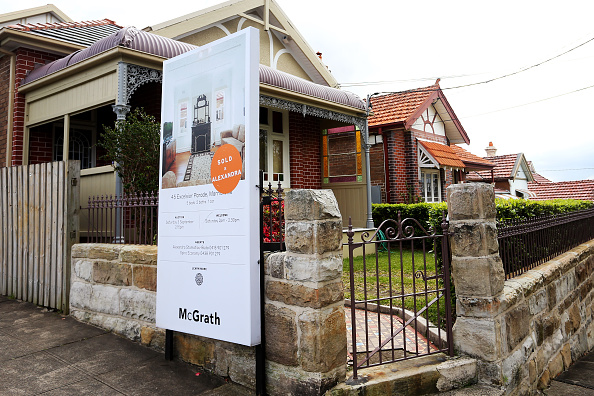
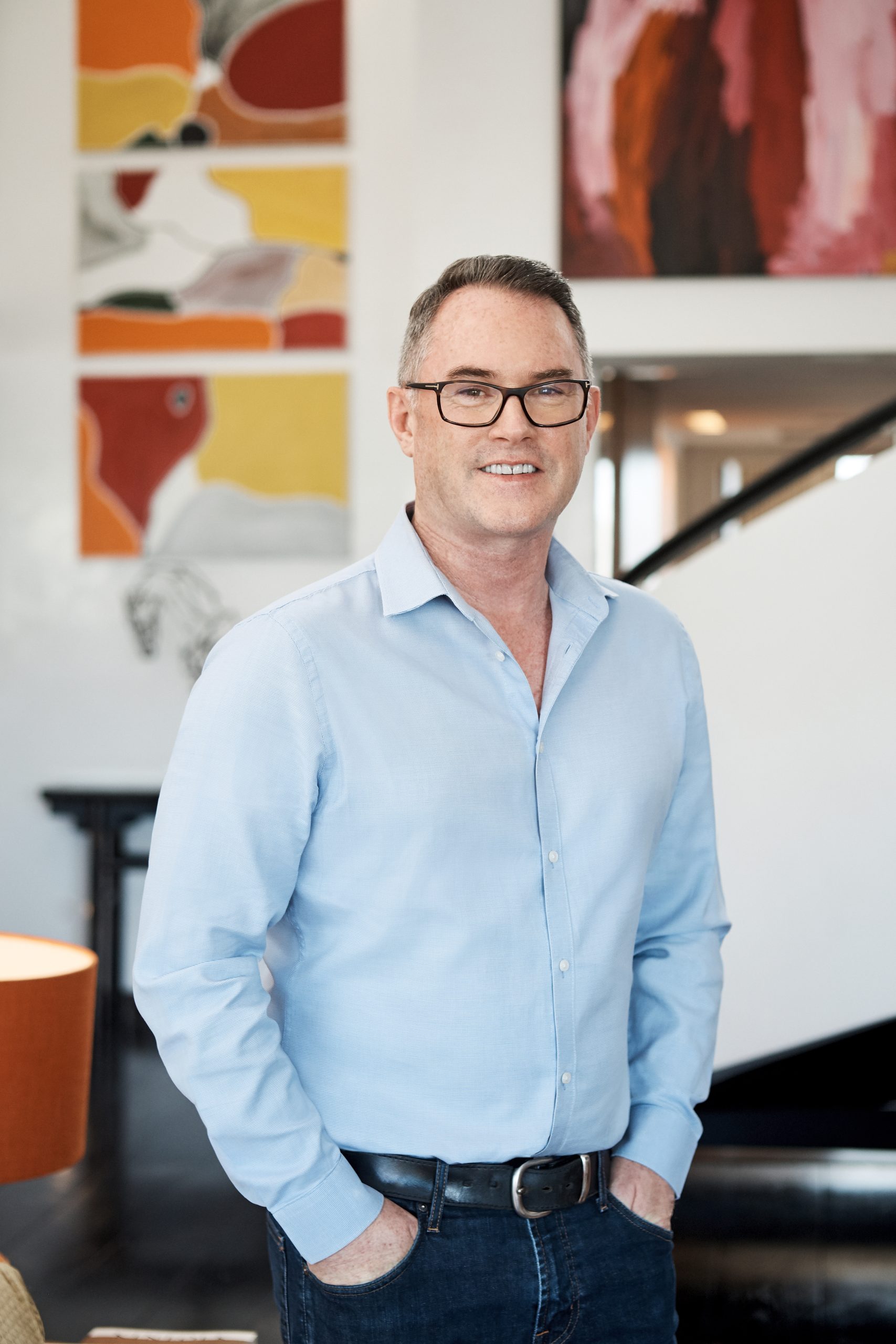
Australian real estate industry leader John McGrath and the board of ASX-listed McGrath Limited are backing a $95.5 million buyout offer from a consortium comprising global property behemoth Knight Frank and New Zealand’s largest full-service real estate group, Bayleys.

McGrath has entered into a scheme implementation deed through which the consortium would acquire 100 percent of McGrath’s share capital by way of a scheme of arrangement.The consortium has offered to buy McGrath at 60 cents per share, which is a 27.7 percent premium on the closing price of McGrath shares the day before the announcement. Shareholders can also elect to receive an unlisted scrip alternative or a combination of both instead.

McGrath founder and CEO, John McGrath intends to elect to receive the unlisted scrip alternative for his stake, which represents about 23.3 percent of McGrath stock on issue. The McGrath board, which holds or controls about 48.1 percent of issued stock, unanimously recommends that shareholders vote in favour of the scheme — unless there is a superior proposal — and subject to an independent expert concluding the deal is fair and in shareholders’ best interests.

Under the deal, Mr McGrath would continue in his role as CEO and managing director. Mr McGrath said he was looking forward to taking advantage of the opportunities available through his new international partners, with whom he said his agency shares “common values and cultures”. Mr McGrath said the network’s franchisees, agents and customers would benefit from the consortium’s global networks, expertise and access to high-net-worth clients.

John McGrath will stay on as CEO and managaing director

The scheme is subject to conditions, including approval by McGrath shareholders at a scheme meeting, which will likely be held in June. If the scheme is implemented, McGrath will be delisted from the ASX. The McGrath board is entitled to declare and pay a dividend prior to the scheme’s implementation, in which case the scheme consideration would not be reduced by the cash amount of the dividend.

Knight Frank CEO of Australia, James Patterson, said: “The acquisition would allow Knight Frank to have a leading position in residential and commercial real estate in Australia, creating a full-service real estate capability to support and advise clients and customers.”

Mr Patterson said the three brands would continue to operate as they are now under the deal. Bayleys managing director, Mike Bayley, commented: “The ability to share ideas and innovations as well as systems and information will add considerable value to our clients across Australasia.”

McGrath was founded in 1988 and listed on the ASX in 2015. A scheme booklet will be prepared and lodged with the Australian Securities and Investments Commission for review in due course. Meantime, shareholders can review further details in an investor presentation lodged with the ASX.

The Three-Row 2025 Infiniti QX80 Makes a Sky-High Debut in New York

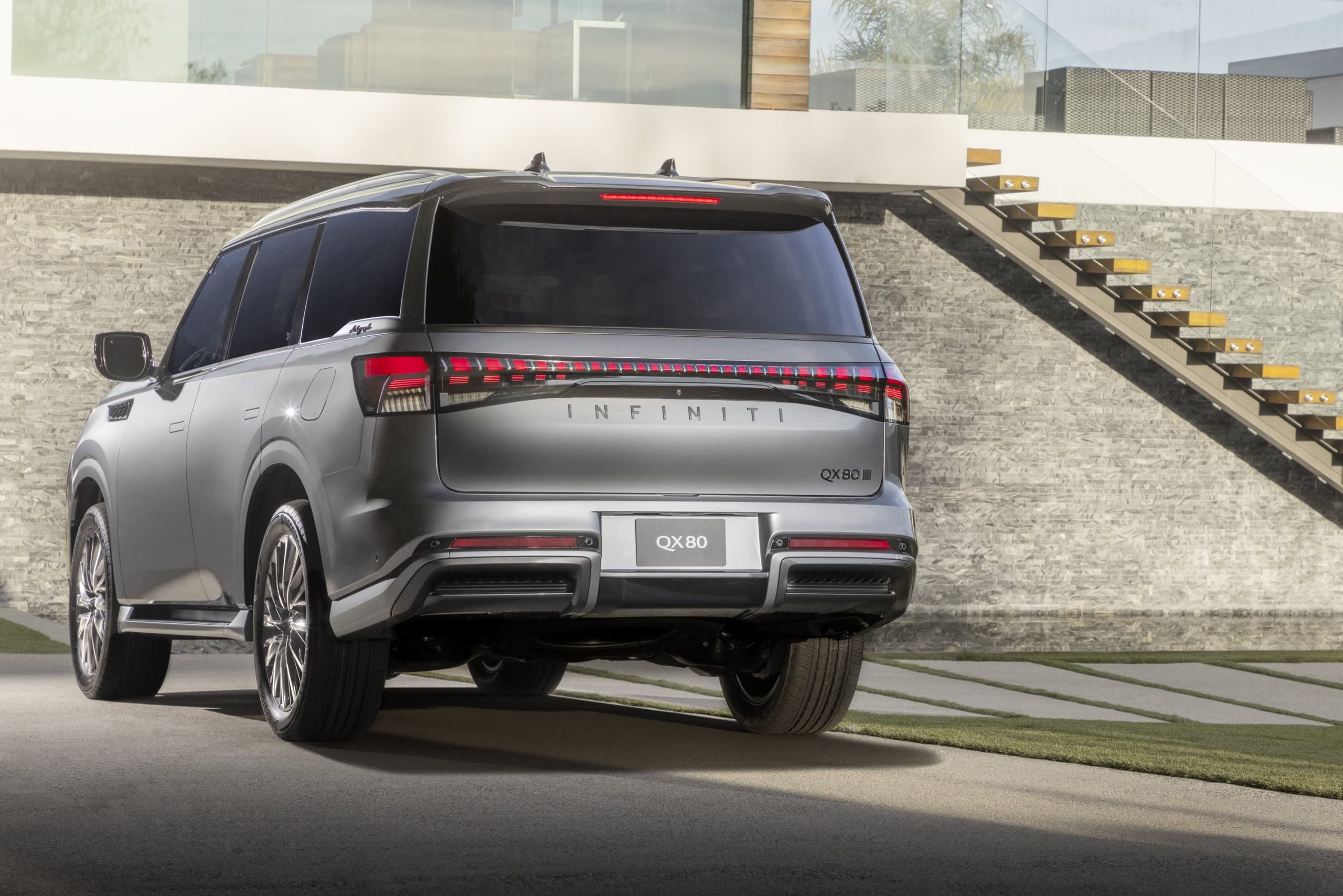
The 2025 Infiniti QX80, which will go on sale towards the end of summer, made a high-flying global debut in Manhattan last month.

The huge, three-row SUV was cut up into pieces then transported via elevator to the 100th floor observation deck of the Edge at Hudson Yards. The Infiniti, the first car to be so ensconced, was revealed 1,100 feet up amid flashing colour lights in partnership with iHeartMedia in a live stream as night descended on New York City. Later, five-time Grammy winner singer/pianist Jon Batiste entertained a group that included executives and dealers.

Luxury three-row SUVs have turned into an important segment, including electric entries such as the seven-passenger Kia EV9 and Cadillacs Escalade IQ and Vistiq (coming as a 2026 model). The QX80 isn’t electric; it’s powered by a 3.5-litre twin-turbo V6-rated engine with 450 horsepower and 516 pound-feet of torque. That’s up 50 horsepower and 103 pound-feet from the current QX80. The nine-speed automatic transmission is shifted with piano key buttons.

Prices start at US$82,450 for the Pure rear-wheel drive version, and soar to US$110,595 for the Autograph all-wheel drive (with four iterations in between). At the launch, Craig Keeys, group vice president of Infiniti Americas, described the QX80 as “our new flagship, pushing the envelope from ordinary to extraordinary.” Keeys didn’t mention the twin-turbo V6 power, and the other speakers skipped over it too—the QX80 is all about luxurious refinements and tech innovations.

Prices for the large, luxury three-row SUV start at US$82,450.
Infiniti

For instance, heated and cooled seats for the first two rows are available, as is massaging in the second row. Upscale Autograph buyers get rear climate controls via touchscreen. Much mentioned at the launch was the segment-first availability of biometric cooling, which monitors second-row passengers body temperatures and automatically adjusts the climate controls and air flow to that section. So, if mom picks up an overheated soccer player, he or she will be cooled down while other passengers and the driver stay steady.

And then there’s the top of the line 1,200-watt, 44-speaker Klipsch premiere audio system with a 24-channel amplifier and, among other things, titanium tweeters and speakers in the roof. Other carmakers have big stereos, too, but this one has something called Individual Audio, which directs phone calls and navigation to the front headrest speakers without interrupting the cabin’s music. Or the driver can listen to sounds directed only at him or her, without waking up sleeping passengers.

The interior on the QX80 is decidedly upscale, with leather, wood, suede, and metal elements. There are two 14.3-inch displays. The driver’s screen has three separate views, and there is a nine-inch touchscreen below the infotainment display with climate functions and a haptic element to let users feel when their fingers are on the correct virtual button. A colour head-up display is available. When drivers approach their QX80, its flush door handles open up to welcome them.

The interior features leather, wood, suede, and metal elements.
Infiniti

At the top of the line is the Autograph grade, which gets a two-tone roof, dark chrome trim, and unique 22-inch Turbine wheels. Inside, it benefits from semi-aniline leather with hand stitching and open-pore ash wood trim with aluminium accents.

As it sat under the coloured lights on the vertigo-inducing observation deck, with a cold wind blowing, it was possible only to get a quick first impression of the QX80. It’s big, the type of SUV that only American automakers built until the Asian brands realised it’s a highly lucrative market. And recent experience suggests that buyers want their three-row SUVs with the top infotainment and luxury appointments. Hence the Autograph version might do quite well.

Batiste, with a drummer and alto sax player, played four songs, mixing up jazz, funk, New Orleans percussion interludes, and soul. He was kinetic, barely staying at the piano for half a song. One number combined John Coltrane and the Beatles before it turned to some jazz-rock. The children’s song “If You’re Happy and You Know It” became a bravura version of  “When the Saints go Marching In.” In a brief interview, Batiste was asked about seeing the QX80 on that windswept platform. “It proves it’s durable,” Batiste says.

The Stock Market’s Magnificent Seven Is Now the Fab Four

The Magnificent Seven trade is beginning to fizzle—and yet, the stock market is still heading higher.

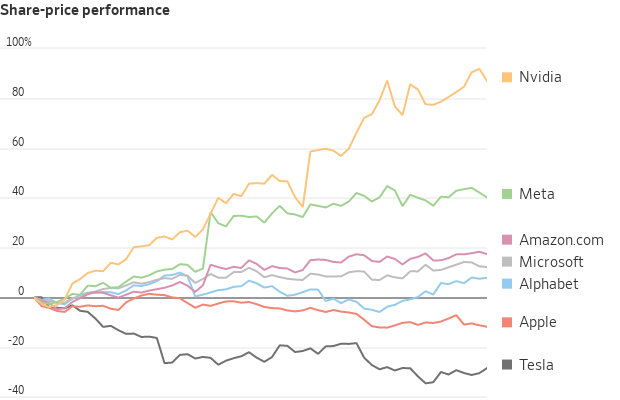
The S&P 500 climbed 10% in the first quarter, its best start to a year since 2019 , even though two of its biggest constituents suffered double-digit declines. Apple shares fell 11% in the first three months of the year, while Tesla dropped almost 30%. Alphabet shares sputtered for much of the period before making a run in the past three weeks and ending up 8%.

The other four big tech stocks in the group known as the Magnificent Seven— Nvidia , Meta Platforms , Microsoft , Amazon.com —continued their meteoric run and outpaced the broader market. Some market strategists have dubbed them the new Fab Four.

Some investors say it is a bullish signal that the market is still rallying without the likes of Apple and Tesla because it means other groups are taking part . All of the S&P 500’s sectors, except real estate, logged gains in the first quarter. Small caps, industrial and financial-services stocks are among those that jumped, fueling bets that the broader market might have more room to run.

Much of the enthusiasm is tied to hopes that the economy has escaped a deep recession and that the Federal Reserve will soon pivot to cutting interest rates , even if not at the pace some investors had previously hoped. A frenzy over the future of artificial intelligence has added to the zeal.

“If you’d have told me eight weeks ago that Apple and Tesla would be down as much as they are, oh and by the way, you’re punting when you’re going to do the rate cuts and you’re getting less rate cuts, I would have assumed the market would be down,” said Ryan Detrick , chief market strategist at Carson Group.

To be sure, some investors worry the divergence in the big tech stocks is a sign of exhaustion in the rally and question whether future gains will be harder to achieve from here. The S&P 500’s market value has swelled more than $9 trillion since late October, and the index has set 22 record closes in 2024.

In the coming days, investors trying to gauge the trajectory of the market and economy will parse the release of U.S. manufacturing data Monday and the monthly jobs report Friday.

Nvidia continues to be a stock-market star. The graphics-chip maker has indicated demand for the computing power that underlies AI remains astronomical . Its shares have jumped more than 80% to start the year, after more than tripling in 2023.

By some metrics, Nvidia has displaced Tesla as the most popular stock among individual investors . It is currently the biggest average holding in individual investors’ portfolios, at about 9%, VandaTrack data show.

Meta shares, meanwhile, have soared partly thanks to Meta’s investments in artificial intelligence that have made targeted ads smarter. The social-media company recently said it would pay its first shareholder dividend. Microsoft stole the crown of biggest U.S. company from Apple earlier this year, with a valuation that topped $3 trillion, and Amazon has sharply improved its profitability.

Despite their recent gains, some of the stocks look less pricey than they did last year. Nvidia is trading at 35 times its projected earnings over the next 12 months, below its peak of 62 in May of last year. Amazon’s multiple is 40, down from 2023’s high of 62. The S&P 500 is trading at 21 times future earnings, slightly up from last year’s highs of 19.

The Fab Four are responsible for nearly half of the S&P 500’s first-quarter advance, according to Howard Silverblatt , senior index analyst at S&P Dow Jones Indices.

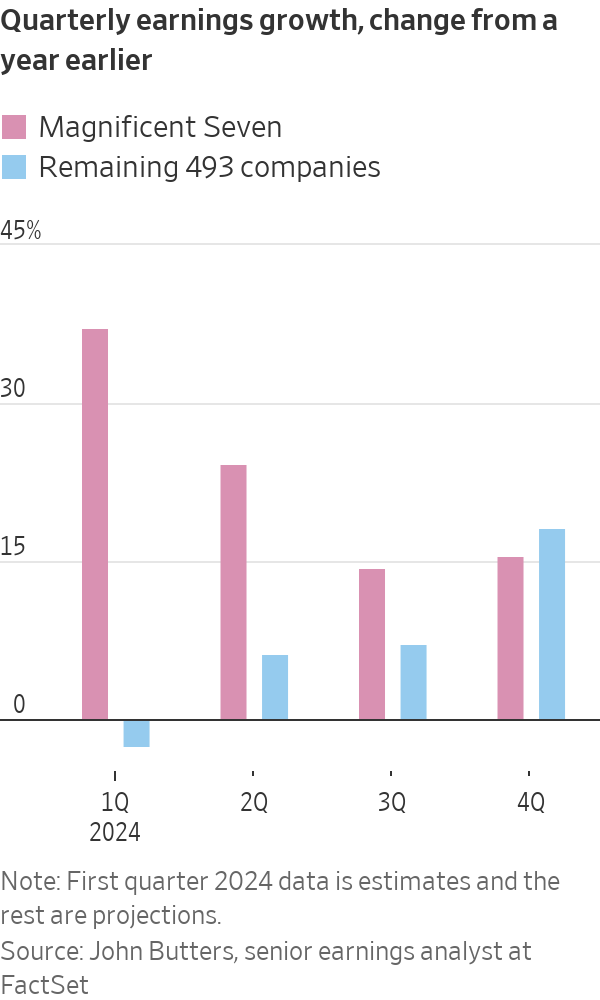
Joseph Ferrara , investment strategist at Gateway Investment Advisers, said he expects investors to rotate out of big tech stocks and funnel into other sectors as the year progresses. That is largely because the earnings of the other 493 companies in the index are expected to outperform those of the Magnificent Seven by the fourth quarter.

“The fact that the market is still holding these levels and trading up without that full force of the Magnificent Seven is actually a really positive thing,” he said.

Jonathan Golub , a strategist at UBS, said one reason Magnificent Seven’s earnings dominance could end is because it will be hard to top the explosive growth they posted at the end of last year. Those results looked like blockbuster beats when compared with 2022’s weaker numbers, he said in a recent research note.

Last year, any hint of weakness in the Magnificent Seven would have sent the broader market tumbling. In fact, for much of the year, those seven stocks were responsible for all of the S&P 500’s advance.

This year is a different story. Tesla is struggling on numerous fronts. The electric-vehicle maker is facing pressure from Chinese competitors, which have rapidly expanded their presence around the globe in recent years. It has also warned of notably slower growth in 2024, and its profit margins have taken a hit.

Apple’s woes have been mounting, too . The Justice Department recently sued the company, accusing it of monopolistic behaviour. European authorities are cracking down on its app store. Plus, it is facing another weak iPhone demand cycle, and investors are worried that Apple is behind in the current wave of excitement around AI.

Bespoke Investment Group data show Apple shares underperformed the S&P 500 over the 200 days through Tuesday by the widest margin since October 2013.

Cadillac’s Electric Push Includes the Opulent Velocity Concept

Though General Motors overall has shown some ambivalence about the pace of electric vehicle introductions—first canceling the entry-level Bolt, then reinstating it last year (though for an undisclosed date)—Cadillac is all in.

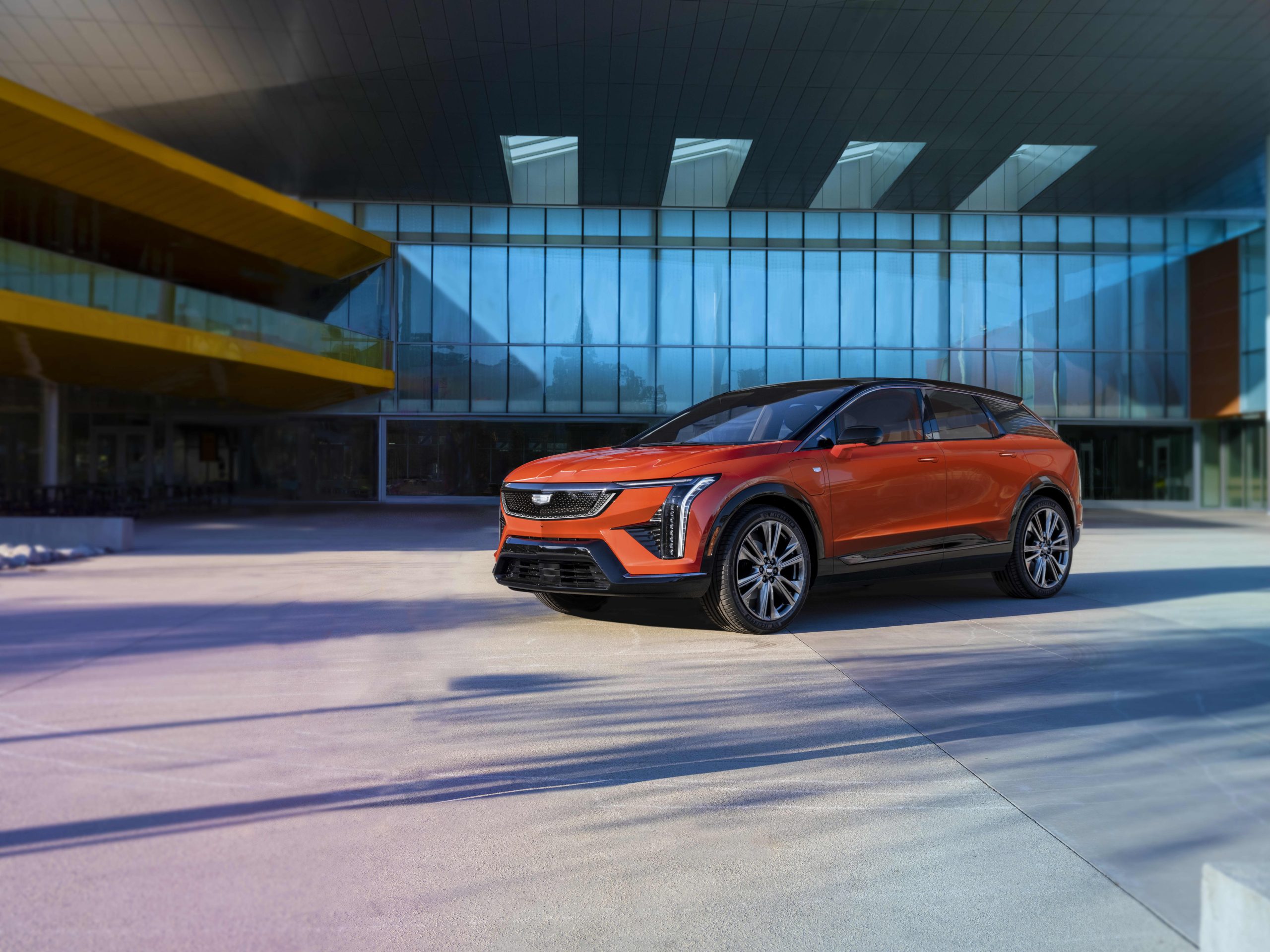
To prove it, the company is introducing a full range of new plug-in models in top-to-bottom market segments. Luxury is definitely covered. GM sold just over 75,000 electric vehicles last year, up 93% from 2022. The Cadillac electric line currently includes the Lyriq (a luxury-minded SUV that starts at US$57,195); Escalade IQ (a very fancy three-row that, later this year, will start at US$130,000); Celestiq (an ultra-luxurious limited-edition sedan, starting at US$350,000); and Optiq (an entry-level electric SUV for 2025, slotted below the Lyriq), starting around US$45,000. And let’s not forget the forthcoming 2026 Vistiq, a three-row SUV to complement the iQ. No price yet. And did you notice they all end in “IQ”?

Cadillac sold approximately 9,000 Lyriqs in 2023, with 3,800 of them moving in the last quarter. That made the Lyriq the best seller among electric compact luxury SUVs. Admittedly, a few qualifiers there: The Lyriq is also offered in China, and sales there climbed 60% in 2023.

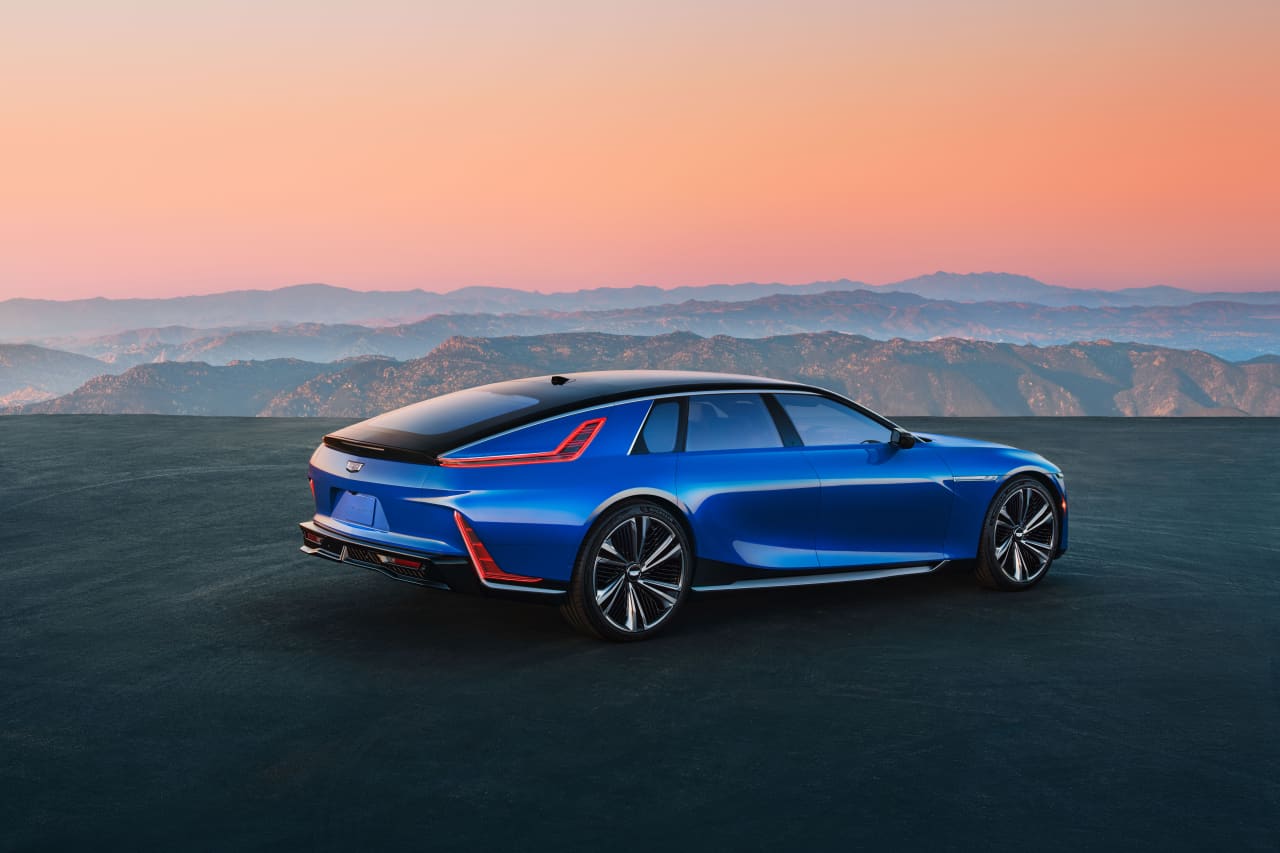
Departing from the IQ convention is a new show car, the Opulent Velocity, which Cadillac has only shown in a teaser photograph and video. In the latter, a blurred image of the car races past. Speculation is that it will be a luxurious sedan like the flamboyantly styled Celestiq, but possibly more conventionally designed and with an emphasis on performance.

The Opulent Velocity concept car is in part a celebration of Cadillac’s V-Series, which presents performance versions of popular models. Recent offerings include the 2025 CT5-V and CT5-V Blackwing. These are brute-force supercharged V8 sedans. The US$96,000 Blackwing version produces 668 horsepower and 659 pound-feet of torque, coupled to a (rare these days) six-speed manual or 10-speed automatic.

The 2025 Optiq will be the entry-level electric Cadillac SUV
Cadillac

Phil Dauchy, global head of brand strategy and international marketing at Cadillac, points out that the company’s performance series is now 20 years old.

“The V-Series cars perform at the top of their segments,” Dauchy says, adding that the V-Series nomenclature will remain as the brand goes electric. But the EVs with lots of power are already there. “If you buy a Lyriq Sport all-wheel drive right now you get a car with more than 500 horsepower,” he says.

The electric lineup now is heavy on SUVs, but Dauchy says that Cadillac’s current CT4 and CT5 sedan models are performing very well in the marketplace. “There is a significant piece of the luxury market that is sedans, including in China,” he says. “Cadillac remains dedicated to its sedan lineup.”

The 2026 Vistiq is slotted between the Lyriq and Escalade IQ.
Cadillac

Dauchy declined to say how many people have bought those pricey Celestiqs. “It’s not about the sales numbers, though we have an internal sales goal,” he says. “We intend to produce fewer than we can sell. We want a vehicle that is hard to get. We also want a unique buying experience, with prospective buyers coming out to the Cadillac House in Warren, Michigan and choosing colours and fabrics and working with a concierge.” This bespoke approach has worked well for other luxury brands, from Rolls-Royce to Maserati.

Spokeswoman Stephanie Obendorfer says the concept will not be featured at the New York International Auto Show , which runs through April 7. “We look forward to sharing more details on Opulent Velocity later this year,” Obendorfer says.

Specialised venues—such as the recent Amelia Island and Audrain concours events—are a better fit for showing exclusive cars like Opulent Velocity, Dauchy says.

All of Cadillac’s new models will be electric going forward. Internal-combustion cars will remain in the lineup until the end of the decade. But the pursuit of performance remains. EVs today are the world’s fastest cars off the line, even if they don’t always excel at top speeds. The Celestiq, though its emphasis is on luxury, reaches 60 mph in 3.8 seconds, and its two electric motors produce 600 horsepower and 640 pound-feet of torque.

Cyprus New Build That Feels Like It’s Floating Over the Mediterranean Lists for €3.19M

A lavish and contemporary villa in Cyprus that sits right on sparkling waters of the Mediterranean Sea has hit the market for €3.19 million (US$3.45 million).

Villa 82, as it’s known, is set in a private gated community within the island’s Paphos district alongside one of the top beaches in the region, according to the property’s developer Leptos Estates, which brought the home to the market earlier this month.

Cyprus has become an increasing wealth hub, as it draws affluent migrants through its golden visa program. Its prime home values have benefited, with prices rising more than 7% in 2023, according to a report earlier this year from Knight Frank.

Leptos Estates

The three-story house boasts a contemporary interior, but while there are modern finishes and fixtures throughout, it also incorporates elements of Cyprus’s traditional architecture, including stone pillars, alcoves and polished marble flooring, according to the listing.

The open-plan hub of the five-bedroom home has a dining area, a sleek custom kitchen and a double-height living room. The space is lined with walls of windows taking in views that give the impression of the rooms floating on the sea.

It’s an “exquisite property,” and “offers a truly luxurious lifestyle,” said Pantelis Leptos, co-president of Leptos Group of Companies.

With “ample space for both relaxation and entertainment, the villa features a range of special amenities, including [the] spacious living room and a spectacular infinity pool that overlooks the Mediterranean Sea,” he added.

Outside, alongside the pool, are private landscaped gardens and large verandas for sunbathing.

Leptos Estates

Cyprus is “the perfect place to live and renowned for its fabulous beaches, which draw people from all over the world,” Leptos said. “There is so much to enjoy here.”

Paphos, meanwhile, ranked as the most popular tourist destination within Cyprus over the last two years, with 36% of all inbound travellers to the island visiting the coastal city between 2022 and 2023, according to a news release.

“With the increased level of tourism being experienced, Cyprus is well placed to provide opportunities for luxury living,” he said.

The 7 lasting impacts of COVID for Australian investors

AMP chief economist Dr Shane Oliver says the effects of the pandemic continue to reverberate across the world, with seven key lasting impacts leading to “a more fragmented and volatile world for investment returns”.

“Perhaps the biggest impact is that the pandemic related stimulus broke the back of the ultra-low inflation seen pre-pandemic,” said Dr Oliver. “Together with bigger government and reduced globalisation, this means a more inflation-prone world. So, a return to pre-pandemic ultra-low inflation and interest rates looks unlikely.”

Here is a summary of Dr Oliver’s explanation of the seven key lasting impacts of COVID for investors.

1. Bigger government

The pandemic added to support for bigger government by showcasing the power of government to protect households and businesses from shocks, enhancing perceptions of inequality, and adding support to the view that governments should ensure supply chains by bringing production back home. IMF projections for government spending in advanced countries show it settling nearly 2 percent of GDP higher than pre-COVID levels.

Implications for investors: … likely to be less productive economies, lower than otherwise living standards and less personal freedom.

2. Tighter labour markets and faster wages growth

After the pandemic, labour markets have tightened reflecting the rebound in demand post-pandemic, lower participation rates in some countries and a degree of labour hoarding as labour shortages made companies reluctant to let workers go. As a result, wages growth increased, possibly breaking the pre-pandemic malaise of weak wages growth.

Implications for investors: Tighter labour markets run the risk that wages growth exceeds levels consistent with two to three percent inflation.

3. Reduced globalisation

A backlash against globalisation became evident last decade in the rise of Trump, Brexit and populist leaders …. Also, geopolitical tensions were on the rise with the relative decline of the US and faith in liberal democracies waning ... The pandemic inflamed both with supply side disruptions adding to pressure for the onshoring of production [and] heightened tensions between the west and China … we are seeing more protectionism (e.g.,with subsidies and regulation favouring local production) and increased defence spending.

Implications for investors: Reduced globalisation risks leading to reduced potential economic growth for the emerging world and reduced productivity if supply chains are managed on other than economic grounds.

4. Higher prices, inflation and interest rates

Inflation [due to stimulus payments to households and supply chain disruptions] is now starting to come under control … but the pandemic has likely ushered in a more inflation-prone world by boosting bigger government, adding to a reversal in globalisation and adding to geopolitical tensions. All of which combine with ageing populations to potentially result in higher rates of inflation.

Implications for investors: Higher inflation than seen pre-pandemic means higher than otherwise interest rates over the medium term, which reduces the upside potential for growth assets like shares and property.

5. Worsening housing affordability

… the lockdowns and working from home drove increased demand for houses over units and interest in smaller cities and regional locations. As a result, Australian home prices surged to record levels. Meanwhile, the impact of higher interest rates in the last two years on home prices was swamped by housing shortages as immigration surged in a catch-up. The end result is now record low levels of housing affordability for buyers …

Implications for investors: Ever worse housing affordability means ongoing intergenerational inequality and even higher household debt.

6. Working from home

There are huge benefits to physically working together around culture, collaboration, idea generation and learning but there are also benefits to working from home with no commute time, greater focus, less damage to the environment, better life balance and for companies – lower costs, more diverse workforces and happier staff. So the ideal is probably a hybrid model.

Implications for investors: Less office space demand as leases expire resulting in higher vacancy rates/lower rents, more people living in cities as vacated office space is converted, and reinvigorated life in suburbs and regions.

7. Faster embrace of technology

Lockdowns dramatically accelerated the move to a digital world. Many have now embraced online retail, working from home and virtual meetings. It may be argued that this fuller embrace of technology will enable the full productivity-enhancing potential of technology to be unleashed. The rapid adoption of AI will likely help.

Implications for investors: … a faster embrace of online retailing … at the expense of traditional retailing, virtual meeting attendance becoming the norm for many … and business travel settling at a lower level.

London’s Luxury Property Market Turns a Corner

The first quarter of the year brought some long-awaited signs of recovery in London’s luxury housing market, offering the first positive quarterly price growth since September 2022, according to a report from Savills on Wednesday.

After six consecutive quarterly price falls, luxury home prices in central London levelled out in the first three months of the year, with a 0.1% quarterly uptick in prices. The £3 million to £5 million (US$3.79 million to US$6.32 million) market saw a slightly larger increase of 0.3%.

Outer London’s luxury market saw greater quarterly price growth, with home prices up 0.8%, as some stability returned to mortgage costs and lured more buyers back to the market, according to the report.

All of this is evidence that the market is “in early stages of recovery,” according to Lucian Cook, head of residential research at Savills.

“The outlook for the housing market has certainly improved, partly because the mortgage market has recovered more quickly than expected,” Cook said in the report. “With the first rate cut rapidly coming into view and recessionary risks easing, greater stability has returned to the cost of mortgage debt, which has positively impacted domestic prime markets, where many buyers rely on borrowing, most notably in leafy outer prime South and West London, as well as the commuter belt.”

Outside of London, prices across the U.K. saw no quarterly growth heading into the beginning of the spring market, which is expected to bring higher levels of buyer activity in many regions.

Suburban regions saw prices dip just 0.1%, while urban areas—like Edinburgh and Glasgow in Scotland, and Bath and Oxford in England—saw prices increase by 0.6%.

Cook said regional buyers are more likely to be concerned about market uncertainty than London buyers in the lead up to the general election.

“As a result, buyers are still expected to be less committed until the dust has settled,” he said.

The crafty workarounds would-be buyers use to get into the market

Aspiring first home buyers are increasingly pooling their resources, adopting new strategies and making compromises to get themselves onto the property ladder, according to research from Westpac. About 56 percent of buyers surveyed are planning to buy their first property jointly with their partner compared to 40 percent three years ago. Three in four buyers say they are willing to compromise on location, up nine percent from three years ago, and 47 percent are willing to pay lenders mortgage insurance to buy their first home sooner.

Additionally, one in two first home hopefuls are considering ‘rentvesting’, whereby they purchase an investment property first ahead of a home for themselves. In this scenario, buyers typically continue renting in expensive lifestyle locations where they want to live and buy an investment property in more affordable locations, often on the outskirts of major cities or in regional areas.

The 2024 Westpac Home Ownership Report, released this month, is based on a survey of 2,015 Australians conducted in January. The report revealed increasing intentions to buy among all types of buyers, with 44 percent intending to buy in the next five years, up from 35 percent in July 2023. This may reflect expectations that interest rates have peaked, with the Reserve Bank keeping rates on hold since December.

Among first home buyers specifically, there was a slight decline in purchasing intention over the next five years, with 86 percent delaying buying a home due to cost-of-living pressures. The survey also found that more people are planning to buy an investment property, which is reflected in recent finance data from the Australian Bureau of Statistics showing a 20 percent increase in the value of investor loans issued over the past year. Additionally, more people are planning to upsize their homes or renovate their existing homes.

Westpac managing director of mortgages Damien MacRae said first home buyers “are becoming more ruthless with their goals”. “They understand it’s a big task, but they are determined to break into the market and are willing to compromise to get there,” Mr MacRae said.

Buyers still prefer houses, but there has been a five percent decline in this preference since 2021 and a seven percent increase for apartments. Preference for a townhouse, or house and land packages, has increased markedly. “Buyers are casting their expectations wider, willing to compromise on location and are forgoing everyday luxuries like food delivery. They are also more inclined to relocate and move to apartment living.”

The latest Westpac-Melbourne Institute Consumer Sentiment Index released this week shows the ‘time to buy a dwelling’ index rose 4.9 percent to 77.8 out of 100 this month, which is a 15-month high, but still relatively weak overall. Buyer sentiment is notably stronger in Victoria at 84.3, with Westpac senior economist Matthew Hassan pointing to softening home values over the past four months.

In contrast, the NSW index is at 73.3 out of 100, likely reflecting affordability challenges in Australia’s most expensive market. “Nearly 70 percent of consumers expect housing prices to continue rising in the year ahead,” Mr Hassan added.


Australia’s February Inflation Comes in Lower Than Expected

SYDNEY—Australia’s monthly inflation indicator came in below expectations in February, signalling that price pressures would likely continue to retreat over coming months.

The monthly consumer-price index indicator rose 3.4% in the 12 months to February, according to the latest data from the Australian Bureau of Statistics. Economists had expected a rise in February of 3.5% on year.

Some economists had expected the monthly CPI update to show a bigger rise, fuelled by services inflation which remains an area of concern for the Reserve Bank of Australia.

The better-than-expected inflation outcome will also help offset some of the uncertainty about the outlook for interest rates that arose in financial markets following news last week of a sharp drop in unemployment in February.

The most significant contributors to the February annual increase were housing costs, which climbed 4.6% on year, while food and nonalcoholic beverages rose 3.6% in the same period.

Alcohol and tobacco prices were up 6.1% and insurance and financial services rose 8.4%, the ABS said Wednesday.

Excluding volatile items from the data, the annual CPI rise in February was 3.9%, down from 4.1% in January.

Annual inflation excluding volatile items has continued to slow over the last 14 months from a high of 7.2% in December 2022, the ABS said.

Rents increased 7.6% for the year to February, up from 7.4% in January, reflecting a tight rental market and low vacancy rates across the country.

New dwelling prices rose 4.9% over the year with builders passing through higher costs for labor and materials. Annual new dwelling price increases have been around the 5% mark the past six months, the data showed.

The 3.6% rise in food prices in the 12 months to February was down from the 4.4% in January. It was the lowest annual growth since January 2022.

Insurance costs jumped 16.5% over the past 12 months to February, with rises in premiums across all insurance types due to higher reinsurance, natural disaster and claim costs, the ABS said.

EV Home Charging: I Did the Math—and Saved Hundreds of Dollars

Things I miss about my local gas station:

…

That’s it. That’s the list. OK, fine, I did enjoy the communal squeegees.

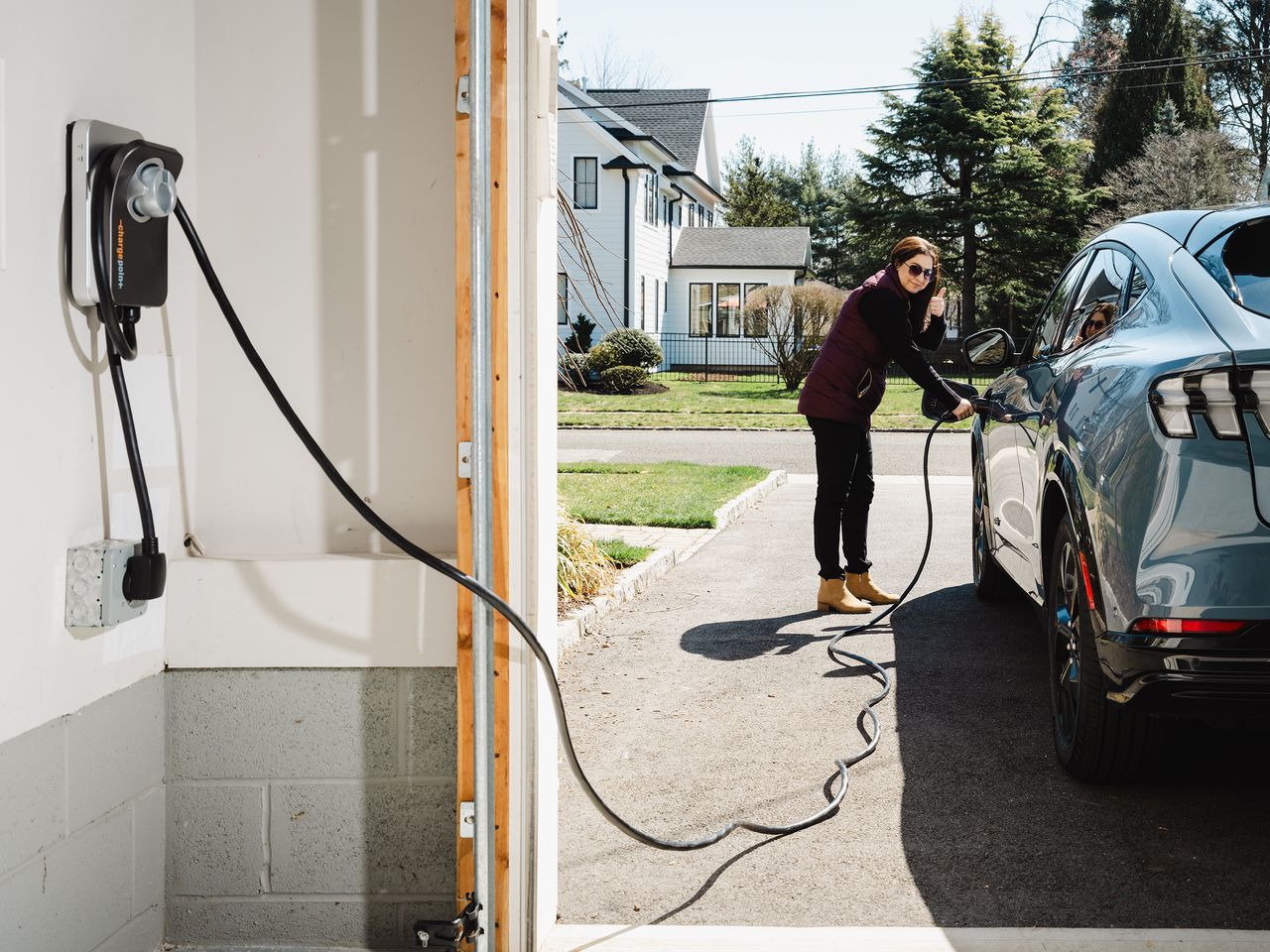
This week marks six months since the grand opening of my home electric-vehicle charging station. Congrats to the whole team! (Me and my electrician.) Located between my garage door and recycling bin, it’s hard to beat for the convenience. And also the price.

If you’ve followed my ad-EV-ntures, you’re aware of my feelings about the hell that is public EV charging , at least before Tesla started sharing its Superchargers with its rivals. Truth is, I rarely go to those public spots. The vast majority of EV owners—83%—regularly charge at home, according to data-analytics company J.D. Power.

I already discovered many EV virtues , but I didn’t quite grasp the cost savings until I tallied up half a year of home-charging data. In that time, I spent roughly $125 on electricity to drive just under 2,500 miles. In my old car, that would have cost me more than twice as much—assuming gas held steady at around $3.25 a gallon . And I was charging through the winter, when electricity doesn’t stretch as far in an EV.

Rebates and programs from my state and utility company sweeten the deal. So I will be able to take advantage of discounted electricity, and offset the cost of my charger. The same may be available to you.

But first, there are technical things to figure out. A 240-volt plug? Kilowatt-hours? Peak and off-peak charging? While other people are in their garages founding world-altering tech companies or hit rock bands, I’m in there finding answers to your home-charging questions.

How to get set up

Sure, you can plug your car into a regular 120-volt wall outlet. (Some cars come with a cable.) And sure, you can also simultaneously watch all of Netflix while it charges. It would take more than two days to fill my Ford Mustang Mach-E’s 290-mile battery via standard plug, known as Level 1 charging.

That’s why you want Level 2, which can charge you up overnight. It requires two components:

• A 240-volt electric outlet. Good news: You might already have one of these higher-powered outlets in your house. Some laundry dryers and other appliances require them. Bad news: It might not be in your garage—assuming you even have a garage. I realise not everybody does.

Since my suburban New Jersey home has an attached garage, the install process wasn’t horrible—or at least that’s what my electrician said. He ran a wire from the breaker panel in the basement to the garage and installed a new box with a NEMA 14-50 outlet. People with older homes or detached garages might face trickier wiring issues—more of a “Finding NEMA” adventure. (I apologise to everyone for that joke.)

My installation cost about $1,000 but the pricing can vary widely.

• A smart charger. Choosing a wall charger for your car is not like choosing one for your phone. These mini computers help you control when to start and stop charging, calculate pricing and more.

“This is not something where you just go to Amazon and sort for lowest to highest price,” said Tom Moloughney, the biggest EV-charging nerd I know. On his website and “State of Charge” YouTube channel , Moloughney has reviewed over 100 home chargers. In addition to technical measurements, he does things like freezing the cords, to see if they can withstand wintry conditions.

“Imagine you are fighting with this frozen garden hose every time you want to charge,” he said.

One of his top picks, the ChargePoint Home Flex , was the same one my dad had bought. So I shelled out about $550 for it.

Just remember, if you want to make use of a charger’s advanced features—remote controls, charging updates, etc.—you’ll also need strong Wi-Fi in your garage.

How to save money

I hear all you money-minded WSJ readers: That’s at least $1,600 after getting the car. How the heck is this saving money? I assumed I’d recoup the charging-equipment investment over time, but then I found ways to get cash back even sooner.

My utility provider, PSE&G, says it will cover up to $1,500 on eligible home-charger installation costs . I just need to submit some paperwork for the rebate. In addition, New Jersey offers a $250 rebate on eligible charger purchases. (Phew! My ChargePoint is on the list.) If all is approved, I’d get back around $1,250. Fingers crossed!

I didn’t know about these programs until I started reporting on this. Nearly half of home-charging EV owners say they, too, are unaware of the programs offered by their electric utility, according to a 2024 study released by J.D. Power . So yes, it’s good to check with your provider. Kelley Blue Book also offers a handy state-by-state breakdown.

How to charge

Now I just plug in, right? Kinda. Even if you have a Level 2 charger, factors affect how many hours a fill-up will take, from the amperage in the wall to the current charge of your battery. Take Lionel Richie’s advice and plan on charging all night long .

It can also save you money to charge during off-peak hours.

Electricity costs are measured in kilowatt-hours. On my basic residential plan, PSE&G charges 18 cents per kWh—just 2 cents above the 2023 national average . My Mustang Mach-E’s 290-mile extended-range battery holds 91 kilowatt-hours.

Translation: A “full tank” costs $16. For most gas-powered cars, that wouldn’t cover half a tank.

And If I’m approved for PSE&G’s residential smart-charging plan, my off-peak charging (10 p.m. to 6 a.m. and weekends) will be discounted by up to 10.5 cents/kWh that I’ll get as a credit the following month. I can set specific charging times in the ChargePoint app.

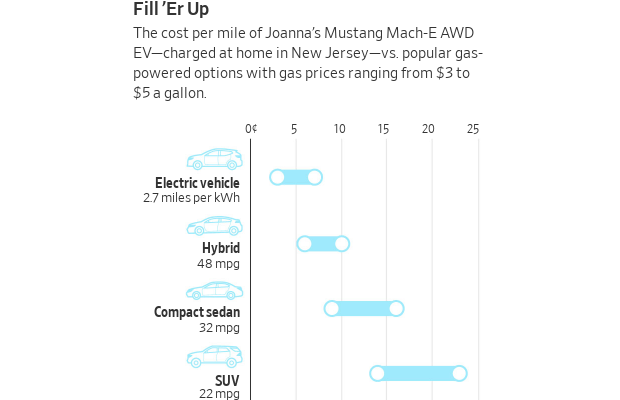
Electricity prices fluctuate state to state but every expert I spoke to said no matter where in the country you live, home charging should cost less than half what gas would for the same mileage. (See chart above for a cost comparison of electric versus gas.) And as I’ve previously explained , fast charging at public stations will cost much more.

One big question: Am I actually doing anything for the environment if I’m just taxing the grid? Eventually, I’d like to offset the grid dependence—and cost—by powering my fancy little station with solar panels. Then, I’ll just be missing the squeegee.

The Best High Interest Savings Accounts to Consider Right Now

Banking

In the grand scheme of modern investments—that is, how best to gain capital on your cashflow—high-interest savings accounts may take a back seat to other forms of investments, but those looking to grow their finances steadily over the course of each month really should pay close attention.

With interest rates on bank deposit accounts on the rise—currently presenting between 4 to 5.50 per cent, and higher, in some cases—the benefits of having and up-keeping a traditional savings account are a no brainer for the modern day customer.

In 2024, if you’re after the best high-interest savings account, it’s important to remember to compare interest rates, fees, terms, and conditions across the board, as different providers may suit your needs and preferences in different ways. Below, you will find everything you need to know about investing your time (and money) into high-interest savings accounts, and which bank may work best for your current circumstances.

But first…

—

What Are High-Interest Savings Accounts?

In its simplest form, high-interest savings accounts are bank accounts that will reward you with interest on the amount of money you add into the account each month. The amount received is dependant on the annual interest rate. Of course, some accounts will pay interest with little to no conditions, while others may offer a better rate, but you’ll likely have to meet specific requirements.

What Are the Best High-Interest Savings Accounts in 2024?

The best high-interest savings accounts in Australia can vary depending on factors such as interest rates, account features, bonus promotions, and eligibility criteria. While we recommend each individual conduct their own research as to what the right savings product will be for your personal circumstances, here are some notable high-interest savings accounts to consider in March 2024:

1. Australian Unity

  • Freedom Saver Account
  • 5.20% interest rate

2. Rabobank

  • High interest savings account
  • 5.75% for the first four months

3. ANZ

  • ANZ Save Account (ANZ Plus)
  • 4.90% interest rate

4. Macquarie Bank

  • Savings Account
  • 5.35% for the first four months

5. ING

  • Savings Maximiser
  • 5.50% interest rate when:
  • Deposit $1,000, make 5 purchases, and grow your account each month

6. MOVE Bank

  • Growth Saver
  • 5.50% interest rate when:
  • Deposit $200 and make no withdrawals monthly

7. AMP Bank

  • AMP Saver Account
  • 5.40% interest rate when:
  • Deposit $1,000 each month

8. ME Bank

  • HomeME Savings Account
  • 5.55% interest rate when:
  • Deposit $2,000 into your SpendME account and grow your balance each month