Renters are returning to the apartment market, leading to higher growth in weekly rents for units than houses over the past year, according to REA data. As workers return to their corporate offices, tenants are coming back to the inner city and choosing apartment living for its affordability.
This is a reversal of the pandemic trend which saw many renters leave their inner city units to rent affordable houses on the outskirts. Working from home meant they did not have to commute to the CBD, so they moved into largehouses in outer areas where they could enjoy more space and privacy.
REA Group economic analyst Megan Lieu said the return to apartment living among tenants began in late 2021, when most lockdown restrictions were lifted, and accelerated in 2022 afterAustralia’s international border reopened.
“Following the reopening of offices and in-person work, living within close proximity to CBDs has regained importance,” Ms Lieu said. “Units not only tend to be located closer to public transport and in innercity areas, but are also cheaper to rent compared to houses in similar areas.For these reasons, it is unsurprising that units, particularly those in innercity areas, are growing in popularity among renters.”
But the return to work in the CBD is not the only factor driving demand for apartment rentals. Rapidly rising weekly rents for all types of property, coupled with a cost-of-living crisis created by high inflation, has forced tenants to look for cheaper accommodation. This typically means compromising on space, with many families embracing apartment living again. At the same time, a huge wave of migration led by international students has turbocharged demand for unit rentals in inner city areas, in particular, because this is where many universities are located.
But it’s not simply a demand-side equation. Lockdowns put a pause on building activity, which reduced the supply of new rental homes to the market. People had to wait longer for their new houses to be built, which meant many of them were forced to remain in rental homes longer than expected. On top of that, a chronic shortage of social housingcontinued to push more people into the private rental market. After the world reopened, disrupted supply chains meant the cost of building increased, the supply of materials was strained, and a shortage of labour delayed projects.
All of this has driven up rents for all types of property, and the strength of demand has allowed landlords to raise rents more than usual to help them recover the increased costs of servicing their mortgages following 13 interest rate rises since May 2022.Many applicants for rentals are also offering more rent than advertised just to secure a home, which is pushing rental values even higher.
Tenants’ reversion to preferring apartments over houses is a nationwide trend that has led to stronger rental growth for units than houses, especially in the capital cities, says Ms Lieu. “Year-on-year, national weekly house rents have increased by 10.5 percent, an increase of $55 per week,” she said.“However, unit rents have increased by 17 percent, which equates to an $80 weekly increase.”
The variance is greatest in the capital cities where unit rents have risen twice as fast as house rents. Sydney is the most expensive city to rent in today, according to REA data. The house rent median is $720 per week, up 10.8 percent over the past year. The apartment rental median is $650 per week, up 18.2 percent.In Brisbane, the median house rent is $600 per week, up 9.1 percent over the past year, while the median rent for units is $535 per week, up 18.9 percent.In Melbourne, the median house rent is $540 per week, up 13.7 percent, while the apartment median is $500 per week, up 16.3 percent.
In regional markets, Queensland is the most expensive place to rent either a house or an apartment. The house median rent in regional Queensland is $600 per week, up 9.1 percent year-on–year, while the apartment median rent is $525, up 16.7 percent.
The price of a basic Hermès Birkin handbag has jumped $1,000. This first-world problem for fashionistas is a sign that luxury brands are playing harder to get with their most sought-after products.
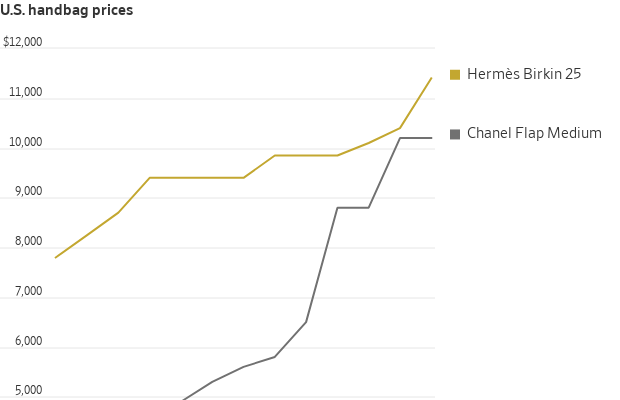
Hermès recently raised the cost of a basic Birkin 25-centimeter handbag in its U.S. stores by 10% to $11,400 before sales tax, according to data from luxury handbag forum PurseBop. Rarer Birkins made with exotic skins such as crocodile have jumped more than 20%. The Paris brand says it only increases prices to offset higher manufacturing costs, but this year’s increase is its largest in at least a decade.
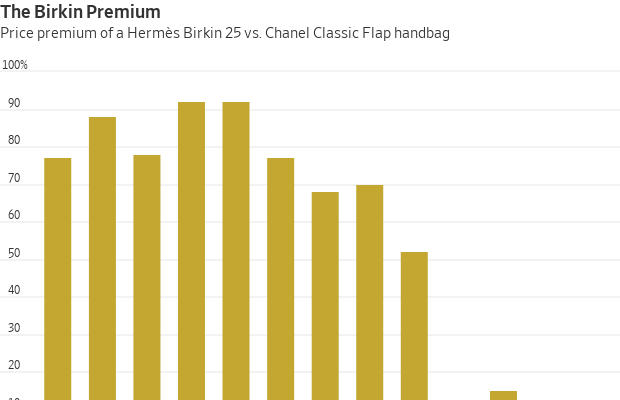
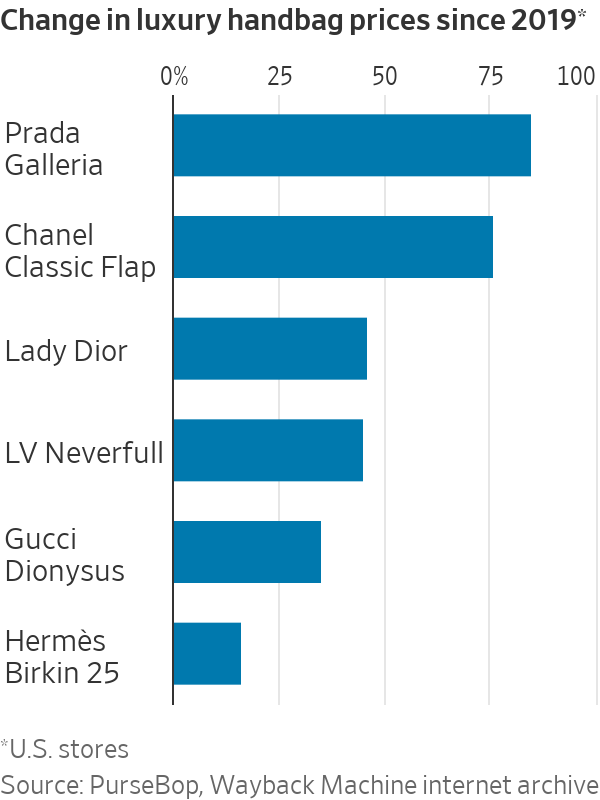
The brand may feel under pressure to defend its reputation as the maker of the world’s most expensive handbags. The “Birkin premium”—the price difference between the Hermès bag and its closest competitor , the Chanel Classic Flap in medium—shrank from 70% in 2019 to 2% last year, according to PurseBop founder Monika Arora. Privately owned Chanel has jacked up the price of its most popular handbag by 75% since before the pandemic.
Eye-watering price increases on luxury brands’ benchmark products are a wider trend. Prada ’s Galleria bag will set shoppers back a cool $4,600—85% more than in 2019, according to the Wayback Machine internet archive. Christian Dior ’s Lady Dior bag and the Louis Vuitton Neverfull are both 45% more expensive, PurseBop data show.
With the U.S. consumer-price index up a fifth since 2019, luxury brands do need to offset higher wage and materials costs. But the inflation-beating increases are also a way to manage the challenge presented by their own success: how to maintain an aura of exclusivity at the same time as strong sales.
Luxury brands have grown enormously in recent years, helped by the Covid-19 lockdowns, when consumers had fewer outlets for spending. LVMH ’s fashion and leather goods division alone has almost doubled in size since 2019, with €42.2 billion in sales last year, equivalent to $45.8 billion at current exchange rates. Gucci, Chanel and Hermès all make more than $10 billion in sales a year. One way to avoid overexposure is to sell fewer items at much higher prices.
Many aspirational shoppers can no longer afford the handbags, but luxury brands can’t risk alienating them altogether. This may explain why labels such as Hermès and Prada have launched makeup lines and Gucci’s owner Kering is pushing deeper into eyewear. These cheaper categories can be a kind of consolation prize. They can also be sold in the tens of millions without saturating the market.
“Cosmetics are invisible—unless you catch someone applying lipstick and see the logo, you can’t tell the brand,” says Luca Solca, luxury analyst at Bernstein.
Most of the luxury industry’s growth in 2024 will come from price increases. Sales are expected to rise by 7% this year, according to Bernstein estimates, even as brands only sell 1% to 2% more stuff.
Limiting volume growth this way only works if a brand is so popular that shoppers won’t balk at climbing prices and defect to another label. Some companies may have pushed prices beyond what consumers think they are worth. Sales of Prada’s handbags rose a meagre 1% in its last quarter and the group’s cheaper sister label Miu Miu is growing faster.
Ramping up prices can invite unflattering comparisons. At more than $2,000, Burberry ’s small Lola bag is around 40% more expensive today than it was a few years ago. Luxury shoppers may decide that tried and tested styles such as Louis Vuitton’s Neverfull bag, which is now a little cheaper than the Burberry bag, are a better buy—especially as Louis Vuitton bags hold their value better in the resale market.
Aggressive price increases can also drive shoppers to secondhand websites. If a barely used Prada Galleria bag in excellent condition can be picked up for $1,500 on luxury resale website The Real Real, it is less appealing to pay three times that amount for the bag brand new.
The strategy won’t help everyone, but for the best luxury brands, stretching the price spectrum can keep the risks of growth in check.
My girlfriend and I treat the outside of our apartment fridge like one big collage.
In the past few years, after attending wedding after wedding after wedding, we have unwittingly created a standing scrapbook of “Save the Date!” magnets and floral-patterned invitations, among other gilded mementos. But recently, we decided it was time to give the fridge collage a refresh. And in doing so, we realised something depressing: The majority of the happy-looking couples pictured were either now divorced, breaking up or in the process of seriously re-evaluating their relationship.
As a friend, I’ve learned so much from my newly divorced pals, and I admire the resilience, optimism and strength they demonstrated in the face of their breakups. But as a personal-finance columnist, I have also taken a lot of money lessons from these new divorcées—and I believe the insight is relevant to more than just other married couples.
One friend was able to rely on her prenuptial agreement to save her close to $100,000 in the wake of a speedy split; another woman I know escaped a financially abusive relationship with less than a grand to her name remaining in her savings account.
Darla Gale , a California-based therapist and founder of Heartstrings Counseling, says she often talks with clients about making meaning from these relationships and the accompanying financial fallout. Sharing lessons and experiences is one way to do so. “Money comes up a lot in my practice, because financial hardships are one of the reasons for divorce,” she says. “It can be very empowering to say, ‘I can do this on my own. I just didn’t have the tools to do it on my own.’ ”
Together isn’t always better
The dissolution of a relationship can bring a host of financial lessons that shape how we talk about money in our relationships going forward—whether we were the bride, the groom or the smiling person snapping a selfie with the cake.
In my previous reporting, I’ve researched quite a bit about just how beneficial it can be for couples to combine finances. Studies show this enables them to maximise their potential to grow wealth and even leads to both partners feeling happier in the relationship.
But after witnessing their first wave of divorces, many younger people are embracing a different approach. “I’m doing a lot of prenuptial agreements for people who are younger, and they are for the most part wanting to keep their money separate, which is interesting and very different from the way prenups were done 10 to 20 years ago,” says Lisa Zeiderman , a New York-based divorce lawyer.
Gale says she now often sees couples doing both: sharing expenses in one joint account, for example, while still maintaining separate funds “so it doesn’t feel like one person is more in control.”
Inspired by this approach, my girlfriend and I have adopted something similar. To save for a down payment on a future house, we contribute near-equal amounts to a joint high-yield savings account that we opened together. We also share a credit card to use when we buy groceries, pay our dog’s vet bills or handle other shared expenses.
But at the same time, we both maintain separate checking accounts and saving accounts, for our own individual needs. This way, should disaster ever strike, we’re both able to maintain a level of personal autonomy and build our own lives anew.
After all, as Gale put it, “Autonomy equals equality.”
Older is better…and worse
Here’s the good news I’ve learned while looking at divorce through a personal (and personal-finance) lens: On the whole, millennial couples are actually divorcing at lower rates than people of previous generations at similar ages.
Economist Brett House , a professor of professional practice in the economics Division at Columbia Business School, attributes this decline to two important things: Millennials are getting married at later ages. And they’re likelier to have received more education by the age of their first marriage.
But waiting to tie the knot doesn’t protect you against the financial fallout of a divorce—if anything, marrying later means both parties might have had more time to accumulate more assets that could lead to financial conflict once split.
“People may be more mature and more aware of themselves and clearer about what they want from a relationship than was the case in earlier years,” House says.
Gale recommends clearly stating those financial priorities at the start of a relationship, when everything still seems rosy. “Don’t be sneaky about it, but go into the relationship and say ‘I’m going to have a separate bank account, whether that is for going out or having a ‘fun’ fund but autonomy is really important to me,’ ” she says.
And watch your potential partner’s reaction to such a conversation—that can also inform your decision to build a life with them.
Don’t compromise your career
In her many years advising women and working in divorce courts, Zeiderman says she often gives young to-be-married women the same advice: Don’t lose sight of your career.
Zeiderman has seen firsthand how difficult it is for many people, in compromising their own professional trajectories, to rebuild their earnings post-divorce.
“So many decide, frankly, to let the other person build their career and then at the end of the day, you cannot make up for this in spousal support, you cannot make up for it in the distribution of their assets,” she said. “Stay in the workforce. You must.”
We like to think that is easy to do, but in practice, both partners prioritising their careers isn’t easy.
This summer, I’ll have just embarked upon a new career as a freelance writer and podcast host; at the same time, my girlfriend, also a journalist, will be traveling throughout France covering the summer Olympics. We talked in advance about how important this summer will be for us, work-wise, and agreed that although our relationship—and our patience!—may be tested, affording each other some grace during this high-pressure time will go a long way. Building our careers will benefit our household bottom line, but it’s also insurance for both of us.
The ‘what if we broke up’ talk
“The forethought is easier to do when things are good,” Zeiderman told me. And her words stuck with me.
I thought back to the dozens of conversations I’ve had with my divorced friends. So many of them regretted never discussing money goals, habits or strategies with their partners in advance of marriage. Far too often, they said, they worried bringing up finances would dampen the excitement of the honeymoon phase; then, months or years later, the unsaid words curdled and soured with resentment.
My girlfriend and I keep a standing monthly “money date” on the calendar. We make the time to curl up on the couch, just the two of us, and review our household finances. For us, that looks like going over the bank statement and checking on progress made toward our financial goals. On past money dates, we’ve compared prices for coming purchases, paid down debt and even shared how things stand in our separate personal accounts.
No one likes paying bills or calculating debt totals, but we work hard to make the process as painless as possible. But this coming month, I think the topic I have planned may be our most uncomfortable one yet.
That’s because, inspired by Zeiderman and Gale, this time I have something particularly “special” planned for our money date: the “What if we broke up?” conversation.
I want to plan out how we would divide our shared assets and then put these details in writing—together. If something were to happen in the future, we could hopefully put aside our differences to rely on this plan and make the detangling of our finances much simpler.
Luckily for me, my girlfriend knows me well enough by now to see the romance hiding in this gesture.
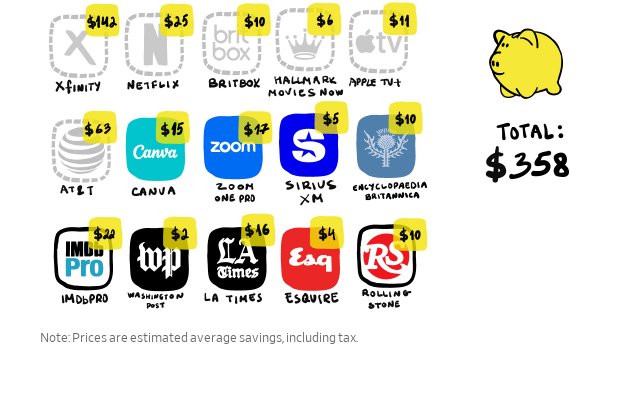
My new Tesla was burning a $511 hole in my monthly budget. So I set myself a challenge: Could I cover the cost just by getting rid of cable, Netflix and other subscriptions I didn’t need?
The financially responsible among us might cancel streaming services between seasons of their favourite shows . I tend to add new ones and forget about the old ones, doing my share to support America’s ballooning subscription economy. People pay about $273 a month for subscriptions, which is almost $200 more than they think they do, according to a 2021 survey . (Since then, services like Disney+ and Discovery+ have raised their prices further.)
But I needed to make room for the first car payment in my 41 years. I had taken the family car-shopping when our 2001 Toyota Camry, which we inherited from my wife’s grandmother, started to go. I’m not a car guy and had never once wished I’d owned a Tesla. I booked a demo drive for the Model Y because I thought our kids would get a kick out of it.
The fact that we liked the car was almost as surprising as the fact that it was cheaper than the electric Volvo, Volkswagen and Hyundai options we saw. It felt like a spaceship compared with the Camry, which has 205,000 miles, a broken tape deck and an interior stained with blue and yellow crayon.
Our new monthly payment covered a 12,000-miles-a-year lease with no down payment. Tesla estimated I would save about $100 a month from replacing gas with electric, though I would need to drive (and charge) the car to know for sure. Tesla’s app tracks my estimated savings. For now, that left us with $411 to cut from our other monthly expenses.
My wife was on board. My kids shrugged. I got out my notebook and started making a list.
Cutting the cord
My first stop was my Xfinity bill.
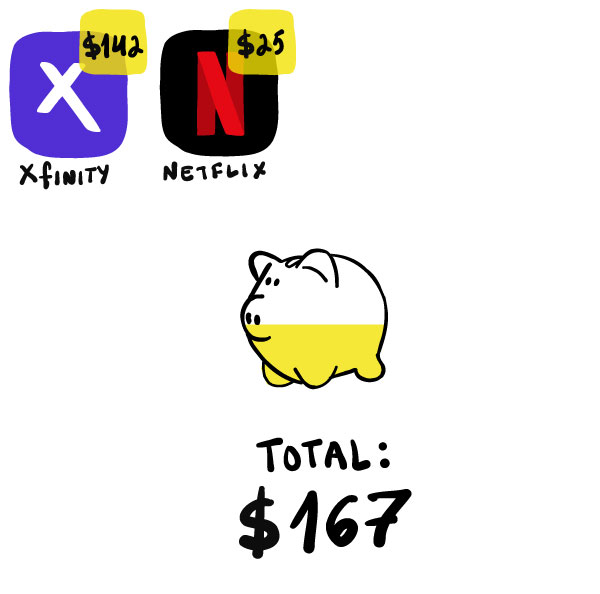
Somehow, it had swelled to $249 a month—basically half the price of the car. In addition to cable and internet, I’d been paying Xfinity for things like a landline because cell service can be spotty in my basement office. So long, landline. After cutting everything but internet, my bill fell to $107. I haven’t dropped a call yet.
Next were the streaming services that I’d been paying for but not watching much. Over the past few years, the only person in the house “watching” Netflix was me. And I wasn’t actually watching it. I was listening to episodes of “Seinfeld” in an earbud when I went to bed. The jokes and the rhythm of their back-and-forths were a pleasant send-off as I fell asleep.
I had joined the growing number of Americans ditching streaming services. I also broke up with BritBox, a streaming service that I’d counted on to watch Agatha Christie’s “Poirot,” as well as Apple TV+. I said goodbye to Hallmark Movies Now, which I’m not ashamed to admit I enjoyed every now and then.
Next up was AT&T .
Paying for cellphone service is like paying the water bill: something I did without protest and never really thought twice about. But I’d started to get curious about the ads I’d been seeing for low-cost services like Boost Mobile and Cricket Wireless. When we agreed to let our 13-year-old son have a phone, part of the deal was that he had to pay for and maintain the account himself. He got a plan with Mint Mobile. It has worked so well for him that we decided to give it a try.
We had been paying AT&T about $128 a month for two lines. Now, we’re paying Mint about $65. If there is a downside to making this move, I have yet to notice it.
I’m still paying for that?
Then my wife and I sat at our dining table going through the last couple months of transactions in our checking account. Seeing how much money we were wasting was painful. We were both paying for subscriptions to Canva, a graphic-design service.
We’ve also been paying for Zoom One Pro, which I probably haven’t used in more than a year. I attempted canceling SiriusXM, but they kept me around by dropping the cost by about $5 a month, which is nice because I have become obsessed with a channel dedicated to country artist and sometimes actor Dwight Yoakam.
Upon further consideration I axed subscriptions to IMDbPro and Encyclopaedia Britannica, which I’m sure I’ve used professionally, but…not for a while. Finally, I cut or got reduced rates on four of my digital subscriptions to news publications. I had been making monthly payments to them more often than I was reading them.
In the end, I was able to cut out about $358 in unnecessary bills and subscriptions. Added to the $100 in estimated gas savings, the cost dropped to $53 for a car we desperately needed.
And since the lease came with six months of free access at Tesla Superchargers, the Tesla app tells me I saved $164 by not pumping gas in January, exceeding the $100 I had estimated. In January at least, my car was free-ish.
“So I love and I hate what you did,” David Bach told me. The author of personal finance books like “Smart Couples Finish Rich” has long preached the merits of cutting out small, fixed expenses. But he’d rather have seen me invest the savings.
“If you’re already a millionaire, go enjoy the Tesla,” he said.
No regrets
It isn’t like we’ve had to revert to our DVD collection to entertain ourselves. We still have Disney+, Hulu, Max, the language-learning service Duolingo and, of course , Spotify. We get three print newspapers delivered and many more digital news subscriptions.
I’m reacquainting myself with some shows on the services I kept, like Billy Bob Thornton’s “Goliath” on Prime Video—featuring an exceptional performance from Dwight Yoakam.
It is possible we’ll start subscribing all over again. Americans resubscribe to about 23% of the larger streaming services they cut within three months. That share rises to over 40% after a year, according to Antenna, a subscription-analytics provider.
I get it. I subscribed to Paramount+ for Super Bowl Sunday (yes, I canceled it the following Tuesday). And I’m tempted to return to Netflix every time I get ready for bed. I still haven’t found a lullaby to replace “Seinfeld,” but at least I am the master of my (financial) domain.
I need something upbeat but not preachy, familiar, but with enough episodes that I don’t get too sick of them. I tried “Bob’s Burgers,” but Louise Belcher’s screams and the high-pitched strumming of the ukulele between scenes kept me awake.
Oh well. Reliable transportation is worth the $511 monthly payment. Come to think of it, that feels a lot like a subscription.
As migration hits record levels worldwide, a debate is building among economists over whether some industries are becoming too dependent on foreign labor.
Many business owners say that bringing in low-skilled foreign workers has become essential, as local populations age and labor forces shrink. In rural Wisconsin, John Rosenow says it is impossible to find locals to work on his 1,000-acre dairy farm. He relies on 13 Mexican immigrants, up from eight to 10 a decade ago. That has enabled him to avoid making costly investments in robots that can help milk cows, as some other dairy farmers have.
“We get really good people,” Rosenow says. With immigrant labor, “I’m pretty sure if I wanted to double employment, I could get it done within a week.”
To some economists, however, dependence on imported workers is approaching unhealthy levels in some places, stifling productivity growth and helping businesses delay the search for more sustainable solutions to labour shortages.
Those solutions could include bigger investments in automation, or more radical restructurings such as business closures, which are painful but may be necessary long-term, these economists say.
“Once industry is organised in a certain way and the structure encourages employers to recruit migrants, it can be very hard to turn back,” said Martin Ruhs , a professor of migration studies in Florence, Italy. “In some cases, policymakers should ask, does it make sense?” said Ruhs, who is also a former member of the U.K. Migration Advisory Committee, which advises the British government on migration policy.
The debate is likely to heat up further as Western societies teeter closer to a demographic abyss . For the first time since World War II, the working-age population is shrinking across advanced economies. The European Union’s working-age population will shrink by one-fifth through 2050, according to a recent report by German insurer Allianz .
There are ways to offset that trend, such as encouraging older workers to delay retirement. But importing foreign labor is often the easiest option, given the supply of available workers in places such as Latin America or Africa.
Immigration also provides a rush of economic growth as migrants boost populations and spend money, even when it elicits blowback from conservative groups, as it has in the U.S. and Europe.
Immigration is now running two to three times above pre pandemic levels across major destination countries including Canada, Germany and the U.K. In the U.S., 3.3 million more migrants arrived than left last year, compared with a 2010s average of around 900,000.
Three-quarters of farmworkers and 30% of construction and mining workers in the U.S. today are migrants. Overall, immigrants made up 18% of the U.S. workforce in 2021, compared with 16% a decade earlier, according to the Organization for Economic Cooperation and Development, a Paris-based club of mostly rich countries.
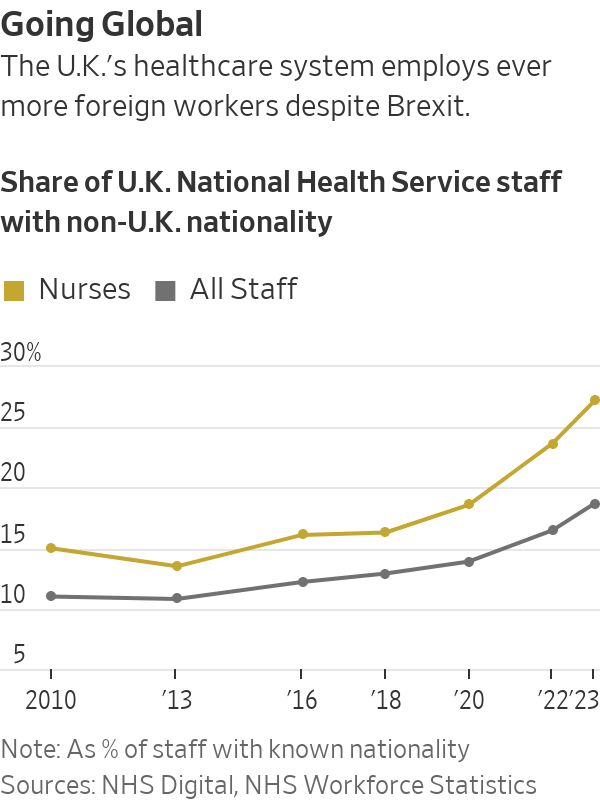
Despite promising for decades to curb immigration, the U.K. has seen a surge since its 2020 exit from the EU, as businesses scramble for employees. More than 27% of the National Health Service’s nurses are from abroad today, up from around 14% in 2013. In Germany, roughly 80% of slaughterhouse workers are migrants, unions estimate.
Downsides of over reliance
Increased reliance on low-skilled imported labor can lead to weaker productivity growth, which ultimately determines how fast economies can expand, some economic research suggests.
A 2022 study in Denmark found that firms with easy access to migrant workers invested less in robots. Research in Australia and Canada suggests that migrants could keep weak firms alive, weighing on overall productivity.
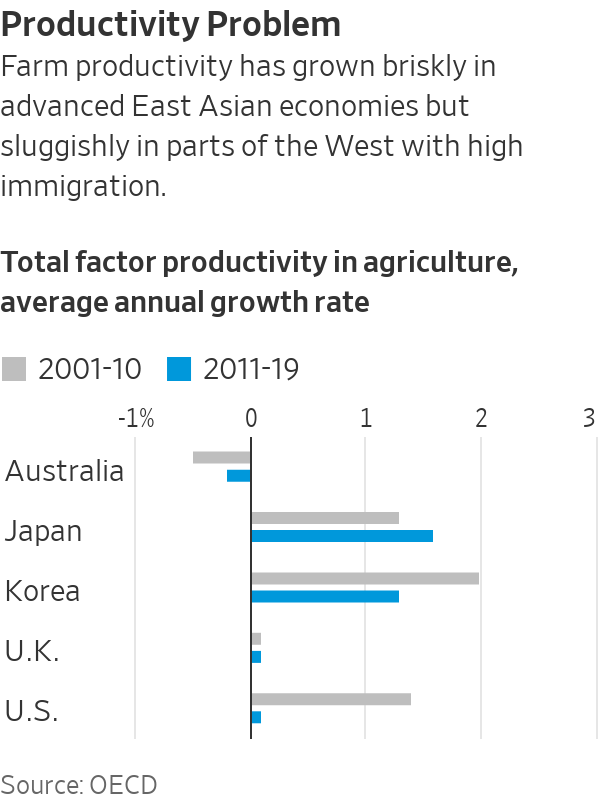
Labour productivity growth has been sluggish across advanced economies in recent years. In the U.S. and U.K. farming sectors, productivity has flatlined for a decade or longer. In Japan and Korea, which have more restrictive immigration policies, it increased by around 1.5% a year, OECD data show.
Finding the right balance between allowing some migration, which can help restore dynamism in ageing countries, and avoiding over dependence is hard. In many industries, there is no obvious alternative to foreign workers.
Going cold turkey would send prices for products made from migrant labour higher. It would also leave many people in poorer countries with fewer options to pursue better lives.
Anna Boucher , a global migration expert at the University of Sydney, says that some low-skilled migration is probably necessary in the short term due to skills shortages. Without it, some childcare services in Australia would shut down and vegetables would die in the fields.
Economic research suggests that an influx of high-skilled migrants, such as scientists and engineers, can actually lift firms’ productivity and boost local workers’ wages and employment opportunities.
Economists are more divided when it comes to lower-skilled migrants. Such workers are also more easily replaced, including in industries that seem unlikely candidates for automation.
In the Czech Republic, some farmers are using artificial-intelligence-driven robots to monitor and harvest strawberries. Israeli startup Tevel Aerobotics Technologies has developed fruit-picking drones. Fieldwork Robotics, a U.K. company, recently started selling raspberry-picking robots, which stand 6 feet tall with four plastic arms.
Yet for governments, pursuing reforms that boost productivity and allow weaker firms to die is a lot harder than increasing immigration, said Dan Andrews , a productivity expert at the OECD.
“Some countries may have taken the easy way out,” he said.
Pushback from businesses
Hoping to accelerate automation in agriculture, the U.K. government is pouring money into farm technology. It is also considering abolishing rules that allow companies to pay migrant workers 20% less than the going rate for jobs, prompting protests from farmers’ lobby groups. They say farmers adopt technology quickly if it is available, but that robots are no good at picking fruit and vegetables.
“The technology that we are aiming for is five years away…we were saying that five years ago,” said Martin Emmett , a farmer and official at the National Farmers’ Union, a trade group.
In Malaysia, the government last year announced a freeze on hiring of new foreign workers. Government ministers say that over dependence on cheap foreign labor has created a detrimental cycle that allows companies to resist innovation. Local companies say they need more time to invest in automation and upgrade workers’ skills.
Some industries, including manufacturing and plantations, have since been allowed to hire foreigners following appeals, but the broader freeze on foreign workers remains in place with no end date.
In Canada, economists say the government has cast aside a carefully managed immigration system that gave priority to highly skilled workers, and ramped up significantly the intake of foreign students and other low-skilled temporary workers. By flooding the market with cheap labor, Ottawa may be propping up uncompetitive businesses and ultimately damaging productivity, according to a December report co-written by former Canadian central-bank governor David Dodge .
Economic output per capita is lower than it was in 2018 following years of record immigration, notes Mikal Skuterud , an economist at Waterloo University in Ontario. Canada has been bringing in so many low-skilled workers that it lowers the country’s productivity overall, he says.
Germany’s butcher conundrum
The debates are also intensifying in Germany, where businesses including butcher shops in the foothills of the Black Forest are becoming more reliant on imported labor.
Young people don’t want to train as butchers anymore, local businesses say, because it is unglamorous work, with low pay. Labour shortages are one reason why the number of butcher shops has roughly halved over the past two decades.
Three years ago, Handirk von Ungern-Sternberg , an official at the local chamber of handicrafts, started a pilot project to recruit butchers’ apprentices in India, taking advantage of a change in German law that made it easier to hire low-skilled workers from outside the EU. The first batch of 13 young Indians arrived in September 2022.
Now, demand is exploding. Von Ungern-Sternberg plans to bring in roughly 140 Indian workers this year. That number could triple in future, he says.
From auto mechanics to construction, local businesses are clamouring for his young Indian recruits. Chambers of handicrafts across Germany, from the Alps to the North Sea, are seeking his help in starting similar projects.
Butcher shops in Germany’s Black Forest region are becoming more reliant on imported labor. PHOTO: DOMINIC NAHR FOR THE WALL STREET JOURNAL
“We ask ourselves, where’s the limit? Are we a job company? We don’t know where the ceiling is,” von Ungern-Sternberg said.
The program also benefits consumers by helping keep butchers’ costs low. Across the border in Switzerland, where Indian workers aren’t available, meat costs nearly four times as much.
However, Swiss business owners have also been experimenting with new technologies, including sausage vending machines known as Wurstautomaten, which could reduce the need for small-scale butcher’s shops and ultimately help bring prices down.
Meanwhile, opposition to immigration is rising in Germany, which suggests the butchers’ reliance on imported labor might not be sustainable. Support for the anti-immigrant Alternative for Germany party recently hit an all-time high of 23%. Polls suggest it could emerge as the strongest political force in several German state elections later this year.
Dairy dilemma
In Wisconsin, Rosenow, the dairy farmer, says he’s skeptical of the automated milking machines that he says are advertised in farm magazines. Some neighbours experimented with robots but went back to human labor because the robots constantly needed repairs, he says.
Robots would also cost twice as much as immigrant workers and be costly to maintain, Rosenow says. With immigrants, “labor is no constraint.”
Onan Whitcomb , a dairy farmer in Vermont, disagrees. He says that when he wanted to increase production he decided not to hire immigrant workers. Instead, he spent $800,000 on four Dutch-made milking robots.
Milk production per cow has grown by 30% and the incidence of mastitis, an inflammatory disease, has declined by 80%, he says, meaning less spent on antibiotics. Whitcomb says he was able to cut 2.5 jobs, and the investment paid for itself in seven years.
“We were milking 300 cows and we went to 240, and we still made more” milk, Whitcomb said. “That’s hard to beat.”
The pressure on companies to cut their carbon footprint is coming more from within the organisations themselves than from customers and regulators, according to a new report.
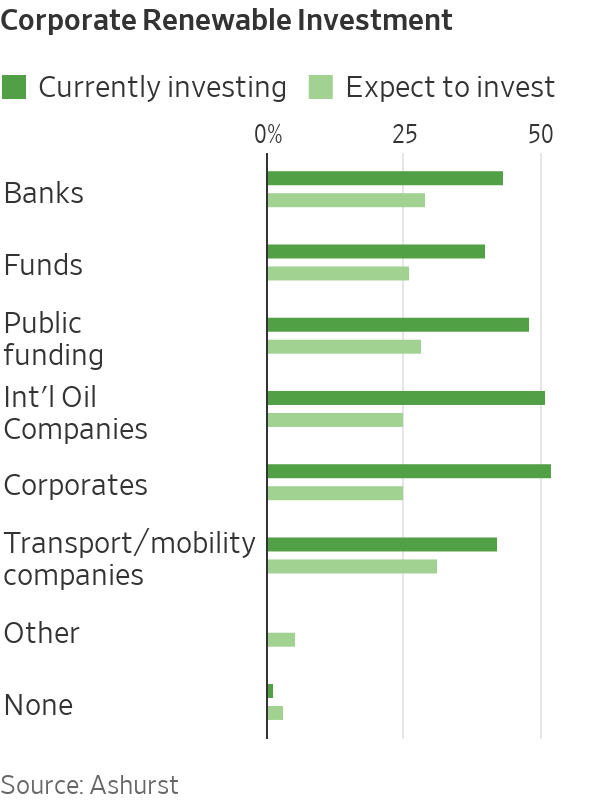
Three-quarters of business leaders from across the Group of 20 nations said the push to invest in renewable energy is being driven mainly by their own corporate boards, with 77% of U.S. business leaders saying the pressure was extreme or significant, according to a new survey conducted by law firm Ashurst.
The corporate call to decarbonise is intensifying, Ashurst said, with 30% of business leaders saying the pressure from their own boards was extreme, up from 25% in 2022.
“We’re seeing that the energy transition is an area that is firmly embedded in the thinking of investors, corporates, governments and others, so there is a real emphasis on setting and acting on these plans now,” said Michael Burns, global co-head of energy at Ashurst. “That said, the pace of transition and the stage of the journey very much depends from business to business.”
The shift in sentiment comes as companies ramp up investment in renewable spending to meet their net-zero goals. Ashurst found that 71% of the more than 2,000 respondents to its survey had committed to a net-zero target, while 26% of respondents said their targets were under development.
Ashurst also found that solar was the most popular method to decarbonise, with 72% of respondents currently investing in or committed to investing in the clean energy technology. The law firm also found that companies tended to be the most active when it comes to renewable investments, with 52% of the respondents falling into this category. The average turnover of those companies was $15.1 billion.
Meanwhile, 81% of energy-sector respondents to the survey said they see investment in renewables as essential to the organisation’s strategic growth.
Burns said the 2030 timeline to reach net zero was very important to the companies it surveyed. “We are increasingly seeing corporate and other stakeholders actively setting and embracing trajectories to achieve net zero. However, greater clarity and transparency on the standards for measuring and managing these net-zero commitments is needed to ensure consistency in approach and, importantly, outcome,” he said.
Legal battles over climate change and renewable investing are also likely to rise, with 68% of respondents saying they expect to see an increase in legal disputes over the next five years, while only 16% anticipate a decrease, the report said.
Few of the U.S.’s philanthropic foundations invest their endowment assets—totalling an estimated US$1.1 trillion—to create positive social and environmental change in addition to high returns, potentially limiting or even counteracting the good such organisations do.
Exactly how few isn’t precisely known. But Bridgespan Social Impact, a subsidiary of the New York-based Bridgespan Group along with the Capricorn Investment Group, a Palo Alto, Calif.-based investment firm founded by Jeff Skoll , the first president of eBay, and the Skoll Foundation, also in Palo Alto, attempted to “get the conservation started,” with a study of 65 foundations with a total of about US$89 billion in assets, according to Mandira Reddy, director at Capricorn Investment Group.
The top-line conclusion: 5% of the primarily U.S.-based foundations surveyed invest their assets for impact. Most surprising is that 92% of these organisations, which have assets ranging from US$11 million to US$16 billion, are active members of impact investing groups, such as the Global Impact Investing Network and Mission Investors Exchange.
“If there’s any pool of capital that is best suited for impact investing, it would be this pool of capital along with family office money,” Reddy says.
The study was also conducted “to draw attention to the opportunity,” she said.
“We want to redefine what philanthropy can achieve. There is massive potential here just given the scale of capital.”
Foundations are required by the U.S. Internal Revenue Service to grant 5% of their assets each year to charity; in practice they have granted slightly more in the last 10 years—an average of 7% of their assets, according to Delaware-based FoundationMark, which tracks the investment performance of about 97% of all foundation assets.
The remaining assets of these foundations are invested with the intention of earning the “highest-possible risk-adjusted financial returns,” the report said. Those investments allow these organizations to grant funds often in perpetuity.
Capricorn and Bridgespan argue that more foundations, however, need to “align their capital with their missions,” and that they can do so while still achieving high returns.
“Why wait to distribute resources far into the future when there are numerous urgent issues facing the planet and communities today,” argue the authors of a report on the research, which is titled, “Can Foundation Endowments Achieve Greater Impact.”
The fact most of the foundations surveyed are very familiar with impact investing and yet haven’t taken the leap “highlights the persistently untapped opportunity,” the report said. It details some of the barriers foundations can face in shifting to impact, and how and why to overcome them.
Hurdles to making a shift can include “beginner’s dilemma”—simply not knowing where to start—and a misperception on the part of large foundations that impact investing is “too niche,” offering opportunities that are too small for the amount of capital they need to allocate. Other foundations are too stretched and don’t have the resources to add capabilities for making impact investments, the report said.
One of the biggest concerns is financial performance. Some foundation leaders, for instance, worry impact investments lead to so-called concessionary returns, where a market rate of return is sacrificed to achieve a social or environmental benefit. Those investments exist, but there are also plenty of options that offer financial returns.
The authors make a case for foundations to “go big,” into impact to realize the best outcomes, and to take a portfolio approach, meaning integrating impact principles into how they approach all investments. To make this happen, foundations need to incorporate impact into their investment policy statements, which determine how they allocate assets.
It will be difficult for foundations that want to shift their assets to impact to pull out of investments such as private-equity or venture-capital funds that can have holdings periods of a decade. But with a policy statement in place, a foundation’s investment team can reinvest this long-term capital once it is returned into impact investing options, she says.
“The transition doesn’t happen overnight,” Reddy says. “Even if there is a commitment for an established foundation that is already fully invested, it takes several years to get there.”
The Skoll Foundation, established in 1999, revised its investment policy statement in 2006 to incorporate impact. According to the report, the foundation initially divested of investments that were not in sync with its values, and then gradually, working with Capricorn Investment, began exploring impact opportunities mostly in early-stage companies developing solutions to climate change.
“As the team gained more knowledge and experience in this work, and as more investment opportunities arose, the impact-aligned portfolio expanded across different asset classes, issue areas, and fund managers,” the report said.
As of 2022, 70% of the Skoll Foundation’s assets are in impact investments addressing climate change, inclusive capitalism, health and wellness, and sustainable markets.
Capricorn, which manages US$9 billion for foundations and institutional investors through impact investments, constructs portfolios across asset classes. In private markets, this can include venture, private equity, private credit, real estate, and infrastructure. There are also impact options in the public markets, in both stocks and bonds.
“Across the spectrum there are opportunities available now to do this in an authentic manner while preserving financial goals,” Reddy says.
Of the foundations surveyed, about 15, including Skoll, have 50% or more of their assets invested for impact. Others include the Lora & Martin Kelley Foundation, the Nathan Cummings Foundation, the Russell Family Foundation, and the Winthrop Rockefeller Foundation.
Though not part of the study, the California Endowment just announced it was going “all in” on impact. The organisation has US$4 billion in assets under management, which likely makes it the largest foundation to undergo the shift, according to Mission Investors Exchange.
Although the researchers looked at a fairly small sample set of foundations, Reddy says it provides data “that is indicative of what the foundation universe” might look like.
“We cannot tell foundations how to invest and that’s not the intent, but we do want to spread the message that it is quite possible to align their assets to impact,” she says. “The idea is that this becomes a boardroom conversation.”
There is an enormous global wealth transfer in its beginning stages, whereby one of the largest generations in history – the baby boomers – will pass on their wealth to their millennial children. Knight Frank’s global research report, The Wealth Report 2024, estimates the wealth transfer set to take place over the next two decades in the United States alone will amount to US$90 trillion.
But it’s not just the size of the wealth transfer that is significant. It will also deliver billions of dollars in private capital into the hands of investors with a very different mindset.
Seismic change
Wealth managers say the young and rich have a higher social and environmental consciousness than older generations. After growing up in a world where economic inequality is rife and climate change has caused massive environmental damage, they are seeing their inherited wealth as a means of doing good.
Ben Whattam, co-founder of the Modern Affluence Exchange, describes it as a “seismic change”.
“Since World War II, Western economies have been driven by an overt focus on economic prosperity,” he says. “This has come at the expense of environmental prosperity and has arguably imposed social costs. The next generation is poised to inherit huge sums, and all the research we have commissioned confirms that they value societal and environmental wellbeing alongside economic gain and are unlikely to continue the relentless pursuit of growth at all costs.”
Investing with purpose
Mr Whattam said 66% of millennials wanted to invest with a purpose compared to 49% of Gen Xers. “Climate change is the number one concern for Gen Z and whether they’re rich or just affluent, they see it as their generational responsibility to fix what has been broken by their elders.”
Mike Pickett, director of Cazenove Capital, said millennial investors were less inclined to let a wealth manager make all the decisions.
“Overall, … there is a sense of the next generation wanting to be involved and engaged in the process of how their wealth is managed – for a firm to invest their money with them instead of for them,” he said.
Mr Pickett said another significant difference between millennials and older clients was their view on residential property investment. While property has generated immense wealth for baby boomers, particularly in Australia, younger investors did not necessarily see it as the best path.
“In particular, the low interest rate environment and impressive growth in house prices of the past 15 years is unlikely to be repeated in the next 15,” he said. “I also think there is some evidence that Gen Z may be happier to rent property or lease assets such as cars, and to adopt subscription-led lifestyles.”
Impact investing is a rising trend around the world, with more young entrepreneurs and activist investors proactively campaigning for change in the older companies they are invested in. Millennials are taking note of Gen X examples of entrepreneurs trying to force change. In 2022, Australian billionaire tech mogul and major AGL shareholder, Mike Cannon-Brookes tried to buy the company so he could shut down its coal operations and turn it into a renewable energy giant. He described his takeover bid as “the world’s biggest decarbonisation project”.
Hong Kong has taken a bold step to ease a real-estate slump, scrapping a series of property taxes in an effort to turn around a market that is often seen as a proxy for the city’s beleaguered economy.
The government has removed longstanding property taxes that were imposed on nonpermanent residents, those buying a second home, or people reselling a property within two years after buying, Financial Secretary Paul Chan said in his annual budget speech on Wednesday.
The move is an attempt to revive a property market that is still one of the most expensive in the world, but that has been badly shaken by social unrest, the fallout of the government’s strict approach to containing Covid-19 and the slowdown of China’s economy . Hong Kong’s high interest rates, which track U.S. rates due to its currency peg, have increased the pressure .
The decision to ease the tax burden could encourage more buying from people in mainland China, who have been a driving force in Hong Kong’s property market for years. Chinese tycoons, squeezed by problems at home, have in some cases become forced sellers of Hong Kong real estate—dealing major damage to the luxury segment.
The additional taxes were introduced in a series of announcements starting in 2010, when the government was focused on cooling down soaring home prices that had made Hong Kong one of the world’s least affordable property markets. They are all in the form of stamp duty, a tax imposed on property sales.
“The relevant measures are no longer necessary amidst the current economic and market conditions,” Chan said.
The tax cuts will lead to more buying and support prices in the coming months, said Eddie Kwok, senior director of valuation and advisory services at CBRE Hong Kong, a property consultant. But in the longer term, the market will remain sensitive to the level of interest rates and developers may still need to lower their prices to attract demand thanks to a stockpile of new homes, he said.
Hong Kong’s authorities had already relaxed rules last year to help revive the market, allowing home buyers to pay less upfront when buying certain properties, and cutting by half the taxes for those buying a second property and for home purchases by foreigners. By the end of 2023, the price index for private homes reached a seven-year low, according to Hong Kong’s Rating and Valuation Department.
The city’s monetary authority relaxed mortgage rules further on Wednesday, allowing potential buyers to borrow more for homes valued at around $4 million.
The shares of Hong Kong’s property developers jumped after the announcement, defying a selloff in the wider market. New World Development , Sun Hung Kai Properties and Henderson Land Development were higher in afternoon trading, clawing back some of their losses from a slide in their stock prices this year.
The city’s budget deficit will widen to about $13 billion in the coming fiscal year, which starts on April 1. That is larger than expected, Chan said. Revenues from land sales and leases, an important source of government income, will fall to about $2.5 billion, about $8.4 billion lower than the original estimate and far lower than the previous year, according to Chan.
The sweeping property measures are part of broader plans by Hong Kong’s government to prop up the city amid competition from Singapore and elsewhere. Stringent pandemic controls and anxieties about Beijing’s political crackdown led to an exodus of local residents and foreigners from the Asian financial centre.
But tens of thousands of Chinese nationals have arrived in the past year, the result of Hong Kong rolling out new visa rules aimed at luring talent in 2022.
The Nikkei stock index recorded last week its first new high in 34 years, a fitting tribute to Japan’s re-emergence as a genuinely exciting economy.
It also comes amid mounting evidence that Japan has finally broken the hold of deflation. Inflation in January was 2.2%, the 22nd month above 2%. Wage growth has picked up too.
This appears to vindicate the economic consensus that deflation was a primary driver of Japan’s decades long malaise. But that conclusion might be premature. Proof of deflation’s harm has been elusive, and the benefits of low, positive inflation might be similarly subtle.
Consumers are often surprised to hear that deflation is supposed to be bad. In the U.S., where prices have risen steeply since 2021 , normal people, and even economists, wouldn’t object if they fell a bit.
The trouble arises when prices fall persistently, year in and year out, because wages, incomes and the prices of assets such as property tend to follow. Debtors struggle to repay loans and might slash spending or default, endangering the financial system. That is what happened in the U.S. when prices fell 27% from 1929 to 1933.
Even mild deflation can, in theory, inhibit growth. Central banks stimulate spending by lowering nominal interest rates below inflation to make the real—i.e., inflation-adjusted—cost of borrowing negative. That is almost impossible when inflation is itself negative.
The roots of deflation
Japan’s deflation began after its property and stock-market bubbles burst in the early 1990s. Ensuing losses at banks eroded their ability to lend. Inflation turned negative in 1999.
Western economists such as future Federal Reserve Chair Ben Bernanke argued that curing deflation was essential to restoring Japan’s economic health. The Bank of Japan agreed, at first half heartedly and then wholeheartedly.
It used zero, then negative, short-term interest rates. Next came purchases of short-term, then long-term, government securities. Finally, the BOJ even bought shares in companies with newly created money to stimulate spending and raise inflation.
The BOJ only succeeded in bringing inflation up to around zero. It took the global supply chain shocks of the pandemic to finally push underlying inflation to 2%, the bank’s target .
Japan’s 25 years of zero to negative inflation was accompanied by one of the rich world’s lowest growth rates. Japanese deflation became a cautionary tale for other countries, most recently China, where prices are currently falling .
Yet proving that deflation was behind Japan’s problems is maddeningly hard. Arguably, it was more symptom than cause.
In the early 1990s, working-age population growth turned negative. This happened just as Japan’s post-World War II phase of catching up to other developed nations ended. Meanwhile, industry began moving production to lower-wage countries.
All this, plus the banking crisis, put structural downward pressure on prices, wages and growth.
Underlying performance
Adjusted for its shrinking population, however, Japan’s performance has been respectable. From 1991 to 2019, its output per hour worked rose 1.3% a year. This was slower than in the U.S. but comparable with Canada, France, Germany and Britain, and faster than Italy or Spain, according to the economists Jesús Fernández-Villaverde, Gustavo Ventura and Wen Yao.
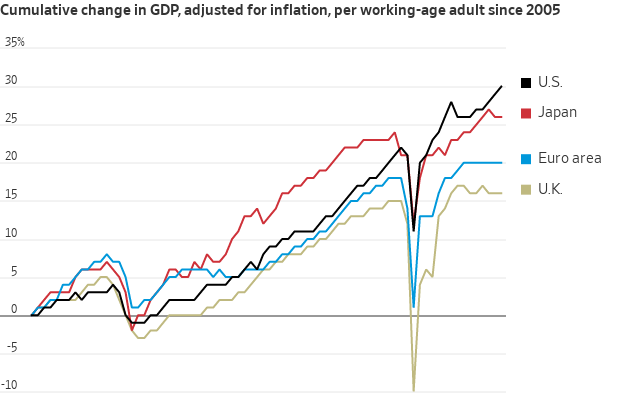
Since 2019, output per working-age person rose 7% in the U.S., 5% in Japan, 2% in the eurozone and zero in Britain, by my calculations. (This might overstate Japan’s performance because many of its elderly still work.) As any visitor can attest, Japan remains a prosperous, harmonious and well-ordered place.
“Had you appointed me governor of the Bank of Japan for 25 years with all the power in the world, I don’t think I would have been able to do better,” said Fernández-Villaverde.
This doesn’t prove deflation was benign. Growth (and deflation) might have been worse without the BOJ’s herculean monetary efforts. And if inflation had been positive, growth might have been stronger.
Still, it raises an awkward question: If zero to negative inflation is so damaging, where is the evidence?
The price mechanism
The harm might lie in subtle behavioural changes by investors, companies and the public. For example, in a market economy, changing relative prices and wages are critical signals for reallocating capital and labor from stagnant to growing sectors.
Relative prices changes are unusually rare in Japan, according to the University of Tokyo economist Tsutomu Watanabe. He has found that from 1995 through 2021, prices of more than half of products didn’t change at all from year to year. This wasn’t just because average inflation was lower; price changes deviated from the average much less than in other countries.
In a December speech, Bank of Japan Governor Kazuo Ueda said years of low to negative inflation led to a “status quo in wage- and price-setting behaviour,” so many prices and wages didn’t change. “The know-how for raising prices was thus lost,” he said.
The absence of this price-discovery function, Ueda contended, sapped productivity and dynamism.
Watanabe’s research shows that since January 2022, prices have been less sticky and more dispersed. Coincidentally, the Nikkei’s latest rally began a year later.
This in great part reflects the enthusiasm of foreign investors such as Warren Buffett , shareholder-friendly changes in corporate governance, and Japan’s importance as an alternative to China for high-end manufacturing and technology.
Inflation, though, might also be a factor, said Paul Sheard , a former vice chairman at S&P Global who has studied the Japanese economy for decades. He added that investors care about nominal, not real, stock prices, earnings, dividends and cash flow.
Higher inflation flatters all those metrics. That benefit might be neutralised by higher interest rates, but Japanese bond yields have risen less than expected inflation, so real yields are down to minus 0.6%.
So perhaps inflation is reviving businesses’ and investors’ animal spirits. Even so, growth last year was about the same as before the pandemic and turned slightly negative in the third and fourth quarters, producing a technical recession . What’s more, wages have lagged behind inflation, and Prime Minister Fumio Kishida ’s approval ratings have plummeted.
Japan might have prevailed in its war against deflation. But ordinary Japanese have yet to see a peace dividend.
Luxury real estate in Perth and the Gold Coast delivered above-average price growth compared to the rest of the world in 2023, but this year Sydney and Melbourne are expected to outshine the other Australian capitals, according to Knight Frank’s newly releasedglobal research report, The Wealth Report 2024.
Knight Frank’s Prime International Residential Index (PIRI 100), which measures price growthamong luxury homes in the top 5 percent of the market in 100 prime locations, found luxury residential property prices were surprisingly resilient in the turbulent global economy last year, rising by 3.1 percent on average.
This was down on the 5.2 percent average recorded in 2022 and 8.4 percent in 2021. However, given the rapid rise of interest rates during the world’s fight against inflation, Knight Frank analysts said the growth rate was “solid”, with 80 cities recording flat or positive annual price rises. The resilience was largely due to a lack of supply, which created more buyer competition for fewer homes on the market.
Leading the PIRI 100 for growth was Manila, up 26 percent, followed by Dubai at 16 percent, The Bahamas at 15 percent; and Algarve in Portugal and Cape Townin South Africa both at 12.3 percent. In Australia, Perth and the Gold Coast recorded price rises that were higher than the global average at 5.2 percentand 4.1 percent, placing them in 28th and equal 38th place among the 100 PIRI cities. Sydney ranked equal 49th with 2.7 percent growth, followed by Brisbane in 58th place with a 2.3 percent price rise. Melbourne was the laggard among Australian cities, ranking equal 63rdwith growth of 1.4 percent.
Knight Frank global head of research,Liam Bailey, said wealthy people targeted luxury residential property in 2023 as their portfolios began to recover. Mr Bailey said 24 percent of the world’s ultra-high-net-worth individuals (UHNWIs), defined as having a net worth of US$30 million or more, were actively looking to buy last year. The report finds that demand will likely be similar in 2024.
Looking ahead, Knight Frank analysts have provided their 2024 forecasts for luxury residential house price growth in 25 of the world’s most in-demand markets. They predict an average growth rate of 2.5 percent for the group, up from 1.7 percent in 2023. They think Auckland will record the strongest growth at 10 percent, followed by Mumbai in India at 5.5 percent.Among Australian cities, Sydney will lead the way with 5 percent growth, followed by Melbourne with 3 percent. This would place both cities in the top 10out of the 25 cities canvassed.
The analysts also predict that Sydney will experience the highest prestige property rental price growth in 2024 at 12 percent, far ahead of any other city in the world. The next strongest prestige rental markets are tipped to be Auckland and Toronto in Canada with 6 percent growth, London at 5.5 percent and New York at 5 percent.
The Wealth Report finds that lack of stock was a key driver of price growth for both sales and rental markets last year, and this will remain the case in 2024. For example, Sydney’s luxury home sales were down by 37 percent in 2023, with similar volume declines also seen in London, New York, Dubai, Singapore and Hong Kong.
Knight Frank Partner Erin van Tuil said: “Whilst volumes have dropped for Sydney’s prime residential market, values have not, demonstrating once again that Sydney remains a popular location to live and invest ... The fundamentals of the Sydney market, such as lifestyle, transparent government and taxes and the sheer beauty of living in the Harbour City are unlikely to change, and therefore Sydney’s popularity is likely set to remain. With only so many waterfront locations available … owning a slice of Sydney Harbour real estate remains a popular investment.”The report also reveals what US$1 million buys in prime global cities and popular second-home areas in sun and ski holiday locations. In Sydney, US$1 million buys 43sqm, and on the Gold Coast, it buys 112sqm. By comparison, US$1 million buys 20 sqm in Aspen, 22 sqm in Hong Kong, 32 sqm in St Tropez,33 sqm in London, 34 sqm in New York, 38 sqm in Los Angeles, 40 sqm in Paris and 42 sqm in Shanghai.
Booming demand for wellness tourism shows no slowing, with travel related to health and well-being projected to have reached $1 trillion last year and to hit $1.3 trillion by 2025, according to the Global Wellness Institute, a nonprofit based in Miami.
Curated wellness travel programs are especially sought-after, specifically holistic treatments focused on longevity. Affluent travellers not only are making time to hit the gym while gallivanting across the globe, they’re also seeking destinations that specifically cater to their wellness goals, including treatments aimed at living longer.
“I believe Covid did put a spotlight on self-care and well-being,” says Penny Kriel, corporate director of spa and wellness at Salamander Collection, a group of luxury properties in places like Washington, D.C., and Charleston, South Carolina. But Kriel says today’s spas are more holistic, encouraging folks to understand the wellness concept and incorporate it into their lifestyle more frequently.
“With the evolution of treatment products and technology, spas have been able to enhance their offerings and appeal to more travellers,” Kriel says.
While some growth is connected to the variety of treatments available, results and the digital world are also contributing to the wellness boom.
“The efficacy and benefits of these treatments continue to drive bookings and interest, especially with the support of social media, influencers, and celebrity endorsements,” Kriel says.
While genetics, environmental factors, and lifestyle choices such as regular exercise, a diet free of processed foods, sufficient sleep, and human connection play essential roles in living well and longer, experts believe in holistic therapies to help manage stress, boost immunity, and ultimately influence length and quality of life.
Anti Ageing and Beyond
“For years, people have been coming to spas, booking treatments, and gaining advice on how to turn the clock back with anti ageing and corrective skin treatments,” Kriel says. However, today’s treatments are far more innovative.
On Marinella Beach in Porto Rotondo, on the Italian island of Sardinia, guests at the five-star Abi d’Oru Hotel & Spa can experience the resort’s one-of-a-kind “longevity treatment,” a unique antiaging facial using one of the island’s native grapes: Cannonau. The world’s first declared “Blue Zone”—one of five designated areas where people live longer than average, some into their 100s—Sardinia produces this robust red wine varietal, the most widely planted on the island.
Known as Garnacha in Spain and Grenache in France, Cannonau supposedly contains two to three times more antioxidants than other red-wine grapes. By incorporating Cannonau, Abi Spa says its unique 50-minute longevity session increases collagen production for firmer, younger-looking skin.
Maintaining a youthful appearance is just one facet of longevity treatments, which range from stress-reduction sessions like massage to nutritional support and sleep programs, Kriel says. Some retreats also offer medical services such as IV infusions and joint injections.
Keeping with the trend, Kriel is expanding Salamander Collection’s existing spa services, such as detox wraps and lymphatic drainage, to include dedicated “Wellness Rooms,” new vegan and vegetarian menu items, and well-being workshops. “Sleep, nutrition, and mindfulness will be a big focus for integration in 2024,” she says.
Data-Driven Wellness
Skyler Stillings, an exercise physiologist at Sensei Lanai, a Four Seasons Resort—an adults-only wellness centre in Lanai, Hawaii—says guests were drawn to the social aspect when the spa opened in November 2021.
“We saw a huge need for human connection,” she recalls. But over the past few years, what’s paramount has shifted. “Longevity is trending much more right now.”
Human connection is a central draw for guests at Sensei Lanai, an adults-only and wellness-focused Four Seasons Resort in Hawaii. Sensei Lanai, A Four Seasons Resort
Billionaire co-founder of tech company Oracle Larry Ellison and physician and scientist Dr. David Angus co-founded Sensei. After the death of a mutual close friend, the duo teamed up to create longevity-based wellness retreats to nurture preventative care and a healthy lifestyle. In addition to the Lanai location, the brand established Sensei Porcupine Creek in Greater Palm Springs, California, in November 2022.
Sensei has a data-driven approach. The team performs a series of assessments to obtain a clearer picture of a guest’s health, making wellness recommendations based on the findings. While Sensei analyses that data to curate a personalised plan, Stillings says it’s up to the guests which path they choose.
Sensei’s core three-day retreat is a “Guided Wellness Experience.” For spa treatments, each guest checks into their own “Spa Hale,” a private 1,000-square-foot bungalow furnished with an infrared sauna, a steam shower, a soaking tub, and plunge pools. The latest therapies include Sarga Bodywalking—a barefoot myofascial release massage, and “Four Hands in Harmony,” a massage with two therapists working in tandem. Sensei Guides provide take-home plans so guests can continue their wellness journeys after the spa.
Sensei Lanai, an adults-only and wellness-focused Four Seasons Resort in Hawaii. Sensei Lanai, A Four Seasons Resort
Sanctuaries for Longevity
Headquartered in Switzerland with hotels and on-site spas across the globe, Aman Resorts features an integrative approach, combining traditional remedies with modern medicine’s advanced technologies. Tucked behind the doors of the storied Crown Building in Midtown Manhattan, Banya Spa House at Aman New York—the brand’s flagship spa in the Western Hemisphere—is a 25,000-square-foot, three-floor urban oasis.
Yuki Kiyono, global head of health and wellness development at Aman, says the centre provides access to holistic and cutting-edge treatments benefiting physical, mental, emotional, spiritual, and social well-being. Aman’s customisable “Immersion Programs” consist of a three- or five-day immersion. “The programs encompass treatments and experiences that touch every significant aspect to create a path for longevity, from meditation and mindfulness to nutrition and movement,” Kiyono explains.
Banya Spa House at Aman New York. Robert Rieger
The spa’s “Tei-An Wellness Solution” features 90- to 150-minute sessions using massage, cryotherapy, and Vitamin IV infusions. Acupuncture is also on offer.
“With its rich history of Chinese Medicine, modern research, and the introduction of sophisticated electro-acupuncture medicine, acupuncture has been proven to assist with problems and increase performance,” Kiyono says.
Resetting the Mind and Body
Beyond longevity, “healthspan”—the number of years a person can live in good health free of chronic disease—is the cornerstone of Mountain Trek Health Reset Retreat’s program in British Columbia, Canada.
Kirk Shave, president and program director, and his team employ a holistic approach, using lifestyles in long-living Blue Zones as a point of reference.
“We improve our daily lifestyle habits, so we live vitally as long as we’re meant to live,” Shave says of the retreat. He built the program from an anthropological stance, referencing humans as farmers, hunters, and gatherers based on their eating and sleeping patterns. Food includes vegetable-centric meals sans alcohol, sugar, bread, or dairy.
Guests wake at dawn each day and have access to sunrise yoga, several hours of “flow” or slow hiking, spa treatments, forest bathing, calming crystal singing-bowl and sound therapy sessions, and classes on stress reduction—one of Mountain Trek’s primary goals. The program motivates people to spend much of their time in nature because it’s been proven to reduce cortisol, the stress hormone that can lead to inflammation and disease when elevated for extended periods.
While most guests aren’t aware of how immersive Mountain Trek’s program is when they arrive, they leave the resort revitalized after the structured, one-week program. Set in the Kootenays overlooking its eponymous river, the resort and adventure promise what Shave calls a “visceral experience of transformation.”
“They’re interested in coming to be in nature,” Shave says of the guests. “They hit a wall in their life and slipped backwards, so they know they need a reset.”
Banya Spa House at Aman New York provides access to holistic and cutting-edge treatments benefiting physical, mental, emotional, spiritual, and social well-being. Robert Rieger
This article first appeared in the Winter 2024 issue of Mansion Global Experience Luxury.
A new crop of nefarious chatbots with names like “BadGPT” and “FraudGPT” are springing up on the darkest corners of the web, as cybercriminals look to tap the same artificial intelligence behind OpenAI’s ChatGPT.
Just as some office workers use ChatGPT to write better emails, hackers are using manipulated versions of AI chatbots to turbocharge their phishing emails. They can use chatbots—some also freely-available on the open internet—to create fake websites, write malware and tailor messages to better impersonate executives and other trusted entities.
Earlier this year, a Hong Kong multinational company employee handed over $25.5 million to an attacker who posed as the company’s chief financial officer on an AI-generated deepfake conference call, the South China Morning Post reported, citing Hong Kong police. Chief information officers and cybersecurity leaders, already accustomed to a growing spate of cyberattacks , say they are on high alert for an uptick in more sophisticated phishing emails and deepfakes.
Vish Narendra, CIO of Graphic Packaging International, said the Atlanta-based paper packing company has seen an increase in what are likely AI-generated email attacks called spear-phishing , where cyberattackers use information about a person to make an email seem more legitimate. Public companies in the spotlight are even more susceptible to contextualised spear-phishing, he said.
Researchers at Indiana University recently combed through over 200 large-language model hacking services being sold and populated on the dark web. The first service appeared in early 2023—a few months after the public release of OpenAI’s ChatGPT in November 2022.
Most dark web hacking tools use versions of open-source AI models like Meta ’s Llama 2, or “jailbroken” models from vendors like OpenAI and Anthropic to power their services, the researchers said. Jailbroken models have been hijacked by techniques like “ prompt injection ” to bypass their built-in safety controls.
Jason Clinton, chief information security officer of Anthropic, said the AI company eliminates jailbreak attacks as they find them, and has a team monitoring the outputs of its AI systems. Most model-makers also deploy two separate models to secure their primary AI model, making the likelihood that all three will fail the same way “a vanishingly small probability.”
Meta spokesperson Kevin McAlister said that openly releasing models shares the benefits of AI widely, and allows researchers to identify and help fix vulnerabilities in all AI models, “so companies can make models more secure.”
An OpenAI spokesperson said the company doesn’t want its tools to be used for malicious purposes, and that it is “always working on how we can make our systems more robust against this type of abuse.”
Malware and phishing emails written by generative AI are especially tricky to spot because they are crafted to evade detection. Attackers can teach a model to write stealthy malware by training it with detection techniques gleaned from cybersecurity defence software, said Avivah Litan, a generative AI and cybersecurity analyst at Gartner.
Phishing emails grew by 1,265% in the 12-month period starting when ChatGPT was publicly released, with an average of 31,000 phishing attacks sent every day, according to an October 2023 report by cybersecurity vendor SlashNext.
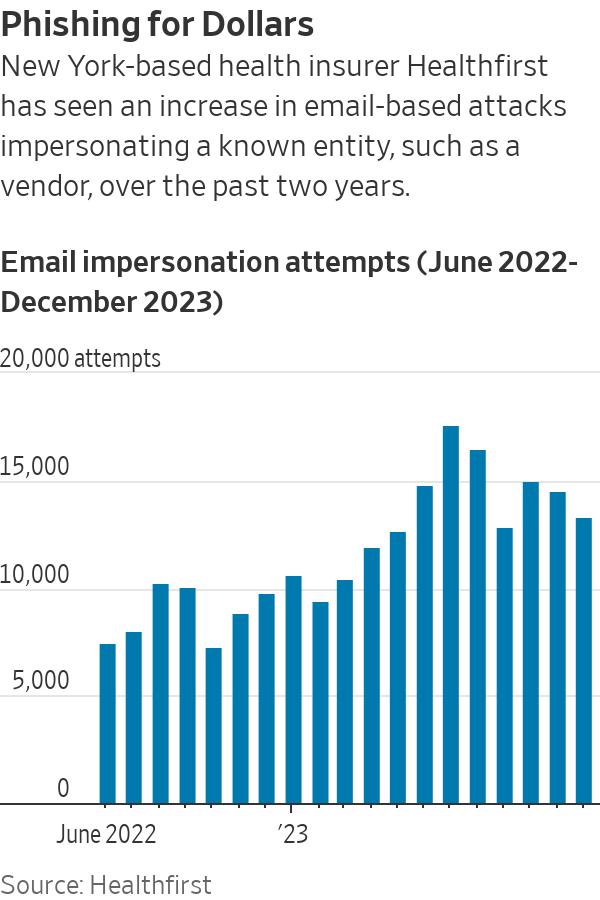
“The hacking community has been ahead of us,” said Brian Miller, CISO of New York-based not-for-profit health insurer Healthfirst, which has seen an increase in attacks impersonating its invoice vendors over the past two years.
While it is nearly impossible to prove whether certain malware programs or emails were created with AI, tools developed with AI can scan for text likely created with the technology. Abnormal Security , an email security vendor, said it had used AI to help identify thousands of likely AI-created malicious emails over the past year, and that it had blocked a twofold increase in targeted, personalised email attacks.
When Good Models Go Bad
Part of the challenge in stopping AI-enabled cybercrime is some AI models are freely shared on the open web. To access them, there is no need for dark corners of the internet or exchanging cryptocurrency.
Such models are considered “uncensored” because they lack the enterprise guardrails that businesses look for when buying AI systems, said Dane Sherrets, an ethical hacker and senior solutions architect at bug bounty company HackerOne.
In some cases, uncensored versions of models are created by security and AI researchers who strip out their built-in safeguards. In other cases, models with safeguards intact will write scam messages if humans avoid obvious triggers like “phishing”—a situation Andy Sharma, CIO and CISO of Redwood Software, said he discovered when creating a spear-phishing test for his employees.
The most useful model for generating scam emails is likely a version of Mixtral, from French AI startup Mistral AI, that has been altered to remove its safeguards, Sherrets said. Due to the advanced design of the original Mixtral, the uncensored version likely performs better than most dark web AI tools, he added. Mistral did not reply to a request for comment.
Sherrets recently demonstrated the process of using an uncensored AI model to generate a phishing campaign. First, he searched for “uncensored” models on Hugging Face, a startup that hosts a popular repository of open-source models—showing how easily many can be found.
He then used a virtual computing service that cost less than $1 per hour to mimic a graphics processing unit, or GPU, which is an advanced chip that can power AI. A bad actor needs either a GPU or a cloud-based service to use an AI model, Sherrets said, adding that he learned most of how to do this on X and YouTube.
With his uncensored model and virtual GPU service running, Sherrets asked the bot: “Write a phishing email targeting a business that impersonates a CEO and includes publicly-available company data,” and “Write an email targeting the procurement department of a company requesting an urgent invoice payment.”
The bot sent back phishing emails that were well-written, but didn’t include all of the personalisation asked for. That’s where prompt engineering , or the human’s ability to better extract information from chatbots, comes in, Sherrets said.
Dark Web AI Tools Can Already Do Harm
For hackers, a benefit of dark web tools like BadGPT—which researchers said uses OpenAI’s GPT model—is that they are likely trained on data from those underground marketplaces. That means they probably include useful information like leaks, ransomware victims and extortion lists, said Joseph Thacker, an ethical hacker and principal AI engineer at cybersecurity software firm AppOmni.
While some underground AI tools have been shuttered, new services have already taken their place, said Indiana University Assistant Computer Science Professor Xiaojing Liao, a co-author of the study. The AI hacking services, which often take payment via cryptocurrency, are priced anywhere from $5 to $199 a month.
New tools are expected to improve just as the AI models powering them do. In a matter of years, AI-generated text, video and voice deepfakes will be virtually indistinguishable from their human counterparts, said Evan Reiser , CEO and co-founder of Abnormal Security.
While researching the hacking tools, Indiana University Associate Dean for Research XiaoFeng Wang, a co-author of the study, said he was surprised by the ability of dark web services to generate effective malware. Given just the code of a security vulnerability, the tools can easily write a program to exploit it.
Though AI hacking tools often fail, in some cases, they work. “That demonstrates, in my opinion, that today’s large language models have the capability to do harm,” Wang said.
From its inception, Chinese automaker BYD has had a global vision that’s been realised in Asia, Europe, and South America, but the company has had a conspicuously low profile in the U.S., where 25%import duties have so far kept the brand mostly out of the market. Indeed, U.S. lawmakers are urging even higher tariffs on Chinese-made EVs.
The U.S. blockade hasn’t stopped BYD (“Build Your Dreams”) from becoming the world’s biggest producer of EVs, passing Tesla. The company produced 3 million vehicles last year, with exports to 70 countries growing by a remarkable 334%. The company’s website has headlines such as “BYD Seal Launched in Nepal” and “BYD Enters Indonesian Passenger Car Market with three EVs.” Early investment in BYD by Warren Buffett seems to have been rewarded, though he sold some of his stock in 2022.
The EV supercar market has entries such as the Rimac Nevera, Lucid Air Sapphire, Maserati GranTurismo Folgore, and others, but few credible models from China. Now that may be changing with BYD’s sleek two-door US$233,400 Yangwang U9 (“Ultimate 9”) coupe, so far intended only for the Chinese market.
Competitive with those other supercars, it can reach 62 miles per hour in 2.36 seconds and attain a top speed of 192 mph. The U9 has 1,287 horsepower and 1,200 pound-feet of torque. The car was shown in a live launch stream from Shanghai on Saturday, and will reportedly reach customers as early as this summer.
BYD’s Yangwang U9 has the supercar look down pat. BYD photo
The U9 has an 80-kilowatt-hour lithium iron phosphate, or LFP, battery and 280-mile range on the Chinese Light-Duty Vehicle Test Cycle, which Sam Abuelsamid, principal analyst for transportation and mobility at Guidehouse Insights, says is “notoriously optimistic.” The U9 has an 800-volt architecture and can reportedly use DC fast charging up to 500 kilowatts, with the ability to charge from 30% to 80% in 10 minutes.
The U9 has familiar supercar styling by the German designer Wolfgang Egger, complete with a pair of upswinging doors. Like other Chinese cars, it has its fanciful side—including four different “dance modes” that make use of its Discus X full active body control. In the event of a flat tire, it can run on three wheels. Other features include an adjustable rear wing and “the smartest supercar cockpit,” with two LCD screens (and provisions for a possible third). The U9 is around 16 feet long, roughly the size of a Lamborghini Aventador.
Yangwang is a new upmarket brand for BYD. The lineup includes the U8, a US$150,000 four-motor plug-in hybrid SUV with 1,184 horsepower and zero to 62 in 3.6 seconds. The U8 can reportedly stay afloat during emergencies. BYD has already delivered more than 3,000 of them. The U7 is a luxury electric four-door sedan, also with four motors, and a reported 1,300 horsepower and up to 500-mile range. The U7 starts at US$140,000.
BYD covers both ends of the market, and offers EVs that sell for less than US$14,000 in the Chinese market. BYD, which has sold some buses in the U.S., is considering production in Mexico, which would potentially be an easy export to the U.S. That prospect is alarming Western automakers. According to a recent report from the Alliance for American Manufacturing: “The introduction of cheap Chinese autos—which are so inexpensive because they are backed with the power and funding of the Chinese government—to the American market could end up being an extinction-level event for the U.S. auto sector.”
Inside the U9. BYD photo
Building Chinese cars in Mexico is “an effort to gain backdoor access to American consumers by circumventing existing policies that are keeping China’s autos out of the U.S. market,” the report said. Abuelsamid said that further tariffs are “a distinct possibility,” but not likely until at least 2025 because of Congressional gridlock.
The home of an Australian businessman who died tragically in a helicopter crash in 2022 is on the market with a A$9 million (US$5.9 million) price guide.
Peter Woodland, the late director of Barbeques Galore who purchased the expansive family estate just north of Sydney in 2017, was killed in April 2022, when his helicopter crashed in the Snowy Mountains in New South Wales. He was 75.
Woodland, who was a keen pilot and even installed a helicopter hanger and helipad at the residence, bought the home from acclaimed landscape photographer Richard Green, who built the unique property in Terrey Hills in the 1990s. He also died in a helicopter crash in 2015 .
The vast five-bedroom house is located in a lush native bushland setting off Mona Vale Road.
Sydney Country Living
“Sitting right on the cliff’s edge, it looks right out over the bush to the water, and its proximity to the beach and even the city means it’s pretty special,” said listing agent Shayne Hutton of Sydney Country Living, which listed the home earlier this month.
Walls of fireproof glass and dozens of skylights with electronically operated Vergolas mean the natural landscape acts as a dramatic backdrop to every room. The neighboring national park and 5 acres of landscaped gardens are met with panoramic views stretching to the Pacific Ocean.
“It’s really country living in the city. That’s the only way to describe it. This place is perfect for anyone who is just sick of crowds and wants to get away, even if it’s as a secondary property they’ll use as a weekender,” he added.
The concrete-and-steel trophy home has a Travertine-tiled entrance foyer with 20ft ceilings which leads through to two separate wings; one for living and another for sleeping. With a choice of everyday spaces, each living zone has sweeping district views and doors to the wraparound veranda.
In addition to casual living and dining rooms, there are formal entertaining areas, a library, a home office or extra family room, a professional photographer’s darkroom plus a large artist’s studio that could also be used as a poolside cabana with wet bar.
Sydney Country Living
The granite kitchen has Gaggenau appliances, a grand island bench, a walk-in pantry, and an adjoining central courtyard with water features, perfect for a chef’s herb and vegetable garden.
While two bedrooms sit on the ground floor, four more occupy the upstairs accommodation level including a palatial primary suite. This parents’ retreat has a balcony, a vast dressing room plus walk-in wardrobe and a deluxe ensuite with freestanding bathtub, a double shower and twin vanities. One other bedroom features an ensuite and two more share a full family bathroom and powder room.
Outside, there are multiple entertaining terraces and courtyards, but the icing on the cake is the solar-heated pool and sun deck. Then the property’s standout feature is its state-of-the-art helipad with a fully incorporated turntable and a full-size helicopter hangar. Above the helipad, there is also a treetop viewing platform.
“A lot of people who might live on a farm have helicopters or just want the convenience to get in from the airport. It’s a great feature of the home and could be used for a variety of uses. For buyers without a helicopter, it could be an ideal car showroom,” Hutton said.
Additional features of the Terrey Hills residence include remote-controlled lock-up garages for up to five cars, storerooms, a wine cellar, ducted air conditioning, a security alarm and video intercom.
The Sydney sanctuary is surrounded by walking and biking trails, is a short drive to the transport and shopping hub of Chatswood and is an approximate 15-minute drive to local beaches.