A rising number of young Australians are remaining in the family home after finishing school, as economic and social factors drive them to delay independent living, according to new research. And they’re staying longer, with a marked increase in 20-somethings still living at home over the past two decades.
Just over 54 percent of young men and 47 percent of young women aged between 18 and 29 years are still living in the family home, according to the 18th annual report for the longitudinal Household, Income and Labour Dynamics in Australia (HILDA) Survey. The survey tracks the lives of 17,000 Australians and reports each year on various aspects of life, including health and education, household and family relationships, and income and work. The latest HILDA data was collected in 2021 during the pandemic.
HILDA Survey Co-Director, Professor Roger Wilkins from Melbourne University, said the trend of more young people remaining in the family home began in the early 2000s. He attributes it to a variety of social and economic elements.
“We’ve seen a rise in higher education participation, declining full-time employment opportunities for young people, a rising cost in housing, and a trend towards later marriage and family formation,” he said.
Over the past 20 years, the prevalence of young people living with their parents has been highest among those aged 18 to 21 years, which is unsurprising given these are the first few years of post-school adulthood when many young people are studying and unable to work full time. However, the data also shows that young people are living with mum and dad for longer periods — and well into their 20s.
Among 18 to 29-year-olds, the age category that has seen the most growth in young men living at home is 22 to 25 years. It’s up 12 percent from 42.1 percent in 2001 to 54.1 percent in 2021. Among women, the age category with the highest growth is 18 to 21 years, up 17.6 percent from 61.9 percent in 2001 to 79.5 percent in 2021. The age category with the second highest growth rate for both men and women is 26 to 29 years, up 9.9 percent for men and 11.6 percent for women since 2001.
Professor of Sociology and Social Policy at Melbourne University, Lyn Craig, said the trend has broad macroeconomic implications for Australia. “Since the mid-20-teens, fertility has fallen below replacement in Australia for the first time and I think that has something to do with the price of housing and young people not being able to afford to establish an independent household away from parents,” she said.
During the early 2000s when this trend began, the Australian housing market was in a boom and buying was difficult for young people to afford. Today, simply renting has become hard to afford, particularly following a 40 percent surge in rents nationally since the pandemic began.
While some young people are constrained by economic factors, others are likely delaying independence by choice, Professor Wilkins said.
“Some young people would like to start their adulthood journey and to have their own home but Australia’s economic conditions aren’t allowing that. On the positive side, as a richer society with longer life expectancy, perhaps some young people are making a rational and conscious choice to delay getting into the hard yakka of life. They decide to enjoy themselves and have some fun while they are still young.”
The eclectic London home that Freddie Mercury designed to fit his eccentric lifestyle has hit the market for offers over £30 million (US$38 million).
Garden Lodge, in the capital’s posh Kensington, was Mercury’s much-loved home from 1980—when on a first viewing he decided to buy the property on the spot—until his death in 1991, at which point the Queen frontman’s residence and everything in it was bequeathed to his one-time fianceé and close friend, Mary Austin.
In the 30 years since, Austin has taken “meticulous” care of the home, according to Knight Frank, which listed the walled and private property on Monday.
“This house has been the most glorious memory box, because it has such love and warmth in every room,” Austin, 72, said in a statement. “It has been a joy to live in, and I have many wonderful memories here. Now that it is empty, I’m transported back to the first time we viewed it.”
Knight Frank
“Ever since Freddie and I stepped through the fabled green door, it has been a place of peace, a true artist’s house, and now is the time to entrust that sense of peace to the next person,” she said.
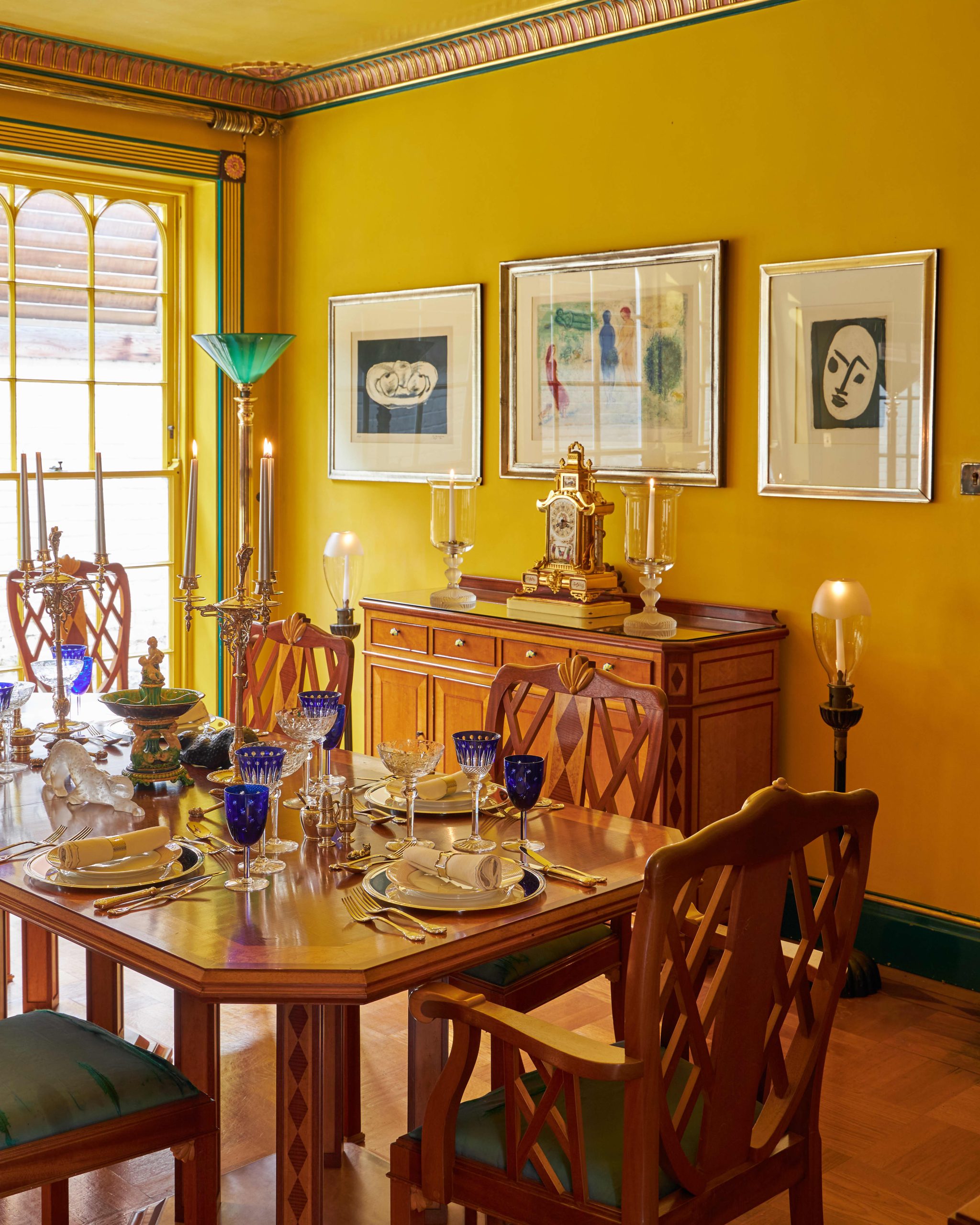
Mercury designed the house to be a memorable, inviting place that reflected his personality, case in point, the dining room, which he painted bright yellow—his favourite colour.
The home’s most “spectacular” space is the double-height drawing room, complete with a wraparound gallery that serves as a library and bar overlooking the room and Mercury’s grand piano, below.
There’s also the Japanese room, a sitting room that leads out to the home’s Japanese-style garden, which Mercury helped to create, complete with magnolia trees, topiary and water features.
Knight Frank
The primary bedroom suite, meanwhile, is lined with floor-to-ceiling mirrored doors, behind which Mercury stored his clothes and stage costumes.
“The sale of Garden Lodge presents a once-in-a-lifetime opportunity to own a significant property combined with a piece of cultural history, the beloved home of an icon,” said Paddy Dring, Knight Frank’s global head of prime sales and joint head of its private office.
“Having been carefully preserved with love and respect over the last three decades, we expect that the exceptional provenance of the property will be incredibly alluring to buyers across the world,” he said. “Notwithstanding the legacy of the house, it is very rare that unmodernised homes of this scale, set in such beautiful mature gardens come to market, so it is certainly an exciting prospect for any future purchaser.”
Mercury, born Farrokh Bulsara, formed Queen, one of the best-selling bands of all time, in 1970. Diagnosed with AIDS in 1987, Mercury died from complications from the disease at the age of 45, the day after publicly announcing his diagnosis.
“Quiet luxury” has become a bit of a dirty phrase in Milan. To some at the Italian brands that embody the term , it’s reductive—an overly TikTok-ified way of describing classic, refined clothing. Many fashion industry people roll their eyes when it comes up.
Brunello Cucinelli , one of the kings of natural textiles, prefers the term “gentle luxury.” At his fall presentation in Milan this past week, the (extremely expensive) clothing at which he excels looked especially touchable. Cashmere sweatsuits were layered with blanket-like scarves and silky suiting hung in loose pleats. Even an evening look, composed of a black sweater tucked into a feathered skirt, appeared comfy. Holding a pillowy bag, one Brunello disciple called it “accogliente”—Italian for “cozy.”
One step beyond coziness is protection, and there was plenty of that in Milan, too. Chalk it up to an uncertain luxury market , the roiling geopolitical climate or global warming, but using clothing as a sanctuary seemed to be on many designers’ minds. For some, like the excellent Brioni La Donna and Loro Piana collections, that means impeccable tailoring and forever-worthy double-breasted coats. Others, like Luke and Lucie Meier at Jil Sander, took the cocooning more literally, making succulent, quilted floor-length capes.
Not everyone is swaddling themselves in shearling. Architect Bianca Censori, who joined her companion, the rapper Ye, at the Marni show, wore a mere scrap of leather that failed to cover her buttocks among other body parts. No protection needed—except her bodyguard.
The Look of Love at Prada
Miuccia Prada and Raf Simons, the co-creative directors of Prada, are on quite a roll. If you were feeling hyperbolic, you might even say that they’re making fashion history. The duo’s fall collection started with thinking about love, explained Simons backstage, but “all the elements of love,” including loving your home, or even loving your sheets. There’s that theme of comfort again.
That manifested in a romance for different eras of fashion, remixed: A Jackie O. linen shift dress shot through with a streak of shearling. A leather bomber jacket embellished with “1913,” the year Prada was founded. A twin set in shocking red and ultraviolet. High-tech nylon jackets in midcentury couture shapes.
“There is no way to think about the future unless you have a good understanding of the past,” said Simons.
Everyday Allure at Bottega Veneta
In less than four years, Matthieu Blazy has completely renewed Bottega Veneta, making it a cult spot for creative types that want unique clothing and accessories with plenty of craftsmanship. Without succumbing to naked dresses and other revealing gimmicks, the brand appeals to a broad demographic, as shown by front-row neighbours Julianne Moore, 63, and A$AP Rocky, 35.
The fall collection, Blazy said backstage, was a “celebration of the everyday.” He found himself thinking about the allure of everyday clothing on his nightly dog walks. This meant recognisable pieces like peacoats, skirts and sweaters, reduced to their essential essence but rendered fabulous through textile innovation and fabrication. A simple yellow evening dress had a shirred-fabric fraying (not unlike recent work by Phoebe Philo ) and a long column skirt boasted leather plumes.
Blazy wanted to express resilience, he said, like flowers blooming in the desert. Fittingly, he designed giant Murano glass cactus flowers to decorate the show space.
Womblike Sumptuousness at Jil Sander
Real life crept into the fashion bubble on the day of Jil Sander’s show, when guests were confronted with a triple-whammy of rain, traffic and multiple public protests that closed the streets. Supermodel Mariacarla Boscono, like several models and editors, had a harrowing trip from Dolce & Gabbana to Jil Sander, and was swept right into hair and makeup and then onto the runway. Wearing the first look, a cocoon-like rounded red suit, Boscono was worth the wait.
Jil Sander put forward an extensive 68-look collection chock-full of satisfyingly sumptuous pieces. Chunky knitwear was sheathed in fine netting, tailored pieces were lined in silky quilting. Coats in deer leather and Himalayan goat fur looked like outerwear for an Icelandic wedding.
Androgynous Realism at Tod’s
At conservative Italian stalwart Tod’s, Matteo Tamburini executed an impressive debut. Upon arriving from Bottega Veneta in December, the first thing Tamburini discussed with Tod’s group boss Diego Della Valle was the need to create “desirable objects.” “You don’t want to have a big fashion show and then find nothing in the store,” said Tamburini after the show.
So in just a few short months, Tamburini was able to create a tightly edited women’s collection full of androgynous separates and light, appealing accessories. Stylist Brian Molloy, who’s also worked with The Row and Hermès , worked magic with restraint. One supersoft foldable tote big enough for a laptop had a slit at the top so it could fit under your shoulder—easy stuff that merits a high price tag.
Nvidia ’s historic run is minting profits for investors big and small . Many are betting the boom is just beginning.
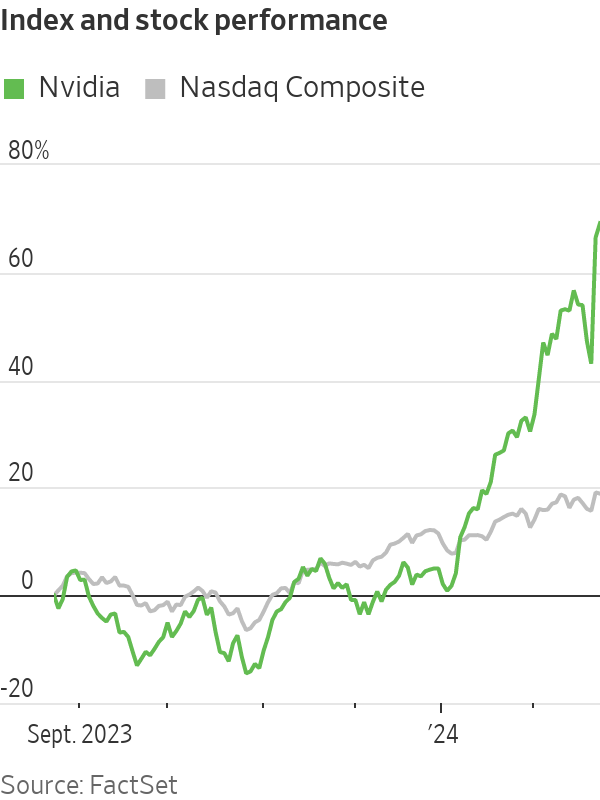
They are piling into trades that the chipmaker’s shares, which have more than tripled over the past year , are headed still higher. Some have turned to the options market to look for ways to turbocharge their bets on artificial intelligence after a blockbuster earnings report sent the stock up 17% over the past two days.
The exuberance reflects hope that the company is the vanguard of wide adoption of artificial intelligence—and an intense fear of missing out among investors who have sat on the sidelines while the company’s valuation has eclipsed $2 trillion .
With the help of Nvidia, stocks have stormed into 2024 . The S&P 500, which has chalked up fresh records in recent weeks, is up 6.7%. That is the index’s second-best performance for this time period over the past 10 years. The gains were only surpassed by an 11% increase in 2019.
Nvidia has contributed to about a quarter of those gains, according to S&P Dow Jones Indices.
The Nasdaq, too, is up 6.6% this year and neared a record Friday. The tech-heavy index has been boosted by Nvidia, which this week tacked on $277 billion in additional market value, along with six other tech titans collectively known as the Magnificent Seven.
The Dow Jones Industrial Average is up 3.8% this year and has hit repeated records in recent weeks.
“You look at these numbers and what this company’s done—it’s almost without precedent,” said Mike Ogborne, founder of San Francisco-based hedge fund Ogborne Capital Management, who counts Nvidia among his top five biggest holdings . “It is nothing short of amazing.”
Ogborne compared AI with the launch of the internet more than two decades ago, which kick-started a technology craze that lasted years.
“It’s exciting,” Ogborne said. “It’s great for America.”
Unfazed by questions about AI
Tamar June in Reno, Nev., is one investor along for Nvidia’s furious stock-market ascent. Since the 1990s, the 61-year-old software-company chief executive has been buying shares of tech firms, including Apple , Microsoft , Cisco, Intel and Oracle . June had been familiar with Nvidia for some time but in recent years kept reading about the chip company in the news. She liked that it was profitable and growing.
June decided to purchase some shares in 2022 at about $260, then watched the stock erase more than half of its value later that year. She held on, knowing that Nvidia’s graphics processing units were in high demand for cloud computing. Then, an AI frenzy hit the stock market in 2023, sending Nvidia’s stock soaring.
Now, Nvidia shares are closing in on $800, and June is looking for opportunities to buy more. She isn’t fazed by worries that the AI boom is bound to come crashing down. June experienced the bursting of the dot-com bubble and the 2008 financial crisis—and watched stocks bounce back to new highs.
“I think it’s still in the beginning stages,” June said of AI developments. “There’s still a lot of headroom for technology because our whole future depends on it.”
$20 billion in options
A herd of investors chased Nvidia while it raced toward its $2 trillion valuation.
At Robinhood Markets , Nvidia was the most purchased stock by customers on a net basis and received the heaviest notional trading volumes over the past month, according to Stephanie Guild, head of investment strategy at the digital brokerage.
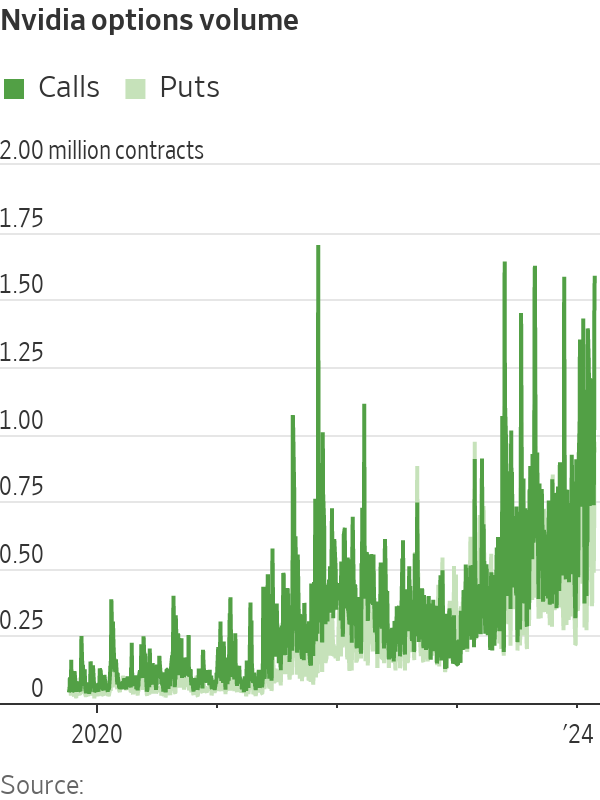
The rise drove many traders to pile into the company’s options, a risky corner of the market notorious for boom-and-bust trades.
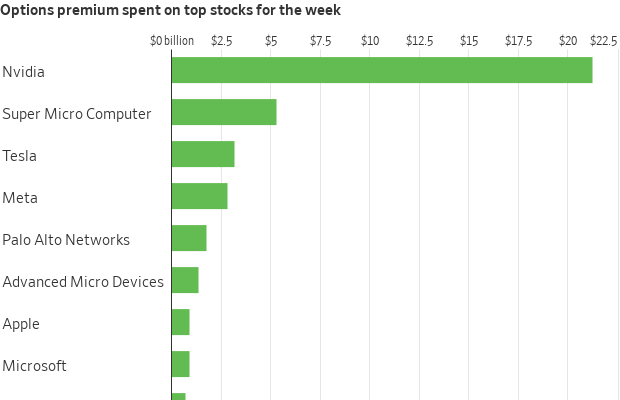
Nvidia has also morphed into one of the most popular trades in this market, with traders placing more than $20 billion in stock-options bets tied to the company over the past week, according to Cboe Global Markets data. That was more than what they spent on Tesla , Meta Platforms , Microsoft, Apple, Amazon and Alphabet combined.
Call options, contracts that confer the right to buy shares at a specific price, were particularly popular. And many of the trades appeared to suggest that investors were fearful of missing out on bigger gains to come. Some of the most active trades Friday were calls pegged to the shares jumping to $800 or $850, up from their closing price of $788.17. Betting against the shares has been a losing game , leading many investors to throw in the towel on bearish wagers.
The values of many of these options bets exploded while Nvidia soared, rewarding those who piled in. The big gains also enticed others to join in the trades while the stock’s rally continued.
“There’s a snowball effect,” said Henry Schwartz, a vice president at exchange-operator Cboe Global Markets, of the options activity surrounding Nvidia.
Ahead of the tech behemoth’s earnings report Wednesday, options pegged to the shares jumping to $1,300 —around double where they were trading at the time—were some of the most popular trades.
And for some investors, the 16% one-day jump in Nvidia’s share price Thursday wasn’t enough. They sought even bigger returns and piled into several niche exchange-traded funds that offer magnified exposure to Nvidia stock.
The GraniteShares 2x Long NVDA Daily ETF has taken in almost half a billion dollars from investors on a net basis since launching late in 2022. The fund’s shares have more than doubled in 2024 and have surged nearly 650% since inception.
There have been few signs of profit-taking so far. Investors added a net $263 million to the fund in the past month. The fund’s cousin, which turbocharges bearish bets against Nvidia, has been much less popular.
The euphoria surrounding Nvidia has spread to other stocks, too. Shares of Super Micro Computer , a much smaller company worth less than $50 billion, popped more than 30% Thursday after Nvidia’s earnings report. Traders spent more than $5 billion on options tied to the company, more than what they spent on Tesla this week. Tesla is worth about 13 times as much as the company.
Software that is eating the world
Nvidia’s continued, rapid ascent has stunned even early bulls on semiconductors and generative AI.
Atreides Management founder Gavin Baker, who started covering Nvidia as an analyst at Fidelity in 2000, reminded investors in his Boston hedge fund in an early 2021 letter of Marc Andreessen ’s adage that software was eating the world. “Today, AI is replacing software,” he wrote.
Atreides started buying Nvidia shares in the fourth quarter of 2022, according to regulatory filings.
The wager proved profitable. But as Nvidia shares kept soaring, Baker started selling. Atreides was out of Nvidia by the end of the second quarter of 2023. “This has been a painful mistake,” Baker wrote in a June 2023 letter to his clients, when Nvidia was trading north of $420 a share.
Atreides’s stake in competitor Advanced Micro Devices has helped alleviate the pain from missing out on larger gains. The firm made nearly a quarter billion last year alone on AMD, which it continues to hold along with several other related bets.
Michael Hannosh, a 20-year-old college student in Chicago, said he first purchased shares of Nvidia in August 2022, when the stock traded below $180. Nvidia was one of his first-ever stock purchases. He had built a custom computer for videogaming and used a lot of Nvidia parts.
Hannosh said he kept the shares until last March, then sold them for a roughly 30% profit. He later bought a few more shares at about $230 and sold them over the course of the next several days at a profit.
The shares have tripled since.
“It’s blown my f—ing mind to bits. It’s insane,” said Hannosh. “I really wish I held it, obviously.”
SYDNEY—Aluminium producer Alcoa has agreed to an all-stock deal to acquire Australia’s Alumina that values its equity at some 3.35 billion dollars.
Pittsburgh-based Alcoa is offering 0.02854 of its own stock for each Alumina share, representing a 13% premium to Alumina’s closing share price on Friday. Alumina said it recommends shareholders vote in favour of the offer, which comes after a number of previous bids by Alcoa were rejected.
Alcoa said it has reached an agreement with fund manager Allan Gray Australia that gives it the right to buy up to 19.9% of Alumina.
Alumina owns a 40% stake in Alcoa World Alumina & Chemicals, or AWAC, a joint venture with Alcoa that runs bauxite mining, alumina refining and aluminium smelting operations.
“Alcoa has been a proven operator of AWAC, and we recognise the value creation opportunities possible under a simplified ownership structure,” said William F. Oplinger , Alcoa’s president and chief executive.
Many companies would love a break on labor, after a year of strife when workers from Hollywood to Detroit flexed their muscle. It may be wishful thinking to expect a reprieve.
A resilient economy isn’t likely to shift leverage from workers to corporate bosses. Despite pockets of layoffs, namely in technology, the job market remains tight, with unemployment near record lows. A backlash against “diversity, equity, and inclusion” initiatives, or DEI, is jumping from colleges to companies— Alphabet and Meta Platforms have reportedly pulled back, for instance. Throw in a virtual lockdown on immigration, combined with a spike in U.S. manufacturing, and many companies may have another rough year of labor challenges.
Some companies are navigating these issues better than others—finding ways to reward workers and meet DEI goals without taking big hits to their profits or reputations for social responsibility. Several of those faring well made it into Barron’s ranking of the 100 most sustainable companies .
To make the list, our seventh annual ranking, companies were scored on a variety of environmental, social, and governance, or ESG, measures. Barron’s worked with Calvert Research and Management, a leader in responsible investing, to rank the companies. The top 100 firms—winnowed from the largest 1,000 publicly traded U.S. companies—achieved the highest scores across 230 ESG metrics, from workplace diversity to greenhouse-gas emissions. (See below for the complete list and more about the methodology.)
Home-products company Clorox sits at the top of the leader board for the second straight year, edging out Kimberly-Clark , CBRE Group , Hasbro , and Agilent Technologies in the top five. The overall lineup spans a wide range of industries, with tech, industrials, and consumer companies all well represented.
Many of the companies delivered solid results for shareholders. The top 100 returned an average 19% in 2023, versus 26%, including dividends, for the S&P 500 index. That doesn’t look great. But the S&P 500 is weighted by market capitalisation and last year’s “Magnificent Seven”— Apple , Microsoft , Amazon.com , Nvidia , Meta Platforms, Tesla , and Alphabet—fuelled almost all the market’s gains. Strip away that influence, and the equal-weighted S&P 500 returned 14%, trailing the 100 most sustainable companies.
Several stocks delivered standout returns in 2023, led by chip maker Nvidia, ranked 41st with a 239% gain. Other tech winners included HubSpot , Intel , Applied Materials , and Lam Research . Strong performers in other industries were Trex , Lennox International , Williams-Sonoma , Insight Enterprises , and Owens Corning .
A big theme in this year’s rankings was progress on corporate governance and labor relations, says Chris Madden, a managing director at Calvert, which is owned by Morgan Stanley Investment Management. “A lot of the companies on this list have done a stellar job dealing with employees,” he says.
Strikes were big in 2023 as Hollywood screenwriters and Detroit auto workers took to the picket lines, winning concessions and pay raises. Pilots and other unionised groups fared well, breathing life back into the organised labour movement, which had been in decline since the 1950s. New technologies such as artificial intelligence and electric vehicles are upending vast industries, prompting workers to demand more protections.
Tensions between companies and employees are spilling over in more public ways, thanks in part to social media; workers are using platforms like X and TikTok to amplify their message or try to shame their employer, says Alison Taylor, clinical associate professor at NYU Stern School of Business and author of a new book, Higher Ground . One of the most interesting recent trends, she says, has been the rise of “strategic leaking, where young employees undercut sunny messaging from the top with their own lived experiences.” She cites the trend of sharing layoff experiences on TikTok as an example.
Battles are also brewing over DEI, including a political backlash by conservatives, complicating corporate efforts to meet their own DEI goals. Last year, a number of high-profile chief diversity officers exited their roles at some of the biggest U.S. companies, including Walt Disney and Netflix . This month, Zoom Video Communications fired a team focused on DEI initiatives as part of a round of layoffs.
The issue is also bubbling up in the presidential race. During a rally in Philadelphia last year, presidential hopeful Donald Trump promised to eliminate all diversity, equity, and inclusion programs “across the entire federal government.”
Many companies say they remain committed to DEI goals. According to a Conference Board survey late last year of chief human resource officers, none planned to scale back their diversity efforts, while 75% said improving the employee experience and organisational culture would be a top focus in 2024. Alphabet said in a statement that it is inaccurate to suggest it is “deprioritising our longstanding efforts for underrepresented communities.”
One company that scored well on labour and other sustainability factors was Walmart . The world’s largest retailer landed at 61 on the list. “Walmart stands out for its strong labour practices,” says Helen Mbugua-Kahuki, Calvert’s director of research. “We’ve seen Walmart do a really good job as it pertains to increasing wages for its workers.”
One of America’s largest employers, with 1.6 million U.S. workers, Walmart raised entry-level pay for store workers last year, taking its average hourly wage to $18, well above the federal minimum of $7.25. The company also increased wages for store managers to an average $128,000, plus better bonuses. A Walmart spokesperson said the retailer has been “investing in its front-line hourly associates for the past several years.”
Walmart’s other positives include education and training benefits, which the company says have saved workers nearly $500 million over the past five years. Calvert gives the company high marks for being more open to worker feedback through new digital forums . “It’s a form of open communication and provision for employees to freely express themselves,” Mbugua-Kahuki says.
Walmart still has its labour critics. The company has faced multiple lawsuits over gender discrimination. None of its roughly 4,700 U.S. stores have unionised, making it the largest U.S. employer without any unionised workers. In January, the National Labor Relations Board’s San Francisco office issued a complaint against a Walmart store in Eureka, Calif., alleging violations of labor rights. The NLRB said there are 21 other unfair labor practice cases open against Walmart.
Walmart has denied the NLRB’s allegations in a legal response . The company didn’t respond to a request for comment.
Other Faces of Sustainability
Calvert says Clorox, whose brands include its namesake bleach, Burt’s Bees cosmetics, and Glad trash bags, took top honours thanks to its strong governance structure and pay equity, among other factors. The firm’s board is diverse, with 50% women and 25% people of colour. In 2023, Clorox once again achieved pay equity, which means “no statistically significant differences” in pay by gender globally and race or ethnicity in the U.S., according to Clorox. “Pay equity is important because it creates a better culture,” says Madden.
Clorox’s shares underperformed the market in 2023, in part because of a cyberattack that caused wide-scale disruptions and hurt financial results. But its workers, at least, appear to be well treated, with perks including more flexible time for all. “We really intend for people to use this to refuel their tanks,” says Kirsten Marriner, chief people and corporate affairs officer.
About a fifth of this year’s list consists of newcomers. Game publisher Electronic Arts made the list for the first time, debuting at No. 32. Calvert says the company is making strides in DEI, including a push for better representation of women in its games. EA’s hugely popular Ultimate Team mode saw women football players introduced for the first time last year . Calvert also lauds the company for hiring “underrepresented talent” above the average rate in the industry for the fifth straight year and placing more minorities in executive roles. EA declined an interview but confirmed Calvert’s information.
Also making its debut this year is Trex, landing at No. 68. The company is a leading maker of “wood-alternative” home decking and railings made from a blend of recycled and reclaimed raw materials.
Some companies made a big leap up in this year’s ranking, among them Tetra Tech , which jumped from No. 56 to No. 8. Calvert singled out the consulting and engineering firm for its efforts to remediate toxic per- and polyfluoroalkyl substances, or PFAS, better known as “forever” chemicals. But it noted that Tetra Tech “could improve on human-capital management and offer more incentives for its employees.”
How We Ranked the Companies
To build our list of most sustainable companies, Barron’s worked with Calvert, a leader in ESG investing. Starting with the 1,000 largest publicly traded companies by market value—excluding real estate investment trusts—Calvert ranked each one by how it performed in five key constituency categories: shareholders, employees, customers, community, and the planet. Specifically, it looked at more than 230 ESG performance indicators from seven rating companies, including ISS, MSCI, and Sustainalytics, along with other data and Calvert’s internal research.
These data were organised into 28 topics that were then sorted into five categories. In the shareholder category, for example, topics included board structure, business ethics, and executive compensation. For employees, workplace diversity was a key topic. The planet category included greenhouse-gas, or GHG, emissions and related policies; biodiversity; and water stress. Calvert assigned a score of zero to 100 in each category, based on company performance. Then it created a weighted average of the categories for each company, based on how financially material the category was in its industry. To make Barron’s list, a company had to be rated above the bottom quarter in each material stakeholder category. If it performed poorly in any key category that was financially material, it was disqualified.
Even amid two international conflicts and an upcoming U.S. presidential election, some philanthropic leaders are optimistic about the direction of overall giving through 2024.
Penta spoke with heads of several non-profits and leading philanthropists to gauge whether charitable giving will continue its reported slump from 2023 or rebound alongside renewed interest in various political and economic issues.
“Contrary to what some might expect, philanthropy has had resilience in these times,” says Stacy Huston, executive director of Sixdegrees.org, a youth empowerment non-profit based in Virginia founded by actor Kevin Bacon in 2007.
Huston’s view echoes recent data from the biennial Bank of America Study of Philanthropy published last year, which found that while affluent giving is largely down, the value of the average philanthropic gift is up 19%, surpassing pre-pandemic levels.
The notion of what these gifts look like is changing, and is partially responsible for the growth. Philanthropy can be executed through more avenues than ever, whether through celebrity association, tech titans stewarding large endowments, or athletes using their platforms to advocate for and create meaningful change.
“The industry and movement is creating new models, and you want to get it right,” says Scott Curran, CEO of Chicago-based Beyond Advisers. “No one should take their foot off the gas pedal.”
Curran spent a number of years with the Clinton Foundation in its infancy before leaving in 2016 to open his own consultancy, which focuses on philanthropy strategy at the highest levels. Curran and his team work with celebrities, athletes, multi-generational family foundations, and other affluent givers who need guidance in directing their philanthropic efforts. It’s a growing area of interest: Over half of affluent households with a net worth between US$5 million and US$20 million have, or are planning to establish, “some kind of giving vehicle” within the next three years, according to the Bank of America report.
Corporate philanthropy, rather than individual giving, is the cornerstone of Marcus Selig’s work as chief conservation officer at the National Forest Foundation, a Congressionally chartered non-profit based in Montana responsible for protecting millions of acres of public lands.
“Our outlook is business as usual,” he says, advising that giving may slow down, but not enough for the foundation to change course.
Factors such as political polarisation in the U.S. and the wars in Eastern Europe and the Middle East are pushing nonprofits to consider their niche, and how they might work with other groups, both on the corporate and philanthropic levels, Selig says.
“It leads to a little more sharing on the ground in what needs to be done,” he adds.
Steve Kaufer , founder of Massachusetts-headquartered e-commerce giving platform Give Freely and founder of TripAdvisor, says that the economy has a much bigger role in election years, as he looks to build and grow something that can act as a “counterbalance.”
“There’s a trend towards democratisation, and acting collectively can lead to greater impact,” he says.
Kaufer’s new platform hopes to leverage the everyday philanthropist through online shopping dollars to benefit major charity partners like UNICEF and charity:water, who earn funds as shoppers choose an organisation to benefit through an online clickthrough process.
“Whether a good year or bad year, e-commerce will continue to keep growing,” he says. “Nobody doubts that.”
Whether a legacy foundation, corporation or individual, the political landscape this year is requiring some to exercise caution as they consider what their own charitable actions might be and how it could be viewed more broadly. For the personal philanthropist, every move is now scrutinised more closely. On the nonprofit side, entities are exercising more due diligence to understand if a specific donor aligns with their mission and that there aren’t any underlying issues that could cause greater pushback.
“You have to be able to walk the walk,” Huston says. “For example, we’ve had to turn down very large donor checks from corporations because there’s a Reddit stream calling them out on their human rights practices.”
She adds that even a routine charity activation could now be aligned with a political party, and that adds complexities to how a higher-profile organisation like Six Degrees can activate, especially as the film Footloose turns 40 in 2024 (which Bacon starred in).
“A lot of organisations and states want to align themselves with this feel good moment, and we should be able to stand side by side with everyone, but we have to be aware,” she says.
Another topic attracting donor interest today is mental health, an area that historically has been underfunded and under-resourced by philanthropy, according to Two Bridge partner Harris Schwartzberg, who has been closely linked to the mental health space for more than a decade.
Today, the issue for mental health nonprofits is less about resources and more about societal divisiveness and polarisation around the topic. There’s an “overwhelming demand” for solutions, but the space is in a “perfect storm” for the broader political issues to make things worse, Schwartzberg says.
In Curran’s opinion, the storms brewing are troublesome, but they are also creating new opportunities for corporate and personal giving. The current state of philanthropy is one of “dynamic, expansive, and blurred lines,” meaning a careful blending of targeted giving combined with an understanding of the broader geopolitical landscape could lead to a successful overall philanthropic strategy.
“There are a lot of headlines that distract, but shouldn’t,” he says. “2024 needs more serious philanthropists than ever.”
ASX earnings season is well underway, with hundreds of Australia’s biggest publicly–listed companies reporting their latest financial results to the market. This week, the country’s three biggest miners, BHP, Fortescue and Rio Tinto released their figures. All three companies benefitted from stronger iron ore prices, however weaker prices for other commodities put a drag on earnings for diversified operators, BHP and Rio Tinto, while ironore pure-play Fortescue delivereda turbocharged profit.
Let’s review the key points of each company’s report.
BHP Group Ltd (ASX: BHP)
BHP released its half-year figures for FY24 on Tuesday. The company reported a 6 percent revenue increase to US$27.2 billion. Its underlying earnings before interest, taxes, depreciation, and amortisation(EBITDA) lifted 5 percent to US$13.9 billion but profit after tax spiralled by 86 percent to US$927 million.
BHP said higher iron ore and copper prices along with production from mines acquired under the Oz Minerals takeover in May 2023 boosted revenue. But its profit was impacted by a US$2.5 billion impairment of the carrying value of itsWest Australian nickel business and a US$3.2 billion provisionfor reparations and compensation relating to the Brazil dam disaster in 2015. The BHP share price fell 1.54 percent on Tuesday, and is down a further 2.57 percent since. BHP closed yesterday at $44.30.
BHP shares will pay a fully franked interim dividend of 72 US cents per share, which is 20 percent lower than last year.
Fortescue Ltd (ASX: FMG)
Fortescue released its results yesterday, reporting a 21% revenue bump to US$9.5 billionfor1H FY24. Underlying EBITDA came in 36% higher at US$5.9 billion and net profit after tax was up 41 percent to US$3.3 billion.
Higher iron ore prices turbocharged Fortescue’s revenue during the period. The company delivered its second–highest number of shipments for a first half ever, includingfirst shipment from the new Iron Bridge project. The Fortescue share price lifted 1.73 percent yesterday to $27.83per share.
Fortescue shares will pay a fully franked interim dividend of AU$1.08 per share, up 44 percent on last year.
Rio Tinto Ltd (ASX: RIO)
Rio Tinto reports on a different financial year cycle to the other two majors, and released its full-year earnings for FY23 yesterday. Revenue fell 3 percent over the year to US$54 billion. Rio’s underlying EBITDA was 9 percent lower at US$23.8 billion and profit after tax declined 19 percent to US$10 billion.
The company said its iron ore division delivered increased revenue and EBITDA due to higher commodity prices, however, this was offset by higher costs and weaker prices for copper, aluminium, diamonds and other minerals due to lower global demand amid increased supply. The Rio Tinto share price fell 0.96 percent yesterday to $124.36 per share.
Rio Tinto shares will pay a fully franked final dividend of US$2.58 per share for 2H FY23, up 14 percent.
The aptly named “opening night” at Christie’s for the eclectic mix of art, photography, costumes, and objects that filled Elton John’s Atlanta home drew a crowd of bidding fans who snapped up everything on offer for a total of US$8 million.
Among items the lucky winners snagged was a collector’s edition of a pinball machine signed by John that plays 16 full-length studio master tracks of his hit songs and features interactive LED lights and LCD displays; a 1990 Bentley Continental two-door convertible; a pair of silver leather platform boots; and silver rocket-shaped cocktail shakers.
Many of the collectible treasures in the 49-lot sale sold above estimates, in total achieving 155% of the low-end of anticipated prices. According to Christie’s, 40% of bidders and buyers were new to Christie’s.
Before the sale, the auction house shared that a heart-shaped collage by Damien Hirst that was made for John and his husband, David Furnish—expected to fetch up to US$450,000—would be withdrawn as the family decided to retain the piece.
The biggest sale of the evening was a painting by Banksy that John acquired directly from the elusive British graffiti artist. Flower Thrower Triptych , 2017, sold for US$1.55 million, US$1.925 million with fees.
Wednesday’s evening auction was the first of two live and six online sales that are filled with a total of nearly 900 items that spoke to John’s passions, style, and vision.
Elton John had acquired Flower Thrower Triptych, 2017, directly from Banksy. It sold for US$1.925 million at Christie’s. Courtesy Christie’s Images Ltd. 2024
Many lots sparked brisk back-and-forth bidding between collectors in the packed saleroom, on the phone with specialists, and online. The auction house generated excitement from the get-go with a pair of 1975 prescription Sir Winston Eyeware sunglasses that sold for a hammer price of US$18,000, six times a presale high estimate. With fees, the sunglasses sold for US$22,680.
That opening lot was followed by the sale of a pair of Elizabeth II silver cocktail shakers shaped like rockets, made by Mark of Theo Fennell in London in 1993, that fetched US$40,000, four times the high estimate, after vigorous bidding. With fees, the shakers cost US$50,400.
Then came a pair of silver leather tall platform boots, circa 1971, that sold for US$70,000—seven times the high estimate, and US$94,500 with fees.
Glittery watches and jewellery also stole the show. An “exuberant and rare” 18K gold, diamond, and yellow sapphire-set automatic chronograph Rolex with a leopard-print dial sold for US$140,000, more than double a high estimate. The total with fees was US$176,500.
A Cartier “crash” model watch from 1991, sold for US$220,000, above a US$100,000 high estimate, or US$227,200 with fees.
Elton John’s gold Daytona Chronograph reference 116598 SACO with a leopard-print dial sold for US$176,400 at Christie’s. Courtesy Christie’s Images Ltd. 2024
The sale also featured photography from Robert Mapplethorpe, Richard Avedon, Helmut Newton, Andy Warhol, and Cindy Sherman, among others. There was also art by Keith Haring, Sol Lewitt, and Julian Schnabel.
John’s conservatory grand piano, a Yamaha Model C6F, circa 1992, that had taken centre stage in his home sold for US$160,000, more than three times a high estimate; with fees, it fetched US$201,600.
The evening auction ended with the sale of John’s 1990 Bentley continental two-door convertible for US$350,000 (10 times the high estimate), or US$441,00 with fees, and the sale of the pinball machine, which fetched US$55,000, or US$69,300 with fees.
Elton John fans have plenty of opportunities to bid again on the singer’s collectibles, including more costumes, watches, fine and decorative arts, and jewellery. Another 281 items will be sold at a live sale at Christie’s on Thursday, and there are six online auctions continuing through next week.
One online sale features John’s friendship with Versace, and including couture, decorative arts, photographs, and jewellery; another titled “Honky Château” celebrates the singer’s aesthetic with brightly coloured art glass, painting, and sculpture.
Gail and Ron Fink weren’t home the day the ocean swallowed their backyard.
The Florida couple, who are in their 70s, were a few miles away on Feb. 6—an unusually blustery day in the Sunshine State—as waves pounded their beachfront property in Jupiter Inlet Colony, sweeping sand, dirt and trees out to sea. When it was all over, the Finks’ newly-built, roughly 10,000-square-foot home was intact; so too was their free-form swimming pool, improbably balanced on exposed concrete-and-steel pilings.
“That’s what saved the whole thing,” said Ron, founder of an air- and-water purification company. “The pilings are holding up the house and pool.”
Gail and Ron Fink recently finished building a roughly 10,000-square-foot home. PHOTO: JAMES JACKMAN FOR THE WALL STREET JOURNAL
Drone footage and pictures from local photographers and the Finks’ builder show the severity of the destruction, which left their pool suspended in the air, with pipes protruding from the earth. Town officials said erosion claimed 7 to 10 feet of sand and created steep drop-offs in front of about half-dozen homes, including one belonging to Kid Rock , the rapper-turned-country rocker, who paid $3.2 million for the property in 2012. Conair heiress Babe Rizzuto also sustained damage to her property down the street, which she bought for $6.3 million in 2015 and currently has listed for $22.5 million, according to Zillow. Neither responded to requests for comment.
But the Finks house, located just past the end of a granite revetment wall—a kind of sea wall—bore the brunt of the heavy wind and waves.
“The whole backyard is shot. All the landscaping is gone,” said Ron. Also gone are fully matured Palm trees and an ipe-wood deck. “It’s out floating in the ocean someplace.” Ron is self-insured and the repair work will be quite expensive. undefined
A New Jersey native, Ron is an engineer by training who worked at nuclear-testing sites in California and Nevada before moving to Florida in the 1980s. He is the founder of RGF Environmental Group, which makes air- water-and food-purification systems.
For almost 40 years, the Finks—who have three adult children and eight grandchildren—have lived in Admirals Cove, a gated community in Jupiter about 5 miles from their new house. They paid $180,000 for the Admirals Cove lot in 1987 and built a roughly 6,000-square-foot house, Ron said. The Finks also own homes in the Cayman Islands and Bahamas.
Until now, the Finks have lived in Admirals Cove, about 5 miles from their new house. PHOTO: JAMES JACKMAN FOR THE WALL STREET JOURNAL
Ron said they began looking for property in Jupiter Inlet Cove years ago. “It’s a neat place, just a closed little colony right on the ocean, low key and quiet,” he said.
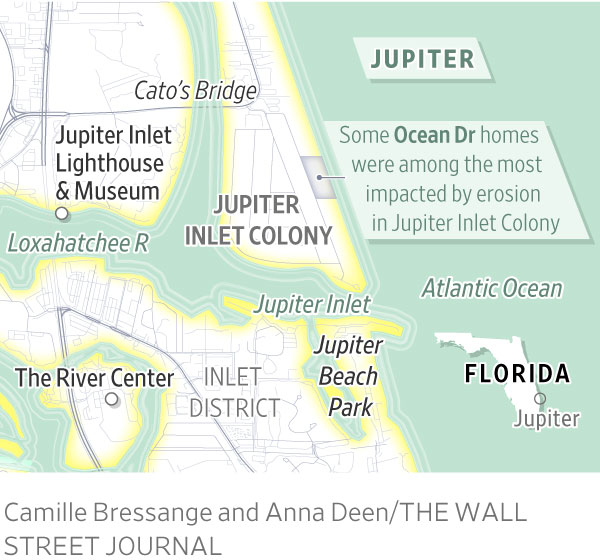
About 20 miles north of Palm Beach, Jupiter Inlet Colony is at the southern tip of Jupiter Island. The town, founded around 1959, has approximately 240 homes and is surrounded on three sides by water—the Atlantic Ocean, Jupiter Inlet and the Intracoastal Waterway. Long a destination for wealthy homeowners, homes in Jupiter Inlet Colony tend to trade for between $2 million and $5 million, although one sold for $18.6 million in January, according to real-estate brokerage Redfin. Last year, a home on the Intracoastal sold for $21.4 million, a record for the town.
In 2020, the Finks paid $4.9 million for a vacant beachfront lot and subsequently built a coastal-style house with a copper-and shake-style roof, covered loggia, pool and outdoor fire pit. “You know, it’s kind of a dream home,” Ron said. “We have built quite a few homes, but this is the end of the line for us, hopefully the last one.”
He said the property originally belonged to the singer Perry Como, one of the town’s first residents. A prior owner demolished Como’s house, and when the Finks bought it, there were concrete-and-steel pilings sticking out of the ground.
Ron Fink said he never removed about 60 pilings, he simply added roughly 30 more. “Now I’m glad I did,” he said. (Pilings are based on the design of a house, so Ron retained some pilings that he didn’t necessarily need.)
John Melhorn of design-build firm Thomas Melhorn, which built the house, said the Finks were a final review away from obtaining a certificate of occupancy when the backyard was destroyed. “They were right there at the goal line,” he said.
The Finks’ house and pool are standing on about 90 concrete-and-steel pilings. PHOTO: JAMES JACKMAN FOR THE WALL STREET JOURNAL
Melhorn said the erosion began in late October amid unusually high winds and ocean swell. During the first week of February, sand beneath a row of sea grapes that stabilized the dunes between the house and ocean began to wash away. By the evening of Feb. 6, the plantings disappeared. The yard was gone by the next morning.
Melhorn said a pre-existing, low wall between the ocean and house—described as a cinder-block retaining wall on land surveys—also washed away, as did a walkway and steps to the beach. But he said the 2-foot-high wall was less of a retaining wall and more like a curb between the street and sidewalk. In this case, a prior owner used it to hold sea grapes back from encroaching on the property. The Finks replaced the wall with decorative stone, now lost to the ocean. An outdoor fire pit is still there, cantilevered over the ocean. “We tried to pull as many things out as we saw the erosion coming, but we lost a lot,” Melhorn said.
In Florida, erosion is increasing because of more frequent, more severe storms and sea-level rise, said Cheryl Hapke, a research professor at the University of South Florida and the chair of the Florida Coastal Mapping Program. But she said it isn’t just hurricane-level storms that cause major damage. “One thing I have found about barrier islands [like Jupiter Inlet Colony] is that sometimes a series of smaller events can have as big an impact as a major hurricane,” she said. “But people get caught off guard. It’s something they don’t think of.”
In Jupiter Inlet Colony, longtime residents said this month’s erosion is the worst the area has seen in years, possibly ever.
Mayor Ed Hocevar, who has lived there for 17 years, said it has been a particularly cool and challenging winter with an abnormal number of Nor’easters. On Feb. 6, local news channels warned of high winds, with gusts between 40 and 50 miles an hour. (There were also reports of an earthquake off the coast that week, causing high waves.)
Since the 1980s, Jupiter Inlet Colony has had a granite rock revetment wall that extends from the northern end of the community past 11 oceanfront homes. “But we’ve got 28 homes along the beachfront, so it isn’t complete,” Hocevar said. “Where the wall ended is where the significant damage occurred.” Hocevar said he doesn’t know why the wall wasn’t completed, although local lore is that homeowners building the wall ran out of money.
Last week, the town hired a local mining company to bring in 7,000 tons of sand to replace what washed away. Hocevar said it would cost about $500,000, which will come out of the town’s reserve fund. Long term, he said, extending the revetment wall isn’t a strong possibility.
Hapke, the coastal geology expert, said that in recent decades, sea walls and hardened structures have fallen out of favor as scientists discovered they are detrimental to the environment around them. “Storm water wants to flow, so it will redirect water to the area without a sea wall,” she said, adding that the most ideal long-term solution is to move homes away from the coastline.
Hocevar, 67, who has been mayor of Jupiter Inlet Colony for about a month, said the town is working closely with the Department of Environmental Protection on its response. He said the DEP’s recommendation, should erosion like this occur again, is to bring in more sand. Hocevar emphasised that the community is rallying together. “Think about it as a fortress and your wall has been breached,” he said. “You want to protect your neighbourhood and that’s what we’re trying to do here.”
Holly Meyer Lucas of Compass, who represented the seller when the Finks purchased their property, said Jupiter Inlet Colony is a “special little enclave” where sales exploded during Covid. “Listings sell after a day or sell off-market,” she said.
Lucas said the consensus among local real-estate agents is that property values will hold, despite the erosion. “I think this is a really rare, weird, fluky event,” she said. “I’ve sold everywhere up and down the coast and I’ve never heard of anything like this.”
The couple were close to getting their certificate of occupancy for the newly-built home. PHOTO: JAMES JACKMAN FOR THE WALL STREET JOURNAL
Babe Rizzuto, whose house is two doors down from the Finks, listed her house for $24.5 million in December 2023 and cut the price to $22.5 million on Feb. 6, according to Zillow.
“She’s going to continue to sell,” said Milla Russo of Illustrated Properties, who is marketing the property with her husband, Andrew Russo. “Even though the timing isn’t great, it is what it is.”
Russo said there has been erosion in the past, and during hurricanes residents of Jupiter Inlet Colony are the first in the area to evacuate. But in general, people are not preoccupied with the weather. “Maybe because we live here, when the hurricanes come, we all have hurricane parties. We go to people’s homes and we barbecue and grill. Of course we’re careful and we lock up and all that, but weather is weather,” she said. “We’ve never been terribly scared.”
(The Russos were also involved in selling the Fink property. However, in 2020 the closing agent on the deal, Florida-based Eavenson, Fraser & Lunsford, PLLC, sued Milla Russo and Illustrated Properties as part of a commission dispute. The seller, Michael Cantor’s Range Road Developers, was named as a defendant and cross-plaintiff in the suit, in which a judge ruled in favor of Eavenson, court records show. Milla Russo declined to comment on the suit. Eavenson declined to comment beyond the judge’s findings and Cantor did not respond to requests for comment.)
Ron was also matter-of-fact about the state of beachfront living. Bring a life jacket, he jokingly told a photographer who inquired last week about taking his picture.
However, the Finks are facing weeks of costly repairs. Although the town is bringing in sand to replace the decimated beachfront, the couple is self-insured and will be on the hook for the cost of rebuilding. Several major home insurers have pulled out of Florida, and Ron said insurance on the house would have cost $100,000 a year. Now, he estimated they could face about $1 million worth of repair work. “We gotta eat it,” he said.
The couple, who was supposed to move into the house this month, has put those plans on hold—for now. An engineer recently inspected the property and deemed the house safe, Ron said. “We’re doing wallpaper today,” he said. “We can put it back together again.” The patio and pool area, meanwhile, are roped off while the area underneath is backfilled with sand.
Ron said being near the ocean makes it worthwhile. “I just love the ocean, we both do. It’s important to us,” he said. “It isn’t easy to look at, but I’ve been through a lot worse.”
Wages grew at their fastest pace since 2009 at an annualised 4.2 percent in the December quarter, according to the Australian Bureau of Statistics (ABS). This is the first time that wages have grown faster than inflation since 2021. Newly implemented enterprise agreements for essential workers drove public sector wages growth to its highest quarterly rate in 15 years at 1.3 percent. Private sector wages growth came in at 0.9 percent, mainly due to annual salary reviews at companies.
Michelle Marquardt, ABS head of prices statistics, said:“In the December quarter 2023, 38 percent of public sector jobs saw a wage rise, considerably higher than the 29 percent from the same quarter in the previous year. The average hourly wage change for these jobs has lifted to 4.3 percent, higher than 2.8 percent at the same time last year and the highest recorded since September 2008.”
CBA economist Belinda Allen commented that rising unemployment was another factor contributing to higher wages growth in the public sector versus the private sector.
“This was the first time since Q1 10 that the public sector was stronger than the private sector in through-the-year growth,” Ms Allen said.“Jobs set by individual agreements aregenerallymore tied to demand for labour. The loosening of the labour market seen in recent months isdampening wages growth pressurein individual agreements.”
The unemployment raterose to its highest level in two years at 4.1 percent in January. It is up 0.5 percent in five months, which CBA says is a significant and somewhat concerning pace of change.
The ABS data showed that at an industry-wide level, quarterly wages growth in December was highest in education at 1.7 percentand lowest in accommodation and food at 0.3 percent. Annual wages growth was highest in health care and socialassistance at 5.5 percent, which represents the greatest growth since the ABS introduced the Wage Price Index (WPI) data series in 1998. The lowest annual wages growth was in the finance and insurance services industry at 3.2 percent.
Federal Treasurer Jim Chalmers said workers were earning more under Labor, and from 1 July the amended Stage 3 tax cuts would allow them to keep more of that income.
“This is the first time since 2018 we’ve seen three consecutive quarters of real wages growth,” Dr Chalmers said. “Since the election, nominal wages have been growing at an annualised average of 4 percent, compared to 2.2 percent for our predecessors.This is a substantial turnaround in just 18 months.”
Ms Allen said CBA expects wages growth to moderate from here to 3.6 percent by year’s end.
“Near-term pressure will still occur from enterprise agreements, but a slowing economy, rising labour market spare capacity, and disinflation will gradually weighonnominal wage increases.”
The ABS data was released on the same day as a report from economic research firm e61 Institutethat found restrictions on job mobility,such as the rising use of non-compete clauses in individual contracts,have contributed to a 15-year slowdown in wages growth and productivity. According to e61, switching jobs results in an average 9 percent higher pay rise for workers, but today more than one-fifth of the workforce is restricted by non-compete and no-poach of co-workers agreements.
Such clauses are more common in knowledgeindustries and “many firms are deploying restraint clauses indiscriminately, potentially adversely affecting low wage workers who lack bargaining power,” saide61.The Federal Government established a Competition Taskforce Advisory Panel in August to investigate ways to increase productivity and wages growth, withnon-compete clauses that stop workers from shifting to better-paying jobsone of the first issues to be considered.
Our refrigerators, washing machines and ovens can do more than ever, from producing symmetrical ice cubes to remotely preheating on your commute home. The downside to all these snazzy features is that the appliances are more prone to breaking.
Appliance technicians and others in the industry say there has been an increase in items in need of repair. Yelp users, for example, requested 58% more quotes from thousands of appliance repair businesses last month than they did in January 2022.
Those in the industry blame a push toward computerisation, an increase in the quantity of individual components and flimsier materials for undercutting reliability. They say even higher-end items aren’t as durable.
American households spent 43% more on home appliances in 2023 than they did in 2013, rising from an inflation-adjusted average of $390 to $558, according to Euromonitor International. Prices for the category declined 12% from the beginning of 2013 through the end of 2023, according to the Labor Department.
One reason for the discrepancy between spending and prices is a higher rate of replacement, say consumers, repair technicians and others. That’s left some people wishing they had held on to their clunky ’90s-era appliances and others bargaining with repair workers over intractable ice makers and dryers that run cold.
“We’re making things more complicated, they’re harder to fix and more expensive to fix,” says Aaron Gianni, the founder of do-it-yourself home-repair app Plunjr.
Horror stories
Sharon J. Swan spent nearly $7,000 on a Bosch gas range and smart refrigerator. She thought the appliances would last at least through whenever she decided to sell her Alexandria, Va., home and impress would-be buyers.
That was before the oven caught fire the first time she tried the broiler, leading to a 911 call and hasty return. The ice-maker in the refrigerator, meanwhile, is now broken for the third time in under two years. Bosch covered the first two fridge fixes, but she says she’s on her own for the latest repair, totalling $250, plus parts.
“I feel like I wasted my money,” says the 65-year-old consultant for trade associations.
A Bosch spokeswoman said in an emailed statement that the company has been responsive to Swan’s concerns and will continue to work with her to resolve ongoing issues. “Bosch appliances are designed and manufactured to meet the highest quality standards, and they are built to last,” she said.
Kevin and Kellene Dinino wish they had held on to their white dishwasher from the ’90s that was still working great.
The sleeker $800 GE stainless steel interior dishwasher they purchased sprang a hidden leak within three years, causing more than $35,000 worth of damage to their San Diego kitchen.
Home insurance covered the claim, which included replacing the hardwood down to the subfloor and all their bottom cabinetry, but kicked the Dininos off their policy. The family also went without access to their kitchen for months.
“This was a $60 pump that was broken. What the hell happened?” says Kevin, 45, who runs a financial public-relations firm.
A GE Appliances spokeswoman said the company takes appliance issues seriously and works quickly to resolve them with consumers.
Increased complexity
Peel back the plastic on a modern refrigerator or washing machine and you’ll see a smattering of sensors and switches that its 10-year-old counterpart lacks. These extra components help ensure the appliance is using only the energy and water it needs for the job at hand, technicians say. With more parts, however, more tends to go wrong more quickly, they say.
Mansoor Soomro, a professor at Teesside University, a technical college in Middlesbrough, England, says home appliances are breaking down more often. He says that manufacturers used to rely mostly on straightforward mechanical parts (think an on/off switch that triggers a single lever). In the past decade or so, they’ve transitioned to relying more on sophisticated electrical and computerised parts (say, a touch screen that displays a dozen different sensor-controlled wash options).
When a complicated machine fails, technicians say they have a much harder time figuring out what went wrong. Even if the technician does diagnose the problem, consumers are often left with repairs that exceed half the cost of replacement, rendering the machine totalled.
“In the majority of cases, I would say buying a new one makes more economic sense than repairing it,” says Soomro, who spent seven years working at Siemens , including in the home-appliances division.
These machines are also now more likely to be made with plastic and aluminium rather than steel, Soomro says. High-efficiency motors and compressors, too, are likely to be lighter-duty, since they’re tasked with drawing less energy .
A spokeswoman for the Association for Home Appliance Manufacturers says the industry has “enhanced the safety, energy efficiency, capacity and performance of appliances while adding features and maintaining affordability and durability for purchasers.” She says data last updated in 2019 shows that the average life of an appliance has “not substantially shifted over the past two decades.”
When simpler is better
Kathryn Ryan and Kevin Sullivan needed a new sensor to fix their recently purchased $1,566 GE Unitized Spacemaker washer-dryer. GE wasn’t able to fix the sensor for months, so the couple paid a local technician $300 to get the machine working.
The repairman also offered them a suggestion: Avoid the sensor option and stick to timed dries.
“You should be able to use whatever function you please on a brand new appliance, ideally,” says Sullivan, a 32-year-old musician in Burbank, Calif.
More features might seem glamorous, Frontdoor virtual appliance tech Jim Zaccone says, but fewer is usually better.
“Consumers are wising up to the failures that are happening and going, ‘Do I really need my oven to preheat while I’m at the grocery store?’” jokes Zaccone, who has been in the appliance-repair business for 21 years.
He just replaced his own dishwasher and says he bought one with “the least bells and whistles.” He also opted for a mass-market brand with cheap and readily available parts. Most surprisingly, he chose a bottom-of-the-line model.
“Spending a lot of money on something doesn’t guarantee you more reliability,” says Zaccone.
Prices are falling in mainland China. That’s a boon for people living in Hong Kong, but a big problem for the city’s businesses.
Consumer prices in China fell 0.8% in January compared with a year earlier, the country’s biggest deflation reading in more than a decade. That is a sign of the tepid state of the world’s second-largest economy, where a sputtering recovery has knocked confidence and encouraged Beijing to censor some economic research .
Hong Kong residents are increasingly hopping across the border to the city of Shenzhen, where they load up on frozen food and cheap furniture at big-box stores such as Costco and Sam’s Club. Hong Kong business owners, unable to compete with their Chinese counterparts on price, are feeling the squeeze.
“Walking on the streets these days, you’ll feel that Hong Kong retailers are in big trouble,” said the city’s former financial secretary, John Tsang, in a recent social-media post.
The pain being felt by businesses in Hong Kong offers a partial answer to a question that has been debated by economists for much of the past year: How will deflation in China affect the rest of the world?
Chinese export prices have dropped steadily since late 2022 and were 8.4% lower in December than they were a year earlier, according to customs data. Economists think that’s probably a good thing for Europe and the U.S., where central banks have been forced to embark on an aggressive series of interest-rate increases to keep rising prices in check. But the impact on smaller countries could be more troublesome.
China is the biggest trading partner for many countries across the world, and is particularly influential for countries in Asia. The risk for them is that Chinese companies dump their goods overseas in response to weak demand at home. They can also undercut manufacturers in countries such as Vietnam and Malaysia, which have slowly been muscling in on China’s status as the world’s factory.
“This Hong Kong story is applicable to countries that are near the neighbourhood of China because the supply chain is much smaller,” said William Lee , chief economist at the Milken Institute, an economic think tank. The shorter supply chain for China’s trade with its neighbours means changes in price pass through more directly, rather than being swallowed up by the various companies that get involved in shipping goods over longer distances.
China’s neighbours in East Asia don’t have the option to impose protectionist policies against it, analysts at Citigroup wrote in a January note. China is simply too big a force in global trade for them to risk its ire.
But if it is hard for China’s neighbours to push back against falling prices, it is even tougher for Hong Kong—which is run by a pro-Beijing government that wants closer integration with the superpower next door.
Hong Kong residents are partly benefiting from the strength of the U.S. dollar. The Hong Kong dollar is pegged to the U.S. dollar, and the city’s de facto central bank has copied the Federal Reserve’s series of interest-rate increases over the past two years. China’s central bank has gone in the opposite direction, cutting rates in an attempt to boost the moribund economy.
Since the end of 2021, the Chinese yuan has lost more than 11% of its value against the Hong Kong dollar.
The apparent embrace of what mainland China had to offer would have appeared unthinkable five years ago, when the city was swept up in antigovernment protests. Back then, shoppers and diners looked up colour-coded maps to help them identify businesses that shared their political stance to patronise—and avoided those perceived as having links to mainland China.
But years spent cooped up in Hong Kong during the pandemic and penny-pinching by anxious residents have helped boost Shenzhen’s appeal.
“We’re seeing a readjustment of our way of life that suggests economic interdependency between Hong Kong and Shenzhen,” said Edmund Cheng, a political sociology professor at the City University of Hong Kong.
Last year, Hong Kong residents made more than 50 million trips up north following the lifting of all pandemic-related travel restrictions in February, according to Hong Kong Immigration Department data. That’s still below pre pandemic levels, but the Hong Kong residents’ spending power helped boost retail sales in Shenzhen, which rose by 7.8% in 2023, recording one of the biggest jumps at any mainland city last year.
In a survey by a business lobby last year, just 37% of Hong Kong businesses said they expected revenue to grow in 2024. Less than a third thought they were on track to beat pre pandemic levels.
Korsy Lee, 39 years old, is one of many Hong Kong residents who make a regular pilgrimage to Shenzhen—and earns a profit from it. He began shuttling goods back from Shenzhen last August as a side hustle, and now goes there four times a week, loading up his Toyota minivan with frozen hamburgers, fish maw soup, Panasonic dishwashing machines and even toilet-paper rolls. He takes orders from customers and charges a flat fee.
“Eighty percent of my customers are housewives who want to make every penny count,” he said.
Demand for share housing has soared as cost of living pressures and a tight rental market push more renters out of single person households.
Data from Flatmates.com.au reveals January recorded the highest month for active members on record, with 212,000 members and more than one million visits to the site.
Membership also rose significantly over January, up 22 percent month on month, with more than 67,000 new members joining the platform.
Demand for share households in Sydney was highest for the eastern suburbs, with 344 people competing for just one listed room in Tamarama. Those seeking a room in Bronte did not fare much better, with 846 people seeking space and just four rooms available. Elizabeth Bay, Clovelly and the Northern Beaches suburb of Curl Curl all made the top 10 of most in-demand areas to live. Three inner circle suburbs in Melbourne — Fitzroy, Malvern and Fitzroy North — were also in high demand, with 1,738 people on the site interested in renting in Fitzroy and just 10 rooms available.
Community manager for Flatmates.com.au Claudia Conley, said January was traditionally a busy time for the site, with cost of living pressures further motivating renters to engage in shared household arrangements. An 18.8 percent increase in property listings over the past year had done little to address the imbalance between supply and demand, she said.
“January is the busiest month of the year for share accommodation with lots of domestic and international travel across cities and states,” Ms Conley said. “The university semester is about to start, many members are looking to move for new jobs, most leases are renewed at this time of year, and migration is high as people flock to Australia for that quintessential Aussie summer experience.
“Add to this a cost-of-living and rental crisis leading even more people to turn to share accommodation than usual, it’s no surprise that this January has been our busiest month ever.”
The PropTrack Rental Report December 2023 showed rental stock at historic lows, down 4.6 percent on December 2022 and 20.7 percent lower than the 10-year average for the month. Higher demand has been followed by higher rents. Over 2023, median advertised rent of realestate.com.au rose 11.5 percent over the year to $580 per week.
Over the last decade, investment in London property had one of the best returns, only beat by Bitcoin and gold, according to a report from Foxtons on Tuesday.
The average price of a London home in December 2013 was £352,028 (US$444,777)—today, the average home is worth £508,037, according to the Land Registry’s December 2023 price data. That’s a 44.3% increase over the last 10 years.
“The London market is undoubtedly the pinnacle when it comes to U.K. property investment and while the last year may have been a challenging one, the value of a London home has still climbed considerably over the last decade,” Foxtons CEO Guy Gittins said in the report.
Foxtons analysed nine other kinds of investments, including wheat, crude oil, natural gas and the FTSE 100 Index, and only two had higher returns than London property over the last decade. No other real estate markets were included in this analysis.
Bitcoin’s value increased the most, up a whopping 4,963% from 2013, according to the report. Gold was the second-best investment of the last decade, with a 66.8% increase in value.
Following London property, the value of silver increased 22.9%, the FTSE 100 Index saw a return of 15.7% and corn’s value increased by 7.9%, according to the report.
The rest of the investment options Foxtons analysed saw a decline in value: wheat fell by 2.5%, WTI Crude Oil by 26.3%, Brent Crude Oil by 30.2% and natural gas by 41.5%.
“The investment landscape is constantly changing, and while some traditional vehicles have seen a sharp decline in value over the last decade, such as natural gas, other emerging markets such as cryptocurrency have experienced a boom period, albeit with a heightened degree of volatility,” Gittins said. “However, it’s fair to say that bricks and mortar has remained one of the most consistent investments one can make down the years and the long-term returns speak for themselves.”