Luke Michel has already lived through two technology overhauls in his career, first desktop publishing in the 1980s and online publishing later on. But AI? He’s had enough.
So when his employer, the Dana-Farber Cancer Institute, made an early-retirement offer to some staff last year, the 68-year-old content strategist decided to speed up his exit. Before, he had expected to work a couple more years.
“The time and energy you have to devote to learning a whole new vocabulary and a whole new skill set, it wasn’t worth it,” he said.
It isn’t that he’s shunning artificial intelligence—he is learning Spanish with the help of Anthropic’s Claude. But, at this point, he’s less than eager to endure all the ways the technology promises to upend work.
“I just want to use it for my own purposes and not someone else’s,” he said.
After rising for decades and then hovering around 40% in the 2010s, the share of Americans over 55 years old in the workforce has slipped to 37.2%, the lowest level in more than 20 years.
The financial cushion of rising home equity and stock-market returns is driving some of the decline, economists and retirement advisers say.
But for some older professionals, money is only part of the equation.
They say they don’t want to spend the last years of their career going through the tumult of AI adoption, which has brought new tools, new expectations and a lot of uncertainty.
Many people retire when key elements of their work lives are disrupted at once, said Robert Laura , co-founder of the Retirement Coaches Association and an expert on the psychology of retirement.
“Maybe their autonomy is being challenged or changed, their friends are leaving the workplace, or they disagree with the company’s direction,” he said.
“When two or three of these things show up, that’s when people start to opt out.”
“AI is a big one,” he adds. “It disrupts their autonomy, their professionalism.”
Michel, whose work required overseeing and strategizing on website content, has been here before.
When desktop publishing arrived in the 1980s, he was a graphic designer using triangles and rubber cement.
The internet’s arrival changed everything again. Both developments required new skills, and he was energized by the challenge of learning alongside colleagues and peers.
It felt different this time around. “Your battery doesn’t hold a charge as long as it used to,” he said.
He would rather spend his energy volunteering, making art, going to operas and chairing the Council on Aging in North Andover, Mass., where he lives.
In an AARP survey last summer of 5,000 people 50 and over, 25% of those who planned to retire sooner than expected counted work stress and burnout as factors.
About half of those retired said they had left work at least partly because they had the financial security to do so.
In general, older Americans are less likely than younger counterparts to use AI, research shows.
About 30% of people from ages 30 to 49 said they used ChatGPT on the job, nearly double the share of those 50 and older, according to a 2025 Pew Research Center survey of more than 5,000 adults.
Baby boomers and members of Generation X also experienced the sharpest declines in confidence using AI technology, according to a ManpowerGroup survey of more than 13,900 workers in 19 countries.
“We as employers aren’t doing a good enough job saying (to older workers), we value the skills that you already have, so much so that we want to invest in you to help you do your job better,” says Becky Frankiewicz , ManpowerGroup’s chief strategy officer.
Jennifer Kerns’s misgivings about AI contributed to her departure last month from GitHub, where the 60-year-old worked as a program manager.
Coming from a family of artists, she said, it offends her that AI models train on the creative work of people who aren’t compensated for their intellectual property. And she worries about AI’s effect on people’s critical-thinking skills.
So she was dismayed when GitHub, a Microsoft-owned hosting service for software projects, began investing heavily in AI products and expecting employees to incorporate AI into much of their work. In employee-engagement surveys, the company had begun asking them to rate their AI usage on a scale of 1 to 5.
When it came time to write reports and reviews, colleagues would suggest that she use ChatGPT.
“I’d be like, ‘I have no idea how to use that and I have no interest in using AI to write anything for me,’” she said.
It would have been more prudent to work until she was closer to Medicare eligibility, she said. But by waiting until her children were out of college and some of her stock grants had vested, the math worked.
Her first act as a nonworking person: a solo trip to Scotland, where she took a darning workshop and learned how to repair sweaters.
“The opposite of AI,” she said.
Employers already under pressure to cut workers—such as in the tech industry—may welcome some of these retirements, said Gad Levanon , chief economist at Burning Glass Institute, which studies labor-market data.
“The more people retire, the fewer they have to let go,” he said.
Some of the savviest tech users are also balking at sticking around for the AI upheaval. Terry Grimm, who worked in IT for 40 years, retired from his senior software consultant role at 65 last May.
His firm had just been acquired by a bigger firm, which meant learning and integrating the parent company’s AI and other tech tools into his work.
Until then, Grimm expected he might work a couple more years, though he felt that he probably had enough saved to retire.
“I just got to the point where I was spending 40 hours at work and then 20 hours training and studying,” said Grimm, who has since moved with his wife from the Dallas area to a housing development on a golf course in El Dorado, Ark.
The lure of the Scottish Highlands is hard to ignore. Rugged scenery, warm hospitality and single malts all conspire to draw people from around the world to this beautiful part of the UK.
Driving is the only way to take in everything the Highlands has to offer truly, and the North Coast 500, an 830km drive around the northern coastline of Scotland, is the perfect framework for doing so.
The biggest decision when starting out on the NC500, as it’s known, is whether to go clockwise or anticlockwise.
No matter which direction you decide upon, you can start or finish your trip at Links House at Royal Dornoch.
Situated just an hour north of Inverness, considered the heart of the Highlands and the beginning (or end) of the drive, it’s the sort of place where you can stop, breathe, and soak in the best of Highlands hospitality.
“We want people to coorie in,” says managing director Phil Scott, explaining this Scottish phrase as “Highland hygge” after the Danish word we know to mean nestling in comfortable surroundings, enjoying simple pleasures.
“It’s an opportunity to come and have a lovely dinner, stay in a warm room, have those fireside moments and enjoy a dram (of whisky).”
A fireside dram captures the spirit of Links House at Royal Dornoch.
Golfers’ Retreat
Links House was established as a golfers’ retreat in 2013, situated as it is less than 100m from the first tee at Royal Dornoch Golf Club, whose coastal Championship Course is currently placed in the number two spot on Golf Digest’s World’s Greatest Courses biennial ranking.
Today, it’s considered a luxury destination in its own right and was recently named among the Top 50 Boutique Hotels in the UK.
The hotel comprises two buildings, a beautifully appointed 1843 manse house, and a new building across the way created for the new hotel.
The total number of rooms in this boutique hotel is just 15. Each is furnished with antique touches and contemporary comforts, with exceptional works of art and Scottish accents, including the ubiquitous tartan blanket.
The spacious Mallart penthouse sits atop the new building, essentially a full apartment that invites pure, indulgent relaxation.
The hotel’s restaurant, Mara, is named for the Scottish Gaelic word for “the sea”. Its menu is built on what the hotel calls S4+0—which translates as Scottish, seasonal, sustainable, slow with an aim to achieve zero waste.
In terms of ingredients, that includes a focus on locally sourced seafood, meat and game, including hand-dived Orkney scallops, Sutherland venison and Clashmore pheasant.
The “minimal intervention” menu, overseen by executive chef Theo Creton, last year saw the restaurant receive two AA Rosettes.
“There’s a sense of informality, but everything is delivered with a five-star respect for the food and the guests,” says Scott.
Mara, the restaurant at Links House, champions seasonal Highland produce with a focus on Scottish, sustainable and zero-waste dining.
Drinks with other guests before dinner is encouraged, just as you would enjoy if invited to a friend’s home for a weekend stay. And if you’d like a wee dram after dinner, you can do so with a round of Scrabble or a fireside chat.
Where once 90 per cent of guests came for the golf, Scott says that since Covid, that number has inverted to just 10 per cent.
And given all the traditional pursuits that the Highlands has to offer, fishing, stalking and falconry for starters, these can also be organised by the hotel with local exponents.
For those less enamoured of outdoor pursuits, there are organised options such as “Retail and Relaxation” – taking in a local shopping experience in Dornoch, including antiques, bookshops and beauty retailers, followed by rejuvenating treatments at Aspen Spa.
Inland drives
If you want to take control of your own adventures, a two- or three-day stay at Links House will give you the perfect vantage point for some inland drives before continuing on the NC500.
Loch Ness is just a half-hour drive southwest from Dornoch, where the vast expanse of water still shows no sign of that mythical monster (at least on the day that we visited).
Along its northern side sits the ruins of Urquhart Castle, a medieval fortress that was once one of the largest castles in Scotland.
Today, walking through the remnants of stone-walled rooms and taking in the remains of Grant Tower, you can only imagine the blood that was shed between the Scots and the English as they fought over this stronghold during the Wars of Independence.
The replica trebuchet gives an idea of how war was waged in medieval times, with enormous rocks catapulted towards the enemy.
The drive south to the Cairngorms National Park takes a little over an hour and offers plenty of scenic treasures, from spotting deer to taking in the grounds of Balmoral Castle, one of several castles in the park.
Indeed, castle ruins seem to appear around every bend in the Highlands, overlooking every loch, acting as constant reminders of the rich and often bloody, history of this tiny country.
Just 15 minutes away from Links House across Dornoch Firth is Glenmorangie, one of the myriad whisky distilleries to be sampled across Scotland.
Even without a full tour, you can take in a thorough history of the brand, where you’ll also learn that you may have been mispronouncing it all these years… (For the record, it’s Glenmorangie, like orange-y.)
Depending on your level of fandom, James Bond tragics might also be tempted to drive three hours southwest from Links House to Glen Coe, where you can take the same scenic route as Daniel Craig and Judi Dench when they go off-grid in Skyfall.
The beauty of the unfolding landscape is breathtaking, its lush peaks covered in grass, ferns and heather, ominous clouds looming overhead, and tiny waterfalls winding down hillsides like tears down a craggy face.
This is picture-perfect Highlands. (To add another Bond attraction later in your NC500 itinerary, you can wander through Eilean Donan Castle, which stood in for the MI6 Scottish HQ in The World is Not Enough.)
Wherever your journey takes you, returning to Links House after a day of driving and sightseeing is nothing short of a tonic.
Taking a long bath, enjoying a delicious meal at Mara, and then that wee dram by the fire is exactly what Highlands dreams are made of.
Leaving is the hardest part, even knowing that more adventures lie ahead in the Highlands.
When Scott sends you off with that traditional Scottish farewell, “Haste ye back,” you feel sure you’ll come back again.
The writer was a guest of Links House and Visit Scotland.This article appeared in the Autumn 26 issue of Kanebridge Quarterly, which you can buy here.
For almost a decade, interiors whispered. Minimalism took over, neutral palettes dominated, and many homes drifted into a safe sameness built from beige, cream and careful restraint.
But something has shifted. As the world becomes more chaotic, homeowners are leaning toward spaces that offer warmth, optimism and personality.
Colour has returned to luxury design because it delivers exactly that, but in a considered, modern way, far from the brash maximalism of the 2010s or the timid pastels of the early pandemic years.
The new wave is thoughtful, layered and emotionally led, a resurgence shaped by a desire to feel grounded in our own space.
From Sydney to Melbourne, Atlanta to Toronto and Portugal, colour is back with conviction.
Why Colour Matters
Major global paint houses see the shift clearly. Warm earth tones and gentle pastels are now sitting comfortably beside deeper colours like burnt orange, moss green, berry shades and vintage rose.
Forecasts suggest a swing back to expressive palettes shaped by nostalgia, slower living and a renewed pull toward nature.
This shift reflects what people are living through: rising costs, global tension, digital overload and plain old burnout. People want comfort, a sense of connection and something that lifts the mood. Designers are responding with palettes that feel warm, grounded and human.
Colour is no longer about trends, but about emotional resonance.
Lauren Treloar, Dulux Colour and Design Manager, says homes are increasingly becoming “canvases of personal storytelling.”
She notes a growing willingness to use colour to bring “energy, joy and personal character throughout the space,” driven by the desire for warmth, individuality and emotional connection.
The broader colour movement is also reflected in the 2026 Dulux Colour Forecast, distilled into three palettes: Ethereal, Elemental and Evoke.
Together they champion warm earth-based neutrals, rich burnt oranges, caramels, sage, moss and spearmint greens, alongside soft pinks, vintage rose tones and muted berries. One of the strongest shifts, Treloar says, is the rise of spearmint green, which pairs effortlessly with earthy pinks, browns and burgundies.
Sydney’s Coastal Blues
In one Sydney penthouse, the shift towards colour begins with quiet confidence. Soft aqua and Mediterranean blues wind through the kitchen, living and bathroom in a way that feels serene rather than showy.
The goal, says Nathalie Scipioni, principal architect and director of Nathalie Scipioni Architects, was to unify what had once been a disconnected, boxed-in layout.
“My aim was to open up what had been a closed, disconnected layout and create a home where the kitchen, living and dining areas feel connected and calm,” she says.
“I used one feature colour (blue) to tie the spaces together, applying it in different ways so it feels consistent but not repetitive.”
The palette works because it’s balanced with soft greys, pale timber, brushed brass and plenty of texture.
“I controlled saturation by choosing muted shades and finishes with texture. I used pale timber, brushed gold and soft greys so the blue stands out without overpowering the overall sense of calm,” she says.
Even so, Australia is still colour-cautious.
“I don’t see bold colour making a major return in Australia just yet,” she says. “The market still leans towards neutrals… clients are hesitant to embrace colour because they don’t see it used around them. It is not part of the visual landscape in the same way it is Europe.”
Yet she sees her work as a quiet education, showing that colour can be gentle, refined and deeply personal.
Earthy Depth
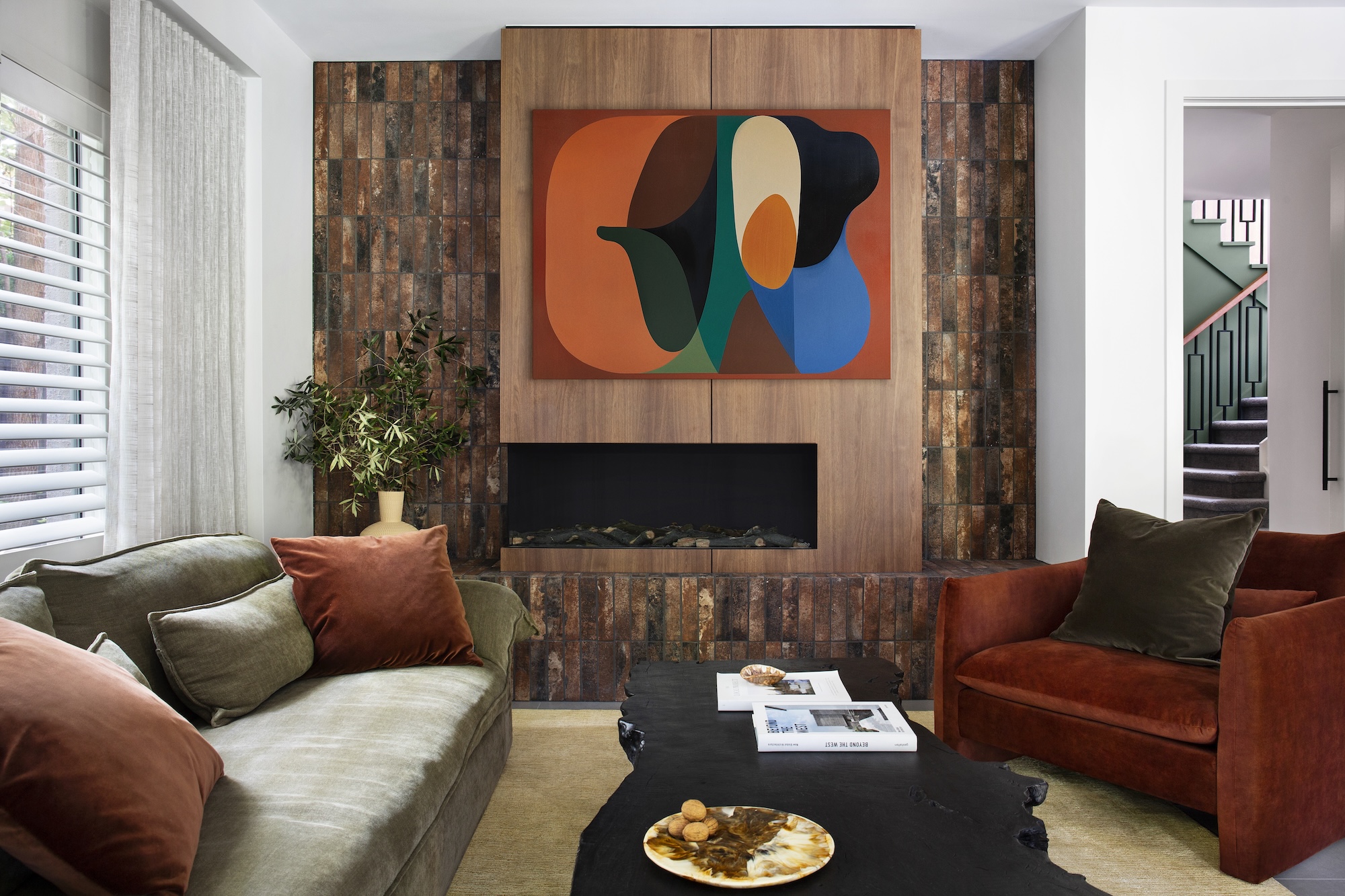
Further south, another family home takes colour in an entirely different direction. Here, deep greens, walnut timber, brushed brass, mustard, rust and black stone fill the rooms with a rich, tactile warmth.
The brief was clear: no more beige.
“The brief was to completely move away from the beige and neutral tones that once defined the home and to reintroduce personality through a palette that felt both sophisticated and nurturing,” says Richard Misso, creative director of The Stylesmiths.
“Deep greens and walnut were chosen for their connection to nature… Brushed brass details added warmth and subtle reflection.”
In the living area, an artwork becomes the anchor that unites rust armchairs, an olive sofa, terracotta tones and black stone.
“A multi-tone palette like this works when each hue earns its place and connects through tone rather than saturation,” he explains.
“Texture plays an equal role to colour… creating variation and visual rhythm without overwhelming the eye.”
What’s ahead?
“Bold colour is already making its return, but in a more refined, tonal way… It’s less about maximalism and more about authenticity through colour.”
Rich earth tones define this living space by The Stylesmiths. Photo: The Stylesmiths
The American Case
Across the Pacific, a roughly 930-square-metre manor near Atlanta champions a cinematic approach to colour, says Seth van den Bergh, principal designer at The Drawing Room.
Long architectural sightlines demanded strong punctuation points, bold red moments, black walls, saturated accents and warm neutrals.
“At Milton Manor, the palette was built around rhythm and a restrained use of colour,” van den Bergh says.
“Boldness only works when it is balanced with restraint… the ‘fearless palette’ gains its strength from warm neutrals, white painted wood floors and a thoughtful use of colours and objects.
These elements allow the saturated gestures to feel intentional rather than overwhelming. It is that balance that lets the home breathe.”
Even the black walls are handled with precision.
“We layered the surfaces and filled the negative space with related tones… the key is to treat black as a finish rather than a colour,” he says.
For those scared to commit, he recommends beginning with emotion, studying the light, understanding the room’s vistas, then editing to one clear direction.
“Think of it like a film. You would not have all your lead characters speaking at once, so let the room have one clear voice to follow,” van den Bergh says.
For homeowners nervous about bold shades, Treloar suggests starting with how a space should feel and introducing colour slowly through architectural details or textures. Moodboards and real paint samples remainessential.
“Colour can change substantially in different lighting or when colour from other furnishings reflects on the wall,” she says. “It’s all about experimentation and allowing your personal style to evolve.”
Playful Confidence in Toronto
In a Toronto condo belonging to actress Amalia Williamson, colour takes on a joyful, youthful energy.
The space started as a blank, characterless developer shell. With a careful mix of custom cabinetry and budget retail pieces, the palette evolved into a vibrant blend of navy, blush, gentle greens, bold orange and saturated green.
Crucially, the bold accents came last.
“We actually selected those accents at the very end,” designer Isabel Clune of Isabel Clune Design says. “The foundation of the room was already rich with colour but in a soft, muted way.
The saturated green pendants and bold orange stools became the perfect counterbalance… It’s a controlled pop, not a swing into ultra-maximalism.”
Even the surfaces balance practicality with beauty.
“I always design with equal consideration for function and beauty… Marble can be refinished, it’s naturally heat-resistant… its subtle imperfections and patina add character over time.”
The embossed tile was chosen purely for its visual impact, with marble behind the stove for everyday practicality.
It proves colour doesn’t require huge budgets – just intentionality.
Colour Me Happy
Colour at Portugal’s Viterbo Interior Design begins with feeling, not pigment. As Gracinha Viterbo and Miguel Vieira da Rocha explain, “we never begin by selecting colours, we begin by talking about how people live.”
The team worked with the family to map the emotional temperature of each room, asking what mood each part of the home should hold: where they should feel energised, where they should slow down, where they should decompress and where they should gather with others.
The palette grew out of that emotional map, refined on site with large samples and fabrics at different hours of the day so that each hue produced the exact feeling the family wanted.
The home’s bold moments never spill into chaos because strict principles anchor the palette.
“Each room was given one strong chromatic gesture – never two,” the designers say, ensuring character without competition.
A restrained architectural backdrop and a tight family of colours allowed tones to reappear through the house in different intensities, creating continuity.
The result is a home that feels expressive and dynamic, yet the flow is seamless.
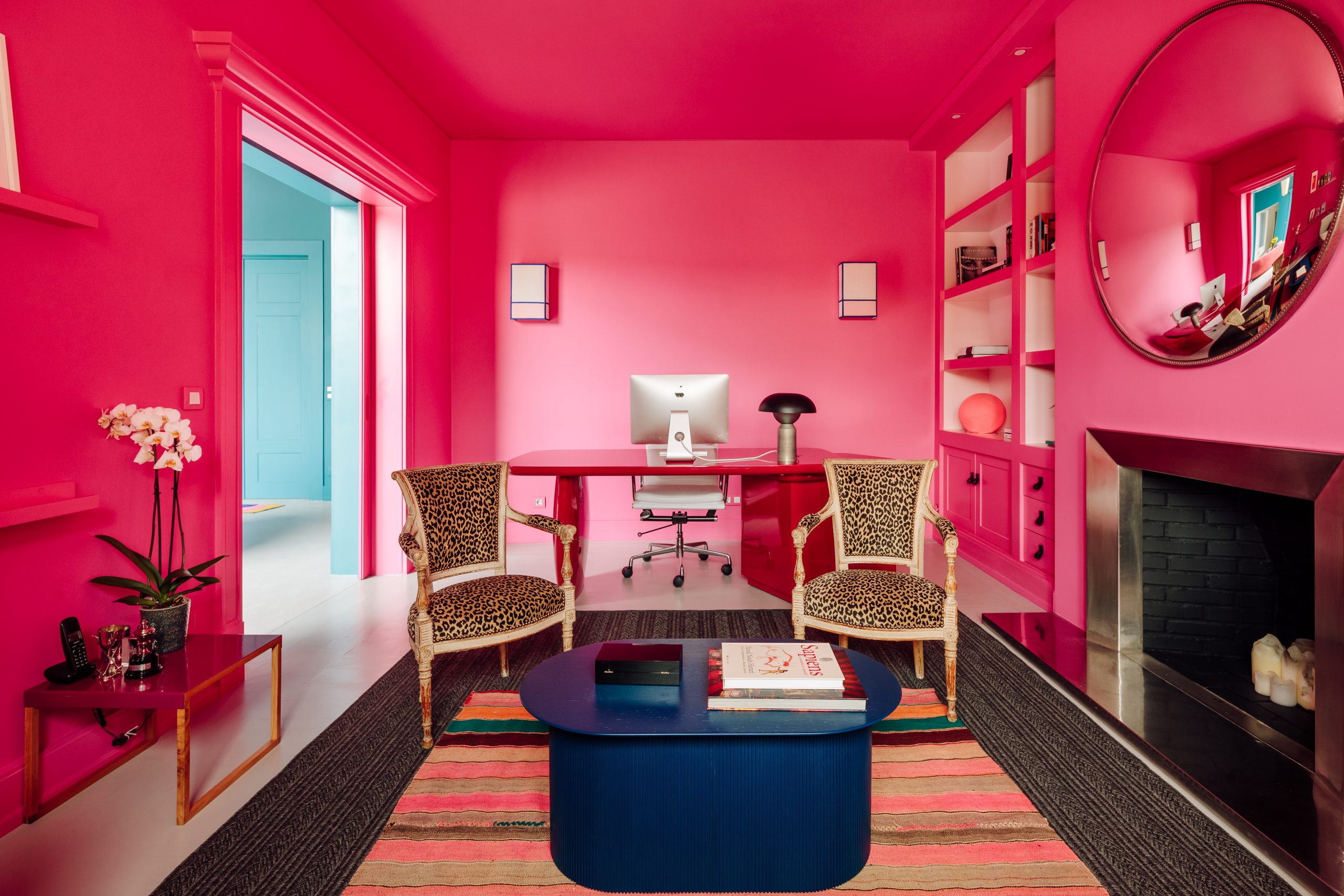
Bold colour meets considered balance. In this Lisbon project by Viterbo Interior Design. Photo: Francisco Nogueira
19th Century Revival
In Turin, colour becomes a bridge between eras. A 19th-century apartment restored by BRH+ Studio has been reimagined as a dialogue between heritage architecture and a vivid contemporary art collection.
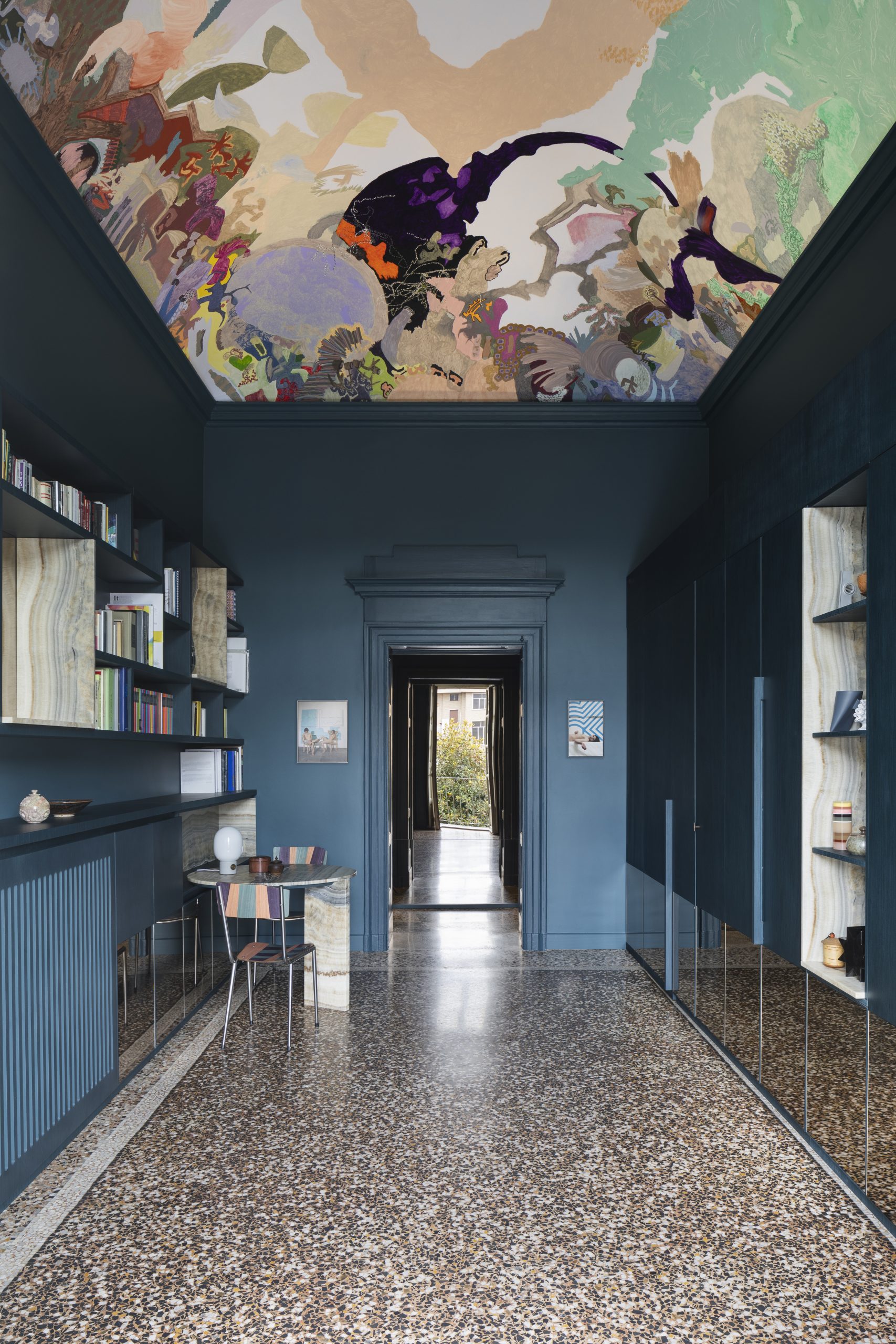
Nowhere is that tension more captivating than in the entryway, where deep octanium walls and a site-specific fresco ignite a striking conversation between past and present.
Victoria Stoian’s fresco transforms the vaulted ceiling into an imagined sky, drawing the eye upward the moment visitors enter the apartment and signalling that this is a home shaped as much by art and narrative as by architecture.
BRH+ Studio treat colour not as decoration but as architecture, using it to connect the original terrazzo floors with new interventions and give the apartment a cohesive rhythm.
A dramatic fresco crowns the entry of Apartment SL.
BRH+ on Colour and Heritage
For architects Barbara Brondi and Marco Rainò, founders of BRH+Q, the entrance to the Turin apartment was conceived as more than a hallway.
“The entrance to an apartment can be understood not only as the threshold to private living spaces, but also as a symbolically charged environment where the personality of the inhabitant can be expressed,” they explain.
In this case, the space was designed to reveal the owners’ passion for contemporary art while connecting that sensibility with the building’s nineteenth-century architecture.
The large tempera fresco by Moldovan artist Victoria Stoian transforms the vaulted ceiling into an imaginary landscape suspended between past and present. At the same time, the deep chromatic treatment of the walls connects visually with the apartment’s terrazzo flooring, creating a dialogue between decorative surfaces.
For Brondi and Rainò, the key to working within historic buildings is restraint. Every project begins with a close study of the context so that new interventions complement rather than overwhelm the architecture.
Pasadena: A Cocoon of Blue
In Pasadena, a second-floor bedroom suite became the perfect test case for how far colour can transform a small space when used with conviction.
The room sits apart from the home’s communal areas, giving interior designer Jennifer Vaquero of September Workshop the freedom to create a space centred entirely around her client’s favourite hue.
“While we loved the idea of creating a relaxing and serene space, it was equally important that the rooms also feel energetic and joyful,” she says.
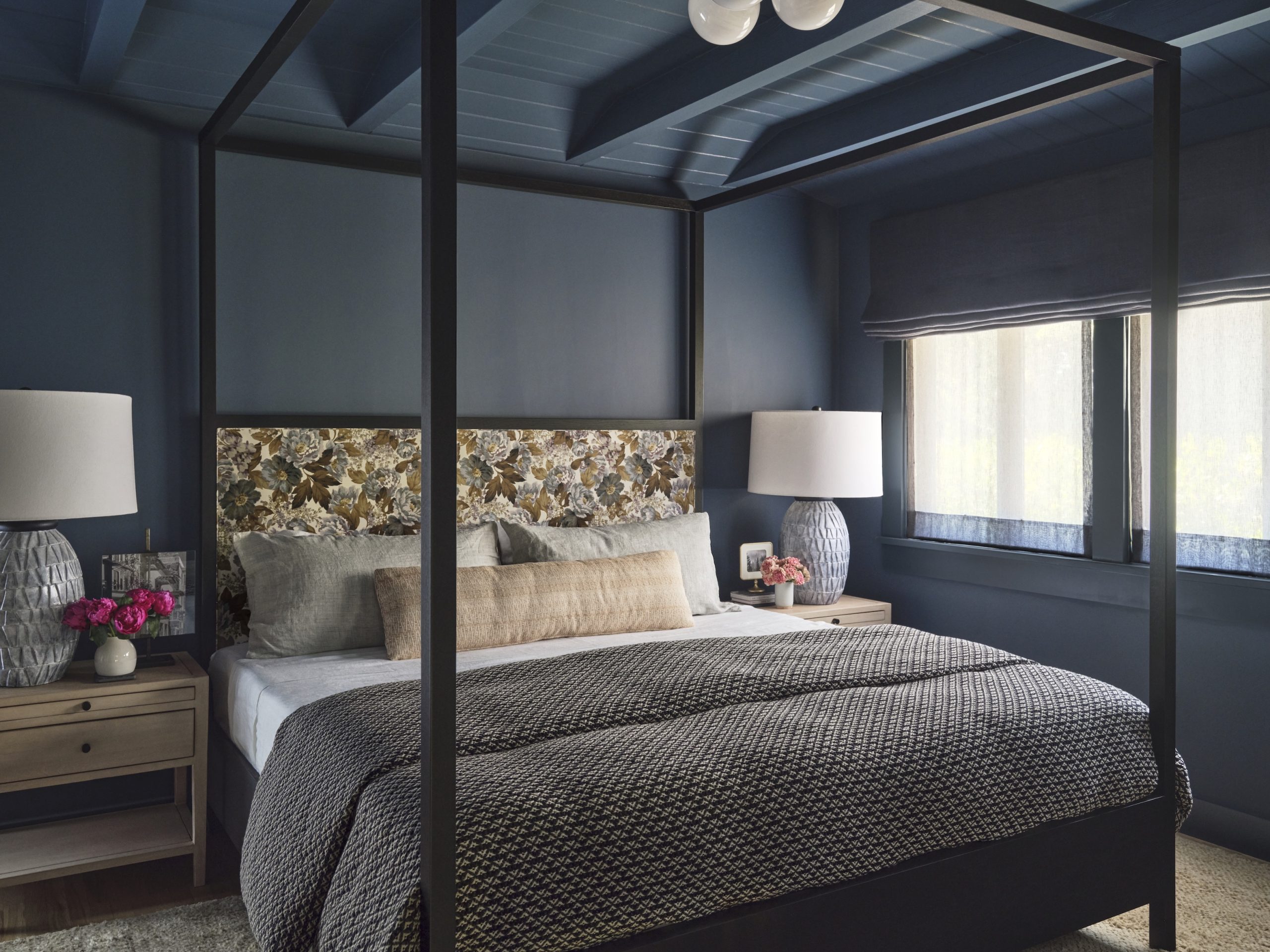
Warm accents, reflective textures and subtle sheen in the window sheers ensure the deep blue palette never feels flat.
“When that light bounces off the golden and purple hues in the marble or the warm woods, the whole suite seems to come alive.”
Wrapped in cocooning layers of deep blue, the September bedroom suite balances calm and energy.
Where Colour Is Heading
Across continents, a consistent story emerges. Colour is returning not as trend but as therapy, craftsmanship and identity.
Homes no longer want to whisper. They want to reflect the lives within them, joyful, complex, grounded and expressive.
Design is shifting from minimalism to meaning. From quiet to considered. From safe to soulful.
The new colour confidence isn’t loud or chaotic. It’s intentional, emotional and human, and one of the most powerful tools in luxury design.
This article appeared in the Autumn 26 issue of Kanebridge Quarterly, which you can buy here.
Sentosa in Hobart has already spent its time in the history books, but now the historic estate in Sandy Bay is set to shine again.
The period home, which sits on a large 2300 square metres riverfront block, made headlines in 2017 when the then century-old mansion sold for a Tasmanian record of $6.5 million.
Fast forward to 2026 and the 1917 trophy home is returning to the market with $15 million expectations – a figure that could set a brand new price benchmark for the Apple Isle.
Owned by Sydney investors, Piers Dawson-Damer and his partner Kim, Sentosa has been used as a Tassie holiday home for almost a decade. The pair bought the riverside residence from locals Wendy and Barry Turnbull, who had paid $815,000 for it in 1993.
The current sale is expected to easily eclipse Hobart’s record, which stands at $8.5 million. That benchmark was set when Point Piper-based Taswegian, financier Greg Woolley, bought historic Waimea House in 2011.
Interestingly, Woolley took the keys to Waimea House – also in Sandy Bay – from the Dawson-Damers, who themselves had paid a then-record of $6.06 million.
Co-agents, Forbes Global Properties directors Tracey Atkins and Robert Fletcher, are tasked with marketing Sentosa.
“Sentosa has been set up perfectly by its interstate owners to serve as a top-tier second home, with state-of-the-art automation, technology and security now in place that allow it to be run seamlessly from anywhere in the world,” Fletcher said, adding that the unique Hobart home has been turning heads since it landed online this week
“There is no question it merits attention locally and internationally – it is a true Tasmanian trophy.”
Taking its name from the Malay word for “peace and tranquility”, Sentosa is once of the city’s most iconic properties. Even early Australian aviator Charles Kingsford-Smith reportedly visited the estate when he honeymooned in Hobart with his second wife Mary in 1931.
With 270-degree views of the Derwent River and mountain backdrop, the house on Blinking Billy Point has given its owners a front-row seat to the final sprints of the Sydney to Hobart Yacht Race.
Now fully renovated, the arts and crafts era house has been restored to its former glory.
Fletcher said the Dawson-Damers wanted to respect the home’s heritage while updating the five-bedroom house for modern living.
The result is a blend of classic craftsmanship and modern luxury, all with a strong connection to the water.
There are many restored original details, like ornate cornices, lead-light windows, fireplaces, and intricate fretwork.
The renovation has also added several modern touches, including a new central staircase, updated joinery, sleek bathrooms, and an entertainer’s kitchen. Other modern features of the Sandy Bay home include advanced home automation and CCTV security.
Living areas include both formal and casual spaces, plus there is a grand main bedroom suite, all designed to capture uninterrupted views of the river and ranges.
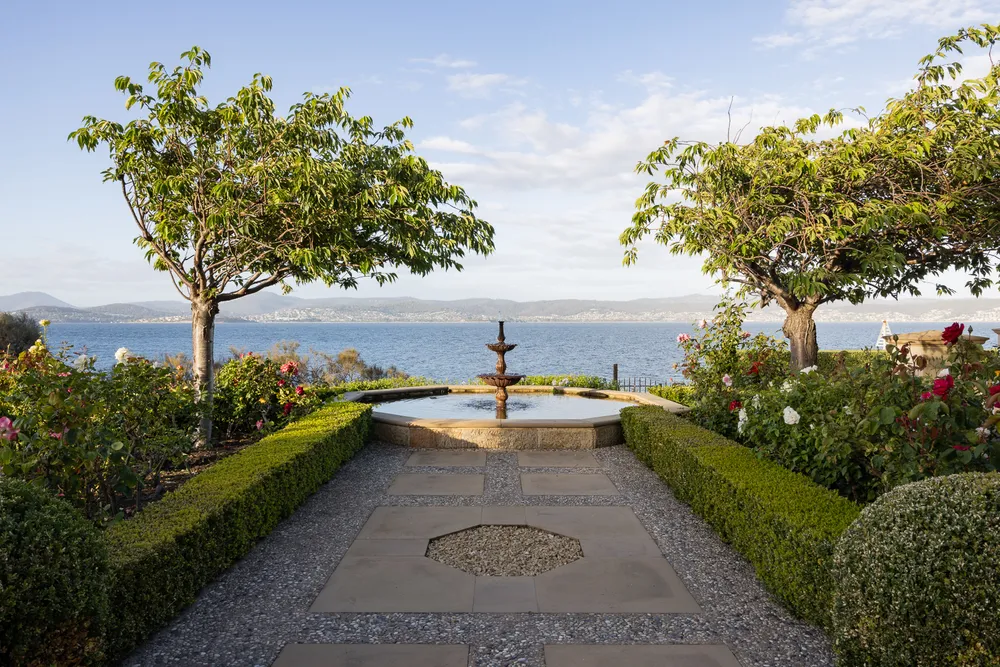
Outside, the estate offers resort-style amenities, including landscaped gardens by award-winning designer Paul Bangay, with European-inspired green spaces, a statement water fountain, level lawns, and sandstone terraces.
Additionally, there is a fully equipped boat shed with a slipway right on the water’s edge.
Sentosa is close to beaches, popular schools, large parks, and Hobart’s CBD.
Sentosa at 650 Sandy Bay Rd, Sandy Bay is listed with price hopes of $15 million through an expressions of interest campaign with Forbes Global Properties agents Robert Fletcher and Tracey Atkins.
It’s go time for the highest-stakes mission at NASA in more than 50 years.
On April 1, the agency is set to launch four astronauts around the moon, the deepest human spaceflight since the final Apollo lunar landing in 1972.
The launch window for Artemis II , as the mission is called, opens at 6:24 p.m. ET.
National Aeronautics and Space Administration teams have been preparing the vehicles to depart from Florida’s Kennedy Space Center on the planned roughly 10-day trip. Crew members have trained for years for this moment.
Reid Wiseman, the NASA astronaut serving as mission commander, said he doesn’t fear taking the voyage. A widower, he does worry at times about what he is putting his daughters through.
“I could have a very comfortable life for them,” Wiseman said in an interview last September.
“But I’m also a human, and I see the spirit in their eyes that is burning in my soul too. And so we’ve just got to never stop going.”
Wiseman’s crewmates on Artemis II are NASA’s Victor Glover and Christina Koch, as well as Canadian Space Agency astronaut Jeremy Hansen.
Photo: NASA’s Artemis II SLS rocket and Orion spacecraft being rolled out at night. Miguel J. Rodriguez Carrillo/Getty Images
What are the goals for Artemis II?
The biggest one: Safely fly the crew on vehicles that have never carried astronauts before.
The towering Space Launch System rocket has the job of lofting a vehicle called Orion into space and on its way to the moon.
Orion is designed to carry the crew around the moon and back. Myriad systems on the ship—life support, communications, navigation—will be tested with the astronauts on board.
SLS and Orion don’t have much flight experience. The vehicles last flew in 2022, when the agency completed its uncrewed Artemis I mission .
How is the mission expected to unfold?
Artemis II will begin when SLS takes off from a launchpad in Florida with Orion stacked on top of it.
The so-called upper stage of SLS will later separate from the main part of the rocket with Orion attached, and use its engine to set up the latter vehicle for a push to the moon.
After Orion separates from the upper stage, it will conduct what is called a translunar injection—the engine firing that commits Orion to soaring out to the moon. It will fly to the moon over the course of a few days and travel around its far side.
Orion will face a tough return home after speeding through space. As it hits Earth’s atmosphere, Orion will be flying at 25,000 miles an hour and face temperatures of 5,000 degrees as it slows down. The capsule is designed to land under parachutes in the Pacific Ocean, not far from San Diego.
Water photo: NASA’s Orion capsule after its splash-down in the Pacific Ocean in 2022 for the Artemis I mission. Mario Tama/Press Pool
Is it possible Artemis II will be delayed?
Yes.
For safety reasons, the agency won’t launch if certain tough weather conditions roll through the Cape Canaveral, Fla., area. Delays caused by technical problems are possible, too. NASA has other dates identified for the mission if it doesn’t begin April 1.
Who are the astronauts flying on Artemis II?
The crew will be led by Wiseman, a retired Navy pilot who completed military deployments before joining NASA’s astronaut corps. He traveled to the International Space Station in 2014.
Two other astronauts will represent NASA during the mission: Glover, an experienced Navy pilot, and Koch, who began her career as an electrical engineer for the agency and once spent a year at a research station in the South Pole. Both have traveled to the space station before.
Hansen is a military pilot who joined Canada’s astronaut corps in 2009. He will be making his first trip to space.
Koch’s participation in Artemis II will mark the first time a woman has flown beyond orbits near Earth. Glover and Hansen will be the first African-American and non-American astronauts, respectively, to do the same.
What will the astronauts do during the flight?
The astronauts will evaluate how Orion flies, practice emergency procedures and capture images of the far side of the moon for scientific and exploration purposes (they may become the first humans to see parts of the far side of the lunar surface). Health-tracking projects of the astronauts are designed to inform future missions.
Those efforts will play out in Orion’s crew module, which has about two minivans worth of living area.
On board, the astronauts will spend about 30 minutes a day exercising, using a device that allows them to do dead lifts, rowing and more. Sleep will come in eight-hour stretches in hammocks.
There is a custom-made warmer for meals, with beef brisket and veggie quiche on the menu.
Each astronaut is permitted two flavored beverages a day, including coffee. The crew will hold one hourlong shared meal each day.
The Universal Waste Management System—that’s the toilet—uses air flow to pull fluid and solid waste away into containers.
What happens after Artemis II?
Assuming it goes well, NASA will march on to Artemis III, scheduled for next year. During that operation, NASA plans to launch Orion with crew members on board and have the ship practice docking with lunar-lander vehicles that Elon Musk’s SpaceX and Jeff Bezos’ Blue Origin have been developing. The rendezvous operations will occur relatively close to Earth.
NASA hopes that its contractors and the agency itself are ready to attempt one or more lunar landing missions in 2028. Many current and former spaceflight officials are skeptical that timeline is feasible.
Rolls-Royce has revealed a new series of bespoke Cullinan motor cars inspired by the world of yachting, with four individually commissioned vehicles reflecting the materials, movement and design codes of life at sea.
Presented at Goodwood in the UK, the Cullinan Yachting collection comprises four one-off vehicles themed around the cardinal directions, North, South, East and West, each expressed through distinct exterior finishes and interior detailing.
The commissions lean heavily into maritime influence, a space Rolls-Royce says is closely aligned with its global client base.
Each vehicle features marine-grade teak, hand-painted fascia artwork inspired by the wake of a tender cutting through water, and intricate marquetry compass motifs made from more than 40 individual pieces of wood veneer.
Hand-painted elements have become an increasingly sought-after feature among Rolls-Royce clients, with the brand employing dedicated artisans to develop bespoke interior compositions.
For the Cullinan Yachting series, the painted wake effect required months of experimentation to achieve a natural sense of movement.
Inside, the vehicles are finished in Arctic White and Navy Blue leather, with hand-stitched detailing designed to echo the structure of nautical ropework. A signature Rolls-Royce Starlight
Headliner has also been reimagined, with fibre-optic constellations arranged to reflect Mediterranean wind patterns.
Each car’s exterior colour has been developed to align with its directional theme, ranging from lighter blue tones evoking northern waters to deeper hues referencing warmer southern seas and storm-lit horizons.
Rolls-Royce said the collection reflects a longstanding relationship between the marque and the world of yachting, dating back to its co-founder Charles Rolls, whose family owned a steam yacht and travelled extensively through the Mediterranean.
The release underscores the growing demand for highly personalised vehicles among ultra-high-net-worth buyers, with Rolls-Royce increasingly positioning its cars as part of a broader luxury lifestyle that extends beyond the road.
In Sydney’s Northern Beaches, there are plenty of homes with a multimillion-dollar view and an enviable position close to the sand.
This unique listing has all that, but it has also earned its page in the local history books.
After 50 years in the same hands, The Palladium in Palm Beach—once a famed dance hall, then a restaurant, a private residence, and an artists’ studio—is now back on the market with a price hopes of $13.5 million through BJ Edwards and David Edwards of LJ Hooker Palm Beach.
Positioned in a rare corner spot where Ocean Rd meets Palm Beach Rd, The Palladium has been front and centre observing the famous sandy stretch for almost a century.
Built in the early 1930s, the Art Deco building was originally conceived as a vibrant community dance hall; the “it” place to be for young folk during Sydney’s thriving interwar period.
Often the dances were held to raise money for the Palm Beach Surf Life Saving Club, and newspaper reports of the time told of rowdy parties lasting until the early hours, bootleg liquor arrests, and where shorts and sandals—or even pyjamas—were scandalously worn by “both sexes”.
Over the decades, The Palladium has worn many hats.
By 1943, the original owner, Joseph Henry Graham, had defaulted on his loan, and a mortgagee sale reportedly sold the building for £1550, which translates to about $137,000 today. It later became a dining space and a general store run by the Milton family. In the 1960s and early 1970s, the property was also home to the Blue Pacific Restaurant.
The current owners acquired the keys in 1976 when it began its next chapter as a creative hub. One of today’s vendors, filmmaker David Elfick, who has been a filmmaker and producer on such films as Newsfront and Rabbit-Proof Fence, has told stories of a free-spirited creative hub that has been used for film sets, to store numerous movie props, as editing rooms, to hold countless parties and has even hosted visiting members of the Royal Shakespeare Company.
From its famed beachside soirees to its grassroots film club nights, the venue has become woven into the cultural fabric of Palm Beach.
Today, that rich history has been reimagined into a coastal home that honours its past while embracing contemporary beachside living.
Built in a unique architectural style known as streamline moderne, the aeroplane hangar-like building reflects the era’s fascination with air travel, mass transport, and modernity. The facade is defined by a sweeping curved roofline and subtle nautical cues.
The main residence features a vast central living space framed by a number of bedrooms and sunrooms, as well as a front dining room and kitchen. In total, there are four to five bedrooms, three bathrooms and a powder room adjoining an upstairs loft space.
Big, broad windows draw in loads of natural light and provide iconic views, plus the sounds of the beach just across the road.
Many of the original elements remain, most fittingly the polished floors of the former dance hall. In the additional building at the back of the block, there is a separate, self-contained studio with its own bedroom, bathroom, kitchen and laundry. From its elevated deck, the outlook stretches across the full sweep of Palm Beach.
Outside, the expansive 1151sq m land parcel also features established gardens with veggie patches and standalone decks for quiet contemplation.
Sitting just across the road from the beach, the property is also within walking distance of local cafes and the surf club. Palm Beach Rock Pool is at one end of the beach, with the Palm Beach Golf Club and the water airport at the other end of the peninsula.
The Palladium and Palm Beach Studio at 16 Ocean Rd, Palm Beach are listed with BJ Edwards and David Edwards of LJ Hooker Palm Beach via a private treaty campaign with a price guide of $13.5 million.
Two years ago, fed up with the long drive to the Hamptons, the actress and daytime talk-show host Drew Barrymore started looking for a weekend home in Westchester County.
When she saw a circa-1700s mansion for sale, Barrymore said, she felt a karmic connection to the Harrison, N.Y., property.
“I walked in, and I was, like, ‘I know my family’s been here. I know that I have to work on this house. I know that I’m supposed to be doing this,’” said Barrymore, 51 years old, who lives primarily in Manhattan with her two daughters. “It was like a strange, spiritual calling.”
It turned out she actually did have a connection to the area: Her great-aunt, the late actress Ethel Barrymore, had a home in nearby Mamaroneck, where an enclave known as Barrymore Lane is widely believed to be named for the family.
Barrymore bought the roughly 12-acre estate for $4.4 million, according to property records. She did an extensive renovation; she has a deep interest in interior design and has considered pursuing it professionally. “Between Pinterest, thrifting and a can of paint, there’s nothing you can’t do,” Barrymore said with a laugh.
But roughly two years later, the actress is listing the property for $4.99 million. The renovation took longer than expected, she said, and the family’s lives have changed in the interim.
The estate includes a roughly 5,600-square-foot, five-bedroom main house, a pool and a poolhouse with an additional bedroom, according to Kori Sassower of Compass.
Barrymore said she previously owned a home in Sagaponack, N.Y., but the distance from the city and the weekend traffic to the Hamptons became untenable as her children’s schedules filled up with social and sporting activities.
Harrison, by contrast, offered accessibility and charm. The property, located roughly an hour from Manhattan, is a short drive from picturesque Rye and Bronxville, while nearby Bedford has drawn celebrities. The median sales price for a home in Harrison is around $1.1 million, according to Redfin.
The property’s expansive acreage gave Barrymore a sense of being close to nature. “It’s really like being in your own personal park,” she said. “There are tons of deer. There are pheasants, there are ducks, there are rabbits.”
When she purchased the home, Barrymore said, she thought it would need only a cosmetic renovation. Instead, it turned into a “complete internal gut,” with much of the plumbing, heating and air conditioning replaced, she said.
Barrymore also revamped the ground floor to open up the kitchen, which felt dark and boxed in. “It took a year of engineering to figure out how to accomplish it,” she said.
Barrymore declined to comment on the exact costs of the renovation, but compared herself to actress Shelley Long’s character in the 1986 film “The Money Pit.”
Some of the rooms have maximalist patterned wallpaper, elaborate art walls and heavy, old-fashioned draperies. Others are minimalist. “Every little corner gets scrutinised for what it could be,” she said. “If I see a closet, it’s probably not a closet, it’s going to become some secret hideout for my kid, or I’m going to take the door off and turn it into a sculptural piece.”
In the home’s living room, Barrymore said she cycled through multiple paint colours, including pink and green.
“I painted it all green because I was dying for greenery. And then the summer came, and I was, like, ‘Oh, God, everything is green!’”
She spent time at the property even while it was under construction. When they didn’t have a kitchen, the family cooked dinner on a grill outside and drank boxed water, she said.
When workers were redoing the pipes, Barrymore couldn’t shower. “I lived in the house in the most primitive of scenarios,” she said. “It’s some of my favourite times and memories.”
When Barrymore celebrated her birthday at the property in February, she and two friends decided to grill for old time’s sake, even though the kitchen was fully functional.
“There we were in zero-degree weather with parkas, hoodies, gloves and face masks. But we were, like, ‘We gotta do it. It’s the tradition.”
Barrymore, who grew up in Los Angeles, stars in films like “Never Been Kissed,” “Riding in Cars With Boys” and “Charlie’s Angels.” Her eponymous daytime talk show launched in September 2020.
Sassower is listing the property with her colleague Brian K. Lewis in New York City.
The current BMW i5 electric sedan has an official range of 278 to 310 miles, and it might be closer to 250 to 270 in the real world.
That is why the coming 2027 BMW i3 50 xDrive—the first of the “Neue Klasse” cars coming to the U.S. early next year and just revealed to the world—is such a game changer.
The range is estimated at 440 miles, beating most EVs on the road now, and it is coupled with exciting performance, including zero-to-60 estimated at 3.8 seconds and an impressive 463 horsepower (with 476 pound-feet of torque) from a pair of electric motors, delivering xDrive to all four wheels.
A single-motor version is down the road. The price isn’t out yet, but it is likely to begin between US$55,000 and $65,000.
If sedans aren’t your thing, the electric 3-Series will also be offered as an approximately $60,000 iX3 crossover SUV, which has a similar powertrain and performance.
The twin-motor iX3 50 xDrive has a slightly lower 400 miles of range, due in part to its less-aerodynamic shape compared with the i3. It is also not quite as speedy, getting to 60 mph in 4.7 seconds.
BMW design has been iffy lately, and virtually no one loves the cars with the huge kidney grilles, but the “Neue Klasse” turns the page, and the i3 and iX3 are both strikingly handsome.
The i3 isn’t a particularly lightweight vehicle, at approximately 4,850 pounds, which is why both the i3 and iX3 need a huge 108-kilowatt-hour battery pack.
The drawback could be longer charge times, but up to 400-kilowatt plug ins are available here.
At a DC fast charger, a charge from 10% to 80% should take only 21 minutes.
A 19.2-kilowatt home charger is available. The pack supports standard bidirectional charging, which means it could theoretically provide power to your home during an outage.
A bonus is that the big battery can also supply 3,700 watts for whatever you have in mind, from tailgating to camping.
The cars share basic suspension, but on the sedan an adaptive M-branded suspension is available.
Both BMWs introduce the new Panoramic iDrive, which features an 18-inch touch screen angled at the driver.
Early users say it is incredibly responsive. Inside, the standard trim features Econeer upholstery that is 100% fabricated from recycled PET bottles.
M Design cars upgrade to black Veganza (aka vegan leather). The top trim is BMW Individual with black Merino leather.
It is standard for automakers to introduce their fully loaded models out of the gate, with the more bread-and-butter versions appearing later.
BMW is certainly doing that here, but i3s and iX3s priced below $50,000 are expected fairly soon.
The momentum for electrics has certainly slowed, but cars like these—offering performance, dynamics and features superior to the conventional alternatives—should help EVs get back on track.
Brick continues to play a significant role in contemporary Australian residential architecture, with a series of recently highlighted projects demonstrating how the traditional building material is being adapted to meet modern design expectations and environmental demands.
The case studies focus on three homes in NSW, Queensland and Victoria, where brick has been used to balance aesthetic considerations with practical performance benefits such as durability, thermal efficiency and reduced maintenance requirements.
At a suburban residence on Badgery Avenue, pale-toned brickwork has been used to reinterpret established streetscapes through a more contemporary architectural approach, with uniform masonry emphasising sculptural curves and clean structural lines.
In regional Queensland, a rural property known as Springdale demonstrates brick’s ability to withstand challenging environmental conditions.
The use of textured brickwork helps the home blend with its natural surroundings while providing strength against heat, wind and long-term weather exposure.
“Australian homes ask a lot of their materials, and brick has always been one of the few that can deliver beauty and performance in equal measure,” says Brickworksspokesperson, Brett Ward.
“These homes show just how versatile brick can be — whether it’s creating a striking façade, providing year-round comfort, or offering the kind of durability that stands up to the harshest conditions.
“Brick gives homeowners confidence. It’s a material that looks incredible on day one and continues to perform for generations.”
Thermal performance is also highlighted in a coastal home at Point Leo on Victoria’s Mornington Peninsula, where brick has been used both internally and externally to help regulate indoor temperatures.
Its density also contributes to acoustic insulation, supporting quieter living environments in both coastal and urban settings.
According to Brickworks, the featured homes reflect growing interest in materials that combine architectural versatility with long-term resilience and passive design benefits suited to Australia’s varied climate conditions.
Luxury safari operator Abercrombie & Kenthas announced the opening of Kitirua Plains Lodge, a new design-led property in Kenya’s Amboseli region that aims to redefine traditional safari accommodation.
Set on a 128-acre private concession bordering Amboseli National Park, the lodge has been designed to blend into its natural surroundings rather than dominate them.
Developed in partnership with architecture firm Luxury Frontiers, the property reflects a broader shift towards environmentally responsive and community-integrated safari experiences.
Positioned within sweeping savannah landscapes and offering uninterrupted views of Mount Kilimanjaro, the lodge features 13 standalone suites oriented to frame the iconic peak.
The design draws on vernacular architecture and local artistic traditions, with an undulating black roof inspired by traditional Maasai buildings and lath screens based on indigenous construction methods to enhance ventilation and shade.
The project marks a return to Amboseli for Abercrombie & Kent, where founder Geoffrey Kent first introduced clients to luxury safari travel in 1962, establishing a model of adventure by day and comfort by night that continues to influence the industry.
Materials used throughout the lodge have been sourced locally where possible.
According to the company, 90 per cent of the furniture was made in Kenya using mango wood and African teak, while Mazeras stone quarried nearby has been used for cladding and flooring.
Interior finishes, including rough-plaster walls mixed with soil from the site, reflect the colours and textures of the surrounding terrain.
Sustainability measures have been embedded into the design from the outset.
The lodge operates on 100 per cent solar power, uses passive cooling strategies to reduce reliance on air-conditioning and recycles greywater for irrigation.
Waste management systems, including recycling and composting, were incorporated during construction.
Community engagement also formed a central part of the development, with local workers employed during construction and traditional techniques used to encourage skills transfer and economic benefit.
Features such as hand-woven sisal ceilings, clay bead pendants and sculptural grass art highlight the role of regional artisans in shaping the property’s aesthetic identity.
Kitirua Plains Lodge is scheduled to open on June 1, 2026, joining A&K Sanctuary’s existing Kenyan properties Olonana Lodge in the Maasai Mara and Tambarare Camp in Ol Pejeta Conservancy.
The lodge will be available as part of the brand’s Tailor Made and Small Group journeys.
Kristin Leite, 38, spends about an hour organising her “stack” for the week.
“In the morning, I take four powders and about five capsules,” said Leite, an esthetician who lives in Tampa, Fla. She pops around five more in the afternoon, and at night she swallows six or seven capsules.
“I’m talking probably like over 20 different supplements throughout the day,” she said, making adjustments based on how she feels.
That’s on top of the injections Leite gives herself regularly: NAD+, which she says makes her feel energised and alleviates her brain fog, and glutathione, which is marketed for antioxidant and immune support.
“It’s very painful, and it stings and it’s horrible,” Leite said of the latter. The Food and Drug Administration has warned that both can cause health problems in injectable form.
On TikTok, where she has more than 615,000 followers, Leite talks about the products she’s using. She links to them on ShopMy and Amazon, where she earns affiliate revenue from sales.
Over-the-top supplement regimens have become bragging rights for the health-conscious and wellness-obsessed.
From beauty lovers to masculinity influencers, everyone is boasting about their “stacks”—the numerous capsules, powders and injections they take regularly in the hopes of achieving a cumulative, self-optimizing effect.
They’re spending over $1,000 a month in some cases on products that purport to improve their sleep, mental health, fertility, appearance and longevity, but often aren’t approved for those purposes. Some are making money from their endorsements.
Influencers and other public figures are driving the frenzy. “I do 150 supplements a day, and I have for 20 years,” biohacker Dave Asprey said on a podcast last year .
Bryan Johnson, the tech entrepreneur and longevity enthusiast, said in a 2023 YouTube video that he took 111 supplements daily.
“A lot of people are pretty confused that I can take this many supplements in a given day,” he said in the video, posted the year before his company Blueprint commercialised multi-nutrient products. (He said in an email that he now takes fewer than 30.)
Health Secretary Robert F. Kennedy Jr., who has vowed to “end the war on vitamins,” has said in interviews that he takes “a ton” of them.
“Supplements aren’t a silver bullet, and they don’t override poor lifestyle choices,” Asprey said in a statement.
He said that the ones he takes aren’t necessarily for everyone. “That’s why I never share my exact supplement stack. Experiment, test, and find out what works for you personally.”
Supplements went from a means of treating diseases caused by nutritional deficiencies in the 1900s to lifestyle products that are now the backbone of a $70 billion industry.
Because they do not undergo approval by the FDA, they aren’t reviewed for safety or efficacy before coming to market.
Some have lots of scientific research backing their use, while others have very limited support.
Manufacturers are prohibited from making claims about treating or preventing disease, but influencers have sold the idea that buying the right products can fend off or cure almost any ailment.
Their videos draw on popular TikTok formats like shopping “hauls” and “get ready with me” routines, making supplements seem like a step toward pleasure or self-actualisation.
“Here are all the supplements I take as a 22-year-old, 125-pound girl in college who prioritises protein, slow movement and a healthy, active lifestyle,” one creator says in a video before filling a pale-pink mirrored pill case with a week’s worth of capsules.
“Rate my stack” is a common prompt in the Reddit forum r/Supplements, where posters share photos of the copious supplement bottles on their shelves.
Dylan Amble, a 28-year-old in North Carolina’s Outer Banks, recently filmed himself taking creatine and electrolytes, an NAC capsule, black seed oil, a saffron capsule and a supplement called Mojo that says it supports the production of testosterone.
“I don’t feel like I’m low-testosterone,” he said in an interview, “but I’ve seen a lot of podcasts where they talk about how it’s a gradual decline for males, so my mindset is, Why don’t I hedge myself as much as possible? ”
He’d been leading a self-described “degenerate lifestyle” that included drinking frequently and vaping before resolving to optimise his health and improve his appearance along the lines of so-called looksmaxxers—young men whose relentless pursuit of a physical ideal can include dangerous behaviours like injecting unknown substances and breaking their own facial bones.
(He considers himself a “softmaxxer,” meaning he doesn’t take things that far.)
To assemble his stack, which costs an average of $115 a month, he followed information shared by podcasters, including Andrew Huberman as well as models on social media.
“I always make sure to emphasise the importance of getting behaviours right first,” Huberman said in an email.
“While I personally have had great benefit from taking certain supplements, the topic of supplementation is a very small fraction of what I discuss on the podcast and social media.”
SuppCo, an app with 675,000 users, helps people track their stacks and assess the quality of certain supplement products.
CEO Steve Martocci, who previously co-founded messaging platform GroupMe and the Uber-for-helicopters company Blade, said he spends $1,114 a month on 28 supplements he takes daily to address nutrient deficiencies and, hopefully, increase his longevity.
The top 20% of SuppCo users spend $479 a month on supplements, according to the company, and the average SuppCo user spends $168 a month.
Nutritionists generally recommend filling nutrient gaps through food rather than supplements when possible. Some supplements can actually introduce or exacerbate health issues.
“It’s a new addiction that people have,” said Mona Sharma, a celebrity nutritionist in Los Angeles. She said many of her clients take upward of 15 supplements a day.
One female client, she said, was taking 70 of them, following guidance she’d seen online, without feeling any positive effect on her well-being.
“We hear that [Andrew] Huberman is taking something, and we all jump on the bandwagon thinking it’s good for us,” Sharma said, “when that’s not the case.”
Saudi Arabia’s oil officials are working frantically to project how high oil prices might go if the Iran war and its disruption of energy supplies doesn’t end soon—and they don’t like what they are seeing.
The base case, several oil officials in the Gulf’s biggest producer said, is that prices could soar past $180 a barrel if the disruptions persist until late April.
While that would sound like a bonanza for a kingdom still heavily leveraged to oil revenue, it is deeply concerning. Prices that high could push consumers into habits that slash their oil use—potentially for the long term—or trigger a recession that also hurts demand. They also would risk casting Saudi Arabia in the role of profiteer in a war it didn’t start.
“Saudi Arabia generally does not like too-rapid increases in oil, because that then creates long-term market instability,” said Umer Karim, an analyst of Saudi foreign policy and geopolitics with the King Faisal Center for Research and Islamic Studies. “For Saudis, the ideal equation is a relatively modest increase in prices while their market share remains stable.”
Saudi Aramco, the country’s national oil company, which handles production, sales and pricing, declined to comment.
This week’s strikes targeting energy facilities have pushed oil prices higher . In retaliation for an Israeli strike Wednesday on Iran’s South Pars gas field , Tehran hit facilities in Qatar’s Ras Laffan energy hub and attacked other Gulf infrastructure including Saudi facilities at Yanbu, the Red Sea end of a pipeline that can take crude around the chokepoint in the Strait of Hormuz .
Iran also continued to hit ships in the Gulf, extending a string of attacks that have all but shut the strait, the narrow conduit for 20% of the world’s oil shipments.
Attacks sent benchmark Brent futures as high as $119 a barrel before easing back Thursday. The contract’s all-time high, reached in July 2008, was $146.08.
“$200 a barrel is not outside the realms of possibility in 2026,” analysts at energy consulting firm Wood Mackenzie said.
Gulf futures tied to Oman crude, which are less liquid but which quickly reflect local supply disruptions, shot past $166 a barrel. Oman is a benchmark for much of the oil sold by Middle East producers such as Saudi Arabia, with tankers of physical crude priced at a fixed spread to the benchmark, which floats up and down each day with the market.
Some Saudi customers are balking at using the benchmark given its volatility, the oil officials said. Aramco, however, is insisting it is a true reflection of supply in the market, they said.
The war has already removed millions of barrels of oil from global supply. Prices are up by around 50% since the conflict began Feb. 28.
Modellers at Saudi Aramco need to assess the direction of the market in time to release the official selling prices for their crude by April 2. They pull in a number of inputs, including soundings on customer demand from staff who handle oil sales.
Saudi Arabian light crude is already being sold to Asian buyers via its Red Sea port for around $125 a barrel. As extra oil in storage—some of which was shipped out of the Gulf ahead of the war—is used up, physical shortages will bite more deeply next week, causing prices to close in on $138 to $140, the officials said.
By the second week of April, with no easing of the supply disruptions and the Strait of Hormuz remaining closed, the Saudi officials said they expected prices could hit $150 before stepping up to $165 and $180 in the weeks ahead.
Oil traders are also putting bets on much higher prices, though many remain far lower than Aramco’s most dire scenario. Wagers that Brent futures will hit $130, $140 or $150 a barrel next month were among the most popular positions in the options market on Wednesday, according to Intercontinental Exchange data. A smaller but growing number of traders are betting prices could shoot up even further.
“The market isn’t acting like this is an end-of-March thing any more,” said Rebecca Babin, a senior energy trader for CIBC Private Wealth, referring to an ending for the war. “I don’t think $150 is out of the question in another month…You start talking about June, I’ll give you $180.”
Many variables could keep prices from going that high, among them an end to the fighting or freed-up barrels from sanctioned producers such as Russia contributing to global supply. Demand could also fall, which would bring prices back down but potentially only in tandem with a recession.
Energy producers are scrambling to figure out how high prices can go before buyers start cutting back, a phenomenon called demand destruction.
“Generally, $150 Brent is where people will really start to put their pencils down and do the math,” Babin said.
At that price, analysts say, Americans might start taking the bus, working from home or rethinking their summer vacations. Manufacturers could slow down rather than operate uneconomically.
The more relevant price for most consumers is at the pump. Gasoline demand tends to start declining once prices exceed $3.50 a gallon, according to James West of Melius Research.
For many, prices are already there. Americans’ average retail prices for gasoline jumped to $3.88 a gallon Thursday, according to AAA, up from $2.93 a month ago. Drivers in Arizona, New Mexico and Colorado have faced the starkest sticker shock.
Diesel’s even more rapid price surge, to $5.10 a gallon, is already hitting companies that rely on the fuel to move everything from produce to semiconductors to steel nationwide.
“Higher fuel costs act like a tax on consumers and businesses, forcing households to spend more on energy and less elsewhere,” said Philip Blancato, chief executive at Ladenburg Asset Management.
Another big risk to demand comes from industrial users curtailing consumption and from the broad economic contraction that can accompany oil shocks, according to Wood Mackenzie.
That pullback in demand would likely initially hit energy-poor countries in Asia and Europe, where prices for jet fuel, diesel and more already are skyrocketing.
An adviser working with Saudi Aramco said the company is weighing a scenario in which the rapidly rising cost of oil imports in Europe, Japan and Korea puts downward pressure on their currencies, raising their effective cost of energy, driving inflation and interest rates up, and eventually slowing their economies and demand.
Analysts warn that a continued run-up in U.S. prices could eventually hit the U.S. , the world’s largest oil producer.
Federal Reserve Chair Jerome Powell said Wednesday that persistently higher energy costs would buoy price pressures and ding growth.
While the U.S. has become a major energy exporter in recent years, Powell said, “The net of the oil shock will still be some downward pressure on spending and employment and upward pressure on inflation.”
Anyone familiar with Port Phillip Bay knows the eclectic mix of prime properties along the popular waterfront strip of Beaconsfield Parade. Now one of the coveted residences has come to market for the first time in more than 20 years.
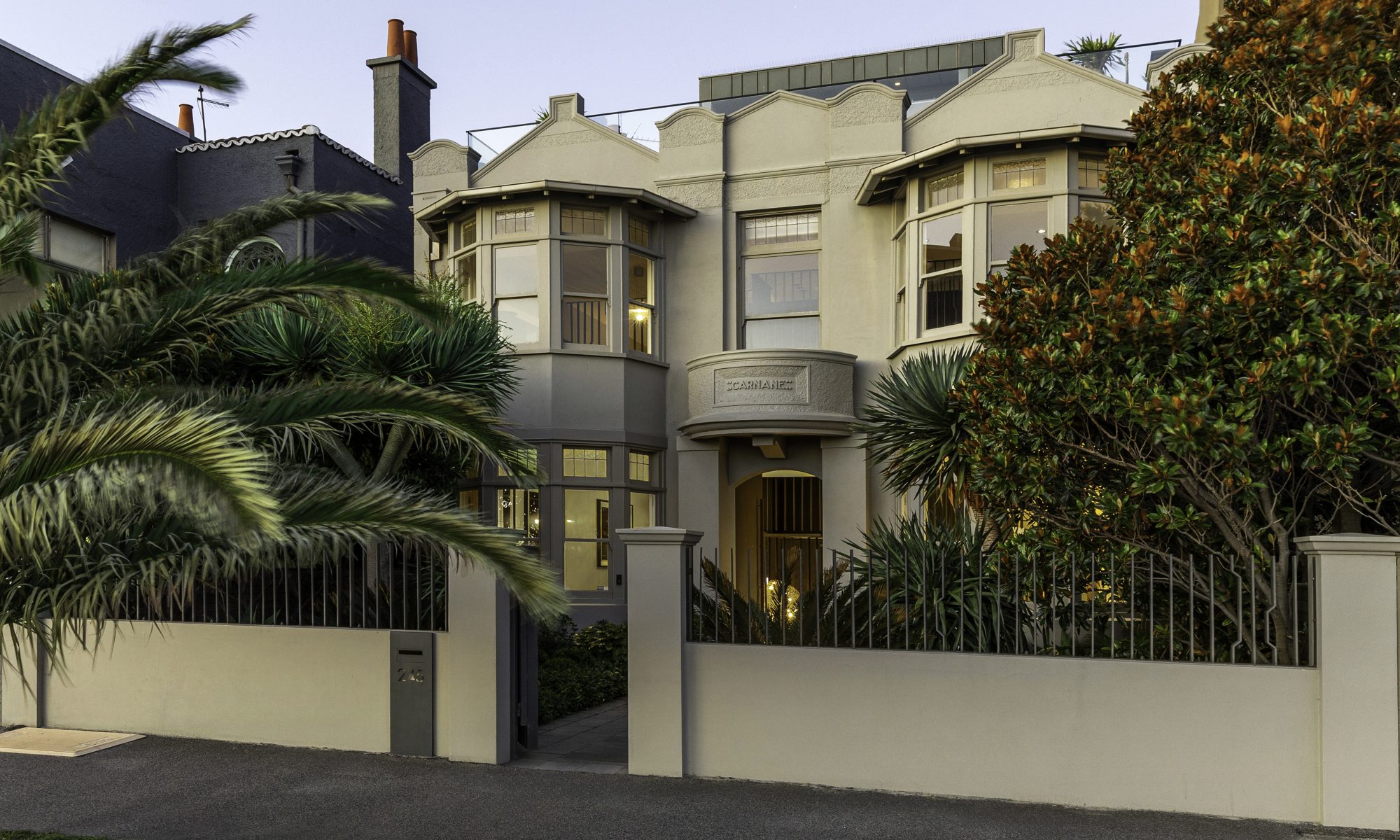
Carnane is an address with the best of both worlds – art deco charm blended with contemporary sophistication.
Originally built around 1915 as four smaller flats, the property has been transformed behind its period facade to reveal a modern designer interior crafted for family living.
Reimagined by Buro Architects and interiors, the five-bedroom, four-bathroom house was shortlisted back in 2008 for an Australian Interior Design Award and subsequently appeared in multiple design magazines.
Last sold in 2005 for $2.32 million, Carnane is now listed with a price guide of $14 million to $15 million. The expressions of interest campaign, via Ben Manolitsas, Melissa Turner, and Thomas Wilson of Marshall White Port Phillip, closes on April 9.
What anchors the historic bayside home in the 21st century is the moody, cantilevered steel staircase set just inside the entry foyer. Sculptural in every sense of the word, the “floating” stairs make a bold statement at first sight and even discreetly conceal a refrigerated wine cellar and bar.
The long 580 sq m footprint and three-story layout allow for a convenient separation between entertainment and accommodation zones. In the shell of the original Art Deco facade, there are two sitting areas framed by deep bay windows.
Beyond the iconic stairs, a gallery walkway leads through to the dining room and show-stopping kitchen. A design statement in itself, the sleek black kitchen has Gaggenau appliances, hidden storage, a grand island bench, a casual meals area, and a vast butler’s pantry with a second entry to cater for any sized soirée.
This ground level has marble floors, Venetian-plastered walls, and full-height glazing, as well as the mammoth rear extension. The stylish addition dishes up another large living room, warmed by an ethanol fireplace, and enormous timber-framed sliding doors that open onto the private north-facing pool deck and lush landscaped gardens.
An internal courtyard offers homeowners a bonus green space, separating the formal and informal dining zones.
Upstairs, there is yet another living area and an adjoining study that mirror the bay windows below and capture sweeping views of the bay. There are two bedrooms with built-ins sharing a palatial family bathroom, as well as the main bedroom with a walk-in Polyform wardrobe, extra built-ins, motorised blinds, and an ensuite with a shower.
One more floor up, a top-level guest or teenager retreat with a bathroom, kitchenette, living area, and a huge water-facing terrace. Additionally, the triple garage, accessed via Ashworth St, has its own fully independent studio.
The Beaconsfield Pde home also has spotted gum floors, a video intercom, an alarm, an integrated sound system, abundant storage, and zoned heating and cooling, all within walking distance of Middle Park village, Albert Park Lake, and city-bound transport.
Carnane at 245 Beaconsfield Pde, Middle Park is listed with a price guide of $14 million to $15 million through Marshall White Port Phillip via an expressions of interest campaign closing on April 9.
Luxury accessories brand MAISON de SABRÉ is welcoming the new season with a whimsical yet meticulously crafted release, unveiling its Spring Harvest Collection.
The global launch introduces a series of collectible SABRÉMOJI Vegetable Charms alongside two new interpretations of the label’s popular Bucket bag silhouette.
Inspired by the changing rhythm of the seasons, the collection reimagines everyday produce as sculptural leather miniatures designed to be attached, stacked and styled.
Crafted entirely from upcycled leather offcuts generated during handbag production, the charms blend playful personalisation with a considered approach to sustainability.
“The new Vegetable Charms reflect our renewed focus on seasonal storytelling – capturing the optimism of spring through an expression of craft,” said Omar Sabré, Co-Founder and Creative Director of MAISON de SABRÉ.
“The SABRÉMOJ platform allows us to push the playful boundaries of our savoir-faire on the smallest and most intricate scale. The charms are contemporary art for your handbag.”
Available in four designs – Carrot, Mushroom, Snap Pea and Chilli – each piece showcases intricate leather marquetry techniques including bombé onlay and underlay panels, hand knotting and detailed tack stitching.
Select styles also feature miniature zipper compartments capable of housing small essentials or even an Apple AirTag, merging decorative craft with everyday practicality.
“For us, vegetables felt like the perfect symbols of the season,” said Sabré.
“They represent growth, abundance and nature – but translating them into leather with this level of detail required incredible craftsmanship from our artisans.”
Complementing the charm launch are two new additions to the brand’s Bucket bag family.
The Mini Bucket Soft Tote offers a petite, fluid interpretation of the original design, crafted from resin-backed full-grain leather and featuring a reinforced base, magnetic closure and detachable strap.
A new dual-tone top handle introduces a fresh design signature while maintaining the relaxed slouch that defines the silhouette.
Meanwhile, the Zipped Bucket Crossbody presents a more structured take on the cult shape.
Designed with a trapezoid profile, full-length brass zipper and crescent silhouette that moulds comfortably to the body, the bag arrives in new seasonal hues intended to complement everyday wardrobes.