Soaring Travel Costs Are Weighing on Even the Wealthiest Vacationers, WSJ Study Shows

Wealthy individuals remain just as interested in travelling as they were last year, but costs have become a larger factor in their plans, according to a Global Travel Study conducted by WSJ Intelligence between June 27-July 19.

Of the 879 Wall Street Journal readers surveyed—who had an average age of 56, were 79% male, and had an average net worth of about US$3.5 million—94% intend to travel for leisure in the next 12 months, down just 1% from 2023. Additionally, 64% plan to travel internationally, up from last year’s 60%.

Travellers are most concerned about costs amid ongoing inflation and other economic challenges, even as 80% of respondents say they plan to increase or maintain their travel spend compared to last year.

The cost of flights and hotels is the top factor of importance for WSJ readers, with 78% concerned about prices, a nine-point increase from 2023.

“Travel is still on the up—our readers are still really enthusiastic,” says Carolyn Romano, associate director of Luxury Lifestyle Intelligence at The Wall Street Journal. “But at the same time, it’s yet another year of market volatility and inflation, so I just think they’re being a little bit more thoughtful about the way that they’re traveling.”

Availability of flights and hotels is the second-biggest issue for travellers, with 76% of readers responding that it is a factor of importance for them.

Notably, as factors of importance, both loyalty programs and discounts and deals are up 10 percentage points year over year. Romano says this increase is “pretty significant.”

“Our reader approaches every purchase as an investment of some sort, and even our reader is still taking all of these factors into consideration,” she says.

Despite rising costs, the post-Covid enthusiasm for travel remains, with 70% of respondents traveling more than they have in the past. Over the next 12 months, WSJ readers’ average anticipated spend on leisure travel is US$18,305, up from last year’s US$18,250.

As for destinations, 86% of respondents are considering traveling to Europe, down just 1% from last year. Italy is the top European country of choice—superseding the U.K.—seeing a 9% annual increase in interest.

Though most destinations, both international and domestic, included in the survey saw similar interest as last year, traveling to Asia is up 10 points from 2023, with 40% of respondents considering booking a trip to the continent. Japan ranks the highest, with 61% of respondents considering traveling there, up 6% from last year.

When making travel plans, 72% of WSJ readers say they go to family and friends for recommendations. Only 13% report consulting a travel agent, though people taking cruises are much more likely to use a travel agent.

Creating An Extended Shelf Life

In an era when every square metre of real estate is worth its weight in gold, something as indulgent as a home library might feel like an anachronism. If we can store thousands of books in our smartphone, why line a room with potential dust collectors?

Despite the technological revolution — or perhaps because of it — the traditional home library space is holding its ground. As work infiltrates our homes and trickles into family life, many homeowners are purposefully carving out a corner of their home in an homage to a low-tech life.

Order prevails in a glass fronted library by Groth & Sons

Reading the room

Award-winning architect Luigi Rosselli says while the pandemic may have brought the office home to the fore, he’s witnessing a revolution against remote working.

“It depends on the client, but I’m mostly seeing two generations interested in libraries. One is the older generation who grew up with books, they still read a lot and like to get up and refer to a book or even feel the ‘microwaves’ from the pages reminding them of these wonderful stories or knowledge that can be passed on through,” he says.

“Then there’s the younger generation who are working long hours in front of a computer or some other electronic device and they are rebelling. They’re reacting to a sort of technology addiction and finding instead an interest in books and reading.”

Smaller footprints, especially in city residences, are notoriously challenging when it comes to storage and function, but Rosselli says libraries needn’t be single-use spaces.

“That’s very much my challenge; people saying they want a room for this, they want a room for that,” he says. “What I’ve done quite a few times is give a dual use to libraries. In fact, books only use up wall space, so in between those walls you can have quite a lot of space leftover.”

In his Bondi Bombora project, Rosselli created a stairwell library to accommodate the resident family’s large — and growing — book collection.

“One storey wouldn’t have been enough. So a stairwell worked ideally in the sense that it now has two functions.

“We also retained an old bay window underneath the stairs to make a study nook that is cocooned and separated from an active house filled with lots of kids.”

For a book-loving calligrapher in Sydney, Rosselli designed The Books House, which resembles a random stack of books from the outside while inside there is a private library hidden behind a moving bookcase.

While a home office and library fusion seems like a perfect match, savvy design and innovative thinking can marry a library to alternative rooms.

“In my house when the children were young they had a library room where the television was not allowed, they could do homework there but also it was a relaxing space with a couch so you could sit and read,” Rosselli says. “Now our children have grown up and moved out we put a table in there.

“It’s ended up being our favourite dining area because it’s in such good company, and the acoustics of books is fantastic.”

A turn up for the books

The Books House by Luigi Rosselli has a moving bookcase.

Whether it’s a limited footprint or a client seeking a hint of James Bond-style intrigue at home, professional cabinet maker Amos Groth of Groth & Sons says libraries are only limited by imagination — and budget.

“It’s a balance of what you’d like in your wildest dreams and what we can give you practically. But we try to really push the boundaries on the aesthetics to get all those bells and whistles,” Groth says, adding that private libraries can cost between $25,000 and $250,000. “A lot of my clients tell me when they go into their libraries and close the door they’re transported to London or Bath or anywhere in the world.

“Libraries offer an element of escapism.”

Over three decades, Groth & Sons has become known as “the bespoke library outfitters” fitting books into almost any space.

“We’ve done libraries in dining rooms, in hallways, as long as you’ve got enough space to get a floor lamp, a library ladder and a comfy chair. It doesn’t have to be an entire room,” Groth says.

“Today, people realise libraries aren’t about showing off a book collection, but are more about what a space represents.

“For me, in my library, I feel like I’m surrounded by my best mates.”

A home library might seem like an old school luxury, but Groth says they have come full circle.

“When I first started, some people thought book-filled rooms were ostentatious but today they can be really practical and fun spaces. It’s about getting away from the stresses and strains of technology to go into a low-tech room for a breath of fresh air,” he says.

Floor-to-ceiling walls of books, secret doors, cabinets on hydraulics and rolling library ladders might seem like the stuff of movies but Groth says fanciful libraries do exist.

“People have the fantasy of a library ladder, it makes them feel like they’re in a film with Audrey Hepburn or Rex Harrison,” he says.

“We often get asked about secret doors — we’re currently working on one where you actually pull a book and the door opens. They’re not the cheapest things, and there’s a lot of behind-the-scenes work because you can’t just put them into a regular doorframe.

“A lot of what we do are one-offs.”

Developing a love of books

A hallway library by Groth & Sons

A challenge for homeowners “rightsizing” to apartments is giving up superfluous living spaces, but developers are taking note of what buyers want, both inside and outside their residences. Along with private dining spaces and fully-equipped wellness spaces, libraries are seen as a desirable option for buyers.

Alceon has answered the call for more communal retreats on site, starting with Akoya in Sydney’s north.

The over-55s project is home to 39 apartments but includes approximately 700sqm of common areas such as a residents-only library to be stocked with 100 books from local bookshop Constant Reader.

“It’s not a tokenistic space, it’s a purpose-built library with a fireplace, a lounging section and plenty of shelving for residents to add more books to,” said Todd Campling, development director at Alceon Group.

“Our goal with the library was to recreate the creature comforts of home for residents who might be relocating from quite substantial family homes.

“There’s also a commercial-grade bar next to the library and personal lock-up wine cellars so people can enjoy a glass while they read.”

Campling adds that as Australians, especially in major cities, move towards multi-density living, it is the developer’s responsibility to create areas where neighbours, friends and family can enjoy social moments.

“Additional amenities aren’t for everyone and they aren’t for every development, it’s about curating spaces that are the perfect blend of what you’ve had — and what you wish you had,” he says.

And as generations age and needs evolve through a building’s lifespan, he says such communal spaces should be adaptable.

“The notion of a library with the Chesterfields lounges and balloons of bourbon could also become multi-generational spaces used by the grandparents down to their grandchildren. We envisage these library spaces or co-working areas can be a place to catch up with your neighbour, sit in a nice quiet space by yourself or hold a book club.”

Photography by Prue Ruscoe

The key drawcard for property buyers in Australia’s capital city markets

Residential property price growth in FY24 was strongest in the lower price brackets of every capital city except Darwin, data from CoreLogic has revealed. Meantime, the mid-tier capital cities of Perth, Brisbane and Adelaide continue to lead the nation in overall value growth. Many home buyers and investors are gravitating toward cheaper suburbs that offer greater affordability due to ongoing price rises and higher interest rates constraining borrowing capacity.

“After recording a higher rate of gain through the early months of the growth cycle, conditions have faded across the upper quartile as borrowing capacity reduced and affordability constraints deflected demand towards middle-and-lower-priced properties,” said CoreLogic research director, Tim Lawless.

Over the past three months, apartment prices have also risen faster than houses in every city bar Darwin and Canberra, indicating more home buyers are compromising on the type of property they buy.

“Most cities now have a median house value that is at least 1.5 times higher than the median unit value,” Mr Lawless said. “With stretched housing affordability, lower borrowing capacity and a lift in both investor and first home buyer activity, it’s not surprising to see the unit sector outperforming for a change.”

REA Group economic analyst Megan Lieu said affordability was “now a key drawcard for buyers”.

“Demand from buyers has been high in the past year due to a number of factors that include strong population growth, increased confidence in the market and scarce rental availability,” Ms Lieu said. “Prices are expected to keep rising in the coming months due to strong demand. However, as housing affordability declines, buyers will likely continue gravitating towards more affordable areas.”

Ms Lieu said REA analysed FY24 search data from its website, realestate.com.au, to identify the ‘affordable’ hot spot suburbs of each capital city. The analysis focused on suburbs with median house and apartment prices below their capital city’s medians, and identified the most popular suburbs based on search volumes.

Here are the results.

Sydney

Sydney’s median house price is $1,407,000. The three most popular affordable suburbs for houses were Blacktown (median $980,000), Campbelltown ($855,000) and Oran Park ($1,080,000).

Sydney’s median apartment price is $775,000. The three most searched affordable suburbs were Blacktown ($530,000), Ryde ($738,000) and Hornsby ($708,000).

Melbourne

Melbourne’s median house price is $870,000. The three most searched affordable suburbs were Frankston ($740,000), Sunbury ($660,000) and Craigieburn ($640,000).

Melbourne’s median apartment price is $605,000. The most popular affordable suburbs in FY24 were Melbourne CBD ($560,000), Richmond ($590,000) and Hawthorn ($584,000).

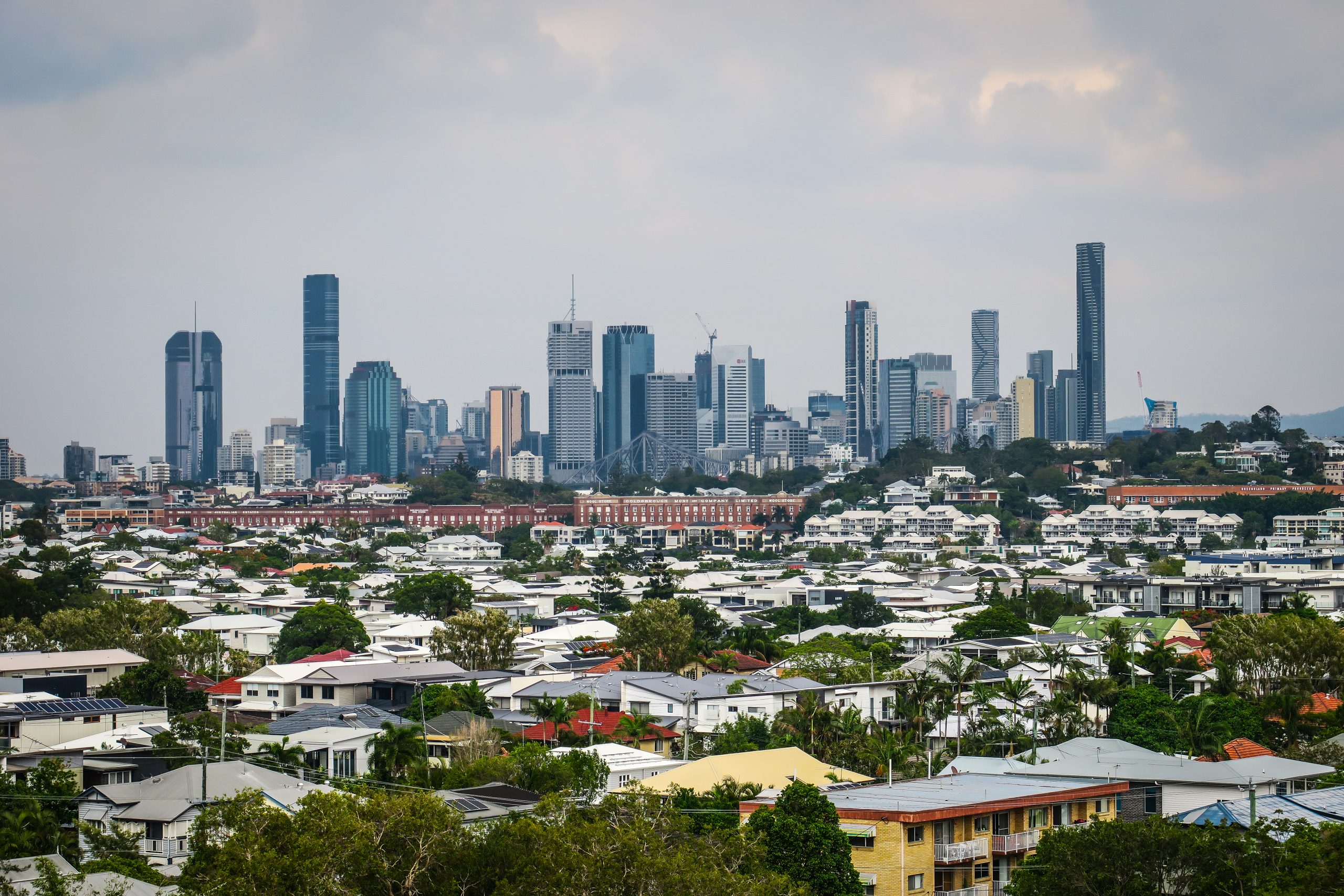
Brisbane

Brisbane’s median house price is $840,000. The most popular affordable suburbs were Redcliffe ($770,000), North Lakes ($809,000) and Narangba ($780,000).

Brisbane’s median unit value is $555,000. The most searched affordable suburbs were Nundah ($535,000), Wilston ($550,000) and Kedron ($535,000).

Brisbane

Adelaide

Adelaide’s median house value is $751,000. The most searched affordable suburbs were Mawson Lakes ($725,000), Modbury ($701,000) and Mount Barker ($661,500).

Adelaide’s median unit price is $501,000. The most popular affordable suburbs were Adelaide CBD ($479,000), West Beach ($495,000) and Mawson Lakes ($440,000).


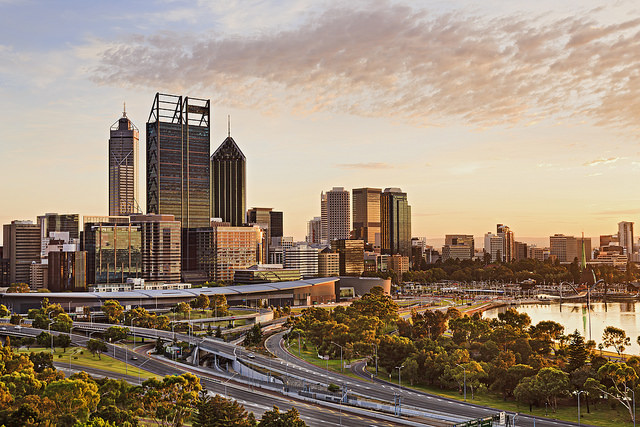
Perth

Perth’s median house price is currently $680,000 and the median unit price is $450,000.

Perth’s median house price is $680,000. The most popular affordable suburbs were Baldivis ($611,000), Rockingham ($610,000) and Morley ($676,000).

Perth’s median unit price is $450,000. The affordable suburbs with the highest search volumes in FY24 were Wembley ($330,000), Mount Lawley ($430,000) and Yokine ($430,000).


Hobart

Hobart’s median house price is $700,000. The most popular affordable suburbs were Geilston Bay ($693,500), Moonah ($610,000) and Glenorchy ($558,000).

Hobart’s median apartment value is $531,000. The most searched affordable suburbs were New Town ($455,000), Glenorchy ($440,000) and Sorell ($507,000).


Darwin  

Darwin’s median house price is $568,000. The most popular affordable suburbs in FY24 were Zuccoli ($530,000), Durack ($550,000) and Wulagi ($528,000).

Darwin’s median unit price is also $568,000. The most searched affordable suburbs were Darwin CBD ($440,000), Nightcliff ($382,000) and Fannie Bay ($502,000).


Canberra

CANBERRA

Canberra’s median house price is $950,000. The most searched affordable suburbs for houses were Kambah ($850,000), Gungahlin ($900,000) and Casey ($815,000).

Canberra’s median unit price is $605,000. The most popular affordable suburbs were Braddon ($582,000), O’Connor ($531,000) and Lyneham ($520,000).

Mariah Carey’s Lavish Beverly Hills Rental up for Sale Asking $32 Million

A Beverly Hills mega mansion that singer Mariah Carey once rented hit the market Monday asking $31.99 million.

The 15,000-square-foot residence, inspired by a mashup of European architectural styles from Baroque to Louis XV, is located on a 0.6-acre lot on Laurel Way. The three-story home includes eight bedrooms, and an entryway that features a 30-foot rotunda and not one, but two imposing double stairways, one outdoors and one indoors.

It was built by a Russian couple who immigrated in the 1970s, and set about building their dream home, much to their neighbours’ consternation . “I used all of what Europe has to offer,” Natalie Glosman, whose husband Leonid is a dentist, told Today.com in 2014.

The Glosmans purchased the land for $2.2 million in 1988 and sold the home in 2019 for $30 million. The buyer was a California entity, BHLW LLC, according to property records. The manager for the entity could not immediately be reached for comment.

Last year, Mariah Carey rented the house for three months in the spring, which was asking for $125,000 in monthly rent at the time. The Queen of Christmas then partnered with Booking.com, which offered visitors a special two-night “ritzy summer reprieve” at the house, with a Carey-curated itinerary, including reservations to her favourite restaurants, according to marketing material from the booking platform.

Mariah Carey rented the Beverly Hills home in a promotion for Booking.com.
Photo by RB/Bauer-Griffin/GC Images

“One of my Lambs has the opportunity to experience L.A. in true Mimi fashion by staying in the same home and visiting all my favourite places in the area!” Carey said in the Booking.com news release at the time . 

The house has some additional Hollywood elan, as it served as filming location on several occasions. Danny DeVito and one of the cast members of the “Real Housewives of Atlanta” have been filmed there, according to Today, and in the second season of “True Detective,” it stood in for the “incredibly gaudy” home of the corrupt and alcoholic mayor Austin Chessani, according to Curbed.

In addition to its grand entryway, the home features arched doorways, French windows, coffered ceilings, wainscotting and Rococo wall mouldings, in a blend of Art Deco and Art Nouveau styles. Outside, there is a broad green lawn with a shaded sitting area, and a back patio with a glamorous pool to match the home’s style.

Alla Furman and David Kramer of Hilton & Hyland/Forbes Global Properties are marketing the property. They were not immediately available for comment.

The Tesla of Italy, Aehra’s Sexy EVs Now Have Names

ByAehra, the company that calls itself “Italy’s first pure EV brand,” has two uncommonly attractive vehicles in the works, the Impeto SUV and the Estasi sedan. The designs were first shown in 2022 and 2023 , then unnamed. Pricing for both vehicles is expected to be in the vicinity of US$170,000.

Aehra has some private resources, but is also awaiting government funding. It has submitted a €1.2 billion (US$1.3 billion) development plan to Italy’s Ministry of Industry (controller of the country’s Automotive Fund) to underwrite construction of a 200,000-square-metre plant, which it plans to build at Mosciano Sant’Angelo, in the Abruzzo region of eastern Italy. Aehra says it will create 540 jobs in the region, and 110 more at its headquarters in Milan.

The Estasi with its doors open
Courtesy of Aehra

Hazim Nada, Aehra’s U.S.-born but Italy-raised CEO and founder, tells Penta he expects the Automotive Fund to be capitalised with €2.5 billion next year.

“The government is quite enthusiastic about this project, and we don’t see anyone else with significant production plans,” he says, adding that automotive start-ups are thin on the ground “in Europe, not just in Italy.”

Nada says the company had originally planned to build its cars via an existing contract manufacturer such as Magna Steyr in Austria, but he says finding a plant that could handle the special carbon-fibre process Aehra plans to use proved difficult. “It’s been a busy year, focusing on the location for our assembly line,” he says. “I hope to move soon to working on consolidating our dealer network and sales process.”

The company likes Abruzzo because it’s not only the centre of Italy’s lightweight carbon-fibre industry, but also a hive of EV expertise at the University of L’Aquila. As its plans changed, Aehra has had to push back its start date. Nada says the company aims to be through the building-permit process by the end of the year or early 2025, then start construction of the plant—a 1.5- to two-year process.

A rendering of the Aehra Estasi interior.
Courtesy of Aehra

Cars should start issuing from the plant in 2027, Nada says. The plan is to eventually scale up to 50,000 vehicles annually. He says Aehra does not intend to produce anything but battery EVs.

“Our focus is to build cars you can’t create with a thermal engine,” he says. “That’s our core. We couldn’t achieve the same results with hybrids.”

The designer of the cars was Filippo Perini, a veteran of Audi and Lamborghini. The cars are certainly beautiful, and closely related in their very streamlined designs. Nada says “the platforms are identical below the beltline.” The vehicles have frameless upward-opening doors (the company calls them Dihedral Facing Doors) that leave a large opening and ease entry and exit. The target is for them to have a very low coefficient of drag, 0.21, which means they should slip easily through the air.

Aehra’s modified styling for its Impeto SUV.
Courtesy of Aehra.

The announced statistics are impressive, with a 500-mile range (close to certain versions of the Lucid Air) via 120-kilowatt-hour Miba Battery Systems packs and a top speed of around 165 miles per hour from the 800-horsepower powertrain. Zero to 62 miles per hour should take less than three seconds in the Estasi sedan, aided by a target curb weight of around 4,850 pounds (low for an EV with that size battery pack). A 10% to 80% fast charge should take 15 minutes.

Like the aforementioned Lucid, the Aehras are intended to be roomy inside. The SUV “will effortlessly accommodate four full-size National Basketball Association players while leaving room for a 6-foot adult in the middle of the rear-seat row,” the company says.

Aehra is targeting North America, Europe, and the Gulf States as markets for its cars. Nada thinks the Impeto SUV might have a sales edge.

“The SUV is easiest in the current market, but we expect to see some surprises with the sedan,” he says.

Is This 1987 All Over Again? What’s Driving the Market Meltdown?

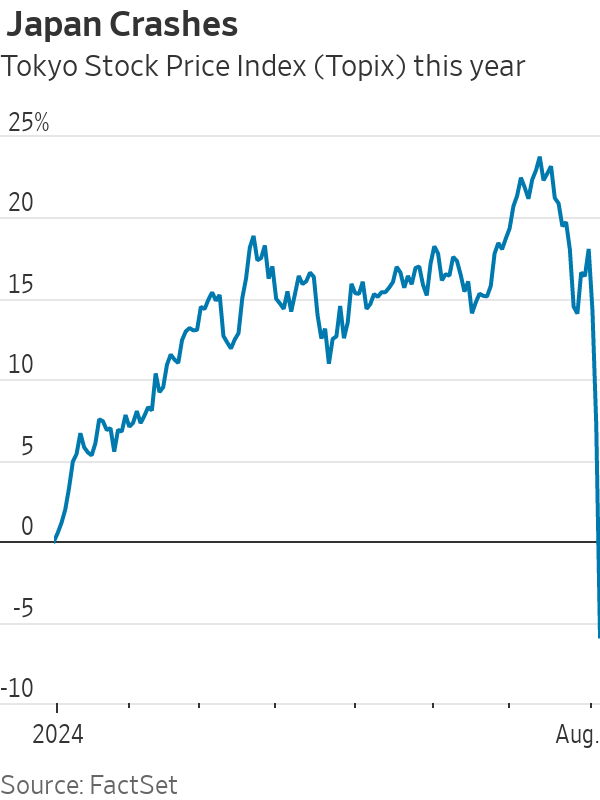
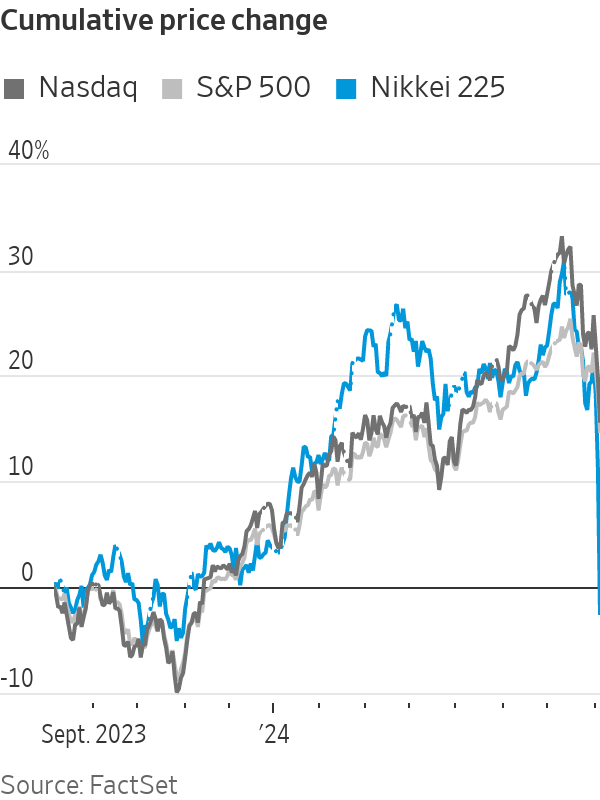
Financial markets are supposed to capture the wisdom of the crowd, but on Monday the crowd ran in all directions waving its hands in the air screaming. Japan’s stock market fell the most in 37 years with a 12% plunge that wiped out all its gains for the year, while in the U.S. the VIX index of implied stock volatility briefly had its biggest rise ever. Panic hit.

The selloff was triggered by Friday’s jobs data prompting a sudden switch in the economic narrative from soft landing to hard landing. Add to the mix a period of deflating hype about artificial intelligence and a Bank of Japan rate rise designed to strengthen the yen. News that Warren Buffett’s Berkshire Hathaway had sold half its Apple shares and boosted its cash pile added to the pain.

But the triggers couldn’t possibly justify the scale of the moves. When a new trigger arrived, in the form of better-than-expected data on the service sector, markets partially rebounded and the Vix fell sharply — again, far more than the data could justify.

The selloff—which at one point had chip maker Nvidia down 15%—was so big because investors had been all-in betting that things would work out well. Now things have calmed a bit, the question is whether the unwind of these bets, and the leverage behind them, is done. If it resumes, will the selloff feed back into higher savings and a weaker economy or, worse, hit the financial system?

The extreme examples of past effects from big market falls are 1987’s crash, 1998’s Long-Term Capital Management blowup and 2008’s global financial crisis. History is never perfect, but so far this looks more like a (much milder) version of 1987 than it does the other two.

In 1987, the stock market had its biggest one-day fall ever, with the S&P 500 down more than 20% on Black Monday in October. Investors had built up excessive leverage after a stunning 39% gain in the year to August’s high, and the crash led both to big margin calls and to badly designed automated trading that exacerbated the selling. But the Federal Reserve poured liquidity into the banks, brokers didn’t default and the market made back all its losses within two years. The economy was fine.

The good news was that 1987 was all about markets: They went up, they went back down, no one else was hurt. The S&P made 36% in the eight months to its August 1987 peak, similar to the 33% it rose in the eight months to the end of June this year. As in 1987, this year’s gains came in spite of tight monetary policy and higher bond yields. Just like today, in 1987 investors were on edge and ready to sell to lock in the unexpected profit. The losses are smaller so far, but lucrative trades have reversed , just as they did for the market as a whole in 1987.

In 1998, the situation was much worse, although stocks recovered more quickly. Highly levered hedge fund LTCM was crushed when Russia’s domestic debt default created a flight to safety. LTCM was big enough that it threatened to bring down Wall Street institutions. The Fed cut rates three times and pulled together a group of banks to rescue the firm and wind down its trades slowly. Stocks took just four months to recover, but the easy money helped stoke the dotcom bubble, which popped two years later and led to a mild recession—and gigantic losses for investors in tech stocks.

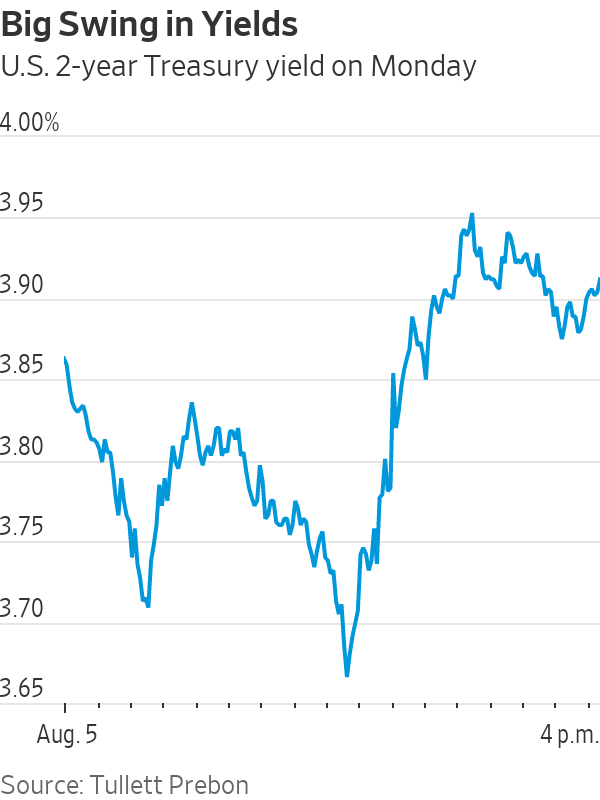
We don’t know yet if any hedge funds have been taken out by the big moves in markets, which have brought heavy losses for those engaged in the “ carry trade ” of borrowing cheaply in yen and buying higher-yielding currencies such as the Mexican peso or dollar. Large swings in Treasurys on Monday might also have hurt, given the large positions hedge funds hold. Traders are betting that the Fed will slash rates, with a super-sized cut of 0.5 percentage points priced into futures for the September meeting (and far more earlier in the day).

The really bad outcome would be a repeat of 2008, but it seems highly unlikely. True, some large U.S. banks failed last year, due to bad bets on government bonds. But banks are much less leveraged than they were, and the system is less exposed to a liquidity crisis, as private lenders have taken on much of the risk that used to sit in banks. Big losses are entirely possible, and private funds could hit trouble, but that would take time and wouldn’t create the same system-wide crisis.

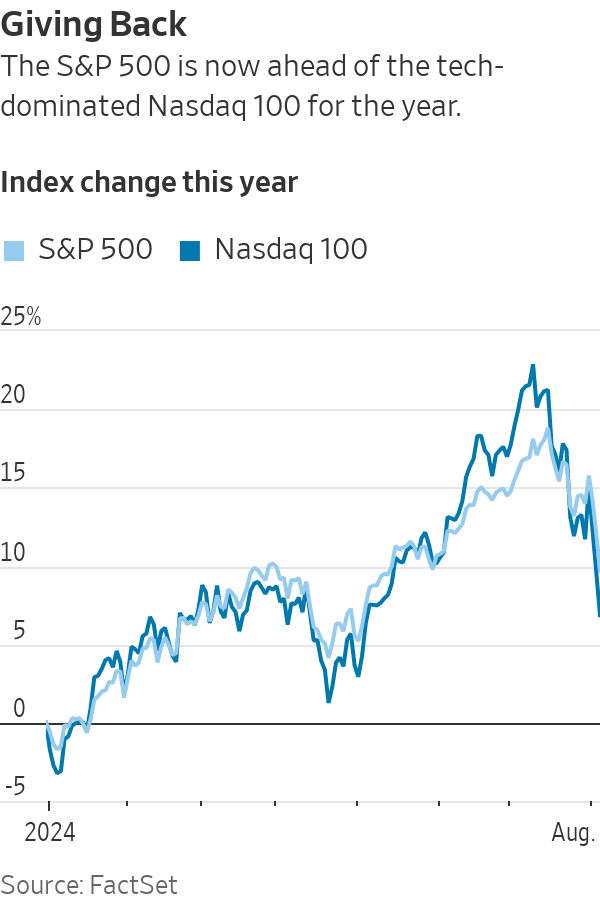
The ideal would be that excess in the stock market unwinds as in 1987 without creating wider trouble, hopefully more gradually than in 1987. AI enthusiasm could deflate stock prices much more—even after falling 30% from its June high, Nvidia has still doubled in price this year. But the market is already much closer to normal, with Monday’s falls leaving the Nasdaq 100 index up only 6% this year, and the S&P 7%.

If panic continues to abate, the Fed cuts and nothing breaks in the financial system, we should count ourselves lucky. But it would be good if investors could remember the sinking feeling they had on Monday morning, and try to be a bit wiser and less speculative.

Beyond the Suite Life. Total Hotel Buyouts Are Growing in Popularity.

Group travel has taken on new meaning for some wealthy consumers, who increasingly are taking over entire hotels.

In an experience-obsessed era, those who can are going beyond just a stay at a five-star hotel to having it all to themselves alongside family and friends. Luxury travel advisors report an uptick among their deep-pocketed clients who book accommodations in their entirety for both large and small groups.

Andrew Steinberg, an advisor with the Ovation Network in New York City, says that his buyout business is up 50% this year compared with 2023.

“From a dozen, I have more than double now. The prices for these weekend stays can start at US$500,000 and easily top US$1 million,” he says. “People love them because they can manage every aspect of the experience and extend their event.”

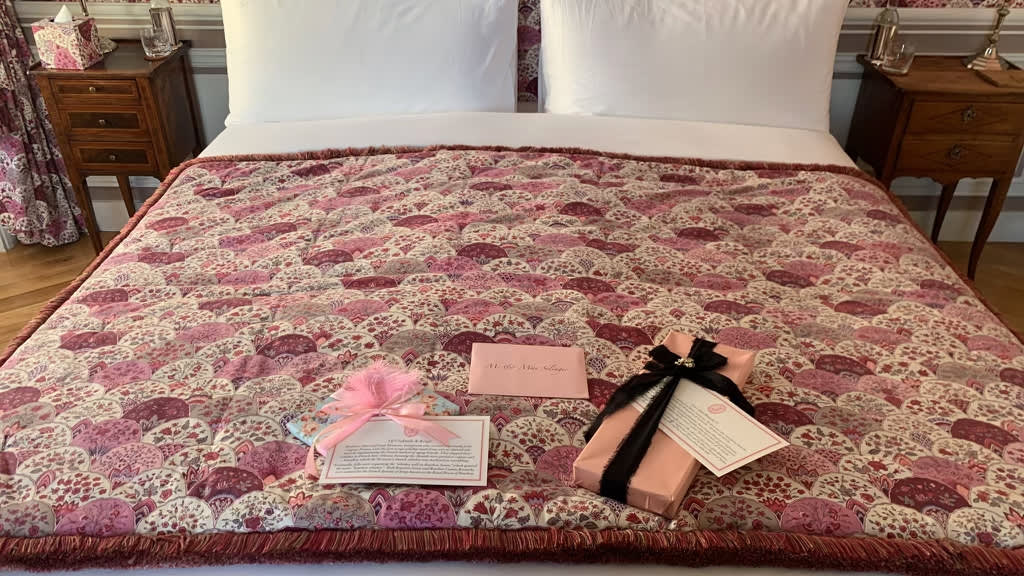
As an example, Steinberg planned a lavish 50th birthday last year in Versailles, France, for a client who took over Airelles Château de Versailles, Le Grande Controle, located on the grounds of Versailles, for a weekend. The extravaganza cost well into the seven figures, he says, and included elements such as a scavenger hunt on the palace grounds and a five-course dinner party prepared by the renowned chef Alain Ducasse, where guests donned 17th-century costumes provided by the host.

Entertainment included fire breathers and Cirque du Soleil-style dancers. Steinberg notes that guests also received a different gift each day such as silk scarves and pricey wines. “By having the property to ourselves, we were able to manage every touchpoint,” Steinberg says. “We had napkins for every meal with the host’s initial and amenities such as a personalised cookie station.”

Andrew Steinberg, an advisor with the Ovation Network in New York City, says that his buyout business is up 50% this year compared with 2023.
Andrew Steinberg

Stacy Fischer-Rosenthal, the president of the New York-based Fischer Travel, which charges a US$150,000 membership fee, is also planning more buyouts than ever before for occasions such as weddings, birthdays, and “just because” get-togethers.

“Takeovers offer complete privacy, safety, and flexibility. The client does not have to adhere to a set schedule and can make theirs up as they go along,” Fischer-Rosenthal says. “There is a dedicated team catering to all of their wants and needs.”

The membership-based travel company Andrew Harper is another brand that has seen a jump in buyouts. Colin Housley, vice president of member experience, says the increase in demand led the company to launch an initiative called Exclusive Experiences, which focus on immersive and private trips such as luxury hotel buyouts and private island stays.

“Our members who plan these trips receive access to unique activities and excursions that we have negotiated with our partners,” Housley says. “We also leverage our relationships to make buyouts happen for properties that normally wouldn’t offer it.”

Andrew Harper has seen a “flood of requests” for private stays since Exclusive Experiences launched, he says.

Steinberg planned a lavish 50th birthday last year in Versailles, France, for a client. The extravaganza cost well into the seven figures, he says,
Andrew Steinberg

Meanwhile, another New York-based travel company Black Tomato had a client who bought out Aman Venice to throw a US$1 million party for his wife’s 50th birthday.

“We arranged performances by opera singers, an orchestra, and a rock band, and the celebration ended with a treasure hunt on the rooftop of the Gritti Palace in the penthouse suite,” says Black Tomato travel expert Sunil Metcalfe , who also notes the uptick in such buyouts.

In addition to travel companies, representatives from several upscale hotels, including the Ranch at Rock Creek in Philipsburg, Mont., and Cal-a-Vie Health Spa in Vista, Calif., say that takeovers of their properties are on the rise. Many, particularly smaller hotels, offer buyout-specific packages.

Cali Mykonos, located on the namesake island’s Kalafati Beach, has created a package for a cost of between US$57,000 and US$75,000 that allows guests to book its 40 villas, each with a pool and large terrace, and enjoy amenities such as the large main pool, yoga classes, boat fleet, beach and restaurants exclusively with others in their group.

Sir Richard Branson ’s Necker Island in the British Virgin Islands has a buyout package starting at US$118,500 a night for 24 rooms that’s consistently booked throughout the year, according to a property representative. The rate includes meals and most activities, such as water skiing, snorkelling, and pickleball.

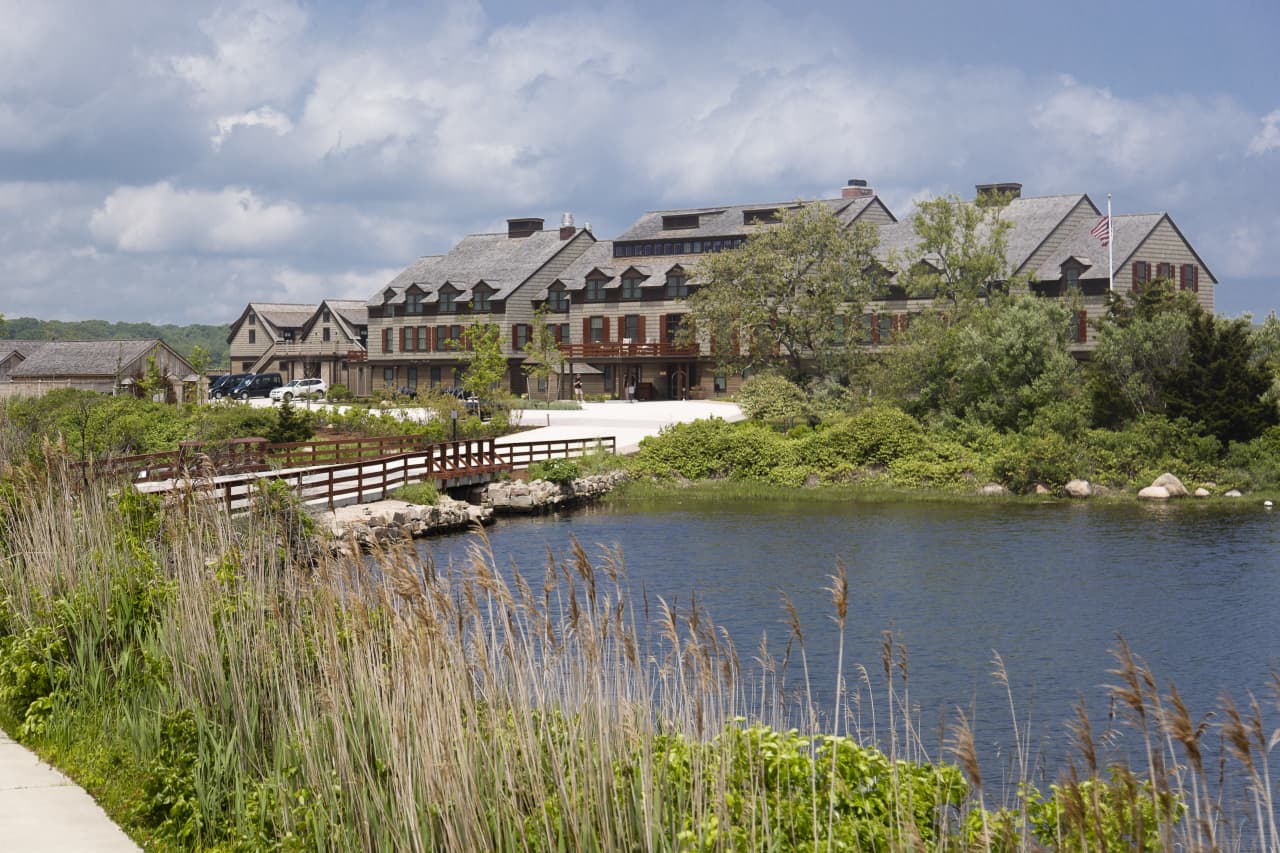
Weekapaug Inn, located in Westerly, R.I., introduced a buyout experience to commemorate its 125th anniversary this year. Called the Milestone Getaway, it encompasses the use of the hotel’s 33 rooms for two nights, meals and activities; the price is US$125,000.

Tom Parisi, an investment banker, and Adriana Destefanis, an asset manager, who live in Darien, Conn., bought out Weekapaug Inn for their wedding last October.

In addition to the wedding events, the couple’s more than 150 guests stayed busy by participating in diversions such as bike riding, birdwatching, stargazing, and s’mores by the fire pit.

“Having a private element is very unique in our view,” Parisi says. “We felt like we were in our own massive house and able to spend quality time with our family and friends. And we could be loud without worrying about other guests. We didn’t want to just have a wedding. We wanted an experience, and the buyout gave us that.”

RBA Board keeps interest rates on hold again as high inflation digs in

In a widely predicted move, the Reserve Bank of Australia board decided to keep rates on hold at its meeting this afternoon.

In a statement, the board said the cash rate will remain at 4.35 percent, while the interest paid on exchnage settlement balances will also be unchanged at 4.25 percent.

The RBA noted that while inflation has fallen since its peak in 2022, the rate of inflation is still outside the board’s target range of between 2 and 3 percent.

“In underlying terms, as represented by the trimmed mean, the CPI rose by 3.9 percent over the year to the June quarter, broadly as forecast in the May Statement ob Monetary Policy,” the board said. “But the latest numbers also demonstrate that inflation is proving persistent.”

Noting that the economic outlook is uncertain and the road to a more manageable rate of inflation is slow and bumpy, the RBA board now predicts that the 2 to 3 percent rate is more likely to take at least another 12 months. The board has repeatedly stated its resolve to bring inflation to heel since it hit a high of 7.8 percent in December 2022.

“This represents a slightly slower return to market than forecast in May, based on estimates that the gap between aggregate demand and supply in the economy is larger than previously thought,” the board said. “In part, this reflects an increase in the forecast for domestic demand. But it also reflects a judgement that the economy’s capacity to meet that demand is somewhat weaker than previously thought, evidenced by the persistence of inflation and ongoing strength in the labour market.”

Research director at CoreLogic Asia Pacific, Tim Lawless, said the decision was unlikely to impact housing demand.

“Although a stable interest rate decision is seen as a positive for borrowers and housing more broadly, we aren’t expecting today’s outcome will have a material influence on housing trends,” Mr Lawless said.  “While stable rates and lower inflation should help to lift consumer sentiment, which has historically shown a close relationship with property sales, the August hold decision may not be enough to see that rise in consumer sentiment flow through to housing market activity.
“Recent growth in property prices has had more to do with low supply, tight rental conditions and demographic factors than sentiment through the housing upswing to date.”
He pointed out that other factors, including ongoing problems with housing affordability and slowing migration were more likely influencing easing property prices.
“Even if sentiment lifts, an improvement in affordability barriers or strengthening in household balance sheets isn’t likely until interest rates start to fall,” he said.
The RBA board is expected to meeting again in six week’s time.


Christie’s to Host Auction in Support of Ocean Health With Works Donated by More Than 20 Leading Artists

Christie’s is partnering with U.K.-based ocean protection charity Blue Marine Foundation to raise funds through a sale of works by  leading contemporary artists during an October week of major London sales.

“Blue: Art for the Ocean” will include works from more than 20 artists, including Serbian performance artist Marina Abramović, Japanese painter Yoshitomo Nara, English artist Lydia Blakeley, English potter and author Edmund de Waal, and German painter Jonas Burgert.

Christie’s announced the first three pieces to be auctioned, including a photograph of Abramović from a May 2024 filming of a separate project that shows the artist on the shores of Fire Island, N.Y.

“My Performance for the Oceans artwork for the auction blends my artistic vision with environmental consciousness,” Abramović said in a news release. The image is one of three from the film that Christie’s will sell for between £50,000 and £70,000 (US$64,012 and US$89,617), according to Blue Marine, citing the Sunday Times of London.

The other two pieces are an underwater painting by Blakeley titled The Hunters and an illustration by Nara titled Walk On .

The foundation works toward ocean health by putting a spotlight on overfishing and efforts to protect critical marine ecosystems around the world.

Christie’s expects to announce a full lineup of lots and price estimates in the coming weeks, according to a company spokesperson. The auction will be held during Christie’s annual Frieze Week sales of 20th- and 21st-century art.

Stocks Are Crashing—That’s a Great Reason to Sit Tight

The red numbers in your 401(k) today might appear to vindicate warnings about an artificial-intelligence bubble and infirm economy. But don’t tilt your portfolio toward full pessimism just yet.

The S&P 500 was down 3% Monday, with the Nasdaq falling even further. Investors have been selling the year’s best performers, concerned that disappointing second-quarter results from big technology companies such as Alphabet , Tesla and Intel are a sign that the AI frenzy is a fad. Also, consumer discretionary stocks have become the worst-performing sector in the S&P 500, as lacklustre labour-market reports have raised worries that the Federal Reserve made a mistake by waiting until September to cut interest rates.

Overseas, the Stoxx Europe 600 closed almost 5% below where it was a week ago, whereas the Swiss franc, a common haven asset, is up roughly 4%. The most eye-popping moves happened in Asia, though, where the Nikkei 225 plunged 12.4% Monday in the worst trading session since Oct. 20, 1987—the day that followed Wall Street’s infamous Black Monday.

Yet it is precisely the breakneck speed with which Japanese equities tumbled that should give most investors a reason to remain calm.

As a guideline, sudden market selloffs are less dangerous than those that unfold progressively over time. This is because investors who rationally price in bad economic data often do so slowly, as it trickles in. Flash crashes, conversely, are often a sign that some tidbit of bad news made speculative bets go awry, triggering a cascade of trades, many of them automated.

Japan is particularly prone to such reversals because interest rates there are so low that many investors use them to fund higher-yielding investments in other currencies. Whenever markets get jittery, these “carry trades” tend to unravel, pushing up the yen and hitting Japanese stocks, many of which are diversified exporters that do better when global growth accelerates. Amplifying this tendency, Japanese stocks had this year become extremely popular among global investors.

The timing of the rout also points a finger at the Bank of Japan , which last week decided to tighten monetary policy for the first time in 17 years with the explicit goal of boosting the yen. Investors who rushed to cover their bets then triggered the reversal of stretched trades elsewhere, including in the U.S.

One of the most striking features of the S&P 500 for most of this year has been its extremely low volatility. Until July, the Cboe Volatility Index, or VIX, was at 2019 levels, and kept sliding lower even as investors made big changes to their monetary-policy forecasts.

While the VIX is often dubbed Wall Street’s “fear gauge,” the options contracts it is based on often themselves influence volatility. Whenever investors make bets against market swings, as they have recently in the U.S. by buying lots of structured products , the banks that sell those options are forced to take the other side. These hedges then suppress volatility in the stock market.

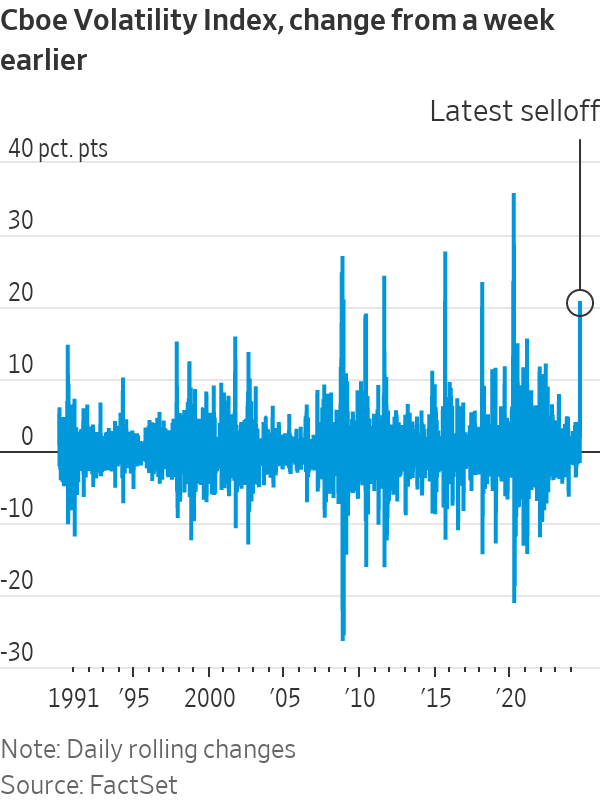
The flip side is that whenever a panic breaks through this feedback loop, volatility skyrockets. As the stock market opened Monday, the VIX hovered above 50, making it the highest weekly jump since the onset of the pandemic, though it later fell below 40.

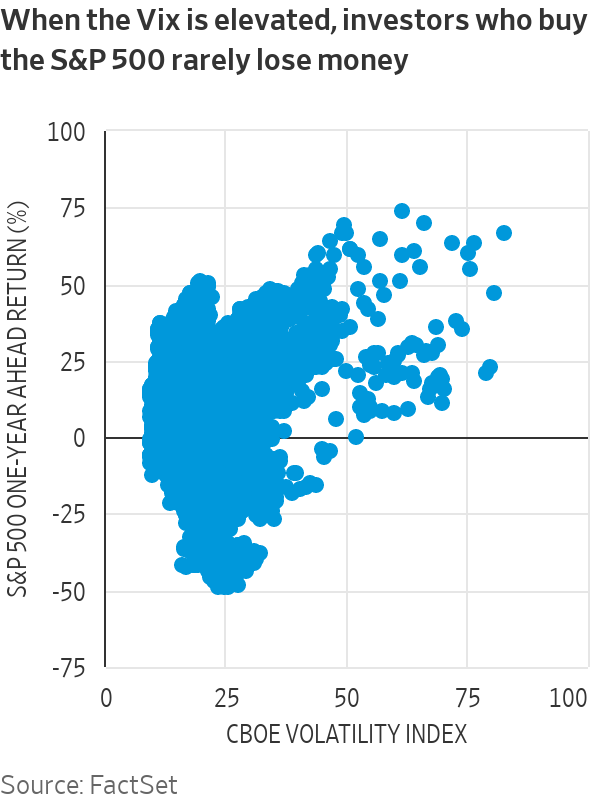
This suggests the selloff is disproportionate, especially looking at the historical record: 87% of the time, investors who bought the S&P 500 on days when the VIX closed at 30 or higher ended up making money a year later.

The second-quarter reporting season has brought mostly good news, with 78% of the S&P 500 firms that have reported so far beating analysts’ earnings estimates—compared with a 74% 10-year average. Both AI-related companies and the rest are reporting net income above what was forecast a month ago. Overall, the U.S. economy still looks robust: The unemployment rate has gone up because the labor force has expanded.

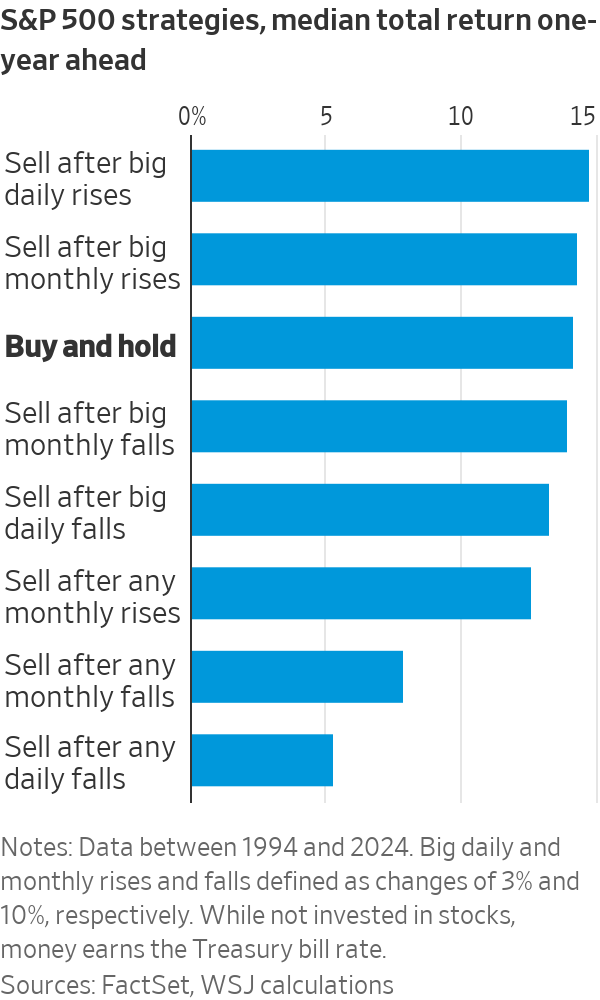
Also, looking at S&P 500 returns since 1994 shows that selling based on the previous day’s falls is a bad strategy. Electing to move into cash after large monthly declines fared better, but still less well than sitting tight.

This isn’t to say that concerns about an economic slowdown or high tech valuations aren’t warranted. Investors have reasons to diversify away from the AI trend or swap more cyclically exposed stocks for more “defensive” names. Indeed, selling out of stocks after particularly exuberant days and months has historically tended to be a winning move. But hindsight is a terrible guide to investing your savings.

The growing impact of Australia’s evolving ‘grandparent economy’

Baby boomers make up just 21 percent of the population but hold almost half of the nation’s private wealth, creating a ‘grandparent economy’. McCrindle Research said the trend indicated it would have a significant influence in today’s society and directly contribute to the financial wellbeing of younger generations.

The impact of baby boomer wealth is routinely seen in the property market, with boomers often observed at auctions standing side-by-side with their younger relatives as they bid for a potential new home. The Bank of Mum and Dad is likely a significant contributor to above-average first-homebuyer activity in a market with rising values and interest rates at their highest point in 13 years.

CoreLogic recently cited figures from the Australian Bureau of Statistics showing first home buyers comprise 28.7 percent of new owner-occupier finance, well above the decade average of 24.6 percent. One might assume that over the year to May 31, when the median national home value rose 8.3 percent and the official interest rate went another 0.5 percent higher, first home buyers’ budgets and borrowing capacity may have been squeezed. Instead, the value of their loans rose by 10.1 percent.

McCrindle says: “Baby Boomers … are having significant impacts in the economic landscape, showcasing their pivotal role in wealth transfers as they actively contribute to and shape the financial dynamics over the years ahead. Over the next two decades, we anticipate that $6.2 trillion of wealth will be transferred to younger generations. As a result, the grandparent economy is rising, facilitating wealth and contributing to the financial wellbeing of younger generations.”

In a survey published last year, McCrindle found grandparents were acutely aware of their younger relatives’ financial challenges. When asked about their greatest concerns for them, 77 percent cited the rising cost of living and 72 percent nominated the rising cost of buying a home. These concerns are influencing baby boomers’ own financial decisions, with 32 percent intending to pass on more than 50 percent of their wealth directly to their grandchildren.

A recent report published by Colonial First State found three in four Australians plan to set aside a portion of their superannuation to pass on as an inheritance. Another survey by financial advisory company Findex found providing for relatives was a key motivator for 29 percent of investors.

McCrindle says: “As the current generation of grandparents continue to live longer and remain active well into their later years, their investments in properties and superannuation funds become pivotal components of the broader economic landscape. This trend signifies a notable shift in the traditional roles of grandparents, who are now not just recipients of support but active participants and contributors to the evolving economic dynamics, embodying the essence of the new investor in the financial landscape in the years to come.”

McCrindle Research shows two in five young Australians have received assistance from their grandparents. Most of that help is financial, including inheritances, living with them rent free, or paying cheap board, and getting help with everyday bills.

Blueprint for living: Juliet Roseville by Hyecorp

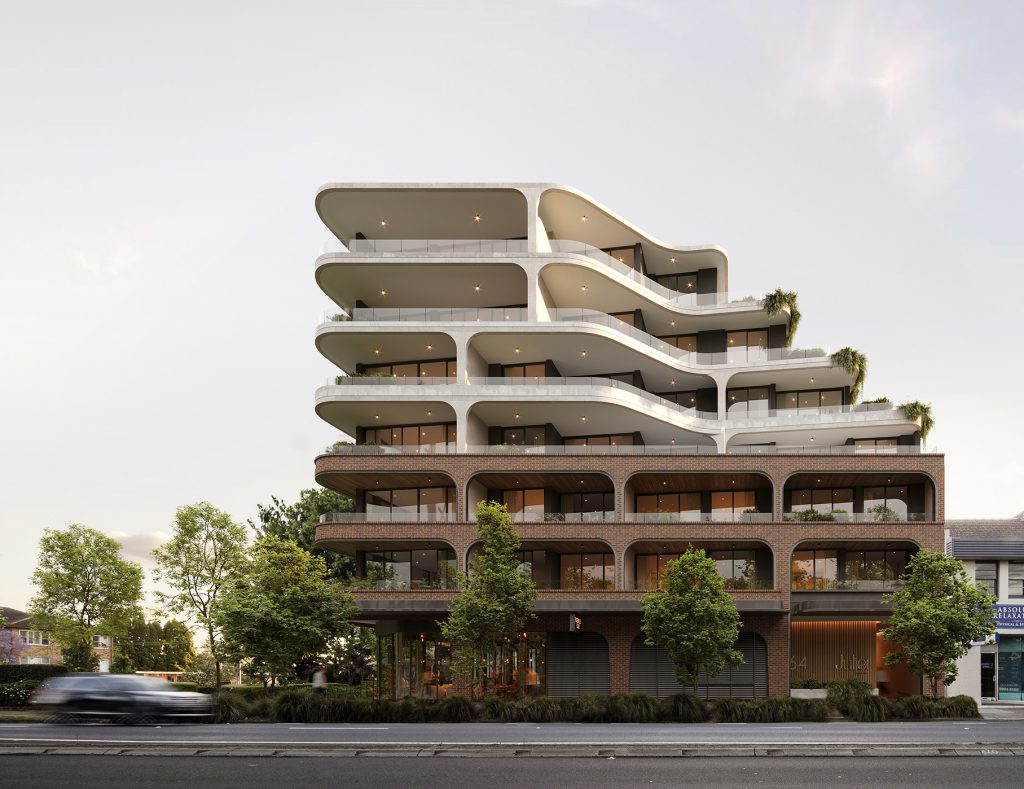
If there was a blueprint for how to do medium density housing in our major cities, Juliet Roseville could well be it. Located on Sydney’s Upper North Shore, close to some of the state’s most prestigious schools including Knox Grammar, Roseville College, Ravenswood Girls’ School and Pymble Ladies College, the residences are ideally positioned to encourage walking and public transport use while creating an enviable lifestyle of calm, comfort and relaxation.

Constructed above the reinvented Roseville Memorial Club — which itself is set to become a local architectural landmark — Juliet Roseville has been offered by award-winning, family owned developer Hyecorp which has been delivering homes in Sydney for more than 25 years.

With just 35 apartments over seven levels, the house-like spaces at Juliet provide the amenity traditionally associated with on-ground accommodation but with all the convenience of en plein air living. Light-filled interiors are complemented by spacious balconies which effectively double the available living space.

With one, two, three and four-bedroom apartments available, the boutique development is ideal for professional couples, families, downsizers and investors alike.

Central to Hyecorp’s interior design approach is the “Live Your Way” service, which allows prospective owners to customise their apartments to reflect their individual style. The bespoke service includes a studio appointment with an interior designer and the choice of two colour schemes for each apartment. For those with very discerning tastes, the bespoke upgrade packages offer buyers the chance to work with an interior designer to choose window coverings, lighting, underfloor bathroom heating and more.

Beyond the interiors, services at Juliet Roseville reflect the very best of contemporary living, with provision for everything from parcel lockers and dog washing bays to EV charging and car washing stations.

In keeping with its sustainability ethos, Juliet also enjoys an average NatHERS energy throughout the building.

While there is ample parking available, the site is conveniently placed near Roseville Village shops, just two minutes away, with Westfield Chatswood and The Concourse Chatswood less than 10 minutes down the road.

Families will enjoy the local parks and recreational facilities including Lane Cove National Park, Roseville Golf Club and Roseville Park Tennis Courts, while three of the city’s best hospitals are less than 20 minutes away.

From the sparkling new amenities to the well-serviced leafy surrounds, it’s hard to think of a better place to start your new life.

Expected completion date: 2026

…

Contact Juliet Sales Team
George Benlian – 0411 809 503
Mariza Federico – 0418 250 536
For more information, visit www.julietroseville.com.au
In partnership with Hyecorp

Can Innovation Curb AI’s Hunger for Power?

Artificial intelligence is known for its seemingly insatiable appetite for energy. But some tech leaders and analysts are questioning the extent of AI’s footprint going forward, saying innovations in the sector could help offset rising energy demand.

There is certainly no shortage of forecasts detailing the ominous rise in AI’s energy consumption. One commonly-cited report by Climate Action against Disinformation, an association of environmental groups, suggests that AI could drive up global emissions by 80%.

Another estimate by researcher Alex de Vries—which he described as a worst-case scenario—suggests that Google’s AI alone could eventually rack up as much annual electricity demand as the country of Ireland.

Such predictions present a substantial challenge for the relationship between computing and the climate in the coming years.

However, others see reason for optimism. In a Salesforce survey of about 500 corporate sustainability professionals, published Wednesday, nearly half were concerned about AI’s potential negative impacts on sustainability efforts. Meanwhile, almost 60% thought the benefits of AI would offset its risks in addressing the climate crisis.

Microsoft founder  Bill Gates recently weighed in on the subject, urging governments not to go “overboard” on concerns about AI’s energy footprint, and suggesting that the technology  could actually drive a reduction in global energy demands.

Putting the AI boom in context

The rise of AI should be considered in a broader perspective, according to Charles Boakye, U.S. sustainability analyst at Jefferies. He noted that relative to other industries, the technology still makes up only a fraction of global power demands.

“Data centers—the engines powering everything from AI to traditional computing to cryptocurrency—currently account for about 2% of global electricity consumption. Of this, AI accounts for roughly 0.5%,” Boakye said.
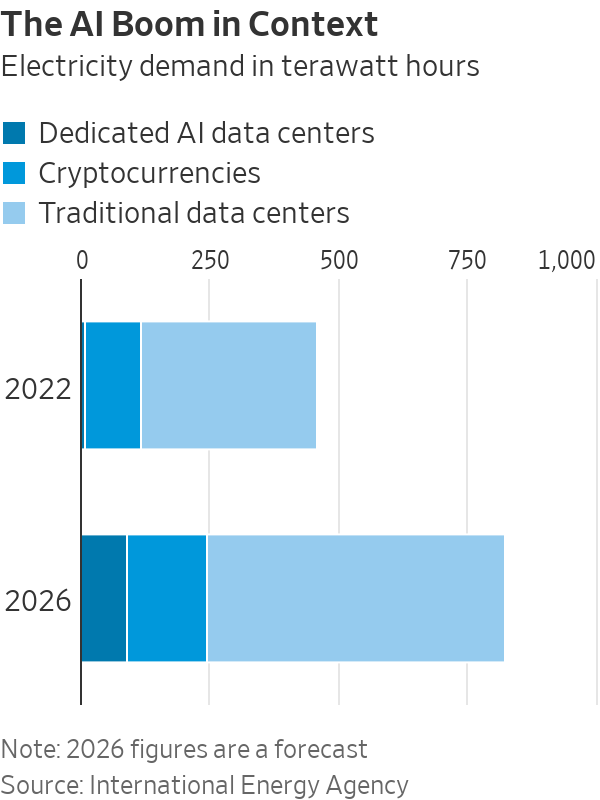
In terms of emissions, statistics last year from the International Energy Agency showed in total, data centers and transmission networks are responsible for 1% of energy-related greenhouse gases. For comparison, the oil-and-gas industry contributed just under 15% of emissions in 2022.

Looking ahead, the intergovernmental organisation said that by 2026, demand for AI is expected to increase ten fold compared with 2023. Even so, IEA data showed that it will still only account for roughly an eighth of total data-center electricity consumption.

“So in terms of AI demand, we’re talking about a small piece of a small piece,” Boakye said, noting that other areas of electrification, such as electric mobility, traditional data center growth and the industrial transition, will ask much greater questions of the power sector.

Charting efficiency trends 

Demand is difficult to predict. But recent trends show that in practice, a rise in demand for computing power rarely correlates one for one with a rise in energy consumption, according to climate researcher Jonathan Koomey.

“Between 2010 and 2018, global data centres saw a 550% increase in compute instances and a 2,500% increase in storage capacity. This compares with just a 6% rise in electricity use,” he said.

Koomey, previously a visiting professor at Stanford, Yale and Berkeley, is best known for his work studying long-term trends in the energy-efficiency—now known as Koomey’s Law—highlighting the propensity of computing technologies to become more efficient over time.

AI may be a different animal, with some estimates suggesting large models such as ChatGPT use 10 times more energy than a Google search. But this is unsurprising for a relatively new technology, Koomey noted. In most areas of computing, energy demand tends to spike before levelling off as efficiencies gather pace, he said, noting that forecasts based on this inflection point will often be misguided.

Koomey cited a brief moment in the mid 1990s when internet data flows doubled every hundred days—a statistic that led to overinvestment in networks in the following years and 97% of fibre capacity sitting unused.

Similar efficiency trends can be seen in the development of AI, Jefferies analyst Boakye said. Google’s new TPU processors, for example, are more than 67% more efficient than in 2022, and the energy used to train OpenAI’s ChatGPT models has gone down by 350 times since 2016, he noted.

“It’s in their best interest, and in the interest of their business models, to increase that efficiency,” the analyst said.

Going for gold in the AI Olympics 

If any company will have a say in the future of AI, it’s Nvidia . The U.S. technology company designs roughly 80% of the world’s specialized AI chips. Its next-generation GPUs, known as Blackwell, are touted to be 25 times more energy efficient than current iteration Hopper, while offering 30 times more computing power. Blackwell chips are slated for release later this year.

So far, the progress appears consistent, with Hopper 25 to 30 times more efficient than Nvidia’s previous generation of chips. Overall, the company said it has experienced a 45,000 times improvement in GPU energy efficiency over the last eight years.

Nvidia added that software optimisation also plays a big role in increasing the energy efficiency of its products.

“Once a platform has been launched, we will make it more efficient in a single year,” the company said. In the year following its launch in 2022, Hopper became two times more efficient after taking part in MLPerf, otherwise known as the Olympics of AI, in which tech companies compete and collaborate to drive improvements in the speed and efficiency of their models.

Part of this optimization involves taking large, energy-intensive AI models—such as ChatGPT—and refining them to perform more specific tasks. On July 18, for example, OpenAI launched a  smaller, smarter and more energy efficient  version of its previous GPT model, known as GPT-4o mini. Koomey sees these more “lightweight” models  driving demand in the future .

“I’m not convinced large-scale AI has a good business model at this point, despite them driving all the investment. The slam dunk machine learning usually involves smaller, more efficient models, focused on a specific task. For me, this is where most of the business value lies,” he said.

Training and education will be essential for getting a more targeted and efficient experience with AI, helping to narrow the gap between businesses and their sustainability goals, said Suzanne DiBianca, Salesforce’s chief impact officer.

According to Nvidia, another way of alleviating AI’s impact is directing workloads—particularly the more energy-intensive jobs of training AI models—to regions with more abundant resources, ideally renewables which are set to keep a lid on electricity emissions in the coming years.

One company making strides in this space is NexGen Cloud, which builds renewable-powered data centers in areas with untapped energy resources.

According to co-founder and CSO Youlian Tzanev, a large portion of AI workloads don’t need to be performed close to traditional logistical hubs like London or New York, and can be powered from more remote areas in countries like Canada and Norway with excess hydropower.

“We have significantly more power than people believe. The power just isn’t reaching the grid in many cases and is going to waste, and so that is where we focus our efforts,” Tzanev said.

In the U.S., Crusoe Energy Systems offers another example of startups finding innovative ways to power the AI boom. Crusoe’s modular data centers are designed to run on excess natural gas produced at oil wells, achieving a 99.9% methane reduction in the process.

Common forecasting pitfalls 

Projecting an outlook for AI’s energy demands is far from straightforward. In its midyear electricity update, the IEA noted that estimates exhibit a wide range of uncertainty, with some analyses following overly “simplistic” extrapolations.

For instance, the organization said certain studies make the mistake of assuming data center operators build all the facilities for which they apply to utilities. Given that several applications can be made for each new data center, this can lead to a multiplication of estimates.

Within data centers themselves, it is tempting for forecasters to imagine computers working flat out around the clock, Koomey said. In practice, GPUs usually operate on much less than their full power capacity, he added.

Based on modeling carried out by Nvidia, GPUs on average tend to run on less than 70% of their potential power. One particular function, known as Multi-Instance GPU, enables workloads—and therefore energy consumption—to be split into seven distinct components, with each able to function independently.

In addition, the company noted the role of substitution effects, in which traditional computing workloads are transferred onto AI platforms and subsequently performed more efficiently—an aspect that can be easily overlooked.

Forecasts can also  conflate local data-centre developments with broader energy demands , Koomey added, noting that the most common estimates for electricity demand come from local utility companies.

In the U.S. as a whole, electricity use actually fell in 2023 compared with the previous year, according to the U.S. Energy Information Administration. In March 2024—the most recent month of available data—total demand reached 306 billion kilowatt-hours, down from 317 billion kWh in the year-prior period.

“I worry that people are jumping on the explosive demand-growth train before really understanding what’s going on,” Koomey said. “If you cluster data centers in certain places you’re going to see some local power constraints, but that doesn’t necessarily mean that AI will be a key driver of electricity use more broadly.”


Corrections & Amplifications undefined Nvidia said it has experienced a 45,000 times improvement in GPU energy efficiency over the last eight years. An earlier version of this article incorrectly said the company developed its first GPU eight years ago. (Corrected on July 24)

What I Wish I Knew Before I Downsized: Homeowners on Their Missteps and Smart Solutions

THREE YEARS AGO , when Marilee Bear looked around her 3,200-square-foot house in Marin County, Calif., it felt big and lonely. “I was a single parent of 6-year-old twins who spend half their time at their dad’s house,” said the software executive. She wanted to teach her children about adventure, travel and experience—“not things,” she recalls.

And so she sold her big house to create more cash flow and a simpler life in a 1,200-square-foot bungalow—albeit one with spiffy elements chosen with the help of Lisa Tornello, an interior designer with Millroad Studio in San Anselmo, Calif. Among them: Calacatta marble backsplashes and a white sectional big enough for her and her boys to cuddle on. “I am in my 40s and now living the life I truly wanted.”

Bear’s one regret? “I didn’t anticipate the amount of sports equipment the boys would need as they grew.” For now, two sets of basketball, flag football, soccer, tennis and lacrosse gear squat in the garage while Bear continues to pare down elsewhere.

The itch to simplify comes in many forms: retirees seeking walkable neighborhoods, empty-nesters preferring low-maintenance, lock-it-and-leave-it apartments. But there can be a lot of Dick van Dyke-like stumbles over old ottomans along the way to smaller digs. Here, designers and homeowners who’ve been knee-deep in stuffed basements and garages share the hard-earned lessons of shrinking their footprint.

Appreciate Your Desire for Company

A number of folks we spoke with realised quickly that they’d cut their hosting capacity too drastically. Empty-nesters Deborah Berger and her husband had moved from a 4,000-square-foot house to a 1,300-square-foot cottage in Maynard, Mass., when Covid hit. The couple’s two grown sons briefly returned home to bunk with them—one slept in the office and the other on a futon at the bottom of the attic steps. “Not only had I gotten rid of their family home, but I could not even welcome them to visit,” said the administrative assistant, 66. The boys have since moved out, but the couple are contemplating converting the attic into an extra bedroom.

Designer Jessica Jubelirer of Montecito, Calif., says some people discover they need to rightsize after they downsize. “One empty-nester couple I worked with chose a chic little condo in Bethesda, Md. They were quite excited,” she said, but they soon realized there was no room for family or friends to stay. Jubelirer says the problem was corrected two years after they moved in, when the unit next door became available for purchase. The two apartments are separated by a home office, so there is built-in privacy. “The units are together but apart,” she said.

An architect for 50 years, Steve Vanze tells prospective clients, “We’ve already made every mistake we could.” Still, the 71-year-old, a principal at BarnesVanze Architects in Washington, D.C., miscalculated the importance of entertainment space when in 2021 he downsized from a 5,000-square-foot home in Chevy Chase, Md., to a 2,700-square-foot row house in Georgetown. So he and partner Lizzie Berardi, 65, who still resides mostly in Massachusetts, transformed the back garden off of an open kitchen living area.

“Now you can be cooking in the kitchen and have 15 guests in there comfortably,” said Vanze. “It better suits our lifestyle.”

If You Can, Hire Help

“Downsizing was probably the most daunting task of my lifetime, and I cure cancer for my day job,” said Lisa Kachnic, a radiation oncologist.

Nine years ago, Kachnic, 59, took two months off to relax and move from a three-story house with a basement and attic in Boston to a home half that size in Nashville, Tenn. “Biggest mistake of my life. There was no relaxation and no income, just sweat and exhaustion in trying to purge a lifetime of stuff,” including the sports-memorabilia collection of her husband, a college-baseball coach.

Their next downsize move, to a 1,400-square-foot Manhattan condo in 2020, took weeks instead of months. The difference? They hired designer Francis Toumbakaris of Francis Interiors in New York, “a genius at small spaces,” said Kachnic.

He inventoried the Nashville furnishings and divided them into three buckets: what could fit in the condo, what could be sold and what could be donated. In the condo he helped them create an office den that doubles as a guest room with the help of a blue lacquer Murphy bed. The wheeled coffee table can be rolled to the living room. It pops up and expands to seat eight for dinner.

Bear’s designer, Tornello, helped her and her twins squeeze into their California bungalow with flip-top storage in kitchen banquettes and drawers under the boys’ beds, but Bear also hired Merci Magdalena. The professional organizer, whose company Great Moves, in Marin County, Calif., charges between $3,000 and $10,000 to sort out a home.

One of the many tips that is helping Bear make room for her kids’ unanticipated sports equipment: an open box into which she tosses clothes that she notices she has not been wearing. When the carton is full, Bear hauls it to charity. “Now I don’t have to set aside a weekend to work through my closet because I am constantly and consistently pruning,” she said.

Reimagine Your Furniture

Susie Mobley in her Athens, Ga., sunroom, decorated by interior designer Tami Ramsay of Cloth & Kind. Photo: Jason Thrasher for WSJ

“Things you think won’t work sometimes do,” said Tami Ramsay, partner and principal designer at Cloth & Kind in Athens, Ga. Ramsay helped client Susie Mobley, 58, switch from a 6,000-square-foot home she shared with a husband and three children to a 2,400 square-foot cottage in Athens all her own. The new house, renovated by local firm the Misfit House, and Mobley’s previous home “could not be more different,” said Ramsay, “but about 70% of the things in the new house come from the old house.”

A pair of natural bamboo chairs, for example, got a coat of vibrant yellow paint and now brighten a screened-in porch. “I’m at a different stage of my life,” said Mobley, a retired director of development for a nonprofit. “I can be daring, more colourful.”

Carter Kay, an interior designer in Atlanta, has helped lots of clients downsize without leaving much behind. “You must be willing to rethink, reshuffle and pivot,” said Kay. An armoire that starred in the living room might end up in your bedroom. A crystal chandelier can elevate a kitchen. A rug cut and surged will cover a new floor. “Sometimes you need to keep moving things around until you can say ‘Aha! That’s it!’” said Kay.

Creative Reuse Has Limits

Designers say that 90% of the time, the old sofa has got to go. Even when in pristine condition, it rarely works in the new space. “A sectional is like an albatross. If it works, it’s a miracle,” said Ramsay.

On the other end of the scale, Berger says she made the mistake of sweating the small stuff when she moved to her cottage. As she unpacked old pillowcases and towels she found herself asking, “Why did I bother to move these things?” What she really wanted was the pleasure of potholders without burn marks and crisp new sheets.

Avoid the Storage-Unit Crutch

Stashing surplus furnishings in a pay-as-you-stow unit can be a costly way of kicking the can down the road. Five years after moving into her smaller house, Berger is still trying to divest herself of the things that she mothballed. “It’s crazy! One of the reasons you downsize is to save money, but I’ve spent thousands on storage!”

One designer’s rule of thumb: “The pieces that go in storage should be the ones that can’t be replaced,” said Kay, who reminds homeowners what goes in must also come out. Her prescription? A checkup every six months to see if anything can be resuscitated.

Talk to Your Accountant

Vanze described himself as “ruthless” when it came to ditching papers and other junk during the relocation to his D.C. townhouse. “I stopped looking in boxes,” he said. Trucks hauled away four loads of mystery boxes. “Fortunately I’m old enough that I don’t remember what might have been in them.”

Unfortunately, though, he purged his papers a little too aggressively. He followed the 7-year guide for holding on to tax records but didn’t realise that to reduce the tax on the sale of his old house, he needed all paperwork related to capital improvements there. When it came time, proving the value of the equity he had put into his old place required a lot of leg work. So before you destroy documents, talk to pros familiar with your financial situation who can tell you what to dig out and save, and what’s safe to feed the shredder.

‘Market’ Your Family Furniture

Mobley always made sure her three children understood the emotional significance of the furnishings in their 6,000-square-foot family home. She believed her kids might one day want them. (“They just don’t know it yet,” she recalls thinking). Thanks to the memories with which she imbued the pieces, her children were happy to take some of them when she transitioned to a 2,400-square-foot cottage for herself.

Her middle child, John, took a dresser that used to belong to her father. A sturdy little Sheraton-style four-drawer dresser from the 1970s, it’s a piece that many others of the 26-year-old’s generation might have rejected as dowdy. But Mobley enticed him with family history. “I told my son that my father always kept important papers in the top drawer, such as the cards I gave him over the years, and I used to open the drawers and peek inside,” said Mobley, whose father, also named John, died when she was pregnant with his namesake. “My son never met his grandfather, and he loves that dresser.”

Another son, 28, took an old set of forest-green encyclopaedias for a similar reason. The vintage volumes now sit on a bookshelf in his one-bedroom condo. Mobley had recounted to her children that her mother frequently made her look up subjects in them. “In fact, she insisted I learn a new word every week, and sometimes I would pick one out of the encyclopaedia,” she said. “It’s a memory for him. And he thinks they look cool.”

Bank of England Rate Cut Offers a ‘Boost to Sentiment’ in the Luxury Sector

The Bank of England’s first interest rate cut in four years on Thursday prompted a sigh of relief from home buyers and sellers nationwide that will boost confidence in the luxury home market, too.

The central bank voted to cut the benchmark lending rate from 5.25% to 5% in a move that is expected to have a more pronounced impact on the middle and lower ends of the property market—who more frequently finance their home purchases—as opposed to the more discretionary top end.

However, it may prove to be an auspicious sign for foreign investors, according to Simon Barry, head of new developments at Harrods Estates. “Today’s rate cut, hopefully the first of several, sends a resounding message to international investors: Now is the opportune moment to move back into U.K. property,” Barry said.

“Investors who have enjoyed solid returns in cash over the past two years may now be tempted to shift their wealth into property before the market picks up, particularly in prime central London, where some areas remain undervalued compared to their 2014 peaks,” he added.

Though high-end buyers tend to be less affected by interest rate fluctuations, they aren’t completely decoupled from the shifts. “Even those who can afford to purchase properties outright at the top end of the market often opt for financing, as it can be a savvy investment strategy,” according to Barry.

Overall, he said, “this announcement will be warmly welcomed across the property sector.”

Following 14 consecutive rises, the base rate had been held at 5.25% since August 2023.

If nothing else, the cut will be a “boost to sentiment to the prime property markets going forward,” said Mark Parkinson, managing director of London-based real estate consultant Middleton Advisors.

“It reflects a positive direction of travel. Less positive was this morning’s news of the government confirming the end of the non-dom status,” Parkinson said, referring to the scrapping of a tax law that has benefited the wealthy for centuries . “But both of these developments today will provide buyers and sellers more certainty of what is in store.”

In July, asking prices across the U.K. dropped 0.4% monthly to £373,493, “a bigger July drop than usual,” according to a report from online property portal Rightmove

“Capacity for house price growth will remain limited until there is a more significant reduction in the cost of debt,” said Emily Williams, director of research at estate agency Savills. “However, this is a clear signal to the market that the Bank feels it has turned a corner in the battle against inflation, and it should give most buyers and sellers confidence that the market will improve as we head into 2025.”